Nature, Functions,
Elements and Various
Models of
Communication
The English term 'Communication' evolved from Latin
language.
“Communis”is a noun, which means common, communality
or sharing. Similarly, “communicare”is a verb, which means
'make something common'.
Zoom In
Communication is a
HUMAN ACTIVITY.
It is a deliberate or accidental
transfer of meaning
(Gamble & Gamble, 2012)
Communication is a complex
process.
Communication as a process is always ongoing
and changing
(Seiler, 1988/2008; Hybels and Weaver, 2009;
Wood, 2009)
Communication
pertains to the manner
by which individuals
express and share
themselves to others
through the imparting
of ideas, thoughts,
information, feelings,
experiences, and
opinions.
FUNCTIONS OF
COMMUNICATION
INFORMATIVE FUNCTION
• To inform other people of what we know
– facts, information, and knowledge.
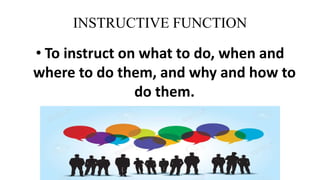
INSTRUCTIVE FUNCTION
• To instruct on what to do, when and
where to do them, and why and how to
do them.
PERSUASIVE FUNCTION
• To influence the opinion of
others to believe and accept
your stand or claim on the issue
or a problem.
MOTIVATION FUNCTION
• To act and reach their objectives or goals
in life.
AESTHETIC FUNCTION
•For pleasure and enjoyment.
REGULATION / CONTROL
• To maintain control and over other
people’s attitudes and behaviour.
SOCIAL INTERACTION
• To start, maintain, regulate, or even end
relationships with other people.
of
The source of information or message
The information, ideas or thoughts
conveyed by the speaker in words or
in actions
The recipient of the
message or someone who
decodes the message
The medium or means,
such as personal or
non-personal, verbal or
nob-verbal, in which
the encoded message is
conveyed.
The reactions, responses
or information provided
by the listener
Any barrier to communication
Physic
al
noise
Physiologi
cal
noise
Psycholog
ical
noise
Physical noise
Actual noise such as loud music
or the irritating engine of a
motorcycle.
Physiological
noise
When the body becomes a hindrance to
good communication.
Psychological
noise
When one deeply thinks about something or
is suffering from emotional condition.
Communicative
Situation
The environment where
communication takes place.
INSTRUCTIONS:
Develop your own model of communication. Include a two- to three
paragraph description of your model and explain any special
characteristic of it.
SUBMISSION: OCTOBER 20, 2022, THURSDAY
Models of
Communication
Zoom In
Zoom In
• Focused on the SPEAKER and MESSAGE.
* The most important part is SETTING – where the LISTENER
is situated.
• SETTING dictates the MESSAGE
Zoom In
• This model introduced the concept of NOISE.
* Due to the intervention of noise or anything that hampers
communication, MESSAGE sent by the SOURCE (Speaker)
isn’t necessarily the message received by the
DESTINATION (Listener).
Zoom In
This model emphasizes that communication can take place if
and only if there is an overlap between the
FIELD OF EXPERIENCE OF THE SPEAKER and FIELD OF
EXPERIENCE OF THE LISTENER
* FIELD OF EXPERIENCE : used to interpret the message and
create a RESPONSE.
Zoom In
This model is a two-way process with the inclusion
of feedback as one element.
Zoom In
This model has four major parts : source (S),
message (M), channel (C) and receiver (R). It is
conceived as a linear model.
Zoom In
This model is circular and continuous, without
beginning or end.
Zoom In
This model presents the concept of time where
continuousness of communication progresses as an
individual gets older.
NATURE_ELEMENTS_FUNCTIONS_AND_MODELS_ORAL_COMM_WEEK1-2.pptx

NATURE_ELEMENTS_FUNCTIONS_AND_MODELS_ORAL_COMM_WEEK1-2.pptx

Editor's Notes

  • #4 * Animals may communicate for safety and procreation but - Listening and speaking using language is a human activity. Gamble and Gamble: - It is a human engagement that takes place in any forms interpersonal, intrapersonal or public.
  • #5 It is not a simple step of hearing “something” and reacting arbitrarily to stimulus * We come from different cultures, experiences and backgrounds/expectations
  • #14 Control : • Organizations have authority hierarchies and formal guidelines employees are required to follow. • When employees are required to communicate any job-related grievance to their immediate boss, to follow their job description, or to comply with company policies, communication is performing a control function. • Does Informal communication also control behaviour? • When work groups harass a member who produces too much..?..