Language change
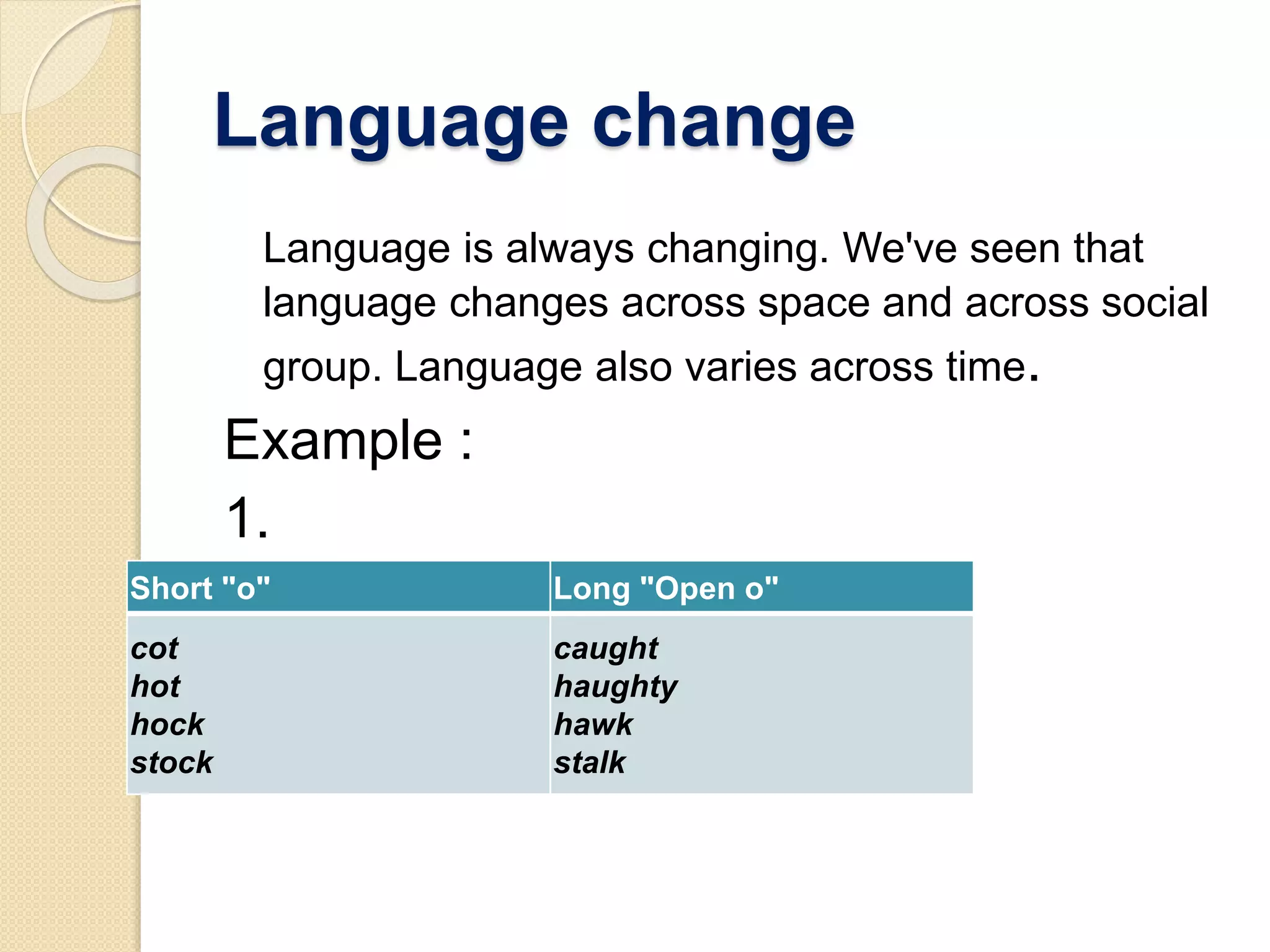
Language is always changing. We've seen that
language changes across space and across social
group. Language also varies across time.
Example :
1.
Short "o" Long "Open o"
cot
hot
hock
stock
caught
haughty
hawk
stalk
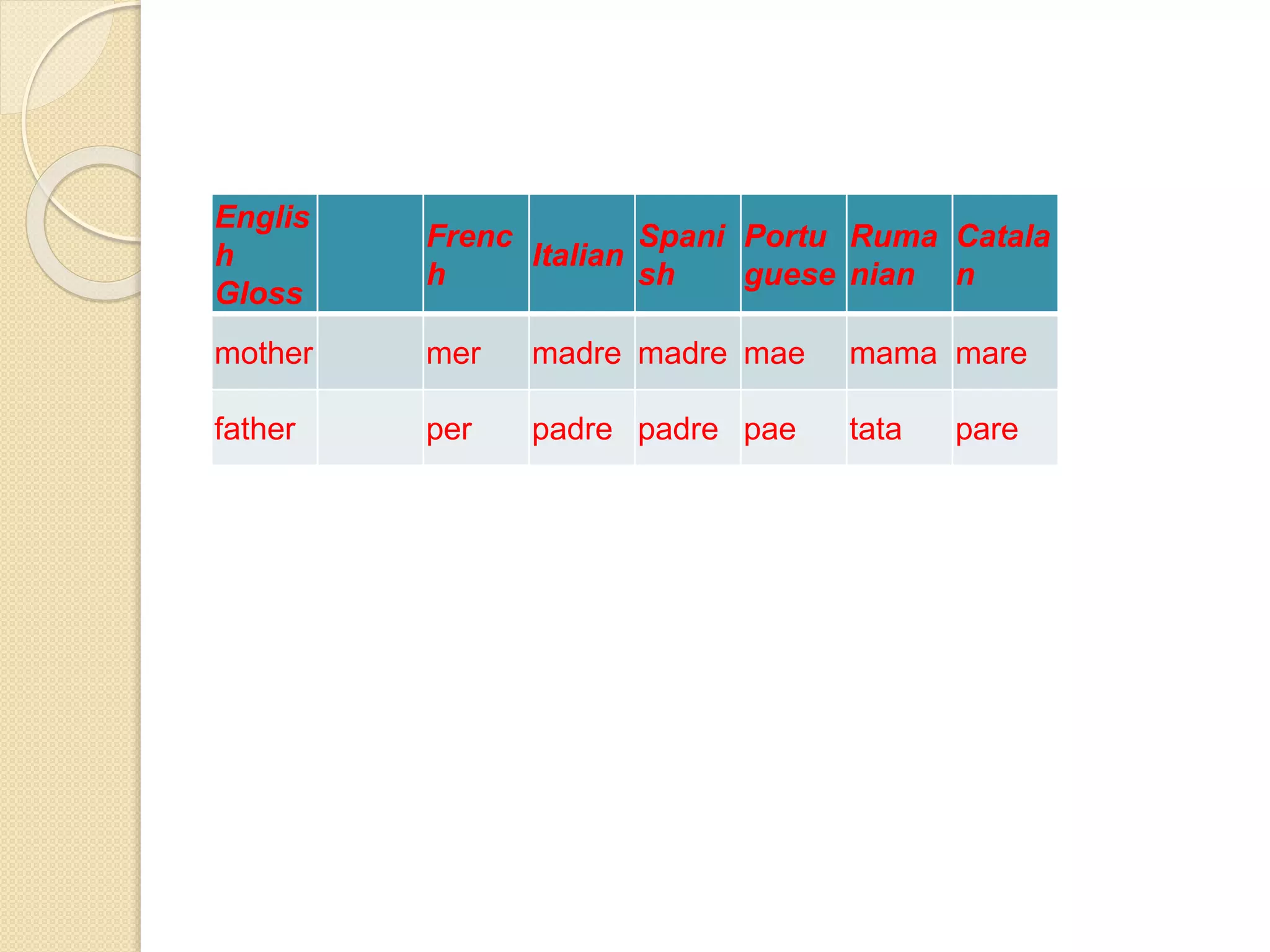
2.
Englis
h
Gloss
Frenc
h
Italian
Spani
sh
Portu
guese
Ruma
nian
Catala
n
mother mer madre madre mae mama mare
father per padre padre pae tata pare
Language variation and
change
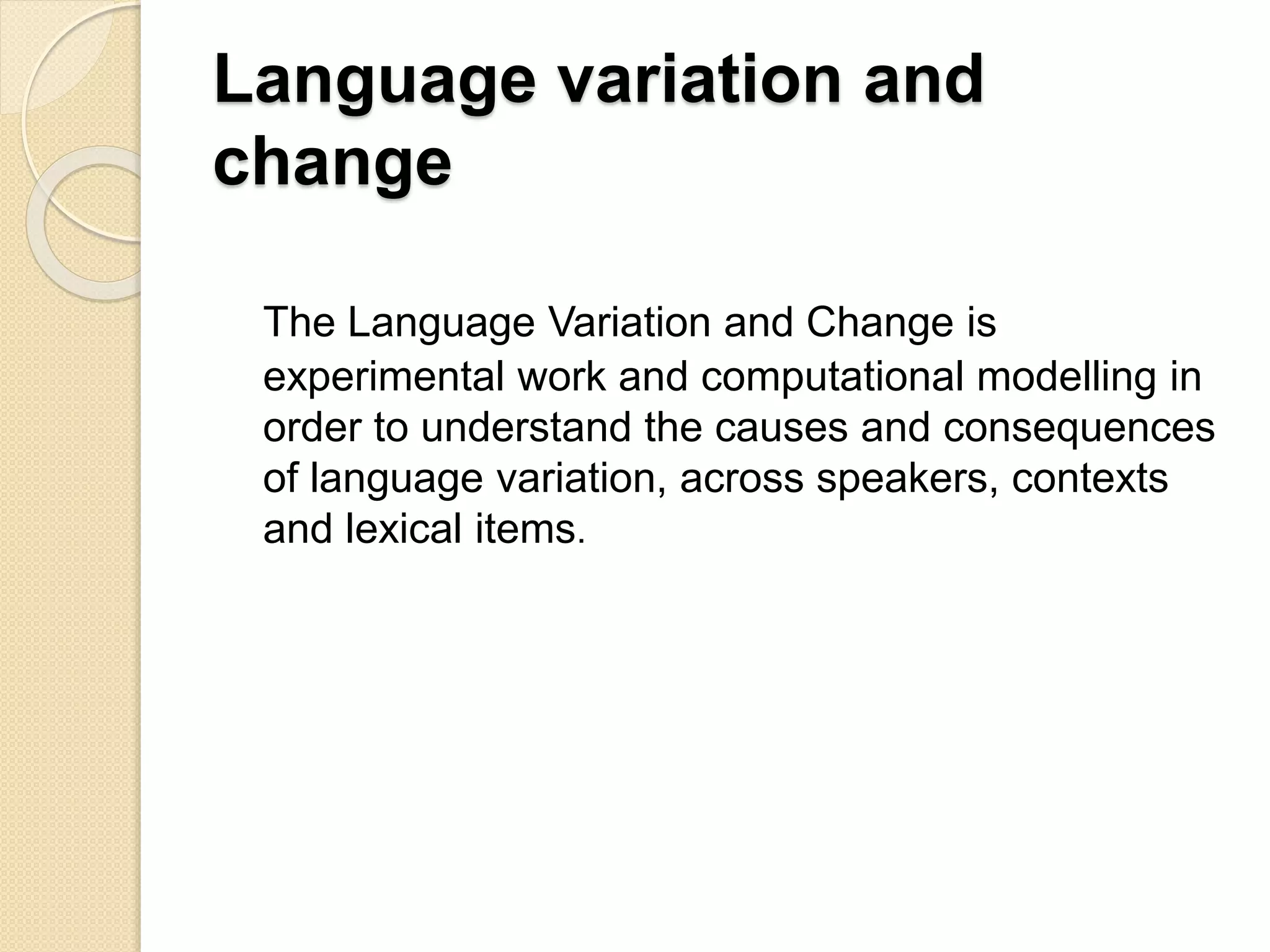
The Language Variation and Change is
experimental work and computational modelling in
order to understand the causes and consequences
of language variation, across speakers, contexts
and lexical items.
Example of Language variation
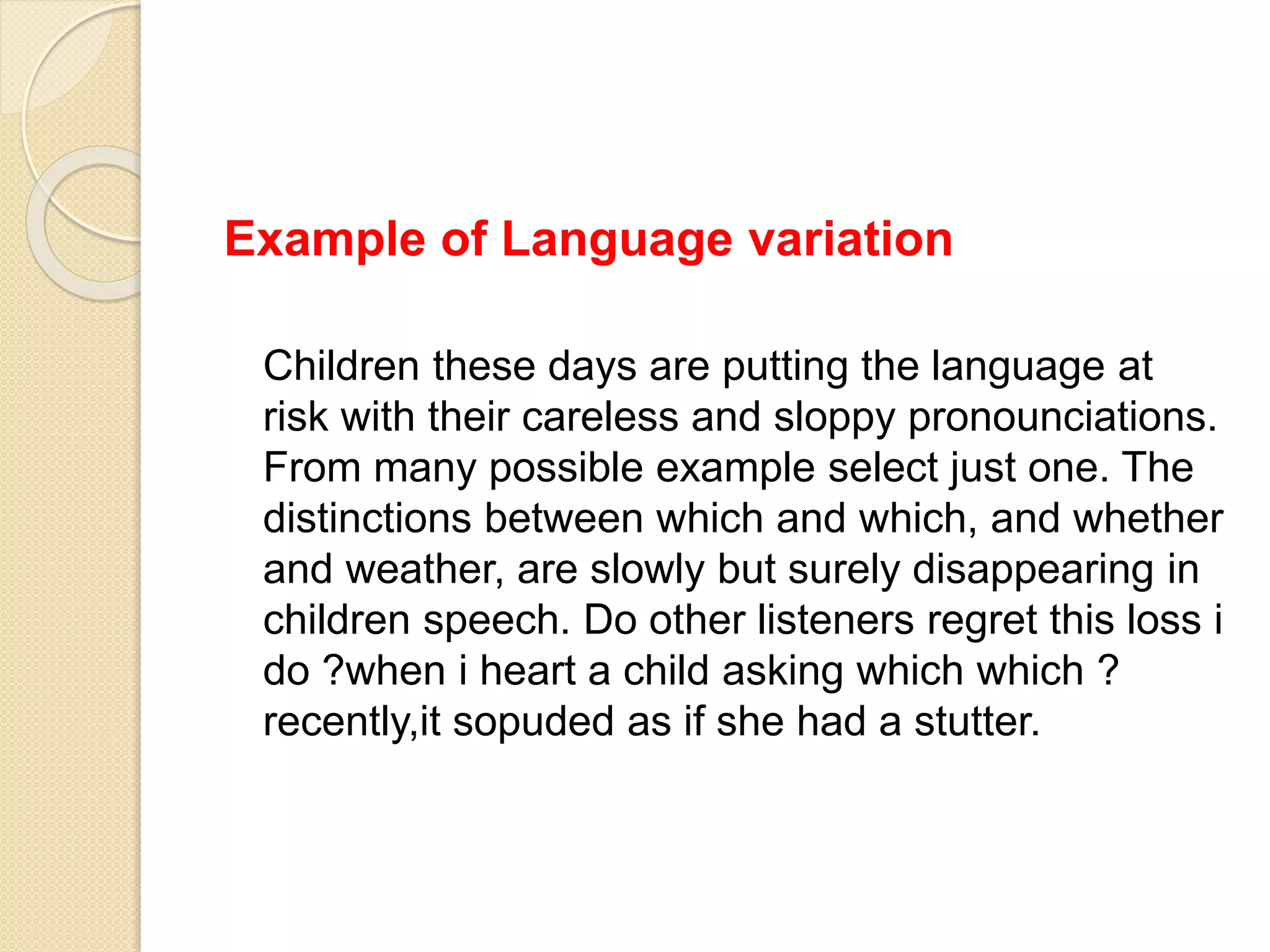
Children these days are putting the language at
risk with their careless and sloppy pronounciations.
From many possible example select just one. The
distinctions between which and which, and whether
and weather, are slowly but surely disappearing in
children speech. Do other listeners regret this loss i
do ?when i heart a child asking which which ?
recently,it sopuded as if she had a stutter.
POST VOCALIC [r] – ITS
SPREAD AND ITS STATUS
In many parts of England and Wales,
standard English has lost the pronunciation
of [r] following vowels in words like star and
star.
Accents with post-vocalic [r] are called
‘rhotic’. In large areas of England rhotic
English accents are regarded as rural and
uneducated
THE SPREAD OF
VERNACULAR FORMS
A pronunciation which is considered prestigious will be
imitated, and will spread trough a community.
It is possible for changes to proceed from a variety of
starting points in a variety of directions.
pronunciation of the vowels in these words had gradually
become more and more centralized
HOW DO CHANGES SPREAD
From group to group
In any speech community different sets of waves intersect.
You belong simultaneously to a particular age group, region,
and social group.
From style to style
FIGURE 9.1 The wave-like spread of linguistic changes. (this
diagram is based on Bailey 1973a: 159)
From word to word
Sound changes spread through different word one by one.
This is called lexical diffusion.
How do we study language
change?
In order to resolve such
problems we need to examine
the reasons for linguistic
change, and to identify factors
other than age as clue to the
direction of changes in
progress.
Language change in real time
The apparent-time method of
studying language change is a
useful shortcut for
sociolinguists who generally
cannot afford to wait around
for twenty years to see what
happens in real time.
Reasons for language change
Social status and language change
Members of the group with most social
status, for example, tend to introduce
changes into a speech community
from neighbouring communities which
have greater status and prestige in
their eyes.
Gender and Linguistic Change
An important consequence of gender differentiation in language
is linguistic change. Aspects of linguistic variability are of interest to
sociolinguists who attempt to chart how the language used by individuals
and groups in various social situations can vary in patterned ways.
Language variation serves to distinguish the speech of different social
groups (social variation),
as well as the speech of an individual in different contexts
(stylistic variation). Over time, these variations may lead to language
change, which occurs when a new linguistic form, used by a particular
sub-section of a speech community, is adopted by other members of the
community and accepted as the norm. Sociolinguists now recognize that
not only linguistic variation between social groups, but also gender
differences in speech play an important role in the promulgation of
language change.
Interaction and contact between people is crucial in providing
the channels for linguistics chage, as previous examples have
implied. In this final section I will briefly identify more explicitly the
ways in which interaction- or lack of it-has affected the progress of
linguistics changes in number of communities
Interaction and Language Change

Language Change

  • 1.
    Language change Language isalways changing. We've seen that language changes across space and across social group. Language also varies across time. Example : 1. Short "o" Long "Open o" cot hot hock stock caught haughty hawk stalk
  • 2.
  • 3.
    Language variation and change TheLanguage Variation and Change is experimental work and computational modelling in order to understand the causes and consequences of language variation, across speakers, contexts and lexical items.
  • 4.
    Example of Languagevariation Children these days are putting the language at risk with their careless and sloppy pronounciations. From many possible example select just one. The distinctions between which and which, and whether and weather, are slowly but surely disappearing in children speech. Do other listeners regret this loss i do ?when i heart a child asking which which ? recently,it sopuded as if she had a stutter.
  • 5.
    POST VOCALIC [r]– ITS SPREAD AND ITS STATUS In many parts of England and Wales, standard English has lost the pronunciation of [r] following vowels in words like star and star. Accents with post-vocalic [r] are called ‘rhotic’. In large areas of England rhotic English accents are regarded as rural and uneducated
  • 6.
    THE SPREAD OF VERNACULARFORMS A pronunciation which is considered prestigious will be imitated, and will spread trough a community. It is possible for changes to proceed from a variety of starting points in a variety of directions. pronunciation of the vowels in these words had gradually become more and more centralized
  • 7.
    HOW DO CHANGESSPREAD From group to group In any speech community different sets of waves intersect. You belong simultaneously to a particular age group, region, and social group. From style to style FIGURE 9.1 The wave-like spread of linguistic changes. (this diagram is based on Bailey 1973a: 159) From word to word Sound changes spread through different word one by one. This is called lexical diffusion.
  • 8.
    How do westudy language change? In order to resolve such problems we need to examine the reasons for linguistic change, and to identify factors other than age as clue to the direction of changes in progress.
  • 9.
    Language change inreal time The apparent-time method of studying language change is a useful shortcut for sociolinguists who generally cannot afford to wait around for twenty years to see what happens in real time.
  • 10.
    Reasons for languagechange Social status and language change Members of the group with most social status, for example, tend to introduce changes into a speech community from neighbouring communities which have greater status and prestige in their eyes.
  • 11.
    Gender and LinguisticChange An important consequence of gender differentiation in language is linguistic change. Aspects of linguistic variability are of interest to sociolinguists who attempt to chart how the language used by individuals and groups in various social situations can vary in patterned ways. Language variation serves to distinguish the speech of different social groups (social variation), as well as the speech of an individual in different contexts (stylistic variation). Over time, these variations may lead to language change, which occurs when a new linguistic form, used by a particular sub-section of a speech community, is adopted by other members of the community and accepted as the norm. Sociolinguists now recognize that not only linguistic variation between social groups, but also gender differences in speech play an important role in the promulgation of language change.
  • 12.
    Interaction and contactbetween people is crucial in providing the channels for linguistics chage, as previous examples have implied. In this final section I will briefly identify more explicitly the ways in which interaction- or lack of it-has affected the progress of linguistics changes in number of communities Interaction and Language Change