FUNDAMENTALS OF
COMMUNICATION
What is communication?
GROUP ACTIVITY
With your group, think of one fact that
you know about communication and
choose somebody to share it with
everyone. You can give any creative
way of citing concrete examples to the
class. Once you have shared
something, you can sit down and listen
to what the rest of the class has to
share.
Is effective communication
important? Why?
Definition of Communication
Communication is the transmission of ideas and
emotions between or among persons with the
use of verbal and non-verbal cues.
It is a process of sharing and conveying messages
or information from one person to another
within and across channels, contexts, media, and
cultures. There is a wide variety of contexts and
situations in which communication can be
manifested; it can be a face-to-face interaction, a
phone conversation, group discussion and many
others.
Nature of Communication
1. Communication is a process.
2. Communication occurs between two
or more people (the speaker and the
receiver)
3. Communication can be expressed
through words, actions, or both at the
same time.
4. Communication is stirring up ideas in
the mind of another.
Elements of Communication
Speaker- the source of information or
message
Message- the information, ideas, or thoughts
conveyed by the speaker in words or in actions
Encoding- the process of converting the
message into words, actions, or other forms
that the speaker understands
Channel- the medium or the means, such as
personal or non-personal, verbal or nonverbal,
in which the encoded message is conveyed
Elements of Communication
Decoding- the process of interpreting the
encoded message of the speaker by the receiver
Receiver- the recipient of the message, or
someone who decodes the message
Feedback- the reactions, responses, or
information provided by the receiver
Context- the environment where the
communication takes place
Barrier- the factors that affect the flow of
communication
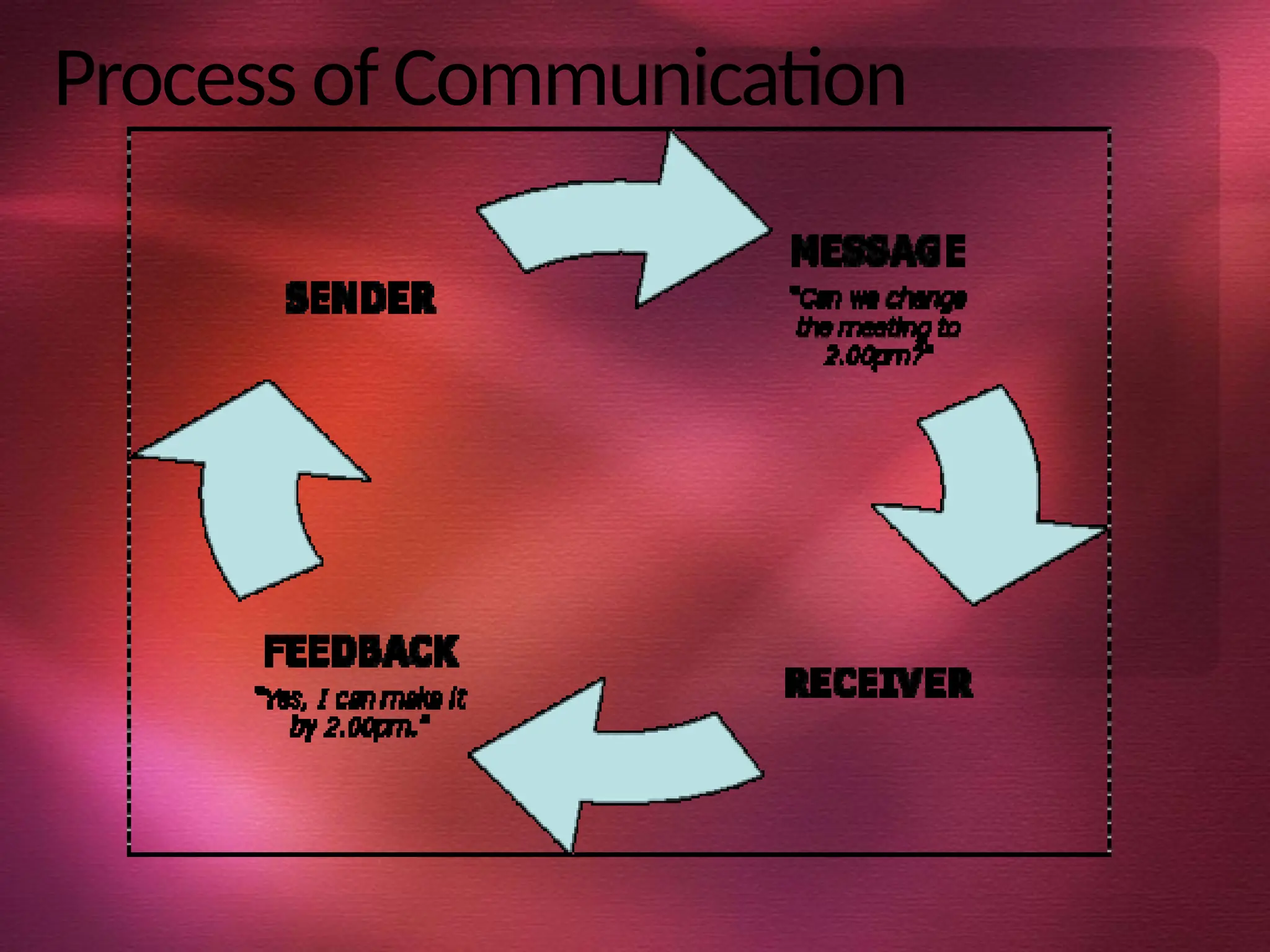
Process of Communication
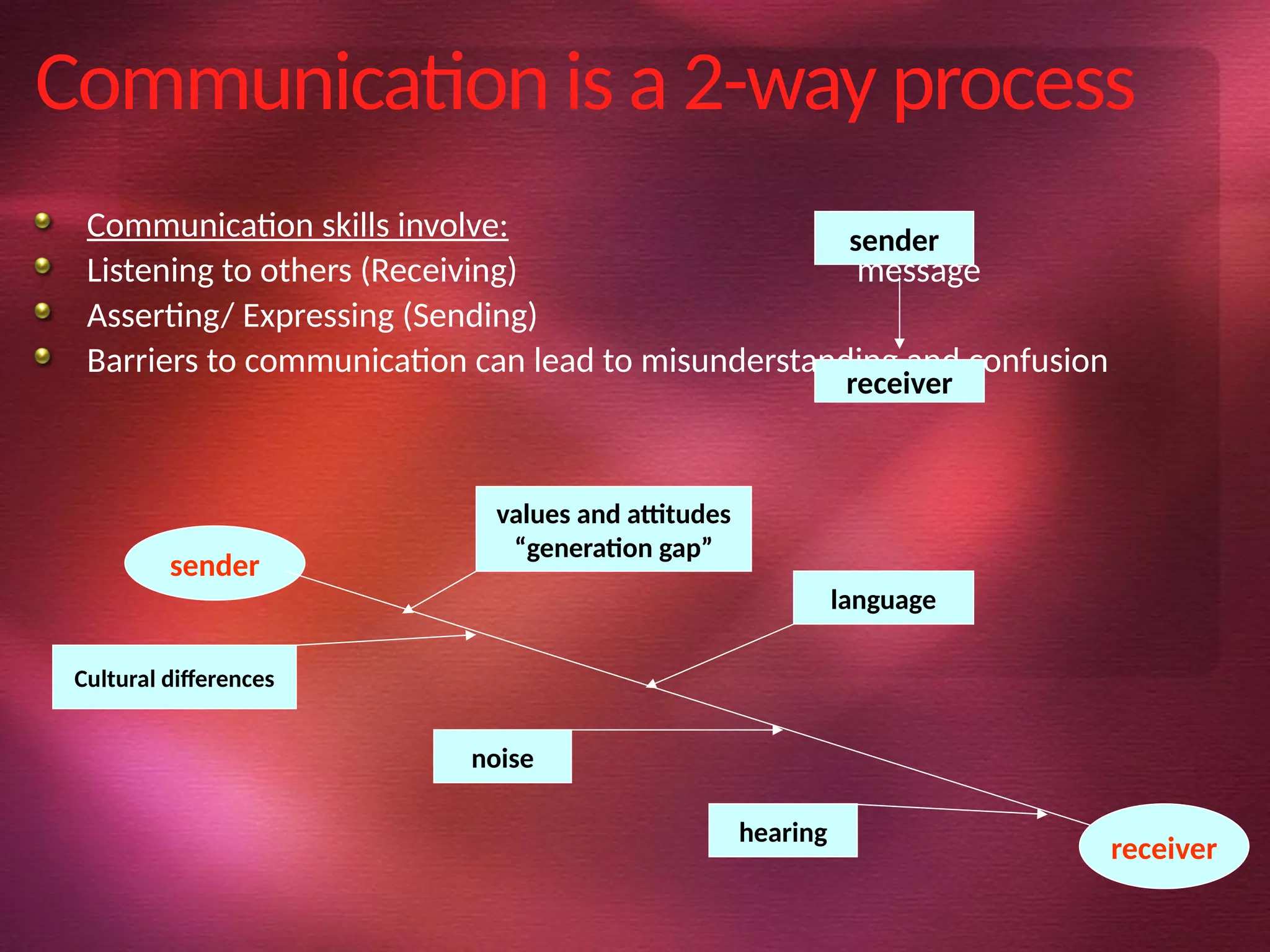
Communication is a 2-way process
Communication skills involve:
Listening to others (Receiving) message
Asserting/ Expressing (Sending)
Barriers to communication can lead to misunderstanding and confusion
sender
receiver
sender
receiver
values and attitudes
“generation gap”
Cultural differences
language
noise
hearing
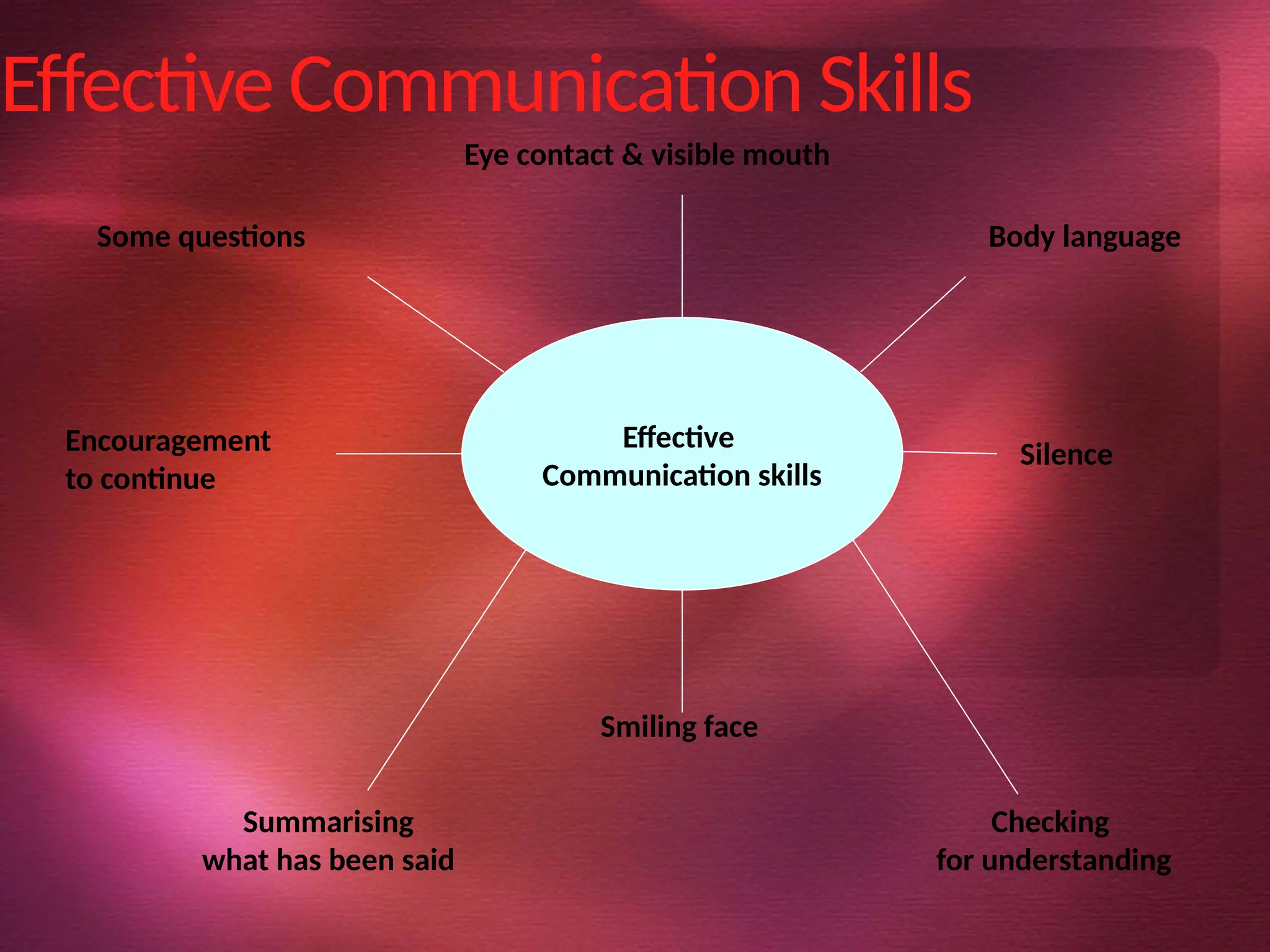
Effective Communication Skills
Effective
Communication skills
Eye contact & visible mouth
Body language
Silence
Checking
for understanding
Smiling face
Summarising
what has been said
Encouragement
to continue
Some questions
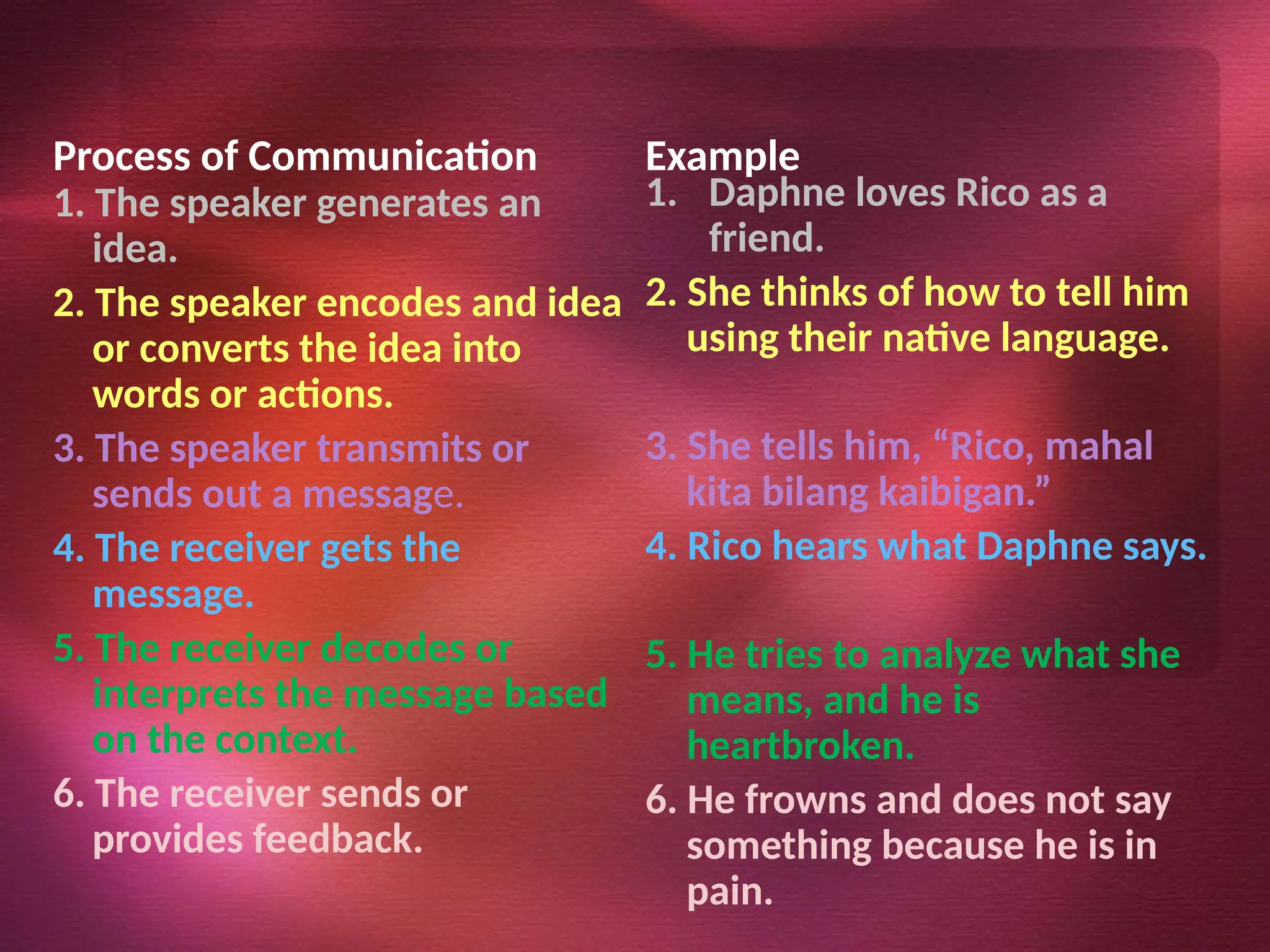
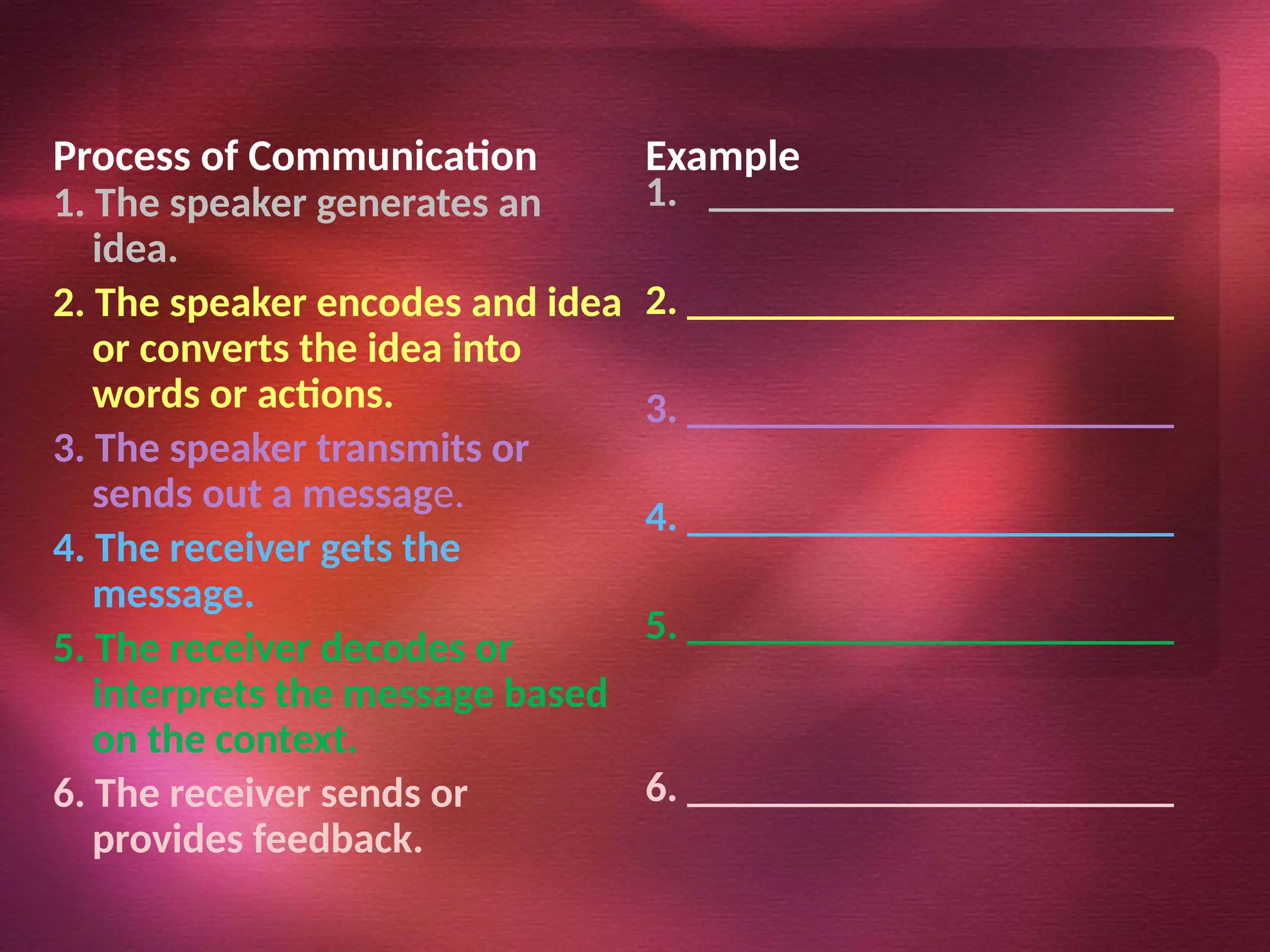
Process of Communication
1. The speaker generates an
idea.
2. The speaker encodes and idea
or converts the idea into
words or actions.
3. The speaker transmits or
sends out a message.
4. The receiver gets the
message.
5. The receiver decodes or
interprets the message based
on the context.
6. The receiver sends or
provides feedback.
Example
1. Daphne loves Rico as a
friend.
2. She thinks of how to tell him
using their native language.
3. She tells him, “Rico, mahal
kita bilang kaibigan.”
4. Rico hears what Daphne says.
5. He tries to analyze what she
means, and he is
heartbroken.
6. He frowns and does not say
something because he is in
pain.
Group Activity
Make your own example of the
process of communication.
Write it on a 1 whole sheet of
paper.
Process of Communication
1. The speaker generates an
idea.
2. The speaker encodes and idea
or converts the idea into
words or actions.
3. The speaker transmits or
sends out a message.
4. The receiver gets the
message.
5. The receiver decodes or
interprets the message based
on the context.
6. The receiver sends or
provides feedback.
Example
1. ______________________
2. _______________________
3. _______________________
4. _______________________
5. _______________________
6. _______________________
If we were supposed to talk more
than listen, we would have been
given two mouths and one ear.”
Mark Twain
Assignment
Research the following Models of
Communication:
1. Aristotles’s Model
2. Shannon-Weaver Model
3. Schramm’s Model
4. White’s Model
5. Transaction Model
The Models of
Communication
Linear, Interactive and Transactional.
Types of Communication Model
There are three general
types of communication
models in which all other
communication models
are mostly categorized.
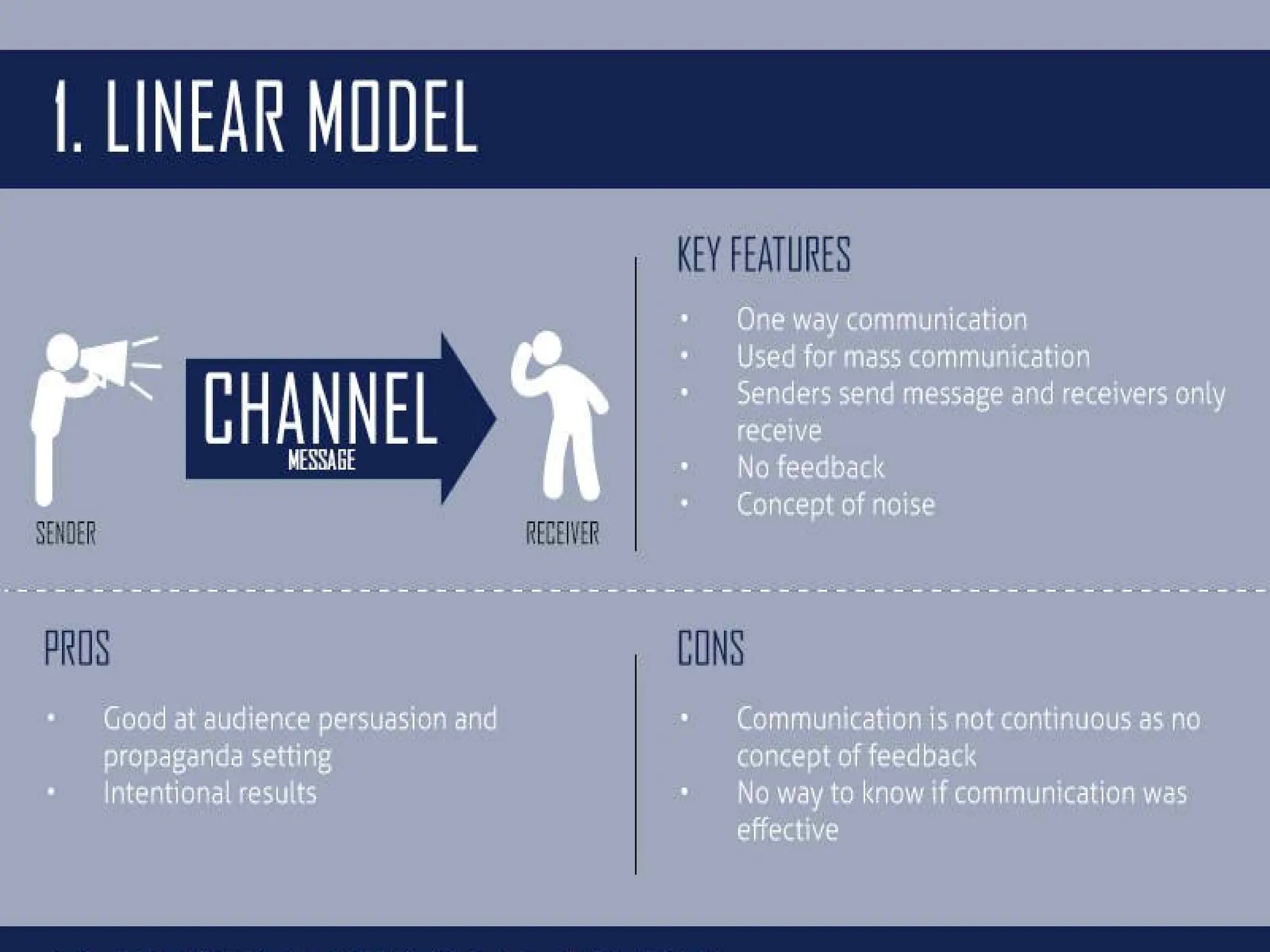
Linear Model of Communication
Linear model of communication is
a simple one way communication
model. The message flows in a
straight line from sender to the
receiver. There is no concept of
feedback. The only task that a
receiver does here is to receive the
message.
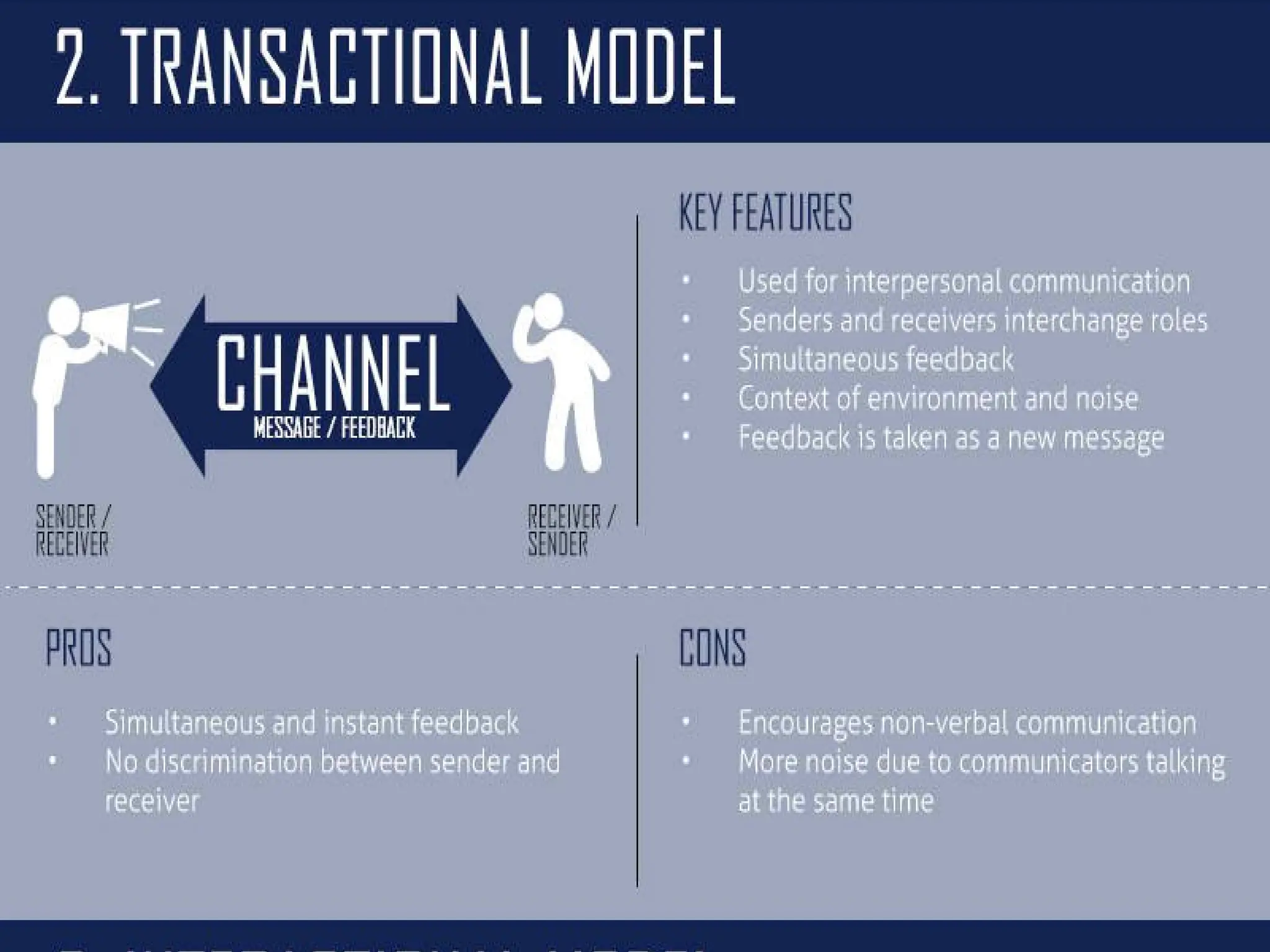
TransactionalModelofCommunication
In transactional model, senders and
receivers both are known as communicators
and both play equally important role in
communication. Transactional model relates
communication with social reality, cultural
up-bringing and relational context
(relationships). Non-verbal feedback like
gestures, body language, is also considered
as feedback in this model.
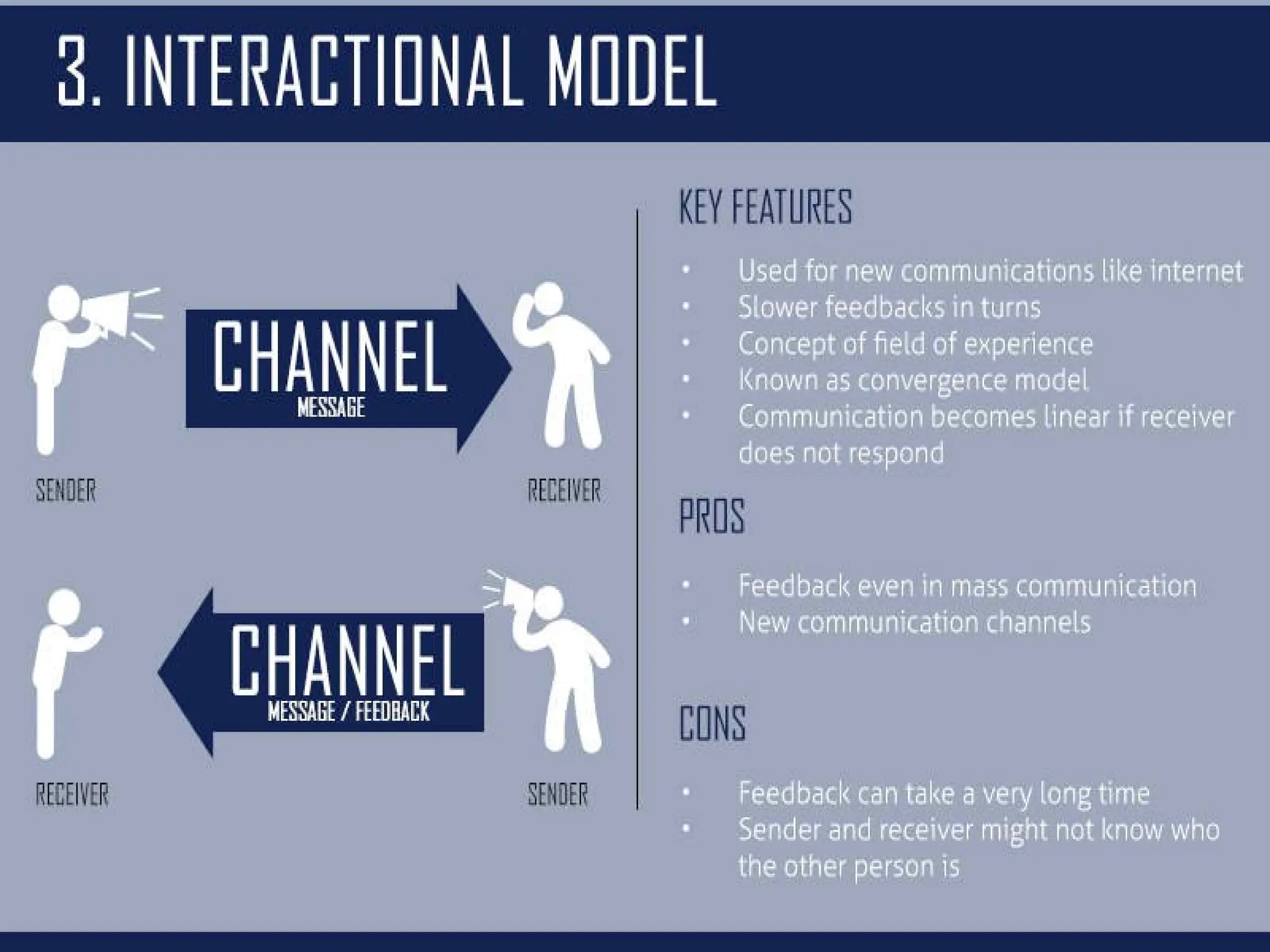
Interactive Model of Communication
Interactive model or convergence
model is similar to transactional model
as they are both two way
communication model. But, interactive
model is mostly used for new media
like internet. Here, people can respond
to any mass communications like
videos, news, etc. People can exchange
their views and ideas.
The Models of Communication
Aristotle’s Communication Model
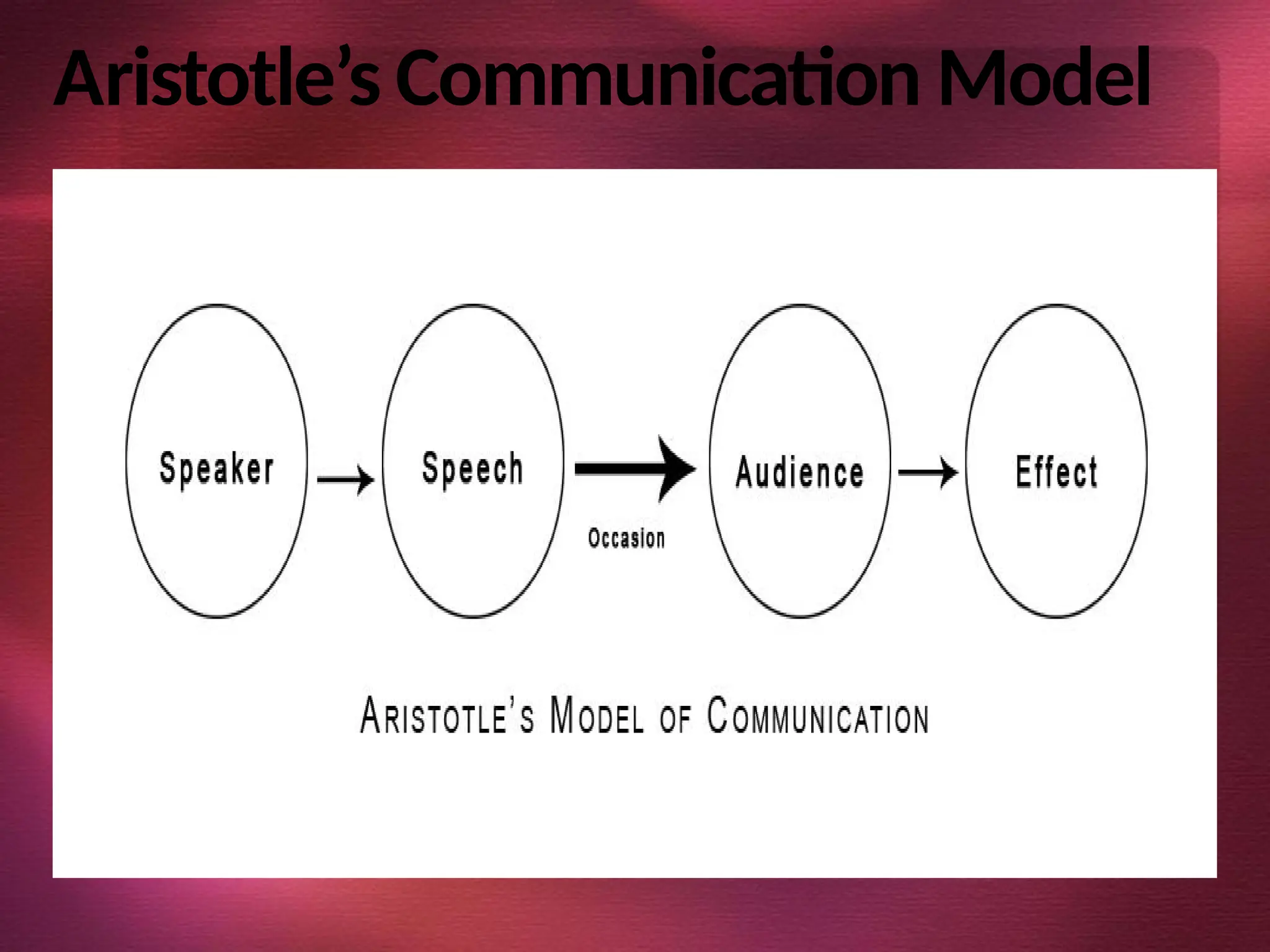
Aristotle, a great philosopher initiative the earliest mass
communication model called “Aristotle’s Model of
Communication”. He proposed model before 300 B.C
who found the importance of audience role in
communication chain in his communication model. This
model is more focused on public speaking than
interpersonal communication.
Aristotle Model of Communication is formed with 5
basic elements
(i) Speaker, (ii) Speech, (iii) Occasion, (iv) Audience and
(v) Effect.
Aristotle advises speakers to build speech for different
audience on different time (occasion) and for different
effects.
Shannon -Weaver Model of
Communication
Shannon-WeaverModelofCommunication
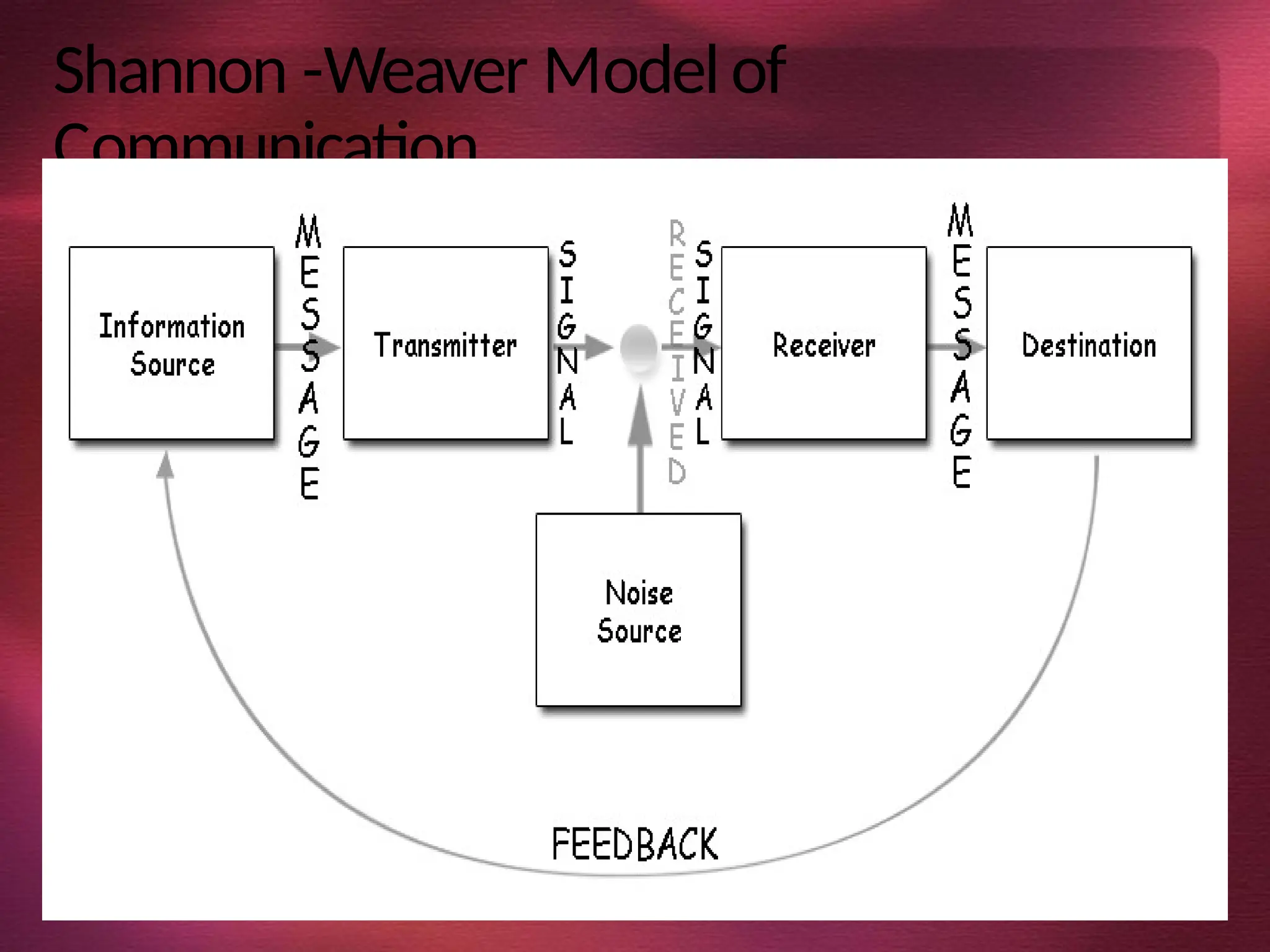
Shannon was an American mathematician
whereas Weaver was a scientist. The
Mathematical theory later came to be
known as Shannon Weaver model of
communication or “mother of all models.”
This model is more technological than
other linear models.
Shannon-WeaverModelofCommunication
Concepts in Shannon Weaver Model
Sender (Information source) – Sender is the person who makes
the message, chooses the channel and sends the message.
Encoder (Transmitter) –Encoder is the sender who uses
machine, which converts message into signals or binary data. It
might also directly refer to the machine.
Channel –Channel is the medium used to send message.
Decoder (Receiver) – Decoder is the machine used to convert
signals or binary data into message or the receiver who
translates the message from signals.
Receiver (Destination) –Receiver is the person who gets the
message or the place where the message must reach. The
receiver provides feedback according to the message.
Noise –Noise is the physical disturbances like environment,
people, etc. which does not let the message get to the receiver
as what is sent.
Shannon-WeaverModelofCommunication
Example of Shannon Weaver Model
A businessman sends a message via
phone text to his worker about a
meeting happening about their brand
promotion. The worker does not receive
the full message because of noise. It
goes like this:
Businessman: We have a meeting at the
office (“at 8 am” goes missing due to
phone network disruption or noise)
Worker (feedback) : At what time?
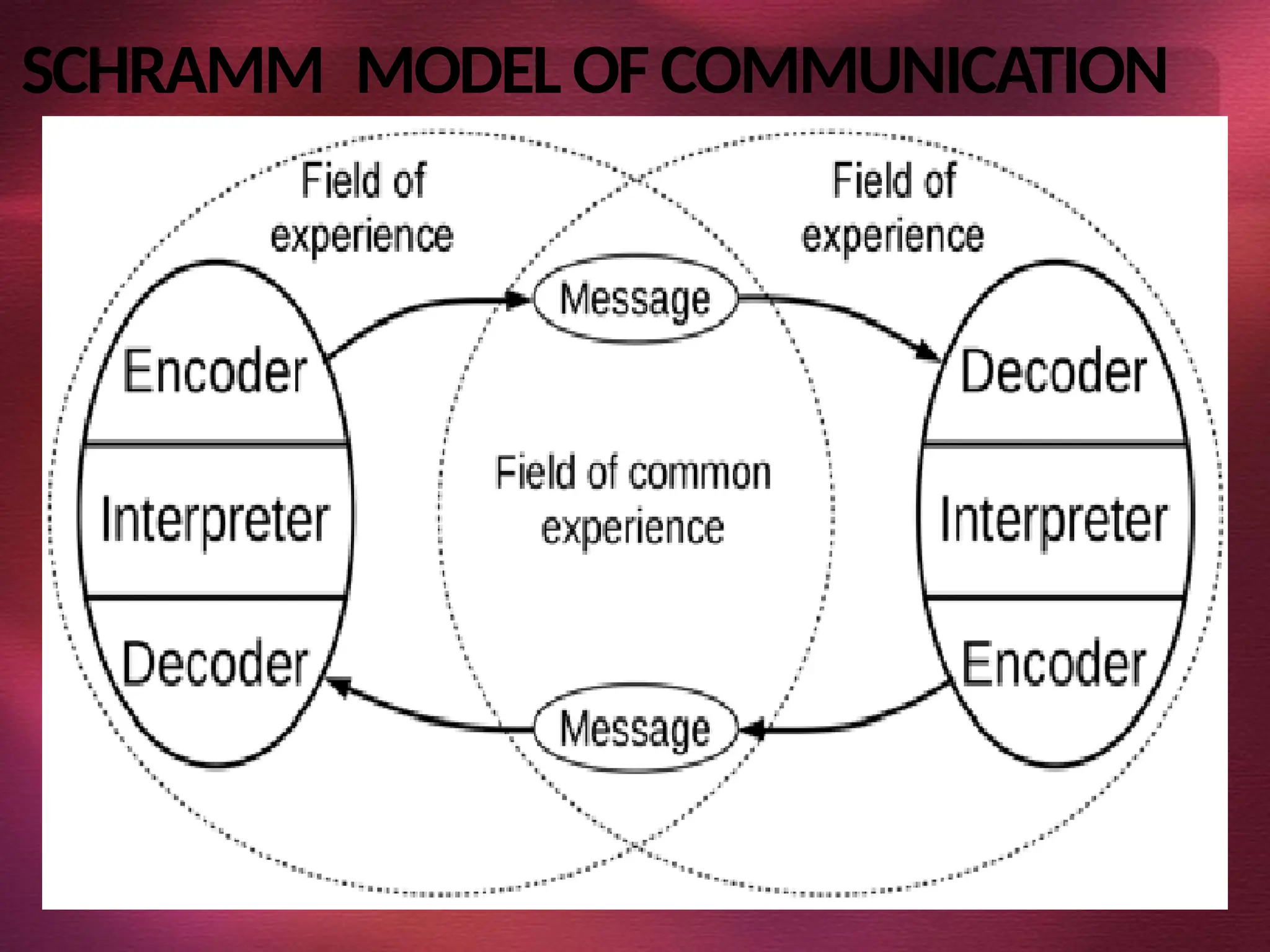
SCHRAMM MODELOFCOMMUNICATION
SCHRAMM MODELOF COMMUNICATION
It is a Circular Model, so that communication is
something circular in nature
Encoder – Who does encoding or Sends the
message (message originates)
Decoder – Who receives the message
Interpreter – Person trying to understand
(analyses, perceive) or interpret
Note: From the message starting to ending,
there is an interpretation goes on. Based on
this interpretation only the message is
received.
SCHRAMM MODELOF COMMUNICATION
This model breaks the sender and receiver model it seems
communication in a practical way. It is not a traditional
model.
It can happen within our self or two people; each person acts
as both sender and receiver and hence use interpretation. It
is simultaneously take place e.g. encoding, interpret and
decoding.
Semantic noise is a concept introduced here it occurs when
sender and receiver apply different meaning to the same
message. It happens mostly because of words and phrases
for e.g. Technical Language, So certain words and phrases will
cause you to deviate from the actual meaning of the
communication.
Note: When semantic noise takes place decoding and
interpretation becomes difficult and people get deviated
from the actual message.
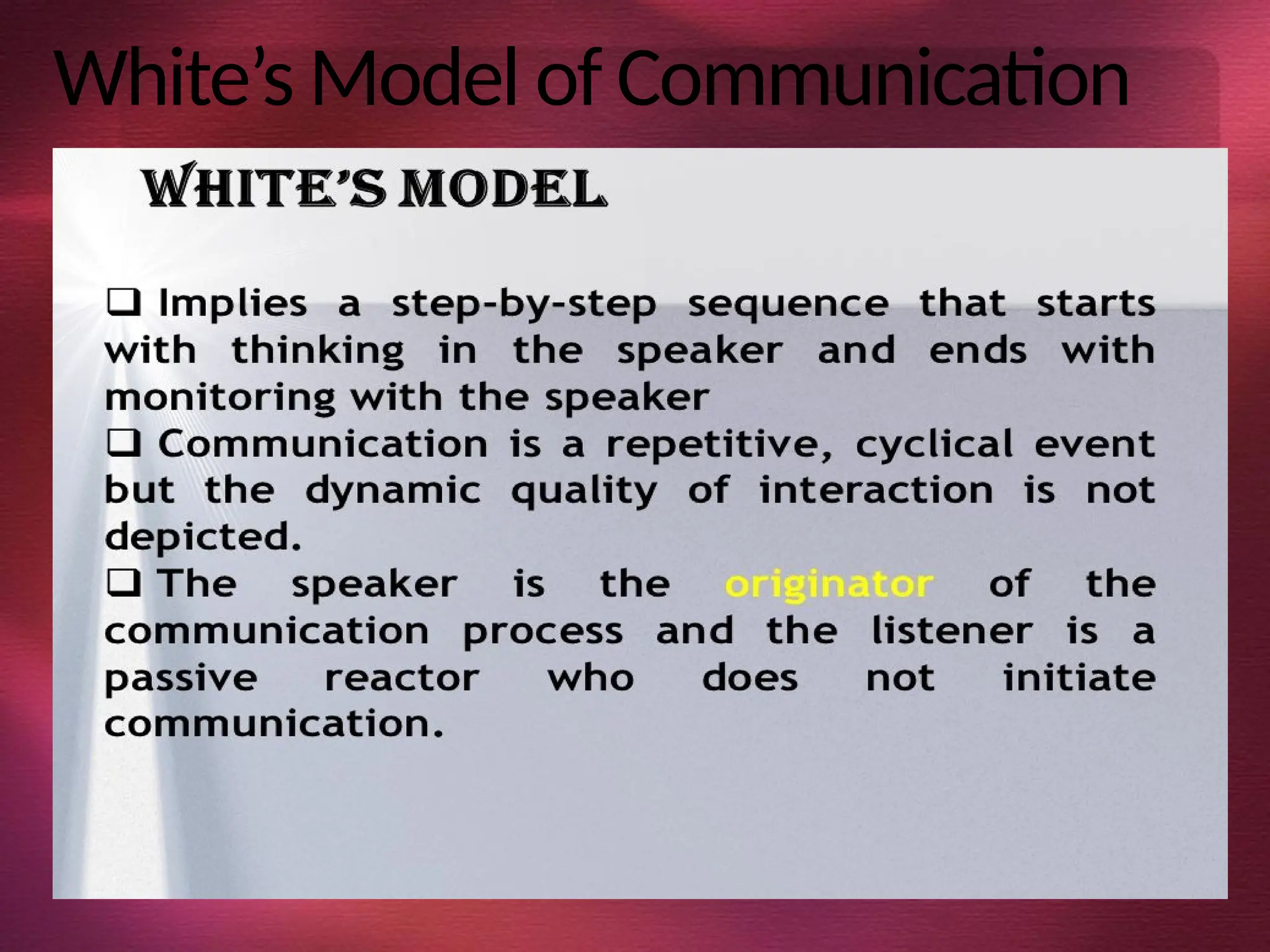
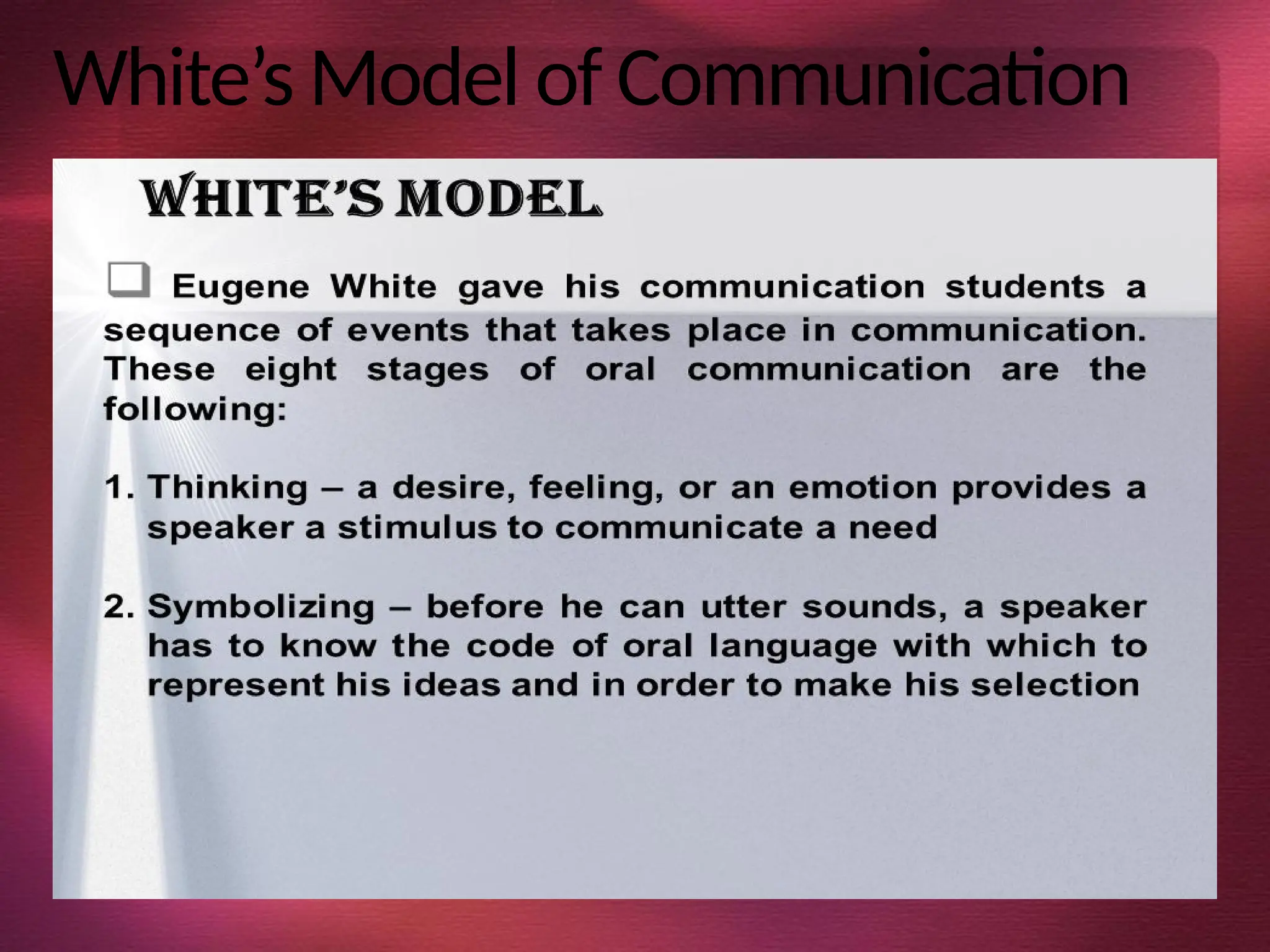
White’s Model of Communication
BARRIERS TO
COMMUNICATION
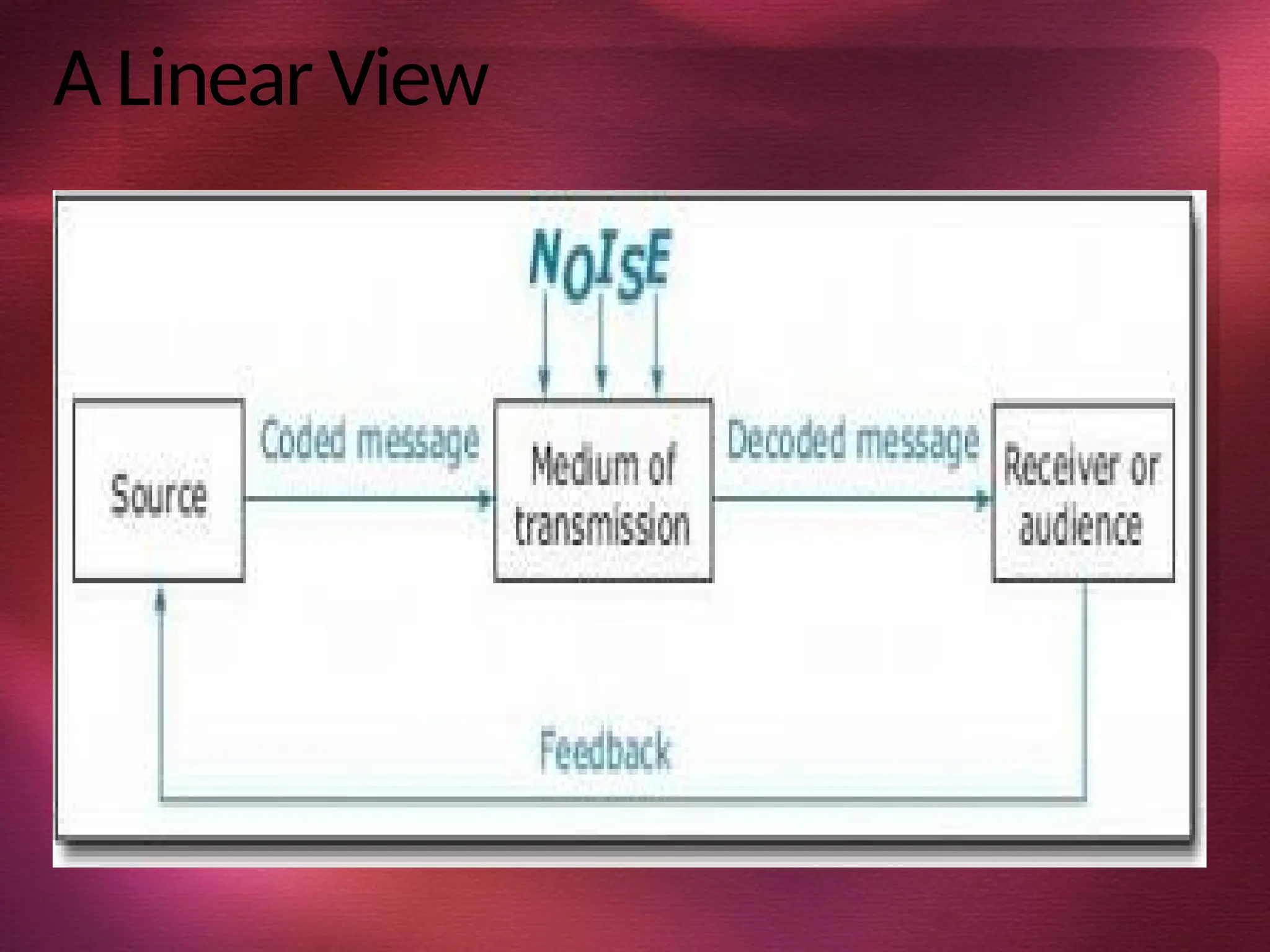
A Linear View
Linear Model
In this linear communication model,
communication is like giving an injection: a
sender encodes ideas and feelings into some
sort of message and then conveys them by
means of a channel (speech, writing, and so on)
into a receiver, who decodes the message.
Linear Model cont.
The model highlights how different channels can
affect the way a receiver responds to a message.
It also introduces the concept of noise- a term
used by social scientist to describe any forces
that interfere with effective communication.
Noise can occur at any stage of the
communication process.
Linear Model cont.
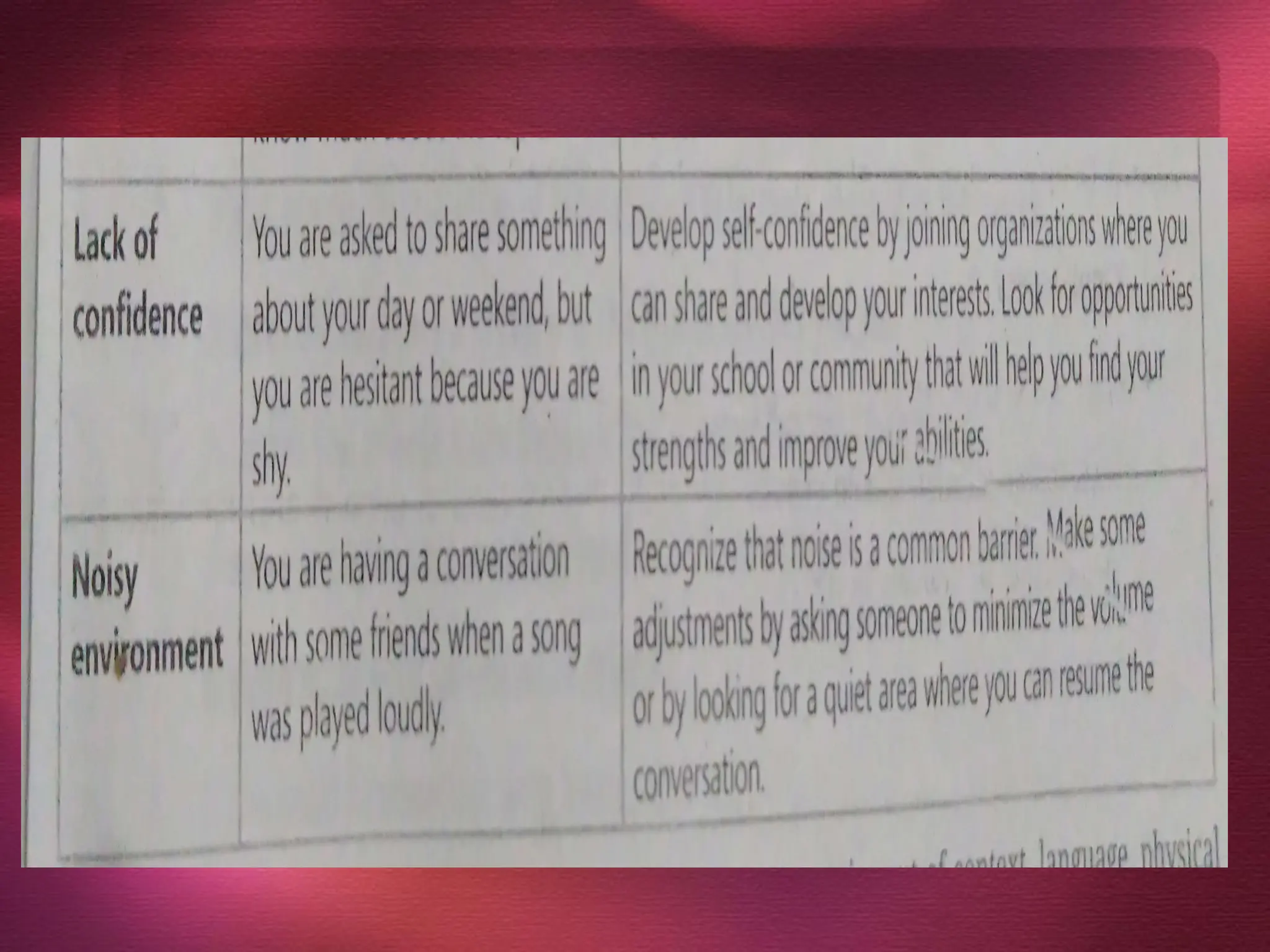
Three types of noise can disrupt
communication- external, physiological and
psychological.
External noise also called physical, includes
those factors outside the receiver that make it
difficult to hear, as well as other kinds of
distractions. Eg., a smoky room.
Physiological noise involves biological factors in
the receiver or sender that interfere with
accurate reception: illness, fatigue and so on.
Linear Model cont.
Psychological Noise refers to forces within a
communicator that interfere with the ability to
express or understand a message accurately. For
eg, stress, defensiveness.
Disadvantages of the Linear View
It makes the assumption that all communication
involves encoding. For eg. There are nonverbal
cues that occur whether we speak or not. Some
of these cues are unconsciously done.
It also suggest that communication flows in one
direction, from sender to receiver. It ignores the
fact that receivers react to messages by sending
other messages of their own.
An Interactive View
Interactive Model
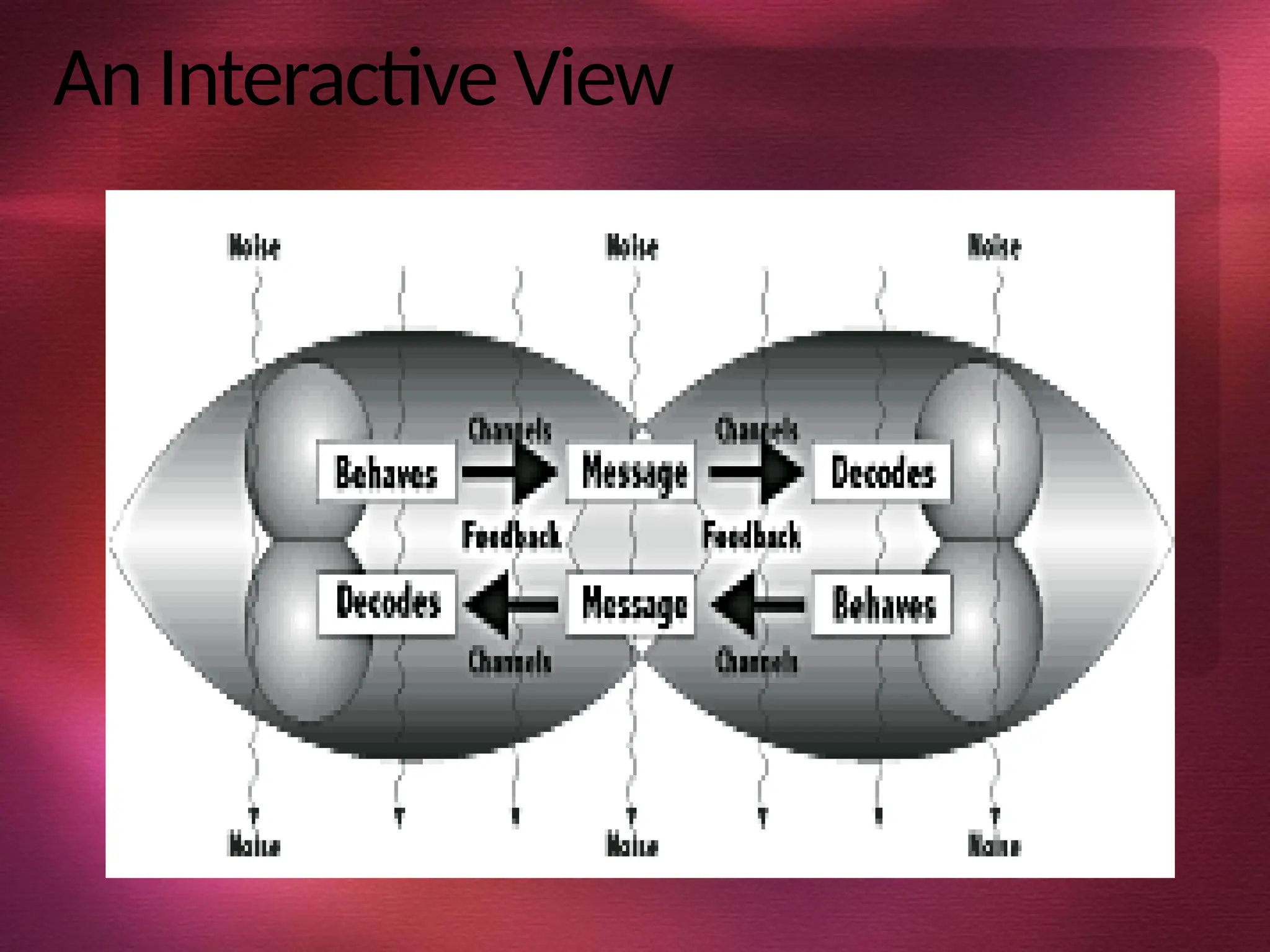
This model makes the importance of feedback
clear. It shows that most communication is ,
indeed, a two way affair in which we both send
and receive messages.
It also identifies a clue to the cause of many
misunderstandings. Such misunderstandings
often arise because communicators often
occupy different environments- fields of
experience- that help them understand others
behaviour.
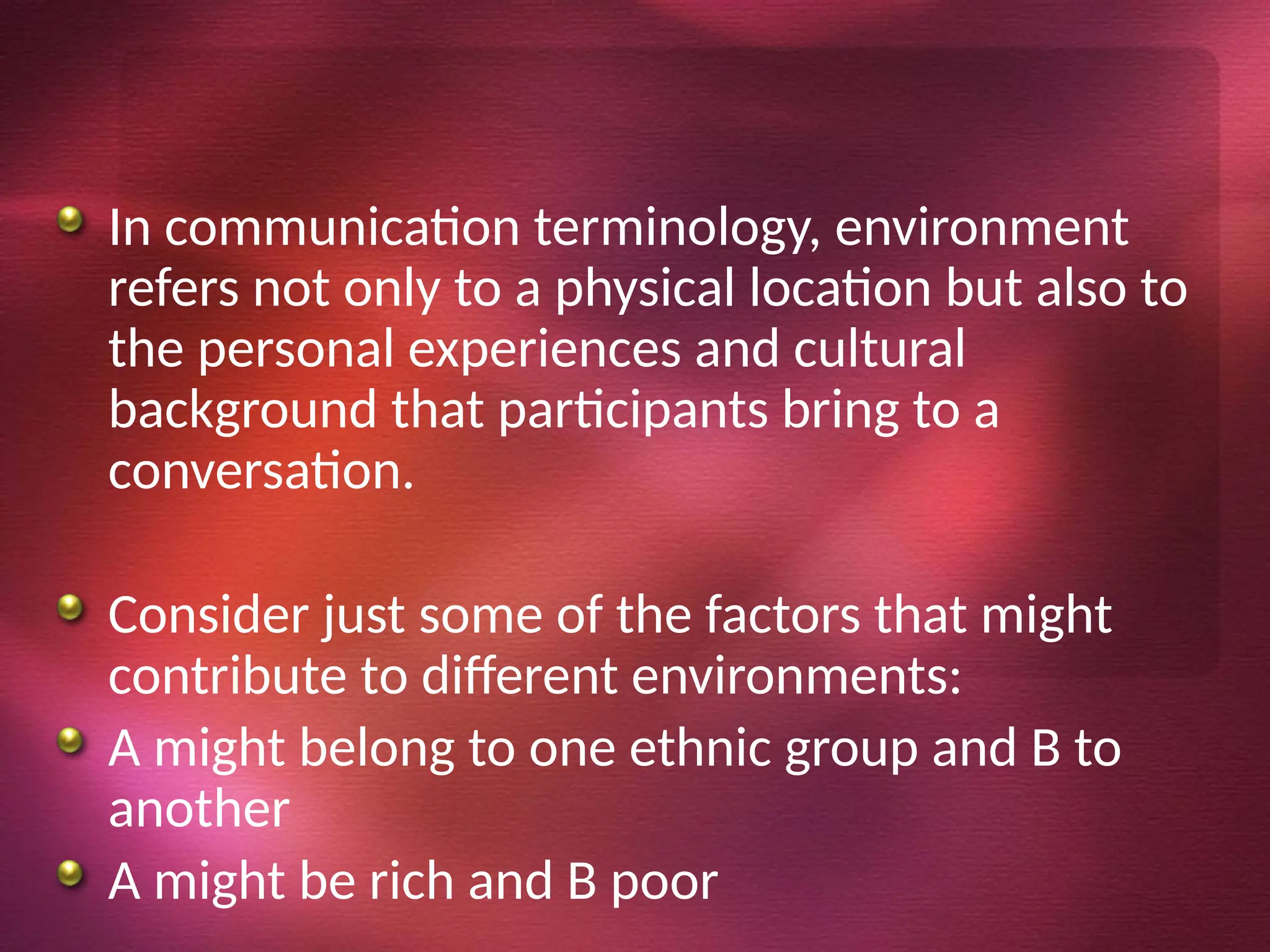
In communication terminology, environment
refers not only to a physical location but also to
the personal experiences and cultural
background that participants bring to a
conversation.
Consider just some of the factors that might
contribute to different environments:
A might belong to one ethnic group and B to
another
A might be rich and B poor
Interactive Model cont.
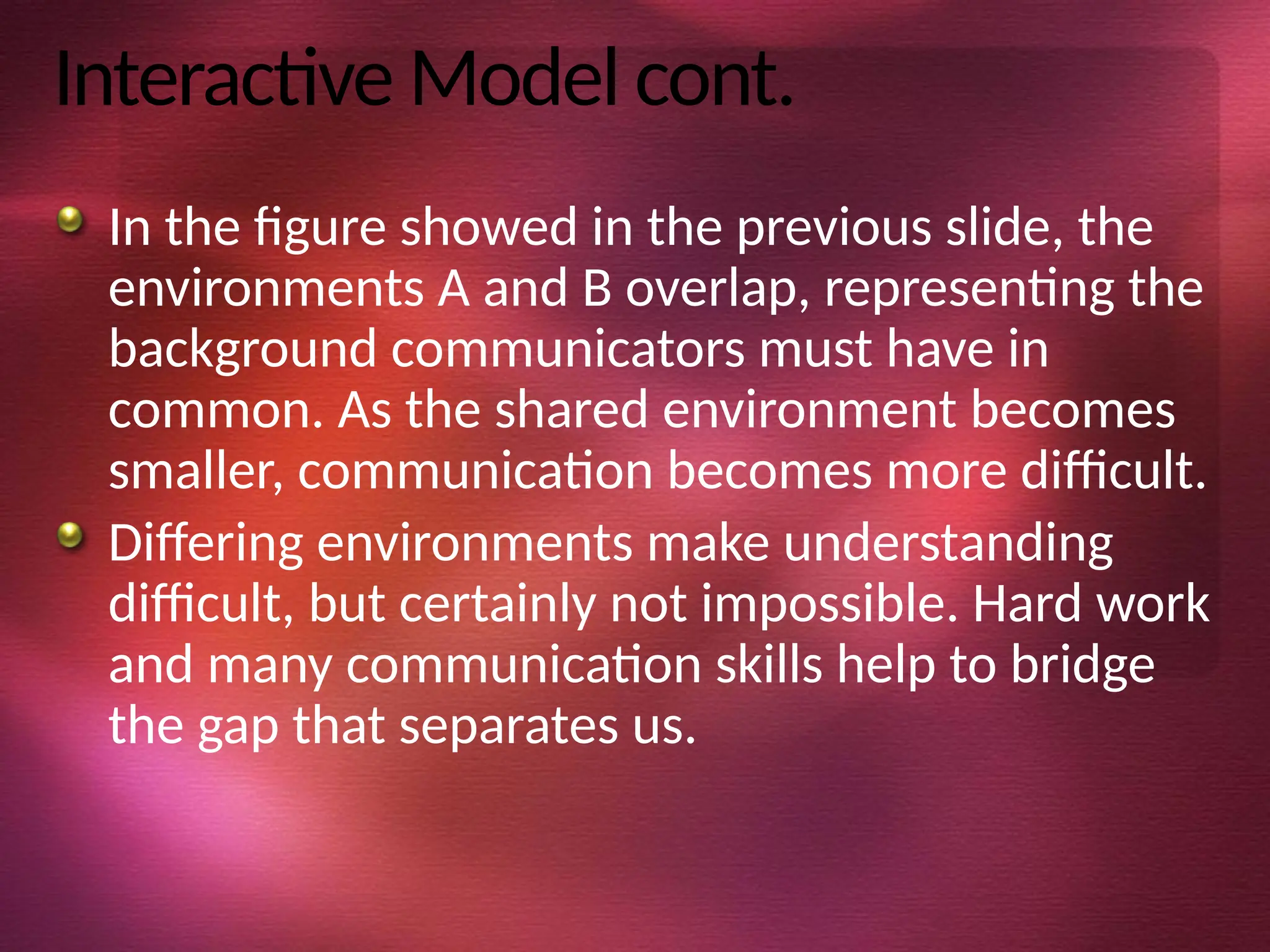
In the figure showed in the previous slide, the
environments A and B overlap, representing the
background communicators must have in
common. As the shared environment becomes
smaller, communication becomes more difficult.
Differing environments make understanding
difficult, but certainly not impossible. Hard work
and many communication skills help to bridge
the gap that separates us.
A Transactional View
A transactional View
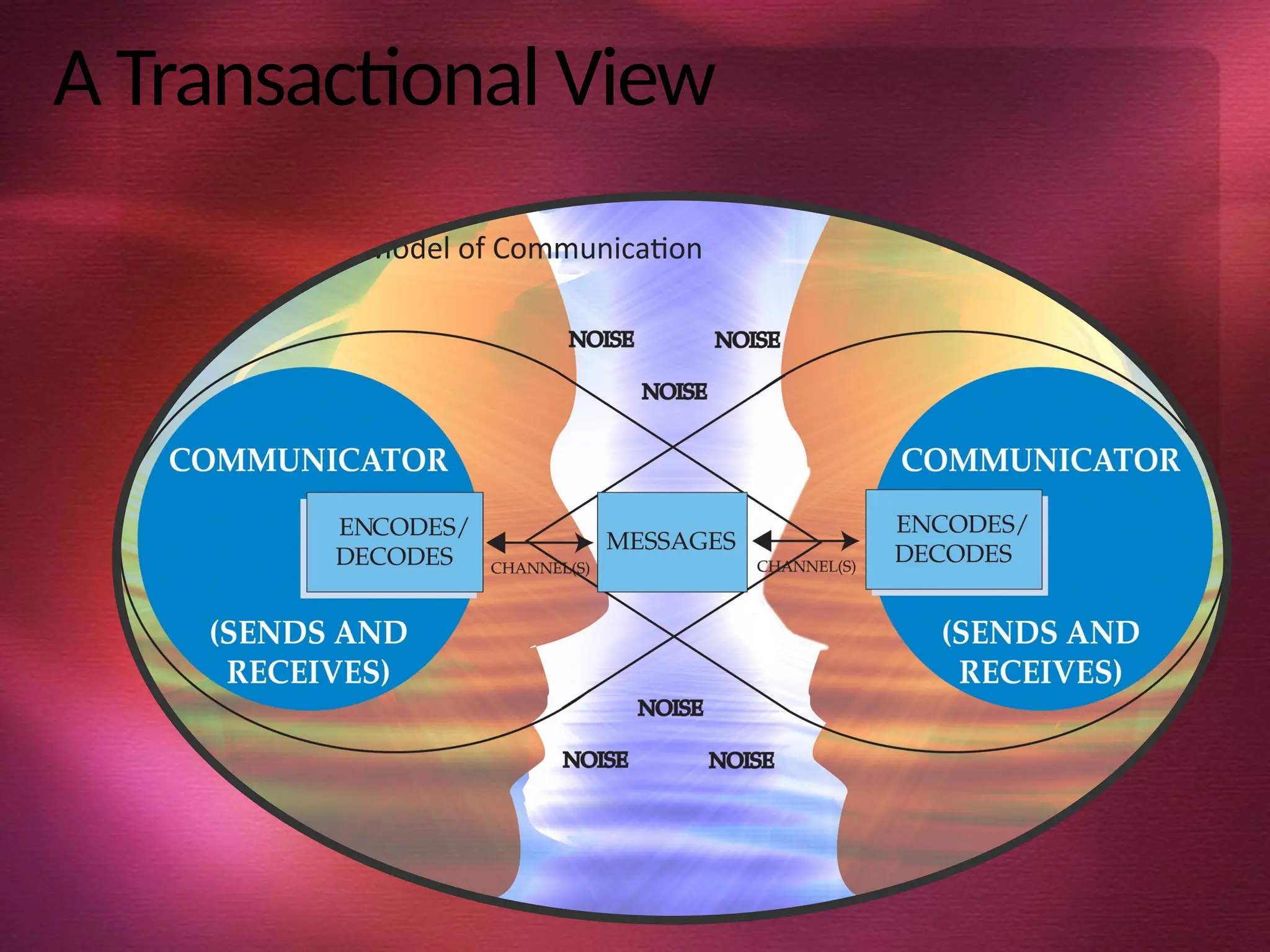
The activity of communicating is best
represented by a transactional communication
model.
A transactional model reveals that we usually
send and receive messages simultaneously, so
that the images of sender and receiver should
not be separated as if a person were doing only
one or the other, but rather superimposed and
redefined as ‘communicators.’
Transactional View cont.
The model also posits that communication isn’t
something we do to others, rather, it is an
activity we do with them.
The transactional nature of communication is
explained in the relationship between parents
and children.
In concluding…
Communication is a continuous, transactional
process involving participants who occupy
different but overlapping environments and
create a relationship by simultaneously sending
and receiving messages, many of which are
distorted by external, physiological and
psychological noise.

fundamentals of communication fundamentals of communication fundamentals of communication

  • 1.
  • 2.
  • 3.
    GROUP ACTIVITY With yourgroup, think of one fact that you know about communication and choose somebody to share it with everyone. You can give any creative way of citing concrete examples to the class. Once you have shared something, you can sit down and listen to what the rest of the class has to share.
  • 4.
  • 5.
    Definition of Communication Communicationis the transmission of ideas and emotions between or among persons with the use of verbal and non-verbal cues. It is a process of sharing and conveying messages or information from one person to another within and across channels, contexts, media, and cultures. There is a wide variety of contexts and situations in which communication can be manifested; it can be a face-to-face interaction, a phone conversation, group discussion and many others.
  • 6.
    Nature of Communication 1.Communication is a process. 2. Communication occurs between two or more people (the speaker and the receiver) 3. Communication can be expressed through words, actions, or both at the same time. 4. Communication is stirring up ideas in the mind of another.
  • 7.
    Elements of Communication Speaker-the source of information or message Message- the information, ideas, or thoughts conveyed by the speaker in words or in actions Encoding- the process of converting the message into words, actions, or other forms that the speaker understands Channel- the medium or the means, such as personal or non-personal, verbal or nonverbal, in which the encoded message is conveyed
  • 8.
    Elements of Communication Decoding-the process of interpreting the encoded message of the speaker by the receiver Receiver- the recipient of the message, or someone who decodes the message Feedback- the reactions, responses, or information provided by the receiver Context- the environment where the communication takes place Barrier- the factors that affect the flow of communication
  • 9.
  • 10.
    Communication is a2-way process Communication skills involve: Listening to others (Receiving) message Asserting/ Expressing (Sending) Barriers to communication can lead to misunderstanding and confusion sender receiver sender receiver values and attitudes “generation gap” Cultural differences language noise hearing
  • 11.
    Effective Communication Skills Effective Communicationskills Eye contact & visible mouth Body language Silence Checking for understanding Smiling face Summarising what has been said Encouragement to continue Some questions
  • 12.
    Process of Communication 1.The speaker generates an idea. 2. The speaker encodes and idea or converts the idea into words or actions. 3. The speaker transmits or sends out a message. 4. The receiver gets the message. 5. The receiver decodes or interprets the message based on the context. 6. The receiver sends or provides feedback. Example 1. Daphne loves Rico as a friend. 2. She thinks of how to tell him using their native language. 3. She tells him, “Rico, mahal kita bilang kaibigan.” 4. Rico hears what Daphne says. 5. He tries to analyze what she means, and he is heartbroken. 6. He frowns and does not say something because he is in pain.
  • 13.
    Group Activity Make yourown example of the process of communication. Write it on a 1 whole sheet of paper.
  • 14.
    Process of Communication 1.The speaker generates an idea. 2. The speaker encodes and idea or converts the idea into words or actions. 3. The speaker transmits or sends out a message. 4. The receiver gets the message. 5. The receiver decodes or interprets the message based on the context. 6. The receiver sends or provides feedback. Example 1. ______________________ 2. _______________________ 3. _______________________ 4. _______________________ 5. _______________________ 6. _______________________
  • 15.
    If we weresupposed to talk more than listen, we would have been given two mouths and one ear.” Mark Twain
  • 16.
    Assignment Research the followingModels of Communication: 1. Aristotles’s Model 2. Shannon-Weaver Model 3. Schramm’s Model 4. White’s Model 5. Transaction Model
  • 17.
    The Models of Communication Linear,Interactive and Transactional.
  • 18.
    Types of CommunicationModel There are three general types of communication models in which all other communication models are mostly categorized.
  • 20.
    Linear Model ofCommunication Linear model of communication is a simple one way communication model. The message flows in a straight line from sender to the receiver. There is no concept of feedback. The only task that a receiver does here is to receive the message.
  • 22.
    TransactionalModelofCommunication In transactional model,senders and receivers both are known as communicators and both play equally important role in communication. Transactional model relates communication with social reality, cultural up-bringing and relational context (relationships). Non-verbal feedback like gestures, body language, is also considered as feedback in this model.
  • 24.
    Interactive Model ofCommunication Interactive model or convergence model is similar to transactional model as they are both two way communication model. But, interactive model is mostly used for new media like internet. Here, people can respond to any mass communications like videos, news, etc. People can exchange their views and ideas.
  • 25.
    The Models ofCommunication
  • 26.
  • 27.
    Aristotle’s Communication Model Aristotle,a great philosopher initiative the earliest mass communication model called “Aristotle’s Model of Communication”. He proposed model before 300 B.C who found the importance of audience role in communication chain in his communication model. This model is more focused on public speaking than interpersonal communication. Aristotle Model of Communication is formed with 5 basic elements (i) Speaker, (ii) Speech, (iii) Occasion, (iv) Audience and (v) Effect. Aristotle advises speakers to build speech for different audience on different time (occasion) and for different effects.
  • 28.
    Shannon -Weaver Modelof Communication
  • 29.
    Shannon-WeaverModelofCommunication Shannon was anAmerican mathematician whereas Weaver was a scientist. The Mathematical theory later came to be known as Shannon Weaver model of communication or “mother of all models.” This model is more technological than other linear models.
  • 30.
    Shannon-WeaverModelofCommunication Concepts in ShannonWeaver Model Sender (Information source) – Sender is the person who makes the message, chooses the channel and sends the message. Encoder (Transmitter) –Encoder is the sender who uses machine, which converts message into signals or binary data. It might also directly refer to the machine. Channel –Channel is the medium used to send message. Decoder (Receiver) – Decoder is the machine used to convert signals or binary data into message or the receiver who translates the message from signals. Receiver (Destination) –Receiver is the person who gets the message or the place where the message must reach. The receiver provides feedback according to the message. Noise –Noise is the physical disturbances like environment, people, etc. which does not let the message get to the receiver as what is sent.
  • 31.
    Shannon-WeaverModelofCommunication Example of ShannonWeaver Model A businessman sends a message via phone text to his worker about a meeting happening about their brand promotion. The worker does not receive the full message because of noise. It goes like this: Businessman: We have a meeting at the office (“at 8 am” goes missing due to phone network disruption or noise) Worker (feedback) : At what time?
  • 32.
  • 33.
    SCHRAMM MODELOF COMMUNICATION Itis a Circular Model, so that communication is something circular in nature Encoder – Who does encoding or Sends the message (message originates) Decoder – Who receives the message Interpreter – Person trying to understand (analyses, perceive) or interpret Note: From the message starting to ending, there is an interpretation goes on. Based on this interpretation only the message is received.
  • 34.
    SCHRAMM MODELOF COMMUNICATION Thismodel breaks the sender and receiver model it seems communication in a practical way. It is not a traditional model. It can happen within our self or two people; each person acts as both sender and receiver and hence use interpretation. It is simultaneously take place e.g. encoding, interpret and decoding. Semantic noise is a concept introduced here it occurs when sender and receiver apply different meaning to the same message. It happens mostly because of words and phrases for e.g. Technical Language, So certain words and phrases will cause you to deviate from the actual meaning of the communication. Note: When semantic noise takes place decoding and interpretation becomes difficult and people get deviated from the actual message.
  • 35.
    White’s Model ofCommunication
  • 36.
    White’s Model ofCommunication
  • 37.
    White’s Model ofCommunication
  • 38.
    White’s Model ofCommunication
  • 39.
    White’s Model ofCommunication
  • 40.
  • 43.
  • 44.
    Linear Model In thislinear communication model, communication is like giving an injection: a sender encodes ideas and feelings into some sort of message and then conveys them by means of a channel (speech, writing, and so on) into a receiver, who decodes the message.
  • 45.
    Linear Model cont. Themodel highlights how different channels can affect the way a receiver responds to a message. It also introduces the concept of noise- a term used by social scientist to describe any forces that interfere with effective communication. Noise can occur at any stage of the communication process.
  • 46.
    Linear Model cont. Threetypes of noise can disrupt communication- external, physiological and psychological. External noise also called physical, includes those factors outside the receiver that make it difficult to hear, as well as other kinds of distractions. Eg., a smoky room. Physiological noise involves biological factors in the receiver or sender that interfere with accurate reception: illness, fatigue and so on.
  • 47.
    Linear Model cont. PsychologicalNoise refers to forces within a communicator that interfere with the ability to express or understand a message accurately. For eg, stress, defensiveness.
  • 48.
    Disadvantages of theLinear View It makes the assumption that all communication involves encoding. For eg. There are nonverbal cues that occur whether we speak or not. Some of these cues are unconsciously done. It also suggest that communication flows in one direction, from sender to receiver. It ignores the fact that receivers react to messages by sending other messages of their own.
  • 49.
  • 50.
    Interactive Model This modelmakes the importance of feedback clear. It shows that most communication is , indeed, a two way affair in which we both send and receive messages. It also identifies a clue to the cause of many misunderstandings. Such misunderstandings often arise because communicators often occupy different environments- fields of experience- that help them understand others behaviour.
  • 51.
    In communication terminology,environment refers not only to a physical location but also to the personal experiences and cultural background that participants bring to a conversation. Consider just some of the factors that might contribute to different environments: A might belong to one ethnic group and B to another A might be rich and B poor
  • 52.
    Interactive Model cont. Inthe figure showed in the previous slide, the environments A and B overlap, representing the background communicators must have in common. As the shared environment becomes smaller, communication becomes more difficult. Differing environments make understanding difficult, but certainly not impossible. Hard work and many communication skills help to bridge the gap that separates us.
  • 53.
  • 54.
    A transactional View Theactivity of communicating is best represented by a transactional communication model. A transactional model reveals that we usually send and receive messages simultaneously, so that the images of sender and receiver should not be separated as if a person were doing only one or the other, but rather superimposed and redefined as ‘communicators.’
  • 55.
    Transactional View cont. Themodel also posits that communication isn’t something we do to others, rather, it is an activity we do with them. The transactional nature of communication is explained in the relationship between parents and children.
  • 56.
    In concluding… Communication isa continuous, transactional process involving participants who occupy different but overlapping environments and create a relationship by simultaneously sending and receiving messages, many of which are distorted by external, physiological and psychological noise.

Editor's Notes

  • #11 Encourage participants to think about a situation where they must communicate with someone who is hard of hearing; anxious; has been put down in the past; doesn’t know who you are – what are some of the things you can do to help communication?