Modeling and Analysis
DSS modeling – Issues 
• DSS – can be composed of multiple models 
• Modeling Issues - 
• Identification of problems and environment 
analysis 
• Variable identification 
• Forecasting (predictive analysis)
DSS modeling – Categories 
• Optimisation of problems with few 
alternatives 
• Optimisation via algorithm 
• Optimisation via analytical formula 
• Simulation 
• Heuristics 
• Predictive models 
• Other Models
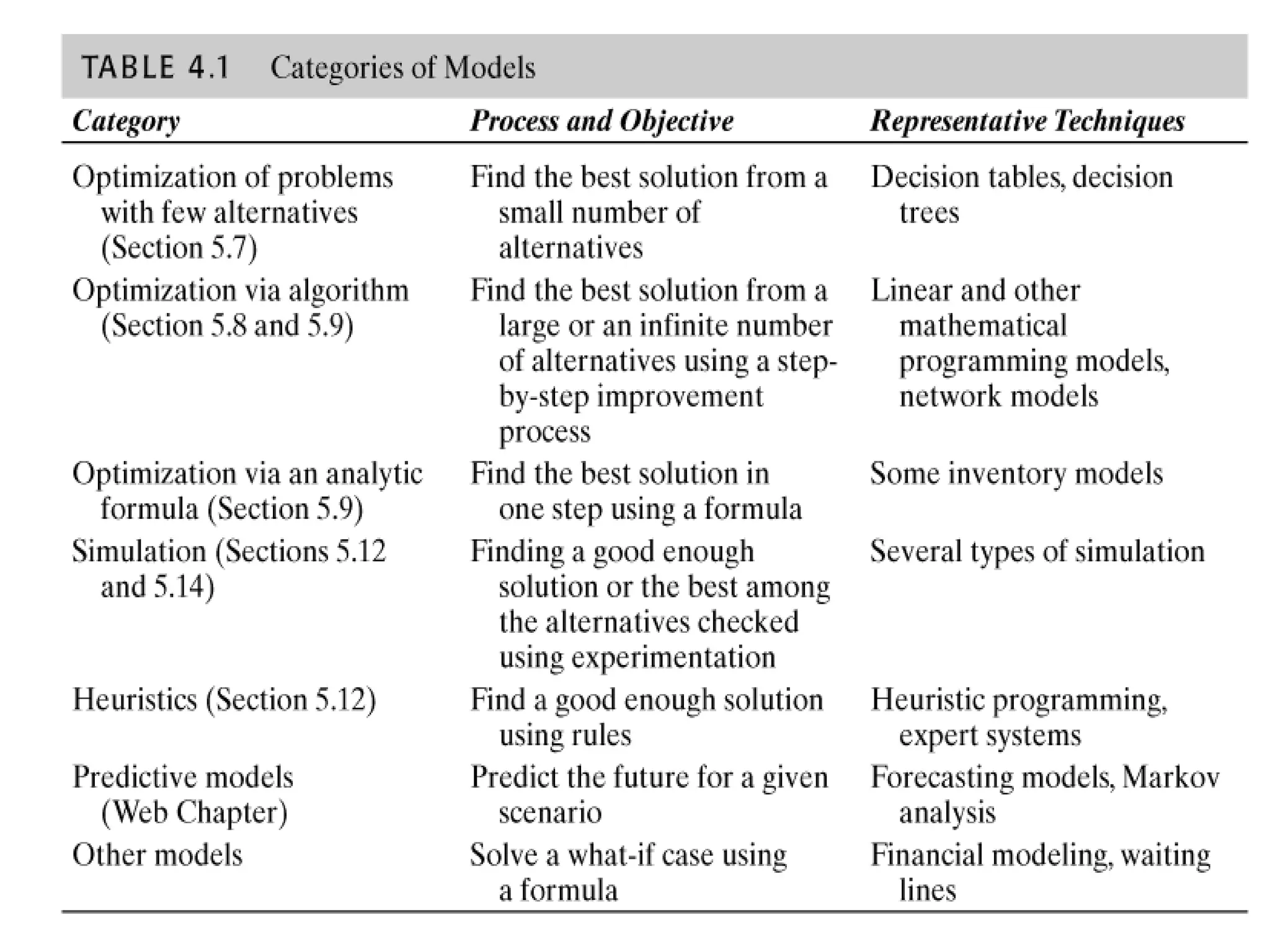
DSS modeling – Categories
DSS modeling – Trends 
• Model libraries and solution techniques 
• Using web tools – perform modeling, 
optimisation, simulation etc 
• Multidimensional analysis 
• Model for model analysis
Classification of DSS Models 
Static Analysis: 
• Static model takes a single snapshot of 
situation 
• Everything occurs in a single interval. 
• E.g. Make or buy decision 
• Stability of the relevant data is assumed.
Dynamic Analysis: 
• Represents scenarios that change over time. 
• E.g. 5-year profit and loss projection in which 
the input data, such as costs, prices, and 
quantities, change from year to year. 
• Time dependent 
• Important because they use, represent, or 
generate trends and patterns over time. 
• Shows average per period, moving averages 
and comparative analysis.
Certainty, uncertainty, and risk 
Decision situations are often classified on the 
basis of what the decision maker believes about 
the forecasted results. The categories are: 
• Certainty 
• Risk 
• Uncertainty
Decision Making Under Certainty 
• Complete knowledge is available 
• Decision maker knows the outcome of each 
course of action 
• Situation involve is often with structured 
problems with short time horizons 
• Certain models are relatively easy to develop 
and solve and they can yield optimal 
solutions.
Decision making under uncertainty 
• Several outcomes for each course of action. 
• Decision maker does not know, or cannot 
estimate the possible outcomes. 
• More difficult because of insufficient 
information. 
• Involves assessment of the decision maker’s 
attitude towards risk.
Decision making under risk 
(Risk analysis) 
• Decision maker must consider several possible 
outcomes for each alternative. 
• The decision maker can assess the degree of 
risk associated with each alternative. 
• Risk analysis can be performed by calculating 
the expected value for each alternative and 
selecting the one with best expected value.
Decision analysis with decision tables 
and decision trees 
Decision Table: 
• Organize information and knowledge in 
systematic tabular manner
Decision Trees: 
• Alternative representation of the decision 
table 
• Shows the relationship of the problem 
graphically and handle complex situations 
• Can be cumbersome if there are many 
alternatives or static nature. 
• TreeAge Pro and Precision Tree: Powerful and 
sophisticated decision tree analysis systems
Structure of mathematical models for 
decision support 
Components of decision 
support mathematical 
models: 
• Result Variables 
• Decision Variables 
• Uncontrollable variables 
• Intermediate result 
variables
• Result Variables: reflect the level of effectiveness 
of a system 
• Decision Variables: describes alternative course 
of action. 
• Uncontrollable Variables: Some factors that 
affect the result variables but not under the 
control of decision maker. 
• Intermediate result Variables: reflect 
intermediate outcomes in mathematical models.
Multiple Goals
Sensitivity Analysis 
• Attempts to assess the impact of a change in input data 
on proposed solution. 
• Important because it allows flexibility and adaptation 
to changing conditions 
• Provides a better understanding of the model and the 
decision making situation 
• Used for: 
1.Revising models to eliminate too-large sensitivities. 
2.Adding details about sensitive variables. 
3.Obtainong better estimate of sensitive external 
variables. 
4.Altering a real-world system to reduce actual 
sensitivities.
What-If-Analysis 
• What will happen to the solution if an input 
variables, an assumption, or a parameter 
value is changed 
• With the appropriate user interface, it is easy 
for manager to ask a computer model 
different questions and get the answers. 
• Common in expert systems. 
• User get an opportunity to change their 
answers to some question’s.
Goal Analysis 
• Calculates the values of the inputs necessary 
to achieve a desired level of output. 
• Represents a backward solution approach
Problem solving search methods 
The choice phase of problem solving involves a 
search for an appropriate course of action. 
Search approaches are: 
• Analytical Techniques 
• Algorithms 
• Blind Searching 
• Heuristic Searching
Simulation 
• Is a appearance of reality. 
• A technique for conducting experiments with 
computer on model of a management system 
• Characteristics: 
1.Simulation typically imitative. 
2.Technique for conducting experiments. 
3.Descriptive rather than a normative. 
4.Used only when a problem is too complex to be 
treated using numerical optimizing techniques.
Advantages of simulation 
• Theory is fairly straightforward. 
• Great time compression 
• Descriptive rather than normative. 
• Built from the manager’s perspective. 
• Built for one particular problem and cannot solve 
any other problem. 
• A manager can experiment to determine which 
decision variables and which part of environment 
are really important, and with different 
alternatives.
• Can handle an extremely wide variety of 
problem types, such as inventory and staffing. 
• Can include the real complexities of 
problems. 
• Automatically produce many important 
performance measures. 
• Relatively easy-to-use simulation packages. 
• Often the only DSS modeling method that can 
readily handle relatively unstructured 
problem.
Disadvantages of simulation 
• An optimal solution cannot be guaranteed. 
• Model construction can be a slow and costly 
process. 
• Solutions are not transferable to other 
problems 
• Easy to explain to managers that analytic 
methods are overlooked. 
• Requires special skills because of the 
complexity of the formal solution method.
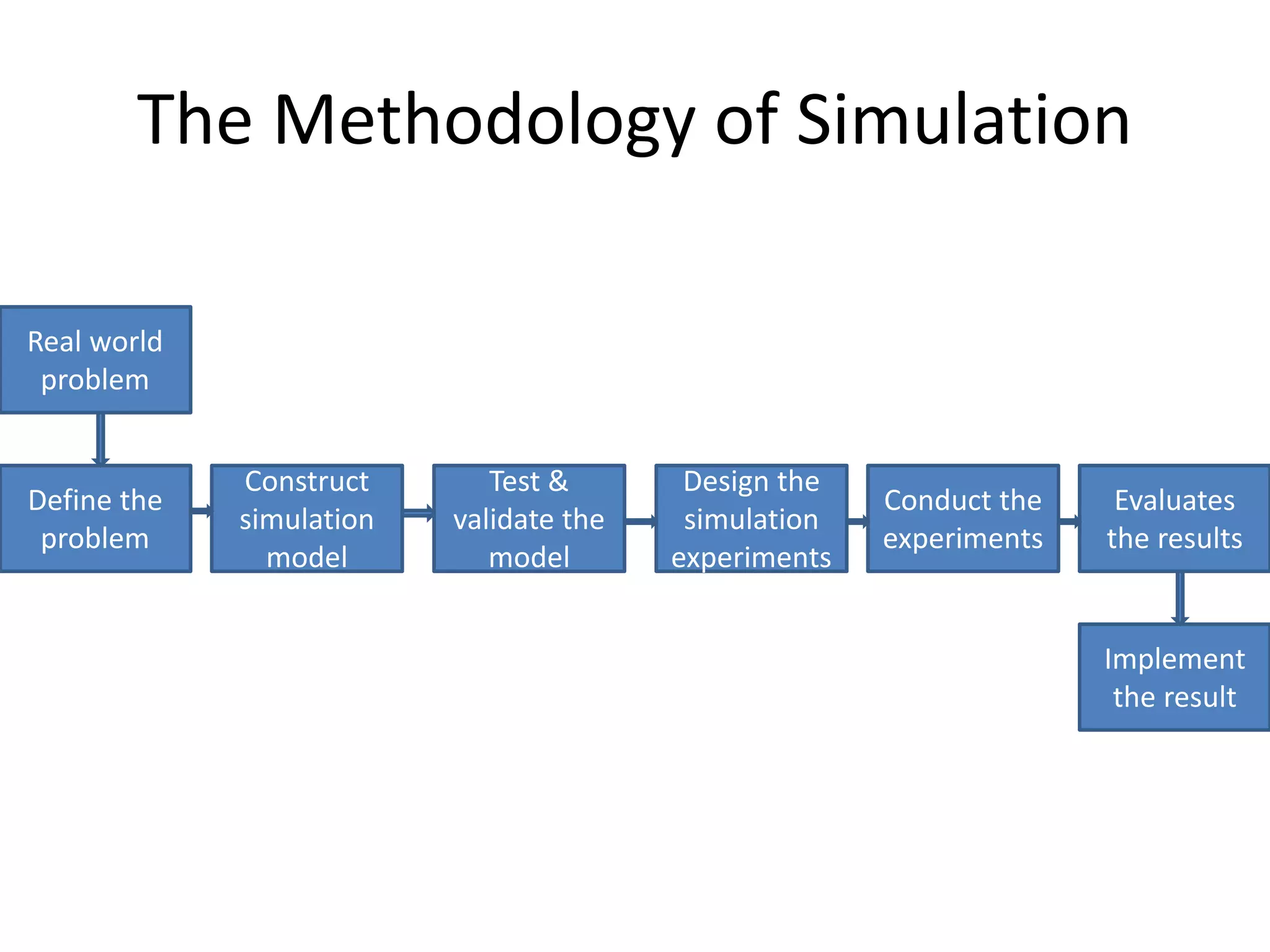
The Methodology of Simulation 
Test & 
validate the 
model 
Real world 
problem 
Define the 
problem 
Construct 
simulation 
model 
Implement 
the result 
Design the 
simulation 
experiments 
Conduct the 
experiments 
Evaluates 
the results
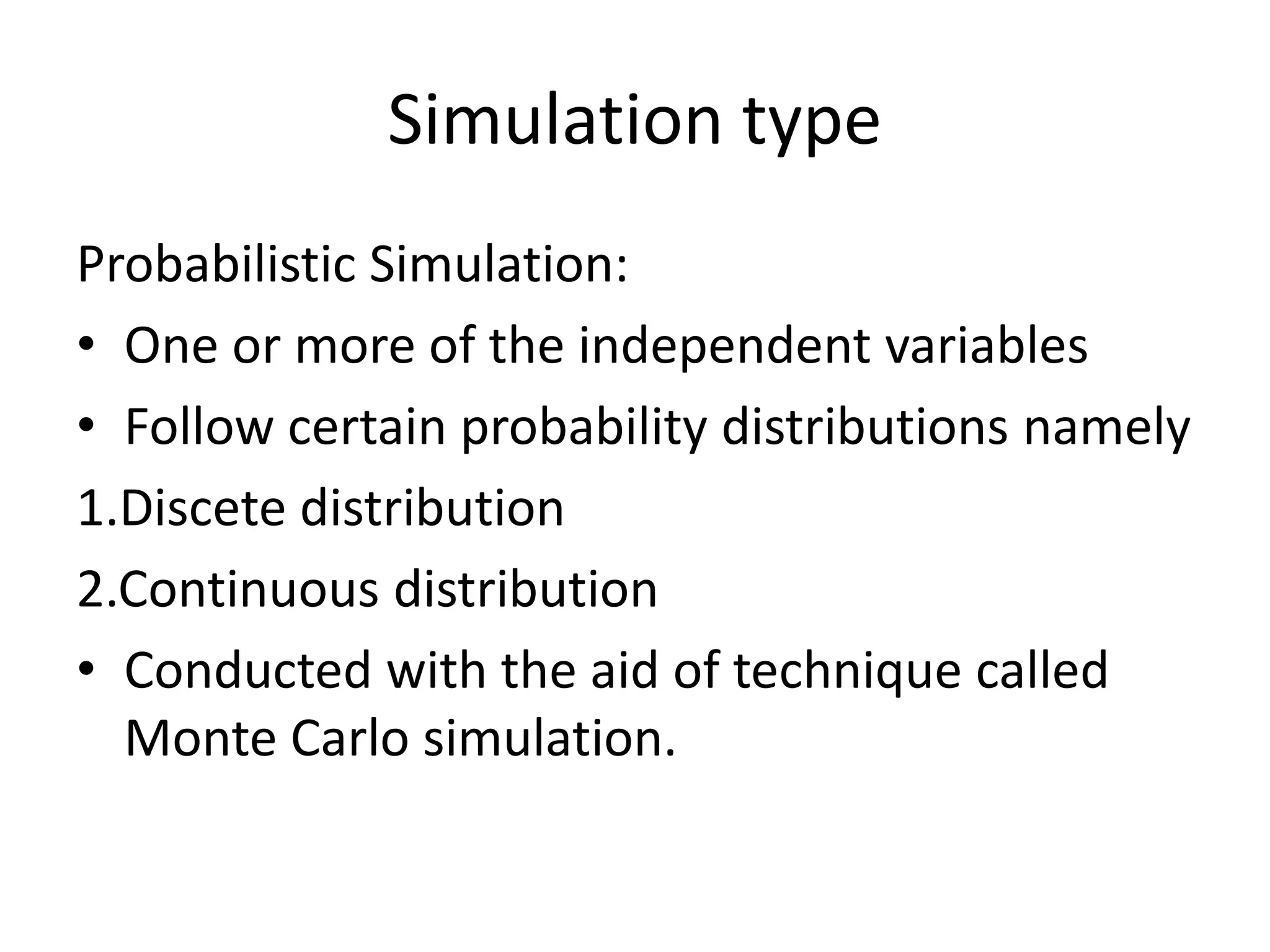
Simulation type 
Probabilistic Simulation: 
• One or more of the independent variables 
• Follow certain probability distributions namely 
1.Discete distribution 
2.Continuous distribution 
• Conducted with the aid of technique called 
Monte Carlo simulation.
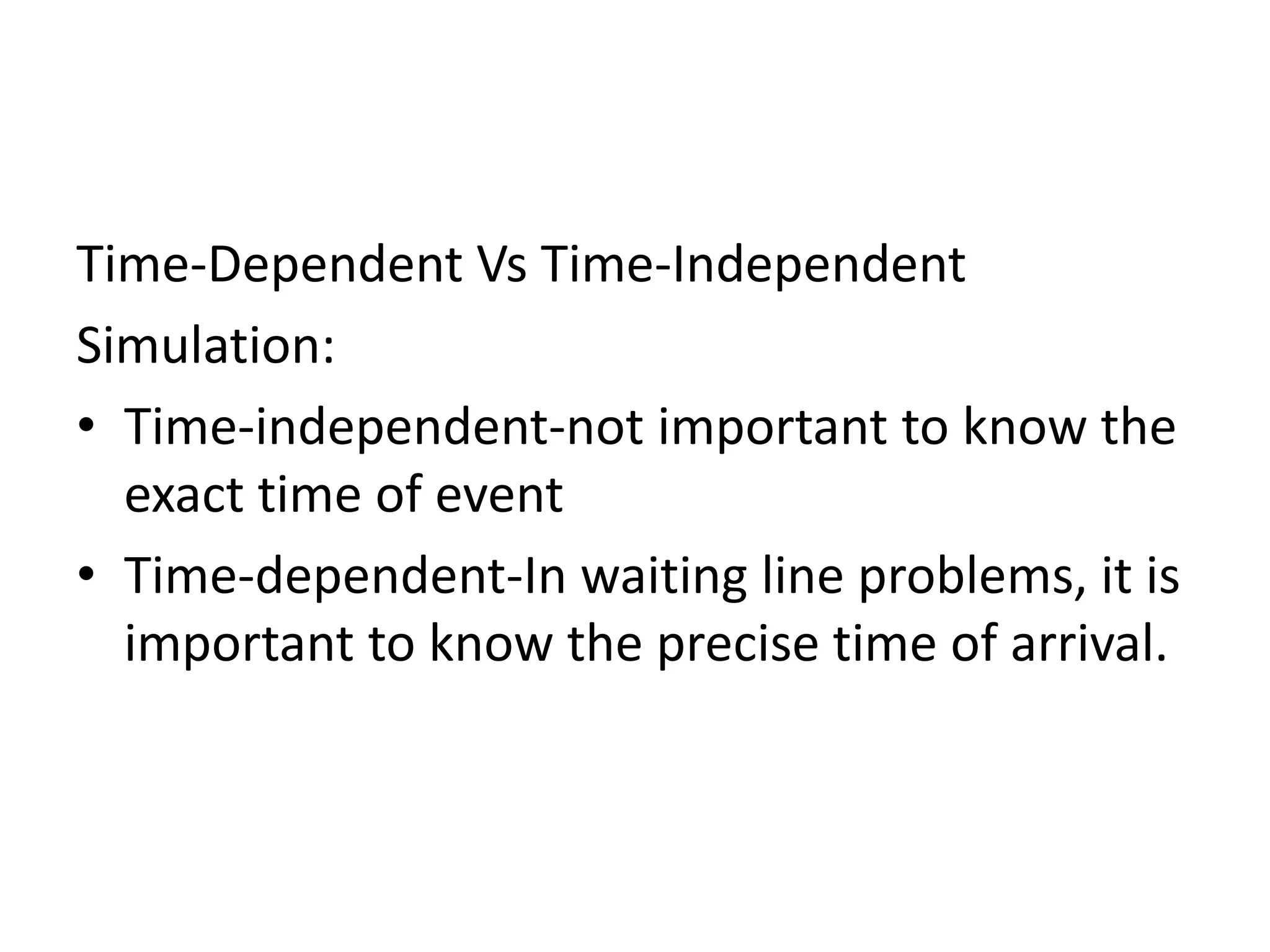
Time-Dependent Vs Time-Independent 
Simulation: 
• Time-independent-not important to know the 
exact time of event 
• Time-dependent-In waiting line problems, it is 
important to know the precise time of arrival.
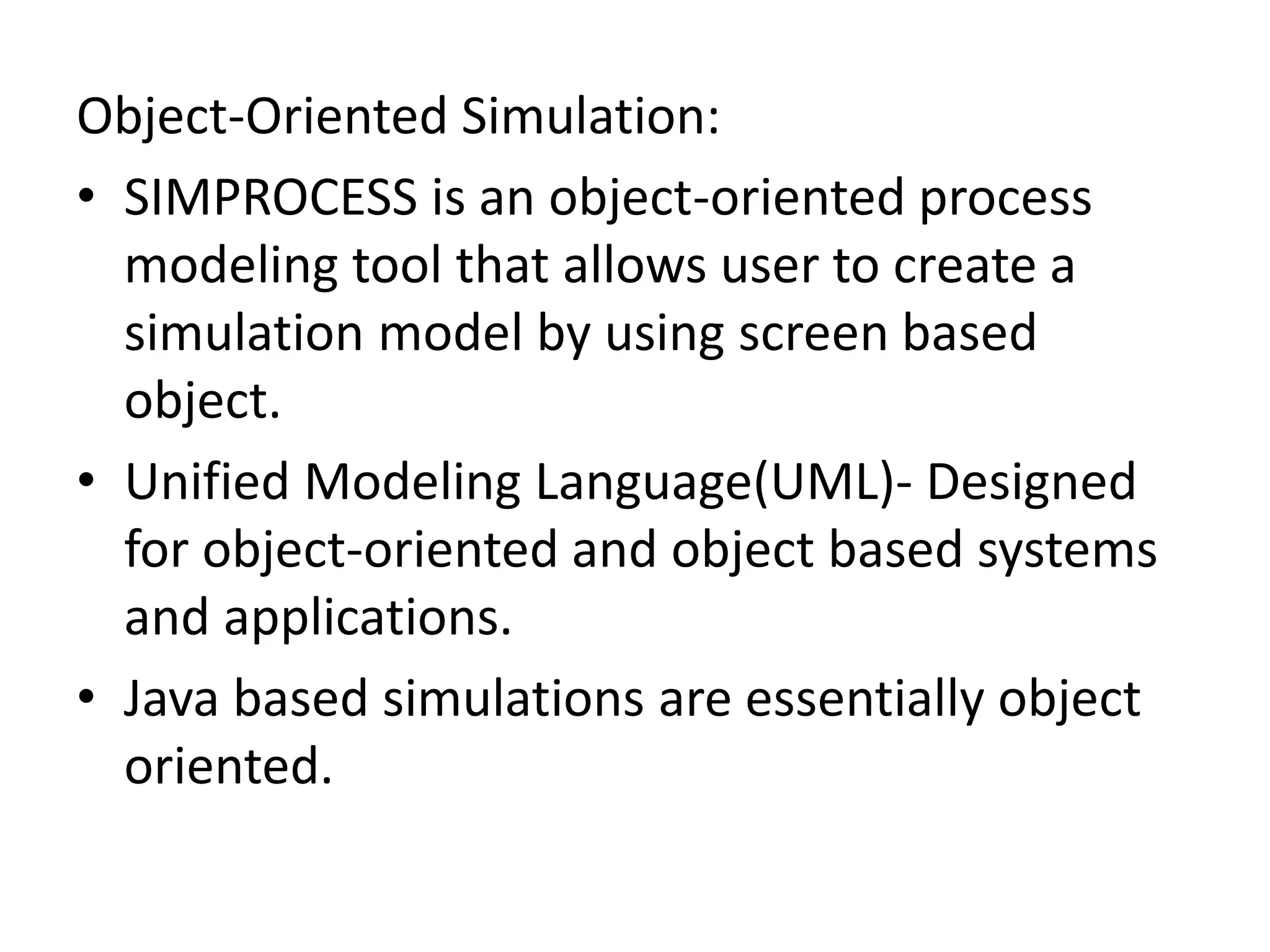
Object-Oriented Simulation: 
• SIMPROCESS is an object-oriented process 
modeling tool that allows user to create a 
simulation model by using screen based 
object. 
• Unified Modeling Language(UML)- Designed 
for object-oriented and object based systems 
and applications. 
• Java based simulations are essentially object 
oriented.
Visual Simulation: 
• Graphical display of computerized results 
• Includes animations 
• Is one of the most successful development in 
computer-human interactions and problem 
solving.
Quantitative Software Packages 
• Are preprogrammed models and optimization systems. 
• Serve as building blocks for other quantitative models 
• A variety of these are available for inclusion in DSS as 
major and minor modeling components. 
• Revenue management systems focus on identifying 
right product for right customer. 
• Airlines have used such systems to determine right 
price for each airline seat. 
• System also available for retail operations, 
entertainment venues, and many other industries.

Modeling and analysis

  • 1.
  • 2.
    DSS modeling –Issues • DSS – can be composed of multiple models • Modeling Issues - • Identification of problems and environment analysis • Variable identification • Forecasting (predictive analysis)
  • 3.
    DSS modeling –Categories • Optimisation of problems with few alternatives • Optimisation via algorithm • Optimisation via analytical formula • Simulation • Heuristics • Predictive models • Other Models
  • 4.
    DSS modeling –Categories
  • 5.
    DSS modeling –Trends • Model libraries and solution techniques • Using web tools – perform modeling, optimisation, simulation etc • Multidimensional analysis • Model for model analysis
  • 6.
    Classification of DSSModels Static Analysis: • Static model takes a single snapshot of situation • Everything occurs in a single interval. • E.g. Make or buy decision • Stability of the relevant data is assumed.
  • 7.
    Dynamic Analysis: •Represents scenarios that change over time. • E.g. 5-year profit and loss projection in which the input data, such as costs, prices, and quantities, change from year to year. • Time dependent • Important because they use, represent, or generate trends and patterns over time. • Shows average per period, moving averages and comparative analysis.
  • 8.
    Certainty, uncertainty, andrisk Decision situations are often classified on the basis of what the decision maker believes about the forecasted results. The categories are: • Certainty • Risk • Uncertainty
  • 9.
    Decision Making UnderCertainty • Complete knowledge is available • Decision maker knows the outcome of each course of action • Situation involve is often with structured problems with short time horizons • Certain models are relatively easy to develop and solve and they can yield optimal solutions.
  • 10.
    Decision making underuncertainty • Several outcomes for each course of action. • Decision maker does not know, or cannot estimate the possible outcomes. • More difficult because of insufficient information. • Involves assessment of the decision maker’s attitude towards risk.
  • 11.
    Decision making underrisk (Risk analysis) • Decision maker must consider several possible outcomes for each alternative. • The decision maker can assess the degree of risk associated with each alternative. • Risk analysis can be performed by calculating the expected value for each alternative and selecting the one with best expected value.
  • 12.
    Decision analysis withdecision tables and decision trees Decision Table: • Organize information and knowledge in systematic tabular manner
  • 13.
    Decision Trees: •Alternative representation of the decision table • Shows the relationship of the problem graphically and handle complex situations • Can be cumbersome if there are many alternatives or static nature. • TreeAge Pro and Precision Tree: Powerful and sophisticated decision tree analysis systems
  • 14.
    Structure of mathematicalmodels for decision support Components of decision support mathematical models: • Result Variables • Decision Variables • Uncontrollable variables • Intermediate result variables
  • 15.
    • Result Variables:reflect the level of effectiveness of a system • Decision Variables: describes alternative course of action. • Uncontrollable Variables: Some factors that affect the result variables but not under the control of decision maker. • Intermediate result Variables: reflect intermediate outcomes in mathematical models.
  • 16.
  • 17.
    Sensitivity Analysis •Attempts to assess the impact of a change in input data on proposed solution. • Important because it allows flexibility and adaptation to changing conditions • Provides a better understanding of the model and the decision making situation • Used for: 1.Revising models to eliminate too-large sensitivities. 2.Adding details about sensitive variables. 3.Obtainong better estimate of sensitive external variables. 4.Altering a real-world system to reduce actual sensitivities.
  • 18.
    What-If-Analysis • Whatwill happen to the solution if an input variables, an assumption, or a parameter value is changed • With the appropriate user interface, it is easy for manager to ask a computer model different questions and get the answers. • Common in expert systems. • User get an opportunity to change their answers to some question’s.
  • 19.
    Goal Analysis •Calculates the values of the inputs necessary to achieve a desired level of output. • Represents a backward solution approach
  • 20.
    Problem solving searchmethods The choice phase of problem solving involves a search for an appropriate course of action. Search approaches are: • Analytical Techniques • Algorithms • Blind Searching • Heuristic Searching
  • 21.
    Simulation • Isa appearance of reality. • A technique for conducting experiments with computer on model of a management system • Characteristics: 1.Simulation typically imitative. 2.Technique for conducting experiments. 3.Descriptive rather than a normative. 4.Used only when a problem is too complex to be treated using numerical optimizing techniques.
  • 22.
    Advantages of simulation • Theory is fairly straightforward. • Great time compression • Descriptive rather than normative. • Built from the manager’s perspective. • Built for one particular problem and cannot solve any other problem. • A manager can experiment to determine which decision variables and which part of environment are really important, and with different alternatives.
  • 23.
    • Can handlean extremely wide variety of problem types, such as inventory and staffing. • Can include the real complexities of problems. • Automatically produce many important performance measures. • Relatively easy-to-use simulation packages. • Often the only DSS modeling method that can readily handle relatively unstructured problem.
  • 24.
    Disadvantages of simulation • An optimal solution cannot be guaranteed. • Model construction can be a slow and costly process. • Solutions are not transferable to other problems • Easy to explain to managers that analytic methods are overlooked. • Requires special skills because of the complexity of the formal solution method.
  • 25.
    The Methodology ofSimulation Test & validate the model Real world problem Define the problem Construct simulation model Implement the result Design the simulation experiments Conduct the experiments Evaluates the results
  • 26.
    Simulation type ProbabilisticSimulation: • One or more of the independent variables • Follow certain probability distributions namely 1.Discete distribution 2.Continuous distribution • Conducted with the aid of technique called Monte Carlo simulation.
  • 27.
    Time-Dependent Vs Time-Independent Simulation: • Time-independent-not important to know the exact time of event • Time-dependent-In waiting line problems, it is important to know the precise time of arrival.
  • 28.
    Object-Oriented Simulation: •SIMPROCESS is an object-oriented process modeling tool that allows user to create a simulation model by using screen based object. • Unified Modeling Language(UML)- Designed for object-oriented and object based systems and applications. • Java based simulations are essentially object oriented.
  • 29.
    Visual Simulation: •Graphical display of computerized results • Includes animations • Is one of the most successful development in computer-human interactions and problem solving.
  • 30.
    Quantitative Software Packages • Are preprogrammed models and optimization systems. • Serve as building blocks for other quantitative models • A variety of these are available for inclusion in DSS as major and minor modeling components. • Revenue management systems focus on identifying right product for right customer. • Airlines have used such systems to determine right price for each airline seat. • System also available for retail operations, entertainment venues, and many other industries.