Requirements Engineering Processes
                        Loganathan R
Objectives
• To describe the principal requirements
  engineering activities and their relationships
• To introduce techniques for requirements
  elicitation and analysis
• To describe requirements validation and the role
  of requirements reviews
• To discuss the role of requirements management
  in support of other requirements engineering
  processes

                  Prof. Loganathan R, CSE,HKBKCE   2
Requirements engineering processes
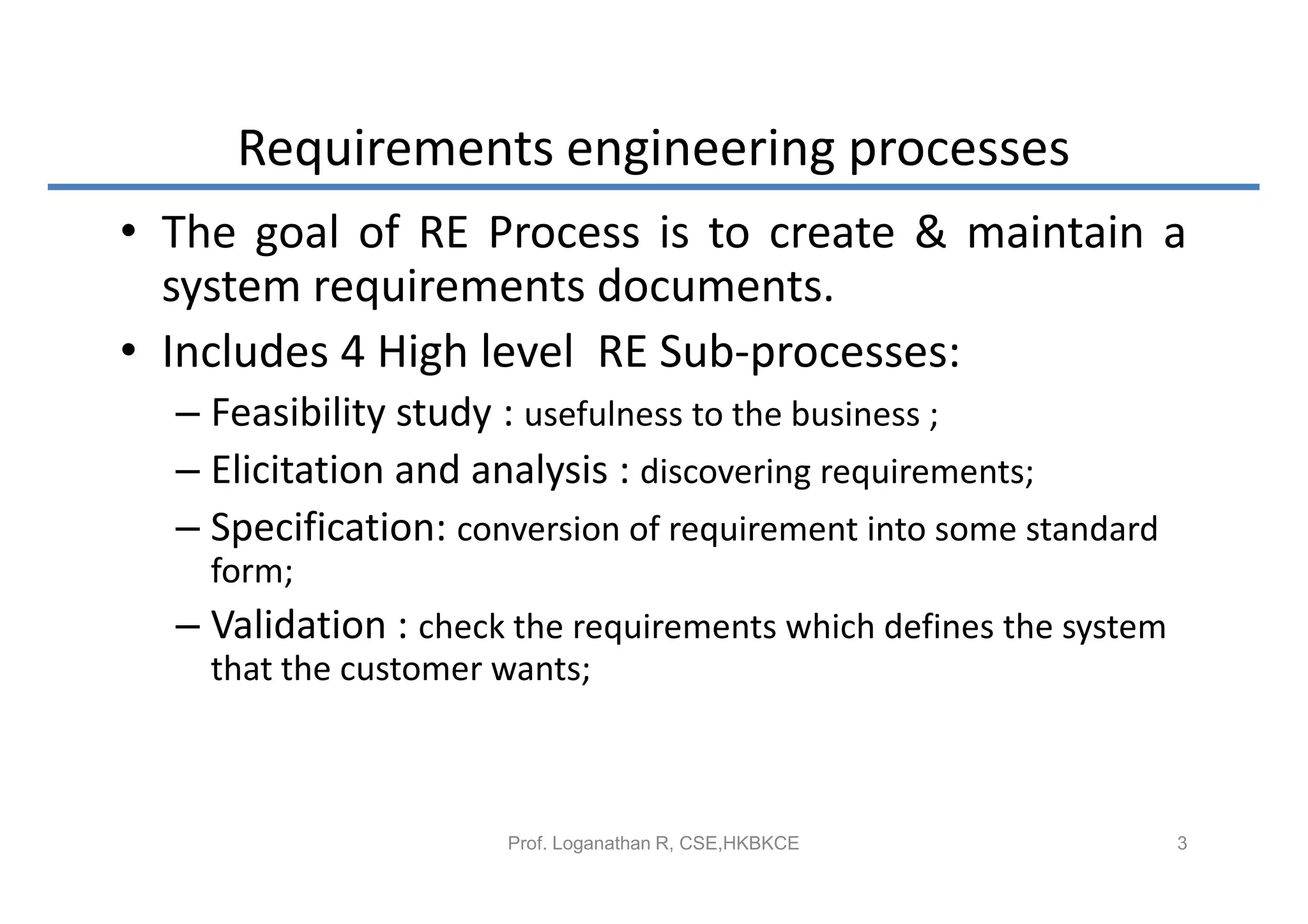
• The goal of RE Process is to create & maintain a
  system requirements documents.
• Includes 4 High level RE Sub-processes:
  – Feasibility study : usefulness to the business ;
  – Elicitation and analysis : discovering requirements;
  – Specification: conversion of requirement into some standard
    form;
  – Validation : check the requirements which defines the system
    that the customer wants;


                      Prof. Loganathan R, CSE,HKBKCE               3
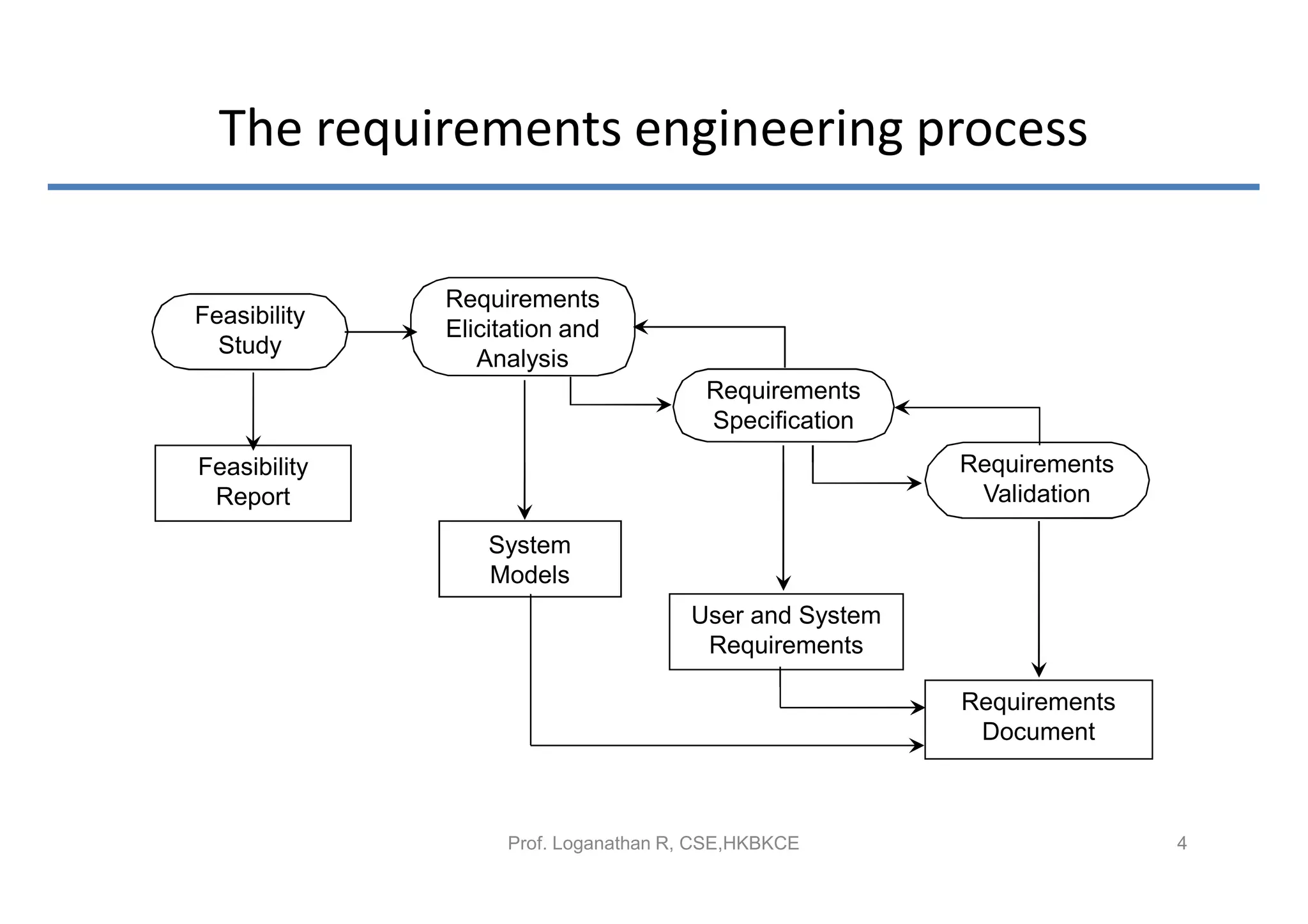
The requirements engineering process

              Requirements
Feasibility
              Elicitation and
  Study
                 Analysis
                                        Requirements
                                        Specification
Feasibility                                             Requirements
 Report                                                  Validation

                  System
                  Models
                                      User and System
                                       Requirements

                                                        Requirements
                                                         Document


                    Prof. Loganathan R, CSE,HKBKCE                     4
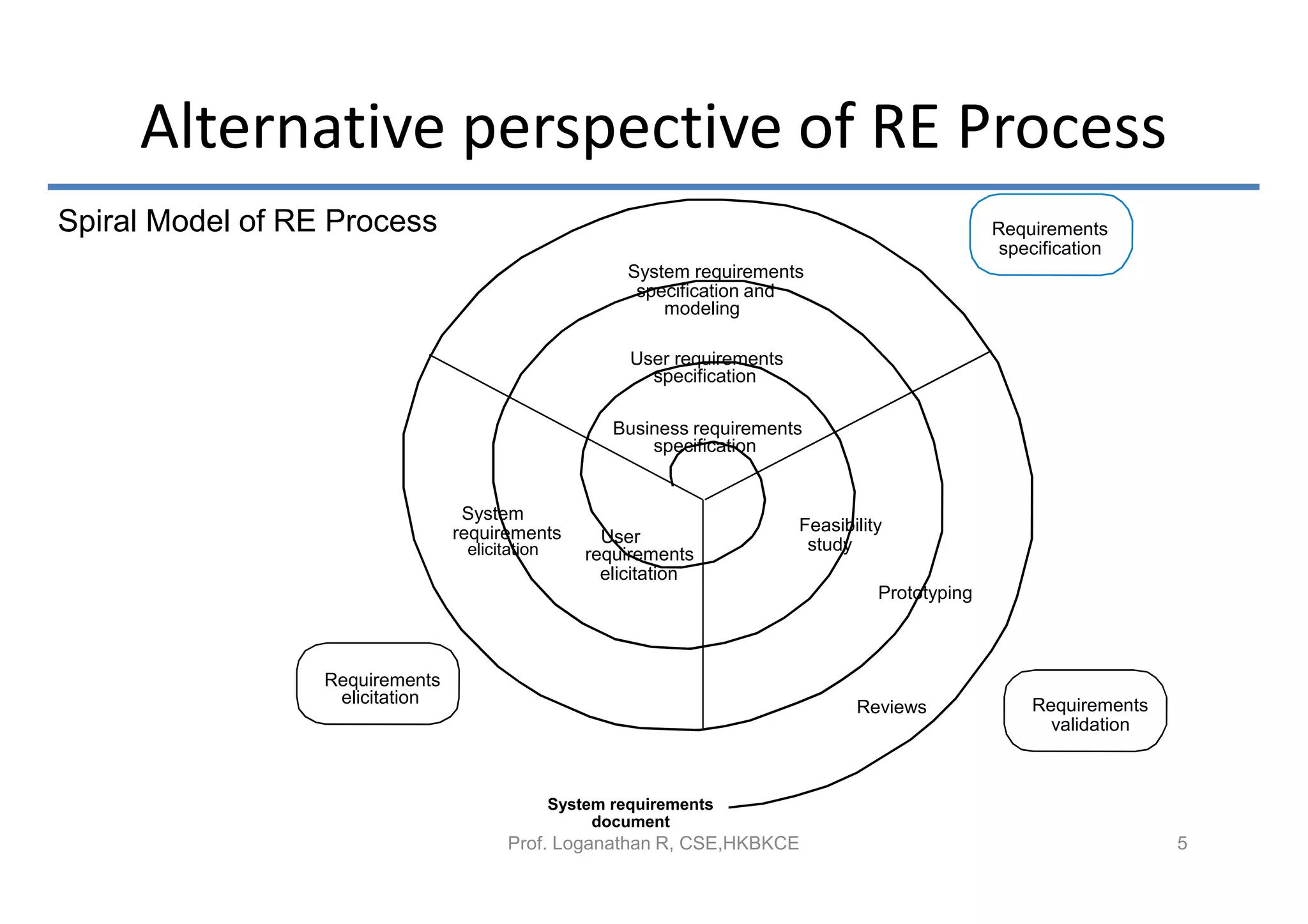
Alternative perspective of RE Process
Spiral Model of RE Process                                                                           Requirements
                                                                                                      specification
                                                         System requirements
                                                          specification and
                                                             modeling

                                                         User requirements
                                                           specification

                                                       Business requirements
                                                           specification


                                  System
                                 requirements                                Feasibility
                                                      User                    study
                                  elicitation       requirements
                                                      elicitation
                                                                                       Prototyping


                  Requirements
                   elicitation                                                                           Requirements
                                                                                    Reviews
                                                                                                           validation


                                                System requirements
                                                     document
                                        Prof. Loganathan R, CSE,HKBKCE                                                  5
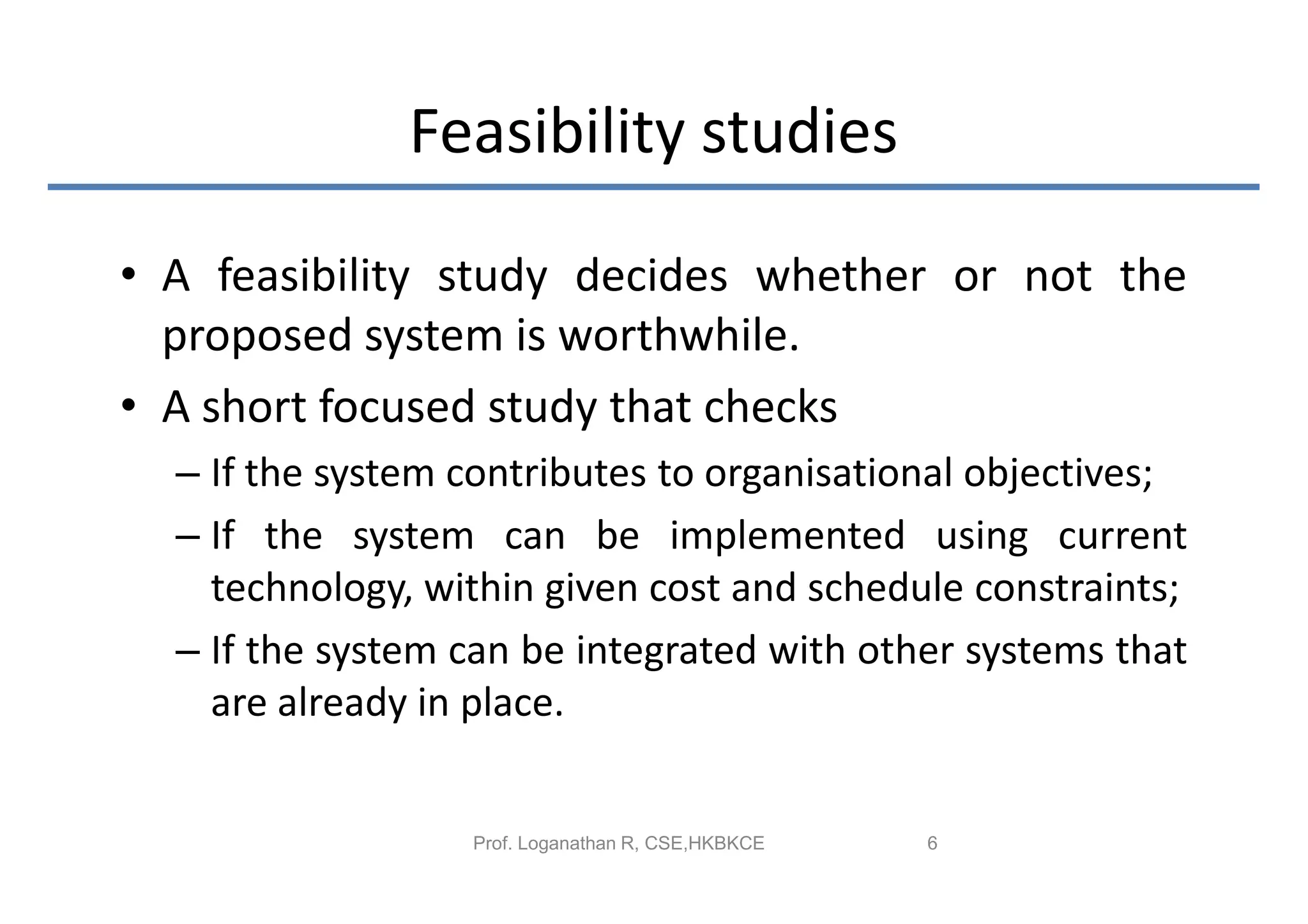
Feasibility studies

• A feasibility study decides whether or not the
  proposed system is worthwhile.
• A short focused study that checks
  – If the system contributes to organisational objectives;
  – If the system can be implemented using current
    technology, within given cost and schedule constraints;
  – If the system can be integrated with other systems that
    are already in place.


                  Prof. Loganathan R, CSE,HKBKCE   6
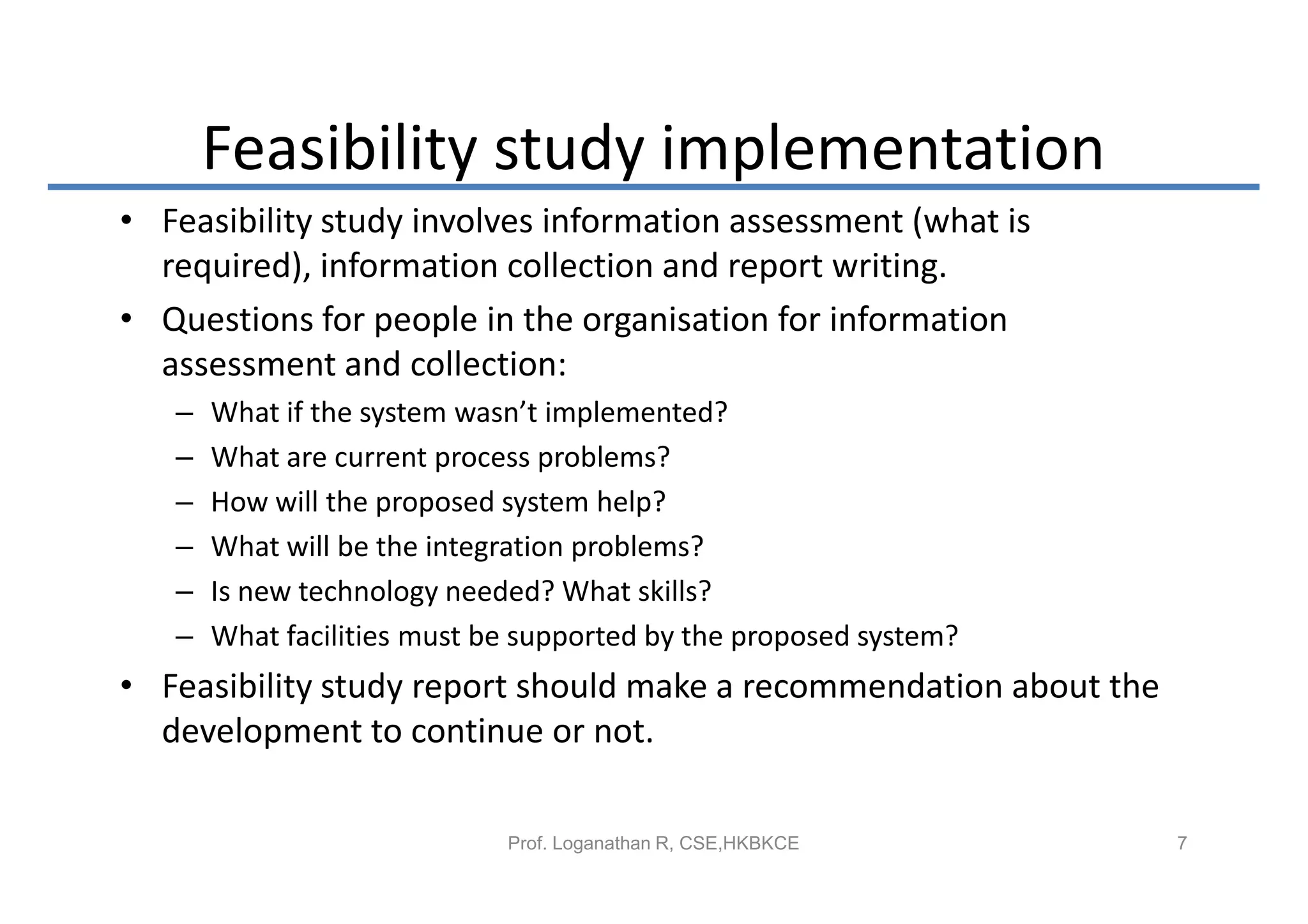
Feasibility study implementation
• Feasibility study involves information assessment (what is
  required), information collection and report writing.
• Questions for people in the organisation for information
  assessment and collection:
   –   What if the system wasn’t implemented?
   –   What are current process problems?
   –   How will the proposed system help?
   –   What will be the integration problems?
   –   Is new technology needed? What skills?
   –   What facilities must be supported by the proposed system?
• Feasibility study report should make a recommendation about the
  development to continue or not.

                             Prof. Loganathan R, CSE,HKBKCE         7
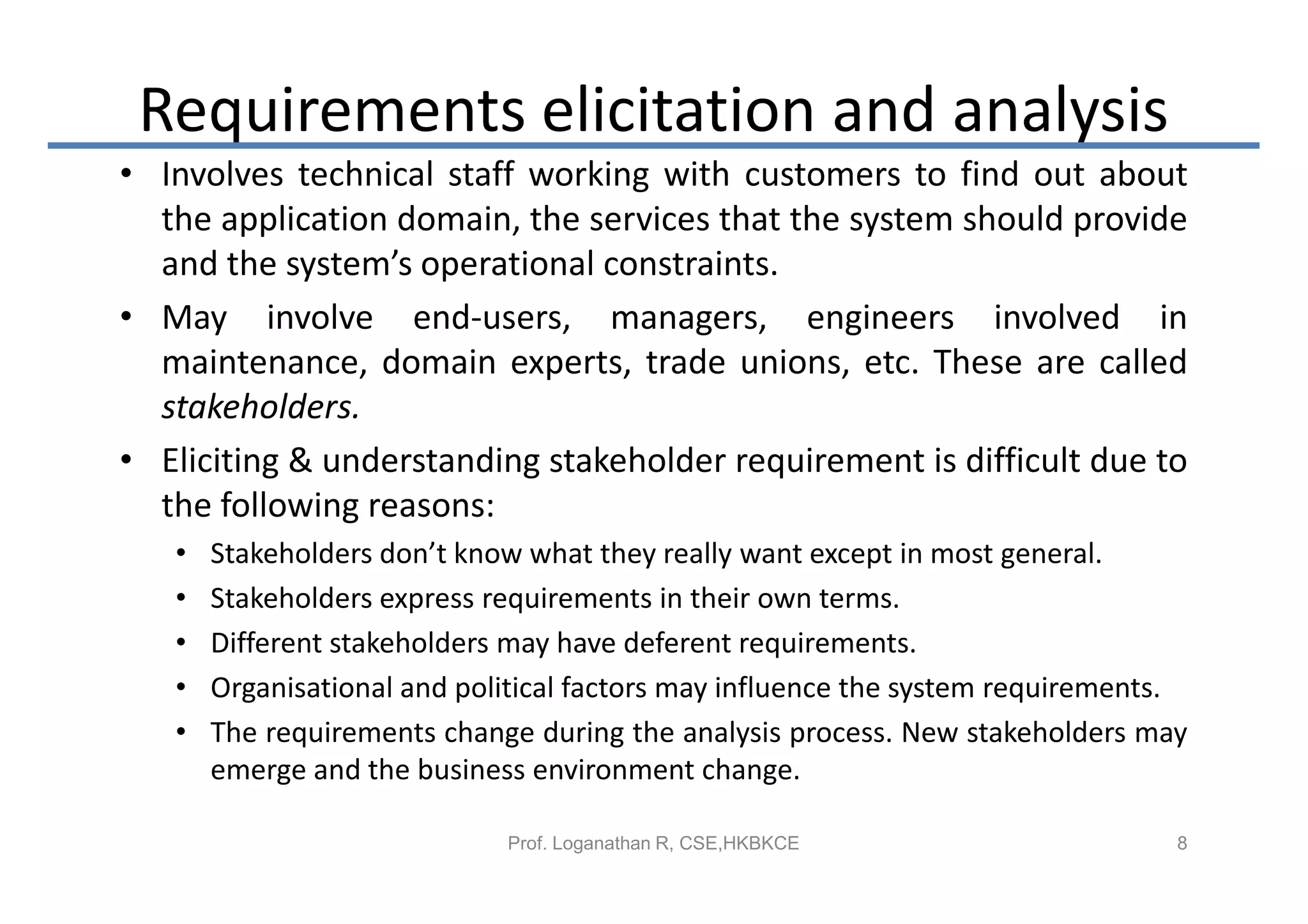
Requirements elicitation and analysis
• Involves technical staff working with customers to find out about
  the application domain, the services that the system should provide
  and the system’s operational constraints.
• May involve end-users, managers, engineers involved in
  maintenance, domain experts, trade unions, etc. These are called
  stakeholders.
• Eliciting & understanding stakeholder requirement is difficult due to
  the following reasons:
   •   Stakeholders don’t know what they really want except in most general.
   •   Stakeholders express requirements in their own terms.
   •   Different stakeholders may have deferent requirements.
   •   Organisational and political factors may influence the system requirements.
   •   The requirements change during the analysis process. New stakeholders may
       emerge and the business environment change.

                             Prof. Loganathan R, CSE,HKBKCE                      8
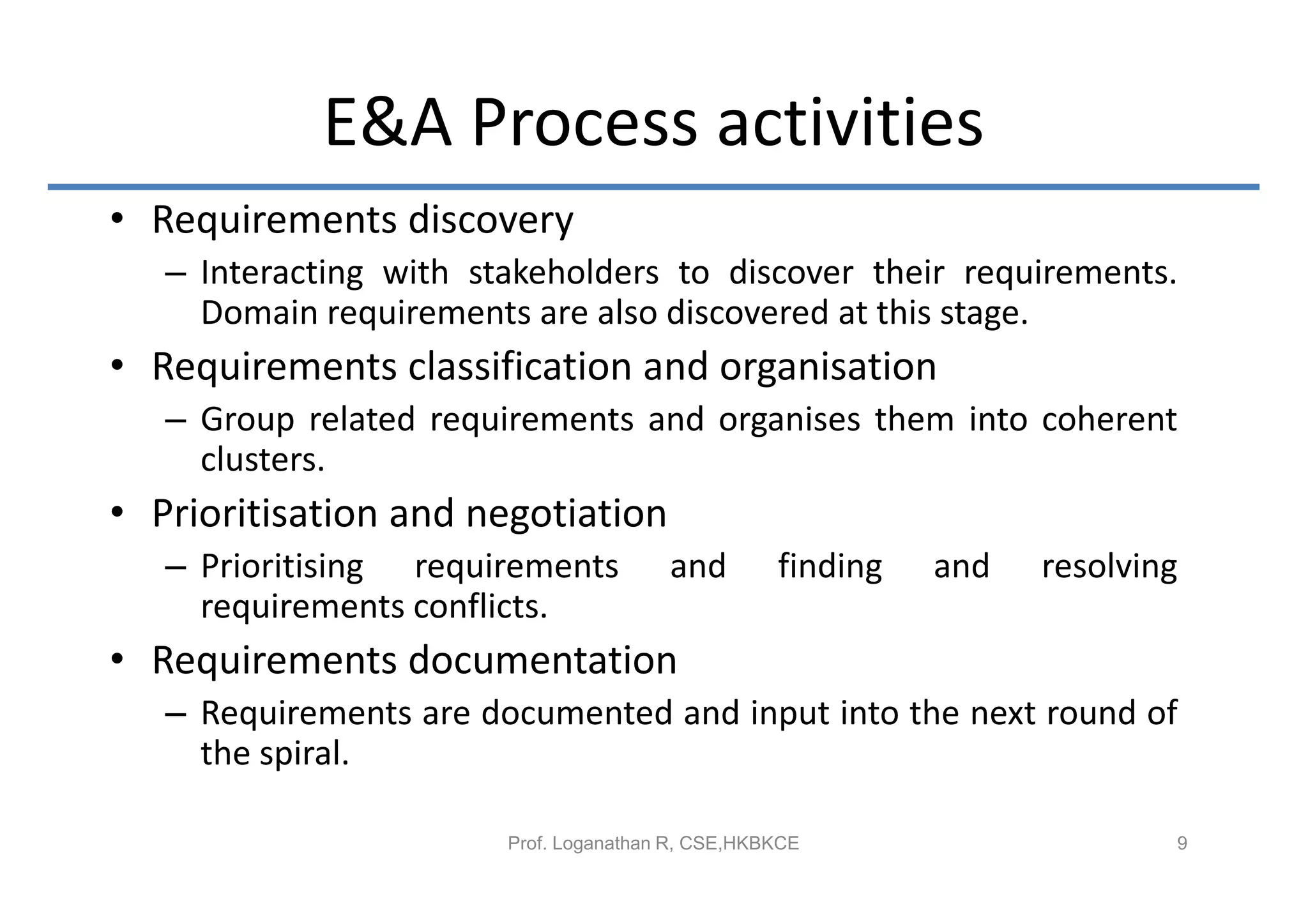
E&A Process activities
• Requirements discovery
   – Interacting with stakeholders to discover their requirements.
     Domain requirements are also discovered at this stage.
• Requirements classification and organisation
   – Group related requirements and organises them into coherent
     clusters.
• Prioritisation and negotiation
   – Prioritising requirements          and        finding   and   resolving
     requirements conflicts.
• Requirements documentation
   – Requirements are documented and input into the next round of
     the spiral.

                        Prof. Loganathan R, CSE,HKBKCE                     9
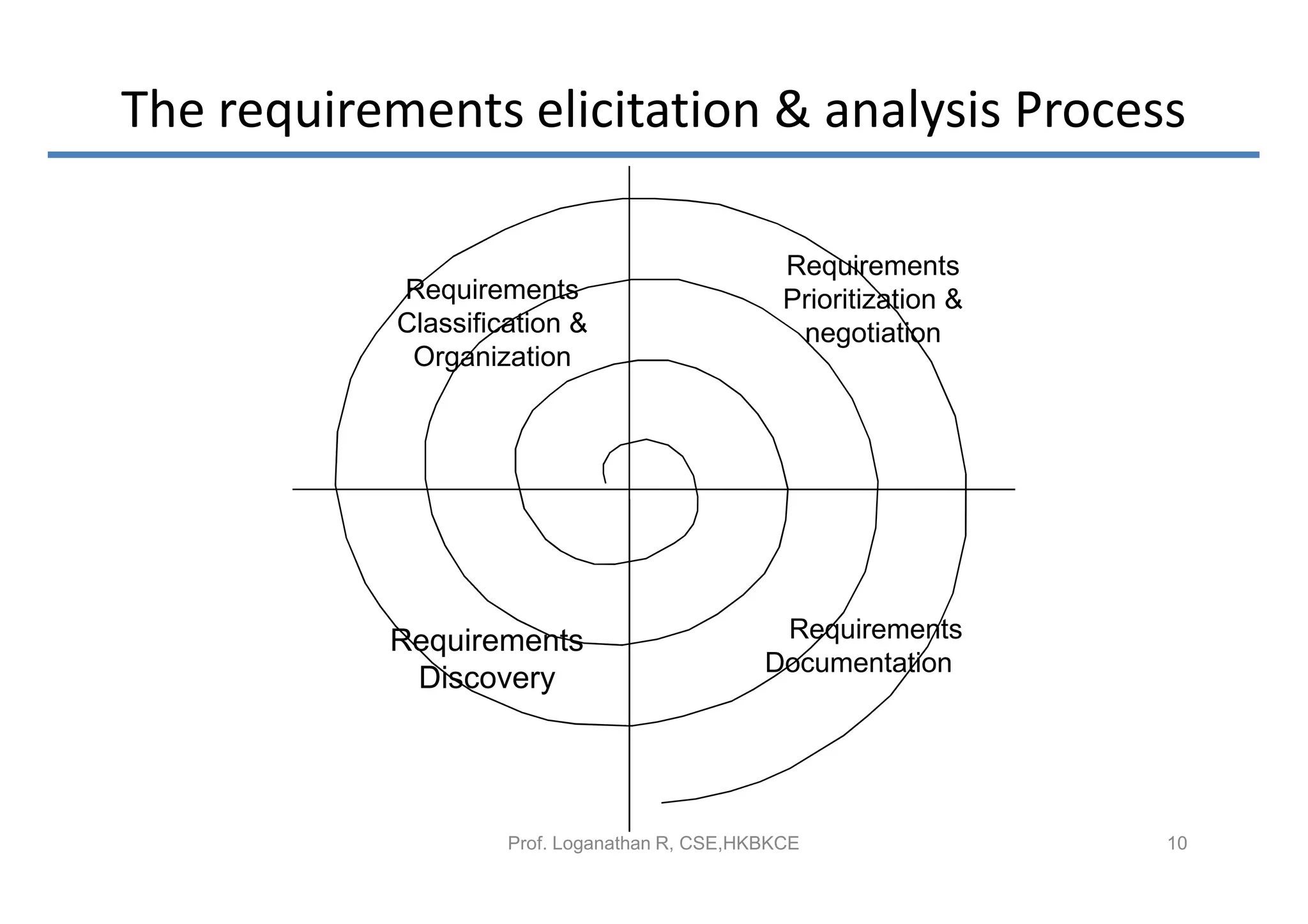
The requirements elicitation & analysis Process

                                                 Requirements
            Requirements                         Prioritization &
            Classification &                      negotiation
             Organization


           Requirements                         Requirements
                                               Documentation
            Discovery


                     Prof. Loganathan R, CSE,HKBKCE                 10
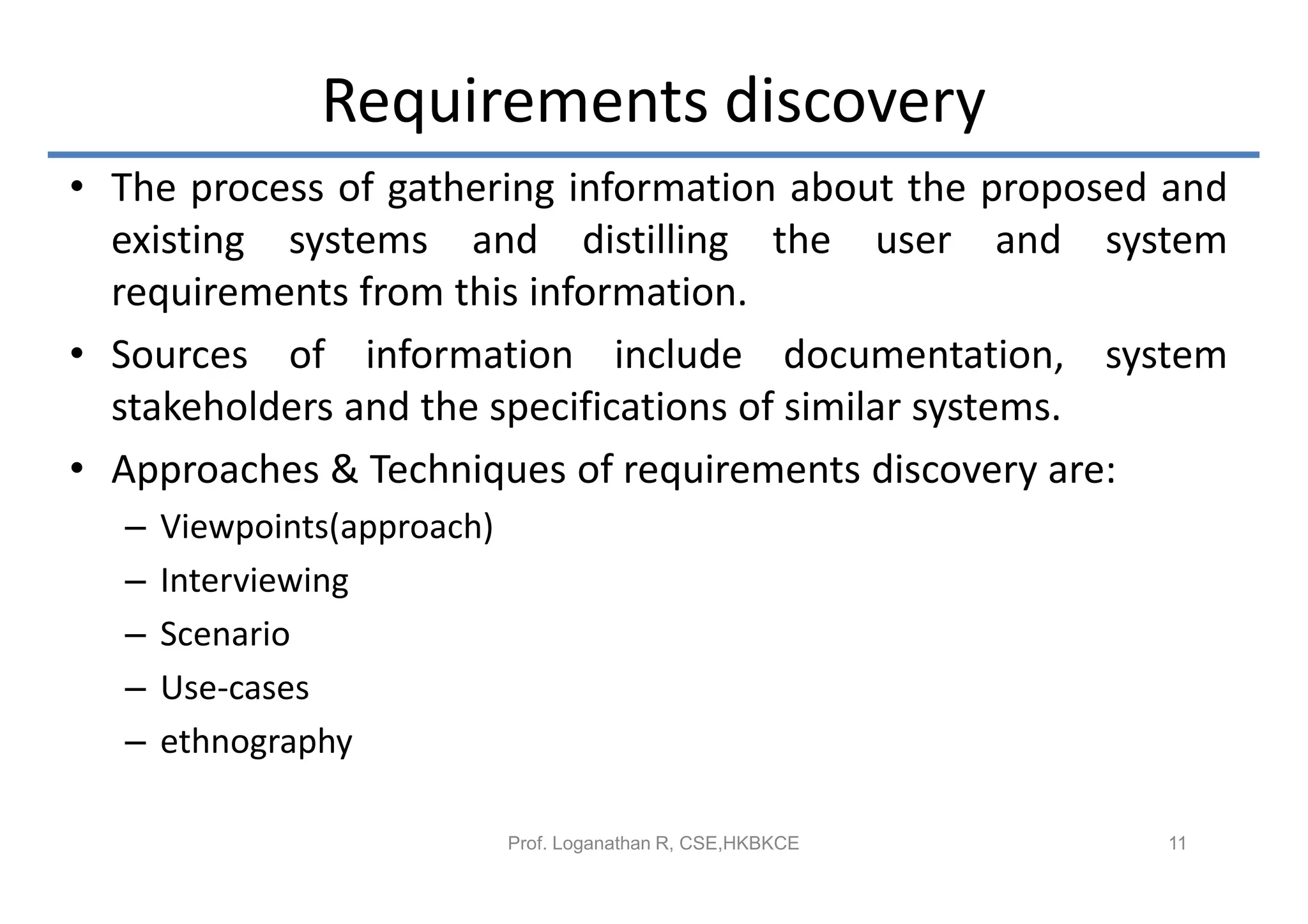
Requirements discovery
• The process of gathering information about the proposed and
  existing systems and distilling the user and system
  requirements from this information.
• Sources of information include documentation, system
  stakeholders and the specifications of similar systems.
• Approaches & Techniques of requirements discovery are:
  –   Viewpoints(approach)
  –   Interviewing
  –   Scenario
  –   Use-cases
  –   ethnography

                             Prof. Loganathan R, CSE,HKBKCE   11
Example : ATM stakeholders
• Bank customers – who receive services
• Representatives of other banks – who have reciprocal agreements
  for ATM usage
• Bank branch managers –who obtain management information
• Counter staff – who involved in day-to-day running of system
• Database administrators - who responsible for integrating system
  with customers database
• Bank Security managers
• The Bank’s Marketing department
• Hardware and software maintenance engineers
• Banking regulators Who ensures system conforms to banking
  regulations

                       Prof. Loganathan R, CSE,HKBKCE           12
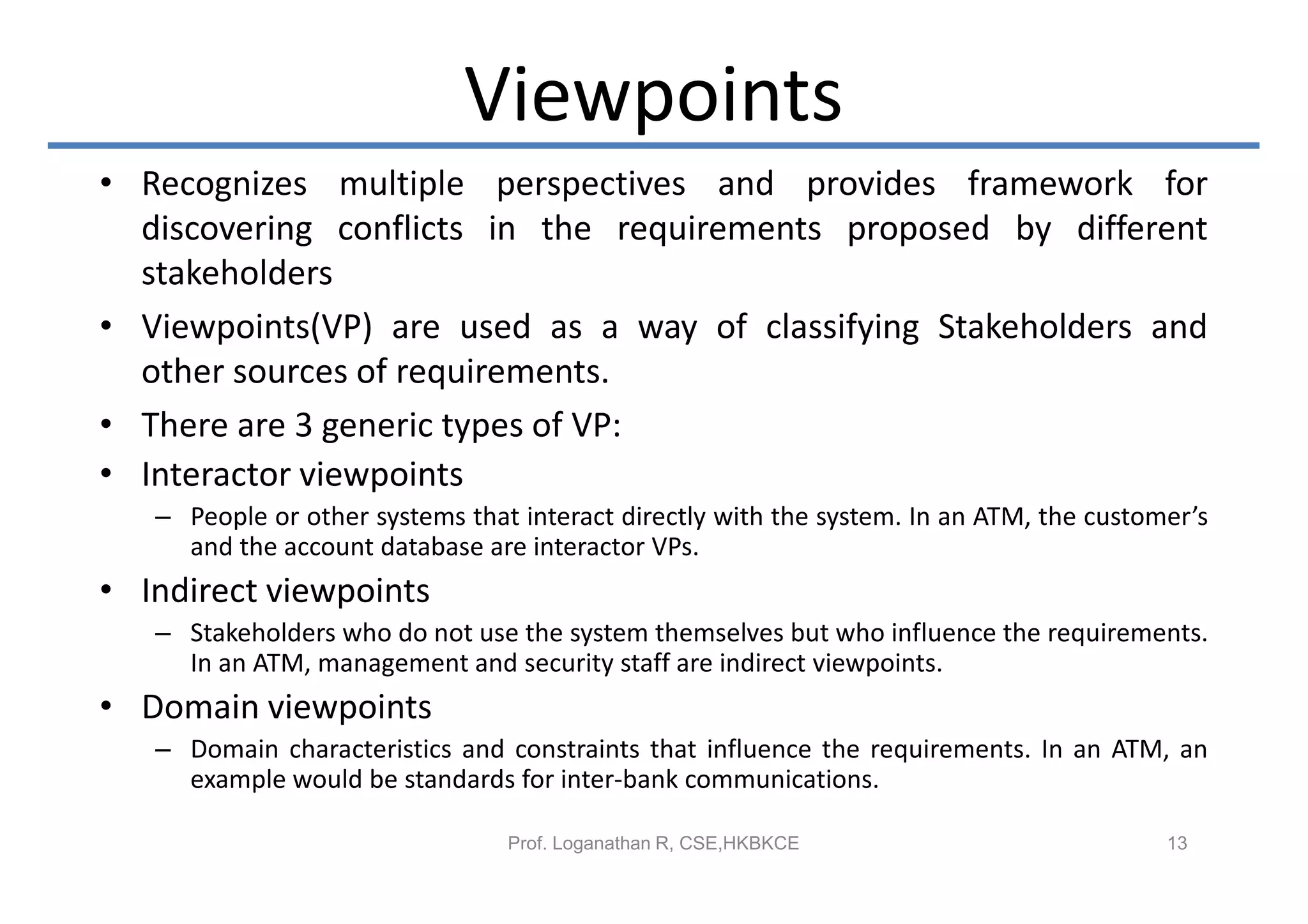
Viewpoints
• Recognizes multiple perspectives and provides framework for
  discovering conflicts in the requirements proposed by different
  stakeholders
• Viewpoints(VP) are used as a way of classifying Stakeholders and
  other sources of requirements.
• There are 3 generic types of VP:
• Interactor viewpoints
   – People or other systems that interact directly with the system. In an ATM, the customer’s
     and the account database are interactor VPs.
• Indirect viewpoints
   – Stakeholders who do not use the system themselves but who influence the requirements.
     In an ATM, management and security staff are indirect viewpoints.
• Domain viewpoints
   – Domain characteristics and constraints that influence the requirements. In an ATM, an
     example would be standards for inter-bank communications.

                                 Prof. Loganathan R, CSE,HKBKCE                           13
Viewpoint identification
• Identify viewpoints using following more specific VP
  types:
  – Providers and receivers of system services;
  – Systems that interact directly with the system being
    specified;
  – Regulations and standards that apply to the system;
  – Sources of business and non-functional requirements.
  – Engineers who have to develop and maintain the system;
  – Marketing and other business viewpoints.


                    Prof. Loganathan R, CSE,HKBKCE     14
LIBSYS viewpoint hierarchy
                                                  All VPs


          Indirect                             Interactor                    Domain


Library                 Article                           Library       UI       Classification
manager   Finance      providers            Users           staff    standards       system


                                                            System
            Students       Staff       External           managers   Cataloguers


                                   Prof. Loganathan R, CSE,HKBKCE                         15
Interviewing
• Used for getting an overall understanding of what
  stakeholders do, how they interact with system
  and difficulties they face with current system
• In formal or informal interviewing, the RE team
  puts questions to stakeholders about the system
  that they use and the system to be developed.
• There are two types of interview
  – Closed interviews where a pre-defined set of questions
    are answered.
  – Open interviews where there is no pre-defined agenda
    and a range of issues are explored with stakeholders.
                    Prof. Loganathan R, CSE,HKBKCE      16
Interviews in practice
• Normally a mix of closed and open-ended interviewing.
• Interviews are good for getting an overall understanding
  of what stakeholders do and how they might interact with
  the system.
• Interviews are not good for understanding domain
  requirements
   – Requirements engineers cannot understand specific domain
     terminology;
   – Some domain knowledge is so familiar that people find it hard
     to articulate or think that it isn’t worth articulating.


                       Prof. Loganathan R, CSE,HKBKCE           17
Effective interviewers Characteristics

• Interviewers should be open-minded, willing to
  listen to stakeholders and should not have pre-
  conceived ideas about the requirements.
• They should prompt the interviewee with a
  question or a proposal and should not simply
  expect them to respond to a question such as
  ‘what do you want’.


                 Prof. Loganathan R, CSE,HKBKCE   18
Scenarios
• Scenarios are real-life examples of how a system can
  be used.
• They should include
  – A description of what the system & user expect when the
    scenario starts;
  – A description of the normal flow of events in the scenario;
  – A description of what can go wrong and how this is
    handled;
  – Information about other concurrent activities;
  – A description of the state when the scenario finishes.

                      Prof. Loganathan R, CSE,HKBKCE         19
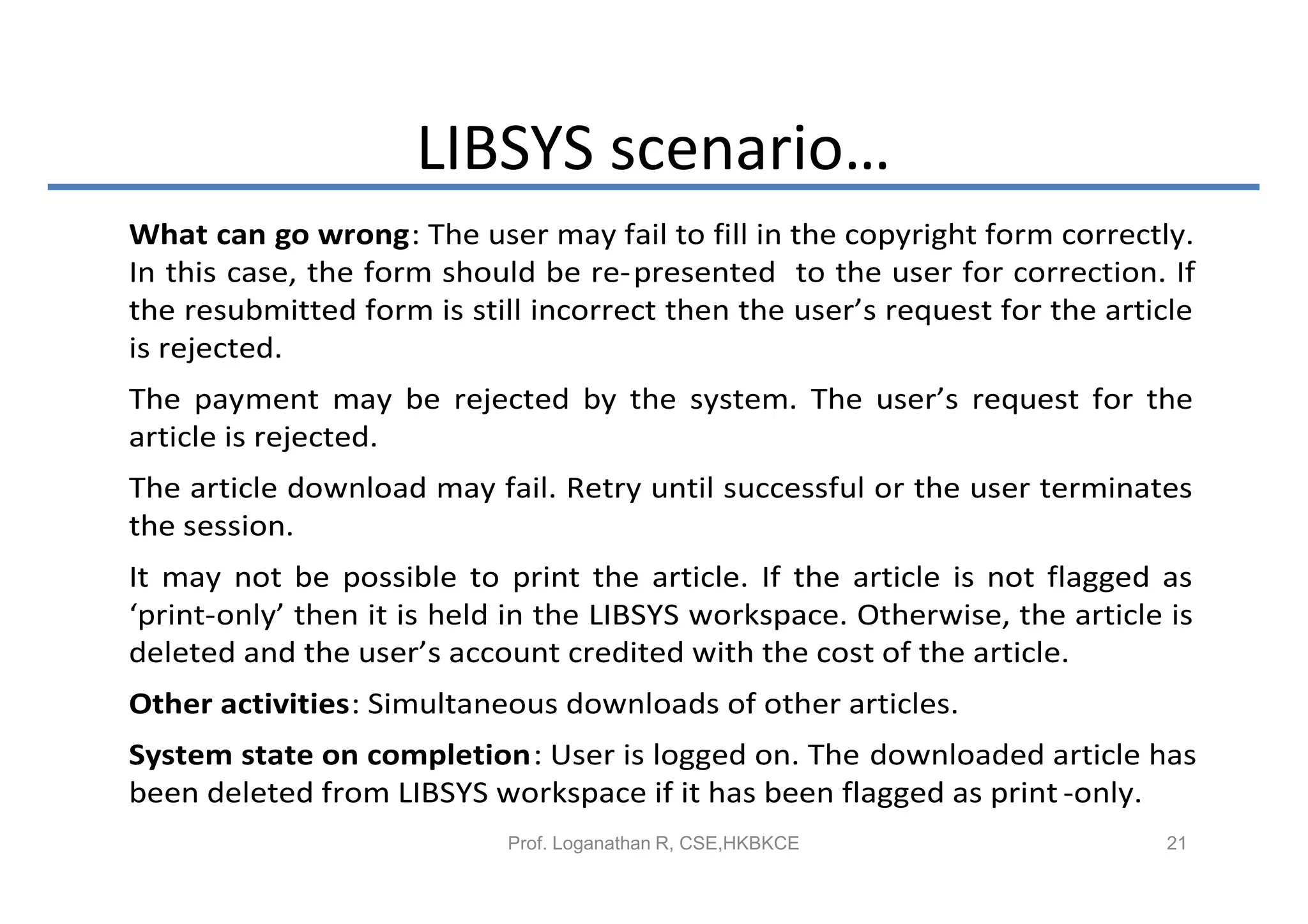
LIBSYS scenario…
Initial assumption: The user has logged on to the LIBSYS system and has
located the journal containing the copy of the article.
Normal: The user selects the article to be copied. He or she is then
prompted by the system to either provide subscriber information for the
journal or to indicate how they will pay for the article. Alternative payment
methods are by credit card or by quoting an organisational account
number.
The user is then asked to fill in a copyright form that maintains details of
the transaction and they then submit this to the LIBSYS system.
The copyright form is checked and, if OK, the PDF version of the article is
downloaded to the LIBSYS working area on the user’s computer and the
user is informed that it is available. The user is asked to select a printer and
a copy of the article is printed. If the article has been flagged as ‘print-only’
it is deleted from the user’s system once the user has confirmed that
printing is complete.
                            Prof. Loganathan R, CSE,HKBKCE                      20
LIBSYS scenario…
What can go wrong: The user may fail to fill in the copyright form correctly.
In this case, the form should be re-presented to the user for correction. If
the resubmitted form is still incorrect then the user’s request for the article
is rejected.
The payment may be rejected by the system. The user’s request for the
article is rejected.
The article download may fail. Retry until successful or the user terminates
the session.
It may not be possible to print the article. If the article is not flagged as
‘print-only’ then it is held in the LIBSYS workspace. Otherwise, the article is
deleted and the user’s account credited with the cost of the article.
Other activities: Simultaneous downloads of other articles.
System state on completion: User is logged on. The downloaded article has
been deleted from LIBSYS workspace if it has been flagged as print -only.
                            Prof. Loganathan R, CSE,HKBKCE                   21
Use cases
• Use-cases are a scenario based technique in the
  UML which identify the actors in an interaction
  and which describe the interaction itself.
• A set of use cases should describe all possible
  interactions with the system.
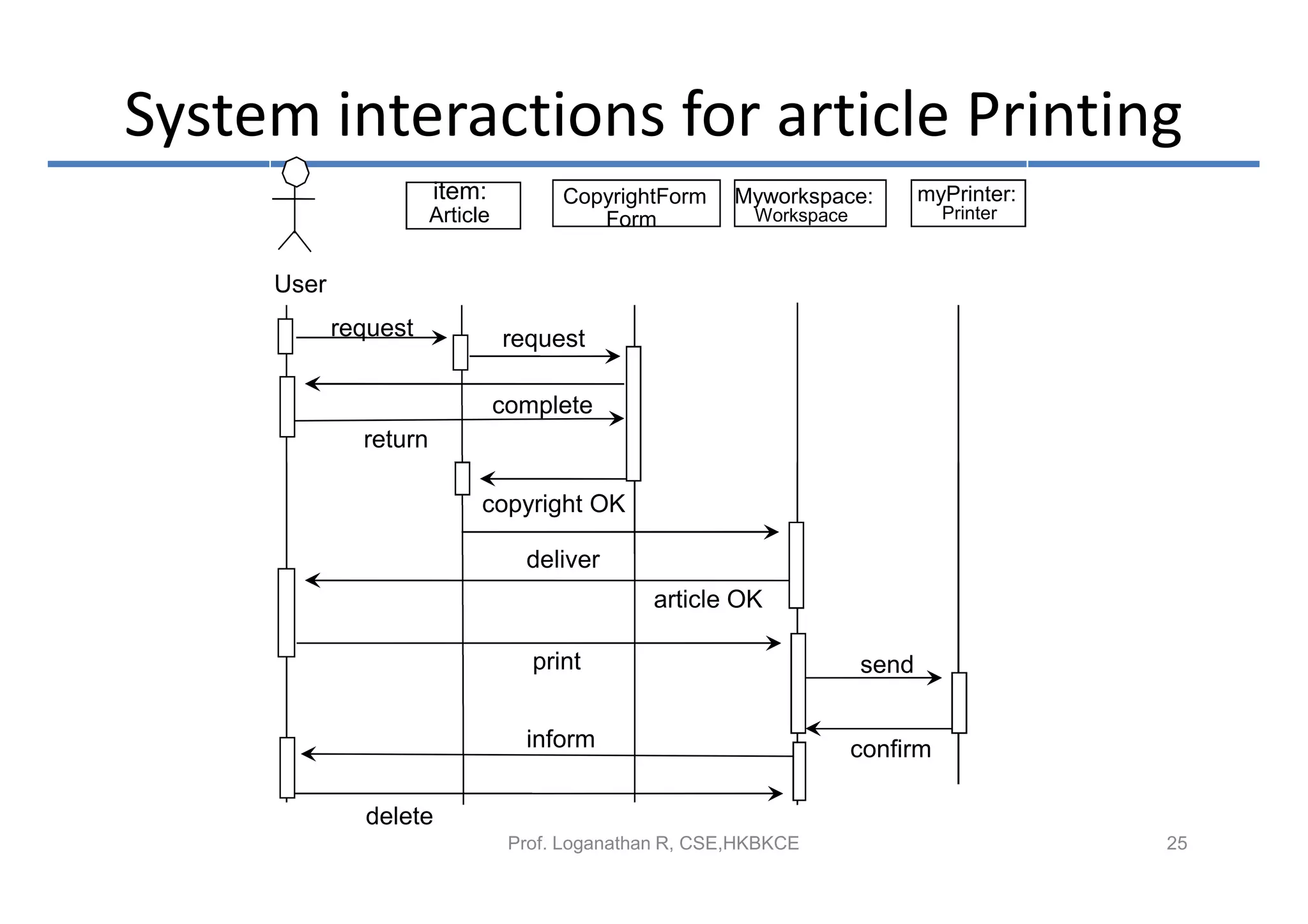
• Sequence diagrams may be used to add detail to
  use-cases by showing the sequence of event
  processing in the system.

                 Prof. Loganathan R, CSE,HKBKCE   22
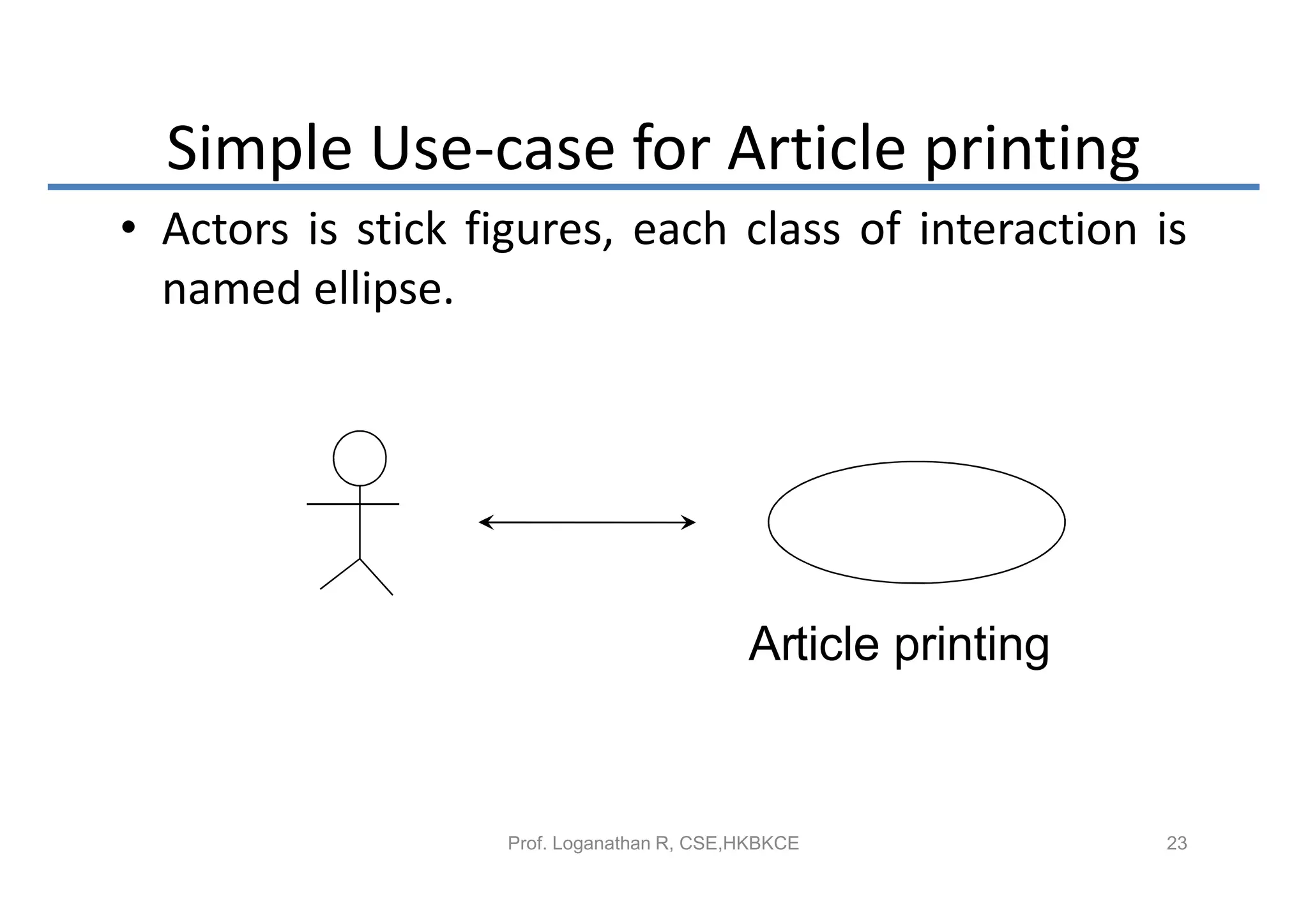
Simple Use-case for Article printing
• Actors is stick figures, each class of interaction is
  named ellipse.


                                           Article printing


                   Prof. Loganathan R, CSE,HKBKCE             23
Use cases for library system
                  Article search


   Library        Article printing
    User


              User administration              Library
                                                Staff


   Supplier       Catalogue services
              Prof. Loganathan R, CSE,HKBKCE             24
System interactions for article Printing
                       item:           CopyrightForm     Myworkspace:         myPrinter:
                       Article            Form             Workspace             Printer


     User
            request              request

                                 complete
              return

                             copyright OK

                                   deliver
                                                 article OK

                                    print                              send


                                   inform                              confirm

              delete
                                  Prof. Loganathan R, CSE,HKBKCE                           25
Ethnography
• Ethnography is an observational technique used to
  understand social and organisational requirements.
• A social scientists spends a considerable time observing
  and analysing how people actually work.
• People do not have to explain or articulate their work.
• Social and organisational factors of importance may be
  observed.
• Ethnographic studies have shown that work is usually
  richer and more complex than suggested by simple
  system models.

                     Prof. Loganathan R, CSE,HKBKCE     26
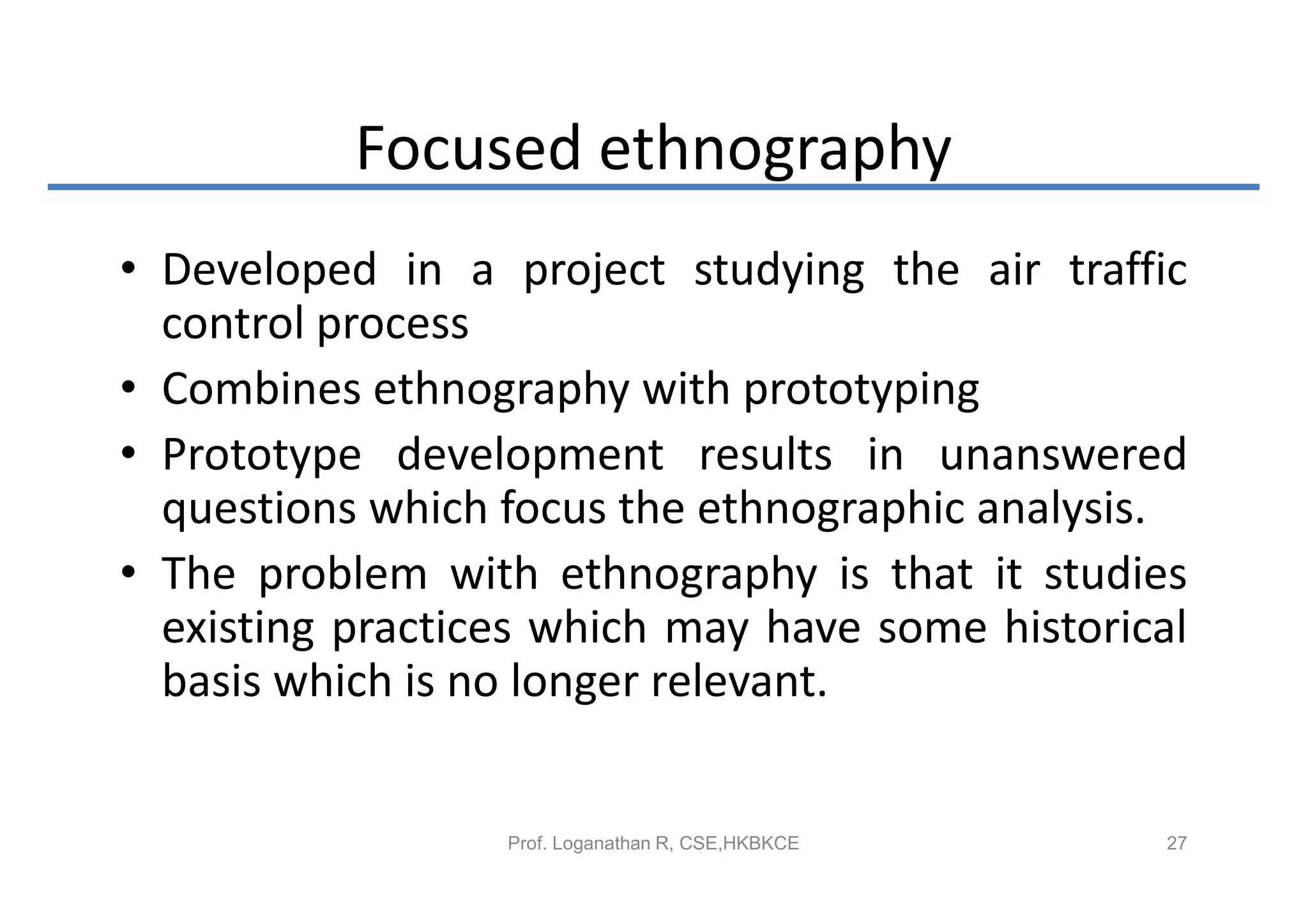
Focused ethnography
• Developed in a project studying the air traffic
  control process
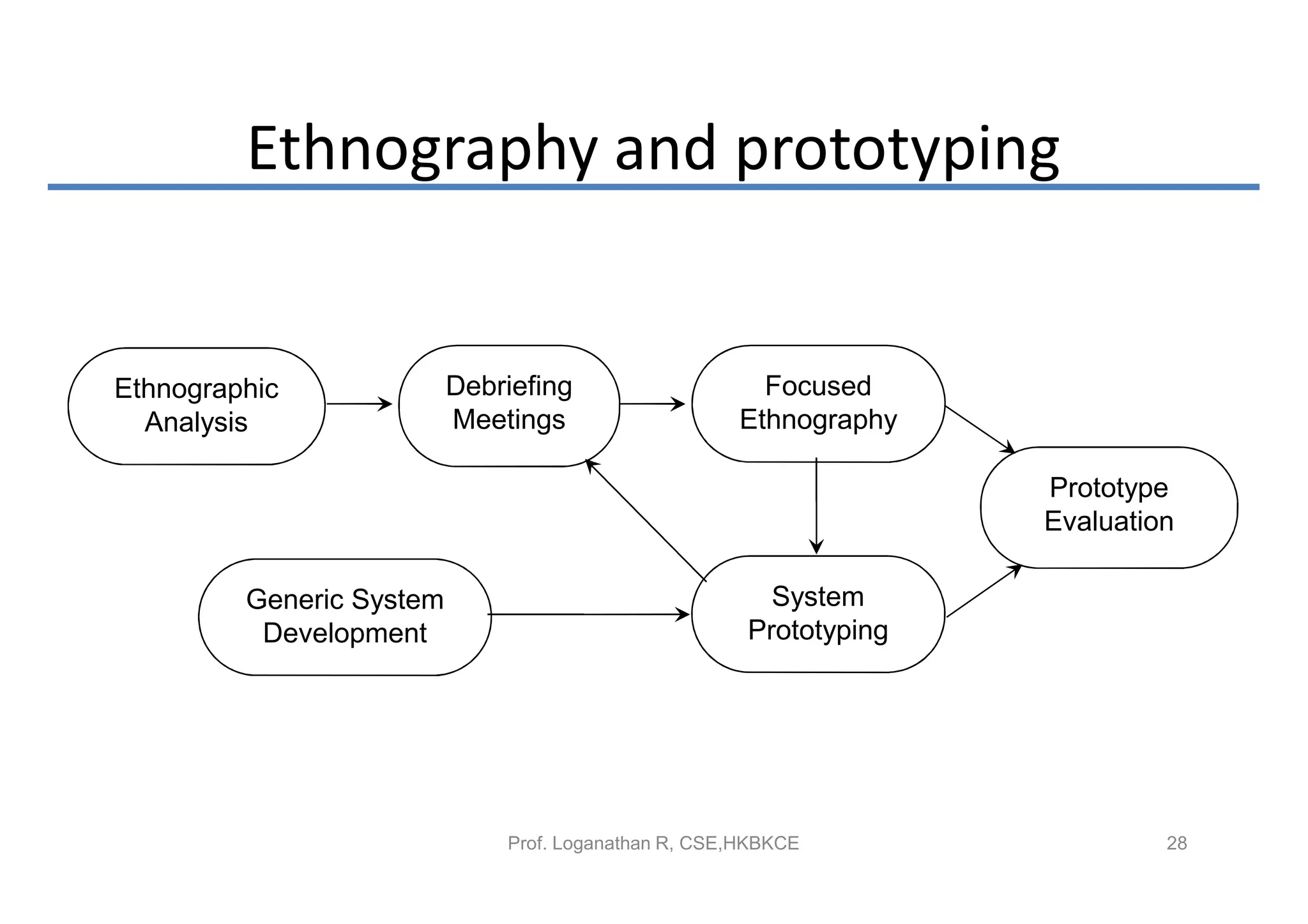
• Combines ethnography with prototyping
• Prototype development results in unanswered
  questions which focus the ethnographic analysis.
• The problem with ethnography is that it studies
  existing practices which may have some historical
  basis which is no longer relevant.


                  Prof. Loganathan R, CSE,HKBKCE   27
Ethnography and prototyping


Ethnographic              Debriefing                   Focused
  Analysis                Meetings                   Ethnography

                                                                    Prototype
                                                                    Evaluation

         Generic System                                 System
          Development                                 Prototyping


                              Prof. Loganathan R, CSE,HKBKCE                 28
Ethnography discovers 2 types of
           requirements
• Requirements that are derived from the way that
  people actually work rather than the way I which
  process definitions suggest that they ought to
  work.
• Requirements that are derived from cooperation
  and awareness of other people’s activities.


                  Prof. Loganathan R, CSE,HKBKCE   29
Requirements validation
• Concerned with demonstrating that the
  requirements define the system that the customer
  really wants.
• Requirements error costs are high so validation is
  very important
  – Fixing a requirements error after delivery may cost up
    to 100 times the cost of fixing an implementation error.


                     Prof. Loganathan R, CSE,HKBKCE       30
Requirements checking
• Validity: Does the system provide the functions which
  best support the customer’s needs?
• Consistency: Are there any requirements conflicts?
• Completeness: Are all functions required by the customer
  included?
• Realism: Can the requirements be implemented given
  available budget and technology
• Verifiability: Can the requirements be checked?


                     Prof. Loganathan R, CSE,HKBKCE     31
Requirements validation techniques
• Requirements reviews
  – Systematic manual analysis of the requirements.
• Prototyping
  – Using an executable model of the system to check
    requirements.
• Test-case generation
  – Developing tests for requirements to check testability.
  – If test is difficult or impossible to design for the
    requirement means it is difficult to implement that
    requirement
                     Prof. Loganathan R, CSE,HKBKCE           32
Requirements reviews
• Regular reviews should be held while the
  requirements definition is being formulated.
• Both client and contractor staff should be involved
  in reviews.
• Reviews may be formal (with completed
  documents) or informal. Good communications
  between developers, customers and users can
  resolve problems at an early stage.

                   Prof. Loganathan R, CSE,HKBKCE   33
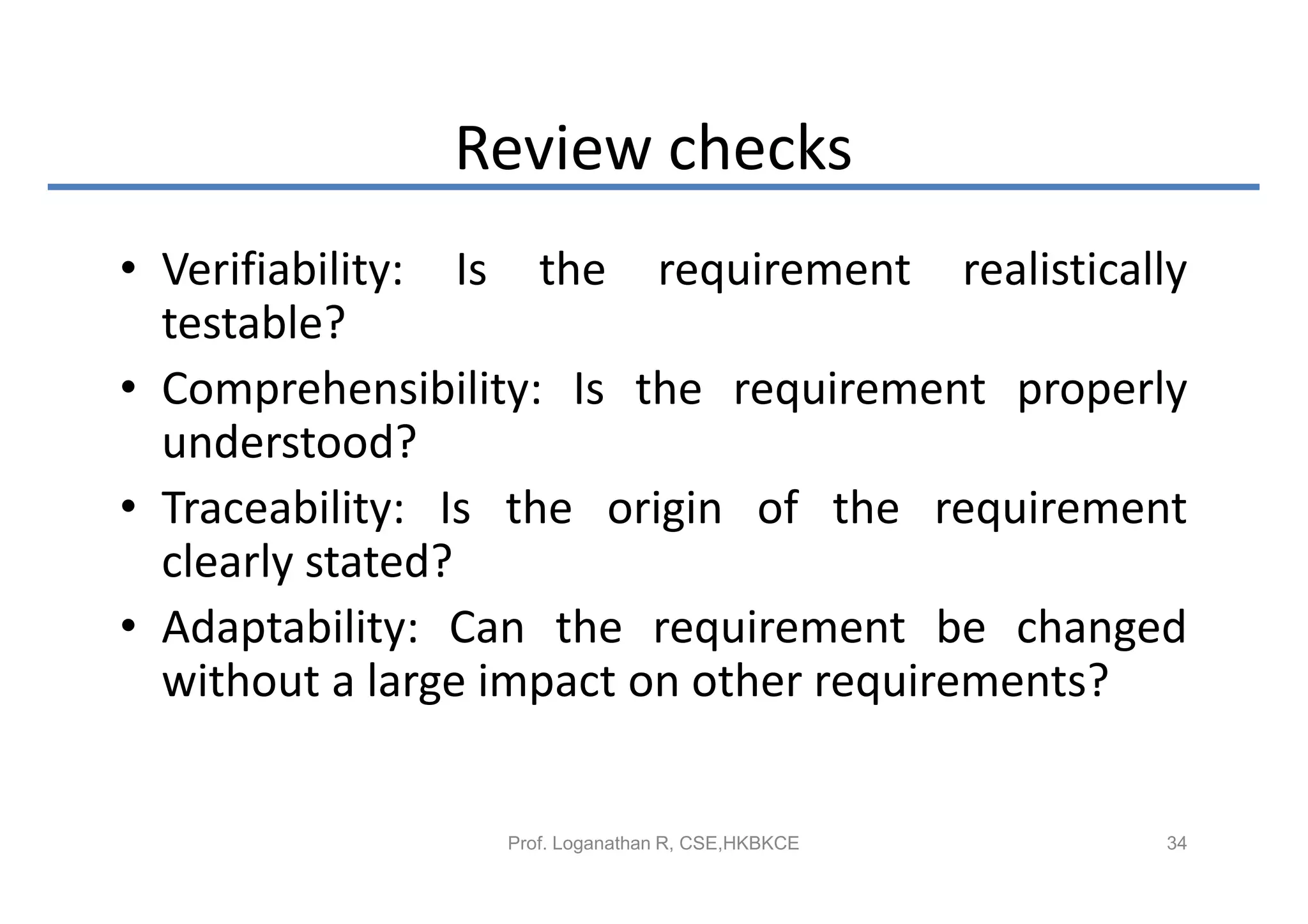
Review checks
• Verifiability: Is the requirement realistically
  testable?
• Comprehensibility: Is the requirement properly
  understood?
• Traceability: Is the origin of the requirement
  clearly stated?
• Adaptability: Can the requirement be changed
  without a large impact on other requirements?


                 Prof. Loganathan R, CSE,HKBKCE   34
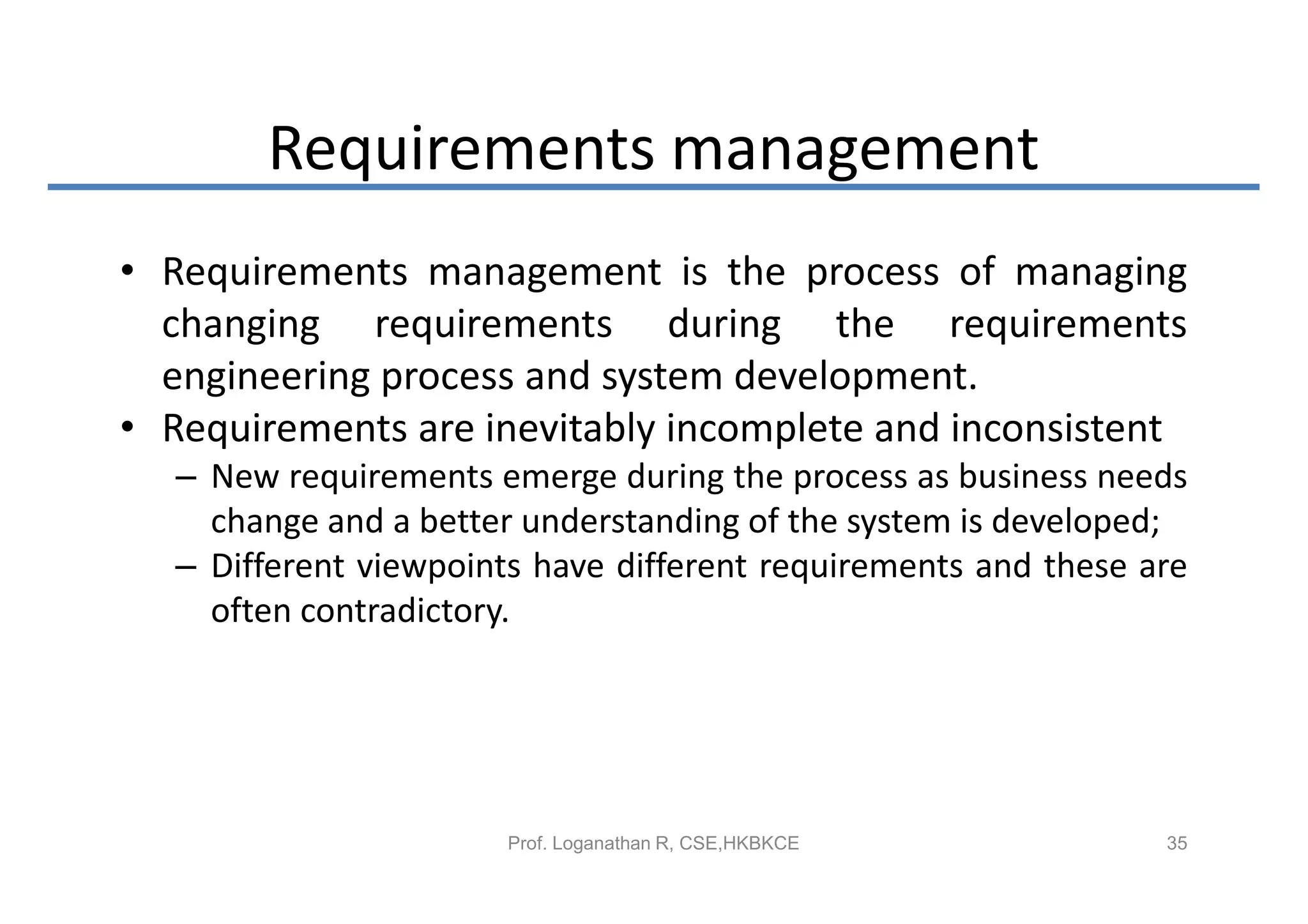
Requirements management
• Requirements management is the process of managing
  changing requirements during the requirements
  engineering process and system development.
• Requirements are inevitably incomplete and inconsistent
  – New requirements emerge during the process as business needs
    change and a better understanding of the system is developed;
  – Different viewpoints have different requirements and these are
    often contradictory.


                       Prof. Loganathan R, CSE,HKBKCE           35
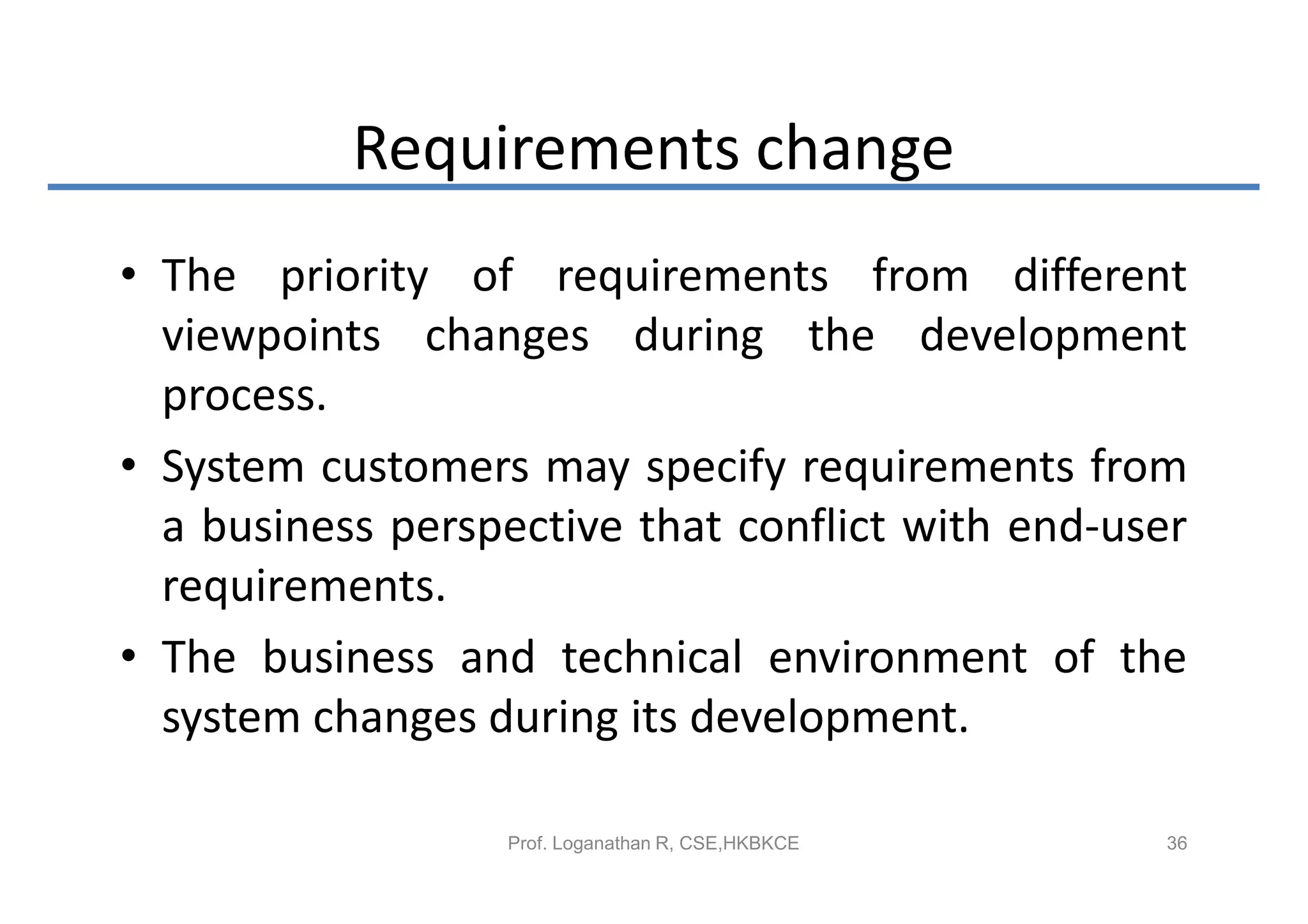
Requirements change
• The priority of requirements from different
  viewpoints changes during the development
  process.
• System customers may specify requirements from
  a business perspective that conflict with end-user
  requirements.
• The business and technical environment of the
  system changes during its development.

                  Prof. Loganathan R, CSE,HKBKCE   36
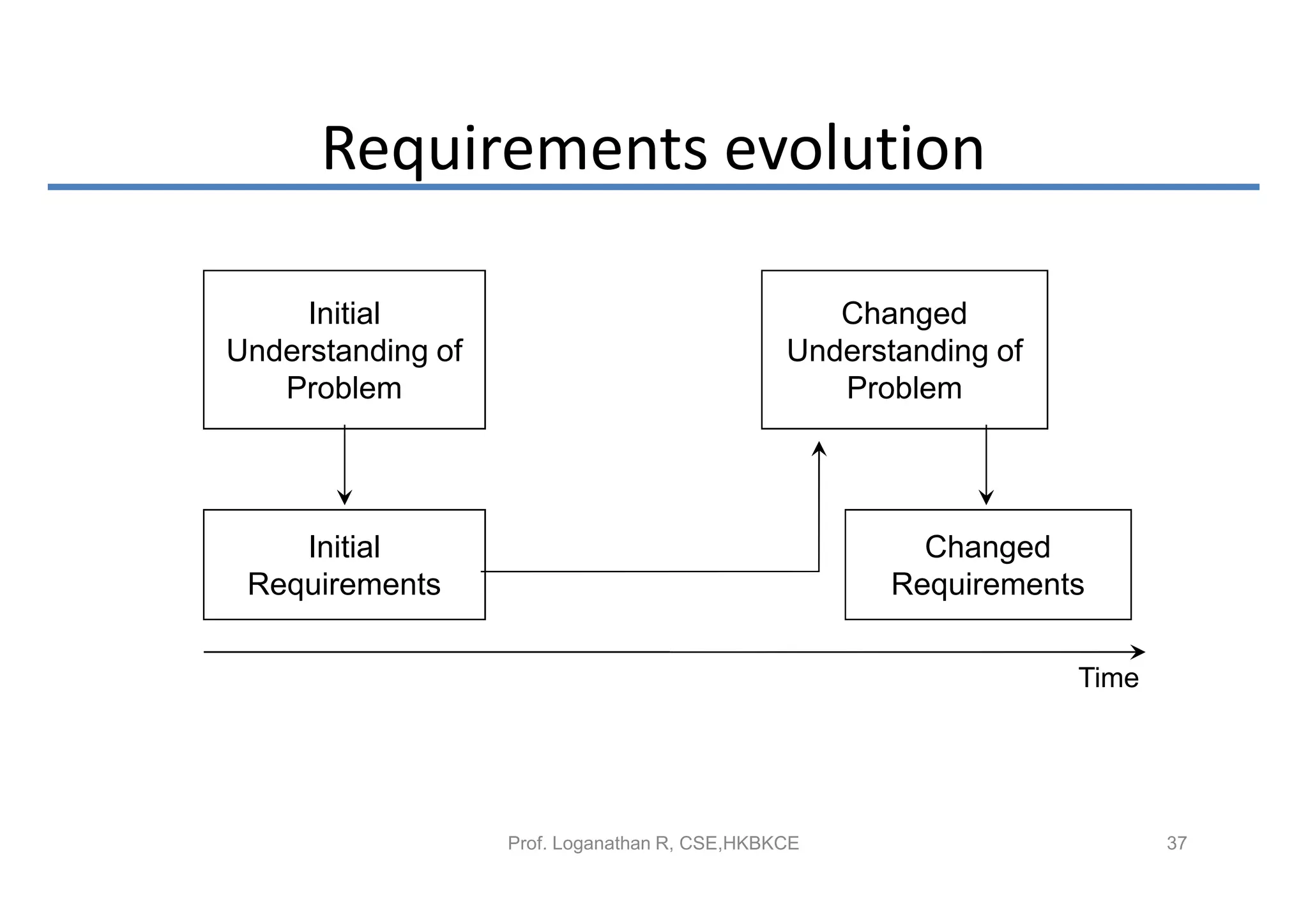
Requirements evolution

     Initial                                      Changed
Understanding of                               Understanding of
   Problem                                        Problem


    Initial                                             Changed
 Requirements                                         Requirements

                                                                  Time


                   Prof. Loganathan R, CSE,HKBKCE                        37
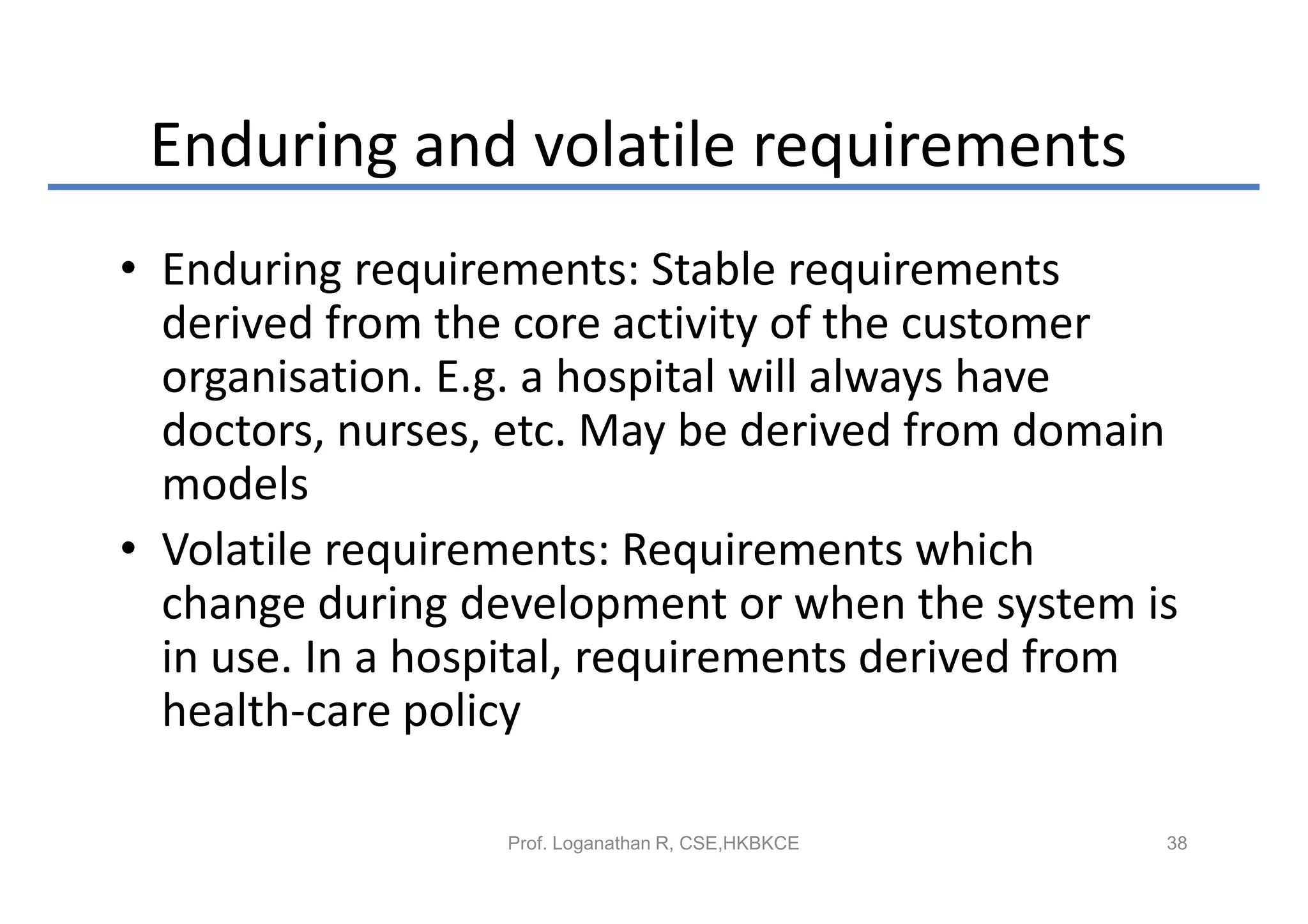
Enduring and volatile requirements
• Enduring requirements: Stable requirements
  derived from the core activity of the customer
  organisation. E.g. a hospital will always have
  doctors, nurses, etc. May be derived from domain
  models
• Volatile requirements: Requirements which
  change during development or when the system is
  in use. In a hospital, requirements derived from
  health-care policy

                  Prof. Loganathan R, CSE,HKBKCE   38
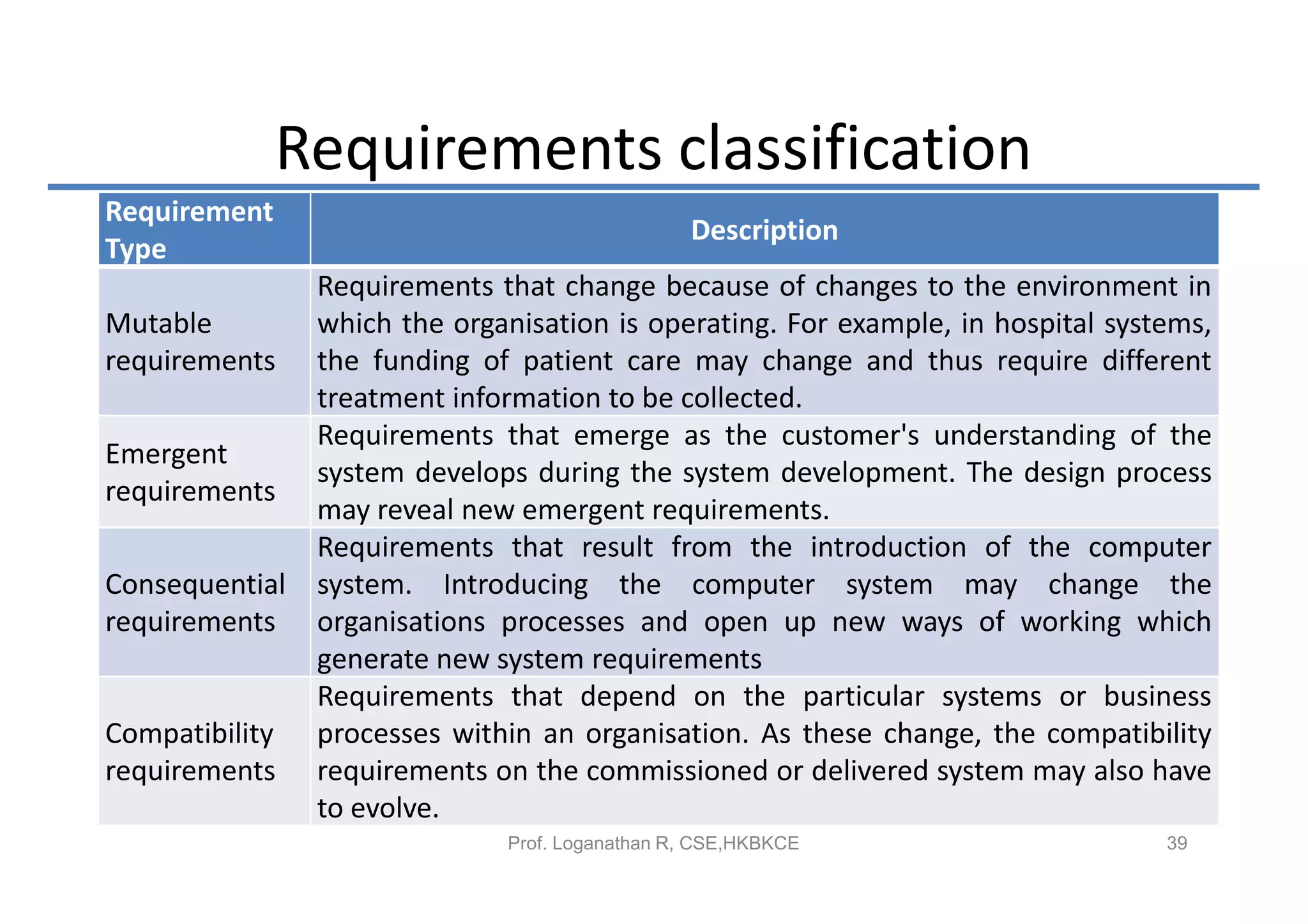
Requirements classification
Requirement
                                                Description
Type
                Requirements that change because of changes to the environment in
Mutable         which the organisation is operating. For example, in hospital systems,
requirements    the funding of patient care may change and thus require different
                treatment information to be collected.
                Requirements that emerge as the customer's understanding of the
Emergent
                system develops during the system development. The design process
requirements
                may reveal new emergent requirements.
                Requirements that result from the introduction of the computer
Consequential   system. Introducing the computer system may change the
requirements    organisations processes and open up new ways of working which
                generate new system requirements
                Requirements that depend on the particular systems or business
Compatibility   processes within an organisation. As these change, the compatibility
requirements    requirements on the commissioned or delivered system may also have
                to evolve.
                              Prof. Loganathan R, CSE,HKBKCE                      39
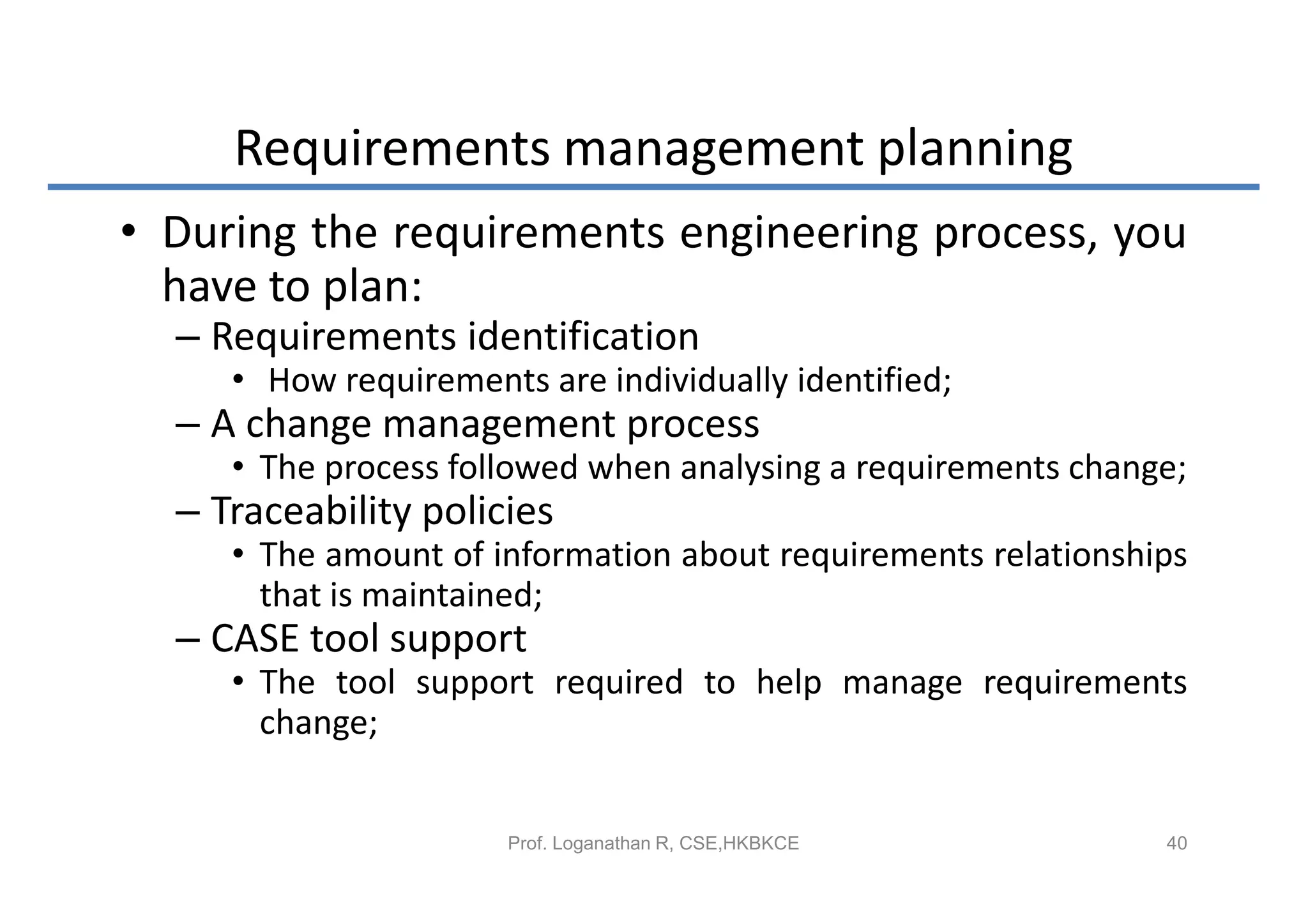
Requirements management planning
• During the requirements engineering process, you
  have to plan:
  – Requirements identification
     • How requirements are individually identified;
  – A change management process
     • The process followed when analysing a requirements change;
  – Traceability policies
     • The amount of information about requirements relationships
       that is maintained;
  – CASE tool support
     • The tool support required to help manage requirements
       change;


                       Prof. Loganathan R, CSE,HKBKCE          40
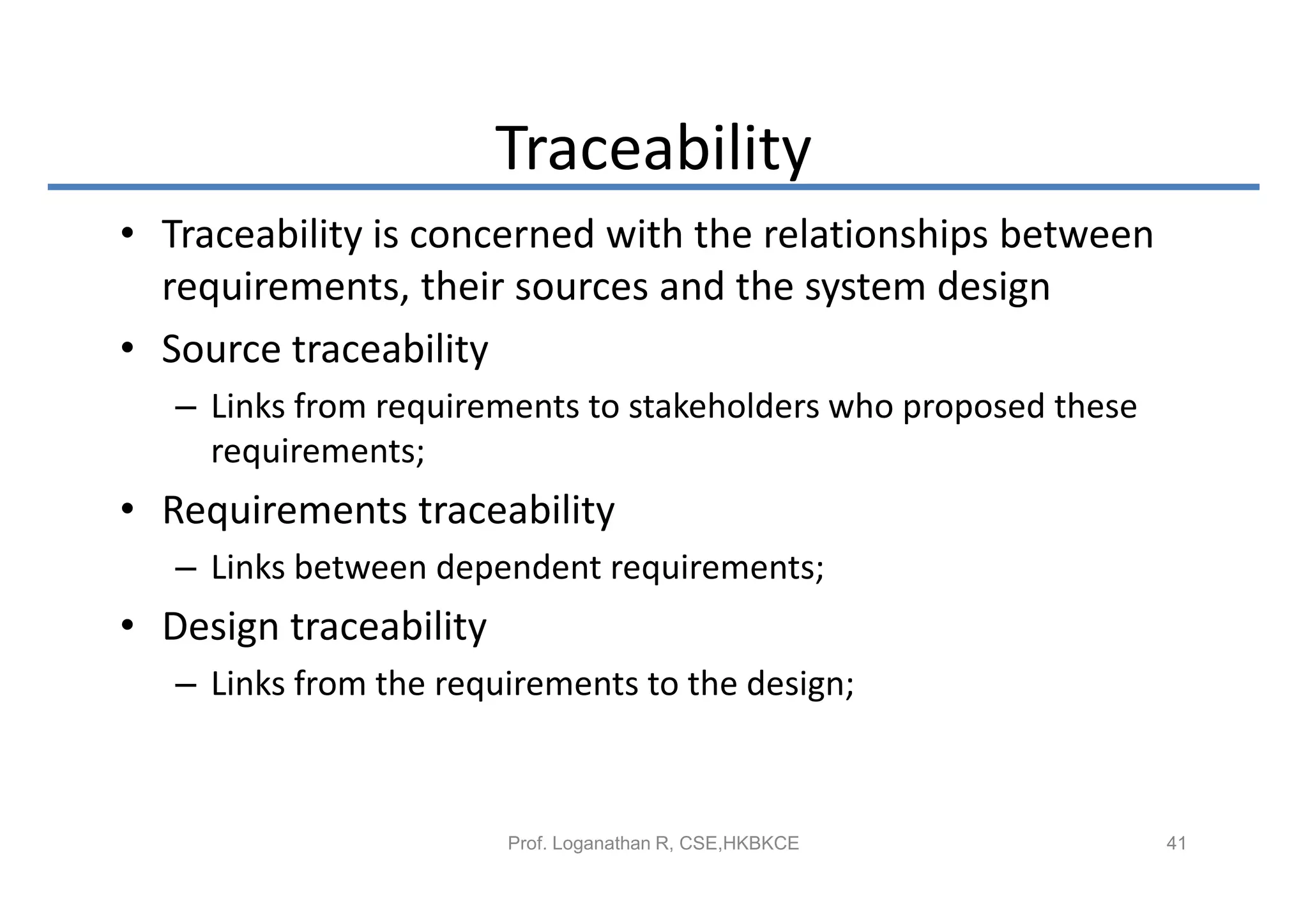
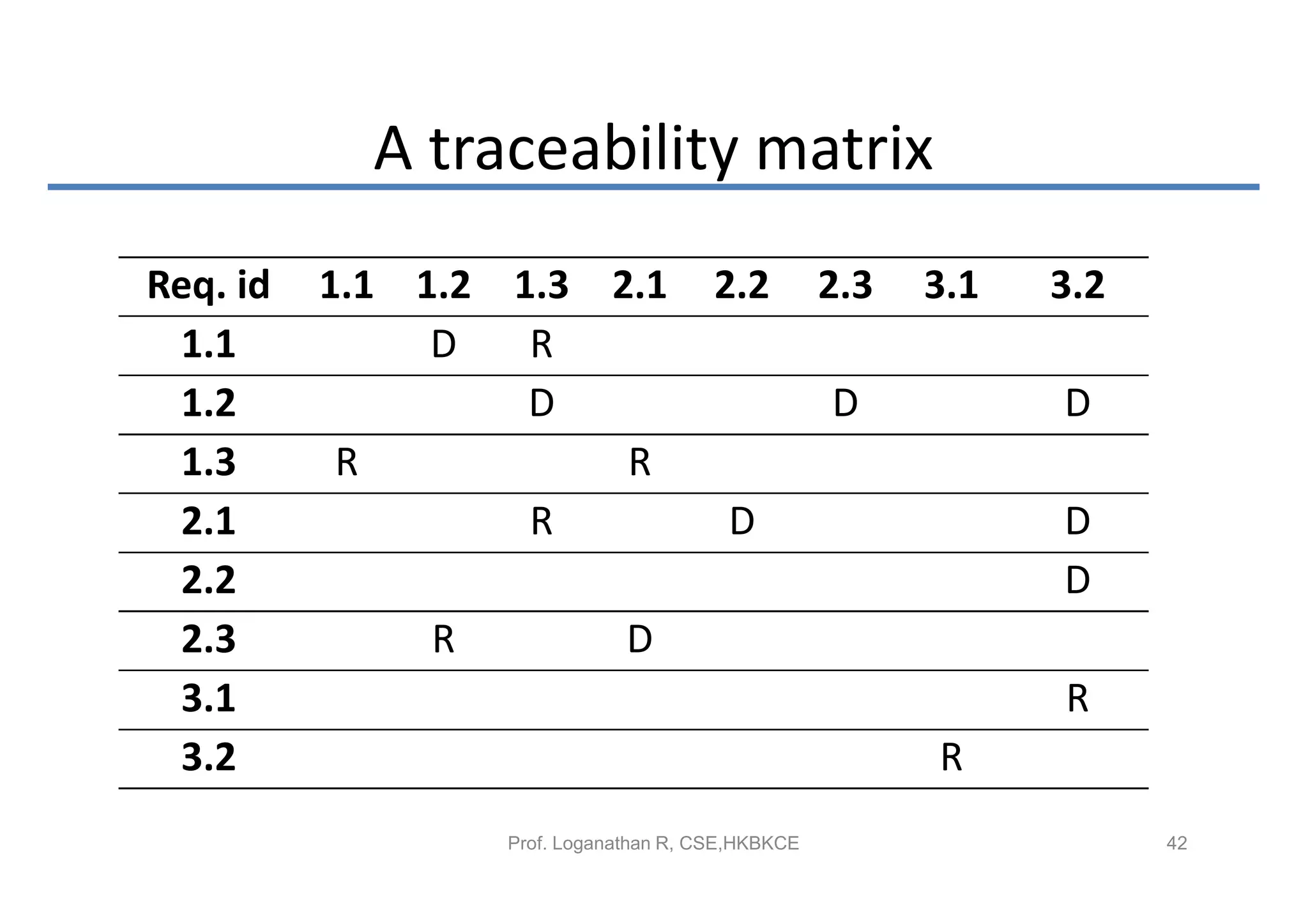
Traceability
• Traceability is concerned with the relationships between
  requirements, their sources and the system design
• Source traceability
   – Links from requirements to stakeholders who proposed these
     requirements;
• Requirements traceability
   – Links between dependent requirements;
• Design traceability
   – Links from the requirements to the design;


                        Prof. Loganathan R, CSE,HKBKCE            41
A traceability matrix
Req. id   1.1 1.2 1.3 2.1              2.2         2.3   3.1   3.2
 1.1           D   R
 1.2               D                               D           D
 1.3       R           R
 2.1               R                    D                      D
 2.2                                                           D
 2.3          R               D
 3.1                                                           R
 3.2                                                     R
                  Prof. Loganathan R, CSE,HKBKCE                     42
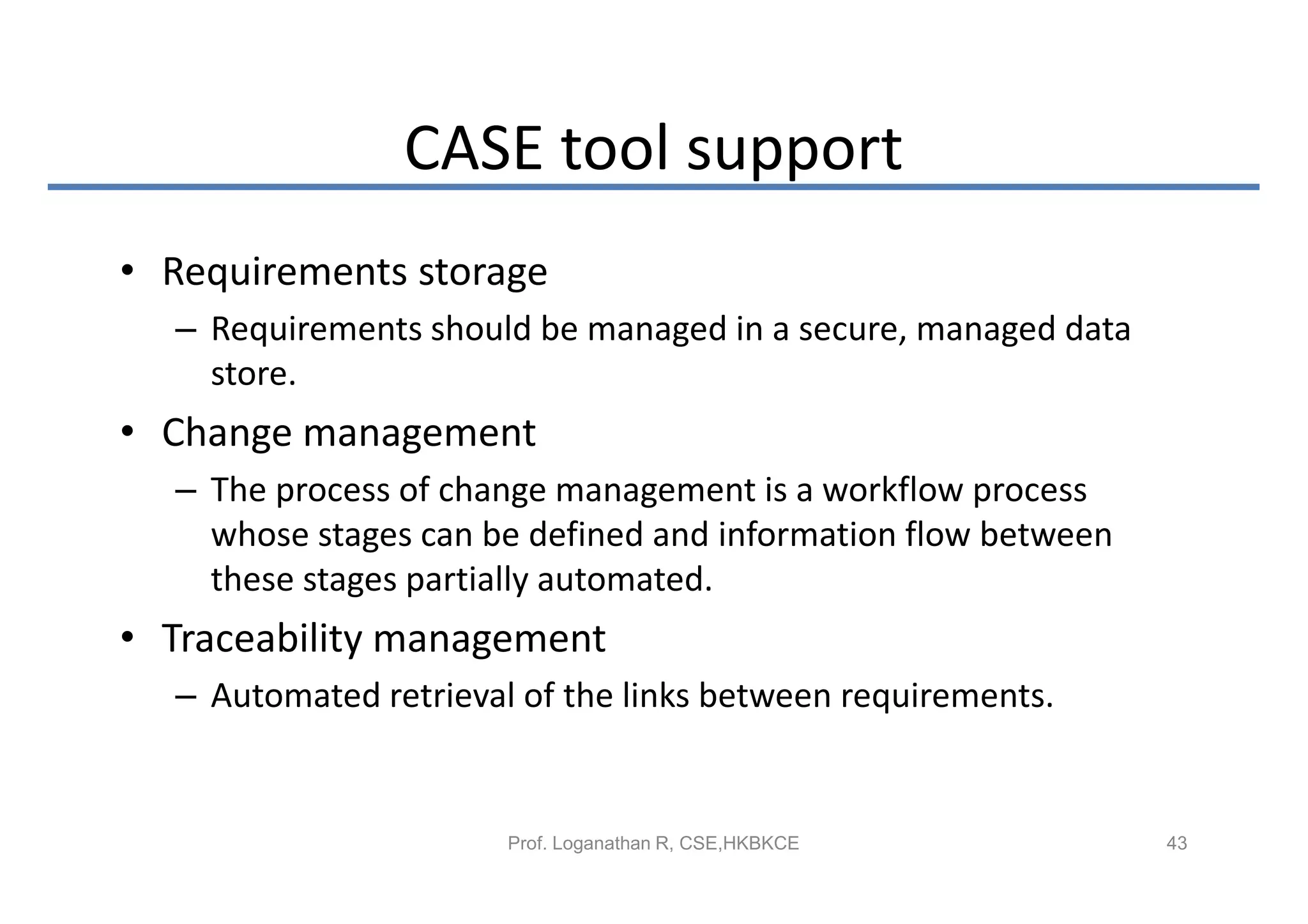
CASE tool support
• Requirements storage
  – Requirements should be managed in a secure, managed data
    store.
• Change management
  – The process of change management is a workflow process
    whose stages can be defined and information flow between
    these stages partially automated.
• Traceability management
  – Automated retrieval of the links between requirements.


                       Prof. Loganathan R, CSE,HKBKCE          43
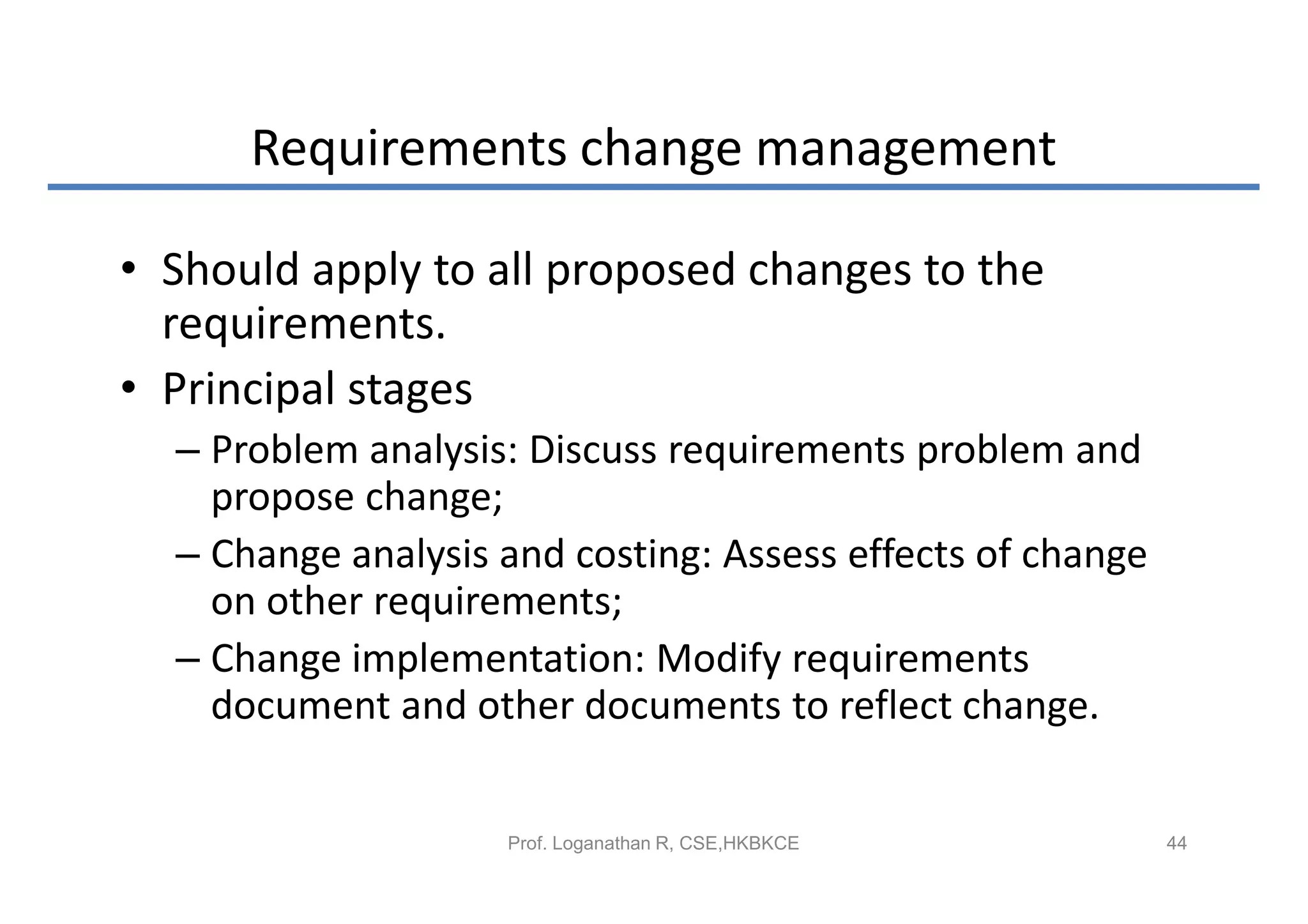
Requirements change management

• Should apply to all proposed changes to the
  requirements.
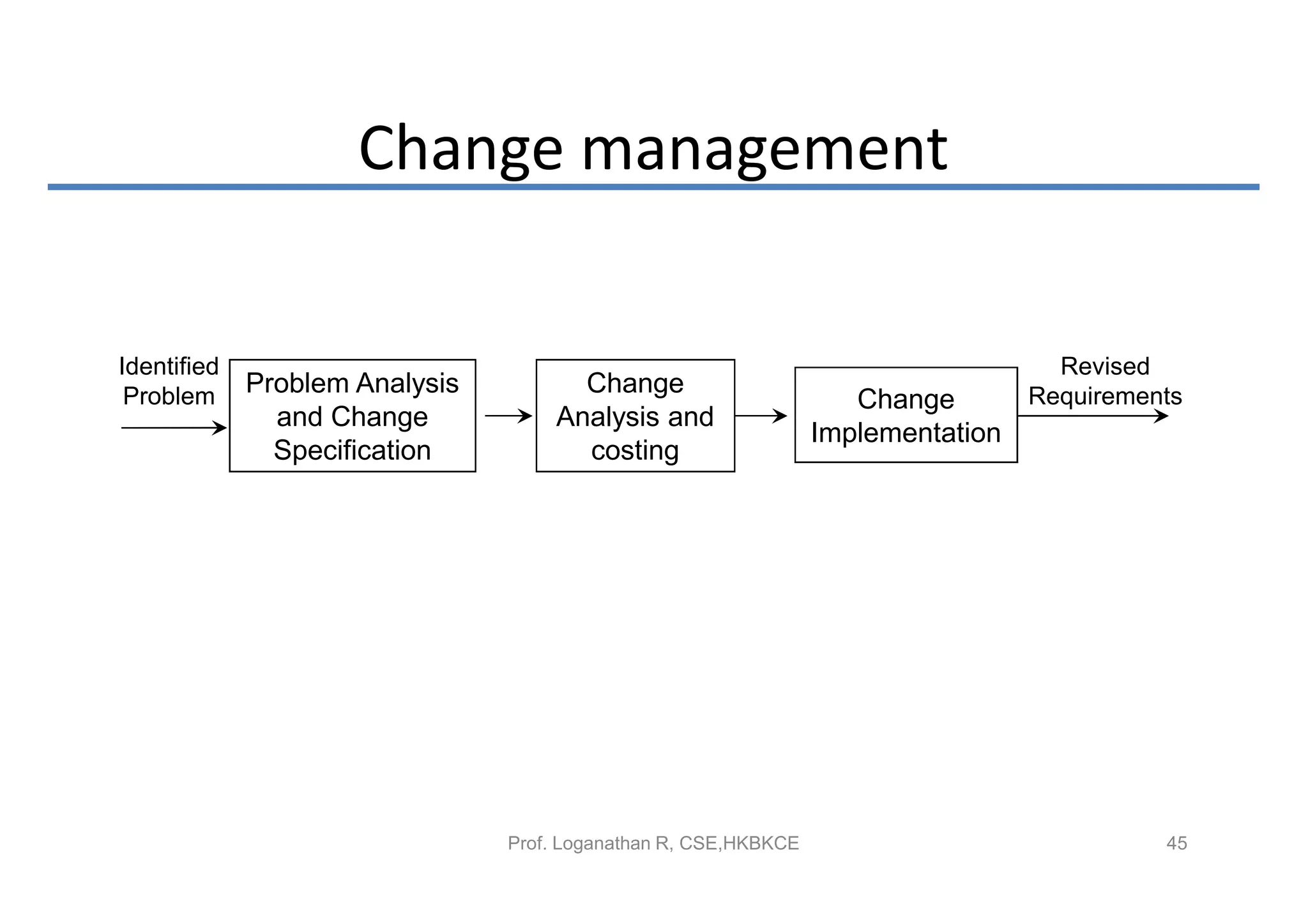
• Principal stages
  – Problem analysis: Discuss requirements problem and
    propose change;
  – Change analysis and costing: Assess effects of change
    on other requirements;
  – Change implementation: Modify requirements
    document and other documents to reflect change.


                    Prof. Loganathan R, CSE,HKBKCE          44
Change management


Identified                                                                          Revised
 Problem     Problem Analysis         Change                                      Requirements
                                                                    Change
               and Change           Analysis and
                                                                 Implementation
               Specification          costing


                                Prof. Loganathan R, CSE,HKBKCE                              45

Requirement engineering process

  • 1.
  • 2.
    Objectives • To describethe principal requirements engineering activities and their relationships • To introduce techniques for requirements elicitation and analysis • To describe requirements validation and the role of requirements reviews • To discuss the role of requirements management in support of other requirements engineering processes Prof. Loganathan R, CSE,HKBKCE 2
  • 3.
    Requirements engineering processes •The goal of RE Process is to create & maintain a system requirements documents. • Includes 4 High level RE Sub-processes: – Feasibility study : usefulness to the business ; – Elicitation and analysis : discovering requirements; – Specification: conversion of requirement into some standard form; – Validation : check the requirements which defines the system that the customer wants; Prof. Loganathan R, CSE,HKBKCE 3
  • 4.
    The requirements engineeringprocess Requirements Feasibility Elicitation and Study Analysis Requirements Specification Feasibility Requirements Report Validation System Models User and System Requirements Requirements Document Prof. Loganathan R, CSE,HKBKCE 4
  • 5.
    Alternative perspective ofRE Process Spiral Model of RE Process Requirements specification System requirements specification and modeling User requirements specification Business requirements specification System requirements Feasibility User study elicitation requirements elicitation Prototyping Requirements elicitation Requirements Reviews validation System requirements document Prof. Loganathan R, CSE,HKBKCE 5
  • 6.
    Feasibility studies • Afeasibility study decides whether or not the proposed system is worthwhile. • A short focused study that checks – If the system contributes to organisational objectives; – If the system can be implemented using current technology, within given cost and schedule constraints; – If the system can be integrated with other systems that are already in place. Prof. Loganathan R, CSE,HKBKCE 6
  • 7.
    Feasibility study implementation •Feasibility study involves information assessment (what is required), information collection and report writing. • Questions for people in the organisation for information assessment and collection: – What if the system wasn’t implemented? – What are current process problems? – How will the proposed system help? – What will be the integration problems? – Is new technology needed? What skills? – What facilities must be supported by the proposed system? • Feasibility study report should make a recommendation about the development to continue or not. Prof. Loganathan R, CSE,HKBKCE 7
  • 8.
    Requirements elicitation andanalysis • Involves technical staff working with customers to find out about the application domain, the services that the system should provide and the system’s operational constraints. • May involve end-users, managers, engineers involved in maintenance, domain experts, trade unions, etc. These are called stakeholders. • Eliciting & understanding stakeholder requirement is difficult due to the following reasons: • Stakeholders don’t know what they really want except in most general. • Stakeholders express requirements in their own terms. • Different stakeholders may have deferent requirements. • Organisational and political factors may influence the system requirements. • The requirements change during the analysis process. New stakeholders may emerge and the business environment change. Prof. Loganathan R, CSE,HKBKCE 8
  • 9.
    E&A Process activities •Requirements discovery – Interacting with stakeholders to discover their requirements. Domain requirements are also discovered at this stage. • Requirements classification and organisation – Group related requirements and organises them into coherent clusters. • Prioritisation and negotiation – Prioritising requirements and finding and resolving requirements conflicts. • Requirements documentation – Requirements are documented and input into the next round of the spiral. Prof. Loganathan R, CSE,HKBKCE 9
  • 10.
    The requirements elicitation& analysis Process Requirements Requirements Prioritization & Classification & negotiation Organization Requirements Requirements Documentation Discovery Prof. Loganathan R, CSE,HKBKCE 10
  • 11.
    Requirements discovery • Theprocess of gathering information about the proposed and existing systems and distilling the user and system requirements from this information. • Sources of information include documentation, system stakeholders and the specifications of similar systems. • Approaches & Techniques of requirements discovery are: – Viewpoints(approach) – Interviewing – Scenario – Use-cases – ethnography Prof. Loganathan R, CSE,HKBKCE 11
  • 12.
    Example : ATMstakeholders • Bank customers – who receive services • Representatives of other banks – who have reciprocal agreements for ATM usage • Bank branch managers –who obtain management information • Counter staff – who involved in day-to-day running of system • Database administrators - who responsible for integrating system with customers database • Bank Security managers • The Bank’s Marketing department • Hardware and software maintenance engineers • Banking regulators Who ensures system conforms to banking regulations Prof. Loganathan R, CSE,HKBKCE 12
  • 13.
    Viewpoints • Recognizes multipleperspectives and provides framework for discovering conflicts in the requirements proposed by different stakeholders • Viewpoints(VP) are used as a way of classifying Stakeholders and other sources of requirements. • There are 3 generic types of VP: • Interactor viewpoints – People or other systems that interact directly with the system. In an ATM, the customer’s and the account database are interactor VPs. • Indirect viewpoints – Stakeholders who do not use the system themselves but who influence the requirements. In an ATM, management and security staff are indirect viewpoints. • Domain viewpoints – Domain characteristics and constraints that influence the requirements. In an ATM, an example would be standards for inter-bank communications. Prof. Loganathan R, CSE,HKBKCE 13
  • 14.
    Viewpoint identification • Identifyviewpoints using following more specific VP types: – Providers and receivers of system services; – Systems that interact directly with the system being specified; – Regulations and standards that apply to the system; – Sources of business and non-functional requirements. – Engineers who have to develop and maintain the system; – Marketing and other business viewpoints. Prof. Loganathan R, CSE,HKBKCE 14
  • 15.
    LIBSYS viewpoint hierarchy All VPs Indirect Interactor Domain Library Article Library UI Classification manager Finance providers Users staff standards system System Students Staff External managers Cataloguers Prof. Loganathan R, CSE,HKBKCE 15
  • 16.
    Interviewing • Used forgetting an overall understanding of what stakeholders do, how they interact with system and difficulties they face with current system • In formal or informal interviewing, the RE team puts questions to stakeholders about the system that they use and the system to be developed. • There are two types of interview – Closed interviews where a pre-defined set of questions are answered. – Open interviews where there is no pre-defined agenda and a range of issues are explored with stakeholders. Prof. Loganathan R, CSE,HKBKCE 16
  • 17.
    Interviews in practice •Normally a mix of closed and open-ended interviewing. • Interviews are good for getting an overall understanding of what stakeholders do and how they might interact with the system. • Interviews are not good for understanding domain requirements – Requirements engineers cannot understand specific domain terminology; – Some domain knowledge is so familiar that people find it hard to articulate or think that it isn’t worth articulating. Prof. Loganathan R, CSE,HKBKCE 17
  • 18.
    Effective interviewers Characteristics •Interviewers should be open-minded, willing to listen to stakeholders and should not have pre- conceived ideas about the requirements. • They should prompt the interviewee with a question or a proposal and should not simply expect them to respond to a question such as ‘what do you want’. Prof. Loganathan R, CSE,HKBKCE 18
  • 19.
    Scenarios • Scenarios arereal-life examples of how a system can be used. • They should include – A description of what the system & user expect when the scenario starts; – A description of the normal flow of events in the scenario; – A description of what can go wrong and how this is handled; – Information about other concurrent activities; – A description of the state when the scenario finishes. Prof. Loganathan R, CSE,HKBKCE 19
  • 20.
    LIBSYS scenario… Initial assumption:The user has logged on to the LIBSYS system and has located the journal containing the copy of the article. Normal: The user selects the article to be copied. He or she is then prompted by the system to either provide subscriber information for the journal or to indicate how they will pay for the article. Alternative payment methods are by credit card or by quoting an organisational account number. The user is then asked to fill in a copyright form that maintains details of the transaction and they then submit this to the LIBSYS system. The copyright form is checked and, if OK, the PDF version of the article is downloaded to the LIBSYS working area on the user’s computer and the user is informed that it is available. The user is asked to select a printer and a copy of the article is printed. If the article has been flagged as ‘print-only’ it is deleted from the user’s system once the user has confirmed that printing is complete. Prof. Loganathan R, CSE,HKBKCE 20
  • 21.
    LIBSYS scenario… What cango wrong: The user may fail to fill in the copyright form correctly. In this case, the form should be re-presented to the user for correction. If the resubmitted form is still incorrect then the user’s request for the article is rejected. The payment may be rejected by the system. The user’s request for the article is rejected. The article download may fail. Retry until successful or the user terminates the session. It may not be possible to print the article. If the article is not flagged as ‘print-only’ then it is held in the LIBSYS workspace. Otherwise, the article is deleted and the user’s account credited with the cost of the article. Other activities: Simultaneous downloads of other articles. System state on completion: User is logged on. The downloaded article has been deleted from LIBSYS workspace if it has been flagged as print -only. Prof. Loganathan R, CSE,HKBKCE 21
  • 22.
    Use cases • Use-casesare a scenario based technique in the UML which identify the actors in an interaction and which describe the interaction itself. • A set of use cases should describe all possible interactions with the system. • Sequence diagrams may be used to add detail to use-cases by showing the sequence of event processing in the system. Prof. Loganathan R, CSE,HKBKCE 22
  • 23.
    Simple Use-case forArticle printing • Actors is stick figures, each class of interaction is named ellipse. Article printing Prof. Loganathan R, CSE,HKBKCE 23
  • 24.
    Use cases forlibrary system Article search Library Article printing User User administration Library Staff Supplier Catalogue services Prof. Loganathan R, CSE,HKBKCE 24
  • 25.
    System interactions forarticle Printing item: CopyrightForm Myworkspace: myPrinter: Article Form Workspace Printer User request request complete return copyright OK deliver article OK print send inform confirm delete Prof. Loganathan R, CSE,HKBKCE 25
  • 26.
    Ethnography • Ethnography isan observational technique used to understand social and organisational requirements. • A social scientists spends a considerable time observing and analysing how people actually work. • People do not have to explain or articulate their work. • Social and organisational factors of importance may be observed. • Ethnographic studies have shown that work is usually richer and more complex than suggested by simple system models. Prof. Loganathan R, CSE,HKBKCE 26
  • 27.
    Focused ethnography • Developedin a project studying the air traffic control process • Combines ethnography with prototyping • Prototype development results in unanswered questions which focus the ethnographic analysis. • The problem with ethnography is that it studies existing practices which may have some historical basis which is no longer relevant. Prof. Loganathan R, CSE,HKBKCE 27
  • 28.
    Ethnography and prototyping Ethnographic Debriefing Focused Analysis Meetings Ethnography Prototype Evaluation Generic System System Development Prototyping Prof. Loganathan R, CSE,HKBKCE 28
  • 29.
    Ethnography discovers 2types of requirements • Requirements that are derived from the way that people actually work rather than the way I which process definitions suggest that they ought to work. • Requirements that are derived from cooperation and awareness of other people’s activities. Prof. Loganathan R, CSE,HKBKCE 29
  • 30.
    Requirements validation • Concernedwith demonstrating that the requirements define the system that the customer really wants. • Requirements error costs are high so validation is very important – Fixing a requirements error after delivery may cost up to 100 times the cost of fixing an implementation error. Prof. Loganathan R, CSE,HKBKCE 30
  • 31.
    Requirements checking • Validity:Does the system provide the functions which best support the customer’s needs? • Consistency: Are there any requirements conflicts? • Completeness: Are all functions required by the customer included? • Realism: Can the requirements be implemented given available budget and technology • Verifiability: Can the requirements be checked? Prof. Loganathan R, CSE,HKBKCE 31
  • 32.
    Requirements validation techniques •Requirements reviews – Systematic manual analysis of the requirements. • Prototyping – Using an executable model of the system to check requirements. • Test-case generation – Developing tests for requirements to check testability. – If test is difficult or impossible to design for the requirement means it is difficult to implement that requirement Prof. Loganathan R, CSE,HKBKCE 32
  • 33.
    Requirements reviews • Regularreviews should be held while the requirements definition is being formulated. • Both client and contractor staff should be involved in reviews. • Reviews may be formal (with completed documents) or informal. Good communications between developers, customers and users can resolve problems at an early stage. Prof. Loganathan R, CSE,HKBKCE 33
  • 34.
    Review checks • Verifiability:Is the requirement realistically testable? • Comprehensibility: Is the requirement properly understood? • Traceability: Is the origin of the requirement clearly stated? • Adaptability: Can the requirement be changed without a large impact on other requirements? Prof. Loganathan R, CSE,HKBKCE 34
  • 35.
    Requirements management • Requirementsmanagement is the process of managing changing requirements during the requirements engineering process and system development. • Requirements are inevitably incomplete and inconsistent – New requirements emerge during the process as business needs change and a better understanding of the system is developed; – Different viewpoints have different requirements and these are often contradictory. Prof. Loganathan R, CSE,HKBKCE 35
  • 36.
    Requirements change • Thepriority of requirements from different viewpoints changes during the development process. • System customers may specify requirements from a business perspective that conflict with end-user requirements. • The business and technical environment of the system changes during its development. Prof. Loganathan R, CSE,HKBKCE 36
  • 37.
    Requirements evolution Initial Changed Understanding of Understanding of Problem Problem Initial Changed Requirements Requirements Time Prof. Loganathan R, CSE,HKBKCE 37
  • 38.
    Enduring and volatilerequirements • Enduring requirements: Stable requirements derived from the core activity of the customer organisation. E.g. a hospital will always have doctors, nurses, etc. May be derived from domain models • Volatile requirements: Requirements which change during development or when the system is in use. In a hospital, requirements derived from health-care policy Prof. Loganathan R, CSE,HKBKCE 38
  • 39.
    Requirements classification Requirement Description Type Requirements that change because of changes to the environment in Mutable which the organisation is operating. For example, in hospital systems, requirements the funding of patient care may change and thus require different treatment information to be collected. Requirements that emerge as the customer's understanding of the Emergent system develops during the system development. The design process requirements may reveal new emergent requirements. Requirements that result from the introduction of the computer Consequential system. Introducing the computer system may change the requirements organisations processes and open up new ways of working which generate new system requirements Requirements that depend on the particular systems or business Compatibility processes within an organisation. As these change, the compatibility requirements requirements on the commissioned or delivered system may also have to evolve. Prof. Loganathan R, CSE,HKBKCE 39
  • 40.
    Requirements management planning •During the requirements engineering process, you have to plan: – Requirements identification • How requirements are individually identified; – A change management process • The process followed when analysing a requirements change; – Traceability policies • The amount of information about requirements relationships that is maintained; – CASE tool support • The tool support required to help manage requirements change; Prof. Loganathan R, CSE,HKBKCE 40
  • 41.
    Traceability • Traceability isconcerned with the relationships between requirements, their sources and the system design • Source traceability – Links from requirements to stakeholders who proposed these requirements; • Requirements traceability – Links between dependent requirements; • Design traceability – Links from the requirements to the design; Prof. Loganathan R, CSE,HKBKCE 41
  • 42.
    A traceability matrix Req.id 1.1 1.2 1.3 2.1 2.2 2.3 3.1 3.2 1.1 D R 1.2 D D D 1.3 R R 2.1 R D D 2.2 D 2.3 R D 3.1 R 3.2 R Prof. Loganathan R, CSE,HKBKCE 42
  • 43.
    CASE tool support •Requirements storage – Requirements should be managed in a secure, managed data store. • Change management – The process of change management is a workflow process whose stages can be defined and information flow between these stages partially automated. • Traceability management – Automated retrieval of the links between requirements. Prof. Loganathan R, CSE,HKBKCE 43
  • 44.
    Requirements change management •Should apply to all proposed changes to the requirements. • Principal stages – Problem analysis: Discuss requirements problem and propose change; – Change analysis and costing: Assess effects of change on other requirements; – Change implementation: Modify requirements document and other documents to reflect change. Prof. Loganathan R, CSE,HKBKCE 44
  • 45.
    Change management Identified Revised Problem Problem Analysis Change Requirements Change and Change Analysis and Implementation Specification costing Prof. Loganathan R, CSE,HKBKCE 45