
Decision 
Support 
systems 
and 
Business 
Intelligence
• Business 
environment 
is 
becoming 
more 
and 
more 
complex 
and 
rapidly 
changing, 
making 
decision 
making 
more 
difficult 
• Must 
respond 
and 
adapt 
by 
making 
faster 
and 
be<er 
decision. 
• Intui?on 
may 
not 
be 
enough, 
hence 
computerised 
systems 
are 
required.
• "Business 
Intelligence 
is 
a 
set 
of 
methodologies, 
processes, 
architectures, 
and 
technologies 
that 
transform 
raw 
data 
into 
meaningful 
and 
useful 
informa?on 
used 
to 
enable 
more 
effec?ve 
strategic, 
tac?cal, 
and 
opera?onal 
insights 
and 
decision-­‐making."[6] 
• 1958 
researcher 
conned 
this 
term 
intelligence, 
IBMs 
hans 
peter 
Luhn 
"the 
ability 
to 
apprehend 
the 
interrela?onships 
of 
presented 
facts 
in 
such 
a 
way 
as 
to 
guide 
ac?on 
towards 
a 
desired 
goal."[4]
Car 
company 
case 
scenario 
• car 
company 
fic??ous 
case: 
• 
car 
logis?cs 
• problem:increasing 
costs 
• increasing 
issues, 
delays 
, 
data 
entry 
errors. 
some 
issues 
resolved 
with 
data 
analysis 
• more 
managers 
could 
see 
problems 
of 
overbilling 
and 
delays 
• sample 
indicates: 
mul?ple 
things: 
flow 
of 
informa?on, 
fast 
decisions, 
vast 
amounts 
of 
data, 
collabora?on:
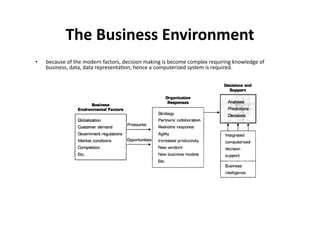
The 
Business 
Environment 
• because 
of 
the 
modern 
factors, 
decision 
making 
is 
become 
complex 
requiring 
knowledge 
of 
business, 
data, 
data 
representa?on; 
hence 
a 
computerized 
system 
is 
required.
Different 
ac;ons 
taken 
by 
managers 
to 
counter 
the 
pressure: 
• Employee 
strategic 
planning 
• Use 
new 
and 
innova?ve 
business 
models 
• Restructure 
business 
processes 
• Par?cipate 
in 
business 
alliances 
• Improve 
corporate 
informa?on 
system 
Con?nue…
• Improve 
partnership 
rela?onships 
• Encourage 
innova?on 
and 
crea?vity 
• Improve 
customer 
service 
and 
rela?onships 
• Move 
to 
electronic 
commerce(e-­‐commerce) 
• Move 
to 
make-­‐to-­‐order 
produc?on 
and 
on-­‐ 
demand 
manufacturing 
and 
services 
• Use 
new 
IT 
to 
improve 
communica?on, 
data 
access(discovery 
of 
informa?on) 
Con?nue…
• Respond 
quickly 
to 
compe?tor’s 
ac?ons(e.g. 
in 
pricing, 
promo?on, 
new 
products 
and 
services) 
• Automate 
many 
tasks 
of 
white-­‐collar 
employees 
• Automate 
certain 
decision 
processes, 
especially 
those 
dealing 
with 
customers 
• Improve 
decision 
making
Why 
we 
use 
computerized 
Decision 
Support 
System 
• Speedy 
computa?ons 
• Improved 
communica?on 
and 
collabora?on 
• Increased 
produc?vity 
of 
group 
members 
• Improved 
data 
management 
• Managing 
giant 
data 
warehouses 
• Quality 
support 
• Agility 
support 
Con?nue….
• Overcoming 
cogni?ve 
limits 
in 
processing 
and 
storing 
informa?on 
• Using 
the 
web 
• Anywhere, 
any?me 
support
Decision 
Support 
Frameworks(gory 
and 
scoD 
morton[1971]
Simon’s 
Decision 
Making 
Process 
• Decision 
making 
process: 
Intelligence 
(searching 
for 
condi?ons 
• 
Design 
• 
Choice 
• 
Implementa?on
Computerized 
Decision 
Support 
• Computer 
support 
for 
Structured 
decision 
-­‐Automated 
Decision 
making(rule 
based 
system, 
price 
determina?on; 
loan 
or 
not, 
price 
op?msa?on) 
• Computer 
support 
for 
unstructured 
decision 
• Computer 
support 
for 
semi 
structured 
problems
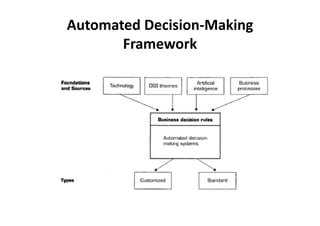
Automated 
Decision-­‐Making 
Framework
Decision 
Support 
System(DSS) 
• “Decision 
support 
system 
couple 
the 
intellectual 
resources 
of 
individuals 
with 
the 
capabili?es 
of 
the 
computer 
to 
improve 
the 
quality 
of 
decisions. 
It 
is 
a 
computer-­‐based 
support 
system 
for 
management 
decision 
makers 
who 
deal 
with 
semi 
structured 
problems” 
-­‐By 
Keen 
and 
Sco<-­‐Morton(1978)
Architecture 
of 
DSS 
• Types 
of 
DSS 
1.Model-­‐oriented 
DSS 
2.Data-­‐oriented 
DSS 
1 
– 
model 
is 
quan?ta?ve 
D-­‐ 
data 
oriented 
: 
adhoc 
queries 
and 
repor?ng
Framework 
for 
Business 
Intelligence 
(BI) 
What 
is 
BI? 
• An 
umbrella 
that 
combines 
architectures, 
tools, 
database, 
analy?cal 
tools, 
applica?ons 
and 
methodologies. 
• Content-­‐free 
expression 
• Objec?ve:1.To 
enable 
interac?ve 
access 
to 
data 
2.To 
enable 
manipula?on 
of 
data 
3.To 
give 
managers 
& 
analyst 
the 
ability 
to 
conduct 
appropriate 
analysis.
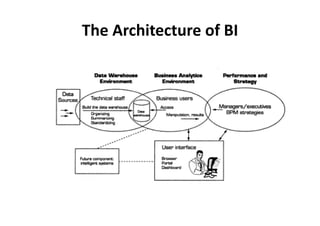
The 
Architecture 
of 
BI
Components 
Of 
BI 
system 
BI 
system 
has 
four 
major 
components: 
• Data 
warehouse: 
Source 
data 
• Business 
Analy2cs: 
a 
collec?on 
of 
tools 
for 
manipula?ng, 
mining, 
and 
analyzing 
the 
data 
in 
the 
data 
warehouse 
• Business 
performance 
management: 
for 
monitoring 
& 
analyzing 
performance 
• User 
interface: 
Dashboard 
& 
other 
informa?on 
broadcas?ng 
tools
Benefits 
of 
BI 
The 
major 
benefits 
of 
BI: 
• Faster, 
more 
accurate 
repor?ng 
• Improved 
decision 
making 
• Improved 
customer 
service 
• Increased 
revenue 
Apart 
from 
these, 
there 
are 
several 
other 
like-­‐ 
• Time 
saving 
• Single 
version 
of 
the 
“truth” 
• Be<er 
strategies 
and 
plans 
• More 
efficient 
process 
• Cost 
saving
Bperformance 
mgmt 
• Adds 
management 
and 
feedback 
to 
core 
BI 
• Top 
– 
bo<m 
process 
• Balanced 
scorecard 
and 
dashboards
Summary 
• Similar 
architecture 
because 
BI 
evolved 
from 
DSS. 
• DSS 
are 
constructed 
to 
directly 
support 
specific 
decision 
making 
while 
BI 
are 
for 
indirect 
support. 
• BI 
has 
an 
execu?ve 
& 
strategic 
orienta?on 
while 
DSS 
is 
oriented 
toward 
analyst. 
• BI 
are 
constructed 
with 
commercially 
available 
tools 
& 
components 
while 
DSS 
is 
construc?ng 
solu?ons 
to 
unstructured 
problems. 
• DSS 
were 
mostly 
in 
the 
academic 
world.BI 
were 
developed 
by 
solware 
companies. 
• Many 
of 
the 
tools 
that 
BI 
uses 
are 
also 
considered 
DSS 
tools.
Management 
Support 
System 
• Combina?on 
of 
DSS 
and 
BI 
tools. 
• Technology 
that 
supports 
managerial 
tasks 
in 
general 
and 
decision 
making 
in 
par?cular. 
• MSS 
use 
when 
the 
nature 
of 
the 
technology 
involved 
is 
not 
clear, 
and 
use 
it 
interchangeably 
with 
the 
combined 
term 
DSS/BI. 
• Vendor 
names: 
Microstrategy, 
microsol, 
IBM, 
oracle, 
Hyperion, 
cognos, 
Business 
objects,SAS,exsys,SAP
Work 
system 
view 
• Remove 
systems 
from 
DSS 
• Improve 
decision 
making 
• Alter(2004) 
Process, 
par?cpants, 
info,tech,product,customers.infra,environmen 
t,strategy
• Case 
study 
on 
microstrategy 
• Microsol 
BI 
offering

Decision support systems and business intelligence

  • 1.
    Decision Support systems and Business Intelligence
  • 2.
    • Business environment is becoming more and more complex and rapidly changing, making decision making more difficult • Must respond and adapt by making faster and be<er decision. • Intui?on may not be enough, hence computerised systems are required.
  • 3.
    • "Business Intelligence is a set of methodologies, processes, architectures, and technologies that transform raw data into meaningful and useful informa?on used to enable more effec?ve strategic, tac?cal, and opera?onal insights and decision-­‐making."[6] • 1958 researcher conned this term intelligence, IBMs hans peter Luhn "the ability to apprehend the interrela?onships of presented facts in such a way as to guide ac?on towards a desired goal."[4]
  • 4.
    Car company case scenario • car company fic??ous case: • car logis?cs • problem:increasing costs • increasing issues, delays , data entry errors. some issues resolved with data analysis • more managers could see problems of overbilling and delays • sample indicates: mul?ple things: flow of informa?on, fast decisions, vast amounts of data, collabora?on:
  • 5.
    The Business Environment • because of the modern factors, decision making is become complex requiring knowledge of business, data, data representa?on; hence a computerized system is required.
  • 6.
    Different ac;ons taken by managers to counter the pressure: • Employee strategic planning • Use new and innova?ve business models • Restructure business processes • Par?cipate in business alliances • Improve corporate informa?on system Con?nue…
  • 7.
    • Improve partnership rela?onships • Encourage innova?on and crea?vity • Improve customer service and rela?onships • Move to electronic commerce(e-­‐commerce) • Move to make-­‐to-­‐order produc?on and on-­‐ demand manufacturing and services • Use new IT to improve communica?on, data access(discovery of informa?on) Con?nue…
  • 8.
    • Respond quickly to compe?tor’s ac?ons(e.g. in pricing, promo?on, new products and services) • Automate many tasks of white-­‐collar employees • Automate certain decision processes, especially those dealing with customers • Improve decision making
  • 9.
    Why we use computerized Decision Support System • Speedy computa?ons • Improved communica?on and collabora?on • Increased produc?vity of group members • Improved data management • Managing giant data warehouses • Quality support • Agility support Con?nue….
  • 10.
    • Overcoming cogni?ve limits in processing and storing informa?on • Using the web • Anywhere, any?me support
  • 11.
    Decision Support Frameworks(gory and scoD morton[1971]
  • 12.
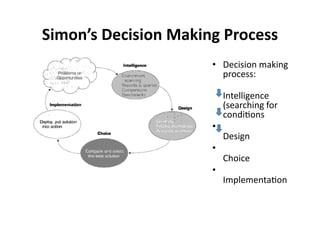
    Simon’s Decision Making Process • Decision making process: Intelligence (searching for condi?ons • Design • Choice • Implementa?on
  • 13.
    Computerized Decision Support • Computer support for Structured decision -­‐Automated Decision making(rule based system, price determina?on; loan or not, price op?msa?on) • Computer support for unstructured decision • Computer support for semi structured problems
  • 14.
  • 15.
    Decision Support System(DSS) • “Decision support system couple the intellectual resources of individuals with the capabili?es of the computer to improve the quality of decisions. It is a computer-­‐based support system for management decision makers who deal with semi structured problems” -­‐By Keen and Sco<-­‐Morton(1978)
  • 16.
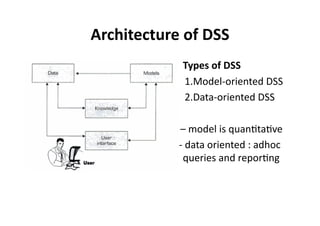
    Architecture of DSS • Types of DSS 1.Model-­‐oriented DSS 2.Data-­‐oriented DSS 1 – model is quan?ta?ve D-­‐ data oriented : adhoc queries and repor?ng
  • 17.
    Framework for Business Intelligence (BI) What is BI? • An umbrella that combines architectures, tools, database, analy?cal tools, applica?ons and methodologies. • Content-­‐free expression • Objec?ve:1.To enable interac?ve access to data 2.To enable manipula?on of data 3.To give managers & analyst the ability to conduct appropriate analysis.
  • 18.
  • 19.
    Components Of BI system BI system has four major components: • Data warehouse: Source data • Business Analy2cs: a collec?on of tools for manipula?ng, mining, and analyzing the data in the data warehouse • Business performance management: for monitoring & analyzing performance • User interface: Dashboard & other informa?on broadcas?ng tools
  • 20.
    Benefits of BI The major benefits of BI: • Faster, more accurate repor?ng • Improved decision making • Improved customer service • Increased revenue Apart from these, there are several other like-­‐ • Time saving • Single version of the “truth” • Be<er strategies and plans • More efficient process • Cost saving
  • 21.
    Bperformance mgmt •Adds management and feedback to core BI • Top – bo<m process • Balanced scorecard and dashboards
  • 22.
    Summary • Similar architecture because BI evolved from DSS. • DSS are constructed to directly support specific decision making while BI are for indirect support. • BI has an execu?ve & strategic orienta?on while DSS is oriented toward analyst. • BI are constructed with commercially available tools & components while DSS is construc?ng solu?ons to unstructured problems. • DSS were mostly in the academic world.BI were developed by solware companies. • Many of the tools that BI uses are also considered DSS tools.
  • 23.
    Management Support System • Combina?on of DSS and BI tools. • Technology that supports managerial tasks in general and decision making in par?cular. • MSS use when the nature of the technology involved is not clear, and use it interchangeably with the combined term DSS/BI. • Vendor names: Microstrategy, microsol, IBM, oracle, Hyperion, cognos, Business objects,SAS,exsys,SAP
  • 24.
    Work system view • Remove systems from DSS • Improve decision making • Alter(2004) Process, par?cpants, info,tech,product,customers.infra,environmen t,strategy
  • 25.
    • Case study on microstrategy • Microsol BI offering