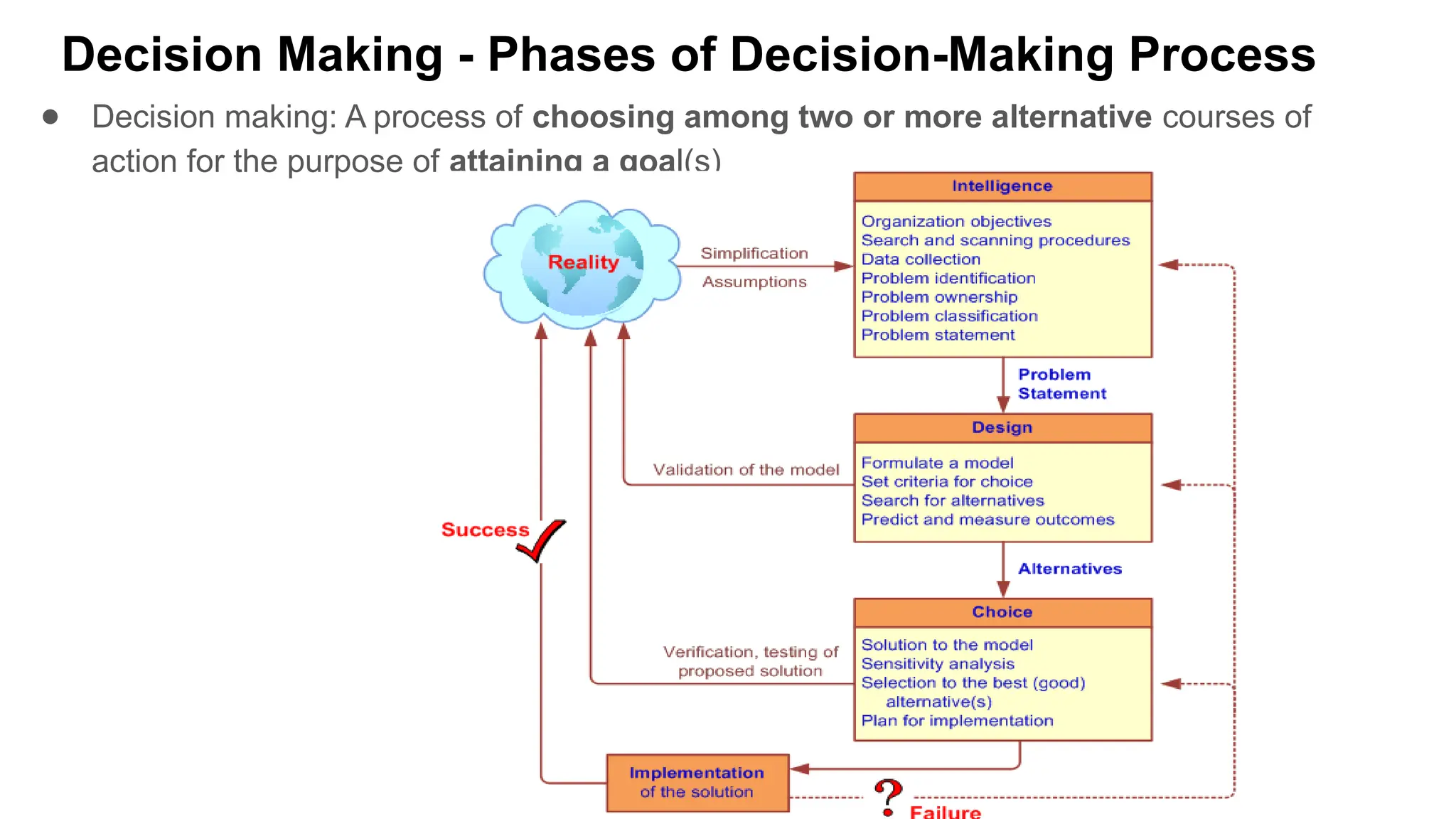
Decision Making -Phases of Decision-Making Process
● Decision making: A process of choosing among two or more alternative courses of
action for the purpose of attaining a goal(s)
5.
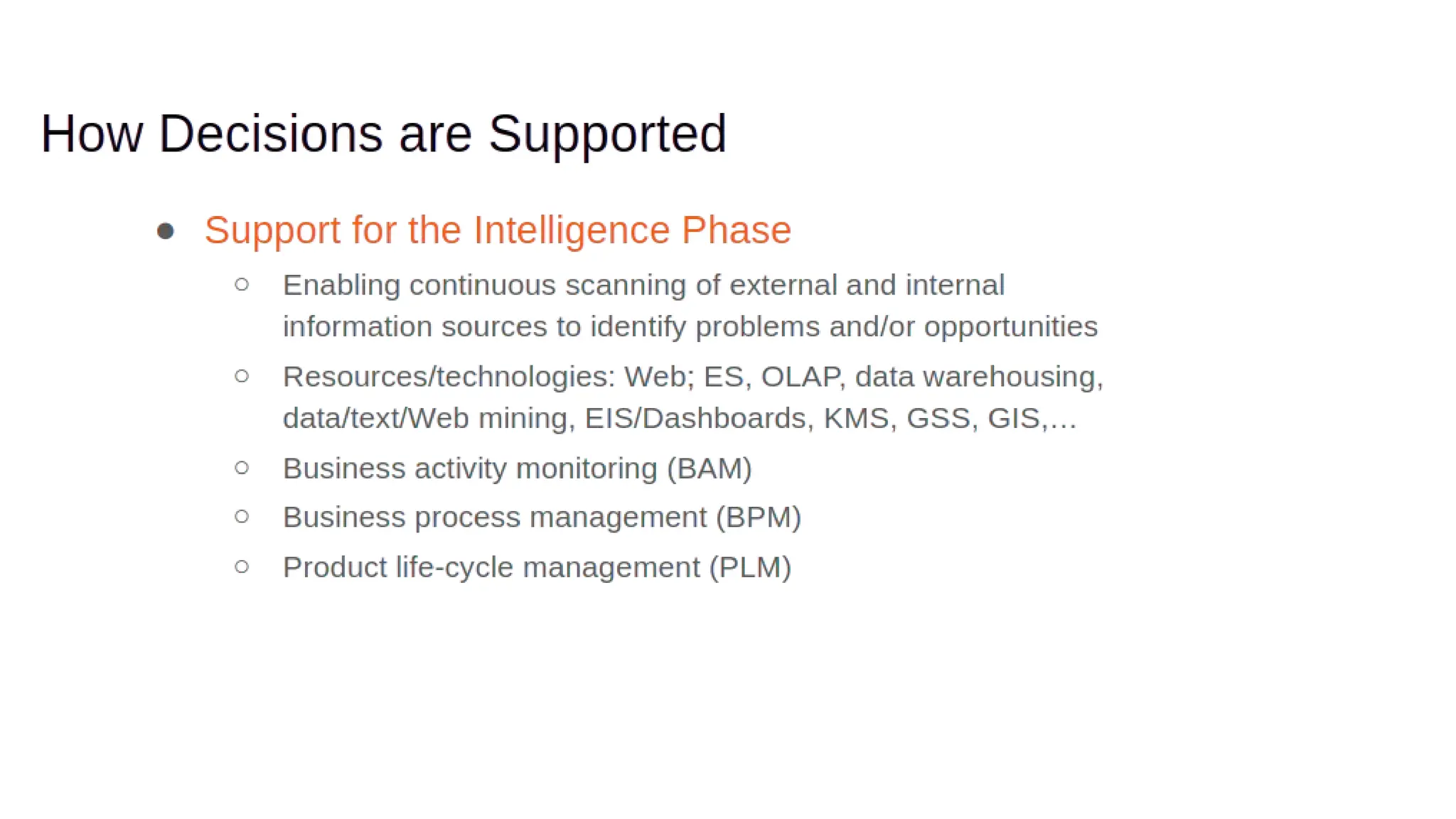
Decision Making: IntelligencePhase
● Intelligence Phase: Identify problem situations or opportunities
● Starting with identifying organization objectives and desires, the Problem is the
difference between what people desire (or expect) and what is actually occurring
● The existence of a problem can be determined by monitoring and analyzing the
organization’s productivity level. The measurement of productivity and the
construction of a model are based on real data. The collection of data and the
estimation of future data are among the most difficult steps in the analysis
● Dissatisfaction is the result of a difference between what people desire (or
expect) and what is occurring. In this first phase, a decision maker attempts to
determine whether a problem exists, identify its symptoms, determine its magnitude,
and explicitly define it [sometimes difficult to distinguish between the symptoms
and the real problem]
● Timely identification of opportunities is as important as identification of problems
1
6.
Decision Making: IntelligencePhase
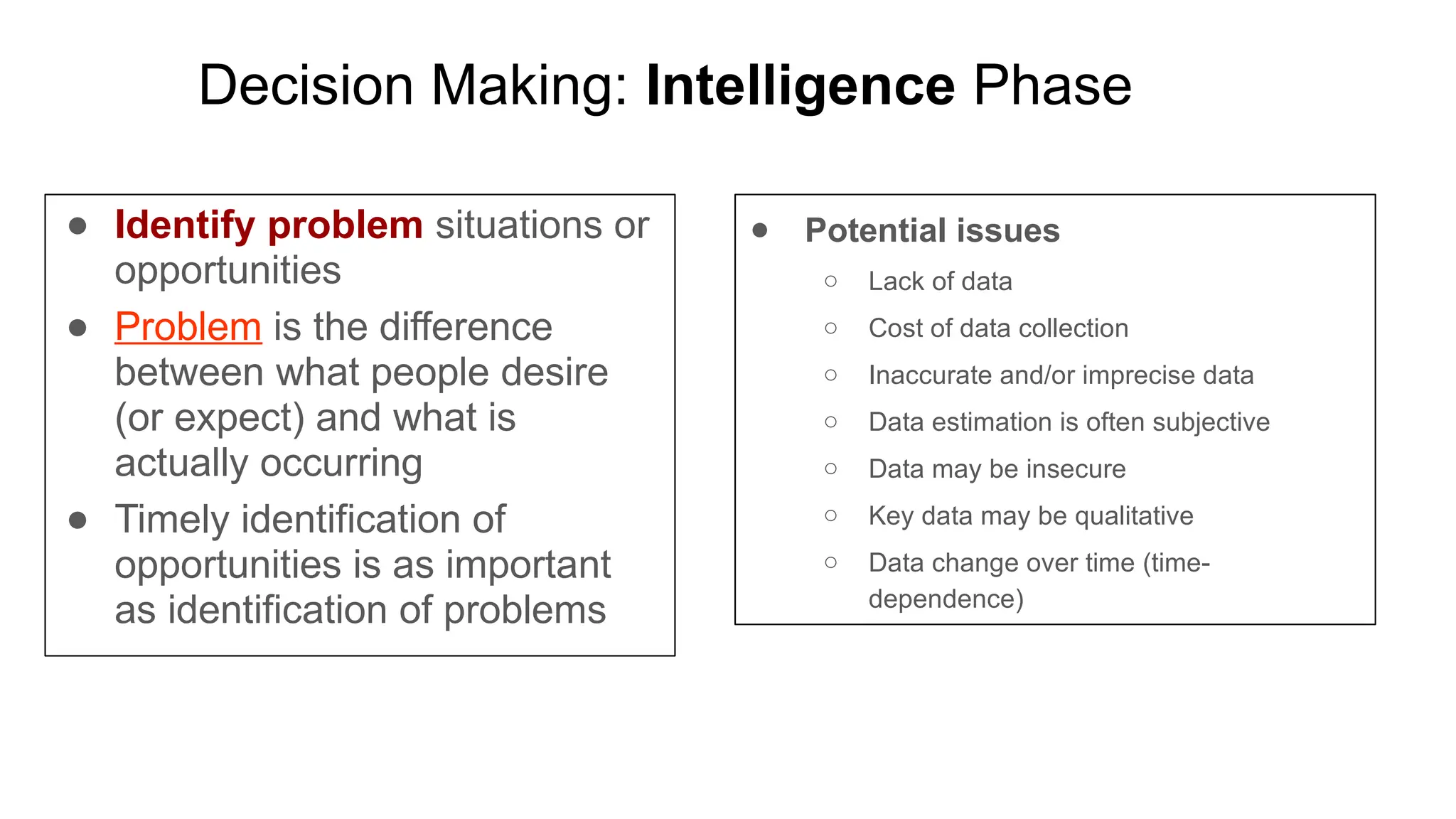
● Identify problem situations or
opportunities
● Problem is the difference
between what people desire
(or expect) and what is
actually occurring
● Timely identification of
opportunities is as important
as identification of problems
● Potential issues
○ Lack of data
○ Cost of data collection
○ Inaccurate and/or imprecise data
○ Data estimation is often subjective
○ Data may be insecure
○ Key data may be qualitative
○ Data change over time (time-
dependence)
7.
Decision Making: IntelligencePhase
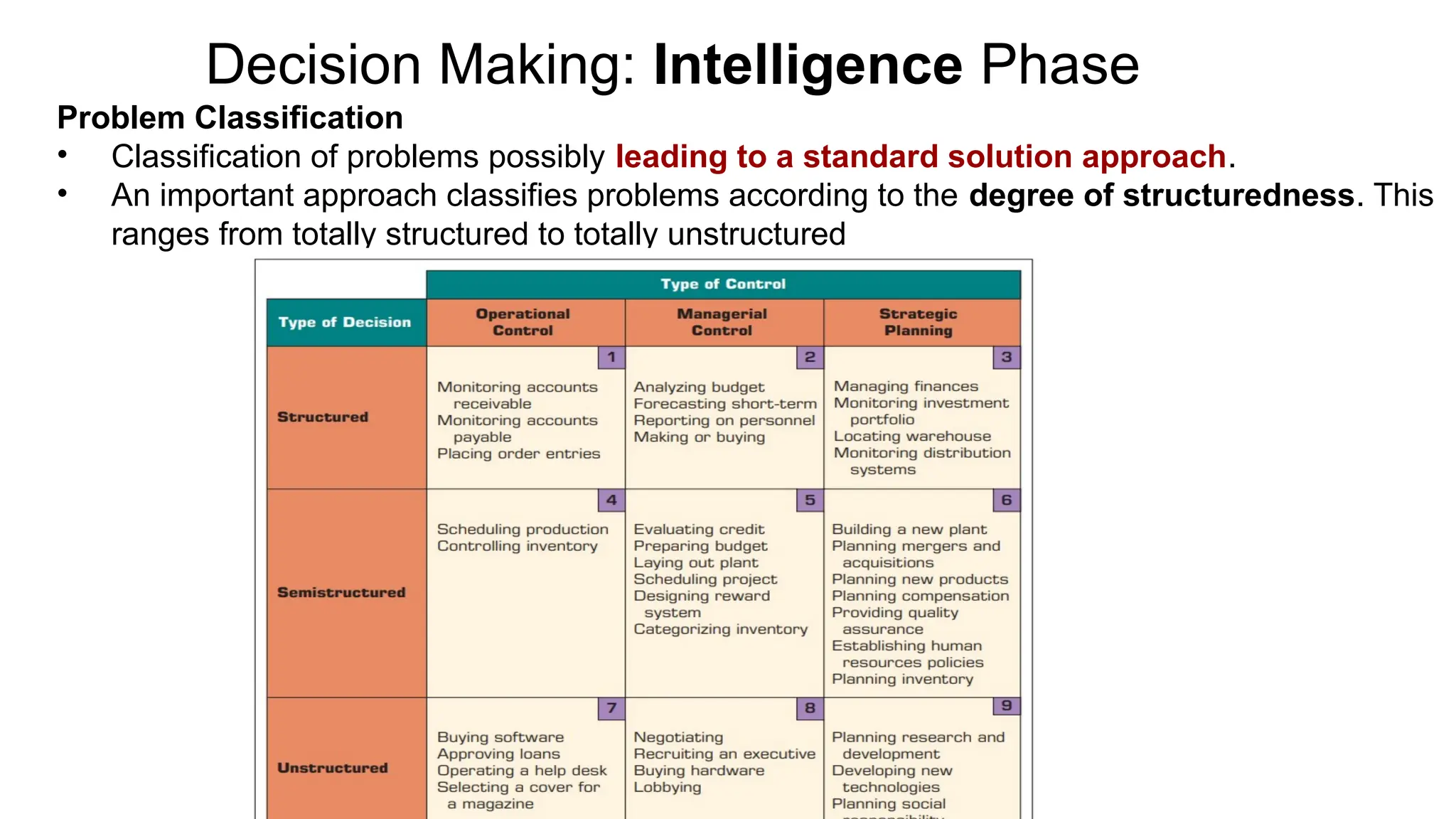
Problem Classification
• Classification of problems possibly leading to a standard solution approach.
• An important approach classifies problems according to the degree of structuredness. This
ranges from totally structured to totally unstructured
8.
Decision Making: IntelligencePhase
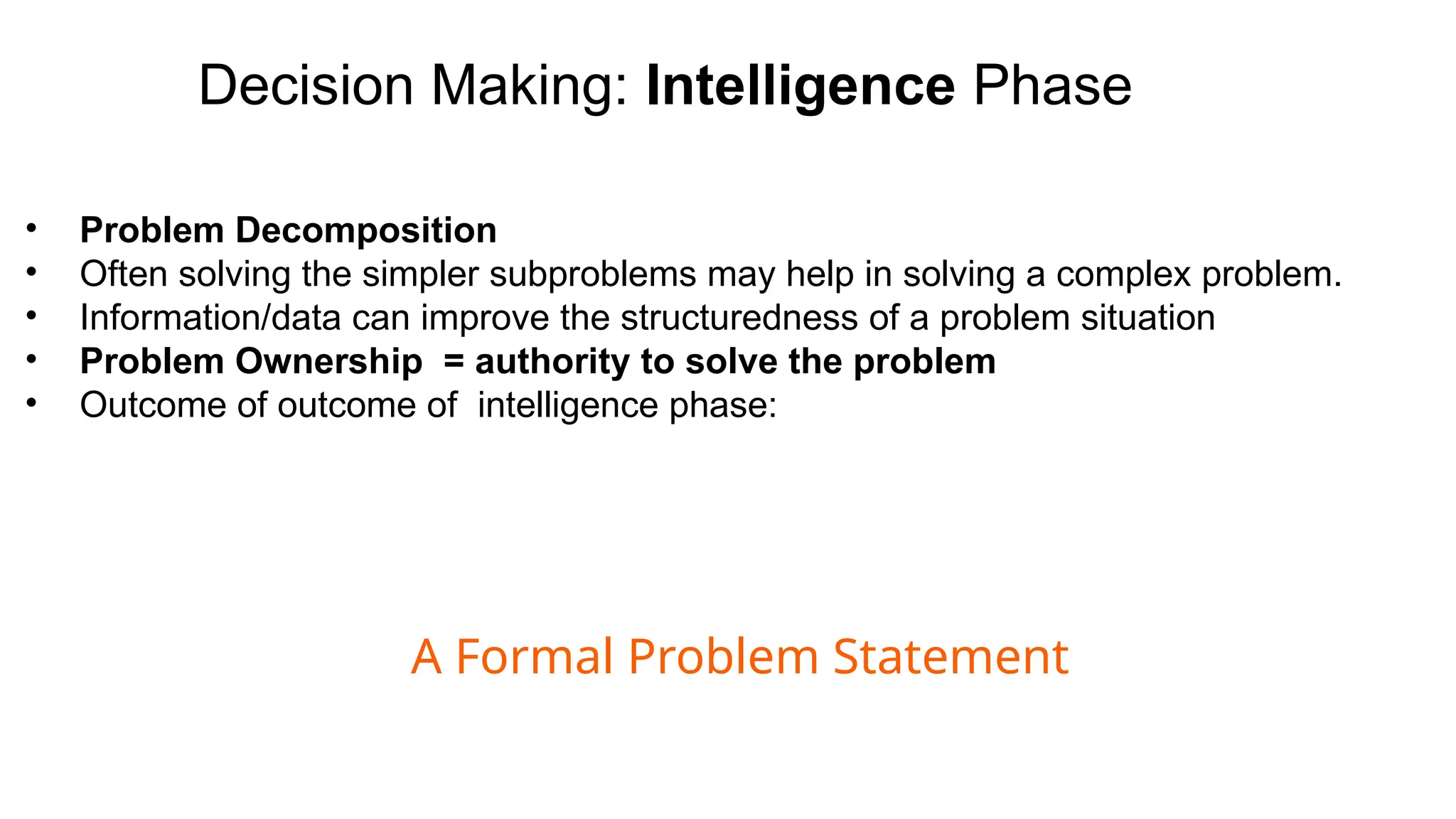
• Problem Decomposition
• Often solving the simpler subproblems may help in solving a complex problem.
• Information/data can improve the structuredness of a problem situation
• Problem Ownership = authority to solve the problem
• Outcome of outcome of intelligence phase:
A Formal Problem Statement
9.
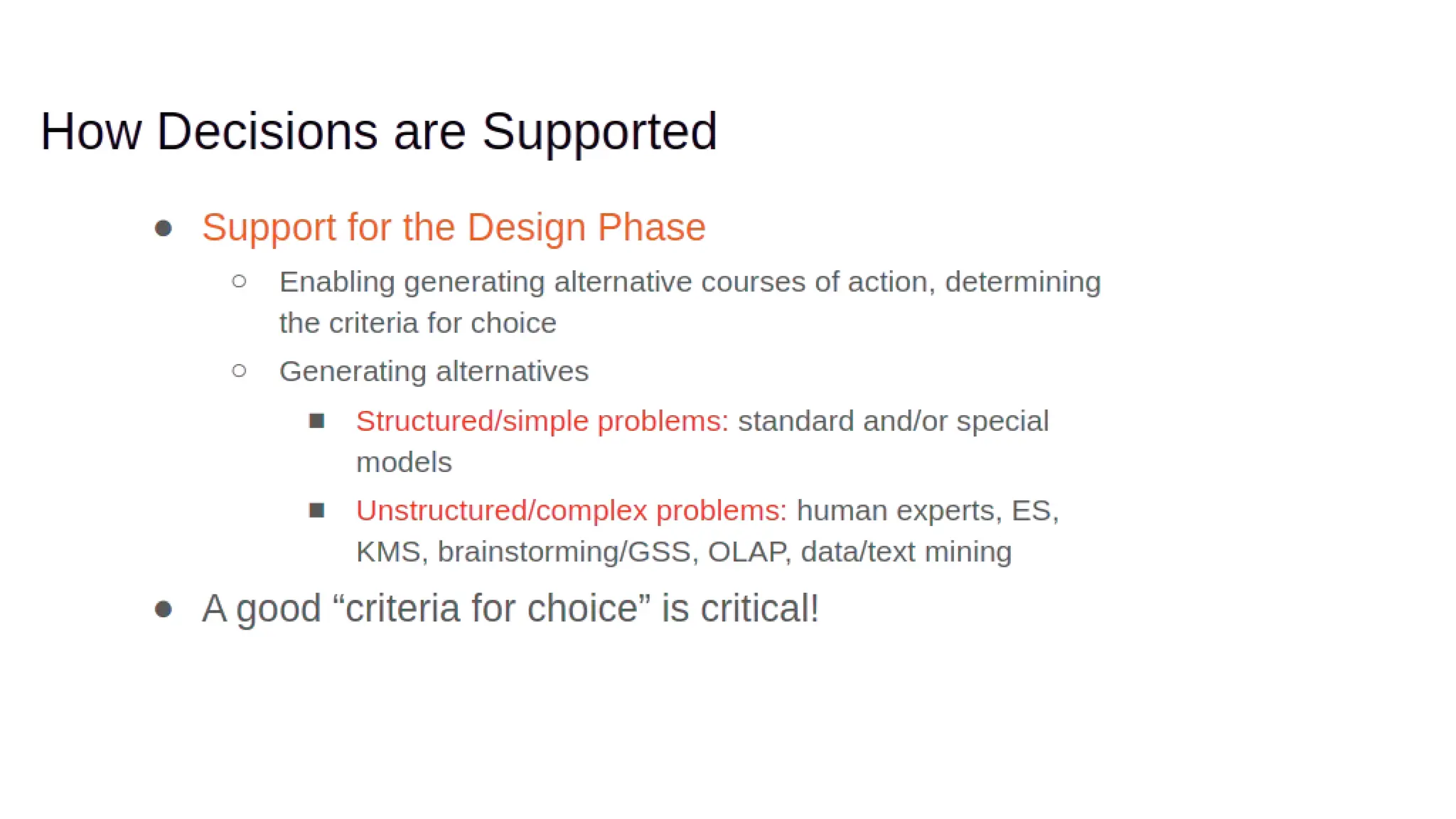
Decision Making: TheDesign Phase
●
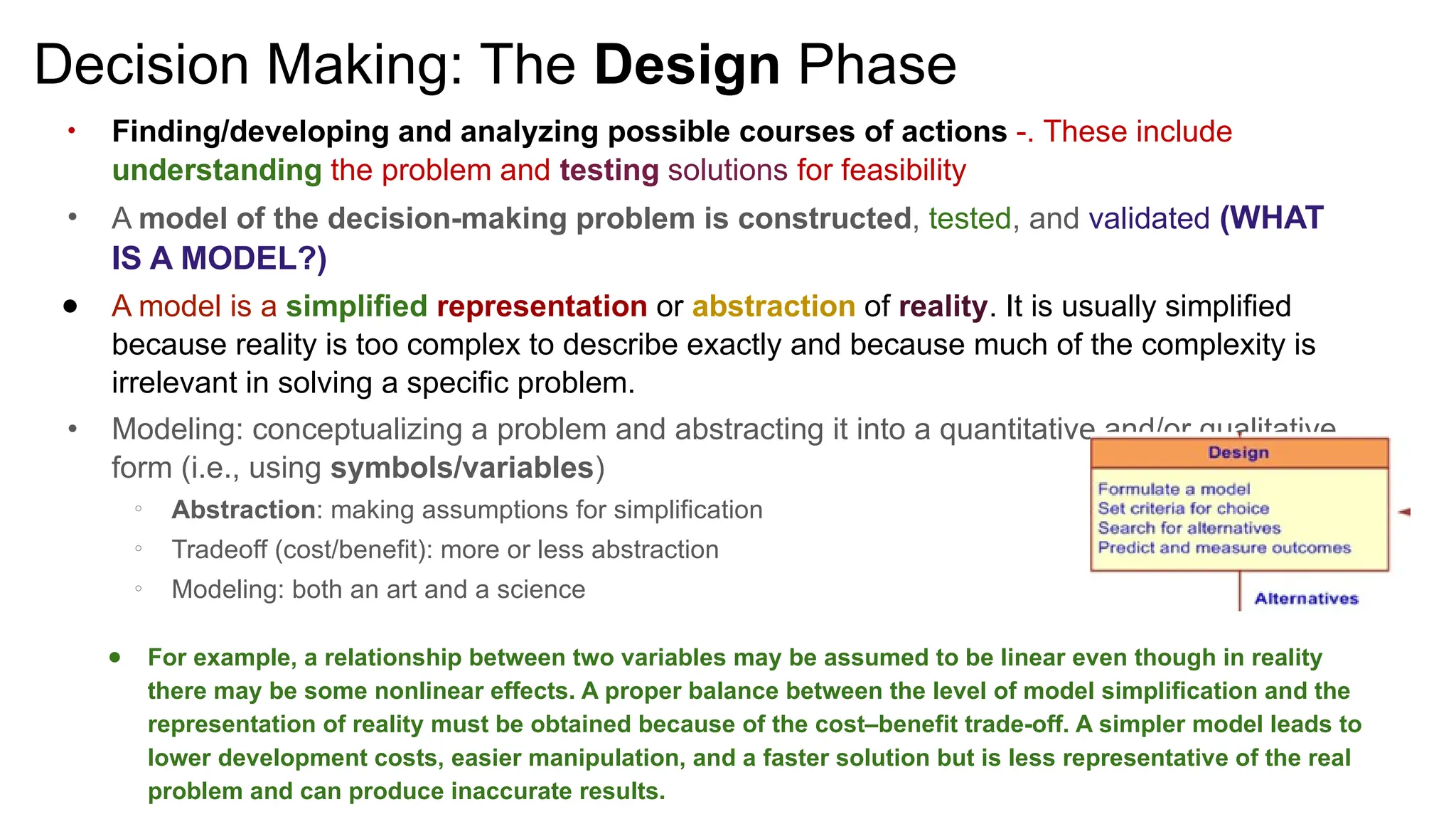
Finding/developing and analyzing possible courses of actions -. These include
understanding the problem and testing solutions for feasibility
● A model of the decision-making problem is constructed, tested, and validated (WHAT
IS A MODEL?)
● A model is a simplified representation or abstraction of reality. It is usually simplified
because reality is too complex to describe exactly and because much of the complexity is
irrelevant in solving a specific problem.
● Modeling: conceptualizing a problem and abstracting it into a quantitative and/or qualitative
form (i.e., using symbols/variables)
○ Abstraction: making assumptions for simplification
○ Tradeoff (cost/benefit): more or less abstraction
○ Modeling: both an art and a science
● For example, a relationship between two variables may be assumed to be linear even though in reality
there may be some nonlinear effects. A proper balance between the level of model simplification and the
representation of reality must be obtained because of the cost–benefit trade-off. A simpler model leads to
lower development costs, easier manipulation, and a faster solution but is less representative of the real
problem and can produce inaccurate results.
10.
The Design Phase
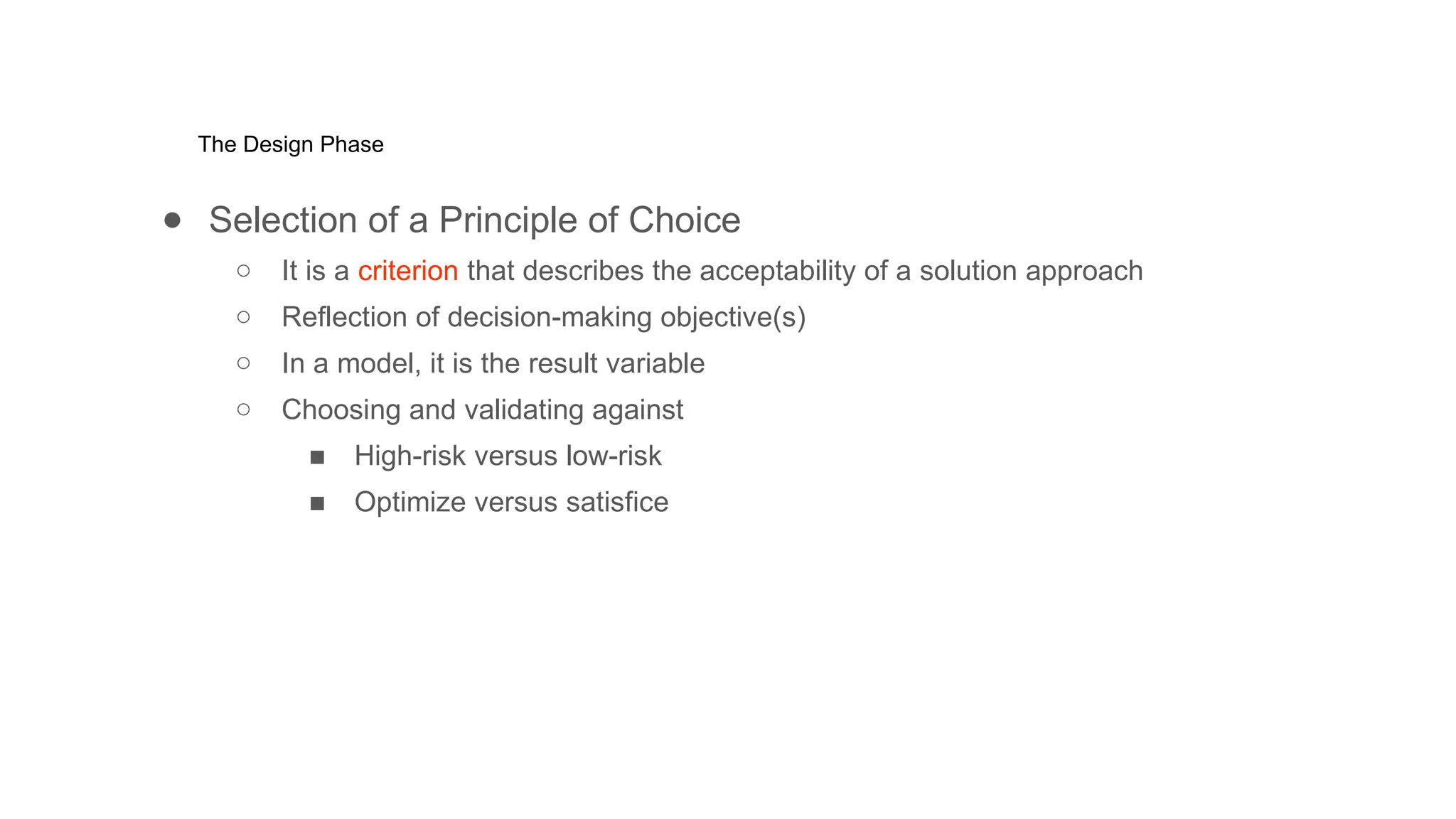
●Selection of a Principle of Choice
○ It is a criterion that describes the acceptability of a solution approach
○ Reflection of decision-making objective(s)
○ In a model, it is the result variable
○ Choosing and validating against
■ High-risk versus low-risk
■ Optimize versus satisfice
11.
The Design Phase
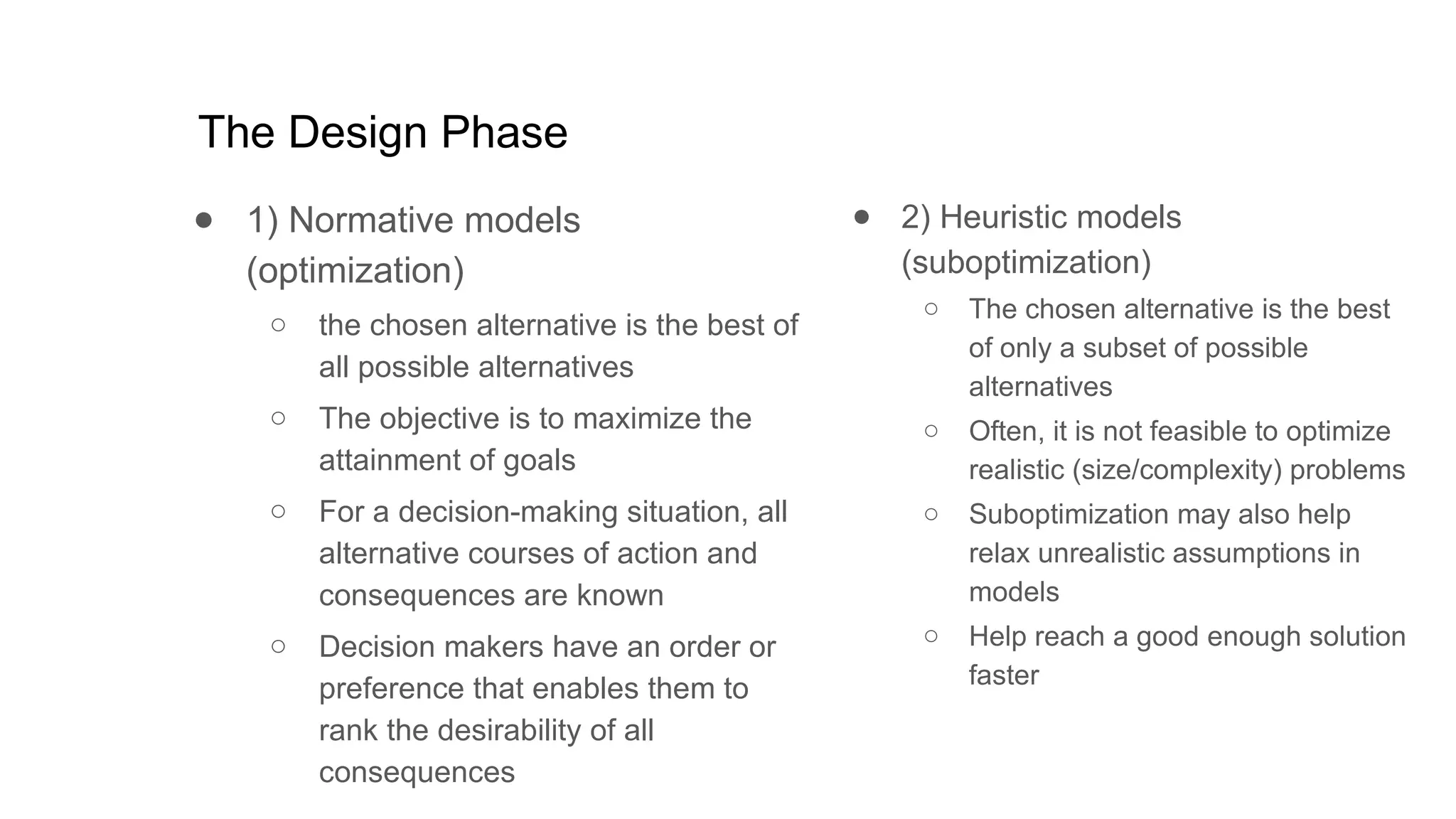
●1) Normative models
(optimization)
○ the chosen alternative is the best of
all possible alternatives
○ The objective is to maximize the
attainment of goals
○ For a decision-making situation, all
alternative courses of action and
consequences are known
○ Decision makers have an order or
preference that enables them to
rank the desirability of all
consequences
● 2) Heuristic models
(suboptimization)
○ The chosen alternative is the best
of only a subset of possible
alternatives
○ Often, it is not feasible to optimize
realistic (size/complexity) problems
○ Suboptimization may also help
relax unrealistic assumptions in
models
○ Help reach a good enough solution
faster
12.
The Design Phase
●Good Enough, or Satisficing
“something less than the best”
○ A form of suboptimization
○ Seeking to achieve a desired level of
performance as opposed to the “best”
○ Benefit: time saving
○ Simon’s idea of bounded rationality
13.
The Design Phase
●3) Descriptive models
○ Describe things as they are or as they are believed to be
(mathematically based)
○ They do not provide a solution but information that may lead to a
solution
○ Simulation - most common descriptive modeling method
(mathematical depiction of systems in a computer environment)
○ Allows experimentation with the descriptive model of a system
14.
Decision Making: TheDesign Phase
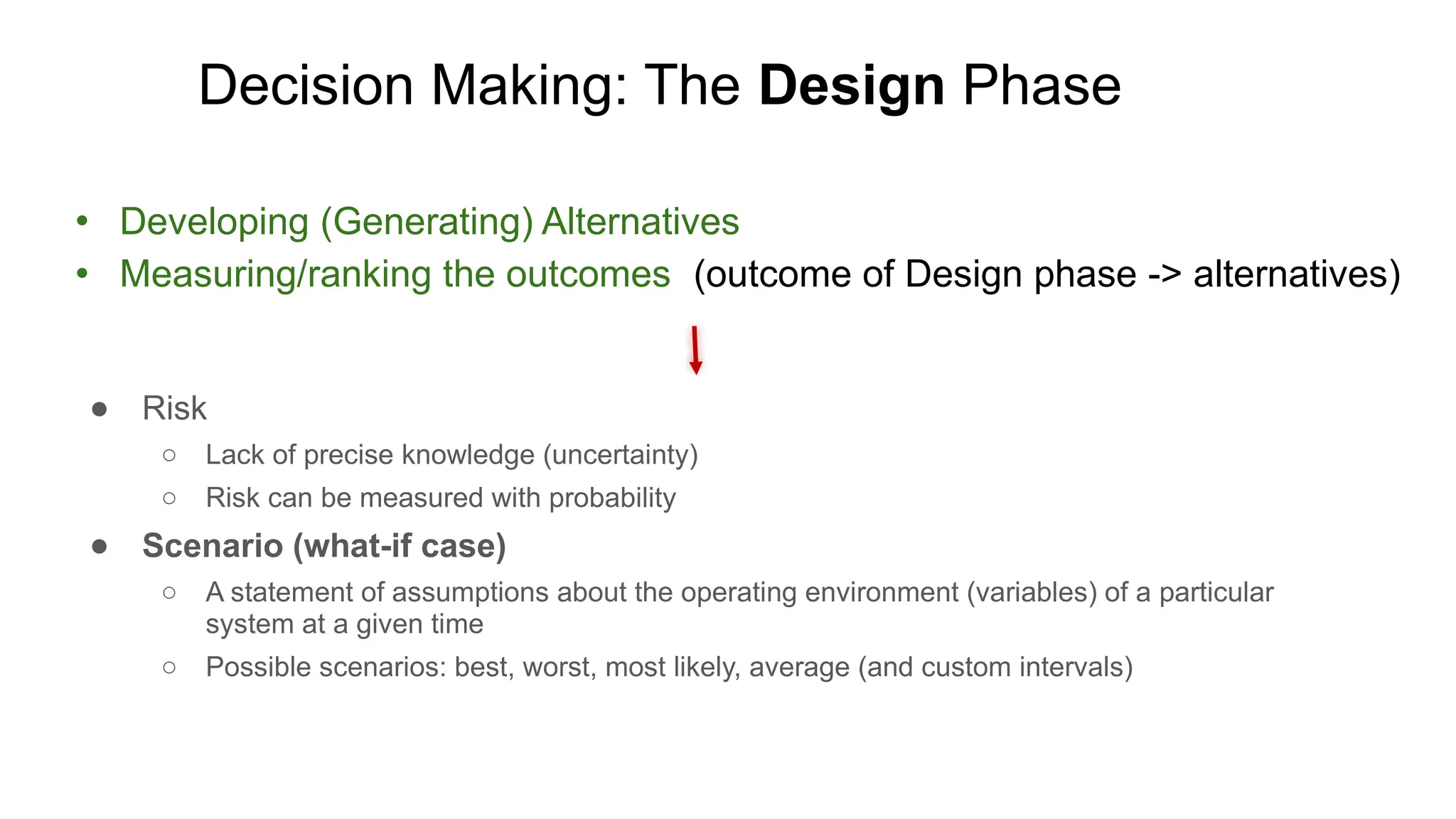
● Developing (Generating) Alternatives
● Measuring/ranking the outcomes (outcome of Design phase -> alternatives)
● Risk
○ Lack of precise knowledge (uncertainty)
○ Risk can be measured with probability
● Scenario (what-if case)
○ A statement of assumptions about the operating environment (variables) of a particular
system at a given time
○ Possible scenarios: best, worst, most likely, average (and custom intervals)
15.
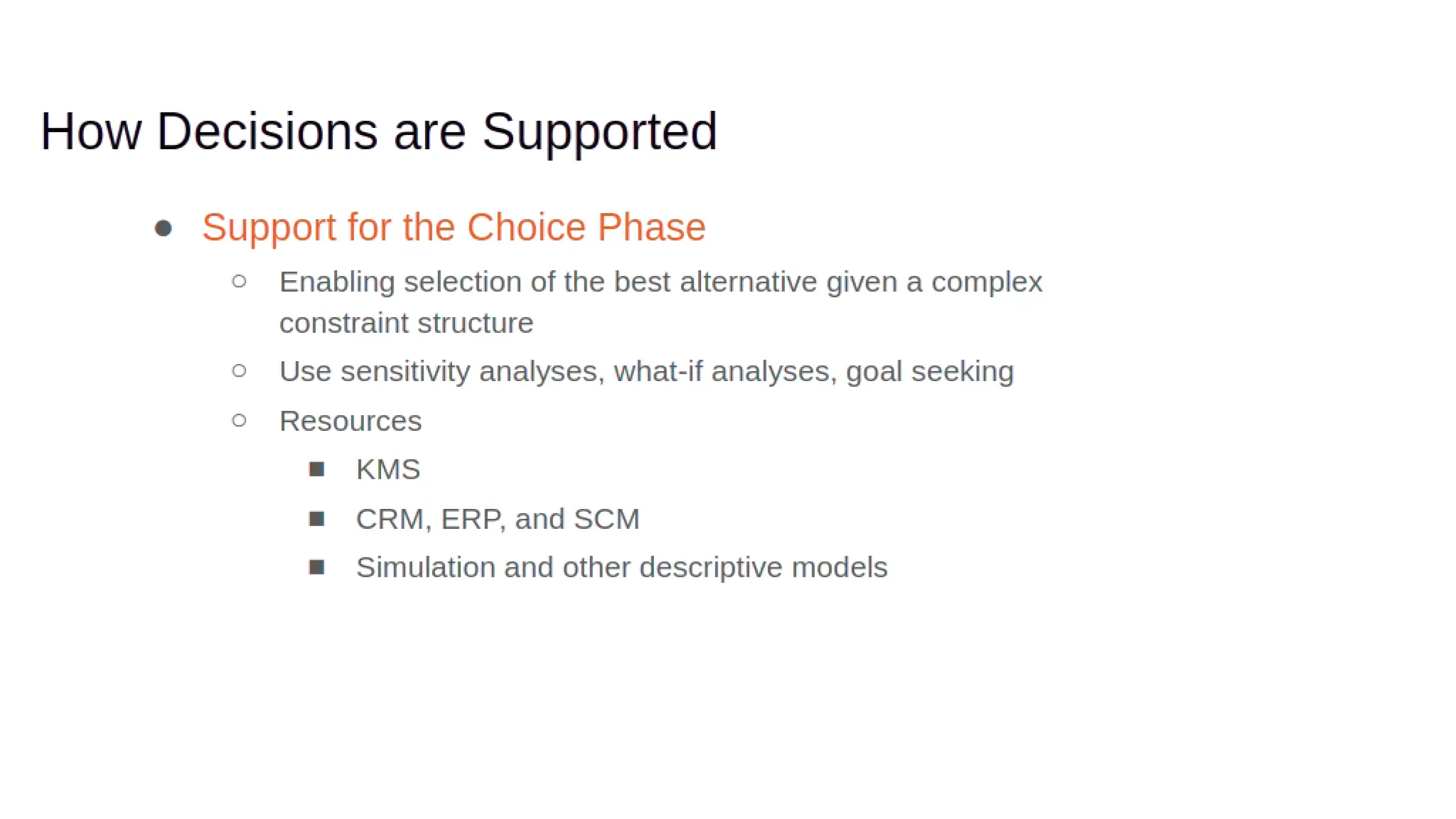
Decision Making: TheChoice Phase
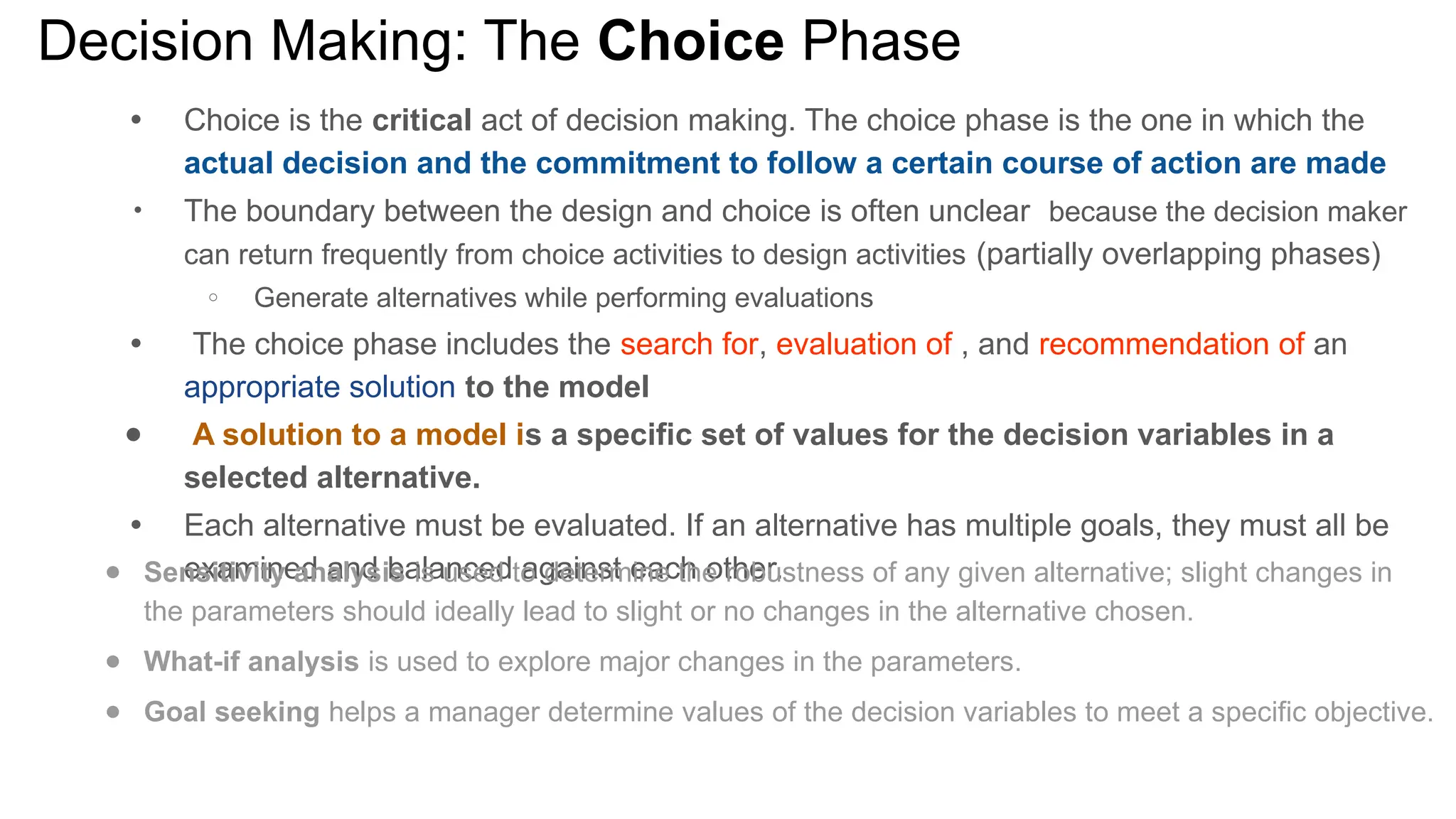
● Choice is the critical act of decision making. The choice phase is the one in which the
actual decision and the commitment to follow a certain course of action are made
●
The boundary between the design and choice is often unclear because the decision maker
can return frequently from choice activities to design activities (partially overlapping phases)
○ Generate alternatives while performing evaluations
● The choice phase includes the search for, evaluation of , and recommendation of an
appropriate solution to the model
● A solution to a model is a specific set of values for the decision variables in a
selected alternative.
● Each alternative must be evaluated. If an alternative has multiple goals, they must all be
examined and balanced against each other.
● Sensitivity analysis is used to determine the robustness of any given alternative; slight changes in
the parameters should ideally lead to slight or no changes in the alternative chosen.
● What-if analysis is used to explore major changes in the parameters.
● Goal seeking helps a manager determine values of the decision variables to meet a specific objective.
16.
Decision Making: TheImplementation Phase
“Nothing more difficult to carry out, nor more doubtful of success, nor more
dangerous to handle, than to initiate a new order of things.”
- The Prince, Machiavelli 1500s
● Implementation is: putting a recommended solution to work
17.
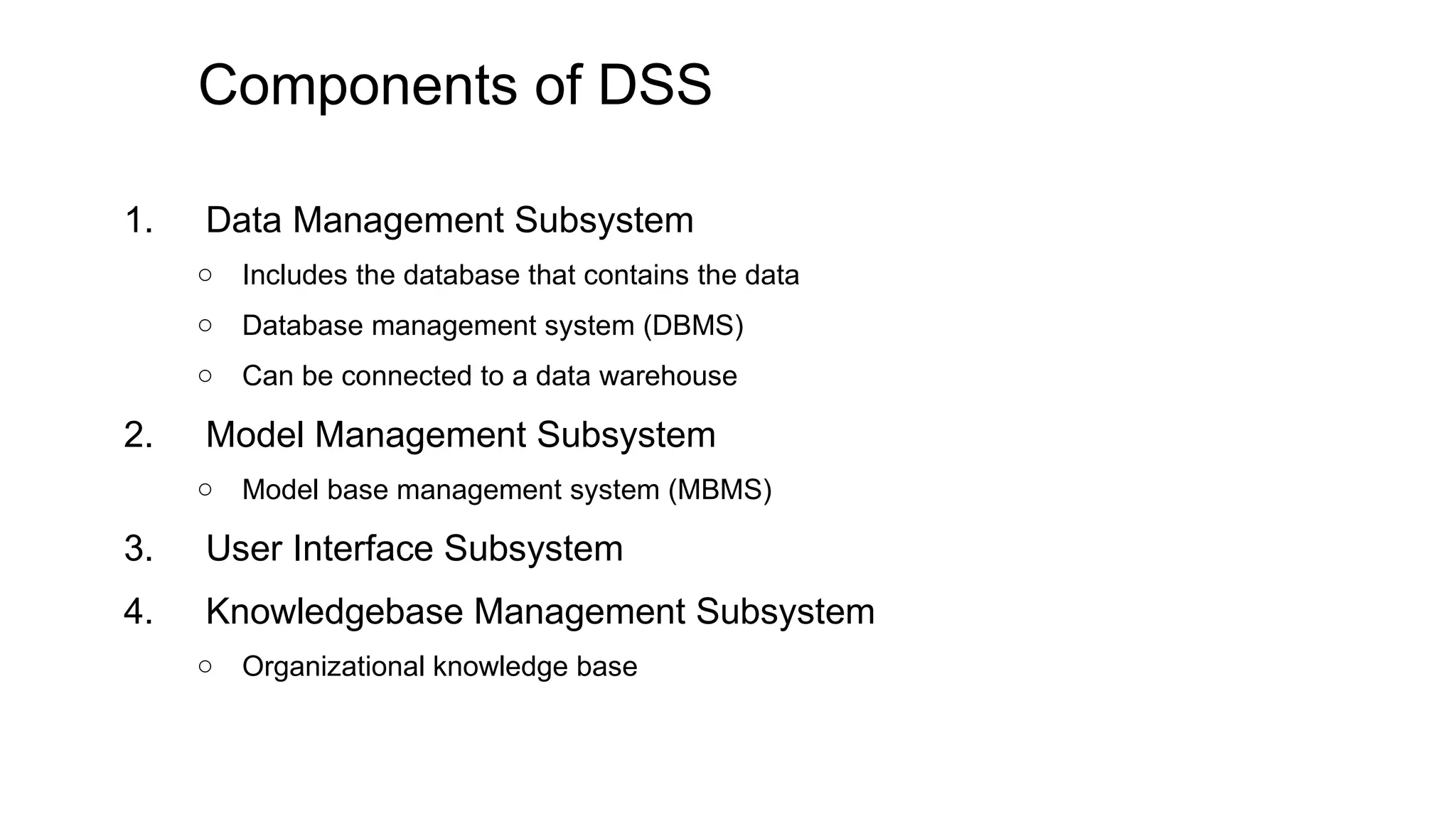
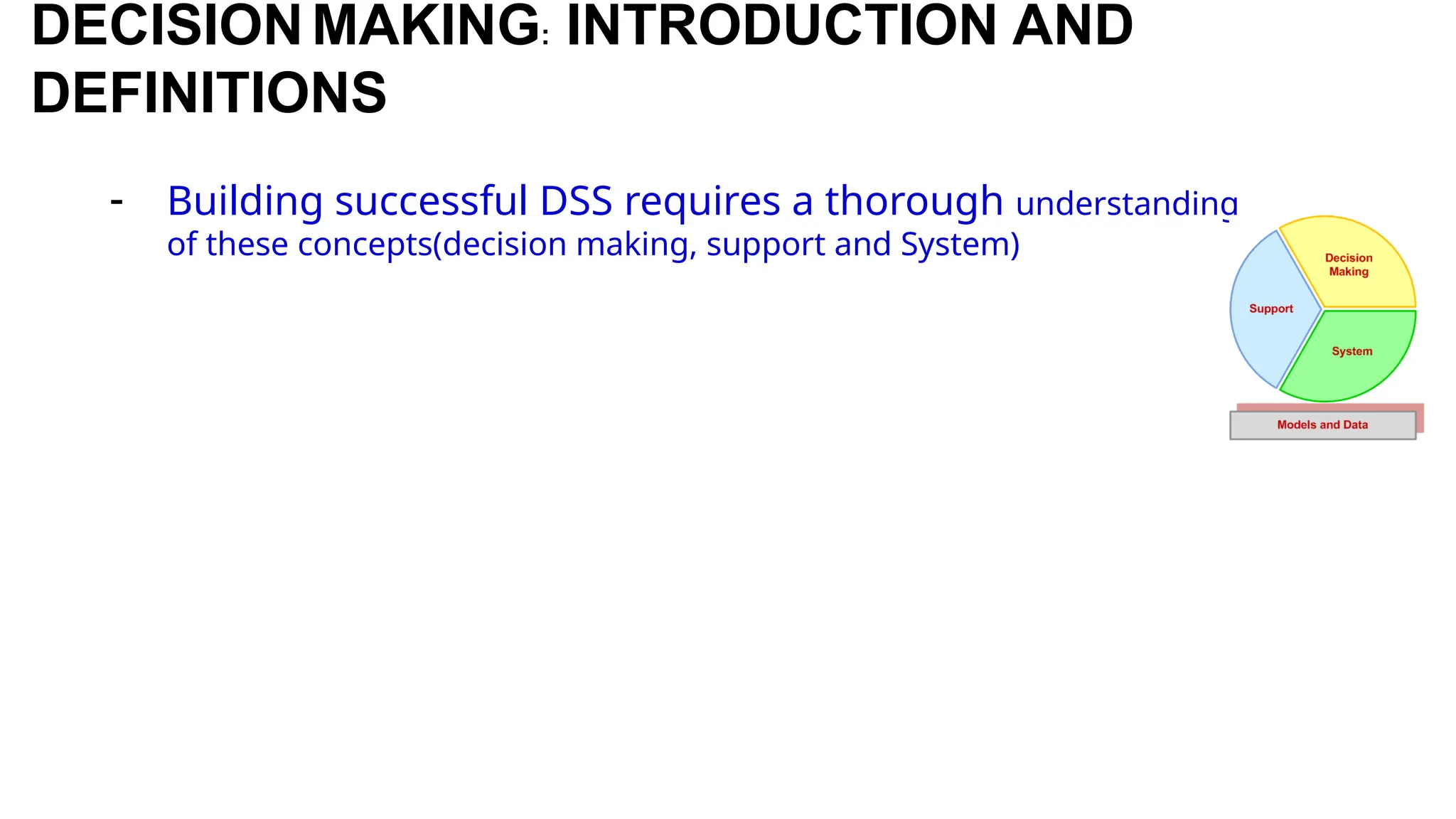
Components of DSS
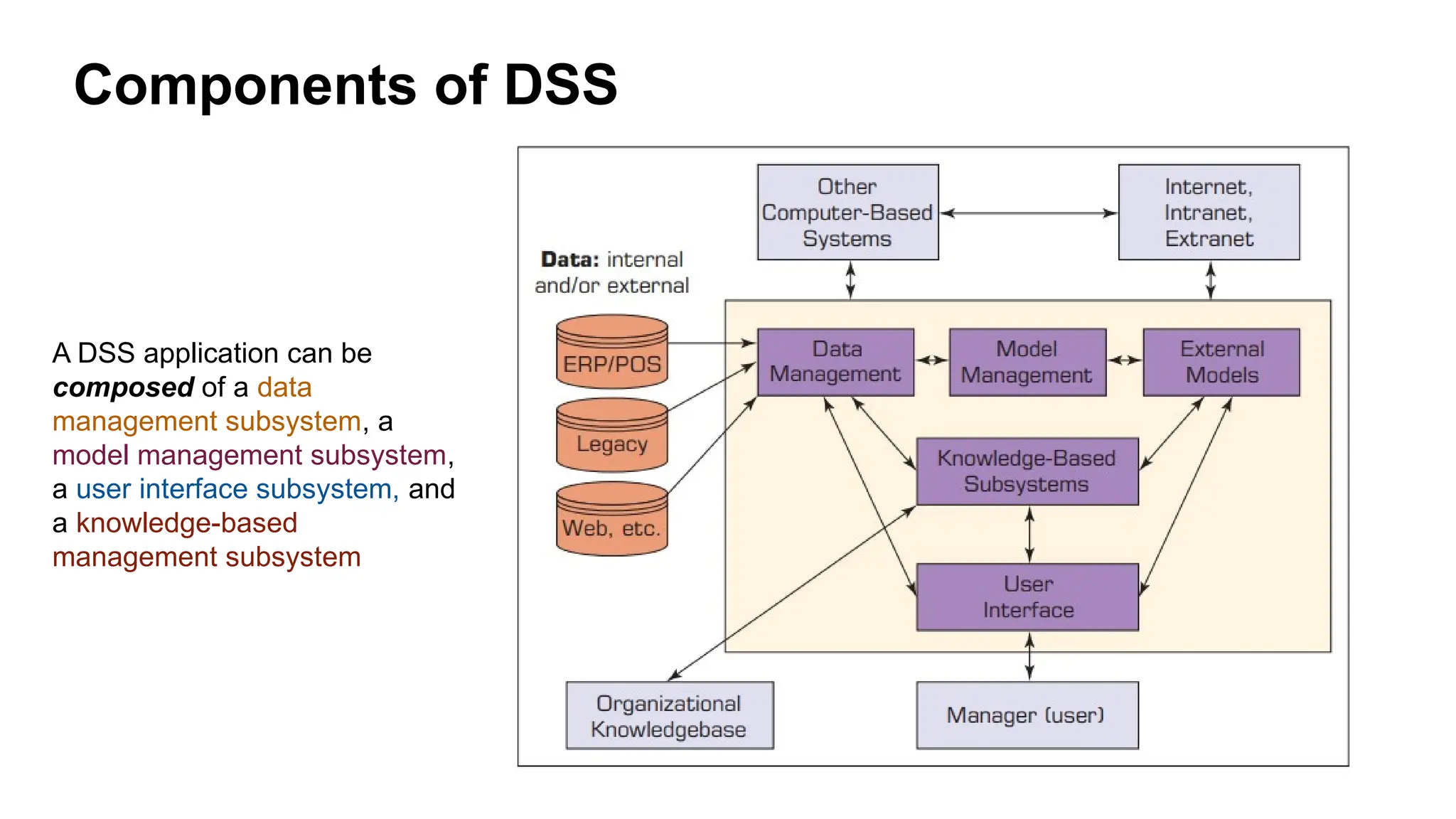
ADSS application can be
composed of a data
management subsystem, a
model management subsystem,
a user interface subsystem, and
a knowledge-based
management subsystem
18.
Components of DSS
1.Data Management Subsystem
○ Includes the database that contains the data
○ Database management system (DBMS)
○ Can be connected to a data warehouse
2. Model Management Subsystem
○ Model base management system (MBMS)
3. User Interface Subsystem
4. Knowledgebase Management Subsystem
○ Organizational knowledge base
#12 Bounded rationality is a human decision-making process in which we attempt to satisfice, rather than optimize. In other words, we seek a decision that will be good enough, rather than the best possible decision.
![Decision Making: Intelligence Phase
● Intelligence Phase: Identify problem situations or opportunities
● Starting with identifying organization objectives and desires, the Problem is the
difference between what people desire (or expect) and what is actually occurring
● The existence of a problem can be determined by monitoring and analyzing the
organization’s productivity level. The measurement of productivity and the
construction of a model are based on real data. The collection of data and the
estimation of future data are among the most difficult steps in the analysis
● Dissatisfaction is the result of a difference between what people desire (or
expect) and what is occurring. In this first phase, a decision maker attempts to
determine whether a problem exists, identify its symptoms, determine its magnitude,
and explicitly define it [sometimes difficult to distinguish between the symptoms
and the real problem]
● Timely identification of opportunities is as important as identification of problems
1](https://image.slidesharecdn.com/dssv3-250426130919-da97c68d/75/dss-_V3-pptxuayadiuy-asidsuu7giusa7-c89aci-5-2048.jpg)