Decision Support and
Business Intelligence Systems
CHAPTER 9:
MODEL BASES DECISION MAKING
OPTIMIZATION DAN MULTI CRITERIA
Learning Objectives
■Understand the basic concepts of analytical decision
modeling
■Describe how prescriptive models interact with data
and the user
■Understand some different, well-known model classes
■Understand how to structure decision making with a
few alternatives
■Describe how spreadsheets can be used for analytical
modeling and solution
Learning Objectives
■Explain the basic concepts of optimization and when to
use them
■Describe how to structure a linear programming model
■Describe how to handle multiple goals
■Explain what is meant by sensitivity analysis, what-if
analysis, and goal seeking
■Describe the key issues of multi-criteria decision
making
Opening Vignette:
■ Introduction
■ Presentation of Problem
■ Methodology/Solution
■ Results/Benefits
Decision Support Systems
Modeling
■ Making decisions using some kind of analytical
model is what we call prescriptive analytics.
■ Although there are situations where one can use
experience and intuition to make decisions, it is
more likely that a decision supported by a model will
help a decision maker make better decisions
■ Modeling is a key element in most DSS and a necessity in a
model-based DSS.
■ DSS modeling contribute to organizational success.
Decision Support Systems
Modeling Example
■ We could be facing a situation of deciding which prospective
customers should receive what promotional campaign
material so that our cost of promotion is not outrageous,
while maximize the response rate.
■ We may be deciding how much to pay for different paid
search keywords to maximize the return on investment of
our advertising budget.
■ We may have to study the history of our customers’ arrival
patterns and, and apply that to schedule an appropriate
number of store employees optimize our labor costs.
■ We could be deciding where to locate our warehouses
based on our analysis and prediction of demand for our
products and the supply chain costs.
Current Modeling Issues
■ Identification of the problem and environmental
analysis
■ environmental scanning and analysis
■ Variable identification
■ influence diagram, ex : cognitive map
■ Forecasting
■ predicting the future
■ essential for construction and manipulating model
■ Model Categories
■ static or dynamic model
■ include spreadsheets, data mining systems, OLAP systems
Current Modeling Issues
■ Model Management
■ Models like data must be managed to maintain their
integrity
■ Knowledge-based modeling
■ predictive analytics techniques : classificaton,
clustering,..
■ Current trends in modeling
■ development of model libraries
■ using Web tools and software
■ multidimensional analysis
■ influence diagram
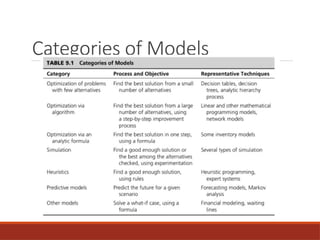
Model Categories
Static and Dynamic Models
■ Static
■ Single snapshot of the situation
■ Single interval
■ Steady state
■ Dynamic
■ Evaluate scenarios that change overtime
■ Time dependent
■ Represent trends and patterns over time
Categories of Models
Structure of Mathematical
Models for Decision Support
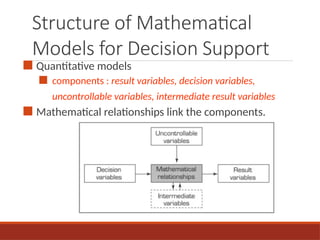
■ Quantitative models
■ components : result variables, decision variables,
uncontrollable variables, intermediate result variables
■ Mathematical relationships link the components.
Structure of Mathematical
Models for Decision Support
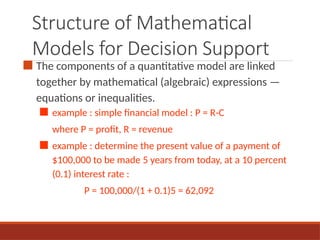
■ The components of a quantitative model are linked
together by mathematical (algebraic) expressions —
equations or inequalities.
■ example : simple financial model : P = R-C
where P = profit, R = revenue
■ example : determine the present value of a payment of
$100,000 to be made 5 years from today, at a 10 percent
(0.1) interest rate :
P = 100,000/(1 + 0.1)5 = 62,092
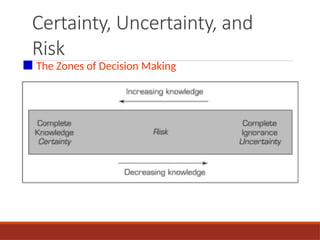
Certainty, Uncertainty, and
Risk
■ The Zones of Decision Making
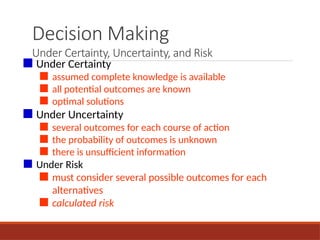
Decision Making
Under Certainty, Uncertainty, and Risk
■ Under Certainty
■ assumed complete knowledge is available
■ all potential outcomes are known
■ optimal solutions
■ Under Uncertainty
■ several outcomes for each course of action
■ the probability of outcomes is unknown
■ there is unsufficient information
■ Under Risk
■ must consider several possible outcomes for each
alternatives
■ calculated risk
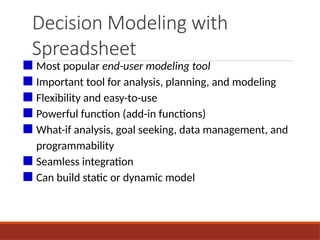
Decision Modeling with
Spreadsheet
■ Most popular end-user modeling tool
■ Important tool for analysis, planning, and modeling
■ Flexibility and easy-to-use
■ Powerful function (add-in functions)
■ What-if analysis, goal seeking, data management, and
programmability
■ Seamless integration
■ Can build static or dynamic model
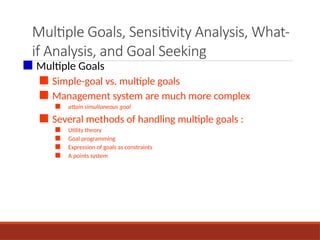
Multiple Goals, Sensitivity Analysis, What-
if Analysis, and Goal Seeking
■ Multiple Goals
■ Simple-goal vs. multiple goals
■ Management system are much more complex
■ attain simultaneous goal
■ Several methods of handling multiple goals :
■ Utility theory
■ Goal programming
■ Expression of goals as constraints
■ A points system
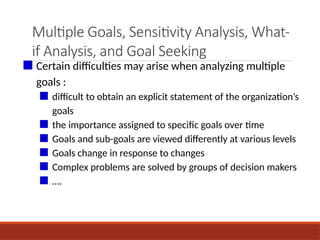
Multiple Goals, Sensitivity Analysis, What-
if Analysis, and Goal Seeking
■ Certain difficulties may arise when analyzing multiple
goals :
■ difficult to obtain an explicit statement of the organization’s
goals
■ the importance assigned to specific goals over time
■ Goals and sub-goals are viewed differently at various levels
■ Goals change in response to changes
■ Complex problems are solved by groups of decision makers
■ ….
Multiple Goals, Sensitivity Analysis, What-
if Analysis, and Goal Seeking
■ Sensitivity analysis
■ attempts to assess the impact of a change in the input data
or parameters on the proposed solution
■ important in MSS -> allows flexibility and adaptation
■ used for :
■ eliminate too-large sensitivities
■ adding details about sensitive variables
■ obtaining better estimates
■ reduce actual sensitivities
■ continuous and close monitoring of actual results
■ Two types : automatic and trial-and-error
Multiple Goals, Sensitivity Analysis, What-
if Analysis, and Goal Seeking
■ What-if analysis
■ structured as “What will happen to the solution if an input
variable, an assumption, or a parameter value is changed?”
■ can perform multiple cases
■ Goal Seeking
■ calculates the values of the inputs necessary to achieve a
desired level of an output (goal).
■ backward solution approach
■ example : computing break-even points
Decision Analysis with Decision Tables
and Decision Trees
■ Decision analysis - involve a finite and usually not too large
number of alternatives
■ Decision Tables - tabular representation of the decision
situation
■ Investment example :
■ goal : maximizing the yield on the investment after one year
■ yield depends on the state of economy :
■ solid
■ stagnation
■ inflation
Decision Table
- Investment examples
■ If there is solid growth in the economy, bonds will yield
12 percent, stocks 15 percent,and time deposits 6.5
percent.
■ If stagnation prevails, bonds will yield 6 percent, stocks
3 percent, and time deposits 6.5 percent.
■ If inflation prevails, bonds will yield 3 percent, stocks
will bring a loss of 2 percent, and time deposits will yield
6.5 percent.
Decision Table
- Investment examples
■ Treating Uncertainty
■ optimistic approach : best possible outcome of each
alternative, select the best of best
■ pessimistic approach : worst possible outcome,
select best of these
■ Treating Risk
■ Use known probabilities
■ expected values
Decision Table
- Investment examples
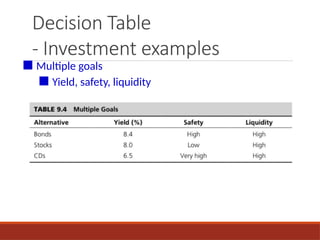
■ Multiple goals
■ Yield, safety, liquidity
Decision Trees
■ Decision tree - shows the relationships of the problem
graphically, can handle complex situations
■ Multiple criteria approach
■ Tools include :
■ Mind tools
■ TreeAge Software
■ Palisade Corp
Multi-Criteria Decision Making with
Pairwise Comparisons
■ One of the most effective approach :
■ use weights based on decision making priorities
■ Analytic Hierarchy Process (AHP)
■ excellent for representing multi-criteria
■ to decompose a decision making into relevant
criteria
■ manipulates quantitative and qualitative decision
making criteria
■ Popular tools - Expert Choice
■ Web-based tools - Web-HIPRE
End of the Chapter
■Questions / Comments…
All rights reserved. No part of this publication may be reproduced, stored in a
retrieval system, or transmitted, in any form or by any means, electronic,
mechanical, photocopying, recording, or otherwise, without the prior written
permission of the publisher. Printed in the United States of America.

Ch9_Model Bases Decision Making Turban.pptx

  • 1.
    Decision Support and BusinessIntelligence Systems CHAPTER 9: MODEL BASES DECISION MAKING OPTIMIZATION DAN MULTI CRITERIA
  • 2.
    Learning Objectives ■Understand thebasic concepts of analytical decision modeling ■Describe how prescriptive models interact with data and the user ■Understand some different, well-known model classes ■Understand how to structure decision making with a few alternatives ■Describe how spreadsheets can be used for analytical modeling and solution
  • 3.
    Learning Objectives ■Explain thebasic concepts of optimization and when to use them ■Describe how to structure a linear programming model ■Describe how to handle multiple goals ■Explain what is meant by sensitivity analysis, what-if analysis, and goal seeking ■Describe the key issues of multi-criteria decision making
  • 4.
    Opening Vignette: ■ Introduction ■Presentation of Problem ■ Methodology/Solution ■ Results/Benefits
  • 5.
    Decision Support Systems Modeling ■Making decisions using some kind of analytical model is what we call prescriptive analytics. ■ Although there are situations where one can use experience and intuition to make decisions, it is more likely that a decision supported by a model will help a decision maker make better decisions ■ Modeling is a key element in most DSS and a necessity in a model-based DSS. ■ DSS modeling contribute to organizational success.
  • 6.
    Decision Support Systems ModelingExample ■ We could be facing a situation of deciding which prospective customers should receive what promotional campaign material so that our cost of promotion is not outrageous, while maximize the response rate. ■ We may be deciding how much to pay for different paid search keywords to maximize the return on investment of our advertising budget. ■ We may have to study the history of our customers’ arrival patterns and, and apply that to schedule an appropriate number of store employees optimize our labor costs. ■ We could be deciding where to locate our warehouses based on our analysis and prediction of demand for our products and the supply chain costs.
  • 7.
    Current Modeling Issues ■Identification of the problem and environmental analysis ■ environmental scanning and analysis ■ Variable identification ■ influence diagram, ex : cognitive map ■ Forecasting ■ predicting the future ■ essential for construction and manipulating model ■ Model Categories ■ static or dynamic model ■ include spreadsheets, data mining systems, OLAP systems
  • 8.
    Current Modeling Issues ■Model Management ■ Models like data must be managed to maintain their integrity ■ Knowledge-based modeling ■ predictive analytics techniques : classificaton, clustering,.. ■ Current trends in modeling ■ development of model libraries ■ using Web tools and software ■ multidimensional analysis ■ influence diagram
  • 9.
    Model Categories Static andDynamic Models ■ Static ■ Single snapshot of the situation ■ Single interval ■ Steady state ■ Dynamic ■ Evaluate scenarios that change overtime ■ Time dependent ■ Represent trends and patterns over time
  • 10.
  • 11.
    Structure of Mathematical Modelsfor Decision Support ■ Quantitative models ■ components : result variables, decision variables, uncontrollable variables, intermediate result variables ■ Mathematical relationships link the components.
  • 12.
    Structure of Mathematical Modelsfor Decision Support ■ The components of a quantitative model are linked together by mathematical (algebraic) expressions — equations or inequalities. ■ example : simple financial model : P = R-C where P = profit, R = revenue ■ example : determine the present value of a payment of $100,000 to be made 5 years from today, at a 10 percent (0.1) interest rate : P = 100,000/(1 + 0.1)5 = 62,092
  • 13.
    Certainty, Uncertainty, and Risk ■The Zones of Decision Making
  • 14.
    Decision Making Under Certainty,Uncertainty, and Risk ■ Under Certainty ■ assumed complete knowledge is available ■ all potential outcomes are known ■ optimal solutions ■ Under Uncertainty ■ several outcomes for each course of action ■ the probability of outcomes is unknown ■ there is unsufficient information ■ Under Risk ■ must consider several possible outcomes for each alternatives ■ calculated risk
  • 15.
    Decision Modeling with Spreadsheet ■Most popular end-user modeling tool ■ Important tool for analysis, planning, and modeling ■ Flexibility and easy-to-use ■ Powerful function (add-in functions) ■ What-if analysis, goal seeking, data management, and programmability ■ Seamless integration ■ Can build static or dynamic model
  • 16.
    Multiple Goals, SensitivityAnalysis, What- if Analysis, and Goal Seeking ■ Multiple Goals ■ Simple-goal vs. multiple goals ■ Management system are much more complex ■ attain simultaneous goal ■ Several methods of handling multiple goals : ■ Utility theory ■ Goal programming ■ Expression of goals as constraints ■ A points system
  • 17.
    Multiple Goals, SensitivityAnalysis, What- if Analysis, and Goal Seeking ■ Certain difficulties may arise when analyzing multiple goals : ■ difficult to obtain an explicit statement of the organization’s goals ■ the importance assigned to specific goals over time ■ Goals and sub-goals are viewed differently at various levels ■ Goals change in response to changes ■ Complex problems are solved by groups of decision makers ■ ….
  • 18.
    Multiple Goals, SensitivityAnalysis, What- if Analysis, and Goal Seeking ■ Sensitivity analysis ■ attempts to assess the impact of a change in the input data or parameters on the proposed solution ■ important in MSS -> allows flexibility and adaptation ■ used for : ■ eliminate too-large sensitivities ■ adding details about sensitive variables ■ obtaining better estimates ■ reduce actual sensitivities ■ continuous and close monitoring of actual results ■ Two types : automatic and trial-and-error
  • 19.
    Multiple Goals, SensitivityAnalysis, What- if Analysis, and Goal Seeking ■ What-if analysis ■ structured as “What will happen to the solution if an input variable, an assumption, or a parameter value is changed?” ■ can perform multiple cases ■ Goal Seeking ■ calculates the values of the inputs necessary to achieve a desired level of an output (goal). ■ backward solution approach ■ example : computing break-even points
  • 20.
    Decision Analysis withDecision Tables and Decision Trees ■ Decision analysis - involve a finite and usually not too large number of alternatives ■ Decision Tables - tabular representation of the decision situation ■ Investment example : ■ goal : maximizing the yield on the investment after one year ■ yield depends on the state of economy : ■ solid ■ stagnation ■ inflation
  • 21.
    Decision Table - Investmentexamples ■ If there is solid growth in the economy, bonds will yield 12 percent, stocks 15 percent,and time deposits 6.5 percent. ■ If stagnation prevails, bonds will yield 6 percent, stocks 3 percent, and time deposits 6.5 percent. ■ If inflation prevails, bonds will yield 3 percent, stocks will bring a loss of 2 percent, and time deposits will yield 6.5 percent.
  • 22.
    Decision Table - Investmentexamples ■ Treating Uncertainty ■ optimistic approach : best possible outcome of each alternative, select the best of best ■ pessimistic approach : worst possible outcome, select best of these ■ Treating Risk ■ Use known probabilities ■ expected values
  • 23.
    Decision Table - Investmentexamples ■ Multiple goals ■ Yield, safety, liquidity
  • 24.
    Decision Trees ■ Decisiontree - shows the relationships of the problem graphically, can handle complex situations ■ Multiple criteria approach ■ Tools include : ■ Mind tools ■ TreeAge Software ■ Palisade Corp
  • 25.
    Multi-Criteria Decision Makingwith Pairwise Comparisons ■ One of the most effective approach : ■ use weights based on decision making priorities ■ Analytic Hierarchy Process (AHP) ■ excellent for representing multi-criteria ■ to decompose a decision making into relevant criteria ■ manipulates quantitative and qualitative decision making criteria ■ Popular tools - Expert Choice ■ Web-based tools - Web-HIPRE
  • 26.
    End of theChapter ■Questions / Comments…
  • 27.
    All rights reserved.No part of this publication may be reproduced, stored in a retrieval system, or transmitted, in any form or by any means, electronic, mechanical, photocopying, recording, or otherwise, without the prior written permission of the publisher. Printed in the United States of America.