CLOUD COMPUTING
Resource Management - II
PROF. SOUMYA K. GHOSH
DEPARTMENT OF COMPUTER SCIENCE AND ENGINEERING
IIT KHARAGPUR
2
Different Resources in Computing
Source: http://www.cse.hcmut.edu.vn/~ptvu/gc/2012/GC-pp.pdf
3
Resources types
Source: http://www.cse.hcmut.edu.vn/~ptvu/gc/2012/GC-pp.pdf
• Physical resource
 Computer, disk, database, network, scientific instruments.
• Logical resource
 Execution, monitoring, communicate application .
4
Resources Management
Source: http://www.cse.hcmut.edu.vn/~ptvu/gc/2012/GC-pp.pdf
• The term resource management refers to the operations
used to control how capabilities provided by Cloud
resources and services cane be made available to other
entities, whether users, applications, services in an efficient
manner.
5
Resource Management for IaaS
• Infrastructure-as-a-Service (IaaS) is most popular cloud service
• In IaaS, cloud providers offer resources that include computers as virtual machines, raw
(block) storage, firewalls, load balancers, and network devices.
• One of the major challenges in IaaS is resource management.
5
Source:
http://www.zearon.com/down/Resource%20management%20for%20Infrastructure%20as%20a%20Service%20%28IaaS%29%20in%20cloud%
20computing%20A%20survey.pdf
6
Resource Management - Objectives
• Scalability
• Quality of service
• Optimal utility
• Reduced overheads
• Improved throughput
• Reduced latency
• Specialized environment
• Cost effectiveness
• Simplified interface
6
7
Resource Management – Challenges (Hardware)
• CPU (central processing unit)
• Memory
• Storage
• Workstations
• Network elements
• Sensors/actuators
7
8
• Operating system
• Energy
• Network throughput/bandwidth
• Load balancing mechanisms
• Information security
• Delays
• APIs/(Applications Programming Interfaces)
• Protocols
8
Resource Management – Challenges (Logical resources)
9
Resource Management Aspects
• Resource provisioning
• Resource allocation
• Resource requirement mapping
• Resource adaptation
• Resource discovery
• Resource brokering
• Resource estimation
• Resource modeling
9
10
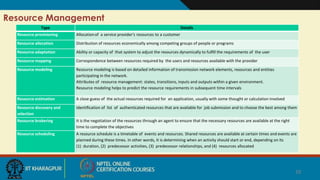
Resource Management
10
Type Details
Resource provisioning Allocationof a service provider's resources to a customer
Resource allocation Distribution of resources economically among competing groups of people or programs
Resource adaptation Ability or capacity of that system to adjust the resources dynamically to fulfill the requirements of the user
Resource mapping Correspondence between resources required by the users and resources available with the provider
Resource modeling Resource modeling is based on detailed information of transmission network elements, resources and entities
participating in the network.
Attributes of resource management: states, transitions, inputs and outputs within a given environment.
Resource modeling helps to predict the resource requirements in subsequent time intervals
Resource estimation A close guess of the actual resources required for an application, usually with some thought or calculation involved
Resource discovery and
selection
Identification of list of authenticated resources that are available for job submission and to choose the best among them
Resource brokering It is the negotiation of the resources through an agent to ensure that the necessary resources are available at the right
time to complete the objectives
Resource scheduling A resource schedule is a timetable of events and resources. Shared resources are available at certain times and events are
planned during these times. In other words, It is determining when an activity should start or end, depending on its
(1) duration, (2) predecessor activities, (3) predecessor relationships, and (4) resources allocated
11
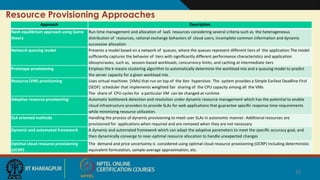
Resource Provisioning Approaches
11
Approach Description
Nash equilibrium approach using Game
theory
Run time management and allocation of IaaS resources considering several criteria such as the heterogeneous
distribution of resources, rational exchange behaviors of cloud users, incomplete common information and dynamic
successive allocation
Network queuing model Presents a model based on a network of queues, where the queues represent different tiers of the application.The model
sufficiently captures the behavior of tiers with significantly different performance characteristics and application
idiosyncrasies, such as, session-based workloads, concurrency limits, and caching at intermediate tiers
Prototype provisioning Employs the k-means clustering algorithm to automatically determine the workload mix and a queuing model to predict
the server capacity for a given workload mix.
Resource (VM) provisioning Uses virtual machines (VMs) that run on top of the Xen hypervisor. The system provides a Simple Earliest Deadline First
(SEDF) scheduler that implements weighted fair sharing of the CPU capacity among all the VMs
The share of CPU cycles for a particular VM can be changed at runtime
Adaptive resource provisioning Automatic bottleneck detection and resolution under dynamic resource management which has the potential to enable
cloud infrastructure providers to provide SLAs for web applications that guarantee specific response time requirements
while minimizing resource utilization.
SLA oriented methods Handling the process of dynamic provisioning to meet user SLAs in autonomic manner. Additional resources are
provisioned for applications when required and are removed when they are not necessary
Dynamic and automated framework A dynamic and automated framework which can adapt the adaptive parameters to meet the specific accuracy goal, and
then dynamically converge to near-optimal resource allocation to handle unexpected changes
Optimal cloud resource provisioning
(OCRP)
The demand and price uncertainty is considered using optimal cloud resource provisioning (OCRP) including deterministic
equivalent formulation, sample-average approximation, etc.
12
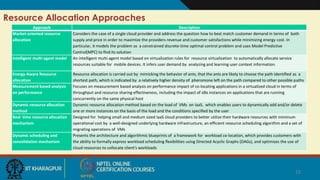
Resource Allocation Approaches
12
Approach Description
Market-oriented resource
allocation
Considers the case of a single cloud provider and address the question how to best match customer demand in terms of both
supply and price in order to maximize the providers revenue and customer satisfactions while minimizing energy cost. In
particular, it models the problem as a constrained discrete-time optimal control problem and uses Model Predictive
Control(MPC) to find its solution
Intelligent multi-agent model An intelligent multi-agent model based on virtualization rules for resource virtualization to automatically allocate service
resources suitable for mobile devices. It infers user demand by analyzing and learning user context information.
Energy-Aware Resource
allocation
Resource allocation is carried out by mimicking the behavior of ants, that the ants are likely to choose the path identified as a
shortest path, which is indicated by a relatively higher density of pheromone left on the path compared to other possible paths
Measurement based analysis
on performance
Focuses on measurement based analysis on performance impact of co-locating applications in a virtualized cloud in terms of
throughput and resource sharing effectiveness, including the impact of idle instances on applications that are running
concurrently on the same physical host
Dynamic resource allocation
method
Dynamic resource allocation method based on the load of VMs on IaaS, which enables users to dynamically add and/or delete
one or more instances on the basis of the load and the conditions specified by the user
Real time resource allocation
mechanism
Designed for helping small and medium sized IaaS cloud providers to better utilize their hardware resources with minimum
operational cost by a well-designed underlying hardware infrastructure, an efficient resource scheduling algorithm and a set of
migrating operations of VMs
Dynamic scheduling and
consolidation mechanism
Presents the architecture and algorithmic blueprints of a framework for workload co-location, which provides customers with
the ability to formally express workload scheduling flexibilities using Directed Acyclic Graphs (DAGs), and optimizes the use of
cloud resources to collocate client's workloads
13
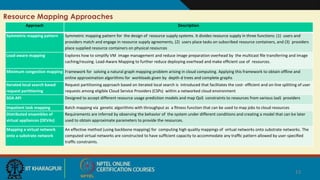
Resource Mapping Approaches
13
Approach Description
Symmetric mapping pattern Symmetric mapping pattern for the design of resource supply systems. It divides resource supply in three functions: (1) users and
providers match and engage in resource supply agreements, (2) users place tasks on subscribed resource containers, and (3) providers
place supplied resource containers on physical resources
Load-aware mapping Explores how to simplify VM image management and reduce image preparation overhead by the multicast file transferring and image
caching/reusing. Load-Aware Mapping to further reduce deploying overhead and make efficient use of resources.
Minimum congestion mapping Framework for solving a natural graph mapping problem arising in cloud computing. Applying this framework to obtain offline and
online approximation algorithms for workloads given by depth-d trees and complete graphs
Iterated local search based
request partitioning
Request partitioning approach based on iterated local search is introduced that facilitates the cost- efficient and on-line splitting of user
requests among eligible Cloud Service Providers (CSPs) within a networked cloud environment
SOA API Designed to accept different resource usage prediction models and map QoS constraints to resources from various IaaS providers
Impatient task mapping Batch mapping via genetic algorithms with throughput as a fitness function that can be used to map jobs to cloud resources
Distributed ensembles of
virtual appliances (DEVAs)
Requirements are inferred by observing the behavior of the system under different conditions and creating a model that can be later
used to obtain approximate parameters to provide the resources.
Mapping a virtual network
onto a substrate network
An effective method (using backbone mapping) for computing high quality mappings of virtual networks onto substrate networks. The
computed virtual networks are constructed to have sufficient capacity to accommodate any traffic pattern allowed by user-specified
traffic constraints.
14
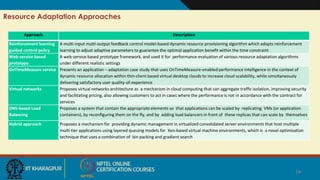
Resource Adaptation Approaches
14
Approach Description
Reinforcement learning
guided control policy
A multi-input multi-output feedback control model-based dynamic resource provisioning algorithm which adopts reinforcement
learning to adjust adaptive parameters to guarantee the optimal application benefit within the time constraint
Web-service based
prototype
A web-service based prototype framework, and used it for performance evaluation of various resource adaptation algorithms
under different realistic settings
OnTimeMeasure service Presents an application – adaptation case study that uses OnTimeMeasure-enabled performance intelligence in the context of
dynamic resource allocation within thin-client based virtual desktop clouds to increase cloud scalability, while simultaneously
delivering satisfactory user quality-of-experience
Virtual networks Proposes virtual networks architecture as a mechanism in cloud computing that can aggregate traffic isolation, improving security
and facilitating pricing, also allowing customers to act in cases where the performance is not in accordance with the contract for
services
DNS-based Load
Balancing
Proposes a system that contain the appropriate elements so that applications can be scaled by replicating VMs (or application
containers), by reconfiguring them on the fly, and by adding load balancers in front of these replicas that can scale by themselves
Hybrid approach Proposes a mechanism for providing dynamic management in virtualized consolidated server environments that host multiple
multi-tier applications using layered queuing models for Xen-based virtual machine environments, which is a novel optimization
technique that uses a combination of bin packing and gradient search
15
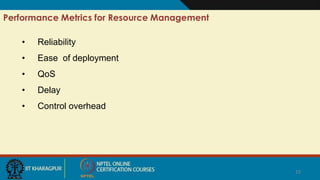
Performance Metrics for Resource Management
15
• Reliability
• Ease of deployment
• QoS
• Delay
• Control overhead
Thank you!

Mod05lec25(resource mgmt ii)

  • 1.
    CLOUD COMPUTING Resource Management- II PROF. SOUMYA K. GHOSH DEPARTMENT OF COMPUTER SCIENCE AND ENGINEERING IIT KHARAGPUR
  • 2.
    2 Different Resources inComputing Source: http://www.cse.hcmut.edu.vn/~ptvu/gc/2012/GC-pp.pdf
  • 3.
    3 Resources types Source: http://www.cse.hcmut.edu.vn/~ptvu/gc/2012/GC-pp.pdf •Physical resource  Computer, disk, database, network, scientific instruments. • Logical resource  Execution, monitoring, communicate application .
  • 4.
    4 Resources Management Source: http://www.cse.hcmut.edu.vn/~ptvu/gc/2012/GC-pp.pdf •The term resource management refers to the operations used to control how capabilities provided by Cloud resources and services cane be made available to other entities, whether users, applications, services in an efficient manner.
  • 5.
    5 Resource Management forIaaS • Infrastructure-as-a-Service (IaaS) is most popular cloud service • In IaaS, cloud providers offer resources that include computers as virtual machines, raw (block) storage, firewalls, load balancers, and network devices. • One of the major challenges in IaaS is resource management. 5 Source: http://www.zearon.com/down/Resource%20management%20for%20Infrastructure%20as%20a%20Service%20%28IaaS%29%20in%20cloud% 20computing%20A%20survey.pdf
  • 6.
    6 Resource Management -Objectives • Scalability • Quality of service • Optimal utility • Reduced overheads • Improved throughput • Reduced latency • Specialized environment • Cost effectiveness • Simplified interface 6
  • 7.
    7 Resource Management –Challenges (Hardware) • CPU (central processing unit) • Memory • Storage • Workstations • Network elements • Sensors/actuators 7
  • 8.
    8 • Operating system •Energy • Network throughput/bandwidth • Load balancing mechanisms • Information security • Delays • APIs/(Applications Programming Interfaces) • Protocols 8 Resource Management – Challenges (Logical resources)
  • 9.
    9 Resource Management Aspects •Resource provisioning • Resource allocation • Resource requirement mapping • Resource adaptation • Resource discovery • Resource brokering • Resource estimation • Resource modeling 9
  • 10.
    10 Resource Management 10 Type Details Resourceprovisioning Allocationof a service provider's resources to a customer Resource allocation Distribution of resources economically among competing groups of people or programs Resource adaptation Ability or capacity of that system to adjust the resources dynamically to fulfill the requirements of the user Resource mapping Correspondence between resources required by the users and resources available with the provider Resource modeling Resource modeling is based on detailed information of transmission network elements, resources and entities participating in the network. Attributes of resource management: states, transitions, inputs and outputs within a given environment. Resource modeling helps to predict the resource requirements in subsequent time intervals Resource estimation A close guess of the actual resources required for an application, usually with some thought or calculation involved Resource discovery and selection Identification of list of authenticated resources that are available for job submission and to choose the best among them Resource brokering It is the negotiation of the resources through an agent to ensure that the necessary resources are available at the right time to complete the objectives Resource scheduling A resource schedule is a timetable of events and resources. Shared resources are available at certain times and events are planned during these times. In other words, It is determining when an activity should start or end, depending on its (1) duration, (2) predecessor activities, (3) predecessor relationships, and (4) resources allocated
  • 11.
    11 Resource Provisioning Approaches 11 ApproachDescription Nash equilibrium approach using Game theory Run time management and allocation of IaaS resources considering several criteria such as the heterogeneous distribution of resources, rational exchange behaviors of cloud users, incomplete common information and dynamic successive allocation Network queuing model Presents a model based on a network of queues, where the queues represent different tiers of the application.The model sufficiently captures the behavior of tiers with significantly different performance characteristics and application idiosyncrasies, such as, session-based workloads, concurrency limits, and caching at intermediate tiers Prototype provisioning Employs the k-means clustering algorithm to automatically determine the workload mix and a queuing model to predict the server capacity for a given workload mix. Resource (VM) provisioning Uses virtual machines (VMs) that run on top of the Xen hypervisor. The system provides a Simple Earliest Deadline First (SEDF) scheduler that implements weighted fair sharing of the CPU capacity among all the VMs The share of CPU cycles for a particular VM can be changed at runtime Adaptive resource provisioning Automatic bottleneck detection and resolution under dynamic resource management which has the potential to enable cloud infrastructure providers to provide SLAs for web applications that guarantee specific response time requirements while minimizing resource utilization. SLA oriented methods Handling the process of dynamic provisioning to meet user SLAs in autonomic manner. Additional resources are provisioned for applications when required and are removed when they are not necessary Dynamic and automated framework A dynamic and automated framework which can adapt the adaptive parameters to meet the specific accuracy goal, and then dynamically converge to near-optimal resource allocation to handle unexpected changes Optimal cloud resource provisioning (OCRP) The demand and price uncertainty is considered using optimal cloud resource provisioning (OCRP) including deterministic equivalent formulation, sample-average approximation, etc.
  • 12.
    12 Resource Allocation Approaches 12 ApproachDescription Market-oriented resource allocation Considers the case of a single cloud provider and address the question how to best match customer demand in terms of both supply and price in order to maximize the providers revenue and customer satisfactions while minimizing energy cost. In particular, it models the problem as a constrained discrete-time optimal control problem and uses Model Predictive Control(MPC) to find its solution Intelligent multi-agent model An intelligent multi-agent model based on virtualization rules for resource virtualization to automatically allocate service resources suitable for mobile devices. It infers user demand by analyzing and learning user context information. Energy-Aware Resource allocation Resource allocation is carried out by mimicking the behavior of ants, that the ants are likely to choose the path identified as a shortest path, which is indicated by a relatively higher density of pheromone left on the path compared to other possible paths Measurement based analysis on performance Focuses on measurement based analysis on performance impact of co-locating applications in a virtualized cloud in terms of throughput and resource sharing effectiveness, including the impact of idle instances on applications that are running concurrently on the same physical host Dynamic resource allocation method Dynamic resource allocation method based on the load of VMs on IaaS, which enables users to dynamically add and/or delete one or more instances on the basis of the load and the conditions specified by the user Real time resource allocation mechanism Designed for helping small and medium sized IaaS cloud providers to better utilize their hardware resources with minimum operational cost by a well-designed underlying hardware infrastructure, an efficient resource scheduling algorithm and a set of migrating operations of VMs Dynamic scheduling and consolidation mechanism Presents the architecture and algorithmic blueprints of a framework for workload co-location, which provides customers with the ability to formally express workload scheduling flexibilities using Directed Acyclic Graphs (DAGs), and optimizes the use of cloud resources to collocate client's workloads
  • 13.
    13 Resource Mapping Approaches 13 ApproachDescription Symmetric mapping pattern Symmetric mapping pattern for the design of resource supply systems. It divides resource supply in three functions: (1) users and providers match and engage in resource supply agreements, (2) users place tasks on subscribed resource containers, and (3) providers place supplied resource containers on physical resources Load-aware mapping Explores how to simplify VM image management and reduce image preparation overhead by the multicast file transferring and image caching/reusing. Load-Aware Mapping to further reduce deploying overhead and make efficient use of resources. Minimum congestion mapping Framework for solving a natural graph mapping problem arising in cloud computing. Applying this framework to obtain offline and online approximation algorithms for workloads given by depth-d trees and complete graphs Iterated local search based request partitioning Request partitioning approach based on iterated local search is introduced that facilitates the cost- efficient and on-line splitting of user requests among eligible Cloud Service Providers (CSPs) within a networked cloud environment SOA API Designed to accept different resource usage prediction models and map QoS constraints to resources from various IaaS providers Impatient task mapping Batch mapping via genetic algorithms with throughput as a fitness function that can be used to map jobs to cloud resources Distributed ensembles of virtual appliances (DEVAs) Requirements are inferred by observing the behavior of the system under different conditions and creating a model that can be later used to obtain approximate parameters to provide the resources. Mapping a virtual network onto a substrate network An effective method (using backbone mapping) for computing high quality mappings of virtual networks onto substrate networks. The computed virtual networks are constructed to have sufficient capacity to accommodate any traffic pattern allowed by user-specified traffic constraints.
  • 14.
    14 Resource Adaptation Approaches 14 ApproachDescription Reinforcement learning guided control policy A multi-input multi-output feedback control model-based dynamic resource provisioning algorithm which adopts reinforcement learning to adjust adaptive parameters to guarantee the optimal application benefit within the time constraint Web-service based prototype A web-service based prototype framework, and used it for performance evaluation of various resource adaptation algorithms under different realistic settings OnTimeMeasure service Presents an application – adaptation case study that uses OnTimeMeasure-enabled performance intelligence in the context of dynamic resource allocation within thin-client based virtual desktop clouds to increase cloud scalability, while simultaneously delivering satisfactory user quality-of-experience Virtual networks Proposes virtual networks architecture as a mechanism in cloud computing that can aggregate traffic isolation, improving security and facilitating pricing, also allowing customers to act in cases where the performance is not in accordance with the contract for services DNS-based Load Balancing Proposes a system that contain the appropriate elements so that applications can be scaled by replicating VMs (or application containers), by reconfiguring them on the fly, and by adding load balancers in front of these replicas that can scale by themselves Hybrid approach Proposes a mechanism for providing dynamic management in virtualized consolidated server environments that host multiple multi-tier applications using layered queuing models for Xen-based virtual machine environments, which is a novel optimization technique that uses a combination of bin packing and gradient search
  • 15.
    15 Performance Metrics forResource Management 15 • Reliability • Ease of deployment • QoS • Delay • Control overhead
  • 16.