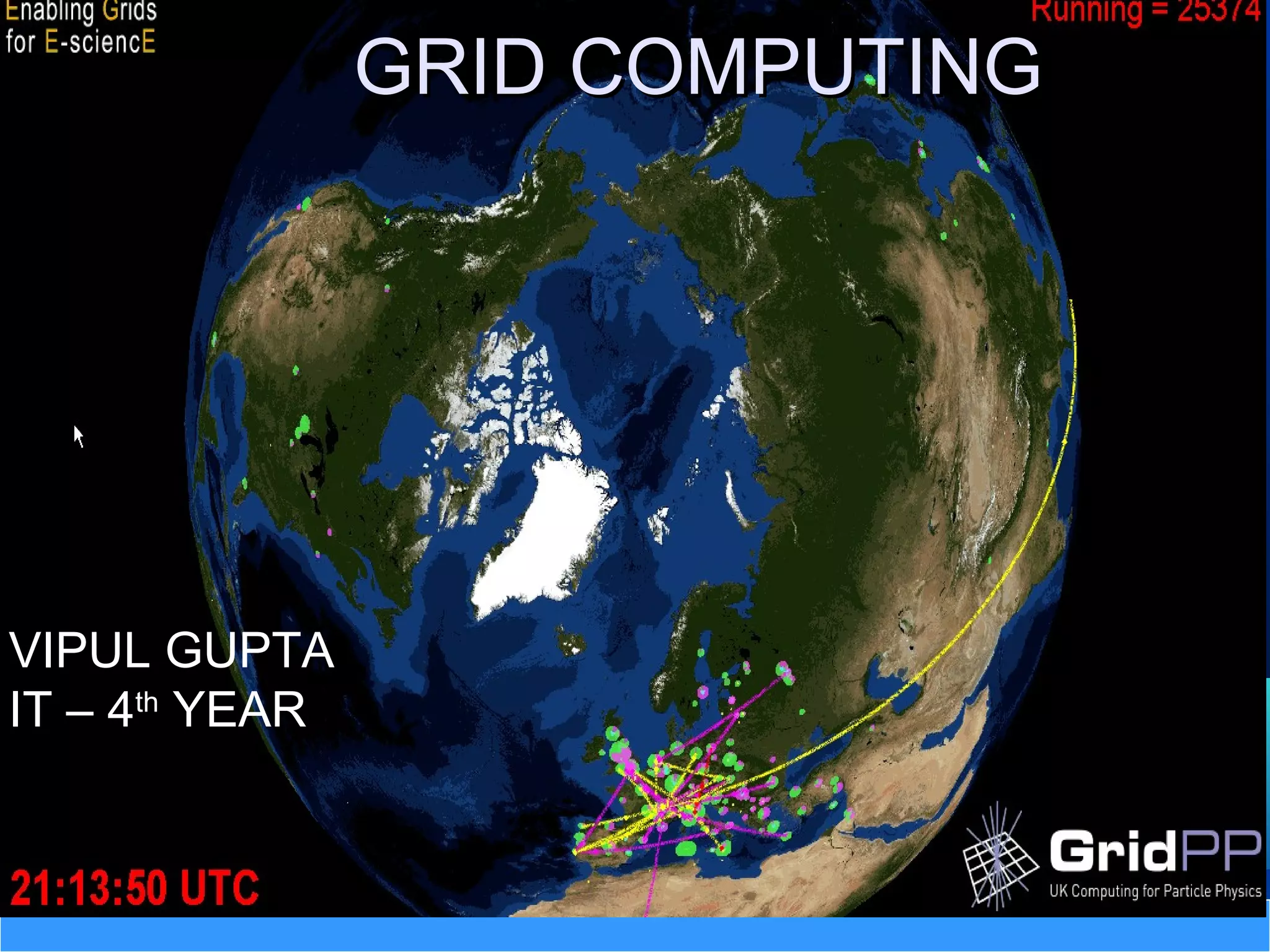
GRID COMPUTINGGRID COMPUTING
VIPUL GUPTA
IT – 4th
YEAR
• What is Grid Computing?
• Cousins of grid computing.
• Methods of grid computing.
• Who Needs It?
• Grid Users
• Companies involved in grid computing.
• Limitation of grid computing
• What’s Next ???
• Conclusion
OUTLINE
What is grid computing?What is grid computing?
• Grid computing involves connecting
geographically remote computers into a
single network to create a virtual
supercomputer by combining the
computational power of all computers on
grid.
• A network of geographically distributed
resources including computers,
peripherals, switches, instruments, and
data.
• Each user should have a single login
account to access all resources.
• Resources may be owned by diverse
organizations
55
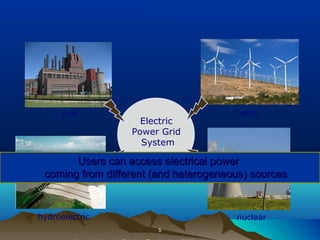
The power Grid paradigm
Electric
Power Grid
System
coal wind
hydroelectric nuclear
Users can access electrical powerUsers can access electrical power
coming from different (and heterogeneous) sourcescoming from different (and heterogeneous) sources
66
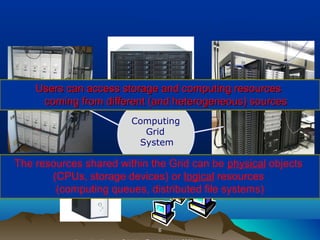
The computing Grid approach
Computing
Grid
System
Users can access storage and computing resourcesUsers can access storage and computing resources
coming from different (and heterogeneous) sourcescoming from different (and heterogeneous) sources
The resources shared within the Grid can be physical objects
(CPUs, storage devices) or logical resources
(computing queues, distributed file systems)
Fourth EELA Workshop,Fourth EELA Workshop,
Bogota, 05.03.2007Bogota, 05.03.2007 77
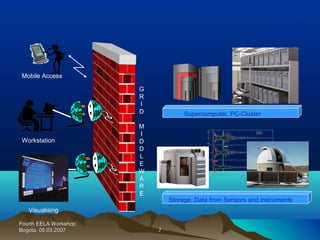
The Grid Metaphor
G
R
I
D
M
I
D
D
L
E
W
A
R
E
Visualising
Workstation
Mobile Access
Supercomputer, PC-Cluster
Storage, Data from Sensors and instruments
Cousins of Grid ComputingCousins of Grid Computing
 Distributed Computing
 Peer-to-Peer Computing etc.
 Distributed Computing
Distributed computing is most often
concerned with distributing the load of a
program across two or more processes
PEER2PEER ComputingPEER2PEER Computing
• Sharing of computer resources and
services by direct exchange between
systems.
• Computers can act as clients or servers
depending on what role is most efficient
for the network.
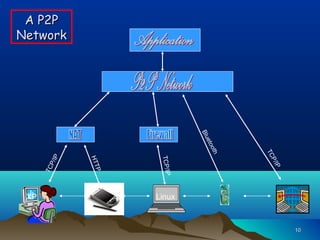
1010
Linux
TCP/IP
Bluetooth
HTTP
TCP/IP
TCP/IP
XP
A P2PA P2P
NetworkNetwork
Methods of Grid ComputingMethods of Grid Computing
• Distributed Supercomputing
• High-Throughput Computing
• On-Demand Computing
• Data-Intensive Computing
• Collaborative Computing
Who Needs Grid Computing?Who Needs Grid Computing?
• A chemist may utilize hundreds of
processors to screen thousands of
compounds per hour.
• Teams of engineers worldwide pool
resources to analyze terabytes of
structural data.
• Meteorologists seek to visualize and
analyze data of climate with enormous
computational demands.
Grid UsersGrid Users
• Grid developers
• Tool developers
• Application developers
• End Users
• System Administrators
Grid DevelopersGrid Developers
• Very small group.
• Implementers of a grid “protocol” who
provides the basic services required to
construct a grid.
Tool DevelopersTool Developers
• Implement the programming models used
by application developers.
• Implement basic services similar to
conventional computing services:
– User authentication/authorization
– Process management
– Data access and communication
Application DevelopersApplication Developers
• Construct grid-enabled applications for
end-users who should be able to use
these applications without concern for the
underlying grid.
• Provide programming models that are
appropriate for grid environments and
services that programmers can rely on
when developing (higher-level)
applications.
System AdministratorsSystem Administrators
• Balance local and global concerns.
• Manage grid components and
infrastructure.
• Some tasks still not well delineated due to
the high degree of sharing required.
SoftwareSoftware infrastructureinfrastructure
• Globus
• Condor
• NetSolve
1919
Companies involved in GridCompanies involved in Grid
ComputingComputing
• Avaki
• Axceleon
• CapCal
• Centrata
• DataSynapse
• Distributed Science
• Elepar
• Entropia.com
• Grid Frastructure
• GridSystems
• Groove Networks
• IBM
• Intel
 Powerllel
 ProcessTree
 Sharman Networks Kazza
 Sun Gridware
 Sysnet Solutions
 Tsunami Research
 Ubero
 United Devices
 Veritas
 Xcomp
 Jivalti
 Mithral
 Mind Electric
 Mojo Nation
 NewsToYou.com
 NICE, Italy
 Noemix, Inc.
 Oracle
 Parabon
 Platform Computing
 Popular Power
Source: http://www.gridcomputing.com/
Limitations of Grid ComputingLimitations of Grid Computing
• Efforts are being made to standardize protocols.
• Uses a command-line interface.
• Requires programming in a language and using
a host of libraries for interacting with Open Grid
Services Infrastructure.
• Our hope is to create an interface to Grid
computing that accomplishes what Internet
browsers (Netscape and Internet Explorer) did to
open up the WWW
What’s Next?What’s Next?
• More “filters” to transform data need to be
developed and tested
• Fancier graphics may be added to the
GUIs
• Extend Grid to include more software
applications
• Extend Grid services to other disciplines
• Include industry and businesses as users
and developers
CONCLUSIONCONCLUSION
• Grid Computing involves cost savings, speed of
computation, and agility.
• The grid adjusts to accommodate the fluctuating
data volumes that are a typical in the seasonal
business.
THANK YOU….THANK YOU….

Grid computing

  • 1.
  • 2.
    • What isGrid Computing? • Cousins of grid computing. • Methods of grid computing. • Who Needs It? • Grid Users • Companies involved in grid computing. • Limitation of grid computing • What’s Next ??? • Conclusion OUTLINE
  • 3.
    What is gridcomputing?What is grid computing? • Grid computing involves connecting geographically remote computers into a single network to create a virtual supercomputer by combining the computational power of all computers on grid.
  • 4.
    • A networkof geographically distributed resources including computers, peripherals, switches, instruments, and data. • Each user should have a single login account to access all resources. • Resources may be owned by diverse organizations
  • 5.
    55 The power Gridparadigm Electric Power Grid System coal wind hydroelectric nuclear Users can access electrical powerUsers can access electrical power coming from different (and heterogeneous) sourcescoming from different (and heterogeneous) sources
  • 6.
    66 The computing Gridapproach Computing Grid System Users can access storage and computing resourcesUsers can access storage and computing resources coming from different (and heterogeneous) sourcescoming from different (and heterogeneous) sources The resources shared within the Grid can be physical objects (CPUs, storage devices) or logical resources (computing queues, distributed file systems)
  • 7.
    Fourth EELA Workshop,FourthEELA Workshop, Bogota, 05.03.2007Bogota, 05.03.2007 77 The Grid Metaphor G R I D M I D D L E W A R E Visualising Workstation Mobile Access Supercomputer, PC-Cluster Storage, Data from Sensors and instruments
  • 8.
    Cousins of GridComputingCousins of Grid Computing  Distributed Computing  Peer-to-Peer Computing etc.  Distributed Computing Distributed computing is most often concerned with distributing the load of a program across two or more processes
  • 9.
    PEER2PEER ComputingPEER2PEER Computing •Sharing of computer resources and services by direct exchange between systems. • Computers can act as clients or servers depending on what role is most efficient for the network.
  • 10.
  • 11.
    Methods of GridComputingMethods of Grid Computing • Distributed Supercomputing • High-Throughput Computing • On-Demand Computing • Data-Intensive Computing • Collaborative Computing
  • 12.
    Who Needs GridComputing?Who Needs Grid Computing? • A chemist may utilize hundreds of processors to screen thousands of compounds per hour. • Teams of engineers worldwide pool resources to analyze terabytes of structural data. • Meteorologists seek to visualize and analyze data of climate with enormous computational demands.
  • 13.
    Grid UsersGrid Users •Grid developers • Tool developers • Application developers • End Users • System Administrators
  • 14.
    Grid DevelopersGrid Developers •Very small group. • Implementers of a grid “protocol” who provides the basic services required to construct a grid.
  • 15.
    Tool DevelopersTool Developers •Implement the programming models used by application developers. • Implement basic services similar to conventional computing services: – User authentication/authorization – Process management – Data access and communication
  • 16.
    Application DevelopersApplication Developers •Construct grid-enabled applications for end-users who should be able to use these applications without concern for the underlying grid. • Provide programming models that are appropriate for grid environments and services that programmers can rely on when developing (higher-level) applications.
  • 17.
    System AdministratorsSystem Administrators •Balance local and global concerns. • Manage grid components and infrastructure. • Some tasks still not well delineated due to the high degree of sharing required.
  • 18.
  • 19.
    1919 Companies involved inGridCompanies involved in Grid ComputingComputing • Avaki • Axceleon • CapCal • Centrata • DataSynapse • Distributed Science • Elepar • Entropia.com • Grid Frastructure • GridSystems • Groove Networks • IBM • Intel  Powerllel  ProcessTree  Sharman Networks Kazza  Sun Gridware  Sysnet Solutions  Tsunami Research  Ubero  United Devices  Veritas  Xcomp  Jivalti  Mithral  Mind Electric  Mojo Nation  NewsToYou.com  NICE, Italy  Noemix, Inc.  Oracle  Parabon  Platform Computing  Popular Power Source: http://www.gridcomputing.com/
  • 20.
    Limitations of GridComputingLimitations of Grid Computing • Efforts are being made to standardize protocols. • Uses a command-line interface. • Requires programming in a language and using a host of libraries for interacting with Open Grid Services Infrastructure. • Our hope is to create an interface to Grid computing that accomplishes what Internet browsers (Netscape and Internet Explorer) did to open up the WWW
  • 21.
    What’s Next?What’s Next? •More “filters” to transform data need to be developed and tested • Fancier graphics may be added to the GUIs • Extend Grid to include more software applications • Extend Grid services to other disciplines • Include industry and businesses as users and developers
  • 22.
    CONCLUSIONCONCLUSION • Grid Computinginvolves cost savings, speed of computation, and agility. • The grid adjusts to accommodate the fluctuating data volumes that are a typical in the seasonal business.
  • 23.