CLOUD COMPUTING
CLOUD SECURITY III
PROF. SOUMYA K. GHOSH
DEPARTMENT OF COMPUTER SCIENCE AND ENGINEERING
IIT KHARAGPUR
Research Article
• Research Paper:
– Hey, You, Get Off of My Cloud! Exploring Information Leakage in Third-Party
Compute Clouds. by Thomas Ristenpart, Eran Tromer, Hovav Shacham, and
Stefan Savage. In Proceedings of CCS 2009, pages 199–212. ACM Press, Nov.
2009.
– First work on cloud cartography
• Attack launched against commercially available “real” cloud (Amazon
EC2)
• Claims up to 40% success in co-residence with target VM
2
New Risks in Cloud
• Trust and dependence
– Establishing new trust relationship between customer and cloud provider
– Customers must trust their cloud providers to respect the privacy of their data
and integrity of their computations
• Security (multi-tenancy)
– Threats from other customers due to the subtleties of how physical resources
can be transparently shared between virtual machines (VMs)
3
Multi-tenancy
• Multiplexing VMs of disjoint customers upon the same physical hardware
– Your machine is placed on the same server with other customers
– Problem: you don’t have the control to prevent your instance from being co-resident with an adversary
• New risks
– Side-channels exploitation
• Cross-VM information leakage due to sharing of physical resource (e.g., CPU’s data caches)
• Has the potential to extract RSA & AES secret keys
– Vulnerable VM isolation mechanisms
• Via a vulnerability that allows an “escape” to the hypervisor
– Lack of control who you’re sharing server space
4
Attack Model
• Motivation
– To study practicality of mounting cross-VM attacks in existing third-party compute clouds
• Experiments have been carried out on real IaaS cloud service provider (Amazon
EC2)
• Two steps of attack:
– Placement: adversary arranging to place its malicious VM on the same physical machine as that of
the target customer
– Extraction: extract confidential information via side channel attack
5
Threat Model
• Assumptions of the threat model:
– Provider and infrastructure to be trusted
– Do not consider attacks that rely on subverting administrator functions
– Do not exploit vulnerabilities of the virtual machine monitor and/or other software
– Adversaries: non-providers-affiliated malicious parties
– Victims: users running confidentiality-requiring services in the cloud
• Focus on new cloud-related capabilities of the attacker and implicitly
expanding the attack surface
6
Threat Model (contd…)
• Like any customer, the malicious party can run and control many
instances in the cloud
– Maximum of 20 instances can be run parallel using an Amazon EC2 account
• Attacker’s instance might be placed on the same physical hardware as
potential victims
• Attack might manipulate shared physical resources to learn otherwise
confidential information
• Two kinds of attack may take place:
– Attack on some known hosted service
– Attacking a particular victim’s service
7
Addresses the Following…
• Q1: Can one determine where in the cloud infrastructure an instance is
located?
• Q2: Can one easily determine if two instances are co-resident on the same
physical machine?
• Q3: Can an adversary launch instances that will be co-resident with other
user’s instances?
• Q4: Can an adversary exploit cross-VM information leakage once co-
resident?
8
Amazon EC2 Service
• Scalable, pay-as-you-go compute capacity in the cloud
• Customers can run different operating systems within a virtual machine
• Three degrees of freedom: instance-type, region, availability zone
• Different computing options (instances) available
– m1.small, c1. medium: 32-bit architecture
– m1.large, m1.xlarge, c1.xlarge: 64-bit architecture
• Different regions available
– US, EU, Asia
• Regions split into availability zones
– In US: East (Virginia), West (Oregon), West (Northern California)
– Infrastructures with separate power and network connectivity
• Customers randomly assigned to physical machines based on their instance, region, and availability
zone choices
9
Amazon EC2 Service (contd…)
• Xen hypervisor
– Domain0 (Dom0): privileged virtual machine
• Manages guest images
• Provisions physical resources
• Access control rights
• Configured to route packets for its guest images and reports itself as a hop in traceroutes.
– When an instance is launched, it is assigned to a single physical machine for its lifetime
• Each instance is assigned internal and external IP addresses and domain names
– External IP: public IPv4 address [IP: 75.101.210.100/domain name: ec2-75-101-210-100.compute-1.amazonaws.com]
– Internal IP: RFC 1918 private address [IP: 10.252.146.52/domain name: domU-12-31-38-00-8D-C6.compute-1.internal]
• Within the cloud, both domain names resolve to the internal IP address
• Outside the cloud, external name is mapped to the external IP address
10
Q1: Cloud Cartography
• Instance placing is not disclosed by Amazon but is needed to launch co-
residency attack
• Map the EC2 service to understand where potential targets are located in the
cloud
• Determine instance creation parameters needed to attempt establishing co-
residence of an adversarial instance
• Hypothesis: different availability zones and instance types correspond to
different IP address ranges
11
Network Probing
• Identify public servers hosted in EC2 and verify co-residence
• Open-source tools have been used to probe ports (80 and 443)
– nmap – perform TCP connect probes (attempt to complete a 3-way hand-shake between a source and target)
– hping – perform TCP SYN traceroutes, which iteratively sends TCP SYN packets with increasing TTLs, until no ACK is
received
– wget – used to retrieve web pages
• External probe: probe originating from a system outside EC2 and has an EC2 instance as
destination
• Internal probe: originates from an EC2 instance, and has destination another EC2 instance
• Given an external IP address, DNS resolution queries are used to determine:
– External name
– Internal IP address
12
Survey Public Servers on EC2
• Goal: to enable identification of the instance type and availability zone of one or more potential targets
• WHOIS: used to identify distinct IP address prefixes associated with EC2
• EC2 public IPs: /17, /18, /19 prefixes
– 57344 IP addresses
• Use external probes to find responsive IPs:
– Performed TCP connect probe on port 80
• 11315 responsive IPs
– Followed up with wget on port 80
• 9558 responsive IPs
– Performed a TCP scan on port 443
• 8375 responsive IPs
• Used DNS lookup service
– Translate each public IP address that responded to either the port 80 or 443 scan into an internal EC2 address
– 14054 unique internal IPs obtained
13
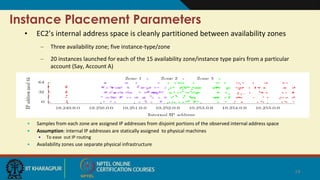
Instance Placement Parameters
• EC2’s internal address space is cleanly partitioned between availability zones
– Three availability zone; five instance-type/zone
– 20 instances launched for each of the 15 availability zone/instance type pairs from a particular
account (Say, Account A)
 Samples from each zone are assigned IP addresses from disjoint portions of the observed internal address space
 Assumption: internal IP addresses are statically assigned to physical machines
 To ease out IP routing
 Availability zones use separate physical infrastructure
14
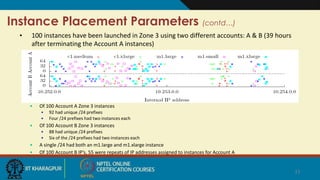
Instance Placement Parameters (contd…)
• 100 instances have been launched in Zone 3 using two different accounts: A & B (39 hours
after terminating the Account A instances)
 Of 100 Account A Zone 3 instances
 92 had unique /24 prefixes
 Four /24 prefixes had two instances each
 Of 100 Account B Zone 3 instances
 88 had unique /24 prefixes
 Six of the /24 prefixes had two instances each
 A single /24 had both an m1.large and m1.xlarge instance
 Of 100 Account B IP’s, 55 were repeats of IP addresses assigned to instances for Account A
15
Q2: Determining Co-residence
• Network-based co-residency checks: instances are likely to be co-
resident if they have-
– Matching Dom0 IP address: determine an uncontrolled instance’s Dom0 IP by
performing a TCP SYN traceroute to it from another instance and inspect the last hop
– Small packet round-trip times: 10 probes were performed and the average is taken
– Numerically close internal IP addresses (e.g., within 7): the same Dom0 IP will be
shared by instances with contiguous sequence of internal IP addresses
16
Verifying Co-residency Check
• If two (under self-control) instances can successfully transmit via the covert channel, then they
are co-resident, otherwise not
• Experiment: hard-disk-based covert channel
– To send a 1, sender reads from random locations on a shared volume, to send a 0 sender does nothing
– Receiver times reading from a fixed location on the disk: longer read times mean a 1 is set, shorter a 0
• 3 m1.small EC2 accounts: control, victim, probe
– 2 control instances in each of 3 availability zones, 20 victim and 20 probe instances in Zone 3
• Determine Dom0 address for each instance
• For each ordered pair (A, B) of 40 instances, perform co-residency checks
• After 3 independent trials, 31 (potentially) co-resident pairs have been identified - 62 ordered
pairs
• 5 bit message from A to B was successfully sent for 60 out of 62 ordered pairs
17
Effective Co-residency Check
• For checking co-residence with target instances:
– Compare internal IP addresses to see if they are close
– If yes, perform a TCP SYN traceroute to an open port on the target and see if
there is only a single hop (Dom0 IP)
• Check requires sending (at most) two TCP SYN packets
– No full TCP connection is established
• Very “quiet” check (little communication with the victim)
18
Q3: Causing Co-residence
• Two strategies to achieve “good” coverage (co-residence with a
good fraction of target set)
– Brute-force placement:
• run numerous probe instances over a long period of time and see how many targets one can
achieve co-residence with.
• For co-residency check, the probe performed a wget on port 80 to ensure the target was still
serving web pages
• Of the 1686 target victims, the brute-force probes achieved co-residency with 141 victim
servers (8.4% coverage)
• Even a naïve strategy can successfully achieve co-residence against a not-so-small fraction of
targets
– Target recently launched instances:
• take advantage of the tendency of EC2 to assign fresh instances to small set of machines
19
Leveraging Placement Locality
• Placement locality
– Instances launched simultaneously from same account do not run on the same physical machine
– Sequential placement locality: exists when two instances run sequentially (the first terminated before
launching the second) are often assigned to the same machine
– Parallel placement locality: exists when two instances run (from distinct accounts) at roughly the same time
are often assigned to the same machine.
• Instance flooding: launch lots of instances in parallel in the appropriate availability zone
and of the appropriate type
20
Leveraging Placement Locality (contd…)
• Experiment
– Single victim instance is launched
– Attacker launches 20 instances within 5 minutes
– Perform co-residence check
– 40% of the time the attacker launching just 20 probes achieves co-residence against a specific target
instance
21
Q4: Exploiting Co-residence
• Cross-VM attacks can allow for information leakage
• How can we exploit the shared infrastructure?
– Gain information about the resource usage of other instances
– Create and use covert channels to intentionally leak information from one instance to
another
– Some applications of this covert channel are:
• Co-residence detection
• Surreptitious detection of the rate of web traffic a co-resident site receives
• Timing keystrokes by an honest user of a co-resident instance
22
Exploiting Co-residence (contd…)
• Measuring cache usage
– Time-shared cache allows an attacker to measure when other instances are
experiencing computational load
– Load measurement: allocate a contiguous buffer B of b bytes, s is cache line size (in
bytes)
• Prime: read B at s-byte offsets in order to ensure that it is cached.
• Trigger: busy-loop until CPU’s cycle counter jumps by a large value
• Probe: measure the time it takes to again read B at s-byte offset
– Cache-based covert channel:
• Sender idles to transmit a 0 and frantically accesses memory to transmit a 1
• Receiver accesses a memory block and observes the access latencies
• High latencies are indicative that “1” is transmitted
23
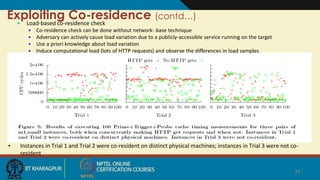
Exploiting Co-residence (contd…)
• Instances in Trial 1 and Trial 2 were co-resident on distinct physical machines; instances in Trial 3 were not co-
resident
 Load-based co-residence check
 Co-residence check can be done without network- base technique
 Adversary can actively cause load variation due to a publicly-accessible service running on the target
 Use a priori knowledge about load variation
 Induce computational load (lots of HTTP requests) and observe the differences in load samples
24
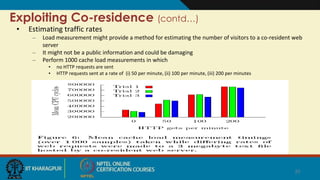
Exploiting Co-residence (contd…)
• Estimating traffic rates
– Load measurement might provide a method for estimating the number of visitors to a co-resident web
server
– It might not be a public information and could be damaging
– Perform 1000 cache load measurements in which
• no HTTP requests are sent
• HTTP requests sent at a rate of (i) 50 per minute, (ii) 100 per minute, (iii) 200 per minutes
25
Exploiting Co-residence (contd…)
• Keystroke timing attack
– The goal is to measure the time between keystrokes made by a victim typing a
password (or other sensitive information)
– Malicious VM can observe keystroke timing in real time via cache-based load
measurements
– Inter-keystroke times if properly measures can be used to perform recovery of the
password
– In an otherwise idle machine, a spike in load corresponds to a letter being typed
into the co-resident VM’s terminal
– Attacker does not directly learn exactly which keys are pressed, the attained
timing resolution suffices to conduct the password-recovery attacks on SSH
sessions
26
Preventive Measures
• Mapping
– Use a randomized scheme to allocate IP addresses
– Block some tools (nmap, traceroute)
• Co-residence checks
– Prevent identification of Dom0
• Co-location
– Not allow co-residence at all
• Beneficial for cloud user
• Not efficient for cloud provider
• Information leakage via side-channel
– No solution
27
Summary
• New risks from cloud computing
• Shared physical infrastructure may and most likely will cause
problems
– Exploiting software vulnerabilities not addressed here
• Practical attack performed
• Some countermeasures proposed
28
29
Thank You!
29

Lecture28 cc-security3

  • 1.
    CLOUD COMPUTING CLOUD SECURITYIII PROF. SOUMYA K. GHOSH DEPARTMENT OF COMPUTER SCIENCE AND ENGINEERING IIT KHARAGPUR
  • 2.
    Research Article • ResearchPaper: – Hey, You, Get Off of My Cloud! Exploring Information Leakage in Third-Party Compute Clouds. by Thomas Ristenpart, Eran Tromer, Hovav Shacham, and Stefan Savage. In Proceedings of CCS 2009, pages 199–212. ACM Press, Nov. 2009. – First work on cloud cartography • Attack launched against commercially available “real” cloud (Amazon EC2) • Claims up to 40% success in co-residence with target VM 2
  • 3.
    New Risks inCloud • Trust and dependence – Establishing new trust relationship between customer and cloud provider – Customers must trust their cloud providers to respect the privacy of their data and integrity of their computations • Security (multi-tenancy) – Threats from other customers due to the subtleties of how physical resources can be transparently shared between virtual machines (VMs) 3
  • 4.
    Multi-tenancy • Multiplexing VMsof disjoint customers upon the same physical hardware – Your machine is placed on the same server with other customers – Problem: you don’t have the control to prevent your instance from being co-resident with an adversary • New risks – Side-channels exploitation • Cross-VM information leakage due to sharing of physical resource (e.g., CPU’s data caches) • Has the potential to extract RSA & AES secret keys – Vulnerable VM isolation mechanisms • Via a vulnerability that allows an “escape” to the hypervisor – Lack of control who you’re sharing server space 4
  • 5.
    Attack Model • Motivation –To study practicality of mounting cross-VM attacks in existing third-party compute clouds • Experiments have been carried out on real IaaS cloud service provider (Amazon EC2) • Two steps of attack: – Placement: adversary arranging to place its malicious VM on the same physical machine as that of the target customer – Extraction: extract confidential information via side channel attack 5
  • 6.
    Threat Model • Assumptionsof the threat model: – Provider and infrastructure to be trusted – Do not consider attacks that rely on subverting administrator functions – Do not exploit vulnerabilities of the virtual machine monitor and/or other software – Adversaries: non-providers-affiliated malicious parties – Victims: users running confidentiality-requiring services in the cloud • Focus on new cloud-related capabilities of the attacker and implicitly expanding the attack surface 6
  • 7.
    Threat Model (contd…) •Like any customer, the malicious party can run and control many instances in the cloud – Maximum of 20 instances can be run parallel using an Amazon EC2 account • Attacker’s instance might be placed on the same physical hardware as potential victims • Attack might manipulate shared physical resources to learn otherwise confidential information • Two kinds of attack may take place: – Attack on some known hosted service – Attacking a particular victim’s service 7
  • 8.
    Addresses the Following… •Q1: Can one determine where in the cloud infrastructure an instance is located? • Q2: Can one easily determine if two instances are co-resident on the same physical machine? • Q3: Can an adversary launch instances that will be co-resident with other user’s instances? • Q4: Can an adversary exploit cross-VM information leakage once co- resident? 8
  • 9.
    Amazon EC2 Service •Scalable, pay-as-you-go compute capacity in the cloud • Customers can run different operating systems within a virtual machine • Three degrees of freedom: instance-type, region, availability zone • Different computing options (instances) available – m1.small, c1. medium: 32-bit architecture – m1.large, m1.xlarge, c1.xlarge: 64-bit architecture • Different regions available – US, EU, Asia • Regions split into availability zones – In US: East (Virginia), West (Oregon), West (Northern California) – Infrastructures with separate power and network connectivity • Customers randomly assigned to physical machines based on their instance, region, and availability zone choices 9
  • 10.
    Amazon EC2 Service(contd…) • Xen hypervisor – Domain0 (Dom0): privileged virtual machine • Manages guest images • Provisions physical resources • Access control rights • Configured to route packets for its guest images and reports itself as a hop in traceroutes. – When an instance is launched, it is assigned to a single physical machine for its lifetime • Each instance is assigned internal and external IP addresses and domain names – External IP: public IPv4 address [IP: 75.101.210.100/domain name: ec2-75-101-210-100.compute-1.amazonaws.com] – Internal IP: RFC 1918 private address [IP: 10.252.146.52/domain name: domU-12-31-38-00-8D-C6.compute-1.internal] • Within the cloud, both domain names resolve to the internal IP address • Outside the cloud, external name is mapped to the external IP address 10
  • 11.
    Q1: Cloud Cartography •Instance placing is not disclosed by Amazon but is needed to launch co- residency attack • Map the EC2 service to understand where potential targets are located in the cloud • Determine instance creation parameters needed to attempt establishing co- residence of an adversarial instance • Hypothesis: different availability zones and instance types correspond to different IP address ranges 11
  • 12.
    Network Probing • Identifypublic servers hosted in EC2 and verify co-residence • Open-source tools have been used to probe ports (80 and 443) – nmap – perform TCP connect probes (attempt to complete a 3-way hand-shake between a source and target) – hping – perform TCP SYN traceroutes, which iteratively sends TCP SYN packets with increasing TTLs, until no ACK is received – wget – used to retrieve web pages • External probe: probe originating from a system outside EC2 and has an EC2 instance as destination • Internal probe: originates from an EC2 instance, and has destination another EC2 instance • Given an external IP address, DNS resolution queries are used to determine: – External name – Internal IP address 12
  • 13.
    Survey Public Serverson EC2 • Goal: to enable identification of the instance type and availability zone of one or more potential targets • WHOIS: used to identify distinct IP address prefixes associated with EC2 • EC2 public IPs: /17, /18, /19 prefixes – 57344 IP addresses • Use external probes to find responsive IPs: – Performed TCP connect probe on port 80 • 11315 responsive IPs – Followed up with wget on port 80 • 9558 responsive IPs – Performed a TCP scan on port 443 • 8375 responsive IPs • Used DNS lookup service – Translate each public IP address that responded to either the port 80 or 443 scan into an internal EC2 address – 14054 unique internal IPs obtained 13
  • 14.
    Instance Placement Parameters •EC2’s internal address space is cleanly partitioned between availability zones – Three availability zone; five instance-type/zone – 20 instances launched for each of the 15 availability zone/instance type pairs from a particular account (Say, Account A)  Samples from each zone are assigned IP addresses from disjoint portions of the observed internal address space  Assumption: internal IP addresses are statically assigned to physical machines  To ease out IP routing  Availability zones use separate physical infrastructure 14
  • 15.
    Instance Placement Parameters(contd…) • 100 instances have been launched in Zone 3 using two different accounts: A & B (39 hours after terminating the Account A instances)  Of 100 Account A Zone 3 instances  92 had unique /24 prefixes  Four /24 prefixes had two instances each  Of 100 Account B Zone 3 instances  88 had unique /24 prefixes  Six of the /24 prefixes had two instances each  A single /24 had both an m1.large and m1.xlarge instance  Of 100 Account B IP’s, 55 were repeats of IP addresses assigned to instances for Account A 15
  • 16.
    Q2: Determining Co-residence •Network-based co-residency checks: instances are likely to be co- resident if they have- – Matching Dom0 IP address: determine an uncontrolled instance’s Dom0 IP by performing a TCP SYN traceroute to it from another instance and inspect the last hop – Small packet round-trip times: 10 probes were performed and the average is taken – Numerically close internal IP addresses (e.g., within 7): the same Dom0 IP will be shared by instances with contiguous sequence of internal IP addresses 16
  • 17.
    Verifying Co-residency Check •If two (under self-control) instances can successfully transmit via the covert channel, then they are co-resident, otherwise not • Experiment: hard-disk-based covert channel – To send a 1, sender reads from random locations on a shared volume, to send a 0 sender does nothing – Receiver times reading from a fixed location on the disk: longer read times mean a 1 is set, shorter a 0 • 3 m1.small EC2 accounts: control, victim, probe – 2 control instances in each of 3 availability zones, 20 victim and 20 probe instances in Zone 3 • Determine Dom0 address for each instance • For each ordered pair (A, B) of 40 instances, perform co-residency checks • After 3 independent trials, 31 (potentially) co-resident pairs have been identified - 62 ordered pairs • 5 bit message from A to B was successfully sent for 60 out of 62 ordered pairs 17
  • 18.
    Effective Co-residency Check •For checking co-residence with target instances: – Compare internal IP addresses to see if they are close – If yes, perform a TCP SYN traceroute to an open port on the target and see if there is only a single hop (Dom0 IP) • Check requires sending (at most) two TCP SYN packets – No full TCP connection is established • Very “quiet” check (little communication with the victim) 18
  • 19.
    Q3: Causing Co-residence •Two strategies to achieve “good” coverage (co-residence with a good fraction of target set) – Brute-force placement: • run numerous probe instances over a long period of time and see how many targets one can achieve co-residence with. • For co-residency check, the probe performed a wget on port 80 to ensure the target was still serving web pages • Of the 1686 target victims, the brute-force probes achieved co-residency with 141 victim servers (8.4% coverage) • Even a naïve strategy can successfully achieve co-residence against a not-so-small fraction of targets – Target recently launched instances: • take advantage of the tendency of EC2 to assign fresh instances to small set of machines 19
  • 20.
    Leveraging Placement Locality •Placement locality – Instances launched simultaneously from same account do not run on the same physical machine – Sequential placement locality: exists when two instances run sequentially (the first terminated before launching the second) are often assigned to the same machine – Parallel placement locality: exists when two instances run (from distinct accounts) at roughly the same time are often assigned to the same machine. • Instance flooding: launch lots of instances in parallel in the appropriate availability zone and of the appropriate type 20
  • 21.
    Leveraging Placement Locality(contd…) • Experiment – Single victim instance is launched – Attacker launches 20 instances within 5 minutes – Perform co-residence check – 40% of the time the attacker launching just 20 probes achieves co-residence against a specific target instance 21
  • 22.
    Q4: Exploiting Co-residence •Cross-VM attacks can allow for information leakage • How can we exploit the shared infrastructure? – Gain information about the resource usage of other instances – Create and use covert channels to intentionally leak information from one instance to another – Some applications of this covert channel are: • Co-residence detection • Surreptitious detection of the rate of web traffic a co-resident site receives • Timing keystrokes by an honest user of a co-resident instance 22
  • 23.
    Exploiting Co-residence (contd…) •Measuring cache usage – Time-shared cache allows an attacker to measure when other instances are experiencing computational load – Load measurement: allocate a contiguous buffer B of b bytes, s is cache line size (in bytes) • Prime: read B at s-byte offsets in order to ensure that it is cached. • Trigger: busy-loop until CPU’s cycle counter jumps by a large value • Probe: measure the time it takes to again read B at s-byte offset – Cache-based covert channel: • Sender idles to transmit a 0 and frantically accesses memory to transmit a 1 • Receiver accesses a memory block and observes the access latencies • High latencies are indicative that “1” is transmitted 23
  • 24.
    Exploiting Co-residence (contd…) •Instances in Trial 1 and Trial 2 were co-resident on distinct physical machines; instances in Trial 3 were not co- resident  Load-based co-residence check  Co-residence check can be done without network- base technique  Adversary can actively cause load variation due to a publicly-accessible service running on the target  Use a priori knowledge about load variation  Induce computational load (lots of HTTP requests) and observe the differences in load samples 24
  • 25.
    Exploiting Co-residence (contd…) •Estimating traffic rates – Load measurement might provide a method for estimating the number of visitors to a co-resident web server – It might not be a public information and could be damaging – Perform 1000 cache load measurements in which • no HTTP requests are sent • HTTP requests sent at a rate of (i) 50 per minute, (ii) 100 per minute, (iii) 200 per minutes 25
  • 26.
    Exploiting Co-residence (contd…) •Keystroke timing attack – The goal is to measure the time between keystrokes made by a victim typing a password (or other sensitive information) – Malicious VM can observe keystroke timing in real time via cache-based load measurements – Inter-keystroke times if properly measures can be used to perform recovery of the password – In an otherwise idle machine, a spike in load corresponds to a letter being typed into the co-resident VM’s terminal – Attacker does not directly learn exactly which keys are pressed, the attained timing resolution suffices to conduct the password-recovery attacks on SSH sessions 26
  • 27.
    Preventive Measures • Mapping –Use a randomized scheme to allocate IP addresses – Block some tools (nmap, traceroute) • Co-residence checks – Prevent identification of Dom0 • Co-location – Not allow co-residence at all • Beneficial for cloud user • Not efficient for cloud provider • Information leakage via side-channel – No solution 27
  • 28.
    Summary • New risksfrom cloud computing • Shared physical infrastructure may and most likely will cause problems – Exploiting software vulnerabilities not addressed here • Practical attack performed • Some countermeasures proposed 28
  • 29.