CLOUD COMPUTING
CLOUD SECURITY IV
Security Issues in Collaborative SaaS Cloud
PROF. SOUMYA K. GHOSH
DEPARTMENT OF COMPUTER SCIENCE AND ENGINEERING
IIT KHARAGPUR
Security Issues in Cloud Computing
• Unique security features:
– Co-tenancy
– Lack of control on outsourced data and application
• General concerns among cloud customers [Liu’11]:
– Inadequate policies and practices
– Insufficient security controls
• Customers use cloud services to serve their clients
• Need to establish trust relationships
• Beneficial to both stakeholders
2
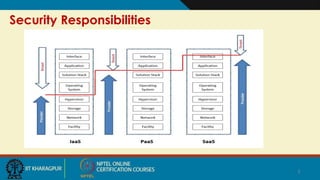
Security Responsibilities
3
SaaS Cloud-based Collaboration
• APIs for sharing resources/information
– Service consumer(customers): human users, applications, organizations/domains,
etc.
– Service provider: SaaS cloud vendor
• SaaS cloud-centric collaboration: valuable and essential
– Data sharing
– Problems handled: inter-disciplinary approach
• Common concerns:
– Integrity of data, shared across multiple users, may be compromised
– Choosing an “ideal” vendor
4
Nirnay Ghosh, Securing Loosely-coupled Collaborations in a SaaS
Cloud through Risk Estimation and Access Conflict Mediation, PhD
Thesis, IIT Kharagpur, 2016
SaaS Cloud-based Collaboration
• Types of collaboration in multi-domain/cloud systems:
– Tightly-coupled or federated
– Loosely-coupled
• Challenges: securing loosely-coupled collaborations in cloud
environment
– Security mechanisms: mainly proposed for tightly-coupled
systems
– Restrictions in the existing authentication/authorization
mechanisms in clouds
5
Motivations and Challenges
• SaaS cloud delivery model: maximum lack of control
• No active data streams/audit trails/outage report
– Security: Major concern in the usage of cloud services
• Broad scope: address security issues in SaaS clouds
• Cloud marketplace: rapid growth due to recent advancements
• Availability of multiple service providers
– Choosing SPs from SLA guarantees: not reliable
• Inconsistency in service level guarantees
• Non-standard clauses and technical specifications
• Focus: selecting an “ideal” SaaS cloud provider and address the security issues
6
Motivations and Challenges
• Online collaboration: popular
• Security issue: unauthorized disclosure of sensitive information
– Focus: selecting an ideal SaaS cloud provider and secure the
collaboration service offered by it
• Relevance in today’s context: loosely-coupled collaboration
– Dynamic data/information sharing
• Final goal (problem statement): selecting an ideal SaaS cloud
provider and securing the loosely-coupled collaboration in its
environment
7
Objective - I
9/20/2017
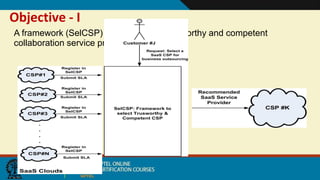
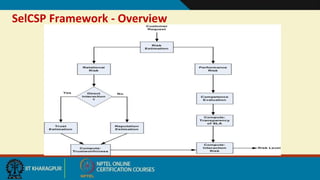
A framework (SelCSP) for selecting a trustworthy and competent
collaboration service provider.
9/20/2017
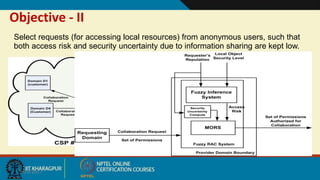
Select requests (for accessing local resources) from anonymous users, such that
both access risk and security uncertainty due to information sharing are kept low.
Objective - II
9/20/2017
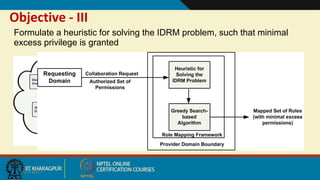
Formulate a heuristic for solving the IDRM problem, such that minimal
excess privilege is granted
Objective - III
9/20/2017
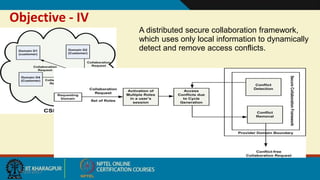
A distributed secure collaboration framework,
which uses only local information to dynamically
detect and remove access conflicts.
Objective - IV
9/20/2017
Selection of Trustworthy and Competent
SaaS Cloud Provider for Collaboration
Trust Models in Cloud
9/20/2017
• Challenges
– Most of the reported works have not presented mathematical
formulation or validation of their trust and risk models
– Web service selection [Liu’04][Garg’13] based on QoS and trust are
available
• Select resources (e.g. services, products, etc.) by modeling their
performance
• Objective: Model trust/reputation/competence of service provider
Service Level Agreement (SLA) for Clouds
9/20/2017
• Challenges:
– Majority of the cloud providers guarantee “availability” of services
– Consumers not only demand availability guarantee but also other
performance related assurances which are equally business critical
– Present day cloud SLAs contain non-standard clauses regarding assurances
and compensations following a violation[Habib’11]
• Objective: Establish a standard set of parameters for cloud SLAs, since it
reduces the perception of risk in outsourced services
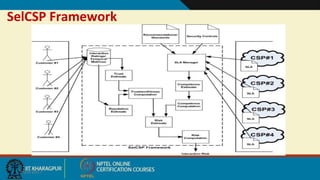
SelCSP Framework
9/20/2017
SelCSP Framework - Overview
Recommending Access Requests from
Anonymous Users for Authorization
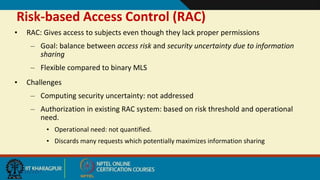
Risk-based Access Control (RAC)
9/20/2017
• RAC: Gives access to subjects even though they lack proper permissions
– Goal: balance between access risk and security uncertainty due to information
sharing
– Flexible compared to binary MLS
• Challenges
– Computing security uncertainty: not addressed
– Authorization in existing RAC system: based on risk threshold and operational
need.
• Operational need: not quantified.
• Discards many requests which potentially maximizes information sharing
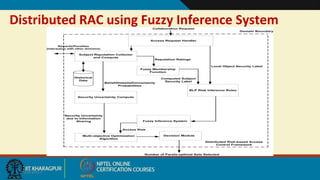
Distributed RAC using Fuzzy Inference System
9/20/2017
9/20/2017
Mapping of Authorized Permissions into
Local Roles
Inter-Domain Role Mapping (IDRM)
9/20/2017
• Finds a minimal set of role which encompasses the requested permission set.
– No polynomial time solution
– Greedy search-based heuristics: suboptimal solutions
• Challenges:
– There may exist multiple minimal role sets
– There may not exist any role set which exactly maps all permissions
• Two variants of IDRM proposed: IDRM-safety, IDRM-availability
• Objective: formulate a novel heuristic to generate better solution for the IDRM-
availability problem.
• Minimize the number of additional permissions
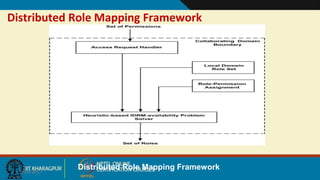
Distributed Role Mapping Framework
9/20/2017
Distributed Role Mapping Framework
Dynamic Detection and Removal of
Access Policy Conflicts
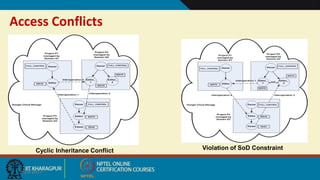
Access Conflicts
9/20/2017
Cyclic Inheritance Conflict Violation of SoD Constraint
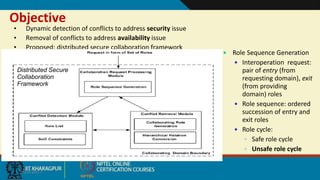
Objective
9/20/2017
• Dynamic detection of conflicts to address security issue
• Removal of conflicts to address availability issue
• Proposed: distributed secure collaboration framework
 Role Sequence Generation
 Interoperation request:
pair of entry (from
requesting domain), exit
(from providing
domain) roles
 Role sequence: ordered
succession of entry and
exit roles
 Role cycle:
 Safe role cycle
 Unsafe role cycle
Distributed Secure
Collaboration
Framework
Conflict Detection
9/20/2017
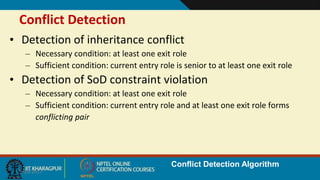
• Detection of inheritance conflict
– Necessary condition: at least one exit role
– Sufficient condition: current entry role is senior to at least one exit role
• Detection of SoD constraint violation
– Necessary condition: at least one exit role
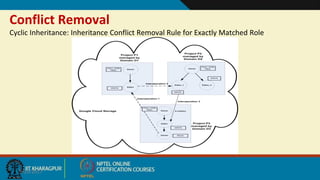
– Sufficient condition: current entry role and at least one exit role forms
conflicting pair
Conflict Detection Algorithm
Conflict Removal
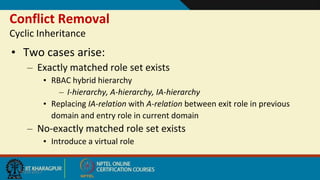
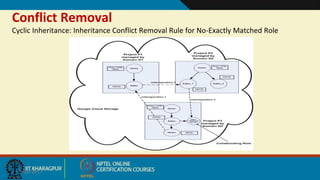
Cyclic Inheritance
9/20/2017
• Two cases arise:
– Exactly matched role set exists
• RBAC hybrid hierarchy
– I-hierarchy, A-hierarchy, IA-hierarchy
• Replacing IA-relation with A-relation between exit role in previous
domain and entry role in current domain
– No-exactly matched role set exists
• Introduce a virtual role
Conflict Removal
Cyclic Inheritance: Inheritance Conflict Removal Rule for Exactly Matched Role
9/20/2017
Conflict Removal
Cyclic Inheritance: Inheritance Conflict Removal Rule for No-Exactly Matched Role
9/20/2017
Conflict Removal
SoD Constraint Violation
9/20/2017
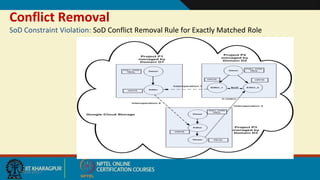
• Two cases: similar to removal of inheritance conflict
– Additional constraint: identifying conflicting permission between
collaborating role and entry role in current domain
– Conflicting permission
• Objects are similar
• Hierarchical relation exists between access modes
• Remove conflicting permission from permission set of
collaborating role
Conflict Removal
SoD Constraint Violation: SoD Conflict Removal Rule for Exactly Matched Role
9/20/2017
Conflict Removal
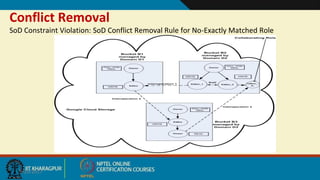
SoD Constraint Violation: SoD Conflict Removal Rule for No-Exactly Matched Role
9/20/2017
Summary
Secure Collaboration SaaS Clouds: A Typical Approach
• Selection of Trustworthy and Competent SaaS Cloud Provider
for Collaboration
• Recommending Access Requests from Anonymous Users for
Authorization
• Mapping of Authorized Permissions into Local Roles
• Dynamic Detection and Removal of Access Policy Conflicts
33
34
Thank You!
34

Lecture29 cc-security4

  • 1.
    CLOUD COMPUTING CLOUD SECURITYIV Security Issues in Collaborative SaaS Cloud PROF. SOUMYA K. GHOSH DEPARTMENT OF COMPUTER SCIENCE AND ENGINEERING IIT KHARAGPUR
  • 2.
    Security Issues inCloud Computing • Unique security features: – Co-tenancy – Lack of control on outsourced data and application • General concerns among cloud customers [Liu’11]: – Inadequate policies and practices – Insufficient security controls • Customers use cloud services to serve their clients • Need to establish trust relationships • Beneficial to both stakeholders 2
  • 3.
  • 4.
    SaaS Cloud-based Collaboration •APIs for sharing resources/information – Service consumer(customers): human users, applications, organizations/domains, etc. – Service provider: SaaS cloud vendor • SaaS cloud-centric collaboration: valuable and essential – Data sharing – Problems handled: inter-disciplinary approach • Common concerns: – Integrity of data, shared across multiple users, may be compromised – Choosing an “ideal” vendor 4 Nirnay Ghosh, Securing Loosely-coupled Collaborations in a SaaS Cloud through Risk Estimation and Access Conflict Mediation, PhD Thesis, IIT Kharagpur, 2016
  • 5.
    SaaS Cloud-based Collaboration •Types of collaboration in multi-domain/cloud systems: – Tightly-coupled or federated – Loosely-coupled • Challenges: securing loosely-coupled collaborations in cloud environment – Security mechanisms: mainly proposed for tightly-coupled systems – Restrictions in the existing authentication/authorization mechanisms in clouds 5
  • 6.
    Motivations and Challenges •SaaS cloud delivery model: maximum lack of control • No active data streams/audit trails/outage report – Security: Major concern in the usage of cloud services • Broad scope: address security issues in SaaS clouds • Cloud marketplace: rapid growth due to recent advancements • Availability of multiple service providers – Choosing SPs from SLA guarantees: not reliable • Inconsistency in service level guarantees • Non-standard clauses and technical specifications • Focus: selecting an “ideal” SaaS cloud provider and address the security issues 6
  • 7.
    Motivations and Challenges •Online collaboration: popular • Security issue: unauthorized disclosure of sensitive information – Focus: selecting an ideal SaaS cloud provider and secure the collaboration service offered by it • Relevance in today’s context: loosely-coupled collaboration – Dynamic data/information sharing • Final goal (problem statement): selecting an ideal SaaS cloud provider and securing the loosely-coupled collaboration in its environment 7
  • 8.
    Objective - I 9/20/2017 Aframework (SelCSP) for selecting a trustworthy and competent collaboration service provider.
  • 9.
    9/20/2017 Select requests (foraccessing local resources) from anonymous users, such that both access risk and security uncertainty due to information sharing are kept low. Objective - II
  • 10.
    9/20/2017 Formulate a heuristicfor solving the IDRM problem, such that minimal excess privilege is granted Objective - III
  • 11.
    9/20/2017 A distributed securecollaboration framework, which uses only local information to dynamically detect and remove access conflicts. Objective - IV
  • 12.
    9/20/2017 Selection of Trustworthyand Competent SaaS Cloud Provider for Collaboration
  • 13.
    Trust Models inCloud 9/20/2017 • Challenges – Most of the reported works have not presented mathematical formulation or validation of their trust and risk models – Web service selection [Liu’04][Garg’13] based on QoS and trust are available • Select resources (e.g. services, products, etc.) by modeling their performance • Objective: Model trust/reputation/competence of service provider
  • 14.
    Service Level Agreement(SLA) for Clouds 9/20/2017 • Challenges: – Majority of the cloud providers guarantee “availability” of services – Consumers not only demand availability guarantee but also other performance related assurances which are equally business critical – Present day cloud SLAs contain non-standard clauses regarding assurances and compensations following a violation[Habib’11] • Objective: Establish a standard set of parameters for cloud SLAs, since it reduces the perception of risk in outsourced services
  • 15.
  • 16.
  • 17.
    Recommending Access Requestsfrom Anonymous Users for Authorization
  • 18.
    Risk-based Access Control(RAC) 9/20/2017 • RAC: Gives access to subjects even though they lack proper permissions – Goal: balance between access risk and security uncertainty due to information sharing – Flexible compared to binary MLS • Challenges – Computing security uncertainty: not addressed – Authorization in existing RAC system: based on risk threshold and operational need. • Operational need: not quantified. • Discards many requests which potentially maximizes information sharing
  • 19.
    Distributed RAC usingFuzzy Inference System 9/20/2017
  • 20.
    9/20/2017 Mapping of AuthorizedPermissions into Local Roles
  • 21.
    Inter-Domain Role Mapping(IDRM) 9/20/2017 • Finds a minimal set of role which encompasses the requested permission set. – No polynomial time solution – Greedy search-based heuristics: suboptimal solutions • Challenges: – There may exist multiple minimal role sets – There may not exist any role set which exactly maps all permissions • Two variants of IDRM proposed: IDRM-safety, IDRM-availability • Objective: formulate a novel heuristic to generate better solution for the IDRM- availability problem. • Minimize the number of additional permissions
  • 22.
    Distributed Role MappingFramework 9/20/2017 Distributed Role Mapping Framework
  • 23.
    Dynamic Detection andRemoval of Access Policy Conflicts
  • 24.
    Access Conflicts 9/20/2017 Cyclic InheritanceConflict Violation of SoD Constraint
  • 25.
    Objective 9/20/2017 • Dynamic detectionof conflicts to address security issue • Removal of conflicts to address availability issue • Proposed: distributed secure collaboration framework  Role Sequence Generation  Interoperation request: pair of entry (from requesting domain), exit (from providing domain) roles  Role sequence: ordered succession of entry and exit roles  Role cycle:  Safe role cycle  Unsafe role cycle Distributed Secure Collaboration Framework
  • 26.
    Conflict Detection 9/20/2017 • Detectionof inheritance conflict – Necessary condition: at least one exit role – Sufficient condition: current entry role is senior to at least one exit role • Detection of SoD constraint violation – Necessary condition: at least one exit role – Sufficient condition: current entry role and at least one exit role forms conflicting pair Conflict Detection Algorithm
  • 27.
    Conflict Removal Cyclic Inheritance 9/20/2017 •Two cases arise: – Exactly matched role set exists • RBAC hybrid hierarchy – I-hierarchy, A-hierarchy, IA-hierarchy • Replacing IA-relation with A-relation between exit role in previous domain and entry role in current domain – No-exactly matched role set exists • Introduce a virtual role
  • 28.
    Conflict Removal Cyclic Inheritance:Inheritance Conflict Removal Rule for Exactly Matched Role 9/20/2017
  • 29.
    Conflict Removal Cyclic Inheritance:Inheritance Conflict Removal Rule for No-Exactly Matched Role 9/20/2017
  • 30.
    Conflict Removal SoD ConstraintViolation 9/20/2017 • Two cases: similar to removal of inheritance conflict – Additional constraint: identifying conflicting permission between collaborating role and entry role in current domain – Conflicting permission • Objects are similar • Hierarchical relation exists between access modes • Remove conflicting permission from permission set of collaborating role
  • 31.
    Conflict Removal SoD ConstraintViolation: SoD Conflict Removal Rule for Exactly Matched Role 9/20/2017
  • 32.
    Conflict Removal SoD ConstraintViolation: SoD Conflict Removal Rule for No-Exactly Matched Role 9/20/2017
  • 33.
    Summary Secure Collaboration SaaSClouds: A Typical Approach • Selection of Trustworthy and Competent SaaS Cloud Provider for Collaboration • Recommending Access Requests from Anonymous Users for Authorization • Mapping of Authorized Permissions into Local Roles • Dynamic Detection and Removal of Access Policy Conflicts 33
  • 34.