1
ATTACHMENT THEORY
2
Bonding:
 Nonsexual feelings of love, respect, and communality
among individuals of the same sex.
 Specifically, a mother’s feelings for her infant, but often
used to refer to the general mother–infant relationship;
fathers often bond to infants.
3
Attachment:
 Early, stable, affectional relationship between a child and
another person, usually a parent.
 Emotional tone between children and their caregivers and is
evidenced by an infant’s seeking and clinging to the
caregiving person, usually the mother.
 By their first month, infants usually have begun to show such
behavior, designed to promote proximity to the desired person.
4
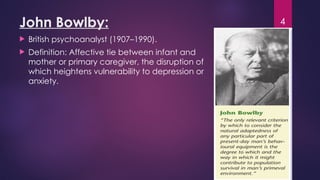
John Bowlby:
 British psychoanalyst (1907–1990).
 Definition: Affective tie between infant and
mother or primary caregiver, the disruption of
which heightens vulnerability to depression or
anxiety.
5
 In his studies of infant attachment and separation, Bowlby
pointed out that attachment constituted a central motivational
force and that mother–child attachment was an essential
medium of human interaction that had significant consequences
for later development and personality functioning.
 Being monotropic, infants tend to attach to one person.
 But they can form attachments to several persons, such as the
father or a surrogate.
6
 Attachment develops gradually; it results in an infant’s wanting
to be with a preferred person, who is perceived as stronger,
wiser, and able to reduce anxiety or distress.
 Attachment thus gives infants feelings of security.
 The interaction between mother and infant facilitates the
process; the amount of time together is less critical than the
activity between the two.
7
Bowlby Concluded;
 “Essential for mental health" that "the infant and young child
should experience a warm, intimate and continuous relationship
with his mother (or permanent mother-substitute) in which both
find satisfaction and enjoyment"
8
 Bowlby went on to make clinical observations of the normal course
of attachment in early life.
 Other researchers studied attachment in a more structured way.
 Their work yielded a surprisingly consistent picture.
1. lnitially, the infant develops an attraction to social objects in
general and to humans in particular; the baby shows proximity
maintaining behaviors (crying, clinging, and other behaviors that
serve to keep humans nearby).
2. Next, the baby distinguishes familiar from unfamiliar people and the
primary caretaker (usually the mother) from other familiar people;
then proximity-maintaining behaviors begin to be aimed more
directly at familiar persons, particularly at the primary caretaker.
9
3. By the second half of their first year, most infants develop a true
attachment HJ the primary caretaker; they recognize that person
and direct proximity-maintaining behaviors toward that person
and not toward others.
4. By the first birthday, the attachment is so strong that children react
negatively to separation from the primary caretaker; they grow
fearful and tearful, for example, when their parent leaves them
with a sitter.
10
Ethologic Studies:
 Bowlby suggested a Darwinian evolutionary basis for attachment
behavior; namely, such behavior ensures that adults protect their
young.
 Ethologic studies show that nonhuman primates and other animals
exhibit attachment behavior patterns that are presumably
instinctual and are governed by inborn tendencies.
 An example of an instinctual attachment system is imprinting.
 Certain stimuli can elicit innate behavior patterns during the first few
hours of an animal’s behavioral development; thus, the animal
offspring becomes attached to its mother at a critical period early
in its development.
11
 A similar sensitive or critical period during which attachment
occurs has been postulated for human infants.
 The presence of imprinting behavior in humans is highly
controversial, but bonding and attachment behavior during the
first year of life closely approximate the critical period; in humans,
however, this period occurs over years rather than hours.
12
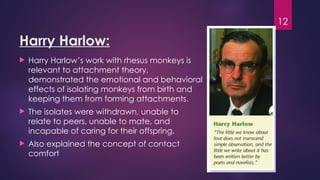
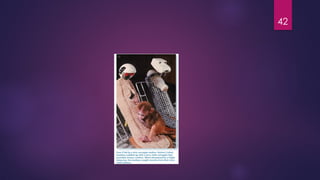
Harry Harlow:
 Harry Harlow’s work with rhesus monkeys is
relevant to attachment theory,
demonstrated the emotional and behavioral
effects of isolating monkeys from birth and
keeping them from forming attachments.
 The isolates were withdrawn, unable to
relate to peers, unable to mate, and
incapable of caring for their offspring.
 Also explained the concept of contact
comfort
13
Characteristics of Attachment
Bowlby’s theory has four main areas of focus;
1. Safe Haven:
 Primary caregiver.
 Usually the mother or the key worker at school or nursery that the child can rely
on for comfort when needed.
2. Secure Base:
 Reliable foundation for the child throughout their learning.
3. Proximity Maintenance:
 Child wishes to explore the world but also needs to know that their Safe Haven is
there for them.
4. Separation Distress:
 Separation from the caregiver  Upset and distress to the child.
14
Phases of Attachment:
1. Pre-attachment stage (birth to 8 or 12 weeks):
 Babies orient to their mothers, follow them with their eyes over a 180-degree
range, and turn toward and move rhythmically with their mother’s voice.
 Not yet attached to the mother, they don’t mind being left with unfamiliar
adults.
2. Indiscriminate attachment in the making (8 to 12 weeks to 6 months):
 Infants become attached to one or more persons in the environment.
 Does not protest when separated but smiles and quiets more with mother.
15
3. Clear-cut specific attachment (6 through 24 months):
 Infants cry and show other signs of distress when separated from the
caretaker or mother.
 As early as 3 months in some infants.
 On being returned to the mother, the infant stops crying and clings, as if
to gain further assurance of the mother’s return.
 Sometimes, seeing the mother after a separation is sufficient for crying to
stop.
4. Reciprocal and multiple attachment (25 months and beyond):
 The mother figure and self is seen as independent, and a more complex
relationship between the mother and the child of give and take
develops based on language development
16
PDD MODEL
 Bowlby described a predictable set and sequence of behavior patterns in
children who are separated from their mothers for long periods (more than 3
months):
1. Protest: in which the child protests the separation by crying, calling out, and
searching for the lost person
2. Despair: in which the child appears to lose hope that the mother will return
3. Detachment: in which the child emotionally separates himself or herself from
the mother. Children in the detachment stage respond in an indifferent
manner when the mother returns; the mother has not been forgotten, but the
child is angry at her for having gone away in the first place and fears that she
will go away again
 Some children have affectionless personalities characterized by emotional
withdrawal, little or no feeling, and a limited ability to form affectionate
relationships
17
 Bowlby described a predictable set and sequence of behavior
patterns in children who are separated from their mothers for
extended periods (more than 3 months):
 Protest: Child protests the separation by crying, calling out, and
searching for the lost person.
 Despair: Child appears to lose hope that the mother will return
 Detachment: Child emotionally separates him- or herself from the
mother.
18
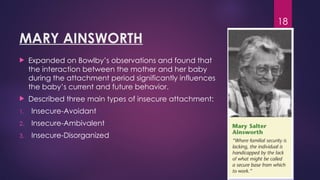
MARY AINSWORTH
 Expanded on Bowlby’s observations and found that
the interaction between the mother and her baby
during the attachment period significantly influences
the baby’s current and future behavior.
 Described three main types of insecure attachment:
1. Insecure-Avoidant
2. Insecure-Ambivalent
3. Insecure-Disorganized
19
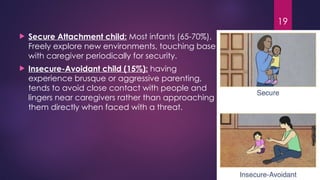
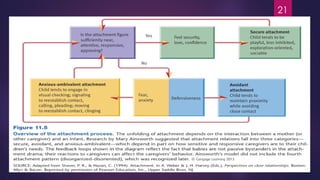
 Secure Attachment child: Most infants (65-70%),
Freely explore new environments, touching base
with caregiver periodically for security.
 Insecure-Avoidant child (15%): having
experience brusque or aggressive parenting,
tends to avoid close contact with people and
lingers near caregivers rather than approaching
them directly when faced with a threat.
20
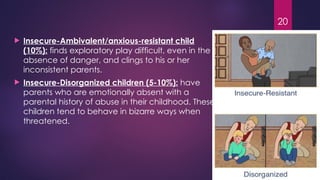
 Insecure-Ambivalent/anxious-resistant child
(10%): finds exploratory play difficult, even in the
absence of danger, and clings to his or her
inconsistent parents.
 Insecure-Disorganized children (5-10%): have
parents who are emotionally absent with a
parental history of abuse in their childhood. These
children tend to behave in bizarre ways when
threatened.
21
22
 Disorganization: Severe form of insecure attachment and a possible
precursor of severe personality disorder and dissociative phenomena
in adolescence and early adulthood.
 Sensitive responsiveness to infant signals: Cuddling a crying baby,
causes infants to cry less in later months, rather than reinforcing
crying behavior.
 Unresponsive mothers produce anxious babies; these mothers often
have lower intelligence quotients (IQs) and are emotionally more
immature and younger than responsive mothers
23
 Secure base effect enables children to move away from
attachment figures and to explore the environment.
 Inanimate objects: Teddy bear and a blanket (called
the transitional object by Donald Winnicott), also serve
as a secure base, one that often accompanies them as
they investigate the world.
24
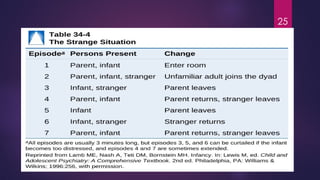
 Ainsworth developed strange situation, the research protocol for
assessing the quality and security of an infant’s attachment.
 In this procedure, the infant is exposed to escalating amounts of
stress; for example, the infant and the parent enter an unfamiliar
room, an unfamiliar adult then enters the room, and the parent
leaves the room. About 65 percent of infants are securely
attached by the age of 24 months.
25
26
STRANGE SITUATION:
 Ainsworth developed strange situation, the research protocol for
assessing the quality and security of an infant’s attachment.
 In this procedure, the infant is exposed to escalating amounts of
stress; for example, the infant and the parent enter an unfamiliar
room, an unfamiliar adult then enters the room, and the parent
leaves the room. About 65 percent of infants are securely attached
by the age of 24 months.
27
Episodes in the strange situation:
1. A mother and her child enter the room. The mother places the baby on the
floor, surrounded by toys, and goes to sit at the opposite end of the room.
2. A female stranger enters the room, sits quietly for a minute, converses with the
mother for a minute, and then attempts to engage the baby in play with a toy.
3. The mother leaves the room unobtrusively. If the baby is not upset, the stranger
returns to sitting quietly. If the baby is upset, the stranger tries to soothe him or
her.
4. The mother returns and engages the baby in play while the stranger slips out of
the room.
5. The mother leaves again, this time leaving the baby alone in the room.
6. The stranger returns. If the baby is upset, the stranger tries to comfort him or her.
7. The mother returns and the stranger slips out of the room.
28
Anxiety:
 Bowlby’s theory of anxiety holds that a child’s sense of distress during
separation is perceived and experienced as anxiety and is the
prototype of anxiety.
 Any stimuli that alarm children and cause fear (e.g., loud noises, falling,
and cold blasts of air) mobilize signal indicators (e.g., crying) that cause
the mother to respond in a caring way by cuddling and reassuring the
child.
 The mother’s ability to relieve the infant’s anxiety or fear is fundamental
to the growth of attachment in the infant.
29
 When the mother is close to the child, and the child experiences no
fear, the child gains a sense of security, the opposite of anxiety. When
the mother is unavailable to the infant because of physical absence
(e.g., if the mother is in prison) or because of psychological
impairment (e.g., severe depression), anxiety develops in the infant.
 Separation anxiety is the response of a child who is isolated or
separated from its mother or caretaker.
 It is most common at 10 to 18 months of age and generally disappears
by the end of the third year.
 It is usually expressed with tearfulness or irritability.
 Somewhat earlier (at about 8 months), stranger anxiety is an anxiety
response to someone other than the caregiver appears.
30
Signal Indicators:
 Signal indicators are infants’ signs of distress that prompt or elicit a
behavioral response in the mother.
 The primary signal is crying.
 The three types of signal indicators are hunger (the most common),
anger, and pain.
 Some mothers can distinguish between them, but most mothers
generalize the hunger cry to represent distress from pain, frustration, or
anger.
 Other signal indicators that reinforce attachment are smiling, cooing,
and looking. The sound of an adult human voice can prompt these
indicators.
31
Losing Attachments:
 Persons’ reactions to the death of a parent or a spouse can be traced
to the nature of their past and present attachment to the lost figure.
 An absence of demonstrable grief may be owing to real experiences of
rejection and the lack of closeness in the relationship.
 The person may even consciously offer an idealized picture of the
deceased.
 Persons who show no grief usually try to present themselves as
independent and disinterested in closeness and attachment.
32
 Sometimes, however, the severing of attachments is
traumatic.
 The death of a parent or a spouse can precipitate a
depressive disorder, and even suicide, in some persons.
 The death of a spouse increases the chance that the surviving
spouse will experience a physical or mental disorder during
the next year.
 The onset of depression and other dysphoric states often
involves rejection by a significant figure in a person’s life.
33
Disorders of Attachment:
 Attachment disorders are characterized by biopsychosocial pathology that results
from maternal deprivation, a lack of care by, and interaction with, the mother or
caregiver.
 Failure-to-thrive syndromes, psychosocial dwarfism, separation anxiety disorder,
avoidant personality disorder, depressive disorders, delinquency, academic
problems, and borderline intelligence have been traced to negative attachment
experiences. When maternal care is deficient because
1. A mother is mentally ill
2. A child is institutionalized for a long time
3. The primary object of attachment dies, children sustain emotional damage.
Bowlby initially thought that the damage was permanent and invariable. However, he
revised his theories to consider the time at which the separation occurred, the type
and degree of separation, and the level of security that the child experienced before
the separation.
34
 Bowlby believed that this sequence involves ambivalent
feelings toward the mother; the child both wants her and is
angry with her for her desertion.
 Children in the detachment stage respond indifferently when
the mother returns; the mother has not been forgotten, but the
child is angry at her for having gone away in the first place
and fears that she will go away again.
 Some children have affectionless personalities characterized
by emotional withdrawal, little or no feeling, and a limited
ability to form affectionate relationships.
35
Anaclitic Depression:
 Also known as hospitalism.
 First described by René Spitz
 In infants who had made normal attachments but were suddenly
separated from their mothers for varying times and placed in
institutions or hospitals.
 The children became depressed, withdrawn, nonresponsive, and
vulnerable to physical illness, but they recovered when their mothers
returned, or surrogate mothering was available.
36
Psychiatric Applications
 The applications of attachment theory in psychotherapy are numerous. When a
patient can attach to a therapist, a secure base effect is seen.
 The patient may then be able to take risks, mask anxiety, and practice new patterns
of behavior that otherwise might not have been attempted.
 Patients whose impairments can be traced to never having made an attachment in
early life may do so for the first time in therapy, with salutary effects.
 Patients whose pathology stems from exaggerated early attachments may attempt
to replicate them in therapy.
 Therapists must enable such patients to recognize the ways their early experiences
have interfered with their ability to achieve independence.
 For patients who are children and whose attachment difficulties may be more
apparent than those of adults, therapists represent consistent and trusted figures who
can engender a sense of warmth and self-esteem in children, often for the first time.
37
Relationship Disorders
 A person’s psychological health and sense of well-being depend significantly on the
quality of his or her relationships and attachment to others, and a core issue in all close
personal relationships is establishing and regulating that connection.
 In a typical attachment interaction, one person seeks more proximity and affection, and
the other either reciprocates, rejects, or disqualifies the request.
 A pattern is shaped through repeated exchanges. Distinct attachment styles have been
observed.
 Adults with an anxious-ambivalent attachment style tend to be obsessed with romantic
partners, suffer from extreme jealousy, and have a high divorce rate.
 Persons with an avoidant attachment style are relatively uninvested in close relationships,
although they often feel lonely. They seem afraid of intimacy and tend to withdraw when
there is stress or conflict in the relationship.
 Break-up rates are high.
 Persons with a secure attachment style are highly invested in relationships and tend to
behave without much possessiveness or fear of rejection.
38
Parenting styles
 In attempting to account for differences in attachment among babies, researchers have
directed most of their attention to the behavior of the primary caregiver, usually the mother. The
main finding is that a caregiver’s sensitive responsiveness to the baby’s needs produces secure
attachment. Mothers of securely attached babies usually respond promptly when the baby cries
and behave affectionately when they pick up the baby. They also tailor their responses to the
baby’s needs (Clarke-Stewart, 1973). In feeding, for example, they use an infant’s signals to
determine when to begin and end feeding, and they attend to the baby’s food preferences. In
contrast, mothers of babies who are insecurely attached respond according to their own needs
or moods rather than according to signals from the baby. For example, they respond to the
baby’s cries for attention when they feel like cuddling the baby but ignore such cries at other
times (Stayton, 1973). Not all developmental psychologists agree that the caregiver’s
responsiveness is the major cause of an infant’s attachment behaviors.
 They call attention to the baby’s own inborn temperament (Campos, Barrett, Lamb, Goldsmith,
& Stenberg, 1983; Kagan, 1984). Perhaps the temperaments that make some babies ‘easy’ also
make them more securely attached than do the temperaments of ‘difficult’ babies. And, as
noted earlier, a parent’s response to a child is often itself a function of the child’s own behavior.
For example, mothers of difficult babies tend to spend less time playing with them (Green, Fox, &
Lewis, 1983). Attachment patterns may reflect this interaction between a baby’s temperament
and the parents’ responsiveness
39
40
41
 In reply, attachment theorists point to evidence that supports the ‘sensitive responsiveness’ hypothesis. For example,
in the first year of life, an infant’s crying changes much more than the mother’s responsiveness to the crying does.
 Moreover, the mother’s responsiveness over a 3-month period predicts the infant’s crying over the next three
months significantly better than the infant’s crying predicts the mother’s subsequent responsiveness to crying.
 In short, the mother appears to influence the infant’s crying more than the infant influences the mother’s
responsiveness to crying (Bell & Ainsworth, 1972).
 In general, the mother’s behavior appears to be the most important factor in establishing a secure or insecure
attachment (Isabella & Belsky, 1991). Other research may resolve this debate.
 Recall that the attachment classification is based not on the baby’s distress when the mother leaves but on how
the baby reacts when she returns.
 It appears that an infant’s temperament predicts the former but not the latter (Frodi &Thompson, 1985; Vaughn,
Lefever, Seifer, & Barglow, 1989).
 Babies with easy temperaments typically are not distressed when the mother leaves.
 When she returns, they tend to greet her happily – showing secure attachment – or show the avoidant type of
insecure attachment. Babies with difficult temperaments typically are distressed when the mother leaves. When she
returns, they tend to seek her out and cling to her – showing secure attachment – or show the ambivalent type of
insecure attachment (Belsky & Rovine, 1987). Children’s overall reaction to the departure and return of their primary
caregiver is a function of both the caregiver’s responsiveness to the child and the child’s temperament.
42

ATTACHMENT THEORY-recent advances dor exam

  • 1.
  • 2.
    2 Bonding:  Nonsexual feelingsof love, respect, and communality among individuals of the same sex.  Specifically, a mother’s feelings for her infant, but often used to refer to the general mother–infant relationship; fathers often bond to infants.
  • 3.
    3 Attachment:  Early, stable,affectional relationship between a child and another person, usually a parent.  Emotional tone between children and their caregivers and is evidenced by an infant’s seeking and clinging to the caregiving person, usually the mother.  By their first month, infants usually have begun to show such behavior, designed to promote proximity to the desired person.
  • 4.
    4 John Bowlby:  Britishpsychoanalyst (1907–1990).  Definition: Affective tie between infant and mother or primary caregiver, the disruption of which heightens vulnerability to depression or anxiety.
  • 5.
    5  In hisstudies of infant attachment and separation, Bowlby pointed out that attachment constituted a central motivational force and that mother–child attachment was an essential medium of human interaction that had significant consequences for later development and personality functioning.  Being monotropic, infants tend to attach to one person.  But they can form attachments to several persons, such as the father or a surrogate.
  • 6.
    6  Attachment developsgradually; it results in an infant’s wanting to be with a preferred person, who is perceived as stronger, wiser, and able to reduce anxiety or distress.  Attachment thus gives infants feelings of security.  The interaction between mother and infant facilitates the process; the amount of time together is less critical than the activity between the two.
  • 7.
    7 Bowlby Concluded;  “Essentialfor mental health" that "the infant and young child should experience a warm, intimate and continuous relationship with his mother (or permanent mother-substitute) in which both find satisfaction and enjoyment"
  • 8.
    8  Bowlby wenton to make clinical observations of the normal course of attachment in early life.  Other researchers studied attachment in a more structured way.  Their work yielded a surprisingly consistent picture. 1. lnitially, the infant develops an attraction to social objects in general and to humans in particular; the baby shows proximity maintaining behaviors (crying, clinging, and other behaviors that serve to keep humans nearby). 2. Next, the baby distinguishes familiar from unfamiliar people and the primary caretaker (usually the mother) from other familiar people; then proximity-maintaining behaviors begin to be aimed more directly at familiar persons, particularly at the primary caretaker.
  • 9.
    9 3. By thesecond half of their first year, most infants develop a true attachment HJ the primary caretaker; they recognize that person and direct proximity-maintaining behaviors toward that person and not toward others. 4. By the first birthday, the attachment is so strong that children react negatively to separation from the primary caretaker; they grow fearful and tearful, for example, when their parent leaves them with a sitter.
  • 10.
    10 Ethologic Studies:  Bowlbysuggested a Darwinian evolutionary basis for attachment behavior; namely, such behavior ensures that adults protect their young.  Ethologic studies show that nonhuman primates and other animals exhibit attachment behavior patterns that are presumably instinctual and are governed by inborn tendencies.  An example of an instinctual attachment system is imprinting.  Certain stimuli can elicit innate behavior patterns during the first few hours of an animal’s behavioral development; thus, the animal offspring becomes attached to its mother at a critical period early in its development.
  • 11.
    11  A similarsensitive or critical period during which attachment occurs has been postulated for human infants.  The presence of imprinting behavior in humans is highly controversial, but bonding and attachment behavior during the first year of life closely approximate the critical period; in humans, however, this period occurs over years rather than hours.
  • 12.
    12 Harry Harlow:  HarryHarlow’s work with rhesus monkeys is relevant to attachment theory, demonstrated the emotional and behavioral effects of isolating monkeys from birth and keeping them from forming attachments.  The isolates were withdrawn, unable to relate to peers, unable to mate, and incapable of caring for their offspring.  Also explained the concept of contact comfort
  • 13.
    13 Characteristics of Attachment Bowlby’stheory has four main areas of focus; 1. Safe Haven:  Primary caregiver.  Usually the mother or the key worker at school or nursery that the child can rely on for comfort when needed. 2. Secure Base:  Reliable foundation for the child throughout their learning. 3. Proximity Maintenance:  Child wishes to explore the world but also needs to know that their Safe Haven is there for them. 4. Separation Distress:  Separation from the caregiver  Upset and distress to the child.
  • 14.
    14 Phases of Attachment: 1.Pre-attachment stage (birth to 8 or 12 weeks):  Babies orient to their mothers, follow them with their eyes over a 180-degree range, and turn toward and move rhythmically with their mother’s voice.  Not yet attached to the mother, they don’t mind being left with unfamiliar adults. 2. Indiscriminate attachment in the making (8 to 12 weeks to 6 months):  Infants become attached to one or more persons in the environment.  Does not protest when separated but smiles and quiets more with mother.
  • 15.
    15 3. Clear-cut specificattachment (6 through 24 months):  Infants cry and show other signs of distress when separated from the caretaker or mother.  As early as 3 months in some infants.  On being returned to the mother, the infant stops crying and clings, as if to gain further assurance of the mother’s return.  Sometimes, seeing the mother after a separation is sufficient for crying to stop. 4. Reciprocal and multiple attachment (25 months and beyond):  The mother figure and self is seen as independent, and a more complex relationship between the mother and the child of give and take develops based on language development
  • 16.
    16 PDD MODEL  Bowlbydescribed a predictable set and sequence of behavior patterns in children who are separated from their mothers for long periods (more than 3 months): 1. Protest: in which the child protests the separation by crying, calling out, and searching for the lost person 2. Despair: in which the child appears to lose hope that the mother will return 3. Detachment: in which the child emotionally separates himself or herself from the mother. Children in the detachment stage respond in an indifferent manner when the mother returns; the mother has not been forgotten, but the child is angry at her for having gone away in the first place and fears that she will go away again  Some children have affectionless personalities characterized by emotional withdrawal, little or no feeling, and a limited ability to form affectionate relationships
  • 17.
    17  Bowlby describeda predictable set and sequence of behavior patterns in children who are separated from their mothers for extended periods (more than 3 months):  Protest: Child protests the separation by crying, calling out, and searching for the lost person.  Despair: Child appears to lose hope that the mother will return  Detachment: Child emotionally separates him- or herself from the mother.
  • 18.
    18 MARY AINSWORTH  Expandedon Bowlby’s observations and found that the interaction between the mother and her baby during the attachment period significantly influences the baby’s current and future behavior.  Described three main types of insecure attachment: 1. Insecure-Avoidant 2. Insecure-Ambivalent 3. Insecure-Disorganized
  • 19.
    19  Secure Attachmentchild: Most infants (65-70%), Freely explore new environments, touching base with caregiver periodically for security.  Insecure-Avoidant child (15%): having experience brusque or aggressive parenting, tends to avoid close contact with people and lingers near caregivers rather than approaching them directly when faced with a threat.
  • 20.
    20  Insecure-Ambivalent/anxious-resistant child (10%):finds exploratory play difficult, even in the absence of danger, and clings to his or her inconsistent parents.  Insecure-Disorganized children (5-10%): have parents who are emotionally absent with a parental history of abuse in their childhood. These children tend to behave in bizarre ways when threatened.
  • 21.
  • 22.
    22  Disorganization: Severeform of insecure attachment and a possible precursor of severe personality disorder and dissociative phenomena in adolescence and early adulthood.  Sensitive responsiveness to infant signals: Cuddling a crying baby, causes infants to cry less in later months, rather than reinforcing crying behavior.  Unresponsive mothers produce anxious babies; these mothers often have lower intelligence quotients (IQs) and are emotionally more immature and younger than responsive mothers
  • 23.
    23  Secure baseeffect enables children to move away from attachment figures and to explore the environment.  Inanimate objects: Teddy bear and a blanket (called the transitional object by Donald Winnicott), also serve as a secure base, one that often accompanies them as they investigate the world.
  • 24.
    24  Ainsworth developedstrange situation, the research protocol for assessing the quality and security of an infant’s attachment.  In this procedure, the infant is exposed to escalating amounts of stress; for example, the infant and the parent enter an unfamiliar room, an unfamiliar adult then enters the room, and the parent leaves the room. About 65 percent of infants are securely attached by the age of 24 months.
  • 25.
  • 26.
    26 STRANGE SITUATION:  Ainsworthdeveloped strange situation, the research protocol for assessing the quality and security of an infant’s attachment.  In this procedure, the infant is exposed to escalating amounts of stress; for example, the infant and the parent enter an unfamiliar room, an unfamiliar adult then enters the room, and the parent leaves the room. About 65 percent of infants are securely attached by the age of 24 months.
  • 27.
    27 Episodes in thestrange situation: 1. A mother and her child enter the room. The mother places the baby on the floor, surrounded by toys, and goes to sit at the opposite end of the room. 2. A female stranger enters the room, sits quietly for a minute, converses with the mother for a minute, and then attempts to engage the baby in play with a toy. 3. The mother leaves the room unobtrusively. If the baby is not upset, the stranger returns to sitting quietly. If the baby is upset, the stranger tries to soothe him or her. 4. The mother returns and engages the baby in play while the stranger slips out of the room. 5. The mother leaves again, this time leaving the baby alone in the room. 6. The stranger returns. If the baby is upset, the stranger tries to comfort him or her. 7. The mother returns and the stranger slips out of the room.
  • 28.
    28 Anxiety:  Bowlby’s theoryof anxiety holds that a child’s sense of distress during separation is perceived and experienced as anxiety and is the prototype of anxiety.  Any stimuli that alarm children and cause fear (e.g., loud noises, falling, and cold blasts of air) mobilize signal indicators (e.g., crying) that cause the mother to respond in a caring way by cuddling and reassuring the child.  The mother’s ability to relieve the infant’s anxiety or fear is fundamental to the growth of attachment in the infant.
  • 29.
    29  When themother is close to the child, and the child experiences no fear, the child gains a sense of security, the opposite of anxiety. When the mother is unavailable to the infant because of physical absence (e.g., if the mother is in prison) or because of psychological impairment (e.g., severe depression), anxiety develops in the infant.  Separation anxiety is the response of a child who is isolated or separated from its mother or caretaker.  It is most common at 10 to 18 months of age and generally disappears by the end of the third year.  It is usually expressed with tearfulness or irritability.  Somewhat earlier (at about 8 months), stranger anxiety is an anxiety response to someone other than the caregiver appears.
  • 30.
    30 Signal Indicators:  Signalindicators are infants’ signs of distress that prompt or elicit a behavioral response in the mother.  The primary signal is crying.  The three types of signal indicators are hunger (the most common), anger, and pain.  Some mothers can distinguish between them, but most mothers generalize the hunger cry to represent distress from pain, frustration, or anger.  Other signal indicators that reinforce attachment are smiling, cooing, and looking. The sound of an adult human voice can prompt these indicators.
  • 31.
    31 Losing Attachments:  Persons’reactions to the death of a parent or a spouse can be traced to the nature of their past and present attachment to the lost figure.  An absence of demonstrable grief may be owing to real experiences of rejection and the lack of closeness in the relationship.  The person may even consciously offer an idealized picture of the deceased.  Persons who show no grief usually try to present themselves as independent and disinterested in closeness and attachment.
  • 32.
    32  Sometimes, however,the severing of attachments is traumatic.  The death of a parent or a spouse can precipitate a depressive disorder, and even suicide, in some persons.  The death of a spouse increases the chance that the surviving spouse will experience a physical or mental disorder during the next year.  The onset of depression and other dysphoric states often involves rejection by a significant figure in a person’s life.
  • 33.
    33 Disorders of Attachment: Attachment disorders are characterized by biopsychosocial pathology that results from maternal deprivation, a lack of care by, and interaction with, the mother or caregiver.  Failure-to-thrive syndromes, psychosocial dwarfism, separation anxiety disorder, avoidant personality disorder, depressive disorders, delinquency, academic problems, and borderline intelligence have been traced to negative attachment experiences. When maternal care is deficient because 1. A mother is mentally ill 2. A child is institutionalized for a long time 3. The primary object of attachment dies, children sustain emotional damage. Bowlby initially thought that the damage was permanent and invariable. However, he revised his theories to consider the time at which the separation occurred, the type and degree of separation, and the level of security that the child experienced before the separation.
  • 34.
    34  Bowlby believedthat this sequence involves ambivalent feelings toward the mother; the child both wants her and is angry with her for her desertion.  Children in the detachment stage respond indifferently when the mother returns; the mother has not been forgotten, but the child is angry at her for having gone away in the first place and fears that she will go away again.  Some children have affectionless personalities characterized by emotional withdrawal, little or no feeling, and a limited ability to form affectionate relationships.
  • 35.
    35 Anaclitic Depression:  Alsoknown as hospitalism.  First described by René Spitz  In infants who had made normal attachments but were suddenly separated from their mothers for varying times and placed in institutions or hospitals.  The children became depressed, withdrawn, nonresponsive, and vulnerable to physical illness, but they recovered when their mothers returned, or surrogate mothering was available.
  • 36.
    36 Psychiatric Applications  Theapplications of attachment theory in psychotherapy are numerous. When a patient can attach to a therapist, a secure base effect is seen.  The patient may then be able to take risks, mask anxiety, and practice new patterns of behavior that otherwise might not have been attempted.  Patients whose impairments can be traced to never having made an attachment in early life may do so for the first time in therapy, with salutary effects.  Patients whose pathology stems from exaggerated early attachments may attempt to replicate them in therapy.  Therapists must enable such patients to recognize the ways their early experiences have interfered with their ability to achieve independence.  For patients who are children and whose attachment difficulties may be more apparent than those of adults, therapists represent consistent and trusted figures who can engender a sense of warmth and self-esteem in children, often for the first time.

  • 37.
    37 Relationship Disorders  Aperson’s psychological health and sense of well-being depend significantly on the quality of his or her relationships and attachment to others, and a core issue in all close personal relationships is establishing and regulating that connection.  In a typical attachment interaction, one person seeks more proximity and affection, and the other either reciprocates, rejects, or disqualifies the request.  A pattern is shaped through repeated exchanges. Distinct attachment styles have been observed.  Adults with an anxious-ambivalent attachment style tend to be obsessed with romantic partners, suffer from extreme jealousy, and have a high divorce rate.  Persons with an avoidant attachment style are relatively uninvested in close relationships, although they often feel lonely. They seem afraid of intimacy and tend to withdraw when there is stress or conflict in the relationship.  Break-up rates are high.  Persons with a secure attachment style are highly invested in relationships and tend to behave without much possessiveness or fear of rejection.

  • 38.
    38 Parenting styles  Inattempting to account for differences in attachment among babies, researchers have directed most of their attention to the behavior of the primary caregiver, usually the mother. The main finding is that a caregiver’s sensitive responsiveness to the baby’s needs produces secure attachment. Mothers of securely attached babies usually respond promptly when the baby cries and behave affectionately when they pick up the baby. They also tailor their responses to the baby’s needs (Clarke-Stewart, 1973). In feeding, for example, they use an infant’s signals to determine when to begin and end feeding, and they attend to the baby’s food preferences. In contrast, mothers of babies who are insecurely attached respond according to their own needs or moods rather than according to signals from the baby. For example, they respond to the baby’s cries for attention when they feel like cuddling the baby but ignore such cries at other times (Stayton, 1973). Not all developmental psychologists agree that the caregiver’s responsiveness is the major cause of an infant’s attachment behaviors.  They call attention to the baby’s own inborn temperament (Campos, Barrett, Lamb, Goldsmith, & Stenberg, 1983; Kagan, 1984). Perhaps the temperaments that make some babies ‘easy’ also make them more securely attached than do the temperaments of ‘difficult’ babies. And, as noted earlier, a parent’s response to a child is often itself a function of the child’s own behavior. For example, mothers of difficult babies tend to spend less time playing with them (Green, Fox, & Lewis, 1983). Attachment patterns may reflect this interaction between a baby’s temperament and the parents’ responsiveness
  • 39.
  • 40.
  • 41.
    41  In reply,attachment theorists point to evidence that supports the ‘sensitive responsiveness’ hypothesis. For example, in the first year of life, an infant’s crying changes much more than the mother’s responsiveness to the crying does.  Moreover, the mother’s responsiveness over a 3-month period predicts the infant’s crying over the next three months significantly better than the infant’s crying predicts the mother’s subsequent responsiveness to crying.  In short, the mother appears to influence the infant’s crying more than the infant influences the mother’s responsiveness to crying (Bell & Ainsworth, 1972).  In general, the mother’s behavior appears to be the most important factor in establishing a secure or insecure attachment (Isabella & Belsky, 1991). Other research may resolve this debate.  Recall that the attachment classification is based not on the baby’s distress when the mother leaves but on how the baby reacts when she returns.  It appears that an infant’s temperament predicts the former but not the latter (Frodi &Thompson, 1985; Vaughn, Lefever, Seifer, & Barglow, 1989).  Babies with easy temperaments typically are not distressed when the mother leaves.  When she returns, they tend to greet her happily – showing secure attachment – or show the avoidant type of insecure attachment. Babies with difficult temperaments typically are distressed when the mother leaves. When she returns, they tend to seek her out and cling to her – showing secure attachment – or show the ambivalent type of insecure attachment (Belsky & Rovine, 1987). Children’s overall reaction to the departure and return of their primary caregiver is a function of both the caregiver’s responsiveness to the child and the child’s temperament.
  • 42.