Lawrence Heller, PsyD
• The Myth Of Memory As A Video Recorder
• Memory is a reconstructive process for
everyone, even those with Hyperthymesia
(“PHOTOGRAPHIC MEMORY”) or highly
superior autobiographical memory (HSAM).
• Individuals with these conditions remember
nearly all of the events that have occurred in
their lives and experience vivid and detailed
recollection.
WOULD YOU WANT SUCH A
MEMORY?
• A PERSON WITH Hyperthymesia
would remember things in great detail,
this includes all the painful memories.
• Does forgetting serve a purpose?
• Forgetting is adaptive
• Is a person with Hyperthymesia
susceptible to false memories?
• Yes and perhaps more than what is
typical.
HOW CAN MEMORIES BE PERFECT YET
PRONE TO DISTORTION?
• A memory for an event is stored
somewhere in the brain.
• ACTUAL:
• Actual, the various “entries” are stored in a
distributed fashion across different areas of the
brain. Memories are not singular units stored in
one location of the brain (Lashley, 1950)
• In fact, a memory does not really exist until it is
retrieved.
• Memories are like dreams where the brain
puts the activated pieces together into a
story. But the “entries” are not haphazardly
chosen.
• All that exists prior to retrieval is the
potential for a memory.
• False Memories Are Very Common
• they can be easily manufactured.
• For example, many people will remember
seeing the first plane hitting the World Trade
Center on 9/11/2001. No one saw the first
plane hit the tower but footage was found later.
• At some level we accept that memories are
faulty.
• 10 False Memories Everyone Believes
• Memory Reconstruction involves a combination
of actual information from the remembered
event, as well as integration of information from
other’s accounts of the event, our on
recollections of the event, and information from
semantic memory.
• Our memory is similar to Wikipedia- a series of
entries called wikis, with many different aspects
encoded such as sight, sounds, taste, people,
the plot, etc.
• At the time of retrieval, we select the entries and
construct memory.
• Many (if not most) distortions occur when we
place the wrong “entry” into the memory
construction because we confuse the source of
the “entry” as being from one episode but in
actuality it was from another. (source confusion)
• Memory is not stored as a single unit in a
localized area of the brain.
• Memory representations are thought to be
distributed across the different brain areas that
were active at the time of the original event.
• Memory is a reconstructive process and as
such it is subject to many distortions.
• For example, the memory sins of omission
refers to errors in which information is
absent of forgotten (memory fails). These
errors include the following:
• Transience- the loss of information from
memory with the passage of time
• Absentmindedness- problems with the
interface between attention and long-term
memory
• Blocking-failure to retrieve information
stored in long-term memory
• SINS OF COMMISSION refers to the presence of
unwanted or inaccurate memories and include the
following:
• 1) Persistence-continued automatic retrieval of
unwanted memories
• 2) Misattribution-memory that is ascribed to the
wrong source
• 3) Suggestibility-leading someone to a false
recollection
• 4) Bias-the influence of who we are (our beliefs
expectations and desires) on what we remember
• Eyewitness testimony is fallable and is
affected by many factors that operate on
encoding/storage.
• For instance, The quality of viewing
conditions and the level of attention
• As stress increases from low to medium
levels, memory accuracy increases but
then as stress levels increase to a high
level, a steady decrease in memory
accuracy occurs
• Stress and trauma can disrupt or enhance
memory depending upon the particular
circumstances
• Emotional stress can narrow the focus of
attention and lead to a decreased recall of
(particularly) peripheral details.
• Weapon Focus, the presence of a weapon
focuses attention on the weapon (narrows the
focus), resulting in a lack of peripheral detail
(such as the details of the perpetrator) in the
memory representation.
• Although the central detail (the weapon) is
described/remembered quite well.
• The general principle has been called
Memory Narrowing or Tunnel Memory
• Similarly, physical exertion can be linked
with detrimental effects on memory.
• Embodied cognition-theoretical
perspective that emphasizes the role that
the body and its ongoing actions can have
in determining perception.
• Perception can include affordances for action
• Memory narrowing according, to Biggs and
colleagues (2014)focuses attention on
information relevant to the person’s goals,
in that situation.
• For example, a person sees a gun pointed at
them. Affordances of the purpose of the gun
and its firing are triggered and memory
narrowing occurs so the focus is on the
weapon only.
DOES SURVIVAL PROCESSING PLAY A
ROLE?
• Other-Race-Effect refers to increased difficulty in
discriminating among faces of another race
relative to faces of one’s own race.
• People are better at recognizing faces of their
own race
• According to Brigham (2001), the chance of
mistaken identification is 1.5 times greater when
the perpetrator is a different race than the
witness.
• Osborne and Davies (2014)
• Cross-racial identification situations-the type of
crime witnessed influences the identification of
the perpetrator by automatically activating
stereotypical beliefs about the physical
appearance of those who are thought to
commit certain crimes.
• The Misinformation Effect
•Refers to the finding that misleading
information presented between the
encoding of the event and its subsequent
recall influences a witness’s memory thus
increases the chances of
misremembering.
• Unconscious transference-occurs when a
witness fails to distinguish between a
target person and another person
encountered at a different time whose face
is also familiar (Loftus, 1976)
• Levin and Simons (2000)- the illusion of
continuity-a perceiver misperceives continuity
between two scenes or situations due to their
own propensity to fill in gaps via top-down
processing.
• Top down processing leads us to see what we
expect to see.
• We expect to see continuity in the visual scene
we’re looking at and so we do.
• But as change blindness indicates, this
continuity is sometimes and illusion as obvious
changes in the environment are often missed.
• Photo Bias-a specific type of unconscious
transference, which refers to the increase in
probability that a person will be recognized as the
culprit due to previous exposure in a photo.
• Exposure to someone through a chance encounter
or in a photo (photo bias) will make the person seem
familiar and increase the chance of being
misidentified as the culprit in a crime.
• Misattribution-the witness misattributes the person
they saw in the photo to be the perpetrator of the
crime they witnessed.
• Attempting to remember which of several
people committed a crime can be similar to
a recognition test.
• A variety of factors can affect whether a
choice is made and if that choice is
accurate.
• A major factor influencing eyewitness
identification is the structure and
procedures used in presenting lineups.
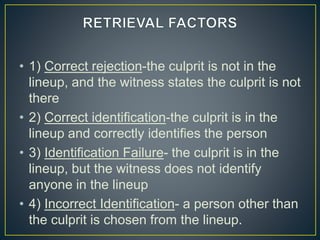
• 1) Correct rejection-the culprit is not in the
lineup, and the witness states the culprit is not
there
• 2) Correct identification-the culprit is in the
lineup and correctly identifies the person
• 3) Identification Failure- the culprit is in the
lineup, but the witness does not identify
anyone in the lineup
• 4) Incorrect Identification- a person other than
the culprit is chosen from the lineup.
What factors can you imagine
could affect identification?
The witness could feel pressure to make an
identification even if they do not recognize anyone.
The goal is to create lineups in such as way as to
maximize correct identifications and correct
rejections, minimize identification failures and
incorrect identifications.
• Creating False memories -Loftus
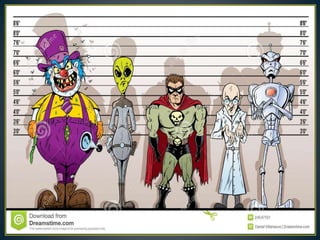
• The National Institute of Justice (NIJ)
guidelines recommended that lineup fillers
be chosen to reflect the witness description
of the perpetrator. “the suspect should not
stand out.”
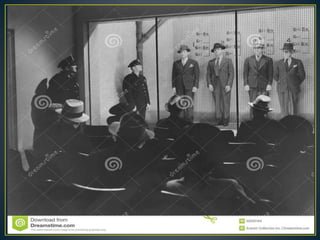
• Simultaneous Lineup-lineup members presented
at the same time
• Sequential lineups (presenting members one by
one) are thought to have more probative value
than simultaneous lineups. The witness must
decide whether each of the lineup members is or
is not the culprit.
Lineups are best administered blind.
• Strength of the relationship between the
suggested evidence (i.e., lineup identification) at
trial and the proposition sought (i.e., the
defendant is guilty of committing the crime)
• Confidence in identification is a poor to mediocre
predictor of identification accuracy
•
• The hypothesis is about who committed the
crime.
• The experiment is to have several people that
match the description in a lineup.
• One of the people is suspected of the crime and
there is likely evidence against them.
• The experiment is for the witness to correctly
identify this person.
• Does the evidence support the hypothesis?
• Other methods of retrieval include hypnosis.
This method can increase recall of the amount of
information reported but this increase is for both
correct and fabricated information
(confabulation).
• A high level of confidence is weak indicator of
memory accuracy
• Witnesses that make quick identifications tend to
be accurate.
• Implements principles of memory to enhance
witness recall.
• 1) There is an attempt to make the witness
comfortable
• 2) The witness is asked open-ended questions (e.g.,
Tell me what happened) that gather multiple pieces
of information rather than more narrow closed ended
questions (where did the culprit put the money?)
Which elicit more specific information.
• 3) The cognitive interview uses what we
know about memory to facilitate it.
• For example, taking into account the
context, recalling the event from different
perspectives and in different orders, using
as many different retrieval pathways as
possible (encoding specificity principle)
• 4) The witnesses are allowed some
freedom in exactly how they describe
events
• Preferred technique for interviewing
witnesses to a crime and has met with
good success eliciting 35%-75% more
information with no increase in
confabulated material.
• I am going to show you a list of words and
I am going to read them to you. Do not
write or say anything until I say go. When I
am finished, I will say GO and you will
have one minute to write down as many of
those words as you possibly can
remember. The first 3 or 4 are going to
come back instantly because you are
regurgitating the information you just got.
Then it will start to get hard, when it gets
hard that is when you will be accessing
true memory.
• When it gets hard, I want you to close your
eyes and try to remember what it looked
like and sounded like when I read the
words and you will be able to remember 5
or 6 more words after that. You will have
60 seconds to write down as many as you
can remember.
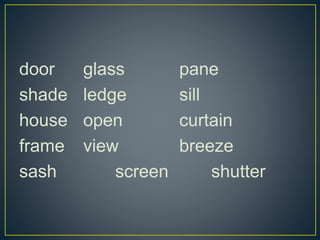
• You will notice these are all themed around a
house
door glass pane
shade ledge sill
house open curtain
frame view breeze
sash screen shutter
Ok Time is up
•Who thinks they did pretty
well?
•Who wished they had a
second chance?
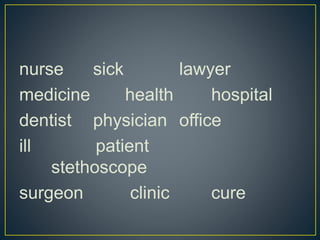
• THESE ARE ALL HOSPITAL
THEMED
nurse sick lawyer
medicine health hospital
dentist physician office
ill patient
stethoscope
surgeon clinic cure
• Memory Illusions aka illusory memories,
aka false memories involve the creation of
a memory for an event that did not happen.
Two basic approaches:
• 1) High levels of false recall and false recognition
have been found in the laboratory using the
DEESE-ROEDIGER-MCDERMOTT (DRM)
PARADIGM
• DRM entails presenting a list of words created
around a non-presented theme word.
• False recognition tends to be based on the
recollection-based judgments rather than
familiarity based judgments.
• False memories are associated with some
advantages, including the ability to make creative
connections between ideas.
WHAT MEMORY SIN DO YOU THINK
IS/ARE AT PLAY IN THE DRM
PARADIGM?
• Misattribution
• the non-presented theme word was probably
thought about while encoding the list and then
the thought of this word was misattributed to
the word actually being presented on the list.
• 2) False memories can be induced for
everyday events, such as being lost.
• Imagination inflation refers to the idea
that imagining how an event may have
occurred increases the feelings that it really
did.
• False narratives and photos (especially
doctored photos) are likely to induce false
remembering.
• Memory distortions can lead to some benefits.
• Memory is both powerful and flexible, which
leads to its adaptiveness.
• The flexibility comes from our tendency to take in
information through our own personal filter of
expectations and beliefs, and combine it with
information already in memory.
• The shortcuts we take to remember things can
lead to memory errors.
• False recall and recognition are not limited
to single words but researchers have been
able to induce participants into falsely
remembering complex events that are as
detailed in some cases as authentic
memories.
• Loftus and Pickrell (1995)- experiment:
Could they induce participants to
completely fabricate a memory.
• The fabricated memory was getting lost
in a shopping mall.
• 25% of the 24 participants generated a
false memory. The detail was high but not
as high as an authentic memory.
What memory sin(s) do you think is/are at
play in the getting lost in the mall study?
• Suggestibility- the assumption and
suggestion from experimenters led to the
creation of the false memory.
• Misattribution: the idea of being lost in a
mall is misattributed to an experienced
event and not to the stories told by the
family members about the event.
How easy is it to manipulate memory?
Seems pretty easy
Have you ever wondered whether
something happened or you just imagined
it?
Has seeing pictures or hearing stores made
you question if you were remembering the
photo/story about the event or the event
itself?
• Imagination Inflation-Simply imagining
that an event occurred increases the
likelihood of someone remembering that it
really did occur. Garry, Manning, Loftus,
and Sherman (1996).
• Mazzoni, Loftus, and Kirsch (2001),
proposed a three-step model of false
memory development
• First, view the pseudo-event as plausible
• Second, believe the event happened
• Third, mistake the false information about
the event as real. (narratives, photos)
• Narratives may make it easier to mistake the
internalized story because they are more similar
to our own memory as opposed to a photo which
is a snapshot in time.
• So Narrative + Photo combined can be
misleading and believable, thus more effective in
creating a false memory.
•
• Doctored-evidence-effect- Doctored evidence
can have a powerful effect on memory distortion
• Social Media- Discuss the potential for
misinformation, “fake news”, believability,
seeming credibility, inability to check or confirm
facts.
• Although social media can influence memory,
this influence depends upon the nature of that
media, and whether the information generated is
from a (socially) known or unknown source. If the
source is stranger you are less likely to believe
the information or accept it at face value.
• Collaboration- sometimes family
members could be recruited to help “sell”
the story. This supports the believability of
the story. Remembering is quite often a
social enterprise (Weldon, 2000).
• For example, were you ever telling a story
about something that happened to you and
some friends and each of you may contribute
to the story telling by remembering different
details?
• Proposes that gist (general information)
and verbatim (exact information traces are
formed when an event is encoded.
• False memories are rooted in the
activation of gist traces.
• Proposes that five stages are necessary
for accurate memory reconstruction.
• The next two Occur During Encoding
• 1) Feature binding all of the components of
the encoded event-including sights,
sounds, the people, and what they said
must somehow cohere into a unitized
memory representation. Failure to do so
will result in memory fragments (unclear
source)
• 2) Pattern separation the bound episodes
must be kept separate from one another;
otherwise you’ll confuse the source events.
• For example, if you repeatedly engage in the
same activities, with the same friends, at the
same place memory for these episodes will be
difficult to separate.
• Occurs During Retrieval
• 1) Focusing- the use of a cue to get to the right
memory. For example, hanging out with friends
at Starbucks when the server spilled the
cappuccino all over the counter. ( the more
specific the memory the better.
• 2) Pattern completion -the successful
reconstruction of the product from this focused
search
• 3) Criterion setting deciding whether the
completed pattern represents a valid
memory.
• In hypnosis, criterion setting is influenced
by the suggestibility of the rememberer.
• This is the last stage of the constructive
memory framework
• Focuses on the processes whereby we
monitor the origins of encoded information.
In other words, memory, (and memory
failure) stems from our ability to nail down
information about the source of events.
• Two Stages
• 1) Reality Monitoring- the process by which we
attribute n experienced memory to either a
perceived external event or an internally
generated event (i.e., imagined event)
• The more perceptually salient the memory he
more likely it will be judged as real.
• 2) Source Monitoring-if memory is attributed to an
externally perceived event, then the source monitoring
stage is engaged to determine the source of the event.
• For example, did I hear this in class? On the news?
From a friend?
• Source confusion- the inability to
determine the source of event memories.
• Memory failures can be understood as a
small cost for a tremendously adaptive
system that allows for quick and efficient
encoding and preparing for the future.
• MEMORY DISTORTIONS-misattribution result of
memory updating-constant need to integrate new
information.
• Gist based errors-we recall information that was
not presented due to activation of related
knowledge.
• Lastly, our tendency to create events out of our
imagination.
• Episodic Simulation Hypothesis- it allows us to
simulate future events (based on what is stored
in memory) in support of future planning and goal
setting.
• This function comes at a cost, when we combine
imagination and memory, we can become
confused about the source of our recollection,
resulting in memory error.
•
• The existence of repressed and subsequently
recovered memories has been an issue of much
debate.
• Research has indicated it is possible to forget
and later recall memories of sexual abuse.
• Corroborated memories of abuse seem to
appear suddenly, in context that reinstates some
aspect of the abuse situation and tend to be
accompanied by great surprise.
• Recovery that occurs in a therapeutic context is
more likely to be uncorroborated, and more
subject to factors that lead to false remembering.
• For example, person that came in for
treatment had lived most of his life with no
memory that he had been abused by his father
and mother sexually over a period of years when
he was very young. The client’s parents had both
died and he was cleaning out their house. He
discovered a few video tapes in his parent’s
bedroom. To see if there was anything of interest
on them he played them. He discovered his
parents had taken turns sexually abusing him
and they had over a dozen videos of the actions.
The client had no memory of this until he
watched the videos.
• The Ordinary Forgetting View-Brewin (2007)
contends that forgetting traumatic memories can
be explained in the same was a forgetting non-
traumatic memories.
• The special mechanisms view, contends that
encoding traumatic events is fundamentally
different from the encoding of non-traumatic
events.
• Trauma enhances function of the amygdala and
disrupts hippocampus activity.
• Consequently, memory for feelings and images
is enhanced; however, memory in the form of a
• Dissociation may be considered a special
mechanism. How can a memory go completely
underground for a long period of time?
Dissociation is a clinical term referring to a state
in which a person loses control of their cognitive
functioning without any conscious awareness of
the loss.
• Long held view of clinicians is that trauma leads
to dissociation
• Trauma Model (of dissociation)- a
psychobiological response whereby
cognitive processes “shut down” to
enhance the chances of surviving the
traumatic event, and its aftermath. A very
specific cue may trigger the recovery of the
trauma.
• Fantasy Model-alternate to the trauma
model-dissociation is not a
psychobiological response to trauma.
Trauma and dissociation are two separate
processes. Dissociation is a process that is
related to exaggeration, suggestibility,
proneness to fantasy. Supporters of this
model suggest that individuals prone to
dissociation overly report trauma due to
cognitive distortion they experience.
• Research suggests it is possible to implant false
memories of traumatic events.
• One piece of evidence if the existence of
retractors (individuals who recover memories of
abuse but later recant their reports).
• Therapeutic approaches that focus on memory
recovery can provide a suggestive environment
that may lead to the creation of memories of
false childhood sexual abuse.
Assessing The Nature Of Recovered Memory
Experiences.
• One view is that what appears to be repressed then
recovered memories are simply memories that are
discontinuous (i.e., forgotten for a period and
recovered suddenly).
• Another view is that the event was not experienced
as traumatic at the time of encoding, and was a later
realization.
• Skepticism about recovered memories has
increased over the last couple of decades.
Ch 7  Reconstructive Memory.pptx

Ch 7 Reconstructive Memory.pptx

  • 1.
  • 2.
    • The MythOf Memory As A Video Recorder • Memory is a reconstructive process for everyone, even those with Hyperthymesia (“PHOTOGRAPHIC MEMORY”) or highly superior autobiographical memory (HSAM). • Individuals with these conditions remember nearly all of the events that have occurred in their lives and experience vivid and detailed recollection.
  • 3.
    WOULD YOU WANTSUCH A MEMORY? • A PERSON WITH Hyperthymesia would remember things in great detail, this includes all the painful memories. • Does forgetting serve a purpose? • Forgetting is adaptive
  • 4.
    • Is aperson with Hyperthymesia susceptible to false memories? • Yes and perhaps more than what is typical. HOW CAN MEMORIES BE PERFECT YET PRONE TO DISTORTION?
  • 5.
    • A memoryfor an event is stored somewhere in the brain. • ACTUAL: • Actual, the various “entries” are stored in a distributed fashion across different areas of the brain. Memories are not singular units stored in one location of the brain (Lashley, 1950) • In fact, a memory does not really exist until it is retrieved.
  • 6.
    • Memories arelike dreams where the brain puts the activated pieces together into a story. But the “entries” are not haphazardly chosen. • All that exists prior to retrieval is the potential for a memory.
  • 7.
    • False MemoriesAre Very Common • they can be easily manufactured. • For example, many people will remember seeing the first plane hitting the World Trade Center on 9/11/2001. No one saw the first plane hit the tower but footage was found later. • At some level we accept that memories are faulty. • 10 False Memories Everyone Believes
  • 8.
    • Memory Reconstructioninvolves a combination of actual information from the remembered event, as well as integration of information from other’s accounts of the event, our on recollections of the event, and information from semantic memory. • Our memory is similar to Wikipedia- a series of entries called wikis, with many different aspects encoded such as sight, sounds, taste, people, the plot, etc. • At the time of retrieval, we select the entries and construct memory.
  • 9.
    • Many (ifnot most) distortions occur when we place the wrong “entry” into the memory construction because we confuse the source of the “entry” as being from one episode but in actuality it was from another. (source confusion) • Memory is not stored as a single unit in a localized area of the brain. • Memory representations are thought to be distributed across the different brain areas that were active at the time of the original event.
  • 10.
    • Memory isa reconstructive process and as such it is subject to many distortions. • For example, the memory sins of omission refers to errors in which information is absent of forgotten (memory fails). These errors include the following:
  • 11.
    • Transience- theloss of information from memory with the passage of time • Absentmindedness- problems with the interface between attention and long-term memory • Blocking-failure to retrieve information stored in long-term memory
  • 12.
    • SINS OFCOMMISSION refers to the presence of unwanted or inaccurate memories and include the following: • 1) Persistence-continued automatic retrieval of unwanted memories • 2) Misattribution-memory that is ascribed to the wrong source • 3) Suggestibility-leading someone to a false recollection • 4) Bias-the influence of who we are (our beliefs expectations and desires) on what we remember
  • 13.
    • Eyewitness testimonyis fallable and is affected by many factors that operate on encoding/storage. • For instance, The quality of viewing conditions and the level of attention
  • 14.
    • As stressincreases from low to medium levels, memory accuracy increases but then as stress levels increase to a high level, a steady decrease in memory accuracy occurs • Stress and trauma can disrupt or enhance memory depending upon the particular circumstances
  • 15.
    • Emotional stresscan narrow the focus of attention and lead to a decreased recall of (particularly) peripheral details. • Weapon Focus, the presence of a weapon focuses attention on the weapon (narrows the focus), resulting in a lack of peripheral detail (such as the details of the perpetrator) in the memory representation. • Although the central detail (the weapon) is described/remembered quite well.
  • 16.
    • The generalprinciple has been called Memory Narrowing or Tunnel Memory • Similarly, physical exertion can be linked with detrimental effects on memory.
  • 17.
    • Embodied cognition-theoretical perspectivethat emphasizes the role that the body and its ongoing actions can have in determining perception. • Perception can include affordances for action
  • 18.
    • Memory narrowingaccording, to Biggs and colleagues (2014)focuses attention on information relevant to the person’s goals, in that situation. • For example, a person sees a gun pointed at them. Affordances of the purpose of the gun and its firing are triggered and memory narrowing occurs so the focus is on the weapon only.
  • 19.
  • 20.
    • Other-Race-Effect refersto increased difficulty in discriminating among faces of another race relative to faces of one’s own race. • People are better at recognizing faces of their own race • According to Brigham (2001), the chance of mistaken identification is 1.5 times greater when the perpetrator is a different race than the witness.
  • 21.
    • Osborne andDavies (2014) • Cross-racial identification situations-the type of crime witnessed influences the identification of the perpetrator by automatically activating stereotypical beliefs about the physical appearance of those who are thought to commit certain crimes.
  • 22.
    • The MisinformationEffect •Refers to the finding that misleading information presented between the encoding of the event and its subsequent recall influences a witness’s memory thus increases the chances of misremembering.
  • 23.
    • Unconscious transference-occurswhen a witness fails to distinguish between a target person and another person encountered at a different time whose face is also familiar (Loftus, 1976)
  • 24.
    • Levin andSimons (2000)- the illusion of continuity-a perceiver misperceives continuity between two scenes or situations due to their own propensity to fill in gaps via top-down processing. • Top down processing leads us to see what we expect to see. • We expect to see continuity in the visual scene we’re looking at and so we do. • But as change blindness indicates, this continuity is sometimes and illusion as obvious changes in the environment are often missed.
  • 25.
    • Photo Bias-aspecific type of unconscious transference, which refers to the increase in probability that a person will be recognized as the culprit due to previous exposure in a photo. • Exposure to someone through a chance encounter or in a photo (photo bias) will make the person seem familiar and increase the chance of being misidentified as the culprit in a crime. • Misattribution-the witness misattributes the person they saw in the photo to be the perpetrator of the crime they witnessed.
  • 26.
    • Attempting toremember which of several people committed a crime can be similar to a recognition test. • A variety of factors can affect whether a choice is made and if that choice is accurate. • A major factor influencing eyewitness identification is the structure and procedures used in presenting lineups.
  • 27.
    • 1) Correctrejection-the culprit is not in the lineup, and the witness states the culprit is not there • 2) Correct identification-the culprit is in the lineup and correctly identifies the person • 3) Identification Failure- the culprit is in the lineup, but the witness does not identify anyone in the lineup • 4) Incorrect Identification- a person other than the culprit is chosen from the lineup.
  • 28.
    What factors canyou imagine could affect identification? The witness could feel pressure to make an identification even if they do not recognize anyone. The goal is to create lineups in such as way as to maximize correct identifications and correct rejections, minimize identification failures and incorrect identifications.
  • 29.
    • Creating Falsememories -Loftus
  • 30.
    • The NationalInstitute of Justice (NIJ) guidelines recommended that lineup fillers be chosen to reflect the witness description of the perpetrator. “the suspect should not stand out.”
  • 34.
    • Simultaneous Lineup-lineupmembers presented at the same time • Sequential lineups (presenting members one by one) are thought to have more probative value than simultaneous lineups. The witness must decide whether each of the lineup members is or is not the culprit. Lineups are best administered blind.
  • 35.
    • Strength ofthe relationship between the suggested evidence (i.e., lineup identification) at trial and the proposition sought (i.e., the defendant is guilty of committing the crime) • Confidence in identification is a poor to mediocre predictor of identification accuracy •
  • 36.
    • The hypothesisis about who committed the crime. • The experiment is to have several people that match the description in a lineup. • One of the people is suspected of the crime and there is likely evidence against them. • The experiment is for the witness to correctly identify this person. • Does the evidence support the hypothesis?
  • 37.
    • Other methodsof retrieval include hypnosis. This method can increase recall of the amount of information reported but this increase is for both correct and fabricated information (confabulation). • A high level of confidence is weak indicator of memory accuracy • Witnesses that make quick identifications tend to be accurate.
  • 38.
    • Implements principlesof memory to enhance witness recall. • 1) There is an attempt to make the witness comfortable • 2) The witness is asked open-ended questions (e.g., Tell me what happened) that gather multiple pieces of information rather than more narrow closed ended questions (where did the culprit put the money?) Which elicit more specific information.
  • 39.
    • 3) Thecognitive interview uses what we know about memory to facilitate it. • For example, taking into account the context, recalling the event from different perspectives and in different orders, using as many different retrieval pathways as possible (encoding specificity principle)
  • 40.
    • 4) Thewitnesses are allowed some freedom in exactly how they describe events • Preferred technique for interviewing witnesses to a crime and has met with good success eliciting 35%-75% more information with no increase in confabulated material.
  • 41.
    • I amgoing to show you a list of words and I am going to read them to you. Do not write or say anything until I say go. When I am finished, I will say GO and you will have one minute to write down as many of those words as you possibly can remember. The first 3 or 4 are going to come back instantly because you are regurgitating the information you just got. Then it will start to get hard, when it gets hard that is when you will be accessing true memory.
  • 42.
    • When itgets hard, I want you to close your eyes and try to remember what it looked like and sounded like when I read the words and you will be able to remember 5 or 6 more words after that. You will have 60 seconds to write down as many as you can remember. • You will notice these are all themed around a house
  • 43.
    door glass pane shadeledge sill house open curtain frame view breeze sash screen shutter
  • 45.
  • 46.
    •Who thinks theydid pretty well? •Who wished they had a second chance?
  • 48.
    • THESE AREALL HOSPITAL THEMED
  • 49.
    nurse sick lawyer medicinehealth hospital dentist physician office ill patient stethoscope surgeon clinic cure
  • 51.
    • Memory Illusionsaka illusory memories, aka false memories involve the creation of a memory for an event that did not happen. Two basic approaches:
  • 52.
    • 1) Highlevels of false recall and false recognition have been found in the laboratory using the DEESE-ROEDIGER-MCDERMOTT (DRM) PARADIGM • DRM entails presenting a list of words created around a non-presented theme word. • False recognition tends to be based on the recollection-based judgments rather than familiarity based judgments. • False memories are associated with some advantages, including the ability to make creative connections between ideas.
  • 53.
    WHAT MEMORY SINDO YOU THINK IS/ARE AT PLAY IN THE DRM PARADIGM? • Misattribution • the non-presented theme word was probably thought about while encoding the list and then the thought of this word was misattributed to the word actually being presented on the list.
  • 54.
    • 2) Falsememories can be induced for everyday events, such as being lost. • Imagination inflation refers to the idea that imagining how an event may have occurred increases the feelings that it really did. • False narratives and photos (especially doctored photos) are likely to induce false remembering.
  • 55.
    • Memory distortionscan lead to some benefits. • Memory is both powerful and flexible, which leads to its adaptiveness. • The flexibility comes from our tendency to take in information through our own personal filter of expectations and beliefs, and combine it with information already in memory. • The shortcuts we take to remember things can lead to memory errors.
  • 56.
    • False recalland recognition are not limited to single words but researchers have been able to induce participants into falsely remembering complex events that are as detailed in some cases as authentic memories.
  • 57.
    • Loftus andPickrell (1995)- experiment: Could they induce participants to completely fabricate a memory. • The fabricated memory was getting lost in a shopping mall. • 25% of the 24 participants generated a false memory. The detail was high but not as high as an authentic memory.
  • 58.
    What memory sin(s)do you think is/are at play in the getting lost in the mall study? • Suggestibility- the assumption and suggestion from experimenters led to the creation of the false memory. • Misattribution: the idea of being lost in a mall is misattributed to an experienced event and not to the stories told by the family members about the event.
  • 59.
    How easy isit to manipulate memory? Seems pretty easy
  • 60.
    Have you everwondered whether something happened or you just imagined it? Has seeing pictures or hearing stores made you question if you were remembering the photo/story about the event or the event itself?
  • 61.
    • Imagination Inflation-Simplyimagining that an event occurred increases the likelihood of someone remembering that it really did occur. Garry, Manning, Loftus, and Sherman (1996).
  • 62.
    • Mazzoni, Loftus,and Kirsch (2001), proposed a three-step model of false memory development • First, view the pseudo-event as plausible • Second, believe the event happened • Third, mistake the false information about the event as real. (narratives, photos)
  • 63.
    • Narratives maymake it easier to mistake the internalized story because they are more similar to our own memory as opposed to a photo which is a snapshot in time. • So Narrative + Photo combined can be misleading and believable, thus more effective in creating a false memory. • • Doctored-evidence-effect- Doctored evidence can have a powerful effect on memory distortion
  • 64.
    • Social Media-Discuss the potential for misinformation, “fake news”, believability, seeming credibility, inability to check or confirm facts. • Although social media can influence memory, this influence depends upon the nature of that media, and whether the information generated is from a (socially) known or unknown source. If the source is stranger you are less likely to believe the information or accept it at face value.
  • 65.
    • Collaboration- sometimesfamily members could be recruited to help “sell” the story. This supports the believability of the story. Remembering is quite often a social enterprise (Weldon, 2000). • For example, were you ever telling a story about something that happened to you and some friends and each of you may contribute to the story telling by remembering different details?
  • 66.
    • Proposes thatgist (general information) and verbatim (exact information traces are formed when an event is encoded. • False memories are rooted in the activation of gist traces.
  • 67.
    • Proposes thatfive stages are necessary for accurate memory reconstruction. • The next two Occur During Encoding
  • 68.
    • 1) Featurebinding all of the components of the encoded event-including sights, sounds, the people, and what they said must somehow cohere into a unitized memory representation. Failure to do so will result in memory fragments (unclear source)
  • 69.
    • 2) Patternseparation the bound episodes must be kept separate from one another; otherwise you’ll confuse the source events. • For example, if you repeatedly engage in the same activities, with the same friends, at the same place memory for these episodes will be difficult to separate.
  • 70.
    • Occurs DuringRetrieval • 1) Focusing- the use of a cue to get to the right memory. For example, hanging out with friends at Starbucks when the server spilled the cappuccino all over the counter. ( the more specific the memory the better. • 2) Pattern completion -the successful reconstruction of the product from this focused search
  • 71.
    • 3) Criterionsetting deciding whether the completed pattern represents a valid memory. • In hypnosis, criterion setting is influenced by the suggestibility of the rememberer.
  • 72.
    • This isthe last stage of the constructive memory framework • Focuses on the processes whereby we monitor the origins of encoded information. In other words, memory, (and memory failure) stems from our ability to nail down information about the source of events.
  • 73.
    • Two Stages •1) Reality Monitoring- the process by which we attribute n experienced memory to either a perceived external event or an internally generated event (i.e., imagined event) • The more perceptually salient the memory he more likely it will be judged as real.
  • 74.
    • 2) SourceMonitoring-if memory is attributed to an externally perceived event, then the source monitoring stage is engaged to determine the source of the event. • For example, did I hear this in class? On the news? From a friend?
  • 75.
    • Source confusion-the inability to determine the source of event memories. • Memory failures can be understood as a small cost for a tremendously adaptive system that allows for quick and efficient encoding and preparing for the future.
  • 76.
    • MEMORY DISTORTIONS-misattributionresult of memory updating-constant need to integrate new information. • Gist based errors-we recall information that was not presented due to activation of related knowledge. • Lastly, our tendency to create events out of our imagination.
  • 77.
    • Episodic SimulationHypothesis- it allows us to simulate future events (based on what is stored in memory) in support of future planning and goal setting. • This function comes at a cost, when we combine imagination and memory, we can become confused about the source of our recollection, resulting in memory error. •
  • 78.
    • The existenceof repressed and subsequently recovered memories has been an issue of much debate. • Research has indicated it is possible to forget and later recall memories of sexual abuse. • Corroborated memories of abuse seem to appear suddenly, in context that reinstates some aspect of the abuse situation and tend to be accompanied by great surprise. • Recovery that occurs in a therapeutic context is more likely to be uncorroborated, and more subject to factors that lead to false remembering.
  • 79.
    • For example,person that came in for treatment had lived most of his life with no memory that he had been abused by his father and mother sexually over a period of years when he was very young. The client’s parents had both died and he was cleaning out their house. He discovered a few video tapes in his parent’s bedroom. To see if there was anything of interest on them he played them. He discovered his parents had taken turns sexually abusing him and they had over a dozen videos of the actions. The client had no memory of this until he watched the videos.
  • 80.
    • The OrdinaryForgetting View-Brewin (2007) contends that forgetting traumatic memories can be explained in the same was a forgetting non- traumatic memories. • The special mechanisms view, contends that encoding traumatic events is fundamentally different from the encoding of non-traumatic events. • Trauma enhances function of the amygdala and disrupts hippocampus activity. • Consequently, memory for feelings and images is enhanced; however, memory in the form of a
  • 81.
    • Dissociation maybe considered a special mechanism. How can a memory go completely underground for a long period of time? Dissociation is a clinical term referring to a state in which a person loses control of their cognitive functioning without any conscious awareness of the loss. • Long held view of clinicians is that trauma leads to dissociation
  • 82.
    • Trauma Model(of dissociation)- a psychobiological response whereby cognitive processes “shut down” to enhance the chances of surviving the traumatic event, and its aftermath. A very specific cue may trigger the recovery of the trauma.
  • 83.
    • Fantasy Model-alternateto the trauma model-dissociation is not a psychobiological response to trauma. Trauma and dissociation are two separate processes. Dissociation is a process that is related to exaggeration, suggestibility, proneness to fantasy. Supporters of this model suggest that individuals prone to dissociation overly report trauma due to cognitive distortion they experience.
  • 84.
    • Research suggestsit is possible to implant false memories of traumatic events. • One piece of evidence if the existence of retractors (individuals who recover memories of abuse but later recant their reports). • Therapeutic approaches that focus on memory recovery can provide a suggestive environment that may lead to the creation of memories of false childhood sexual abuse.
  • 85.
    Assessing The NatureOf Recovered Memory Experiences. • One view is that what appears to be repressed then recovered memories are simply memories that are discontinuous (i.e., forgotten for a period and recovered suddenly). • Another view is that the event was not experienced as traumatic at the time of encoding, and was a later realization. • Skepticism about recovered memories has increased over the last couple of decades.