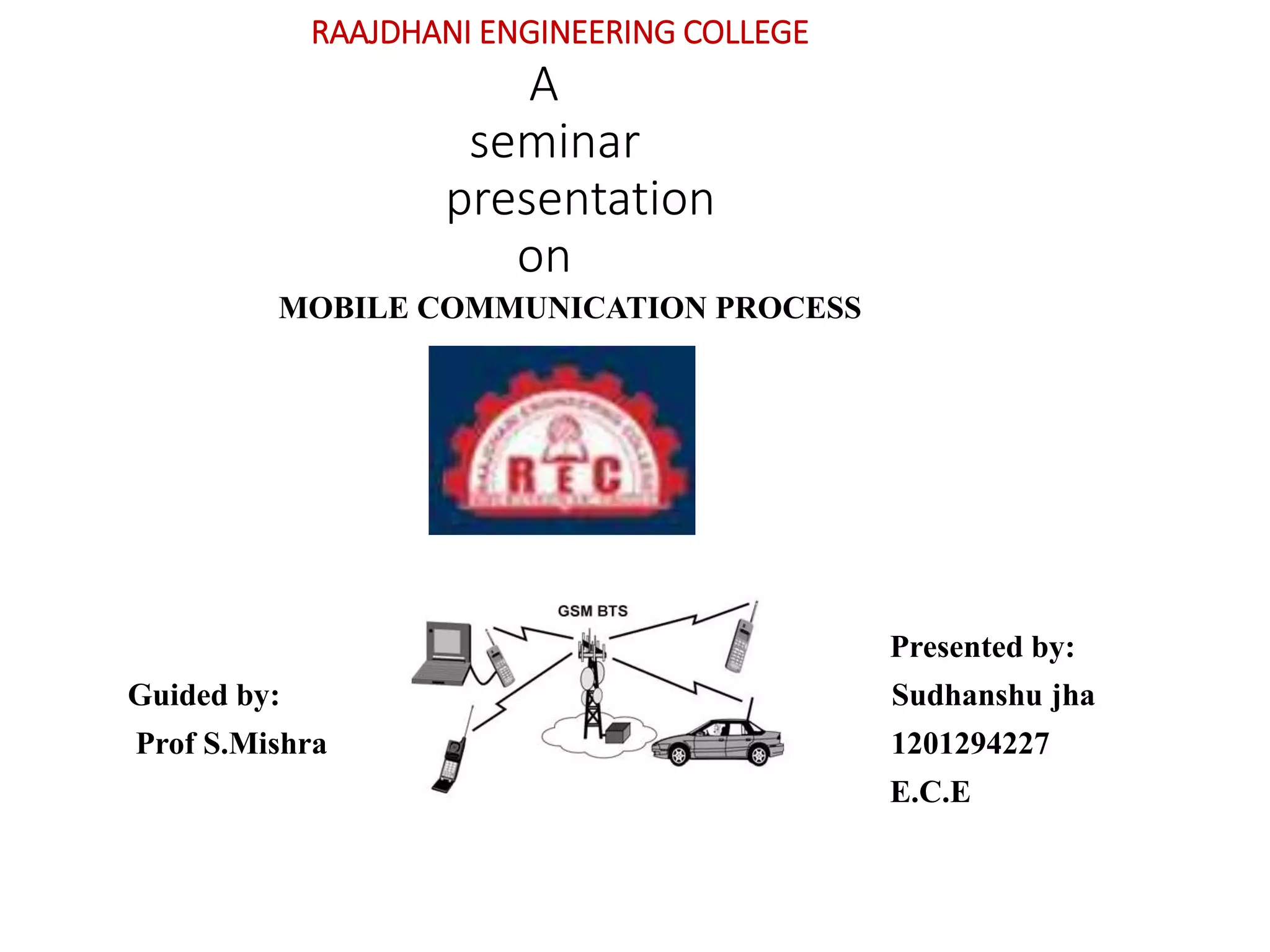
RAAJDHANI ENGINEERING COLLEGE
A
seminar
presentation
on
MOBILE COMMUNICATION PROCESS
Presented by:
Guided by: Sudhanshu jha
Prof S.Mishra 1201294227
E.C.E
CONTENT
 What is Cellular Communication
System
• Cellular communication is designed to provide
communications between two moving units, or
between one mobile unit and one stationary phone or
land unit (PSTN).
• A service provider must be able to locate and track a
caller, assign a channel to the call.
RAAJDHANI ENGINEERING COLLEGE
 COMPOMENT OF CELLULAR COMMUNICATION
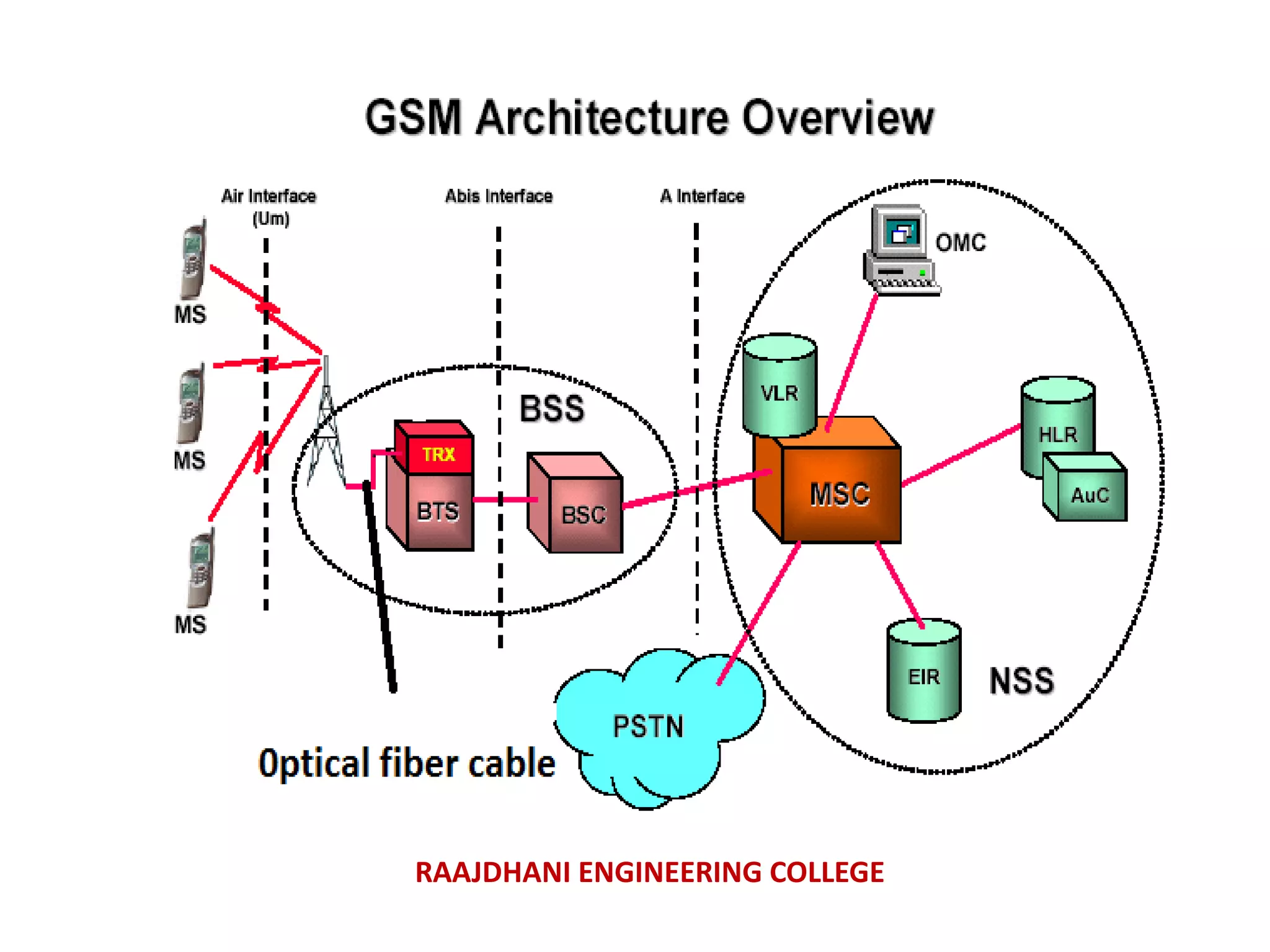
 Main component in cellular communication system.
 Mobile Switching Centre (MSC).
 Base Station Subsystem (BSS).
 Base Transceiver.
 a. Base Transceiver Station (BTS).
 b. Base Station Controller (BSC).
 optical fibre
RAAJDHANI ENGINEERING COLLEGE
 Mobile Switching Center (MSC)
• The MSC is the heart of the GSM network.
• the main role f MSC is to manage the communication
between the GSM user and other telecommunication
network.
• One MSC can handles multiple BSCs and also interfaces
with other MSC's (Using E-Interface).
RAAJDHANI ENGINEERING COLLEGE
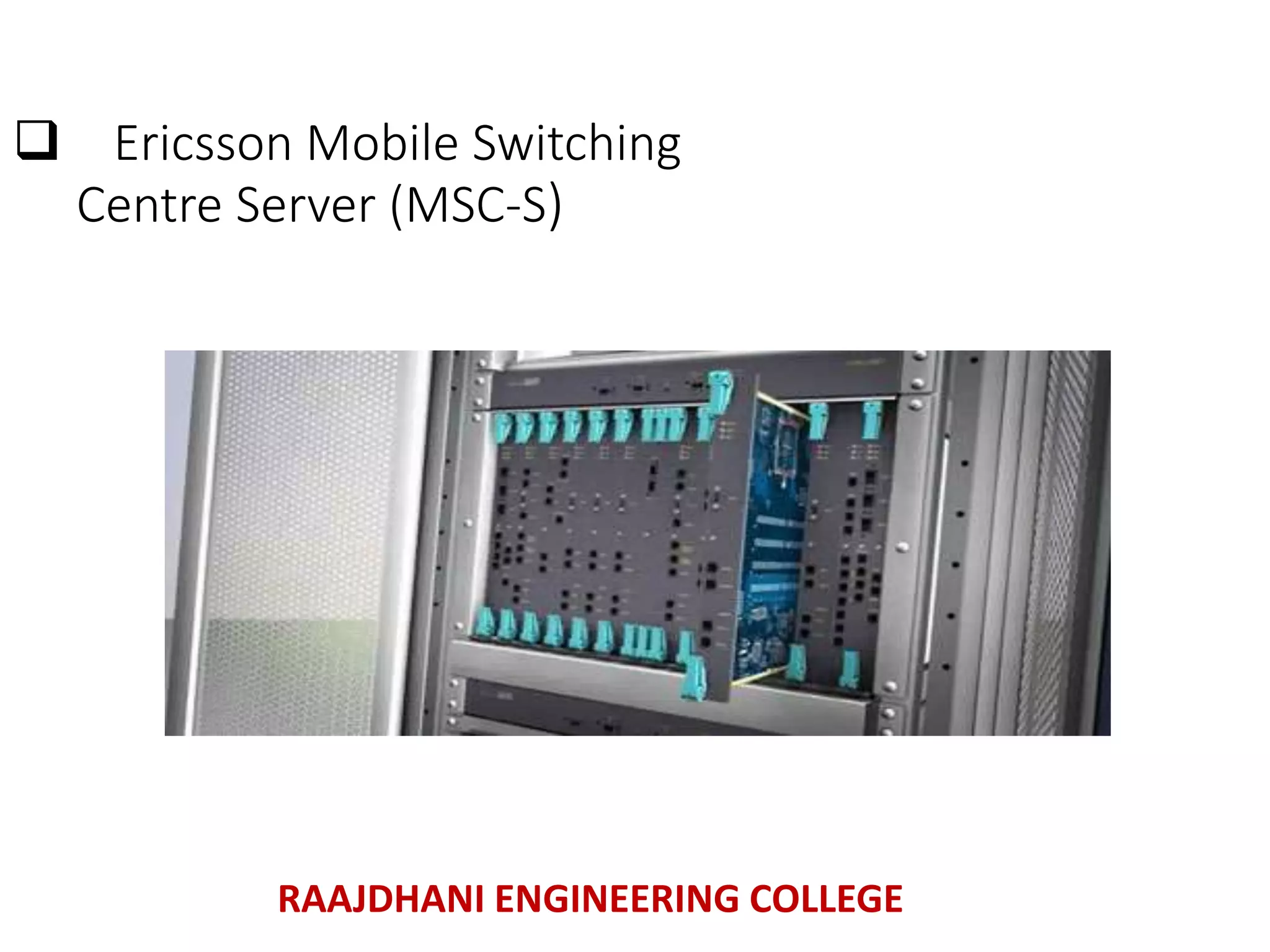
 Ericsson Mobile Switching
Centre Server (MSC-S)
RAAJDHANI ENGINEERING COLLEGE
 Mobile Switching Center (MSC)
RAAJDHANI ENGINEERING COLLEGE
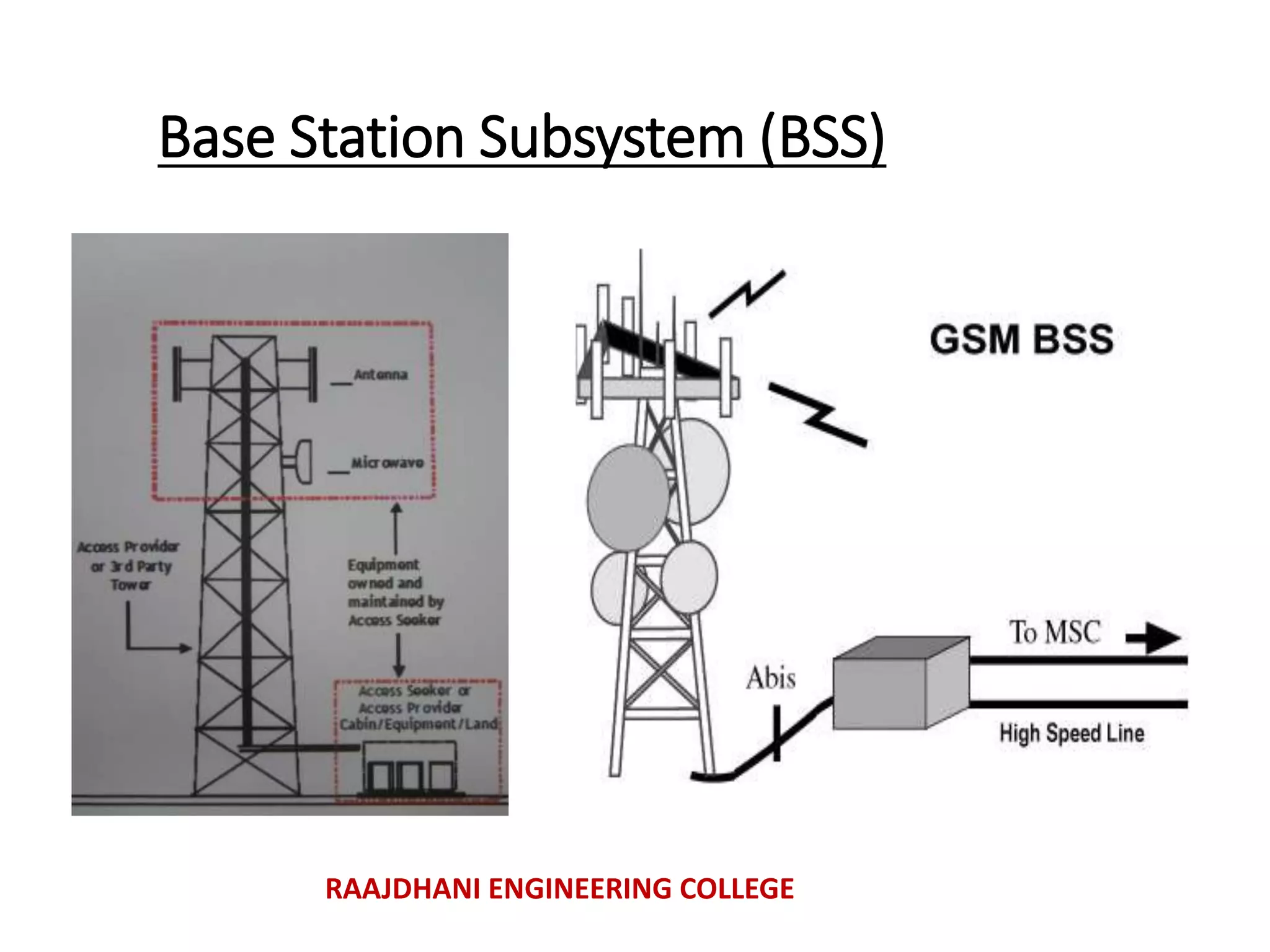
 Base Station Subsystem (BSS)
• BSS is responsible for handling traffic and signaling between
a mobile phone and the NSS.
• The BSS performs all the radio-related functions.
• The BSS is comprised of the following functional units:
• Base Station Controller (BSC)
• Base Transceiver Station (BTS)
• BSS communicate to Mobile Station (MS) using Air Interface
RAAJDHANI ENGINEERING COLLEGE
Base Station Subsystem (BSS)
RAAJDHANI ENGINEERING COLLEGE

Base Transceiver Station (BTS)
•A BTS can transmit or receive radio signal from a
mobile unit
•To perform this function completely the signal
are encoded, encrypted, multiplexed,
modulated and then fed to the antenna.
•Each BTS has between 1 to 16 transceiver
depending on density of the user in the cell
RAAJDHANI ENGINEERING COLLEGE

Base Transceiver Station (BTS)
• BTS provides physical connection between MS to network using Air
Interface (Um)
• Main function of BTS is for maintaining the Um interface and
minimizing the transmission problem (Um very sensitive for
disturbance)
• Using A-bis interface for connection between BTS and BSS
RAAJDHANI ENGINEERING COLLEGE
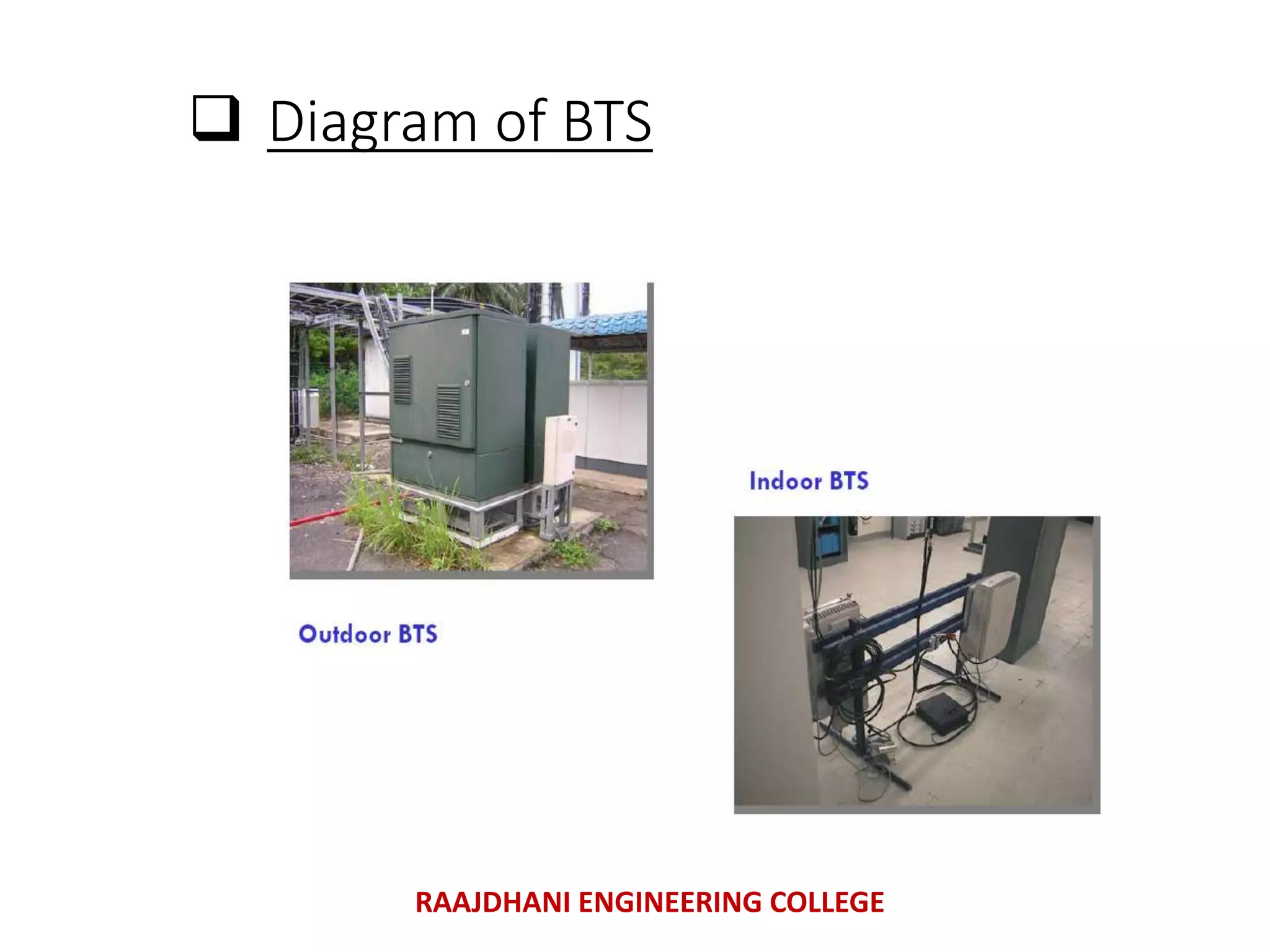
 Diagram of BTS
RAAJDHANI ENGINEERING COLLEGE
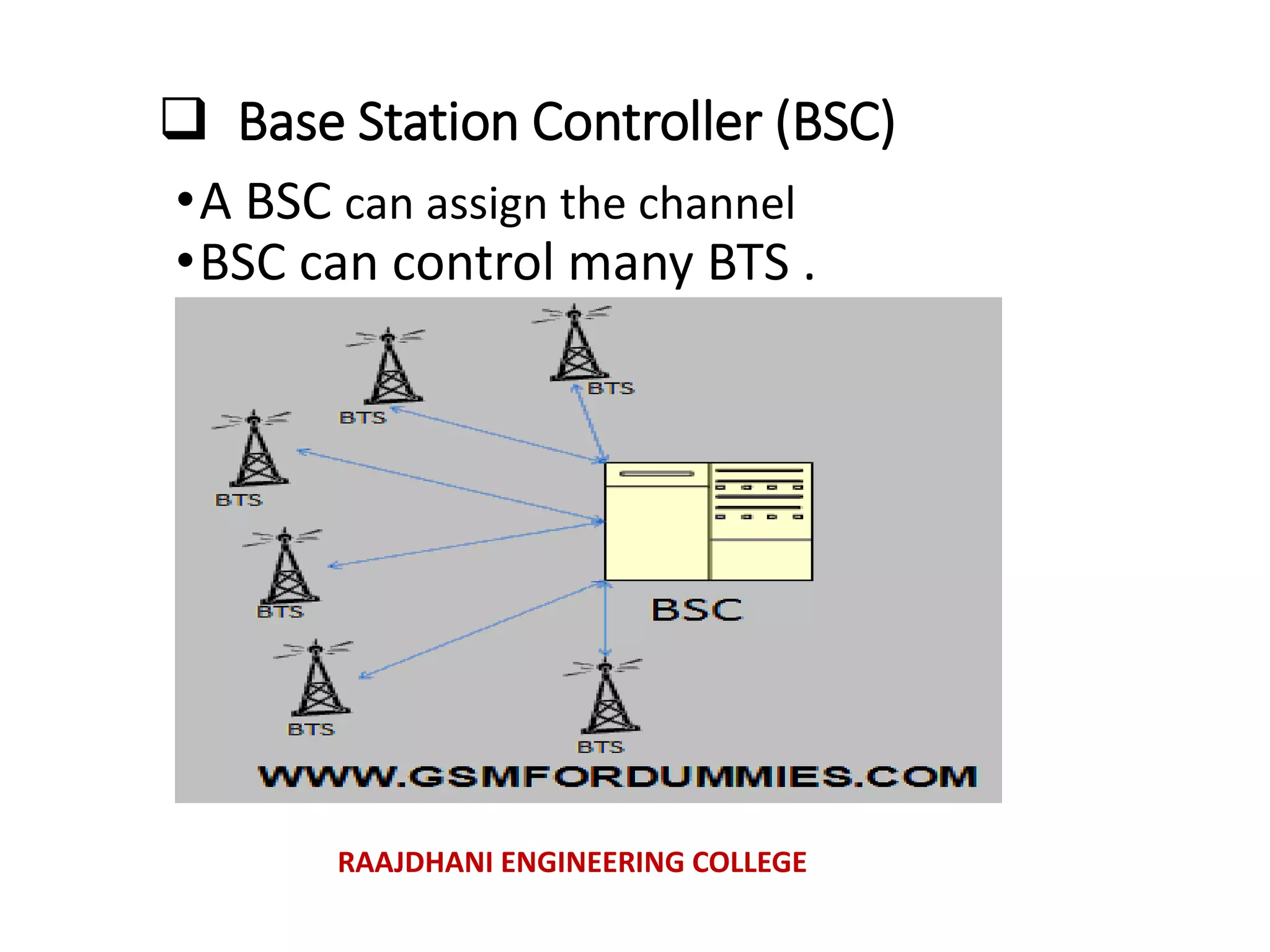
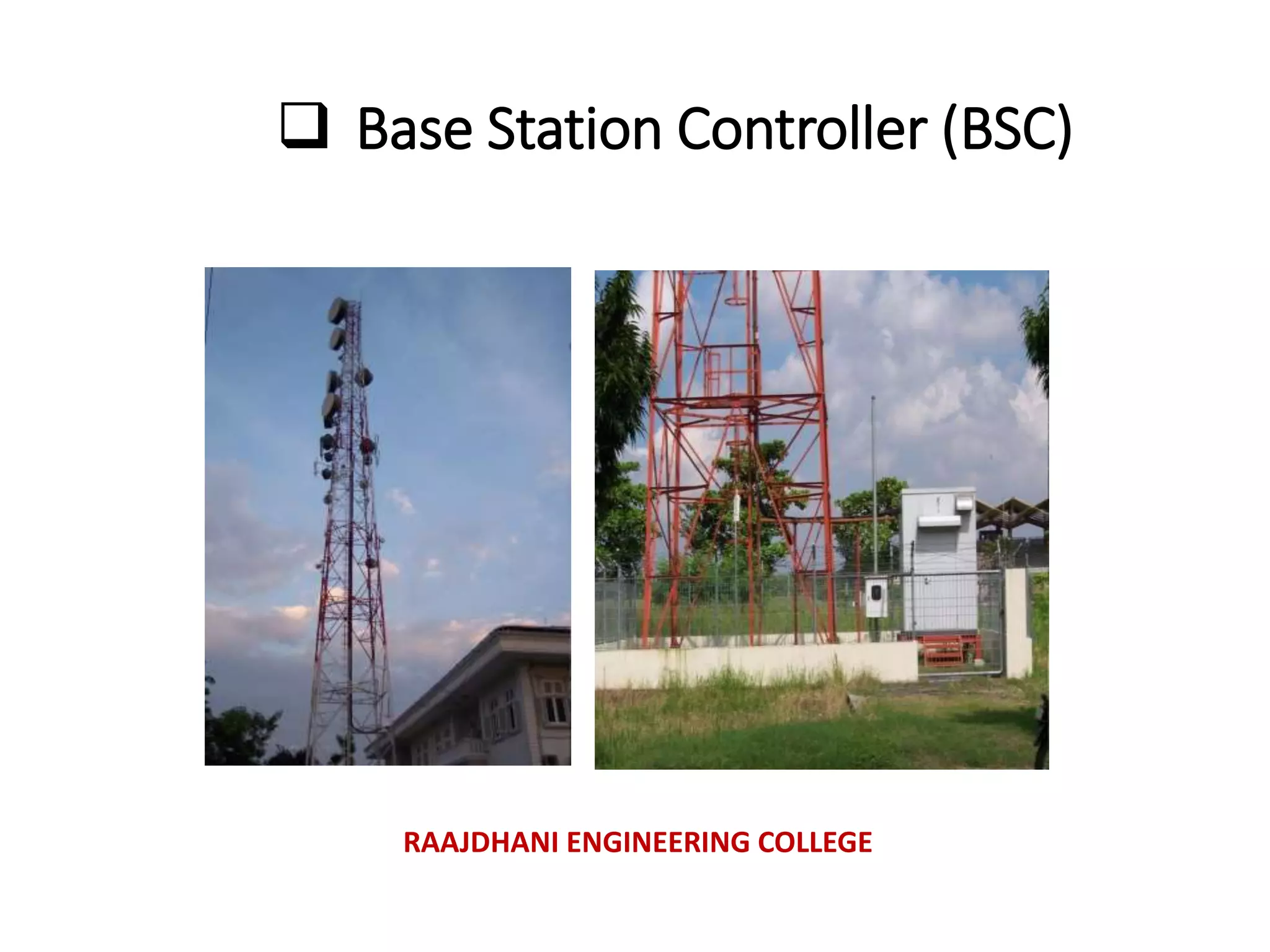
 Base Station Controller (BSC)
•A BSC can assign the channel
•BSC can control many BTS .
RAAJDHANI ENGINEERING COLLEGE
 Base Station Controller (BSC)
RAAJDHANI ENGINEERING COLLEGE
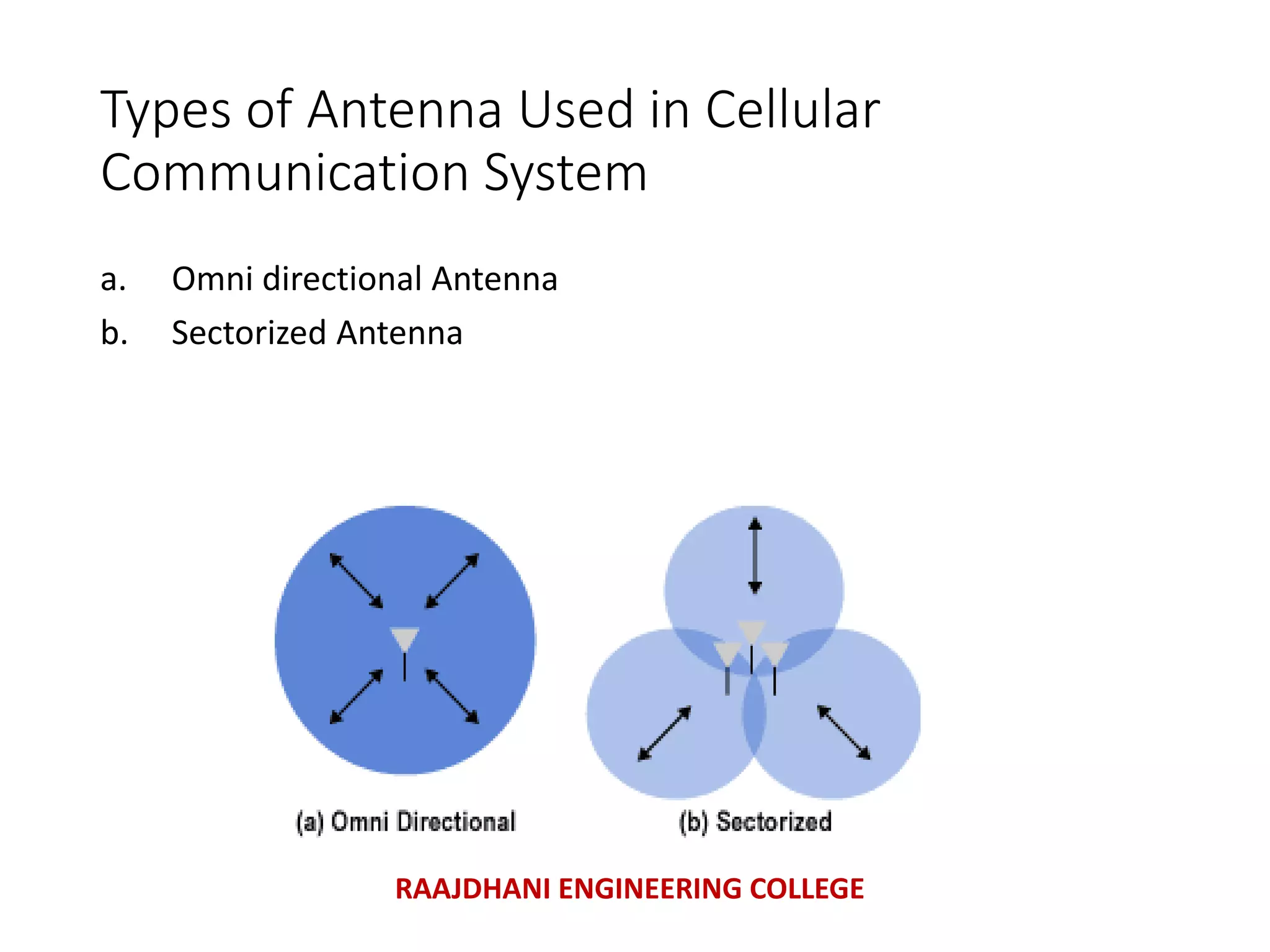
Types of Antenna Used in Cellular
Communication System
a. Omni directional Antenna
b. Sectorized Antenna
RAAJDHANI ENGINEERING COLLEGE
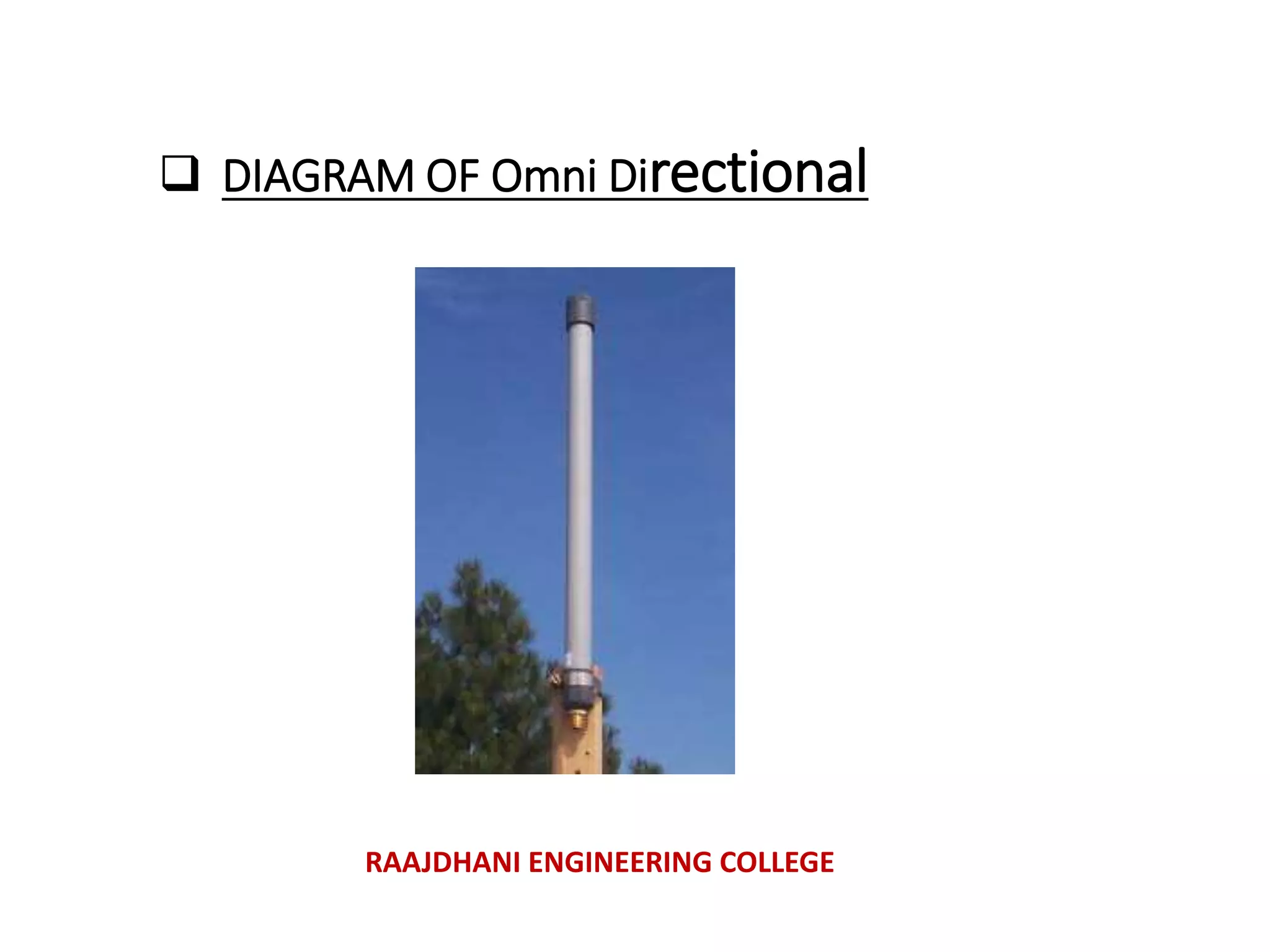
 Omni Directional
•The omnidirectional antenna radiates or
receives equally well in all directions.
•It is also called the "non-directional"
antenna because it does not favor any
particular direction.
•This antenna is built using a metallic bar
RAAJDHANI ENGINEERING COLLEGE
 DIAGRAM OF Omni Directional
RAAJDHANI ENGINEERING COLLEGE
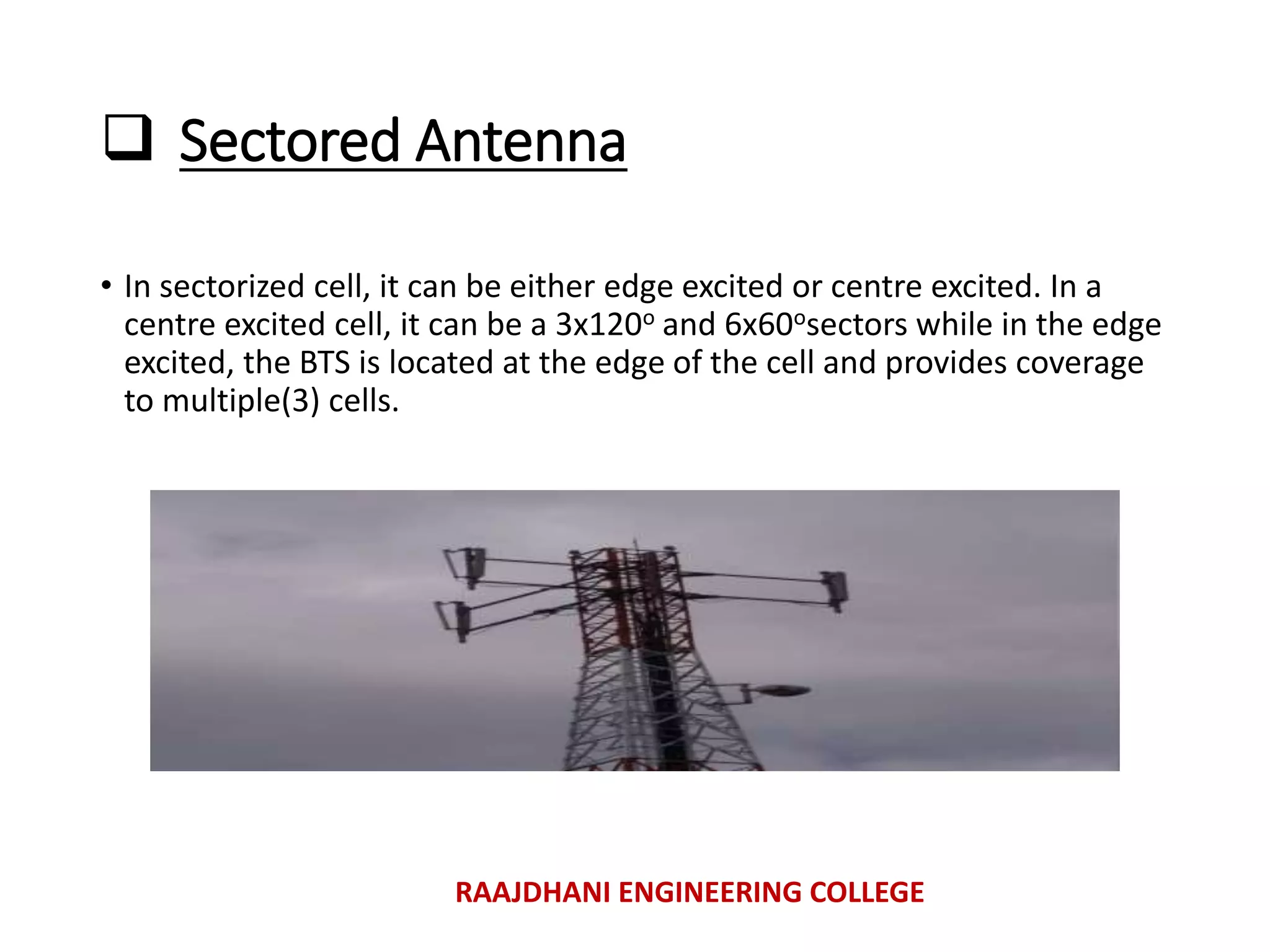
 Sectored Antenna
• In sectorized cell, it can be either edge excited or centre excited. In a
centre excited cell, it can be a 3x120o and 6x60osectors while in the edge
excited, the BTS is located at the edge of the cell and provides coverage
to multiple(3) cells.
RAAJDHANI ENGINEERING COLLEGE
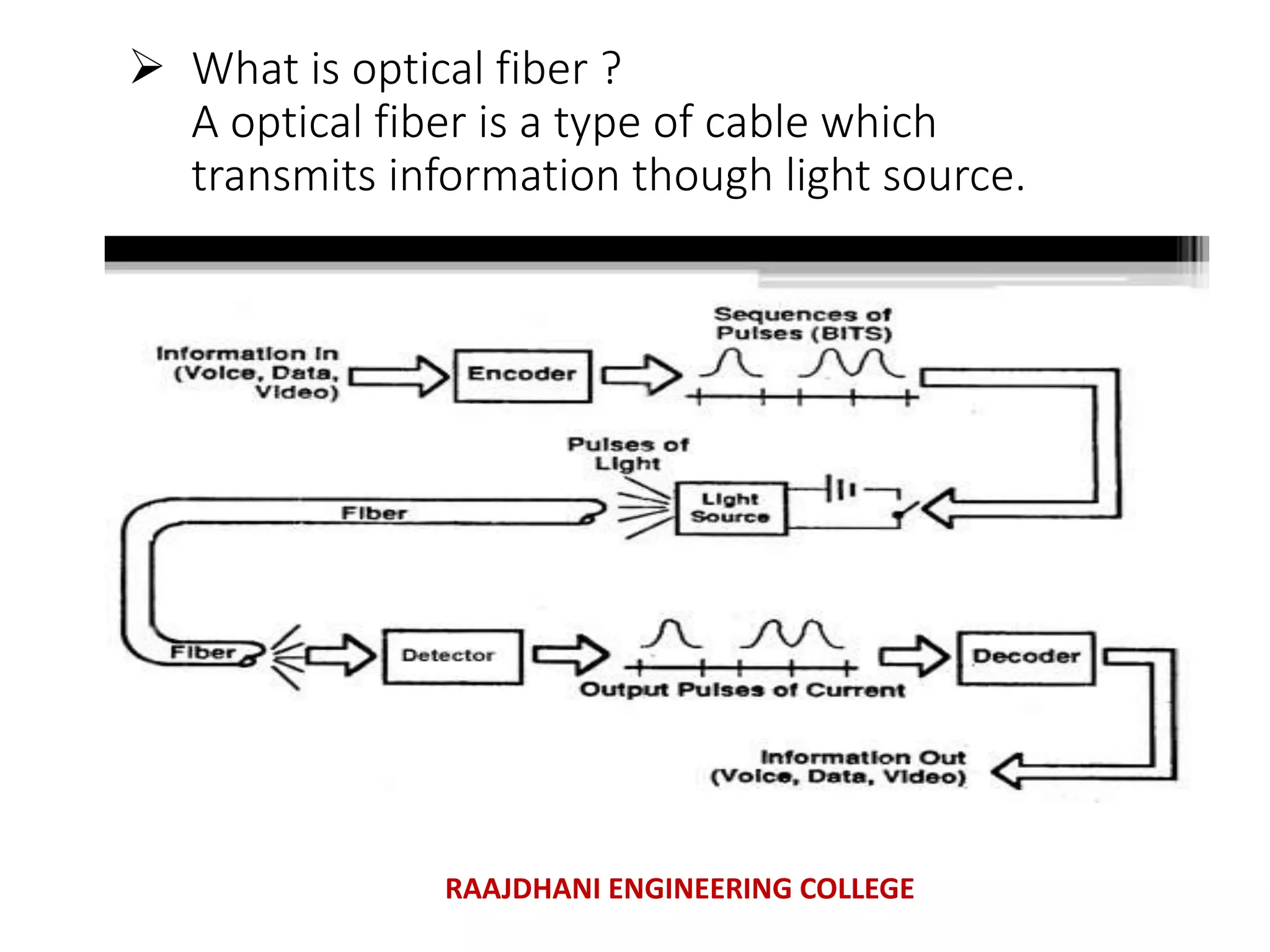
 What is optical fiber ?
A optical fiber is a type of cable which
transmits information though light source.
RAAJDHANI ENGINEERING COLLEGE
TRANSMISSION SEQUENCE
1. Information is encoded into electrical
signals.
2. Electrical signals are converted into light
signals.
3. Light travels down the fiber.
4. A detector changes the light signals into
electrical signals.
5. Electrical signals are decoded into
information.
RAAJDHANI ENGINEERING COLLEGE
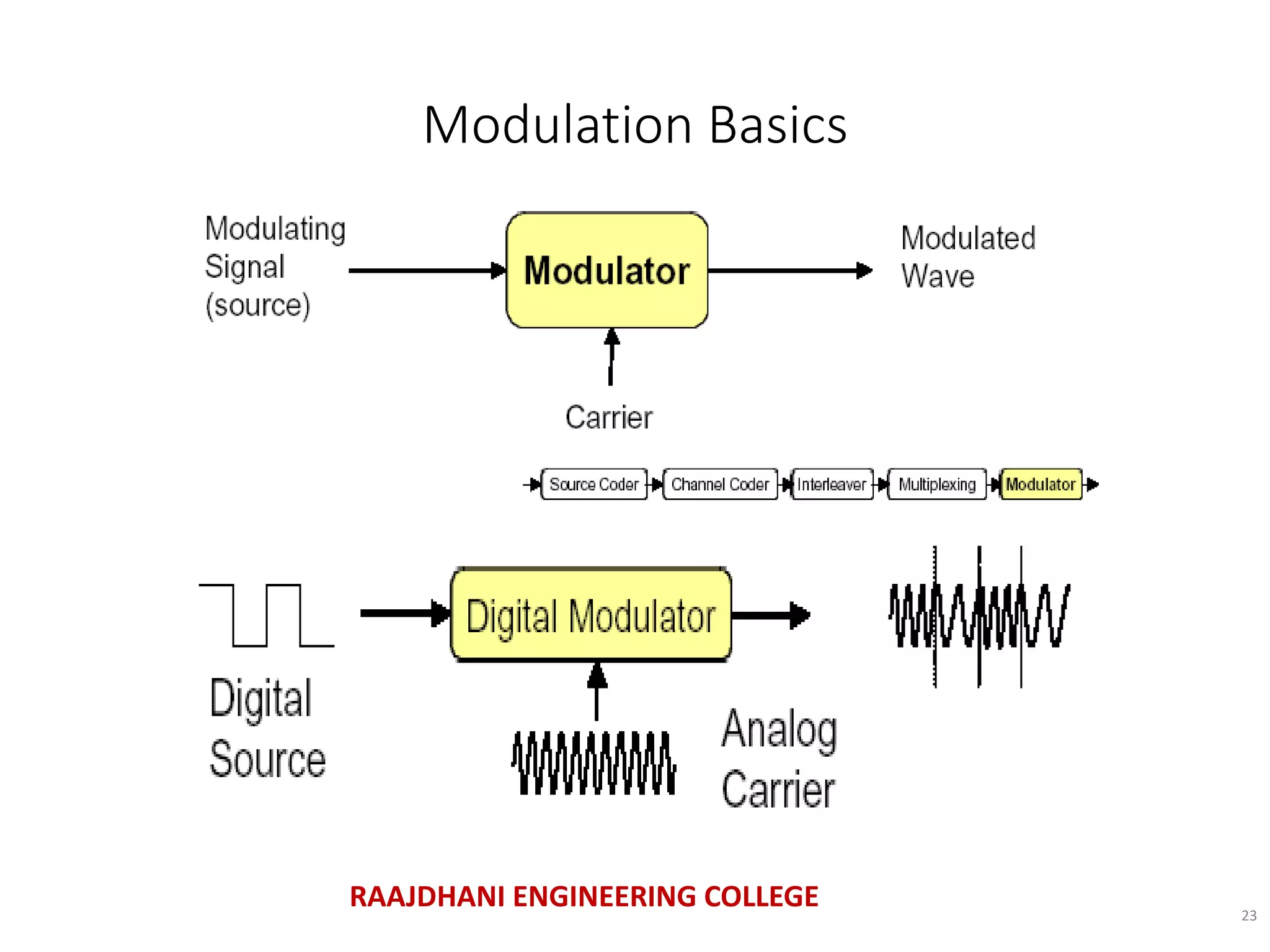
Modulation Basics
• The primary difference between analog and digital modulation is the
source information.
• If the source is analog, the modulation is analog.
• If the source is digital, the modulation is digital.
• The carrier is always analog
• The modulated wave is always propagated through the air as a series
of sine or cosine waves - not pulses!
• RAAJDHANI ENGINEERING COLLEGE
•
22
Modulation Basics
23
RAAJDHANI ENGINEERING COLLEGE
conclusion
• This presentation gives the idea about mobile communication
process and we easily understand how we communicate from one
place to another place by mobile.
• Its give the knowledge about system which use and how it used.
• This representation gives brief information about communication
resources
Mobile communication process or cellular network

Mobile communication process or cellular network

  • 1.
    RAAJDHANI ENGINEERING COLLEGE A seminar presentation on MOBILECOMMUNICATION PROCESS Presented by: Guided by: Sudhanshu jha Prof S.Mishra 1201294227 E.C.E
  • 2.
  • 3.
     What isCellular Communication System • Cellular communication is designed to provide communications between two moving units, or between one mobile unit and one stationary phone or land unit (PSTN). • A service provider must be able to locate and track a caller, assign a channel to the call. RAAJDHANI ENGINEERING COLLEGE
  • 4.
  • 5.
     COMPOMENT OFCELLULAR COMMUNICATION  Main component in cellular communication system.  Mobile Switching Centre (MSC).  Base Station Subsystem (BSS).  Base Transceiver.  a. Base Transceiver Station (BTS).  b. Base Station Controller (BSC).  optical fibre RAAJDHANI ENGINEERING COLLEGE
  • 6.
     Mobile SwitchingCenter (MSC) • The MSC is the heart of the GSM network. • the main role f MSC is to manage the communication between the GSM user and other telecommunication network. • One MSC can handles multiple BSCs and also interfaces with other MSC's (Using E-Interface). RAAJDHANI ENGINEERING COLLEGE
  • 7.
     Ericsson MobileSwitching Centre Server (MSC-S) RAAJDHANI ENGINEERING COLLEGE
  • 8.
     Mobile SwitchingCenter (MSC) RAAJDHANI ENGINEERING COLLEGE
  • 9.
     Base StationSubsystem (BSS) • BSS is responsible for handling traffic and signaling between a mobile phone and the NSS. • The BSS performs all the radio-related functions. • The BSS is comprised of the following functional units: • Base Station Controller (BSC) • Base Transceiver Station (BTS) • BSS communicate to Mobile Station (MS) using Air Interface RAAJDHANI ENGINEERING COLLEGE
  • 10.
    Base Station Subsystem(BSS) RAAJDHANI ENGINEERING COLLEGE
  • 11.
     Base Transceiver Station(BTS) •A BTS can transmit or receive radio signal from a mobile unit •To perform this function completely the signal are encoded, encrypted, multiplexed, modulated and then fed to the antenna. •Each BTS has between 1 to 16 transceiver depending on density of the user in the cell RAAJDHANI ENGINEERING COLLEGE
  • 12.
     Base Transceiver Station(BTS) • BTS provides physical connection between MS to network using Air Interface (Um) • Main function of BTS is for maintaining the Um interface and minimizing the transmission problem (Um very sensitive for disturbance) • Using A-bis interface for connection between BTS and BSS RAAJDHANI ENGINEERING COLLEGE
  • 13.
     Diagram ofBTS RAAJDHANI ENGINEERING COLLEGE
  • 14.
     Base StationController (BSC) •A BSC can assign the channel •BSC can control many BTS . RAAJDHANI ENGINEERING COLLEGE
  • 15.
     Base StationController (BSC) RAAJDHANI ENGINEERING COLLEGE
  • 16.
    Types of AntennaUsed in Cellular Communication System a. Omni directional Antenna b. Sectorized Antenna RAAJDHANI ENGINEERING COLLEGE
  • 17.
     Omni Directional •Theomnidirectional antenna radiates or receives equally well in all directions. •It is also called the "non-directional" antenna because it does not favor any particular direction. •This antenna is built using a metallic bar RAAJDHANI ENGINEERING COLLEGE
  • 18.
     DIAGRAM OFOmni Directional RAAJDHANI ENGINEERING COLLEGE
  • 19.
     Sectored Antenna •In sectorized cell, it can be either edge excited or centre excited. In a centre excited cell, it can be a 3x120o and 6x60osectors while in the edge excited, the BTS is located at the edge of the cell and provides coverage to multiple(3) cells. RAAJDHANI ENGINEERING COLLEGE
  • 20.
     What isoptical fiber ? A optical fiber is a type of cable which transmits information though light source. RAAJDHANI ENGINEERING COLLEGE
  • 21.
    TRANSMISSION SEQUENCE 1. Informationis encoded into electrical signals. 2. Electrical signals are converted into light signals. 3. Light travels down the fiber. 4. A detector changes the light signals into electrical signals. 5. Electrical signals are decoded into information. RAAJDHANI ENGINEERING COLLEGE
  • 22.
    Modulation Basics • Theprimary difference between analog and digital modulation is the source information. • If the source is analog, the modulation is analog. • If the source is digital, the modulation is digital. • The carrier is always analog • The modulated wave is always propagated through the air as a series of sine or cosine waves - not pulses! • RAAJDHANI ENGINEERING COLLEGE • 22
  • 23.
  • 24.
    conclusion • This presentationgives the idea about mobile communication process and we easily understand how we communicate from one place to another place by mobile. • Its give the knowledge about system which use and how it used. • This representation gives brief information about communication resources