
A Presentation 
based on 
Industrial Training in ALTTC, Ghaziabad 
on 
TELE-COMMUNICATION 
Submitted by: 
Anusha Srivastava 
ECE 4th year 
R.K.G.I.T, Ghaziabad 
Guided by: 
Om Pal Singh 
S.D.E, 
ALTTC, Ghaziabad
About ALTTC 
Advanced Level Telecom Training Centre 
Advanced Level Telecom Training Centre (ALTTC), Ghaziabad is the apex training 
institute of BSNL. An ISO 9001: 2008 accredited institute, ALTTC was set up as a 
joint venture of International Telecommunication Union, Geneva, UNDP and the 
Government of India in 1975. ALTTC functions on the frontiers of telecom 
technology, finance and management and imparts training to the leaders in the 
business. The strength of ALTTC lies in the state of art labs, massive infrastructure 
and trained, talented and qualified human resource pool. 
The Centre'sMission statement is "To Deliver Excellence Through Training". 
The training areas cover vast spectrum of topics such as Digital Switching and IN; 
Mobile Communication: GSM, 3G, CDMA; Data communication and Information 
Technology: MPLS, VPN, Broadband, IPv6, Database Administration, Server 
Administartion, IT Security; Optical Networks: SDH, DWDM, NGSDH, NGN, Access 
Networks, Management, Telecom Finance, Building Science (Civil and Electrical) and 
Telecom Network Planning 2
What is Telecommunication 
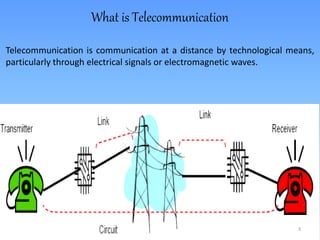
Telecommunication is communication at a distance by technological means, 
particularly through electrical signals or electromagnetic waves. 
3
WORKING OF BASIC TELECOMMUNICATION 
NETWORK 
CALL SETUP: 
When a subscriber calls to another subscriber first its request goes to 
the nearest switching center that is PSTN (Public Switching 
Telecommunication Network). Then it processes the caller and 
subscriber’s number if it exists in the same BSC (Base Station 
Controller) then call setup is completed. 
If subscriber is not in the same BSC then call transfer to MSC (Mobile 
Switching Centre) then it transfers the call to prior BSC then call setup 
is completed. 
If Caller calls to a mobile subscriber then call transfer is done by 
MTSO(Mobile Telephone Switching Office) 
now call transfer is done on BTS (Base Transceiver Station) and call 
setup is completed.
Switching 
Switching is basically establishing a temporary path or connection 
between two points or it can also be defined as writing at one point of 
time and reading at another point of time. There are two modes of 
switching employed in our network. 
• Circuit Switching 
•Packet Switching 
6
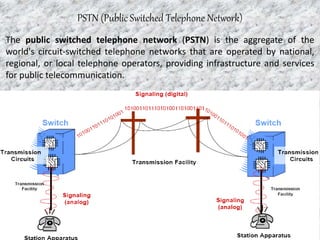
PSTN (Public Switched Telephone Network) 
The public switched telephone network (PSTN) is the aggregate of the 
world's circuit-switched telephone networks that are operated by national, 
regional, or local telephone operators, providing infrastructure and services 
for public telecommunication. 
7
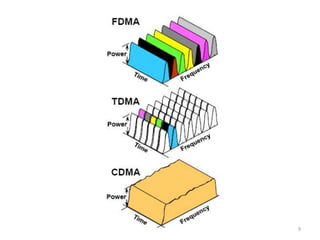
Multiple Access 
FDMA Frequency Division Multiple Access 
• Each user on a different frequency 
• A channel is a frequency 
TDMA Time Division Multiple Access 
• Each user on a different window period in time (“time slot”) 
• A channel is a specific time slot on a specific frequency 
CDMA Code Division Multiple Access 
• A channel is a unique code pattern 
• Each user uses the same frequency all the time, but mixed with different 
distinguishing code patterns 
8
9
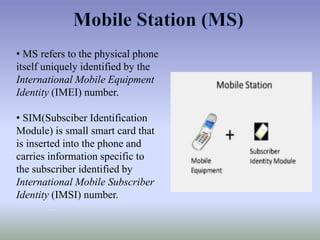
• MS refers to the physical phone 
itself uniquely identified by the 
International Mobile Equipment 
Identity (IMEI) number. 
• SIM(Subsciber Identification 
Module) is small smart card that 
is inserted into the phone and 
carries information specific to 
the subscriber identified by 
International Mobile Subscriber 
Identity (IMSI) number.
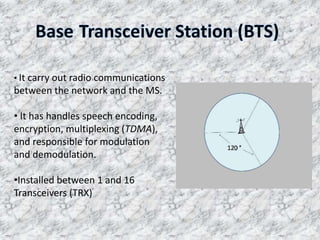
• It carry out radio communications 
between the network and the MS. 
• It has handles speech encoding, 
encryption, multiplexing (TDMA), 
and responsible for modulation 
and demodulation. 
•Installed between 1 and 16 
Transceivers (TRX)
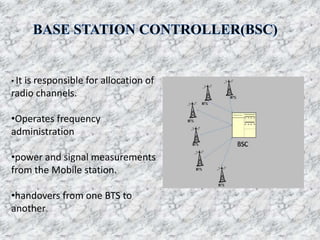
• It is responsible for allocation of 
radio channels. 
•Operates frequency 
administration 
•power and signal measurements 
from the Mobile station. 
•handovers from one BTS to 
another.
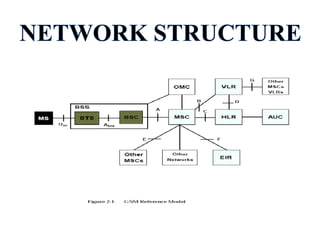
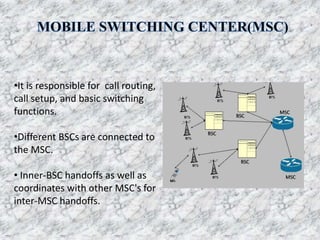
•It is responsible for call routing, 
call setup, and basic switching 
functions. 
•Different BSCs are connected to 
the MSC. 
• Inner-BSC handoffs as well as 
coordinates with other MSC's for 
inter-MSC handoffs.
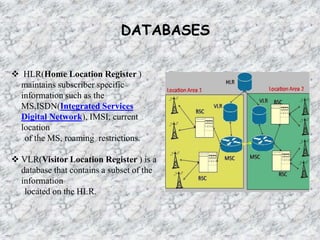
DATABASES 
 HLR(Home Location Register ) 
maintains subscriber specific 
information such as the 
MS,ISDN(Integrated Services 
Digital Network), IMSI, current 
location 
of the MS, roaming restrictions. 
 VLR(Visitor Location Register ) is a 
database that contains a subset of the 
information 
located on the HLR.
IP ADDRESSINNG 
• Each host on a TCP/IP network is uniquely identified at the IP 
layer with an address. 
• An Internet Protocol (IP) address specifies the location of a 
host or client on the Internet. 
• The IP address is also known as Protocol address 
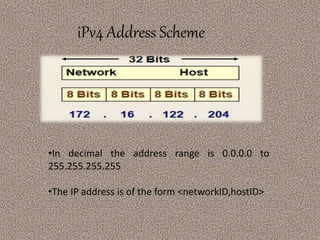
• The IPv4 address is 32 bits long 
16
iPv4 Address Scheme 
17 
•In decimal the address range is 0.0.0.0 to 
255.255.255.255 
•The IP address is of the form <networkID,hostID>
FIBER OPTICS TRANSMISSION SYSTEM 
FIBER OPTICS: The use and demand for optical fiber has grown tremendously 
and optical-fiber applications are numerous. Telecommunication applications are 
widespread, ranging from global networks to desktop computers. These involve 
the transmission of voice, data, or video over distances of less than a meter to 
hundreds of kilometers, using one of a few standard fiber designs in one of several 
cable designs. 
ADVANTAGES OF FIBRE OPTICS : 
Fiber Optics has the following advantages : 
• SPEED: Fiber optic networks operate at high speeds - up into the gigabits 
• BANDWIDTH: large carrying capacity 
• DISTANCE: Signals can be transmitted further without needing to be 
"refreshed" or strengthened. 
• RESISTANCE: Greater resistance to electromagnetic noise such as radios, 
motors or other nearby cables. 
• MAINTENANCE: Fiber optic cables costs much less to maintain.
OPTICAL FIBER CABLE(OFC) 
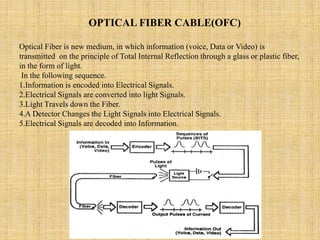
Optical Fiber is new medium, in which information (voice, Data or Video) is 
transmitted on the principle of Total Internal Reflection through a glass or plastic fiber, 
in the form of light. 
In the following sequence. 
1.Information is encoded into Electrical Signals. 
2.Electrical Signals are converted into light Signals. 
3.Light Travels down the Fiber. 
4.A Detector Changes the Light Signals into Electrical Signals. 
5.Electrical Signals are decoded into Information.
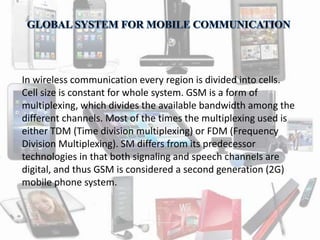
In wireless communication every region is divided into cells. 
Cell size is constant for whole system. GSM is a form of 
multiplexing, which divides the available bandwidth among the 
different channels. Most of the times the multiplexing used is 
either TDM (Time division multiplexing) or FDM (Frequency 
Division Multiplexing). SM differs from its predecessor 
technologies in that both signaling and speech channels are 
digital, and thus GSM is considered a second generation (2G) 
mobile phone system.
• 2G GSM networks operate in the 900 MHz or 
1800 MHz bands 
• GSM-900 uses 890–915 MHz to send information 
from the mobile station to the base station (uplink) 
• 935–960 MHz for the other direction (downlink), 
• providing 125 RF channels (channel numbers 0 to 
124) spaced at 200 kHz. Duplex spacing of 45 MHz is 
used.
CODE DIVISION MULTIPLE ACCESS (CDMA) 
Code Division Multiple Access (CDMA) consistently provides better 
capacity for voice and data communications that other commercial mobile 
technologies, allowing more subscribers to connect at any given time, and 
it is the common platform on which 3G technologies are built. 
CDMA is a spread spectrum technology, allowing many users to occupy 
the same time and frequency allocations in a given band/space 
ADVANTAGES OF CDMA: 
Increased cellular communications security 
Simultaneous conversations 
Low power requirements and little cell-to-cell coordination needed by 
operators. 
Extended reach-beneficial to rural users situated far from cells.
REFERENCES 
1. Data Communication And Networking- Behrouz A. Foruzan 
2. Wireless Communication and Networks-William Stallings 
3. Computer Networking – Kurose & Ross 
4. www.bsnl.co.in 
5. www.newbsnl.co.in
Hina

Hina

  • 1.
    A Presentation basedon Industrial Training in ALTTC, Ghaziabad on TELE-COMMUNICATION Submitted by: Anusha Srivastava ECE 4th year R.K.G.I.T, Ghaziabad Guided by: Om Pal Singh S.D.E, ALTTC, Ghaziabad
  • 2.
    About ALTTC AdvancedLevel Telecom Training Centre Advanced Level Telecom Training Centre (ALTTC), Ghaziabad is the apex training institute of BSNL. An ISO 9001: 2008 accredited institute, ALTTC was set up as a joint venture of International Telecommunication Union, Geneva, UNDP and the Government of India in 1975. ALTTC functions on the frontiers of telecom technology, finance and management and imparts training to the leaders in the business. The strength of ALTTC lies in the state of art labs, massive infrastructure and trained, talented and qualified human resource pool. The Centre'sMission statement is "To Deliver Excellence Through Training". The training areas cover vast spectrum of topics such as Digital Switching and IN; Mobile Communication: GSM, 3G, CDMA; Data communication and Information Technology: MPLS, VPN, Broadband, IPv6, Database Administration, Server Administartion, IT Security; Optical Networks: SDH, DWDM, NGSDH, NGN, Access Networks, Management, Telecom Finance, Building Science (Civil and Electrical) and Telecom Network Planning 2
  • 3.
    What is Telecommunication Telecommunication is communication at a distance by technological means, particularly through electrical signals or electromagnetic waves. 3
  • 4.
    WORKING OF BASICTELECOMMUNICATION NETWORK CALL SETUP: When a subscriber calls to another subscriber first its request goes to the nearest switching center that is PSTN (Public Switching Telecommunication Network). Then it processes the caller and subscriber’s number if it exists in the same BSC (Base Station Controller) then call setup is completed. If subscriber is not in the same BSC then call transfer to MSC (Mobile Switching Centre) then it transfers the call to prior BSC then call setup is completed. If Caller calls to a mobile subscriber then call transfer is done by MTSO(Mobile Telephone Switching Office) now call transfer is done on BTS (Base Transceiver Station) and call setup is completed.
  • 6.
    Switching Switching isbasically establishing a temporary path or connection between two points or it can also be defined as writing at one point of time and reading at another point of time. There are two modes of switching employed in our network. • Circuit Switching •Packet Switching 6
  • 7.
    PSTN (Public SwitchedTelephone Network) The public switched telephone network (PSTN) is the aggregate of the world's circuit-switched telephone networks that are operated by national, regional, or local telephone operators, providing infrastructure and services for public telecommunication. 7
  • 8.
    Multiple Access FDMAFrequency Division Multiple Access • Each user on a different frequency • A channel is a frequency TDMA Time Division Multiple Access • Each user on a different window period in time (“time slot”) • A channel is a specific time slot on a specific frequency CDMA Code Division Multiple Access • A channel is a unique code pattern • Each user uses the same frequency all the time, but mixed with different distinguishing code patterns 8
  • 9.
  • 11.
    • MS refersto the physical phone itself uniquely identified by the International Mobile Equipment Identity (IMEI) number. • SIM(Subsciber Identification Module) is small smart card that is inserted into the phone and carries information specific to the subscriber identified by International Mobile Subscriber Identity (IMSI) number.
  • 12.
    • It carryout radio communications between the network and the MS. • It has handles speech encoding, encryption, multiplexing (TDMA), and responsible for modulation and demodulation. •Installed between 1 and 16 Transceivers (TRX)
  • 13.
    • It isresponsible for allocation of radio channels. •Operates frequency administration •power and signal measurements from the Mobile station. •handovers from one BTS to another.
  • 14.
    •It is responsiblefor call routing, call setup, and basic switching functions. •Different BSCs are connected to the MSC. • Inner-BSC handoffs as well as coordinates with other MSC's for inter-MSC handoffs.
  • 15.
    DATABASES  HLR(HomeLocation Register ) maintains subscriber specific information such as the MS,ISDN(Integrated Services Digital Network), IMSI, current location of the MS, roaming restrictions.  VLR(Visitor Location Register ) is a database that contains a subset of the information located on the HLR.
  • 16.
    IP ADDRESSINNG •Each host on a TCP/IP network is uniquely identified at the IP layer with an address. • An Internet Protocol (IP) address specifies the location of a host or client on the Internet. • The IP address is also known as Protocol address • The IPv4 address is 32 bits long 16
  • 17.
    iPv4 Address Scheme 17 •In decimal the address range is 0.0.0.0 to 255.255.255.255 •The IP address is of the form <networkID,hostID>
  • 18.
    FIBER OPTICS TRANSMISSIONSYSTEM FIBER OPTICS: The use and demand for optical fiber has grown tremendously and optical-fiber applications are numerous. Telecommunication applications are widespread, ranging from global networks to desktop computers. These involve the transmission of voice, data, or video over distances of less than a meter to hundreds of kilometers, using one of a few standard fiber designs in one of several cable designs. ADVANTAGES OF FIBRE OPTICS : Fiber Optics has the following advantages : • SPEED: Fiber optic networks operate at high speeds - up into the gigabits • BANDWIDTH: large carrying capacity • DISTANCE: Signals can be transmitted further without needing to be "refreshed" or strengthened. • RESISTANCE: Greater resistance to electromagnetic noise such as radios, motors or other nearby cables. • MAINTENANCE: Fiber optic cables costs much less to maintain.
  • 19.
    OPTICAL FIBER CABLE(OFC) Optical Fiber is new medium, in which information (voice, Data or Video) is transmitted on the principle of Total Internal Reflection through a glass or plastic fiber, in the form of light. In the following sequence. 1.Information is encoded into Electrical Signals. 2.Electrical Signals are converted into light Signals. 3.Light Travels down the Fiber. 4.A Detector Changes the Light Signals into Electrical Signals. 5.Electrical Signals are decoded into Information.
  • 20.
    In wireless communicationevery region is divided into cells. Cell size is constant for whole system. GSM is a form of multiplexing, which divides the available bandwidth among the different channels. Most of the times the multiplexing used is either TDM (Time division multiplexing) or FDM (Frequency Division Multiplexing). SM differs from its predecessor technologies in that both signaling and speech channels are digital, and thus GSM is considered a second generation (2G) mobile phone system.
  • 21.
    • 2G GSMnetworks operate in the 900 MHz or 1800 MHz bands • GSM-900 uses 890–915 MHz to send information from the mobile station to the base station (uplink) • 935–960 MHz for the other direction (downlink), • providing 125 RF channels (channel numbers 0 to 124) spaced at 200 kHz. Duplex spacing of 45 MHz is used.
  • 22.
    CODE DIVISION MULTIPLEACCESS (CDMA) Code Division Multiple Access (CDMA) consistently provides better capacity for voice and data communications that other commercial mobile technologies, allowing more subscribers to connect at any given time, and it is the common platform on which 3G technologies are built. CDMA is a spread spectrum technology, allowing many users to occupy the same time and frequency allocations in a given band/space ADVANTAGES OF CDMA: Increased cellular communications security Simultaneous conversations Low power requirements and little cell-to-cell coordination needed by operators. Extended reach-beneficial to rural users situated far from cells.
  • 23.
    REFERENCES 1. DataCommunication And Networking- Behrouz A. Foruzan 2. Wireless Communication and Networks-William Stallings 3. Computer Networking – Kurose & Ross 4. www.bsnl.co.in 5. www.newbsnl.co.in