PRASAD ENGINEERING COLLEGE


                          PAPER ON
                  MOBILE AD-HOC NETWORK
                         Presented by
           K.ASHWINI                  096L1A0404
           A.DIVYAJYOTHI              096L1A0405
                           III YEAR
       ELECTRONICS AND COMMUNICATION ENGINEERING
INTRODUCTION


• Mobile wireless networks are popular in 1970s

• There are currently two variations of mobile wireless
                       network

               • Infrastructure network
                   • Ad-hoc network
Why Ad Hoc Networks ?
•  Setting up of fixed access points and backbone infrastructure is not
   always viable
– Infrastructure may not be present in a disaster area or war zone
– Infrastructure may not be practical for short range radios; Bluetooth
   (range ~ 10m)

•   Ad hoc networks:
– Do not need backbone infrastructure support
– Are easy to deploy
– Useful when infrastructure is absent, destroyed or impractical
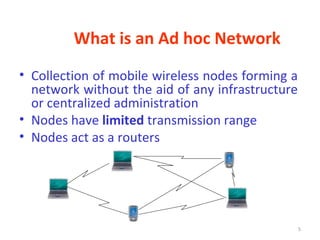
What is an Ad hoc Network
• Collection of mobile wireless nodes forming a
  network without the aid of any infrastructure
  or centralized administration
• Nodes have limited transmission range
• Nodes act as a routers


                                                  5
WHY WE GO FOR MANET?

 The wired network is not available and multi-
  hop wireless networks provide
 The only feasible means for communication and
  information access
 Ex: Battlefield communications,disaster
  recovery etc
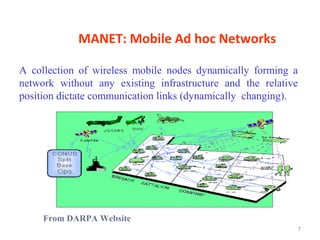
MANET: Mobile Ad hoc Networks

A collection of wireless mobile nodes dynamically forming a
network without any existing infrastructure and the relative
position dictate communication links (dynamically changing).


     From DARPA Website
                                                               7
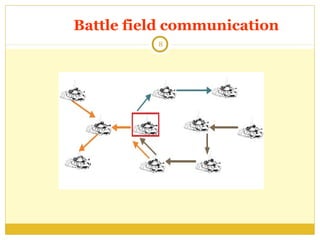
Battle field communication
          8
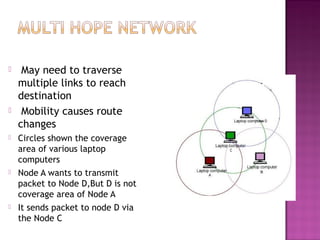
    May need to traverse
    multiple links to reach
    destination
    Mobility causes route
    changes
   Circles shown the coverage
    area of various laptop
    computers
   Node A wants to transmit
    packet to Node D,But D is not
    coverage area of Node A
   It sends packet to node D via
    the Node C
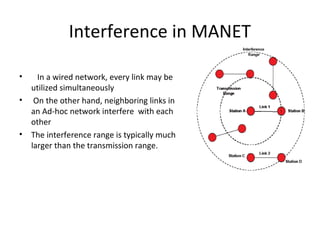
Interference in MANET

•     In a wired network, every link may be
    utilized simultaneously
•    On the other hand, neighboring links in
    an Ad-hoc network interfere with each
    other
•   The interference range is typically much
    larger than the transmission range.
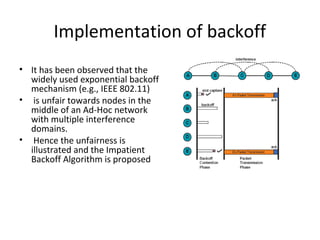
Implementation of backoff
• It has been observed that the
  widely used exponential backoff
  mechanism (e.g., IEEE 802.11)
• is unfair towards nodes in the
  middle of an Ad-Hoc network
  with multiple interference
  domains.
• Hence the unfairness is
  illustrated and the Impatient
  Backoff Algorithm is proposed
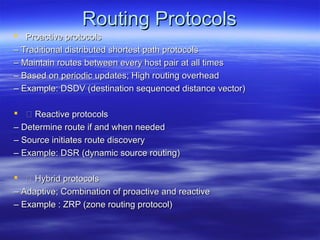
Routing Protocols
 Proactive protocols
– Traditional distributed shortest path protocols
– Maintain routes between every host pair at all times
– Based on periodic updates; High routing overhead
– Example: DSDV (destination sequenced distance vector)

  Reactive protocols
– Determine route if and when needed
– Source initiates route discovery
– Example: DSR (dynamic source routing)

  Hybrid protocols
– Adaptive; Combination of proactive and reactive
– Example : ZRP (zone routing protocol)
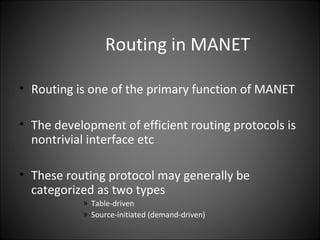
Routing in MANET

• Routing is one of the primary function of MANET

• The development of efficient routing protocols is
  nontrivial interface etc

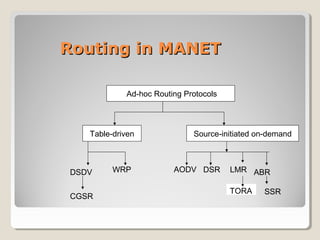
• These routing protocol may generally be
  categorized as two types
           » Table-driven
           » Source-initiated (demand-driven)
Routing in MANET

            Ad-hoc Routing Protocols


   Table-driven              Source-initiated on-demand


DSDV     WRP            AODV DSR       LMR ABR

                                       TORA    SSR
CGSR
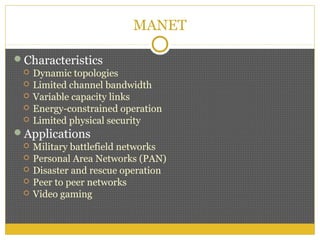
MANET

Characteristics
  Dynamic topologies
  Limited channel bandwidth
  Variable capacity links
  Energy-constrained operation
  Limited physical security

Applications
  Military battlefield networks
  Personal Area Networks (PAN)
  Disaster and rescue operation
  Peer to peer networks
  Video gaming
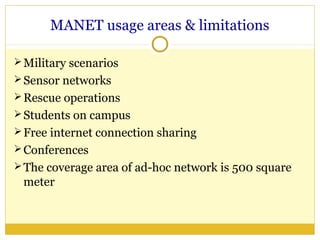
MANET usage areas & limitations

 Military scenarios
 Sensor networks
 Rescue operations
 Students on campus
 Free internet connection sharing
 Conferences
 The coverage area of ad-hoc network is 500 square
 meter
   Variable Bandwidth
   Disconnected Operation
   Limited Power


                             17
Power Consumption
                  18


Limited Power Source

Battery Lifetime is limited

Each sensor node plays a dual role of data originator

 and data router (data processor)
The malfunctioning of a few nodes consumes lot of

 energy (rerouting of packets and significant
 topological changes)
Conclusion

Other interesting problems:
 Applications for MANET

 Address assignment

 Qos issues

 Improving interaction between protocol layers
REFERENCES
   http://ieee.ieeexplore.org/
   [1]. Rajarshi Gupta, Zhanfeng Jia, “Interference-aware QoS Routing (IQ
    Routing) for Ad-Hoc Networks”, published in the proceedings of National
    conference, held at Jawaharlal Nehru National College of Engineering,
    Shimoga on 7-8 July 2006

   [2]. IEEE Standard for Wireless LAN Medium Access Control (MAC) and
    Physical layer (PHY) Specifications, Nov. 1997. P802.11
21


     Any
     Questions?

ad-hoc network by divyajyothi

  • 1.
    PRASAD ENGINEERING COLLEGE PAPER ON MOBILE AD-HOC NETWORK Presented by K.ASHWINI 096L1A0404 A.DIVYAJYOTHI 096L1A0405 III YEAR ELECTRONICS AND COMMUNICATION ENGINEERING
  • 2.
    INTRODUCTION • Mobile wirelessnetworks are popular in 1970s • There are currently two variations of mobile wireless network • Infrastructure network • Ad-hoc network
  • 3.
    Why Ad HocNetworks ? • Setting up of fixed access points and backbone infrastructure is not always viable – Infrastructure may not be present in a disaster area or war zone – Infrastructure may not be practical for short range radios; Bluetooth (range ~ 10m) •  Ad hoc networks: – Do not need backbone infrastructure support – Are easy to deploy – Useful when infrastructure is absent, destroyed or impractical
  • 4.
    What is anAd hoc Network • Collection of mobile wireless nodes forming a network without the aid of any infrastructure or centralized administration • Nodes have limited transmission range • Nodes act as a routers 5
  • 5.
    WHY WE GOFOR MANET?  The wired network is not available and multi- hop wireless networks provide  The only feasible means for communication and information access  Ex: Battlefield communications,disaster recovery etc
  • 6.
    MANET: Mobile Adhoc Networks A collection of wireless mobile nodes dynamically forming a network without any existing infrastructure and the relative position dictate communication links (dynamically changing). From DARPA Website 7
  • 7.
  • 8.
    May need to traverse multiple links to reach destination  Mobility causes route changes  Circles shown the coverage area of various laptop computers  Node A wants to transmit packet to Node D,But D is not coverage area of Node A  It sends packet to node D via the Node C
  • 9.
    Interference in MANET • In a wired network, every link may be utilized simultaneously • On the other hand, neighboring links in an Ad-hoc network interfere with each other • The interference range is typically much larger than the transmission range.
  • 10.
    Implementation of backoff •It has been observed that the widely used exponential backoff mechanism (e.g., IEEE 802.11) • is unfair towards nodes in the middle of an Ad-Hoc network with multiple interference domains. • Hence the unfairness is illustrated and the Impatient Backoff Algorithm is proposed
  • 11.
    Routing Protocols  Proactiveprotocols – Traditional distributed shortest path protocols – Maintain routes between every host pair at all times – Based on periodic updates; High routing overhead – Example: DSDV (destination sequenced distance vector)   Reactive protocols – Determine route if and when needed – Source initiates route discovery – Example: DSR (dynamic source routing)   Hybrid protocols – Adaptive; Combination of proactive and reactive – Example : ZRP (zone routing protocol)
  • 12.
    Routing in MANET •Routing is one of the primary function of MANET • The development of efficient routing protocols is nontrivial interface etc • These routing protocol may generally be categorized as two types » Table-driven » Source-initiated (demand-driven)
  • 13.
    Routing in MANET Ad-hoc Routing Protocols Table-driven Source-initiated on-demand DSDV WRP AODV DSR LMR ABR TORA SSR CGSR
  • 14.
    MANET Characteristics  Dynamictopologies  Limited channel bandwidth  Variable capacity links  Energy-constrained operation  Limited physical security Applications  Military battlefield networks  Personal Area Networks (PAN)  Disaster and rescue operation  Peer to peer networks  Video gaming
  • 15.
    MANET usage areas& limitations  Military scenarios  Sensor networks  Rescue operations  Students on campus  Free internet connection sharing  Conferences  The coverage area of ad-hoc network is 500 square meter
  • 16.
    Variable Bandwidth  Disconnected Operation  Limited Power 17
  • 17.
    Power Consumption 18 Limited Power Source Battery Lifetime is limited Each sensor node plays a dual role of data originator and data router (data processor) The malfunctioning of a few nodes consumes lot of energy (rerouting of packets and significant topological changes)
  • 18.
    Conclusion Other interesting problems: Applications for MANET  Address assignment  Qos issues  Improving interaction between protocol layers
  • 19.
    REFERENCES  http://ieee.ieeexplore.org/  [1]. Rajarshi Gupta, Zhanfeng Jia, “Interference-aware QoS Routing (IQ Routing) for Ad-Hoc Networks”, published in the proceedings of National conference, held at Jawaharlal Nehru National College of Engineering, Shimoga on 7-8 July 2006  [2]. IEEE Standard for Wireless LAN Medium Access Control (MAC) and Physical layer (PHY) Specifications, Nov. 1997. P802.11
  • 20.
    21 Any Questions?

Editor's Notes

  • #6 Nodes have limited transmission range and so two nodes that are far apart can communicate through intermediate nodes which act as routers in forwarding data packets.
  • #16 Since nodes are not bound to any centralized control they are free to move about arbitrarily and hence the topology changes dynamically. Also since communication is thru wireless links they have lower bandwidth compared to their wired counterparts. And the capacity of each link varies due to noise, fading & congestion. Ad hoc network nodes rely on batteries or some other exhaustive means for their energy. Hence the protocols designed for these networks must be optimized for lean power consumption. The absence of infrastructure in these networks make them very attractive for many applications. For example, they can be used in military battlefield networks, PANs, search and rescue operations and peer to peer networks.