POWER POINT PRESENTATION
NAME : MAHESHWARAND
DEPT : CSE-A3ND YEAR
SUB CODE : CS8601
SUBJECT : MOBILE COMPUTING
SUBMITTED DATE : 17 02 2021
REG NO : 810418104059
REFERENCE : www.mc.edu.in
Mobile Ad-Hoc
Networking
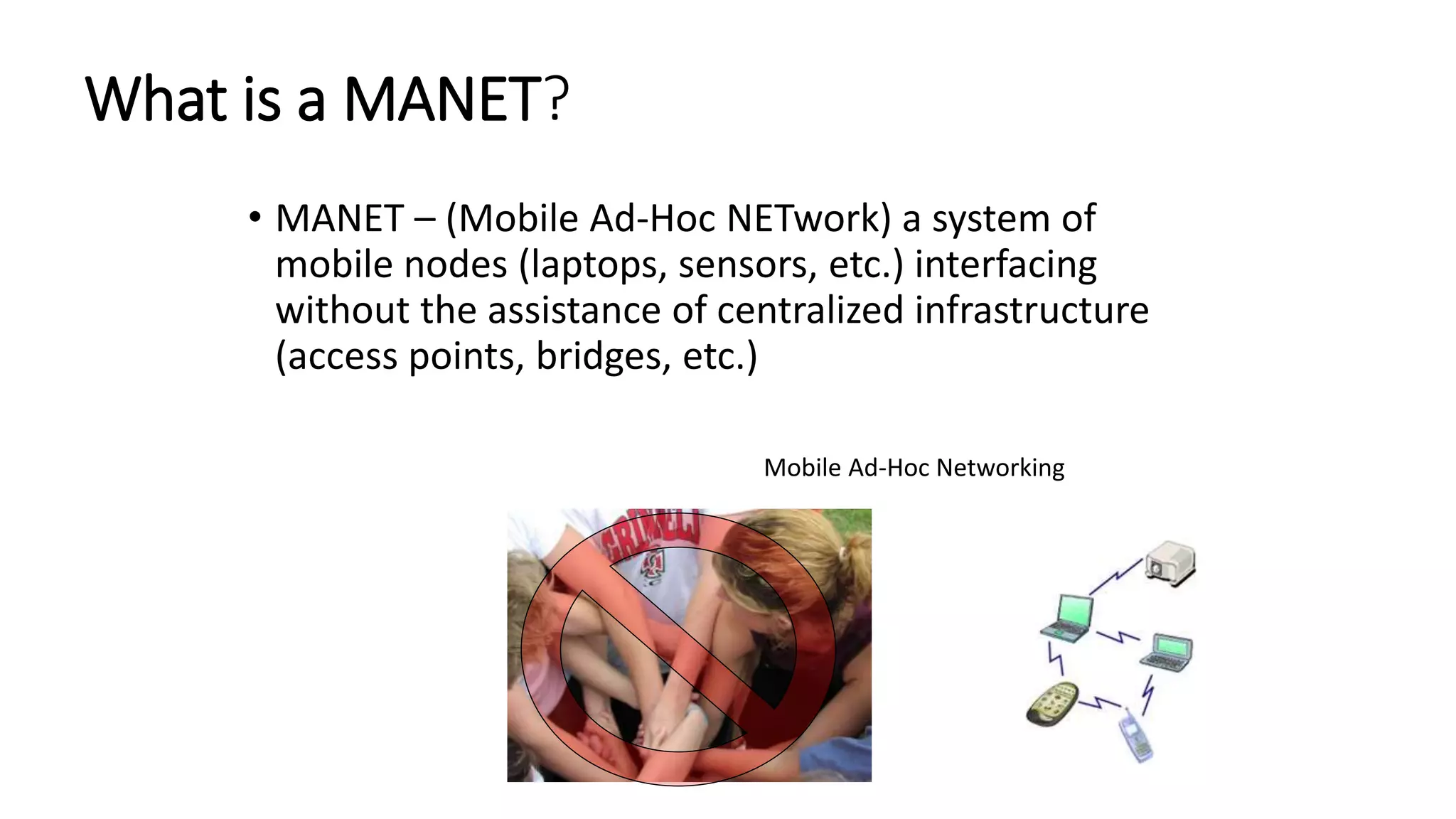
What is a MANET?
• MANET – (Mobile Ad-Hoc NETwork) a system of
mobile nodes (laptops, sensors, etc.) interfacing
without the assistance of centralized infrastructure
(access points, bridges, etc.)
Mobile Ad-Hoc Networking
The Problem
• Unstable paths
• Processing power
• Battery life
• Time delays
• High cost of memory
Factors Affecting MANETs
• Scalability
• Power vs. Latency
• Incompatible Standards
• Data Rates
• User Education
• Security
• Coverage
Solutions
• Table Driven
• DSDV
• CGSR
• WRP
• Source-initiated On-Demand Driven
• AODV
• DSR
• LMR
• TORA
• ABR
• SSR
The Family Tree
Destination-Sequenced Distance-Vector Routing
(DSDV)
• Every node maintains a routing table.
• “Full” vs. “incremental” update
• Settling time – the weighted average time that routes to a destination
will fluctuate before the route with the best metric is received.
Clusterhead Gateway Switch Routing (CGSR)
• A central “clusterhead” node is chosen.
• The clusterhead is chosen by the “Least Cluster Change” algorithm
• Traffic is routed to the current clusterhead who forwards the traffic
through a gateway node to the next clusterhead in line until the
clusterhead of the destination node is located.
• Each node must maintain a cluster member table
CGSR (cont.)
Wireless Routing Protocol (WRP)
• 4 tables: Distance, routing, link-cost, and message retransmission list
• Neighboring nodes broadcast update messages
• Uses hello messages to establish connectivity
• Checks all incoming update information
Comparing Table Driven Routing Protocols
Ad-hoc On-demand Distance Vector Routing
(AODV)
• Route Request Packets (RREQ)
• The source node broadcasts an RREQ to all neighboring nodes.
• Nodes record the source of the first RREQ received to establish a
reverse path.
AODV (cont.)
• Route Reply Packets (RREP)
• The destination or node with a route to the destination unicasts a RREP
back to the source to establish a route.
Dynamic Source Routing (DSR)
• Each node maintains a route cache.
• If a source node has no route in its cache, it broadcasts a route
request.
• A route reply is generated when either the destination or a node with
a route to the destination is found.
• Supports symmetric links
DSR (cont.)
• Maintenance is accomplished by route error packets and
acknowledgements.
• If a node fails to send an acknowledgement, any route that contains that
node is truncated.
Temporally-Ordered Routing Algorithm (TORA)
• Used in highly dynamic networks
• Provides multiple routes for source/destination pair
• Uses direct acyclic graphs to measure “height”
• Assumes all nodes have synchronized clocks
• Classifies links as upstream and downstream
TORA (cont.)
Associativity-Based Routing (ABR)
• Uses degree of association stability as a metric
• Strives to build “longer-lived” routes
Signal Stability Routing (SSR)
• Selects routes based on signal strength and location stability
• Periodic beacons update signal strength tables
• Only requests that are received over strong channels are forwarded
unless the PREF field in the header is set to allow weak channels
Comparing Source-Initiated On-Demand Routing
Protocols
Vehicular Ad–Hoc
Network
What is VANET ?
Vehicular Ad–Hoc Network, or VANET
 a form of Mobile ad-hoc network
 provide communication
- among nearby vehicles
- between vehicles
- nearby fixed equipment
How vehicular communications work
- road-side infrastructure units (RSUs),
named network nodes, are equipped
with on-board processing and wireless
communication modules
How vehicular communications work (Continue)
- vehicle-to-vehicle (V2V) and vehicle-to-infrastructure
(V2I) communication will be possible
What can VANET provide
The VANET can provide
Safety
Efficiency
Traffic and road conditions
Road signal alarm
Local information
Related work
Research have been worked
Outline challenges for VANET
- availablility, mobility
Describe particular attacks
-DoS, alteration attacks
Suggest solution towards attacks
Security Requirements
1. Message Authentication and Integrity
2. Message Non-Repudiation
3. Entity Authentication
4. Access Control Authorization
5. Message Confidentiality
6. Privacy and Anonymity
7. Availability
8. Liability Identification
Security Requirements
Message Authentication and Integrity
- Message must be protected from any
alteration
Message Non-Repudiation
- The sender of a message cannot deny having sent a
message
Entity Authentication
- The receiver is ensured that the sender generated a
message
- The receiver has evidence of the liveness of the sender
System Model
Vehicular communications system
- Users
- Network nodes
- Authorities
System Model
 Users
- user is the owner or the
driver or a passenger
of the vehicle
 Network Nodes
- processes running on computing platforms
capable of wireless communication
- Mounted on vehicles and road-side units
(RSUs)
Communication Model
Frequent Broadcast Communication
Most of the vehicular network traffic is Broadcasted at the network
or application layers
Message are transmitted either
periodically or triggered by network events
Transmission period is low
Time-sensitive Communication
Message delivery can be constrained by deadlines
- different messages have different delay requirements
MANET VS VANET

  • 1.
    POWER POINT PRESENTATION NAME: MAHESHWARAND DEPT : CSE-A3ND YEAR SUB CODE : CS8601 SUBJECT : MOBILE COMPUTING SUBMITTED DATE : 17 02 2021 REG NO : 810418104059 REFERENCE : www.mc.edu.in
  • 2.
  • 3.
    What is aMANET? • MANET – (Mobile Ad-Hoc NETwork) a system of mobile nodes (laptops, sensors, etc.) interfacing without the assistance of centralized infrastructure (access points, bridges, etc.) Mobile Ad-Hoc Networking
  • 4.
    The Problem • Unstablepaths • Processing power • Battery life • Time delays • High cost of memory
  • 5.
    Factors Affecting MANETs •Scalability • Power vs. Latency • Incompatible Standards • Data Rates • User Education • Security • Coverage
  • 6.
    Solutions • Table Driven •DSDV • CGSR • WRP • Source-initiated On-Demand Driven • AODV • DSR • LMR • TORA • ABR • SSR
  • 7.
  • 8.
    Destination-Sequenced Distance-Vector Routing (DSDV) •Every node maintains a routing table. • “Full” vs. “incremental” update • Settling time – the weighted average time that routes to a destination will fluctuate before the route with the best metric is received.
  • 9.
    Clusterhead Gateway SwitchRouting (CGSR) • A central “clusterhead” node is chosen. • The clusterhead is chosen by the “Least Cluster Change” algorithm • Traffic is routed to the current clusterhead who forwards the traffic through a gateway node to the next clusterhead in line until the clusterhead of the destination node is located. • Each node must maintain a cluster member table
  • 10.
  • 11.
    Wireless Routing Protocol(WRP) • 4 tables: Distance, routing, link-cost, and message retransmission list • Neighboring nodes broadcast update messages • Uses hello messages to establish connectivity • Checks all incoming update information
  • 12.
    Comparing Table DrivenRouting Protocols
  • 13.
    Ad-hoc On-demand DistanceVector Routing (AODV) • Route Request Packets (RREQ) • The source node broadcasts an RREQ to all neighboring nodes. • Nodes record the source of the first RREQ received to establish a reverse path.
  • 14.
    AODV (cont.) • RouteReply Packets (RREP) • The destination or node with a route to the destination unicasts a RREP back to the source to establish a route.
  • 15.
    Dynamic Source Routing(DSR) • Each node maintains a route cache. • If a source node has no route in its cache, it broadcasts a route request. • A route reply is generated when either the destination or a node with a route to the destination is found. • Supports symmetric links
  • 16.
    DSR (cont.) • Maintenanceis accomplished by route error packets and acknowledgements. • If a node fails to send an acknowledgement, any route that contains that node is truncated.
  • 17.
    Temporally-Ordered Routing Algorithm(TORA) • Used in highly dynamic networks • Provides multiple routes for source/destination pair • Uses direct acyclic graphs to measure “height” • Assumes all nodes have synchronized clocks • Classifies links as upstream and downstream
  • 18.
  • 19.
    Associativity-Based Routing (ABR) •Uses degree of association stability as a metric • Strives to build “longer-lived” routes
  • 20.
    Signal Stability Routing(SSR) • Selects routes based on signal strength and location stability • Periodic beacons update signal strength tables • Only requests that are received over strong channels are forwarded unless the PREF field in the header is set to allow weak channels
  • 21.
  • 22.
  • 23.
    What is VANET? Vehicular Ad–Hoc Network, or VANET  a form of Mobile ad-hoc network  provide communication - among nearby vehicles - between vehicles - nearby fixed equipment
  • 24.
    How vehicular communicationswork - road-side infrastructure units (RSUs), named network nodes, are equipped with on-board processing and wireless communication modules
  • 25.
    How vehicular communicationswork (Continue) - vehicle-to-vehicle (V2V) and vehicle-to-infrastructure (V2I) communication will be possible
  • 26.
    What can VANETprovide The VANET can provide Safety Efficiency Traffic and road conditions Road signal alarm Local information
  • 27.
    Related work Research havebeen worked Outline challenges for VANET - availablility, mobility Describe particular attacks -DoS, alteration attacks Suggest solution towards attacks
  • 28.
    Security Requirements 1. MessageAuthentication and Integrity 2. Message Non-Repudiation 3. Entity Authentication 4. Access Control Authorization 5. Message Confidentiality 6. Privacy and Anonymity 7. Availability 8. Liability Identification
  • 29.
    Security Requirements Message Authenticationand Integrity - Message must be protected from any alteration Message Non-Repudiation - The sender of a message cannot deny having sent a message Entity Authentication - The receiver is ensured that the sender generated a message - The receiver has evidence of the liveness of the sender
  • 30.
    System Model Vehicular communicationssystem - Users - Network nodes - Authorities
  • 31.
    System Model  Users -user is the owner or the driver or a passenger of the vehicle  Network Nodes - processes running on computing platforms capable of wireless communication - Mounted on vehicles and road-side units (RSUs)
  • 32.
    Communication Model Frequent BroadcastCommunication Most of the vehicular network traffic is Broadcasted at the network or application layers Message are transmitted either periodically or triggered by network events Transmission period is low Time-sensitive Communication Message delivery can be constrained by deadlines - different messages have different delay requirements