By
Asheem Kumar Palo
Centurion University,
INDIA
INTRODUCTION
The era of networked space communications is slowly dawning across ESA (European
Space Agency), NASA (National Aeronautics and Space Administration) etc.
All the major space organizations and industrial partners have been working together
as part of the Consultative Committee for Space Data Systems
The first goal will be to let astronauts communicate among themselves, with control
centers on Earth, and with spaceships and base stations
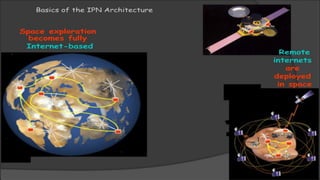
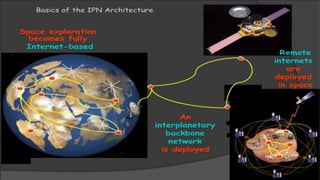
The gateways: The special purpose satellites connecting the earth’s internet with the
network of another planet
A 'bundle protocol' is needed because the IPN will not be able to communicate in real-
time due to the large travel distances
The present scenario
JPL (Jet Propulsion Laboratory) has performed a conceptual study of a proposed Mars
Network and the required satellites.
The satellites are
• Microsats: for communication around Mars using small satellites
• MARSat: Larger Mars Aero-stationary Relay Satellites, more capable MARSat
satellite acting as a higher bandwidth gateway to Earth
PHYSICAL CHALLENGES
Large distance
The time delay between request for and receipt of information
Interactive protocols do not work
TECHNICAL CHALLENGES
 power consumption by the various nodes in the system
 servicing of broken hardware
 orbital dynamics - the problems that arise when the sun is between
two points that wish to communicate
THE FUTURE
The IPN will vastly simplify the communications element of future space exploration
missions.
aiming to be fully implemented between 2020 and 2040
primarily in the moon and the mars
NASA has plans to make this gateway accessible to the public as much as is possible.
However, this capability will demand security of the highest order.
CONCLUSION
Ultimately, we could see a space borne internet that could revolutionize how people
work in outer space, just as the internet is changing our Earth-bound life.
People who surf the Internet today and tap websites in extreme locations such as
Antarctica may someday be able to communicate to web or servers on Martian
microsatellites to request data directly from Mars
Internet in space

Internet in space

  • 1.
  • 2.
    INTRODUCTION The era ofnetworked space communications is slowly dawning across ESA (European Space Agency), NASA (National Aeronautics and Space Administration) etc. All the major space organizations and industrial partners have been working together as part of the Consultative Committee for Space Data Systems The first goal will be to let astronauts communicate among themselves, with control centers on Earth, and with spaceships and base stations
  • 3.
    The gateways: Thespecial purpose satellites connecting the earth’s internet with the network of another planet A 'bundle protocol' is needed because the IPN will not be able to communicate in real- time due to the large travel distances
  • 4.
    The present scenario JPL(Jet Propulsion Laboratory) has performed a conceptual study of a proposed Mars Network and the required satellites. The satellites are • Microsats: for communication around Mars using small satellites • MARSat: Larger Mars Aero-stationary Relay Satellites, more capable MARSat satellite acting as a higher bandwidth gateway to Earth
  • 8.
    PHYSICAL CHALLENGES Large distance Thetime delay between request for and receipt of information Interactive protocols do not work
  • 9.
    TECHNICAL CHALLENGES  powerconsumption by the various nodes in the system  servicing of broken hardware  orbital dynamics - the problems that arise when the sun is between two points that wish to communicate
  • 10.
    THE FUTURE The IPNwill vastly simplify the communications element of future space exploration missions. aiming to be fully implemented between 2020 and 2040 primarily in the moon and the mars NASA has plans to make this gateway accessible to the public as much as is possible. However, this capability will demand security of the highest order.
  • 11.
    CONCLUSION Ultimately, we couldsee a space borne internet that could revolutionize how people work in outer space, just as the internet is changing our Earth-bound life. People who surf the Internet today and tap websites in extreme locations such as Antarctica may someday be able to communicate to web or servers on Martian microsatellites to request data directly from Mars