Presentation Outline
Introduction
Multipath Routing Issues
Multipath Routings
Comparative Analysis
Conclusions
References
Multipath Routing Protocols In MANETs: A
Study
Presented By
Prasanta Kumar Manohari
Silicon Institute of Technology, Bhubaneswar
26thFeb. 2015
Presented By Prasanta Kumar Manohari A-BLAZE-2015
Presentation Outline
Introduction
Multipath Routing Issues
Multipath Routings
Comparative Analysis
Conclusions
References
Presentation Outline
Introduction
Introduction of Routing in Ad Hoc Network
Multipath Routing Issues
Multipath Routings
Multipath Routing In MANETs
Comparative Analysis
Conclusions
Conclusions
References
References
Presented By Prasanta Kumar Manohari A-BLAZE-2015
Presentation Outline
Introduction
Multipath Routing Issues
Multipath Routings
Comparative Analysis
Conclusions
References
Introduction of Routing in Ad Hoc Network
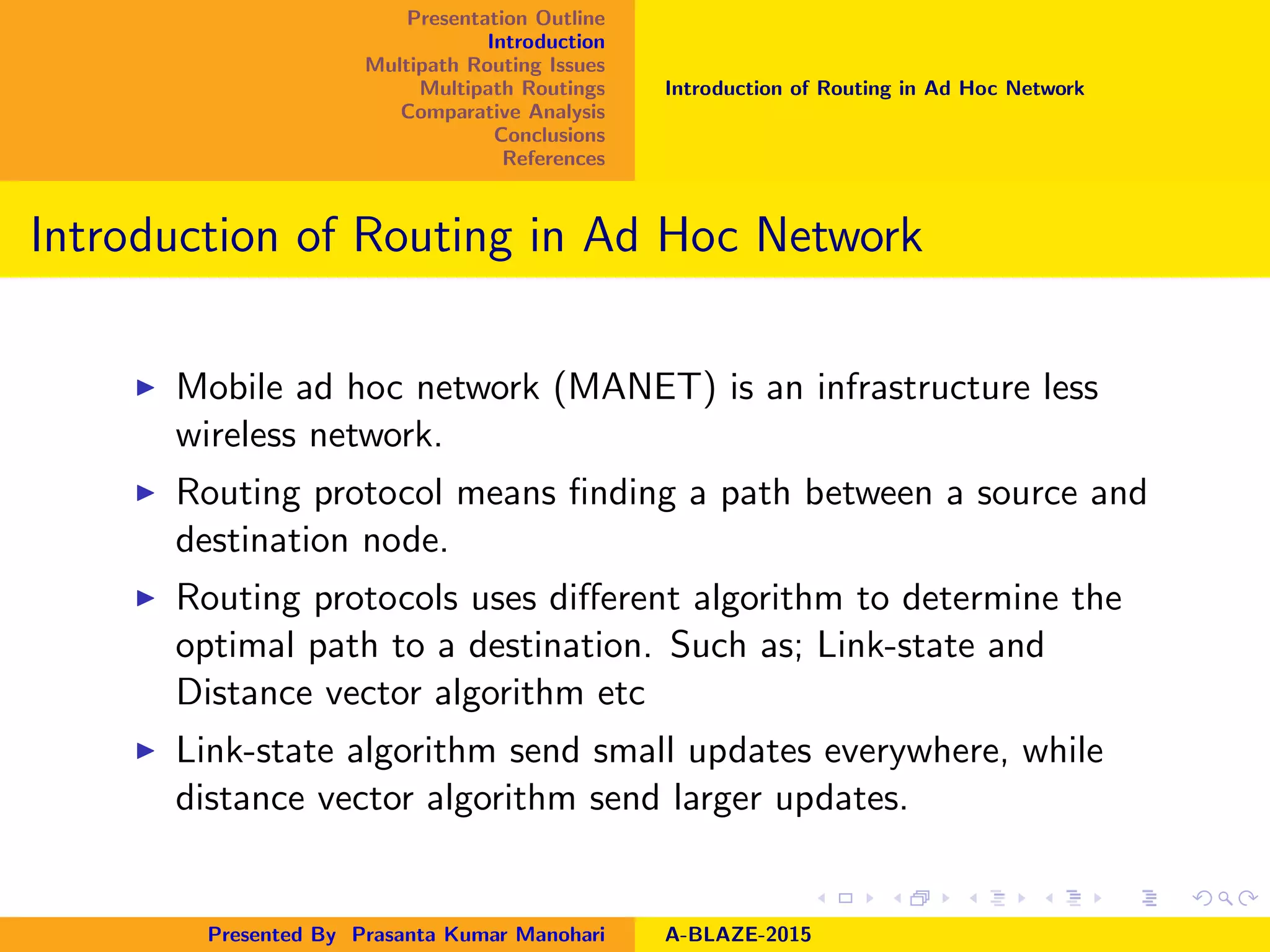
Mobile ad hoc network (MANET) is an infrastructure less
wireless network.
Routing protocol means finding a path between a source and
destination node.
Routing protocols uses different algorithm to determine the
optimal path to a destination. Such as; Link-state and
Distance vector algorithm etc
Link-state algorithm send small updates everywhere, while
distance vector algorithm send larger updates.
Presented By Prasanta Kumar Manohari A-BLAZE-2015
Presentation Outline
Introduction
Multipath Routing Issues
Multipath Routings
Comparative Analysis
Conclusions
References
Introduction of Routing in Ad Hoc Network
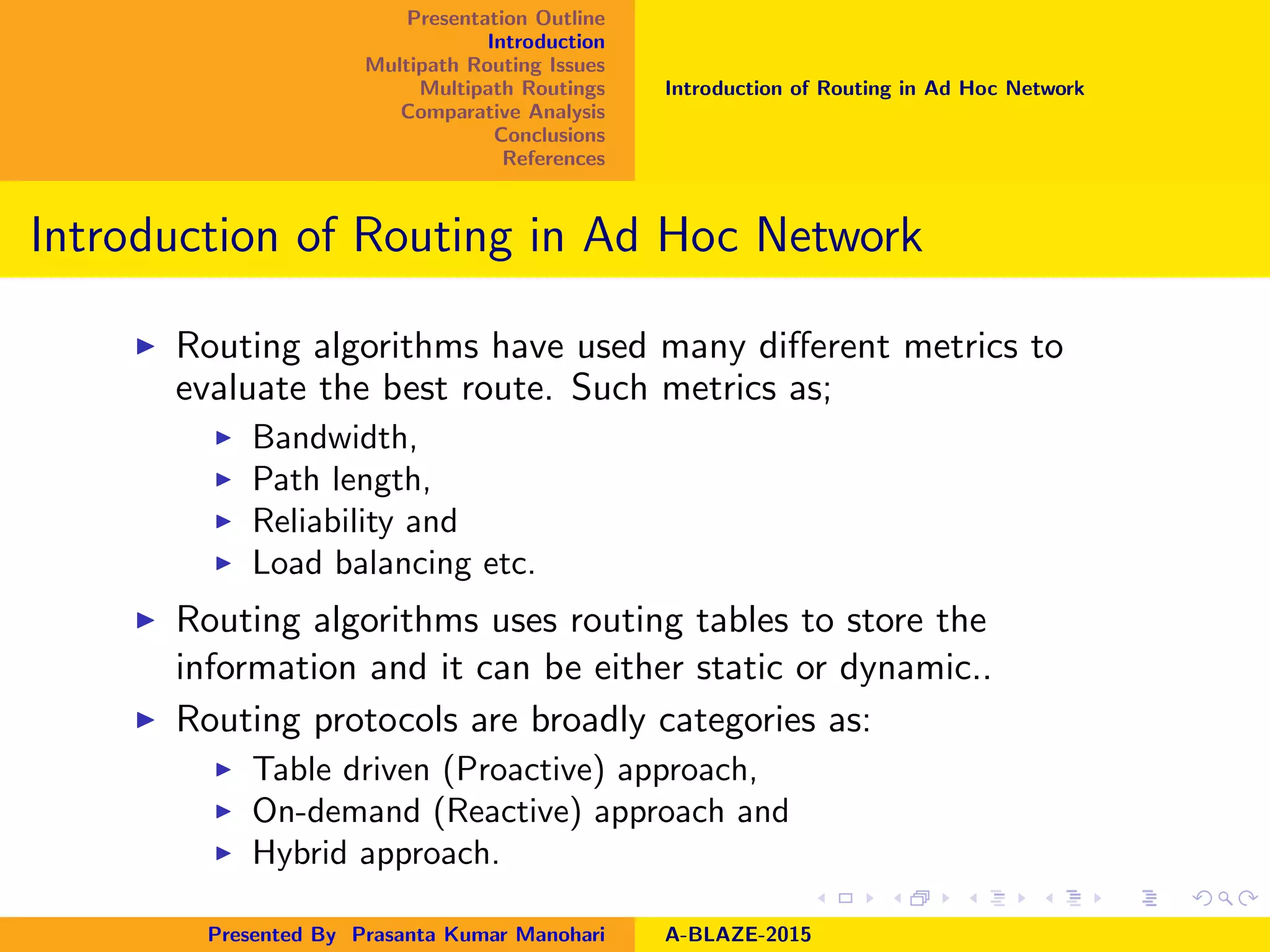
Routing algorithms have used many different metrics to
evaluate the best route. Such metrics as;
Bandwidth,
Path length,
Reliability and
Load balancing etc.
Routing algorithms uses routing tables to store the
information and it can be either static or dynamic..
Routing protocols are broadly categories as:
Table driven (Proactive) approach,
On-demand (Reactive) approach and
Hybrid approach.
Presented By Prasanta Kumar Manohari A-BLAZE-2015
Presentation Outline
Introduction
Multipath Routing Issues
Multipath Routings
Comparative Analysis
Conclusions
References
Introduction of Routing in Ad Hoc Network
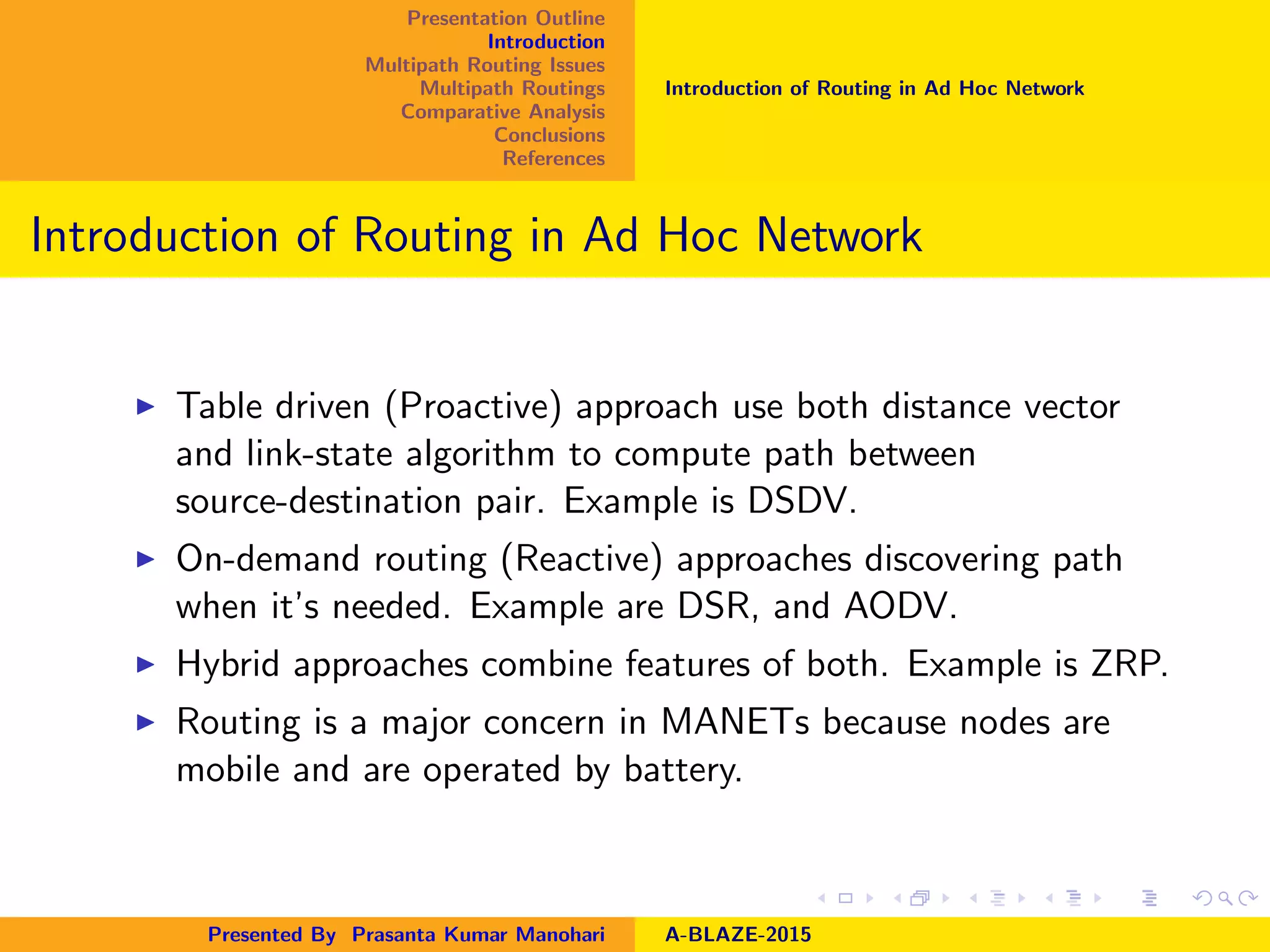
Table driven (Proactive) approach use both distance vector
and link-state algorithm to compute path between
source-destination pair. Example is DSDV.
On-demand routing (Reactive) approaches discovering path
when it’s needed. Example are DSR, and AODV.
Hybrid approaches combine features of both. Example is ZRP.
Routing is a major concern in MANETs because nodes are
mobile and are operated by battery.
Presented By Prasanta Kumar Manohari A-BLAZE-2015
Presentation Outline
Introduction
Multipath Routing Issues
Multipath Routings
Comparative Analysis
Conclusions
References
Multipath Routing Issues
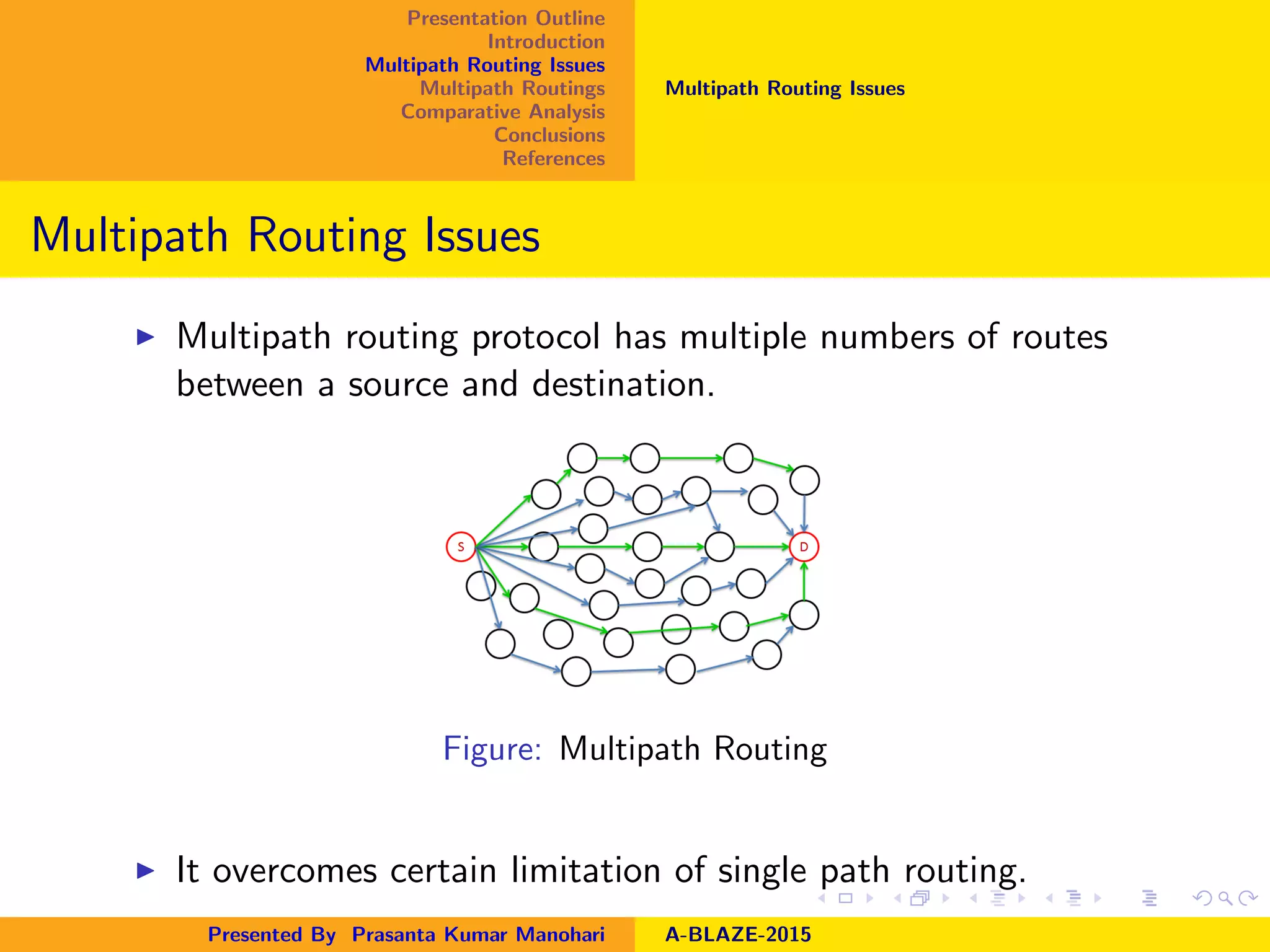
Multipath routing protocol has multiple numbers of routes
between a source and destination.
Figure: Multipath Routing
It overcomes certain limitation of single path routing.
Presented By Prasanta Kumar Manohari A-BLAZE-2015
Presentation Outline
Introduction
Multipath Routing Issues
Multipath Routings
Comparative Analysis
Conclusions
References
Multipath Routing Issues
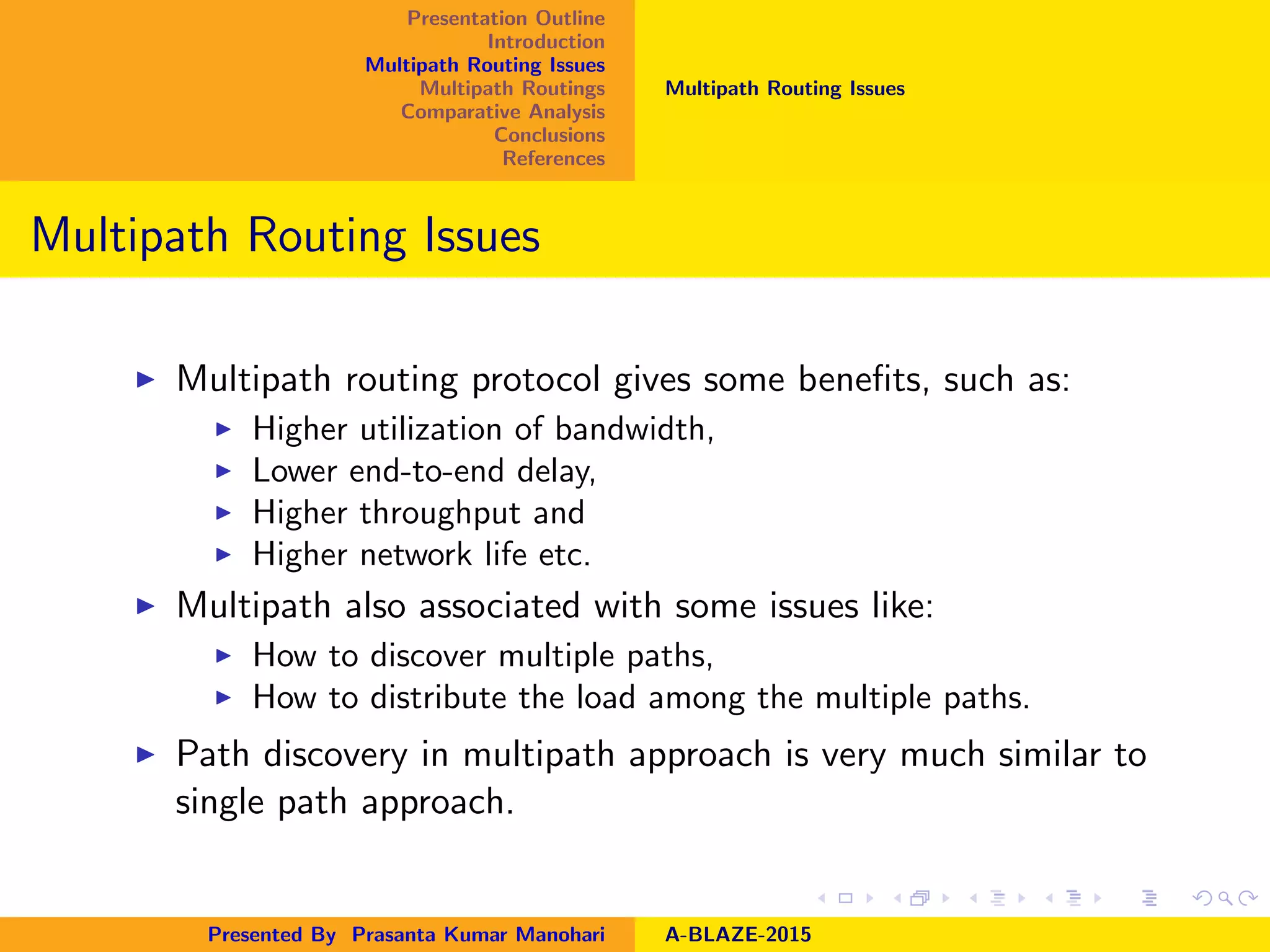
Multipath routing protocol gives some benefits, such as:
Higher utilization of bandwidth,
Lower end-to-end delay,
Higher throughput and
Higher network life etc.
Multipath also associated with some issues like:
How to discover multiple paths,
How to distribute the load among the multiple paths.
Path discovery in multipath approach is very much similar to
single path approach.
Presented By Prasanta Kumar Manohari A-BLAZE-2015
Presentation Outline
Introduction
Multipath Routing Issues
Multipath Routings
Comparative Analysis
Conclusions
References
Multipath Routing Issues
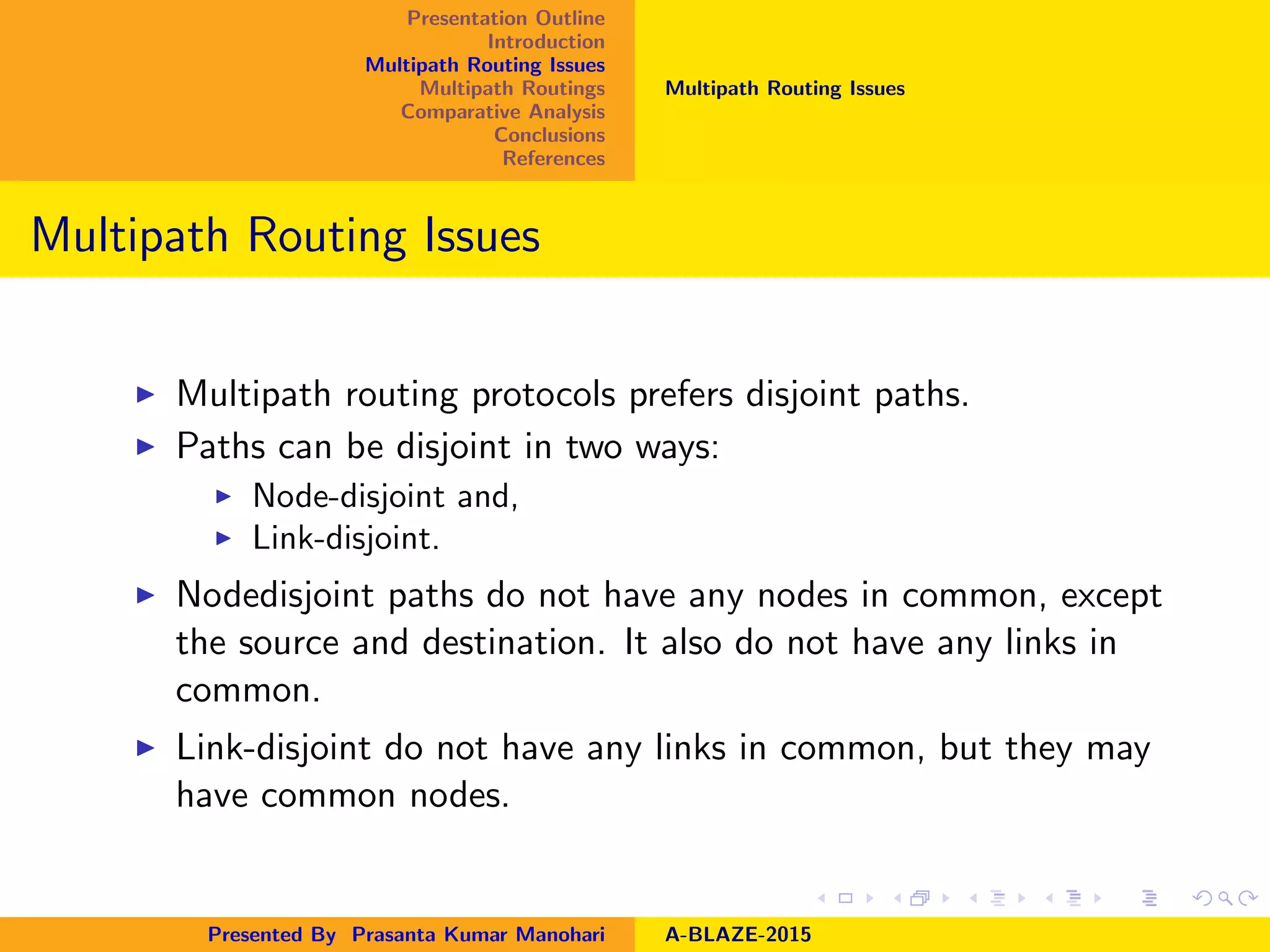
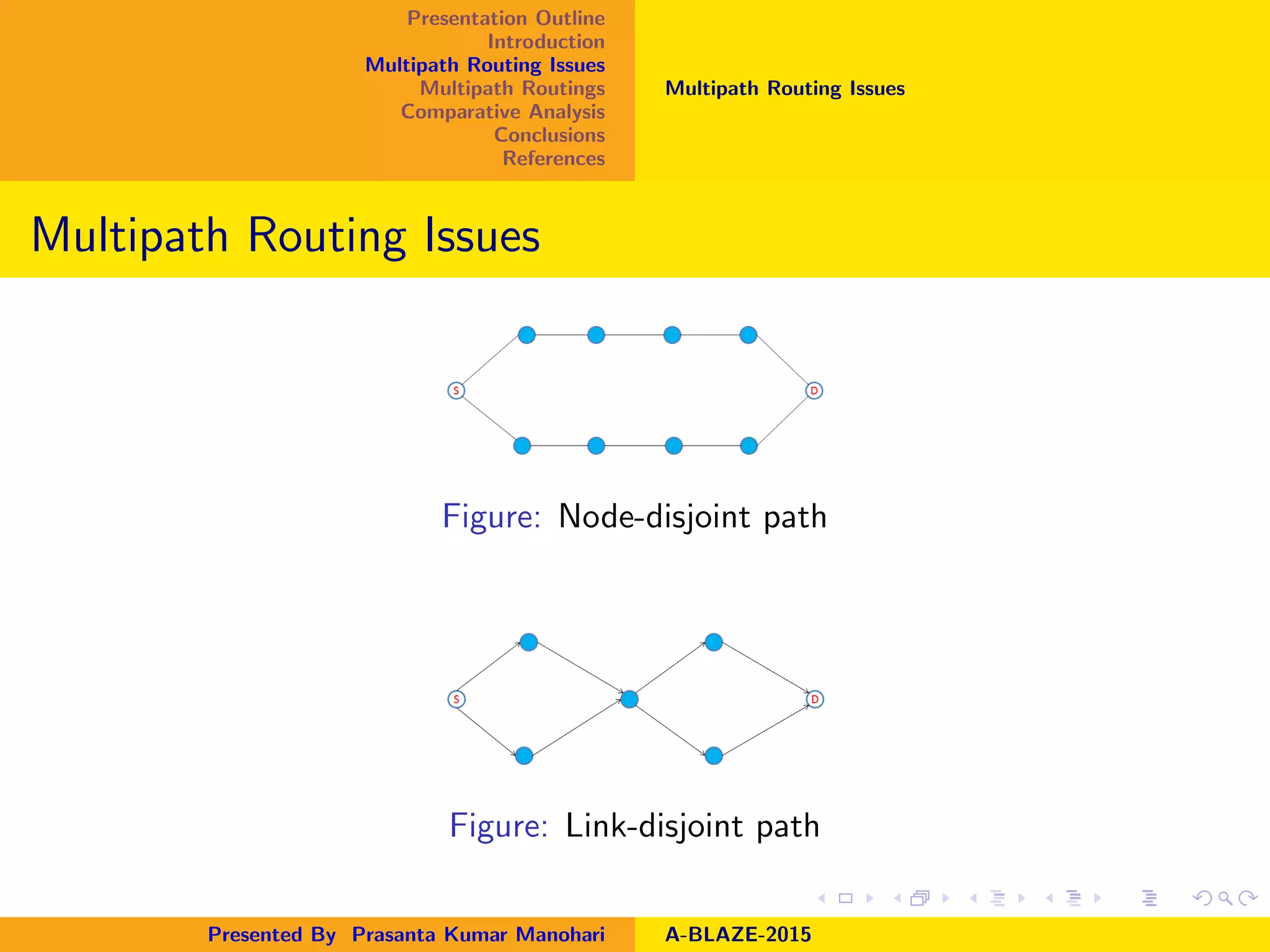
Multipath routing protocols prefers disjoint paths.
Paths can be disjoint in two ways:
Node-disjoint and,
Link-disjoint.
Nodedisjoint paths do not have any nodes in common, except
the source and destination. It also do not have any links in
common.
Link-disjoint do not have any links in common, but they may
have common nodes.
Presented By Prasanta Kumar Manohari A-BLAZE-2015
Presentation Outline
Introduction
Multipath Routing Issues
Multipath Routings
Comparative Analysis
Conclusions
References
Multipath Routing Issues
Figure: Node-disjoint path
Figure: Link-disjoint path
Presented By Prasanta Kumar Manohari A-BLAZE-2015
Presentation Outline
Introduction
Multipath Routing Issues
Multipath Routings
Comparative Analysis
Conclusions
References
Multipath Routing Issues
Some on-demand routing protocols based on multipath path
selection are discussed.
We are categories them as;
AODV variants,
DSR variants and,
Hybrid variants.
AODV, DSR and ZRP are considered to be the most popular
routing protocols in MANET.
Presented By Prasanta Kumar Manohari A-BLAZE-2015
Presentation Outline
Introduction
Multipath Routing Issues
Multipath Routings
Comparative Analysis
Conclusions
References
Multipath Routing In MANETs
Multipath Protocols Based On AODV
Many variants of AODV have been proposed in literature.
Some multipath extension of AODV approaches are;
AOMDV: Ad Hoc On-Demand Multipath Distance Vector
SMORT: Scalable Multipath On-demand Routing
MNL-AODV: Multipath Node-disjoint with Backup List AODV
AODV-MAP: AODV Multiple Alternative Paths
QAAMR: QoS Aware Adaptive Multipath Routing
The main ideas in AOMDV protocol is to find loop-free and
link-disjoint paths.
AOMDV improves fault-tolerance by selecting disjoint paths.
Presented By Prasanta Kumar Manohari A-BLAZE-2015
Presentation Outline
Introduction
Multipath Routing Issues
Multipath Routings
Comparative Analysis
Conclusions
References
Multipath Routing In MANETs
Multipath Protocols Based On AODV
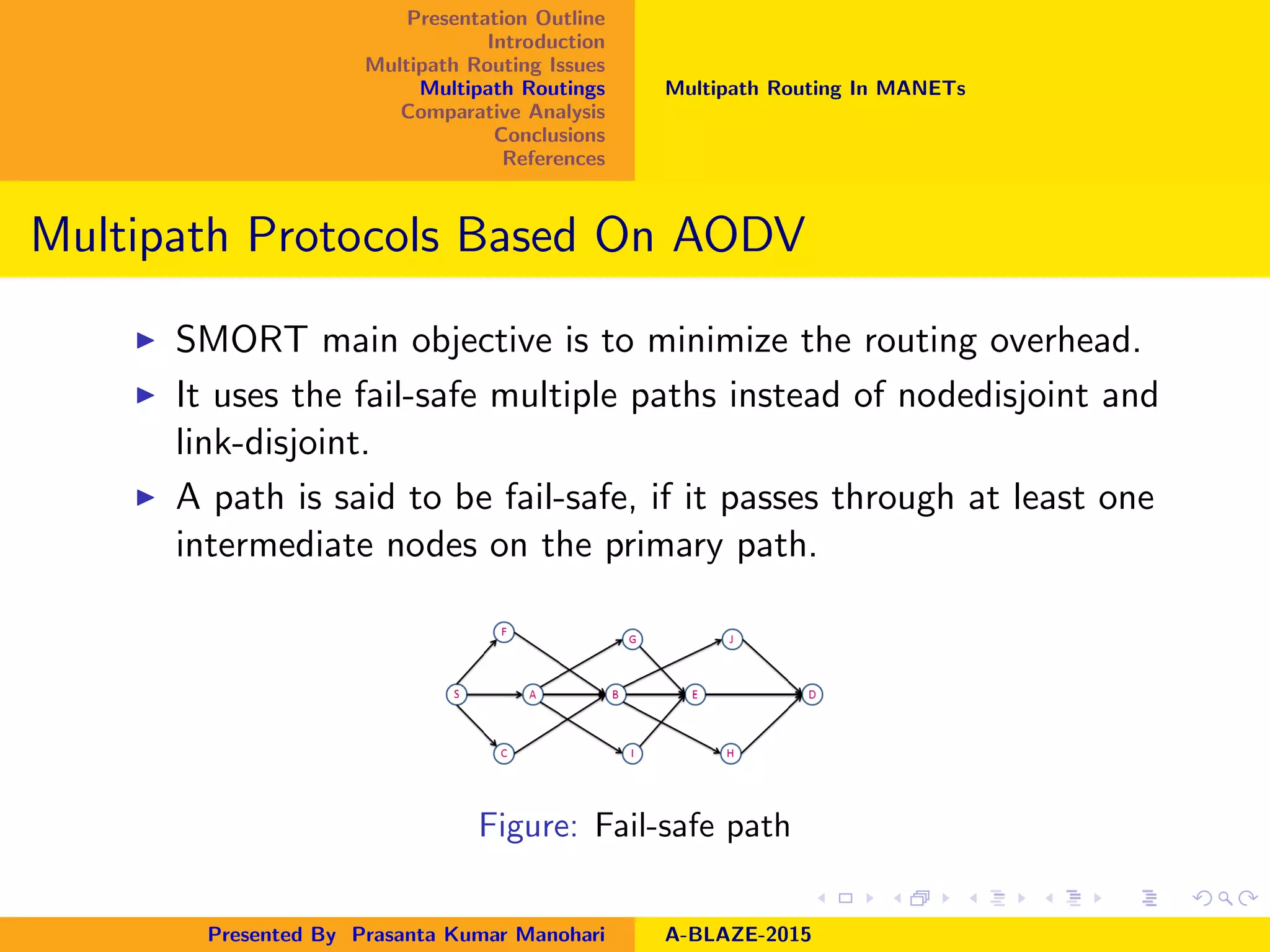
SMORT main objective is to minimize the routing overhead.
It uses the fail-safe multiple paths instead of nodedisjoint and
link-disjoint.
A path is said to be fail-safe, if it passes through at least one
intermediate nodes on the primary path.
Figure: Fail-safe path
Presented By Prasanta Kumar Manohari A-BLAZE-2015
Presentation Outline
Introduction
Multipath Routing Issues
Multipath Routings
Comparative Analysis
Conclusions
References
Multipath Routing In MANETs
Multipath Protocols Based On AODV
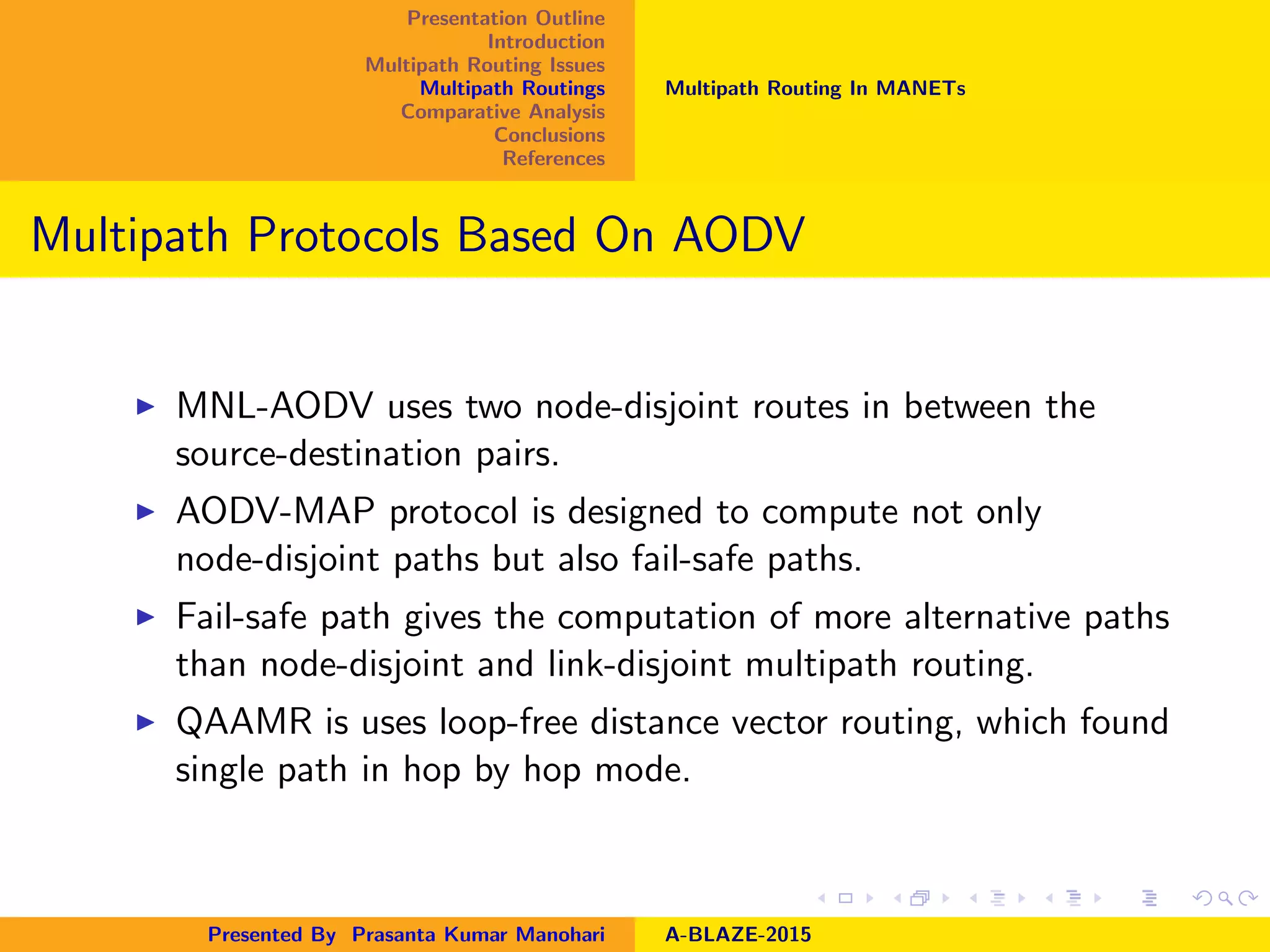
MNL-AODV uses two node-disjoint routes in between the
source-destination pairs.
AODV-MAP protocol is designed to compute not only
node-disjoint paths but also fail-safe paths.
Fail-safe path gives the computation of more alternative paths
than node-disjoint and link-disjoint multipath routing.
QAAMR is uses loop-free distance vector routing, which found
single path in hop by hop mode.
Presented By Prasanta Kumar Manohari A-BLAZE-2015
Presentation Outline
Introduction
Multipath Routing Issues
Multipath Routings
Comparative Analysis
Conclusions
References
Multipath Routing In MANETs
Multipath Protocols Based On DSR
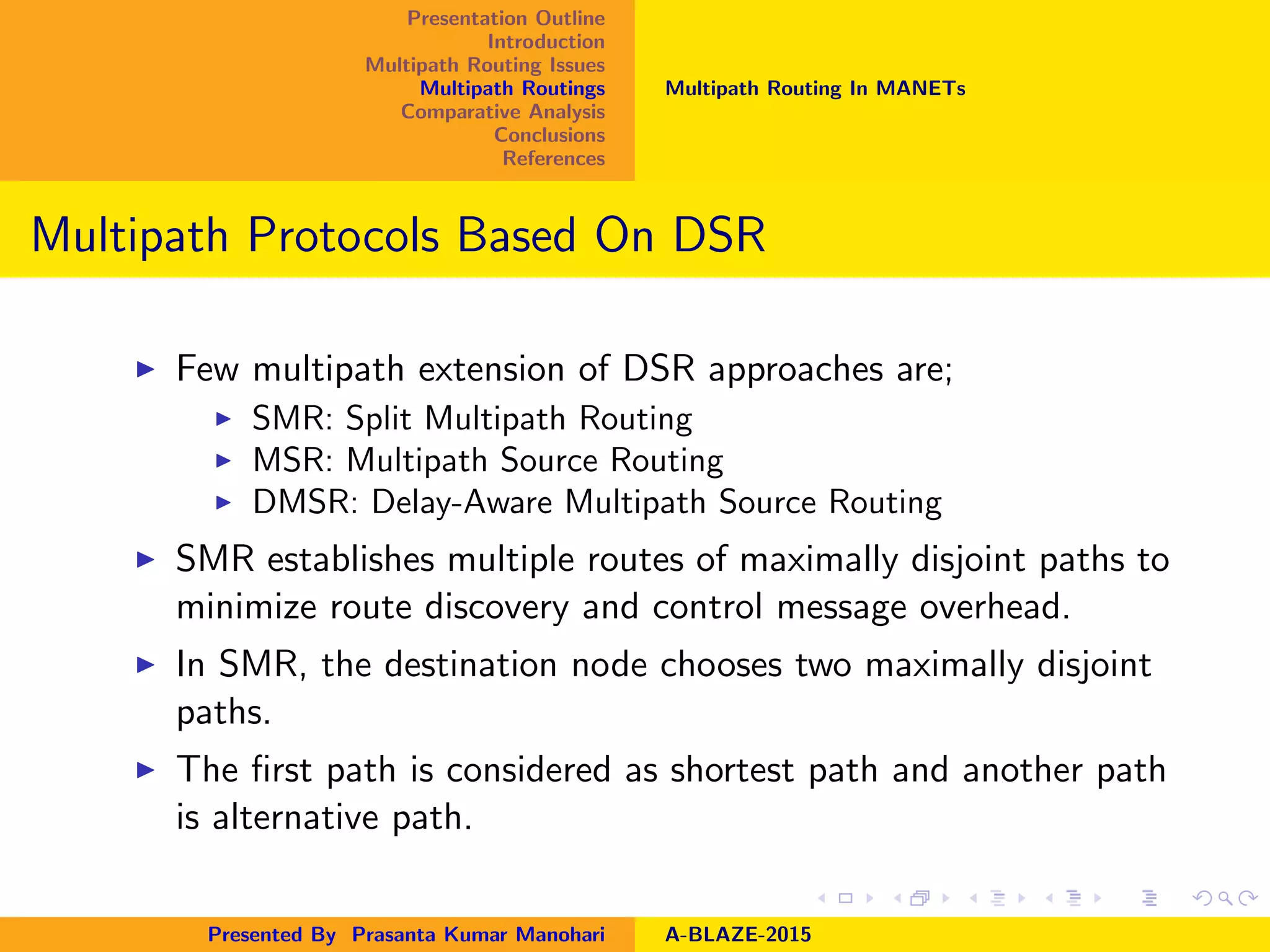
Few multipath extension of DSR approaches are;
SMR: Split Multipath Routing
MSR: Multipath Source Routing
DMSR: Delay-Aware Multipath Source Routing
SMR establishes multiple routes of maximally disjoint paths to
minimize route discovery and control message overhead.
In SMR, the destination node chooses two maximally disjoint
paths.
The first path is considered as shortest path and another path
is alternative path.
Presented By Prasanta Kumar Manohari A-BLAZE-2015
Presentation Outline
Introduction
Multipath Routing Issues
Multipath Routings
Comparative Analysis
Conclusions
References
Multipath Routing In MANETs
Multipath Protocols Based On DSR
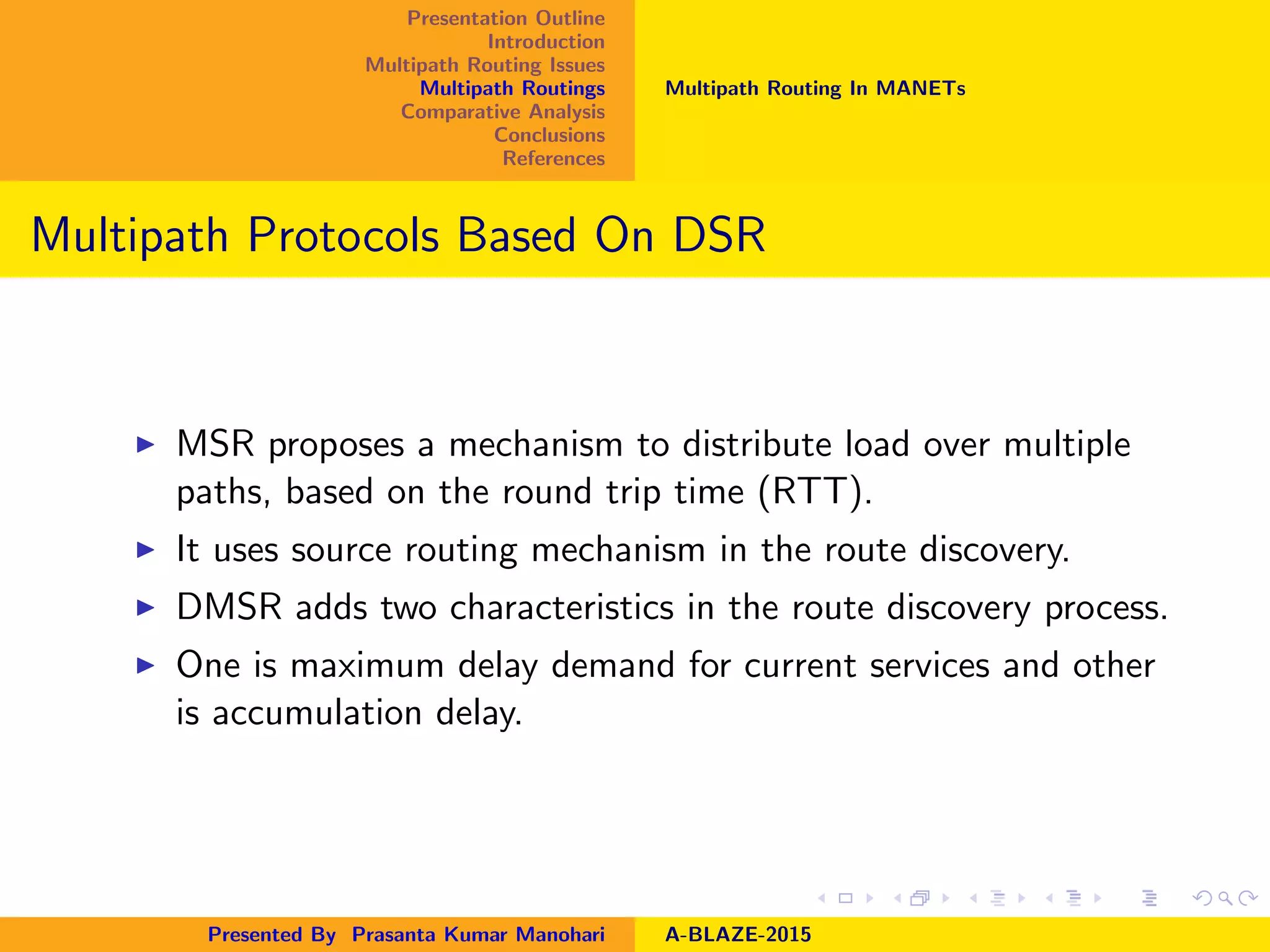
MSR proposes a mechanism to distribute load over multiple
paths, based on the round trip time (RTT).
It uses source routing mechanism in the route discovery.
DMSR adds two characteristics in the route discovery process.
One is maximum delay demand for current services and other
is accumulation delay.
Presented By Prasanta Kumar Manohari A-BLAZE-2015
Presentation Outline
Introduction
Multipath Routing Issues
Multipath Routings
Comparative Analysis
Conclusions
References
Multipath Routing In MANETs
Multipath Protocols Based On Hybrid
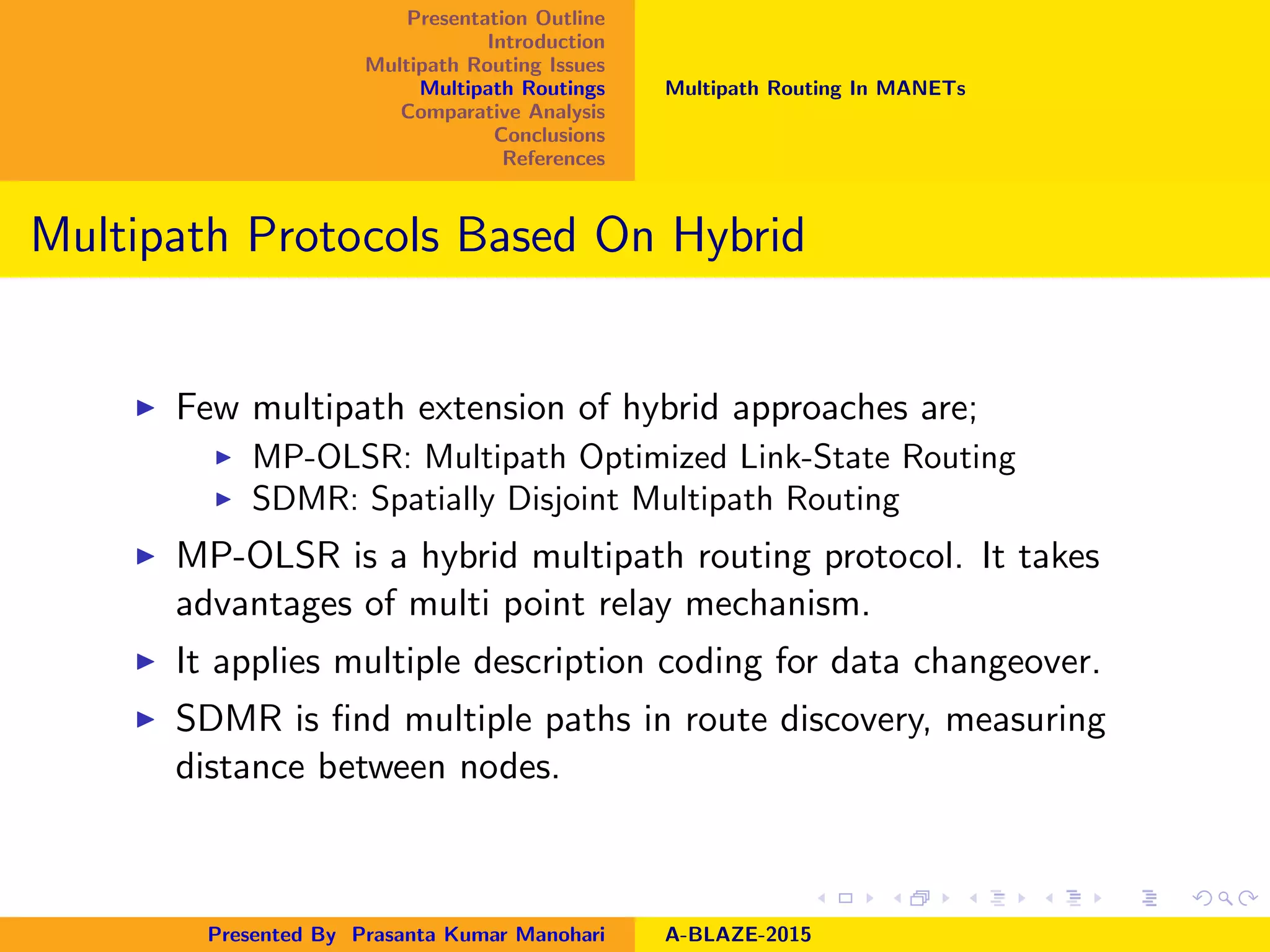
Few multipath extension of hybrid approaches are;
MP-OLSR: Multipath Optimized Link-State Routing
SDMR: Spatially Disjoint Multipath Routing
MP-OLSR is a hybrid multipath routing protocol. It takes
advantages of multi point relay mechanism.
It applies multiple description coding for data changeover.
SDMR is find multiple paths in route discovery, measuring
distance between nodes.
Presented By Prasanta Kumar Manohari A-BLAZE-2015
Presentation Outline
Introduction
Multipath Routing Issues
Multipath Routings
Comparative Analysis
Conclusions
References
Comparative Analysis
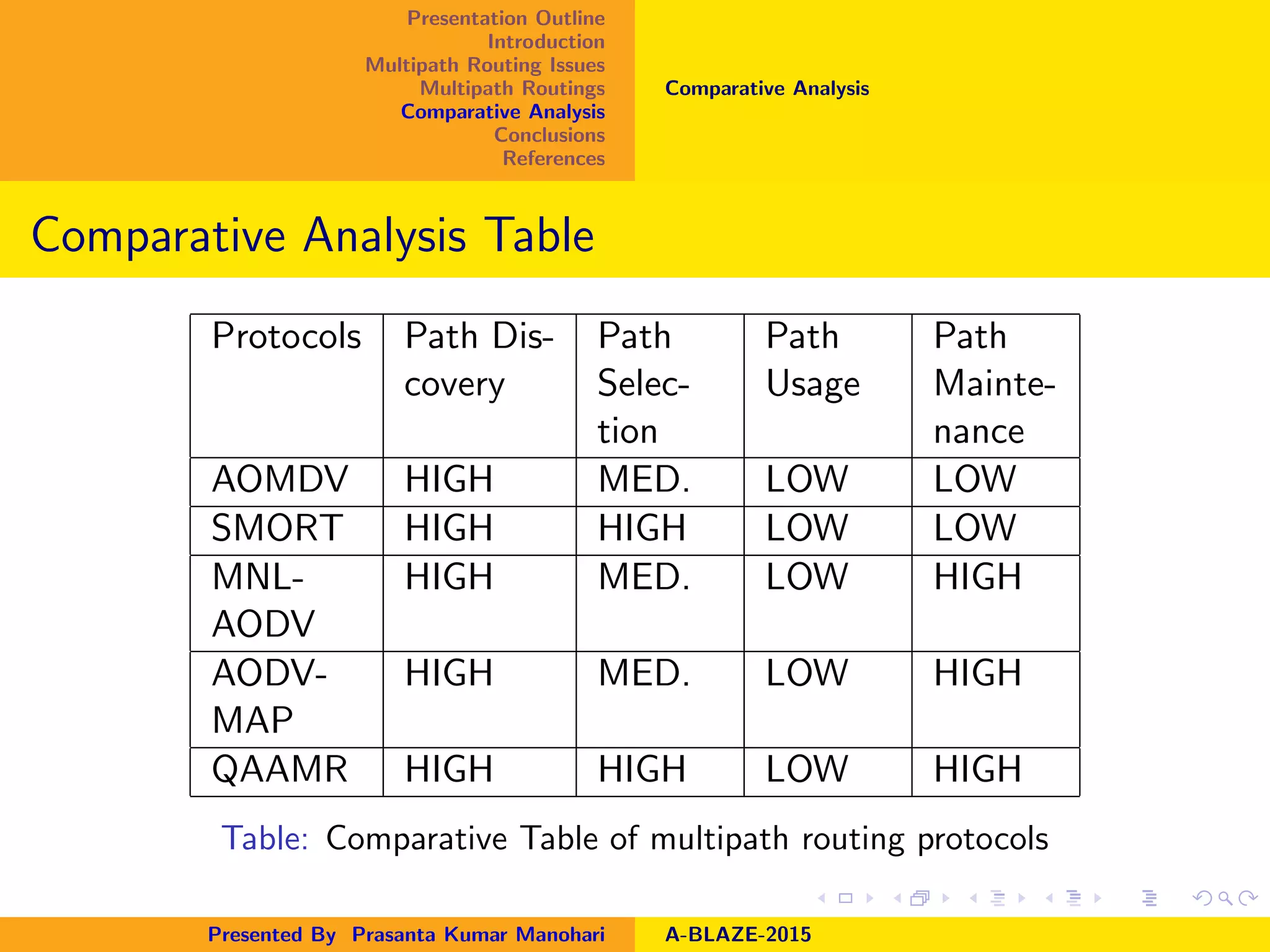
Comparative Analysis Table
Protocols Path Dis-
covery
Path
Selec-
tion
Path
Usage
Path
Mainte-
nance
AOMDV HIGH MED. LOW LOW
SMORT HIGH HIGH LOW LOW
MNL-
AODV
HIGH MED. LOW HIGH
AODV-
MAP
HIGH MED. LOW HIGH
QAAMR HIGH HIGH LOW HIGH
Table: Comparative Table of multipath routing protocols
Presented By Prasanta Kumar Manohari A-BLAZE-2015
Presentation Outline
Introduction
Multipath Routing Issues
Multipath Routings
Comparative Analysis
Conclusions
References
Comparative Analysis
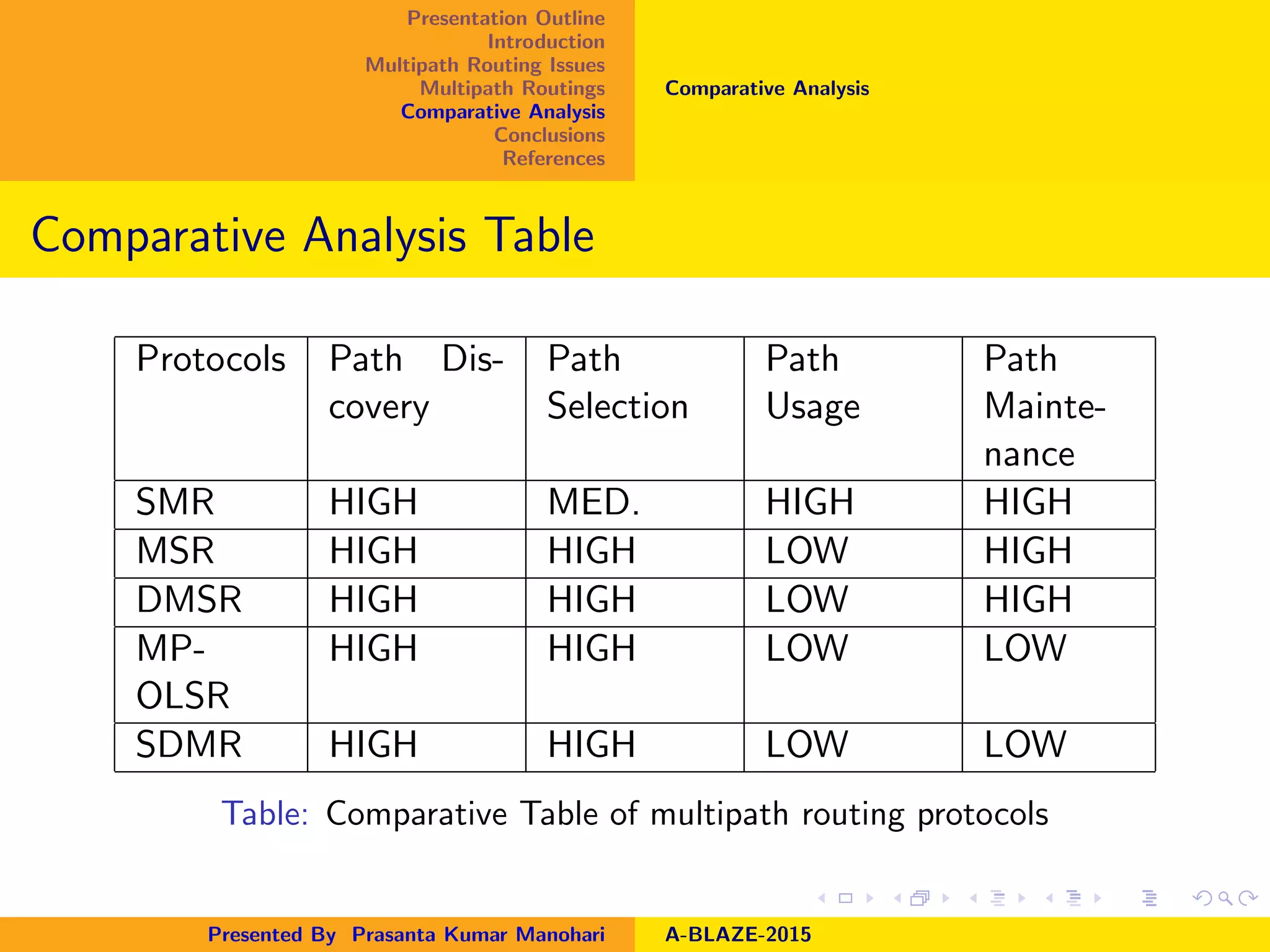
Comparative Analysis Table
Protocols Path Dis-
covery
Path
Selection
Path
Usage
Path
Mainte-
nance
SMR HIGH MED. HIGH HIGH
MSR HIGH HIGH LOW HIGH
DMSR HIGH HIGH LOW HIGH
MP-
OLSR
HIGH HIGH LOW LOW
SDMR HIGH HIGH LOW LOW
Table: Comparative Table of multipath routing protocols
Presented By Prasanta Kumar Manohari A-BLAZE-2015
Presentation Outline
Introduction
Multipath Routing Issues
Multipath Routings
Comparative Analysis
Conclusions
References
Comparative Analysis
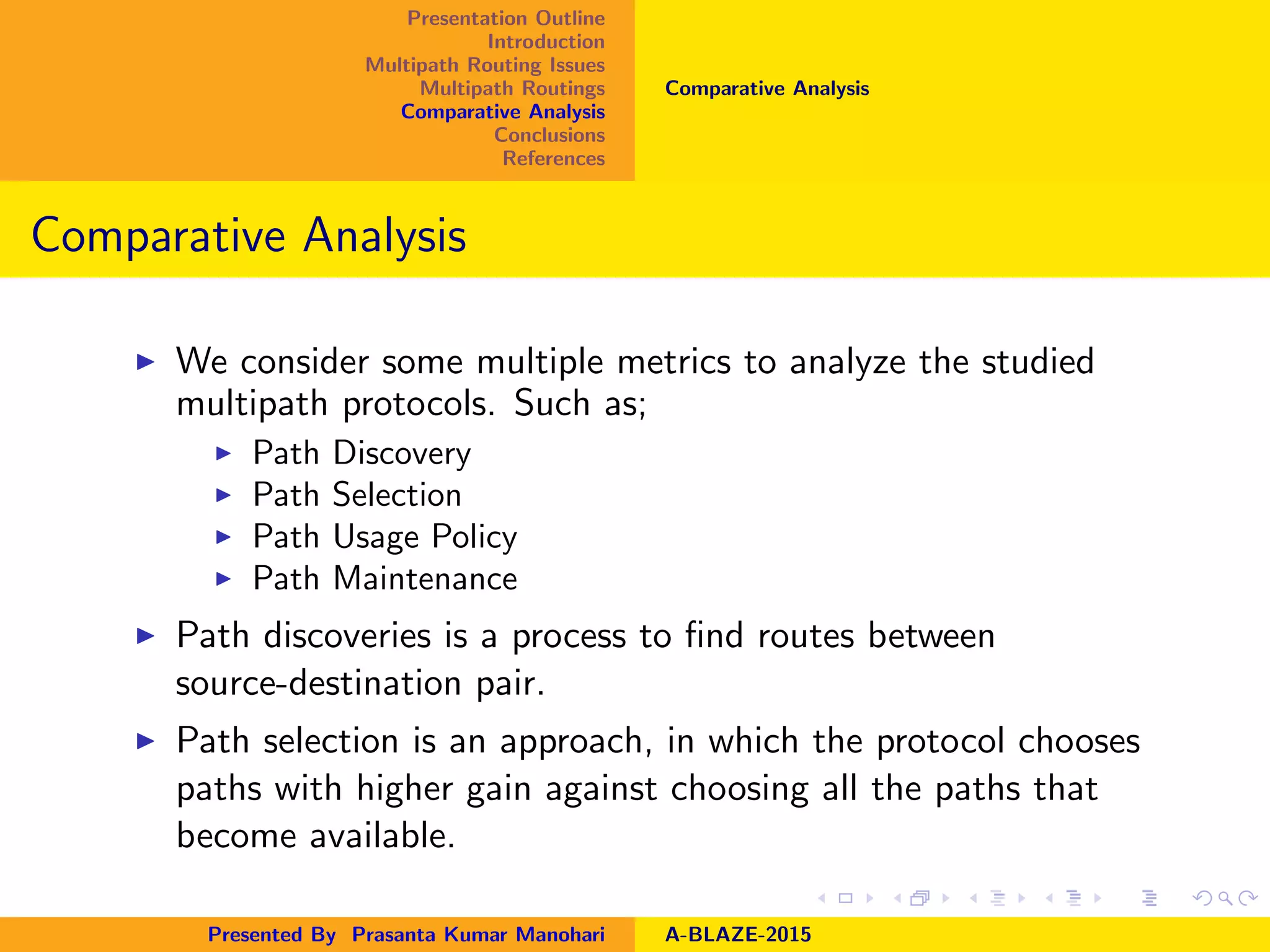
We consider some multiple metrics to analyze the studied
multipath protocols. Such as;
Path Discovery
Path Selection
Path Usage Policy
Path Maintenance
Path discoveries is a process to find routes between
source-destination pair.
Path selection is an approach, in which the protocol chooses
paths with higher gain against choosing all the paths that
become available.
Presented By Prasanta Kumar Manohari A-BLAZE-2015
Presentation Outline
Introduction
Multipath Routing Issues
Multipath Routings
Comparative Analysis
Conclusions
References
Comparative Analysis
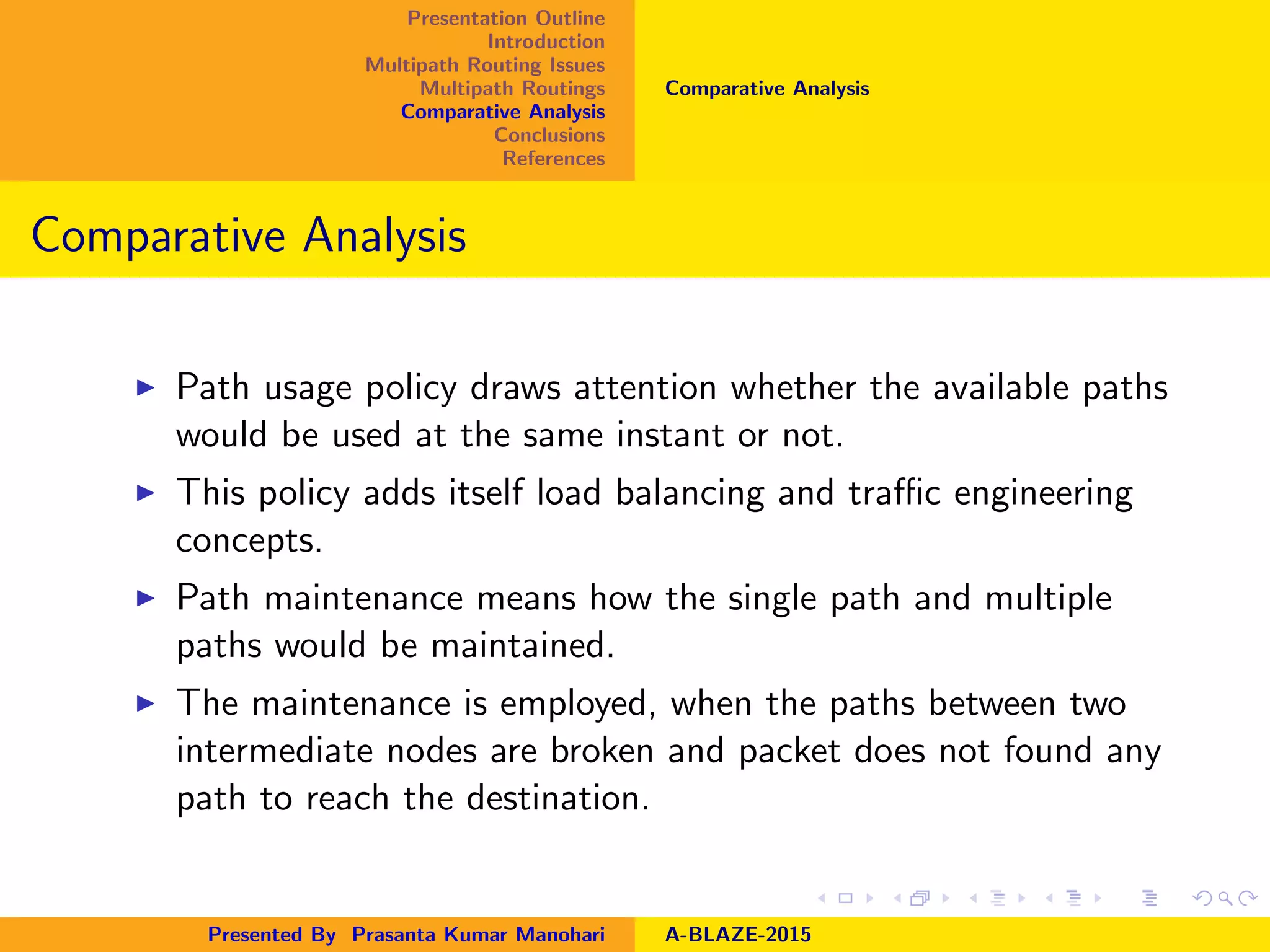
Path usage policy draws attention whether the available paths
would be used at the same instant or not.
This policy adds itself load balancing and traffic engineering
concepts.
Path maintenance means how the single path and multiple
paths would be maintained.
The maintenance is employed, when the paths between two
intermediate nodes are broken and packet does not found any
path to reach the destination.
Presented By Prasanta Kumar Manohari A-BLAZE-2015
Presentation Outline
Introduction
Multipath Routing Issues
Multipath Routings
Comparative Analysis
Conclusions
References
Comparative Analysis
Comparative Analysis Key Points
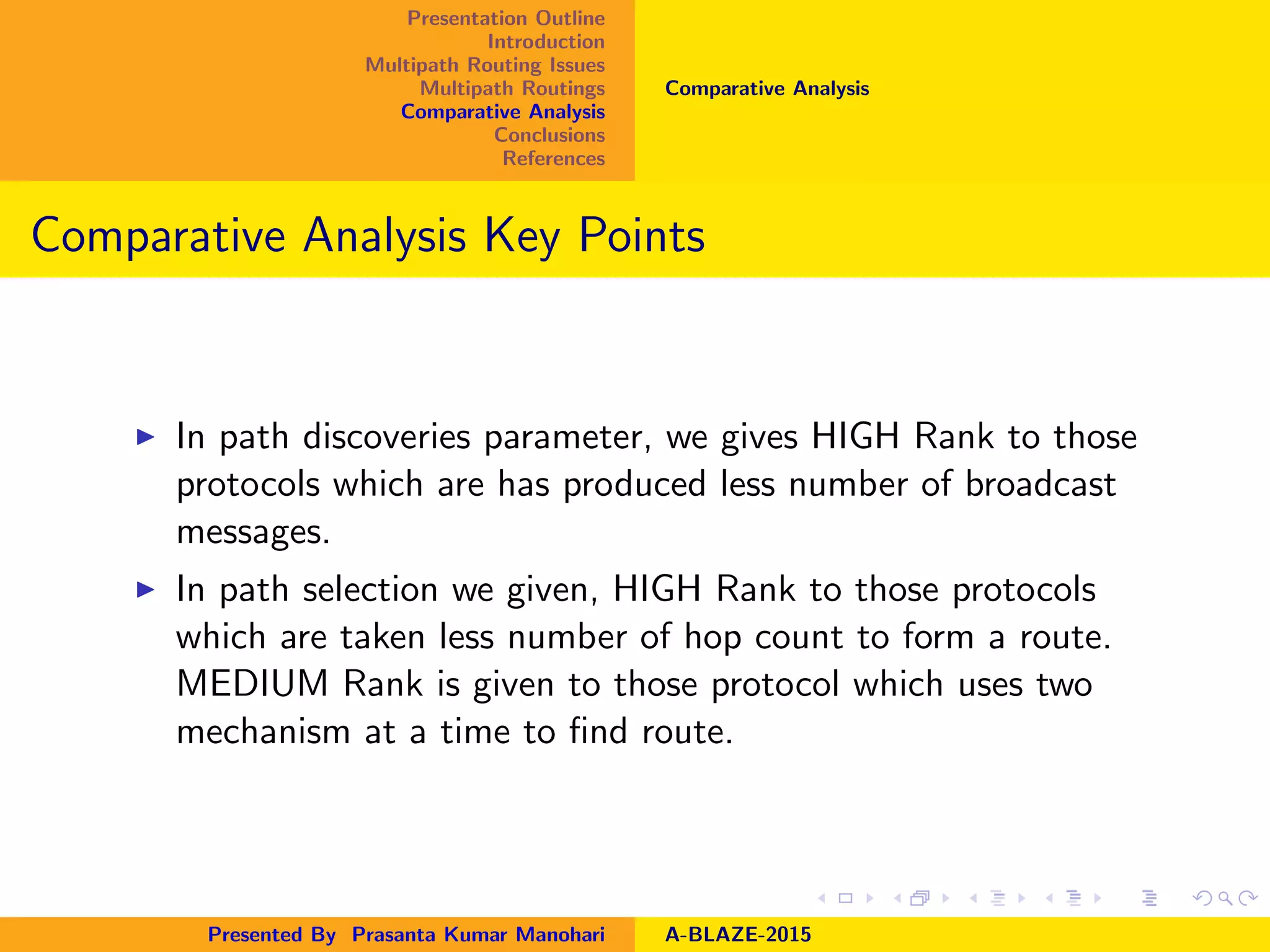
In path discoveries parameter, we gives HIGH Rank to those
protocols which are has produced less number of broadcast
messages.
In path selection we given, HIGH Rank to those protocols
which are taken less number of hop count to form a route.
MEDIUM Rank is given to those protocol which uses two
mechanism at a time to find route.
Presented By Prasanta Kumar Manohari A-BLAZE-2015
Presentation Outline
Introduction
Multipath Routing Issues
Multipath Routings
Comparative Analysis
Conclusions
References
Comparative Analysis
Comparative Analysis Key Points
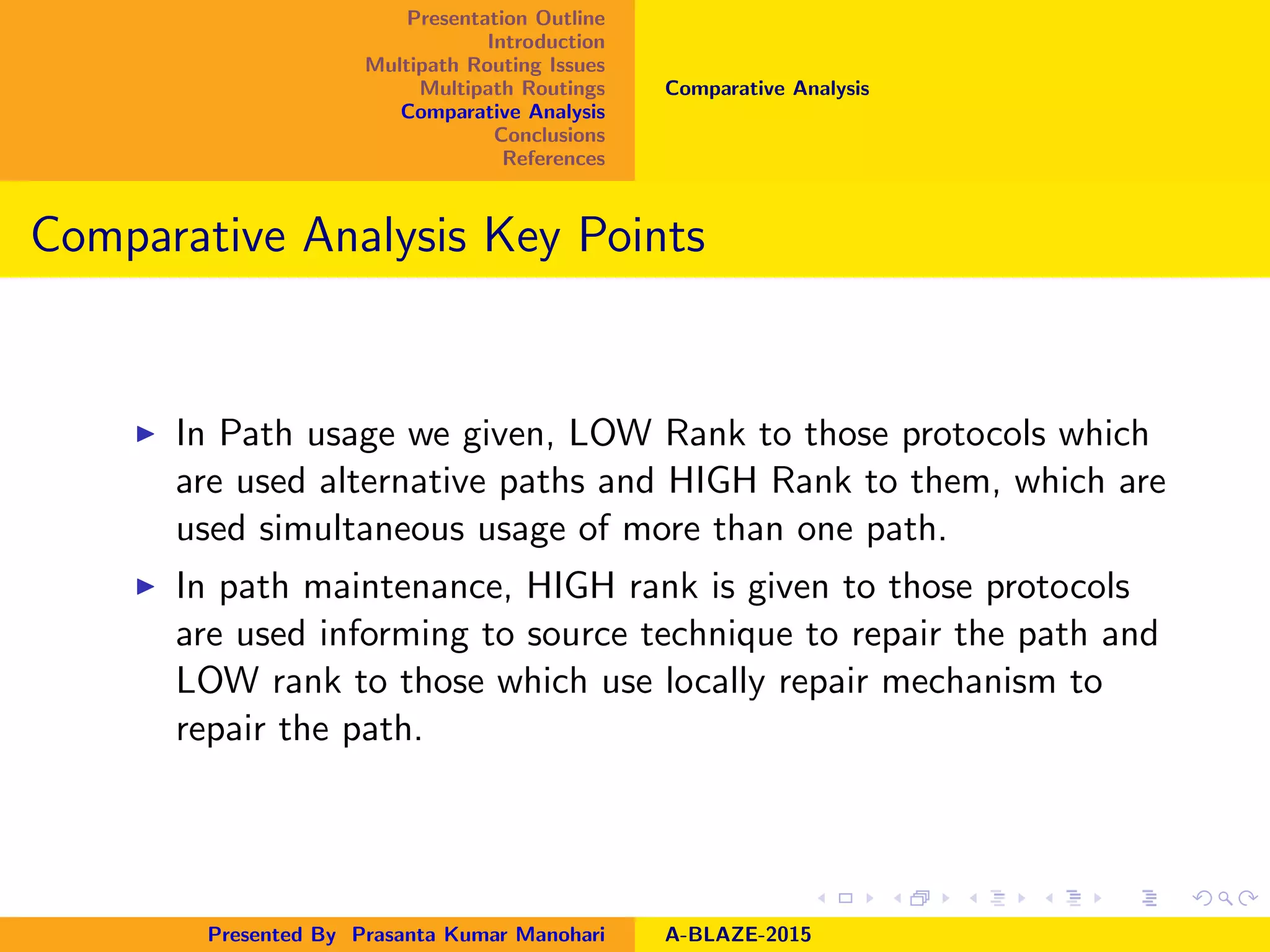
In Path usage we given, LOW Rank to those protocols which
are used alternative paths and HIGH Rank to them, which are
used simultaneous usage of more than one path.
In path maintenance, HIGH rank is given to those protocols
are used informing to source technique to repair the path and
LOW rank to those which use locally repair mechanism to
repair the path.
Presented By Prasanta Kumar Manohari A-BLAZE-2015
Presentation Outline
Introduction
Multipath Routing Issues
Multipath Routings
Comparative Analysis
Conclusions
References
Conclusions
Conclusions
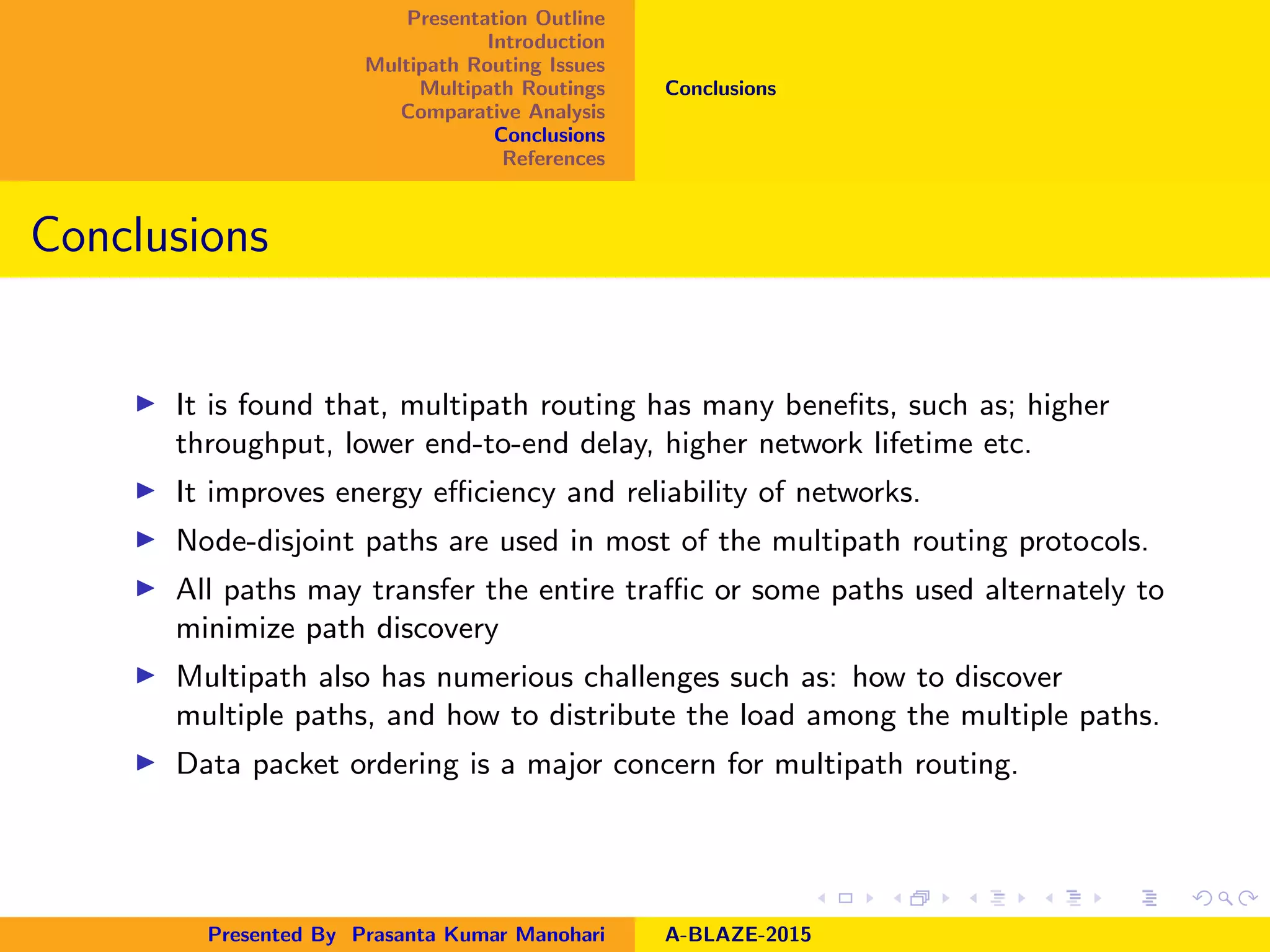
It is found that, multipath routing has many benefits, such as; higher
throughput, lower end-to-end delay, higher network lifetime etc.
It improves energy efficiency and reliability of networks.
Node-disjoint paths are used in most of the multipath routing protocols.
All paths may transfer the entire traffic or some paths used alternately to
minimize path discovery
Multipath also has numerious challenges such as: how to discover
multiple paths, and how to distribute the load among the multiple paths.
Data packet ordering is a major concern for multipath routing.
Presented By Prasanta Kumar Manohari A-BLAZE-2015
Presentation Outline
Introduction
Multipath Routing Issues
Multipath Routings
Comparative Analysis
Conclusions
References
References
References
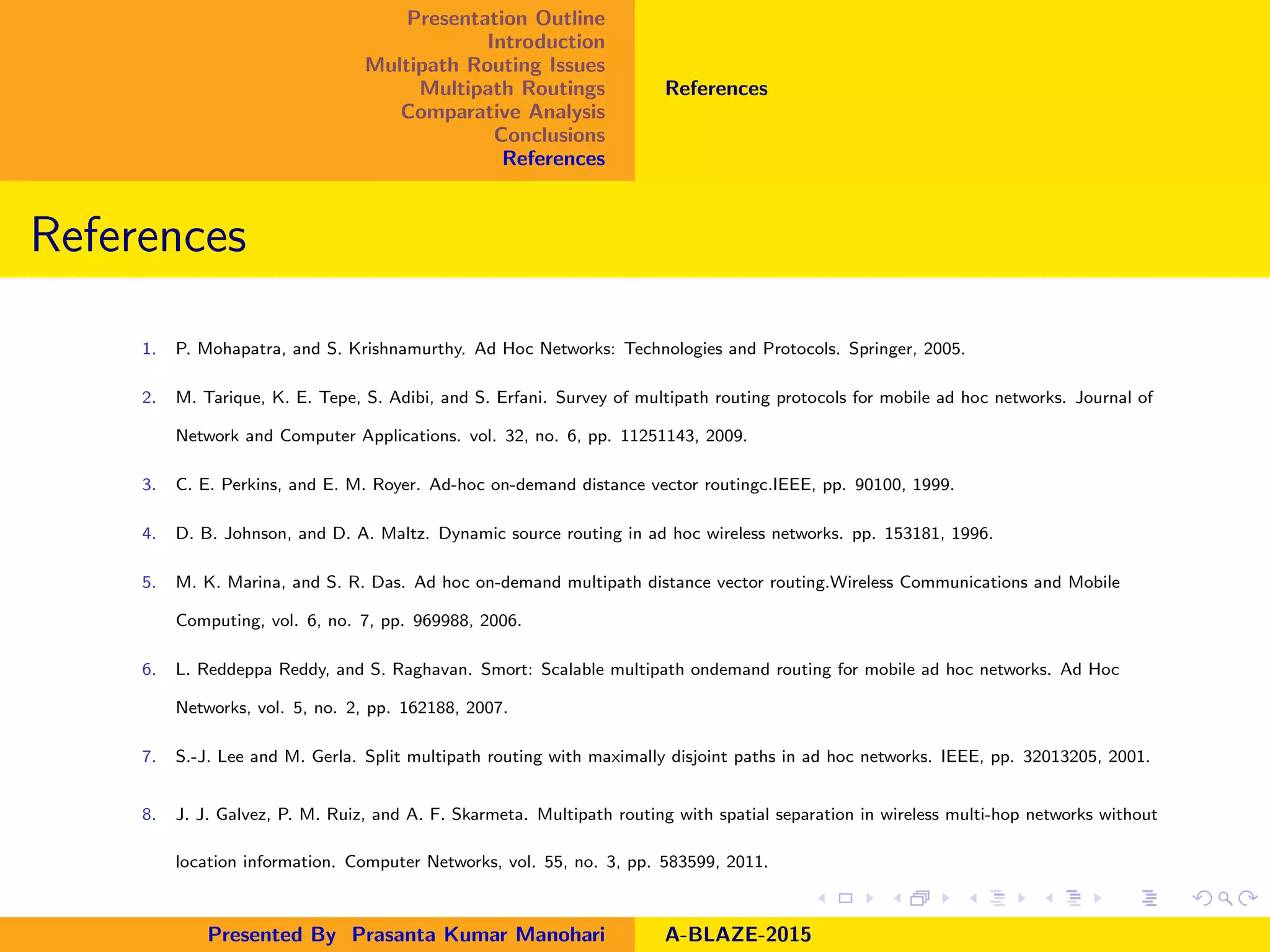
1. P. Mohapatra, and S. Krishnamurthy. Ad Hoc Networks: Technologies and Protocols. Springer, 2005.
2. M. Tarique, K. E. Tepe, S. Adibi, and S. Erfani. Survey of multipath routing protocols for mobile ad hoc networks. Journal of
Network and Computer Applications. vol. 32, no. 6, pp. 11251143, 2009.
3. C. E. Perkins, and E. M. Royer. Ad-hoc on-demand distance vector routingc.IEEE, pp. 90100, 1999.
4. D. B. Johnson, and D. A. Maltz. Dynamic source routing in ad hoc wireless networks. pp. 153181, 1996.
5. M. K. Marina, and S. R. Das. Ad hoc on-demand multipath distance vector routing.Wireless Communications and Mobile
Computing, vol. 6, no. 7, pp. 969988, 2006.
6. L. Reddeppa Reddy, and S. Raghavan. Smort: Scalable multipath ondemand routing for mobile ad hoc networks. Ad Hoc
Networks, vol. 5, no. 2, pp. 162188, 2007.
7. S.-J. Lee and M. Gerla. Split multipath routing with maximally disjoint paths in ad hoc networks. IEEE, pp. 32013205, 2001.
8. J. J. Galvez, P. M. Ruiz, and A. F. Skarmeta. Multipath routing with spatial separation in wireless multi-hop networks without
location information. Computer Networks, vol. 55, no. 3, pp. 583599, 2011.
Presented By Prasanta Kumar Manohari A-BLAZE-2015
Presentation Outline
Introduction
Multipath Routing Issues
Multipath Routings
Comparative Analysis
Conclusions
References
Thank You
Presented By Prasanta Kumar Manohari A-BLAZE-2015

testbmr

  • 1.
    Presentation Outline Introduction Multipath RoutingIssues Multipath Routings Comparative Analysis Conclusions References Multipath Routing Protocols In MANETs: A Study Presented By Prasanta Kumar Manohari Silicon Institute of Technology, Bhubaneswar 26thFeb. 2015 Presented By Prasanta Kumar Manohari A-BLAZE-2015
  • 2.
    Presentation Outline Introduction Multipath RoutingIssues Multipath Routings Comparative Analysis Conclusions References Presentation Outline Introduction Introduction of Routing in Ad Hoc Network Multipath Routing Issues Multipath Routing Issues Multipath Routings Multipath Routing In MANETs Comparative Analysis Comparative Analysis Conclusions Conclusions References References Presented By Prasanta Kumar Manohari A-BLAZE-2015
  • 3.
    Presentation Outline Introduction Multipath RoutingIssues Multipath Routings Comparative Analysis Conclusions References Introduction of Routing in Ad Hoc Network Introduction of Routing in Ad Hoc Network Mobile ad hoc network (MANET) is an infrastructure less wireless network. Routing protocol means finding a path between a source and destination node. Routing protocols uses different algorithm to determine the optimal path to a destination. Such as; Link-state and Distance vector algorithm etc Link-state algorithm send small updates everywhere, while distance vector algorithm send larger updates. Presented By Prasanta Kumar Manohari A-BLAZE-2015
  • 4.
    Presentation Outline Introduction Multipath RoutingIssues Multipath Routings Comparative Analysis Conclusions References Introduction of Routing in Ad Hoc Network Introduction of Routing in Ad Hoc Network Routing algorithms have used many different metrics to evaluate the best route. Such metrics as; Bandwidth, Path length, Reliability and Load balancing etc. Routing algorithms uses routing tables to store the information and it can be either static or dynamic.. Routing protocols are broadly categories as: Table driven (Proactive) approach, On-demand (Reactive) approach and Hybrid approach. Presented By Prasanta Kumar Manohari A-BLAZE-2015
  • 5.
    Presentation Outline Introduction Multipath RoutingIssues Multipath Routings Comparative Analysis Conclusions References Introduction of Routing in Ad Hoc Network Introduction of Routing in Ad Hoc Network Table driven (Proactive) approach use both distance vector and link-state algorithm to compute path between source-destination pair. Example is DSDV. On-demand routing (Reactive) approaches discovering path when it’s needed. Example are DSR, and AODV. Hybrid approaches combine features of both. Example is ZRP. Routing is a major concern in MANETs because nodes are mobile and are operated by battery. Presented By Prasanta Kumar Manohari A-BLAZE-2015
  • 6.
    Presentation Outline Introduction Multipath RoutingIssues Multipath Routings Comparative Analysis Conclusions References Multipath Routing Issues Multipath Routing Issues Multipath routing protocol has multiple numbers of routes between a source and destination. Figure: Multipath Routing It overcomes certain limitation of single path routing. Presented By Prasanta Kumar Manohari A-BLAZE-2015
  • 7.
    Presentation Outline Introduction Multipath RoutingIssues Multipath Routings Comparative Analysis Conclusions References Multipath Routing Issues Multipath Routing Issues Multipath routing protocol gives some benefits, such as: Higher utilization of bandwidth, Lower end-to-end delay, Higher throughput and Higher network life etc. Multipath also associated with some issues like: How to discover multiple paths, How to distribute the load among the multiple paths. Path discovery in multipath approach is very much similar to single path approach. Presented By Prasanta Kumar Manohari A-BLAZE-2015
  • 8.
    Presentation Outline Introduction Multipath RoutingIssues Multipath Routings Comparative Analysis Conclusions References Multipath Routing Issues Multipath Routing Issues Multipath routing protocols prefers disjoint paths. Paths can be disjoint in two ways: Node-disjoint and, Link-disjoint. Nodedisjoint paths do not have any nodes in common, except the source and destination. It also do not have any links in common. Link-disjoint do not have any links in common, but they may have common nodes. Presented By Prasanta Kumar Manohari A-BLAZE-2015
  • 9.
    Presentation Outline Introduction Multipath RoutingIssues Multipath Routings Comparative Analysis Conclusions References Multipath Routing Issues Multipath Routing Issues Figure: Node-disjoint path Figure: Link-disjoint path Presented By Prasanta Kumar Manohari A-BLAZE-2015
  • 10.
    Presentation Outline Introduction Multipath RoutingIssues Multipath Routings Comparative Analysis Conclusions References Multipath Routing Issues Multipath Routing Issues Some on-demand routing protocols based on multipath path selection are discussed. We are categories them as; AODV variants, DSR variants and, Hybrid variants. AODV, DSR and ZRP are considered to be the most popular routing protocols in MANET. Presented By Prasanta Kumar Manohari A-BLAZE-2015
  • 11.
    Presentation Outline Introduction Multipath RoutingIssues Multipath Routings Comparative Analysis Conclusions References Multipath Routing In MANETs Multipath Protocols Based On AODV Many variants of AODV have been proposed in literature. Some multipath extension of AODV approaches are; AOMDV: Ad Hoc On-Demand Multipath Distance Vector SMORT: Scalable Multipath On-demand Routing MNL-AODV: Multipath Node-disjoint with Backup List AODV AODV-MAP: AODV Multiple Alternative Paths QAAMR: QoS Aware Adaptive Multipath Routing The main ideas in AOMDV protocol is to find loop-free and link-disjoint paths. AOMDV improves fault-tolerance by selecting disjoint paths. Presented By Prasanta Kumar Manohari A-BLAZE-2015
  • 12.
    Presentation Outline Introduction Multipath RoutingIssues Multipath Routings Comparative Analysis Conclusions References Multipath Routing In MANETs Multipath Protocols Based On AODV SMORT main objective is to minimize the routing overhead. It uses the fail-safe multiple paths instead of nodedisjoint and link-disjoint. A path is said to be fail-safe, if it passes through at least one intermediate nodes on the primary path. Figure: Fail-safe path Presented By Prasanta Kumar Manohari A-BLAZE-2015
  • 13.
    Presentation Outline Introduction Multipath RoutingIssues Multipath Routings Comparative Analysis Conclusions References Multipath Routing In MANETs Multipath Protocols Based On AODV MNL-AODV uses two node-disjoint routes in between the source-destination pairs. AODV-MAP protocol is designed to compute not only node-disjoint paths but also fail-safe paths. Fail-safe path gives the computation of more alternative paths than node-disjoint and link-disjoint multipath routing. QAAMR is uses loop-free distance vector routing, which found single path in hop by hop mode. Presented By Prasanta Kumar Manohari A-BLAZE-2015
  • 14.
    Presentation Outline Introduction Multipath RoutingIssues Multipath Routings Comparative Analysis Conclusions References Multipath Routing In MANETs Multipath Protocols Based On DSR Few multipath extension of DSR approaches are; SMR: Split Multipath Routing MSR: Multipath Source Routing DMSR: Delay-Aware Multipath Source Routing SMR establishes multiple routes of maximally disjoint paths to minimize route discovery and control message overhead. In SMR, the destination node chooses two maximally disjoint paths. The first path is considered as shortest path and another path is alternative path. Presented By Prasanta Kumar Manohari A-BLAZE-2015
  • 15.
    Presentation Outline Introduction Multipath RoutingIssues Multipath Routings Comparative Analysis Conclusions References Multipath Routing In MANETs Multipath Protocols Based On DSR MSR proposes a mechanism to distribute load over multiple paths, based on the round trip time (RTT). It uses source routing mechanism in the route discovery. DMSR adds two characteristics in the route discovery process. One is maximum delay demand for current services and other is accumulation delay. Presented By Prasanta Kumar Manohari A-BLAZE-2015
  • 16.
    Presentation Outline Introduction Multipath RoutingIssues Multipath Routings Comparative Analysis Conclusions References Multipath Routing In MANETs Multipath Protocols Based On Hybrid Few multipath extension of hybrid approaches are; MP-OLSR: Multipath Optimized Link-State Routing SDMR: Spatially Disjoint Multipath Routing MP-OLSR is a hybrid multipath routing protocol. It takes advantages of multi point relay mechanism. It applies multiple description coding for data changeover. SDMR is find multiple paths in route discovery, measuring distance between nodes. Presented By Prasanta Kumar Manohari A-BLAZE-2015
  • 17.
    Presentation Outline Introduction Multipath RoutingIssues Multipath Routings Comparative Analysis Conclusions References Comparative Analysis Comparative Analysis Table Protocols Path Dis- covery Path Selec- tion Path Usage Path Mainte- nance AOMDV HIGH MED. LOW LOW SMORT HIGH HIGH LOW LOW MNL- AODV HIGH MED. LOW HIGH AODV- MAP HIGH MED. LOW HIGH QAAMR HIGH HIGH LOW HIGH Table: Comparative Table of multipath routing protocols Presented By Prasanta Kumar Manohari A-BLAZE-2015
  • 18.
    Presentation Outline Introduction Multipath RoutingIssues Multipath Routings Comparative Analysis Conclusions References Comparative Analysis Comparative Analysis Table Protocols Path Dis- covery Path Selection Path Usage Path Mainte- nance SMR HIGH MED. HIGH HIGH MSR HIGH HIGH LOW HIGH DMSR HIGH HIGH LOW HIGH MP- OLSR HIGH HIGH LOW LOW SDMR HIGH HIGH LOW LOW Table: Comparative Table of multipath routing protocols Presented By Prasanta Kumar Manohari A-BLAZE-2015
  • 19.
    Presentation Outline Introduction Multipath RoutingIssues Multipath Routings Comparative Analysis Conclusions References Comparative Analysis Comparative Analysis We consider some multiple metrics to analyze the studied multipath protocols. Such as; Path Discovery Path Selection Path Usage Policy Path Maintenance Path discoveries is a process to find routes between source-destination pair. Path selection is an approach, in which the protocol chooses paths with higher gain against choosing all the paths that become available. Presented By Prasanta Kumar Manohari A-BLAZE-2015
  • 20.
    Presentation Outline Introduction Multipath RoutingIssues Multipath Routings Comparative Analysis Conclusions References Comparative Analysis Comparative Analysis Path usage policy draws attention whether the available paths would be used at the same instant or not. This policy adds itself load balancing and traffic engineering concepts. Path maintenance means how the single path and multiple paths would be maintained. The maintenance is employed, when the paths between two intermediate nodes are broken and packet does not found any path to reach the destination. Presented By Prasanta Kumar Manohari A-BLAZE-2015
  • 21.
    Presentation Outline Introduction Multipath RoutingIssues Multipath Routings Comparative Analysis Conclusions References Comparative Analysis Comparative Analysis Key Points In path discoveries parameter, we gives HIGH Rank to those protocols which are has produced less number of broadcast messages. In path selection we given, HIGH Rank to those protocols which are taken less number of hop count to form a route. MEDIUM Rank is given to those protocol which uses two mechanism at a time to find route. Presented By Prasanta Kumar Manohari A-BLAZE-2015
  • 22.
    Presentation Outline Introduction Multipath RoutingIssues Multipath Routings Comparative Analysis Conclusions References Comparative Analysis Comparative Analysis Key Points In Path usage we given, LOW Rank to those protocols which are used alternative paths and HIGH Rank to them, which are used simultaneous usage of more than one path. In path maintenance, HIGH rank is given to those protocols are used informing to source technique to repair the path and LOW rank to those which use locally repair mechanism to repair the path. Presented By Prasanta Kumar Manohari A-BLAZE-2015
  • 23.
    Presentation Outline Introduction Multipath RoutingIssues Multipath Routings Comparative Analysis Conclusions References Conclusions Conclusions It is found that, multipath routing has many benefits, such as; higher throughput, lower end-to-end delay, higher network lifetime etc. It improves energy efficiency and reliability of networks. Node-disjoint paths are used in most of the multipath routing protocols. All paths may transfer the entire traffic or some paths used alternately to minimize path discovery Multipath also has numerious challenges such as: how to discover multiple paths, and how to distribute the load among the multiple paths. Data packet ordering is a major concern for multipath routing. Presented By Prasanta Kumar Manohari A-BLAZE-2015
  • 24.
    Presentation Outline Introduction Multipath RoutingIssues Multipath Routings Comparative Analysis Conclusions References References References 1. P. Mohapatra, and S. Krishnamurthy. Ad Hoc Networks: Technologies and Protocols. Springer, 2005. 2. M. Tarique, K. E. Tepe, S. Adibi, and S. Erfani. Survey of multipath routing protocols for mobile ad hoc networks. Journal of Network and Computer Applications. vol. 32, no. 6, pp. 11251143, 2009. 3. C. E. Perkins, and E. M. Royer. Ad-hoc on-demand distance vector routingc.IEEE, pp. 90100, 1999. 4. D. B. Johnson, and D. A. Maltz. Dynamic source routing in ad hoc wireless networks. pp. 153181, 1996. 5. M. K. Marina, and S. R. Das. Ad hoc on-demand multipath distance vector routing.Wireless Communications and Mobile Computing, vol. 6, no. 7, pp. 969988, 2006. 6. L. Reddeppa Reddy, and S. Raghavan. Smort: Scalable multipath ondemand routing for mobile ad hoc networks. Ad Hoc Networks, vol. 5, no. 2, pp. 162188, 2007. 7. S.-J. Lee and M. Gerla. Split multipath routing with maximally disjoint paths in ad hoc networks. IEEE, pp. 32013205, 2001. 8. J. J. Galvez, P. M. Ruiz, and A. F. Skarmeta. Multipath routing with spatial separation in wireless multi-hop networks without location information. Computer Networks, vol. 55, no. 3, pp. 583599, 2011. Presented By Prasanta Kumar Manohari A-BLAZE-2015
  • 25.
    Presentation Outline Introduction Multipath RoutingIssues Multipath Routings Comparative Analysis Conclusions References Thank You Presented By Prasanta Kumar Manohari A-BLAZE-2015