Guide : Presented by : 
Mr.K.Muralisankar S.Aakasham 
13MCSE01 
PG Scholar
Outline 
 Introduction of HWN 
 Why hybrid wireless network 
 Advantages 
 Classification of Architecture 
 Challenges in HWN 
 Routing protocols 
 Challenges in Routing 
 Proposed system 
 Conclusion 
 Reference 
SVS COLLEGE OF ENGINEERING
Introduction of HWN 
 Hybrid wireless networks that integrate MANETs and 
infrastructure wireless networks have proven to be a 
better network structure for the next generation 
networks. 
 It can act Base station and Ad hoc according to the 
environment conditions 
SVS COLLEGE OF ENGINEERING
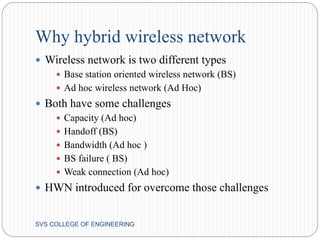
Why hybrid wireless network 
 Wireless network is two different types 
 Base station oriented wireless network (BS) 
 Ad hoc wireless network (Ad Hoc) 
 Both have some challenges 
 Capacity (Ad hoc) 
 Handoff (BS) 
 Bandwidth (Ad hoc ) 
 BS failure ( BS) 
 Weak connection (Ad hoc) 
 HWN introduced for overcome those challenges 
SVS COLLEGE OF ENGINEERING
Advantages 
 More Reliable 
 Better Performance 
 High Scalability 
 Load Balancing 
SVS COLLEGE OF ENGINEERING
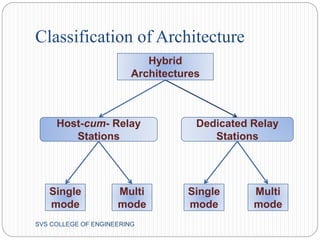
Classification of Architecture 
Hybrid 
Architectures 
Host-cum- Relay 
Stations 
Dedicated Relay 
Stations 
Multi 
mode 
Single 
mode 
Multi 
mode 
Single 
mode 
SVS COLLEGE OF ENGINEERING
Host-cum-relay stations 
 The dedicated relay stations do not originate data traffic on 
their own and assist in forwarding for the sender. 
 Single-Mode Systems 
 MHs operate only multi-hop mode. 
 E.g. Multi hop Cellular Network (MCN) 
 Multi-Mode Systems 
 The mobile hosts act either in single-hop mode or in multi-hop 
mode depending on the architecture. 
 E.g. Directional throughput-enhanced Wireless in Local Loop 
(DWiLL) 
SVS COLLEGE OF ENGINEERING
Dedicated relay stations 
 Dedicated relay stations are used for relaying data 
traffic 
 Single-mode systems 
 E.g. Self-Organizing Packet Radio Ad hoc Network Overlay 
(SOPRANO) 
 Multi-mode systems 
 E.g. integrated Cellular and Ad hoc Relay system (iCAR) 
SVS COLLEGE OF ENGINEERING
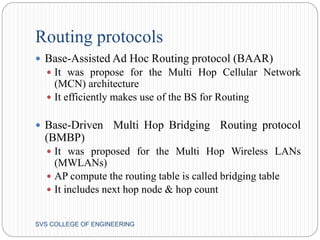
Routing protocols 
 Base-Assisted Ad Hoc Routing protocol (BAAR) 
 It was propose for the Multi Hop Cellular Network 
(MCN) architecture 
 It efficiently makes use of the BS for Routing 
 Base-Driven Multi Hop Bridging Routing protocol 
(BMBP) 
 It was proposed for the Multi Hop Wireless LANs 
(MWLANs) 
 AP compute the routing table is called bridging table 
 It includes next hop node & hop count 
SVS COLLEGE OF ENGINEERING
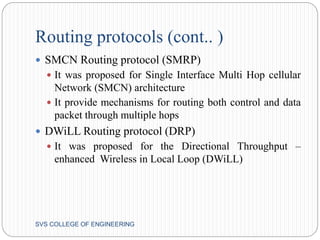
Routing protocols (cont.. ) 
 SMCN Routing protocol (SMRP) 
 It was proposed for Single Interface Multi Hop cellular 
Network (SMCN) architecture 
 It provide mechanisms for routing both control and data 
packet through multiple hops 
 DWiLL Routing protocol (DRP) 
 It was proposed for the Directional Throughput – 
enhanced Wireless in Local Loop (DWiLL) 
SVS COLLEGE OF ENGINEERING
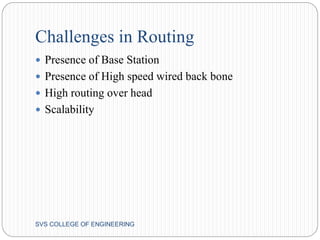
Challenges in Routing 
 Presence of Base Station 
 Presence of High speed wired back bone 
 High routing over head 
 Scalability 
SVS COLLEGE OF ENGINEERING
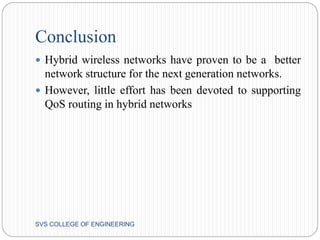
Conclusion 
 Hybrid wireless networks have proven to be a better 
network structure for the next generation networks. 
 However, little effort has been devoted to supporting 
QoS routing in hybrid networks 
SVS COLLEGE OF ENGINEERING
Proposed system 
 Over head 
 Scalability 
SVS COLLEGE OF ENGINEERING
Reference 
 H. Wu and X. Jia, “QoS Multicast Routing by Using 
Multiple Paths/Trees in Wireless Ad Hoc Networks,” 
Ad Hoc Networks, vol. 5, pp. 600-612, 2009. 
 I. Jawhar and J. Wu, “Quality of Service Routing in 
Mobile Ad Hoc Networks,” Network Theory and 
Applications, Springer, 2004. 
 X. Du, “QoS Routing Based on Multi-Class Nodes for 
Mobile Ad Hoc Networks,” Ad Hoc Networks, vol. 2, 
pp. 241-254, 2004. 
SVS COLLEGE OF ENGINEERING

Hybrid wireless network -0th review

  • 1.
    Guide : Presentedby : Mr.K.Muralisankar S.Aakasham 13MCSE01 PG Scholar
  • 2.
    Outline  Introductionof HWN  Why hybrid wireless network  Advantages  Classification of Architecture  Challenges in HWN  Routing protocols  Challenges in Routing  Proposed system  Conclusion  Reference SVS COLLEGE OF ENGINEERING
  • 3.
    Introduction of HWN  Hybrid wireless networks that integrate MANETs and infrastructure wireless networks have proven to be a better network structure for the next generation networks.  It can act Base station and Ad hoc according to the environment conditions SVS COLLEGE OF ENGINEERING
  • 4.
    SVS COLLEGE OFENGINEERING
  • 5.
    Why hybrid wirelessnetwork  Wireless network is two different types  Base station oriented wireless network (BS)  Ad hoc wireless network (Ad Hoc)  Both have some challenges  Capacity (Ad hoc)  Handoff (BS)  Bandwidth (Ad hoc )  BS failure ( BS)  Weak connection (Ad hoc)  HWN introduced for overcome those challenges SVS COLLEGE OF ENGINEERING
  • 6.
    Advantages  MoreReliable  Better Performance  High Scalability  Load Balancing SVS COLLEGE OF ENGINEERING
  • 7.
    Classification of Architecture Hybrid Architectures Host-cum- Relay Stations Dedicated Relay Stations Multi mode Single mode Multi mode Single mode SVS COLLEGE OF ENGINEERING
  • 8.
    Host-cum-relay stations The dedicated relay stations do not originate data traffic on their own and assist in forwarding for the sender.  Single-Mode Systems  MHs operate only multi-hop mode.  E.g. Multi hop Cellular Network (MCN)  Multi-Mode Systems  The mobile hosts act either in single-hop mode or in multi-hop mode depending on the architecture.  E.g. Directional throughput-enhanced Wireless in Local Loop (DWiLL) SVS COLLEGE OF ENGINEERING
  • 9.
    Dedicated relay stations  Dedicated relay stations are used for relaying data traffic  Single-mode systems  E.g. Self-Organizing Packet Radio Ad hoc Network Overlay (SOPRANO)  Multi-mode systems  E.g. integrated Cellular and Ad hoc Relay system (iCAR) SVS COLLEGE OF ENGINEERING
  • 10.
    Routing protocols Base-Assisted Ad Hoc Routing protocol (BAAR)  It was propose for the Multi Hop Cellular Network (MCN) architecture  It efficiently makes use of the BS for Routing  Base-Driven Multi Hop Bridging Routing protocol (BMBP)  It was proposed for the Multi Hop Wireless LANs (MWLANs)  AP compute the routing table is called bridging table  It includes next hop node & hop count SVS COLLEGE OF ENGINEERING
  • 11.
    Routing protocols (cont..)  SMCN Routing protocol (SMRP)  It was proposed for Single Interface Multi Hop cellular Network (SMCN) architecture  It provide mechanisms for routing both control and data packet through multiple hops  DWiLL Routing protocol (DRP)  It was proposed for the Directional Throughput – enhanced Wireless in Local Loop (DWiLL) SVS COLLEGE OF ENGINEERING
  • 12.
    Challenges in Routing  Presence of Base Station  Presence of High speed wired back bone  High routing over head  Scalability SVS COLLEGE OF ENGINEERING
  • 13.
    Conclusion  Hybridwireless networks have proven to be a better network structure for the next generation networks.  However, little effort has been devoted to supporting QoS routing in hybrid networks SVS COLLEGE OF ENGINEERING
  • 14.
    Proposed system Over head  Scalability SVS COLLEGE OF ENGINEERING
  • 15.
    Reference  H.Wu and X. Jia, “QoS Multicast Routing by Using Multiple Paths/Trees in Wireless Ad Hoc Networks,” Ad Hoc Networks, vol. 5, pp. 600-612, 2009.  I. Jawhar and J. Wu, “Quality of Service Routing in Mobile Ad Hoc Networks,” Network Theory and Applications, Springer, 2004.  X. Du, “QoS Routing Based on Multi-Class Nodes for Mobile Ad Hoc Networks,” Ad Hoc Networks, vol. 2, pp. 241-254, 2004. SVS COLLEGE OF ENGINEERING