




“Don’t make me read, make me understand “


www.makemegenius.com– Full of ingredients to make your child a genius.


       Copyright of www.makemegenius.com, for more videos ,visit us.
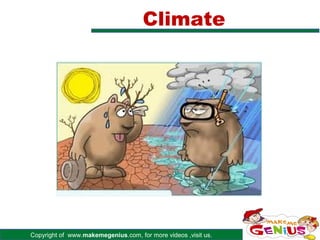
Climate


Copyright of www.makemegenius.com, for more videos ,visit us.
What Causes Climate?

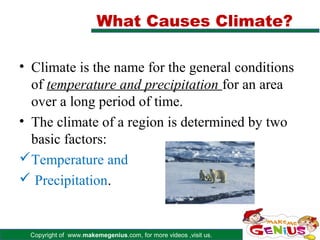
• Climate is the name for the general conditions
  of temperature and precipitation for an area
  over a long period of time.
• The climate of a region is determined by two
  basic factors:
Temperature and
 Precipitation.


 Copyright of www.makemegenius.com, for more videos ,visit us.
Factors that affect Temperature

  There are three natural factors that affect the
       temperature at a particular location.

Latitude,
 Elevation and the
 Presence of ocean currents


 Copyright of www.makemegenius.com, for more videos ,visit us.
Latitude


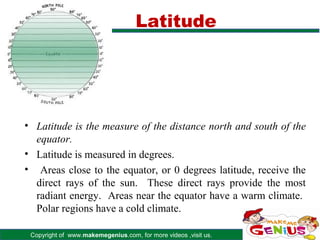
• Latitude is the measure of the distance north and south of the
  equator.
• Latitude is measured in degrees.
• Areas close to the equator, or 0 degrees latitude, receive the
  direct rays of the sun. These direct rays provide the most
  radiant energy. Areas near the equator have a warm climate.
  Polar regions have a cold climate.

 Copyright of www.makemegenius.com, for more videos ,visit us.
Elevation


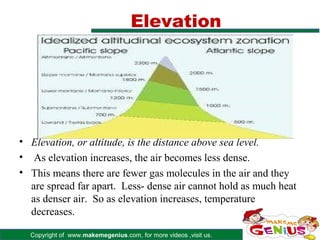
• Elevation, or altitude, is the distance above sea level.
• As elevation increases, the air becomes less dense.
• This means there are fewer gas molecules in the air and they
  are spread far apart. Less- dense air cannot hold as much heat
  as denser air. So as elevation increases, temperature
  decreases.

  Copyright of www.makemegenius.com, for more videos ,visit us.
Location
• Land areas near warm water currents have warm
  temperatures.
• The surface temperature of water affects the temperature of the
  water above it. Warm water warms the air and cold water
  tends to cool it.
• The Gulf Stream is an ocean current that carries warm water
  along the eastern coast of the United States. The California
  Current travels toward the equator carrying cold water along
  the west coast of the United States.


  Copyright of www.makemegenius.com, for more videos ,visit us.
Factors that Affect Precipitation

       The two factors that affect the amount of
       precipitation at a particular location are

Prevailing winds and
 Mountain ranges.


 Copyright of www.makemegenius.com, for more videos ,visit us.
Prevailing Winds


• A wind that blows more often from one direction that from any
  other direction is called a prevailing wind.
• Prevailing winds have a great influence on the climate of
  regions in their path.
• Different prevailing winds carry different amounts of
  moisture. The amount of moisture carried by a prevailing
  wind affects the amount of precipitation a region receives.
  Winds formed by rising warm air tend to bring precipitation.


  Copyright of www.makemegenius.com, for more videos ,visit us.
Direction of Prevailing Winds


• The direction from which a prevailing wind blows
  also affects the amount of moisture it carries.
• Some prevailing winds blow from the water to the
  land (sea breeze).


  Copyright of www.makemegenius.com, for more videos ,visit us.
gi es
                                                                    o lo
                                                               in
                                                             rm
                                                   g te
                                      es
                                        tin                 a te
             in               t er
                                             C l im
          me       ut
       So     a bo
 o   w
N


 Copyright of www.makemegenius.com, for more videos ,visit us.
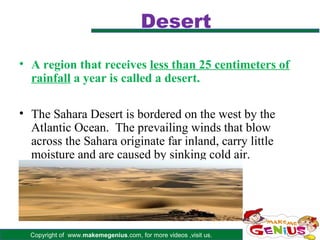
Desert

• A region that receives less than 25 centimeters of
  rainfall a year is called a desert.

• The Sahara Desert is bordered on the west by the
  Atlantic Ocean. The prevailing winds that blow
  across the Sahara originate far inland, carry little
  moisture and are caused by sinking cold air.


  Copyright of www.makemegenius.com, for more videos ,visit us.
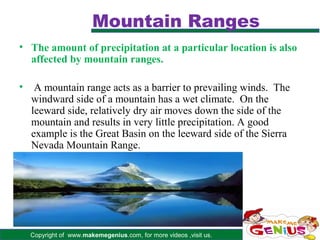
Mountain Ranges
• The amount of precipitation at a particular location is also
  affected by mountain ranges.

•    A mountain range acts as a barrier to prevailing winds. The
    windward side of a mountain has a wet climate. On the
    leeward side, relatively dry air moves down the side of the
    mountain and results in very little precipitation. A good
    example is the Great Basin on the leeward side of the Sierra
    Nevada Mountain Range.


    Copyright of www.makemegenius.com, for more videos ,visit us.
Climate Zones

• The Earth’s climate can be divided into general
  climate zones according to average temperatures.

• Scientist classify localized climates as microclimates.
  The three major climate zones on the Earth are the
 Polar,
 Temperate, and
 Tropical zones.


  Copyright of www.makemegenius.com, for more videos ,visit us.
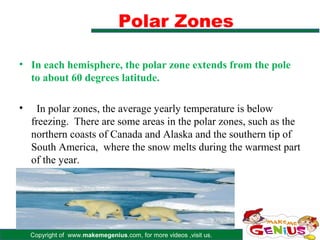
Polar Zones

• In each hemisphere, the polar zone extends from the pole
  to about 60 degrees latitude.

•     In polar zones, the average yearly temperature is below
    freezing. There are some areas in the polar zones, such as the
    northern coasts of Canada and Alaska and the southern tip of
    South America, where the snow melts during the warmest part
    of the year.


    Copyright of www.makemegenius.com, for more videos ,visit us.
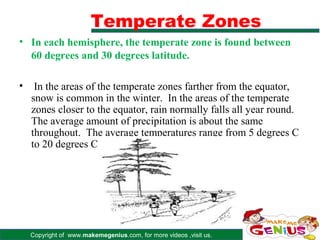
Temperate Zones
• In each hemisphere, the temperate zone is found between
  60 degrees and 30 degrees latitude.

•    In the areas of the temperate zones farther from the equator,
    snow is common in the winter. In the areas of the temperate
    zones closer to the equator, rain normally falls all year round.
    The average amount of precipitation is about the same
    throughout. The average temperatures range from 5 degrees C
    to 20 degrees C.


    Copyright of www.makemegenius.com, for more videos ,visit us.
Deserts in the Temperate Zone

• Deserts in the temperate zones are usually located in land,
  far away from the oceans.

• The winds that blow across these inland deserts carry little
  moisture. Although very hot during the day, temperatures at
  night can drop to below freezing. Inland deserts are found in
  Australia (the Great Sandy Desert) and Central Asia ( the Gobi
  Desert).


  Copyright of www.makemegenius.com, for more videos ,visit us.
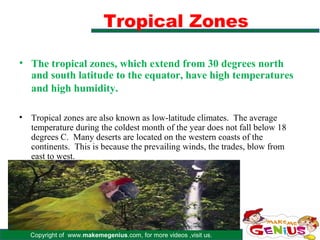
Tropical Zones

• The tropical zones, which extend from 30 degrees north
  and south latitude to the equator, have high temperatures
  and high humidity.

•   Tropical zones are also known as low-latitude climates. The average
    temperature during the coldest month of the year does not fall below 18
    degrees C. Many deserts are located on the western coasts of the
    continents. This is because the prevailing winds, the trades, blow from
    east to west.


    Copyright of www.makemegenius.com, for more videos ,visit us.
Changes in Climate

• The three natural factors responsible for climate changes are
  the slow drifting of the continents, changes in the sun’s energy
  output and variations in the position of the Earth relative to the
  sun. These natural factors are not related to human activity.
  The results of the human activity of the burning of fossil fuels
  may also lead to changes in climate.


  Copyright of www.makemegenius.com, for more videos ,visit us.
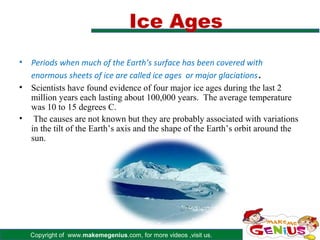
Ice Ages
•   Periods when much of the Earth’s surface has been covered with
    enormous sheets of ice are called ice ages or major glaciations .
•   Scientists have found evidence of four major ice ages during the last 2
    million years each lasting about 100,000 years. The average temperature
    was 10 to 15 degrees C.
•    The causes are not known but they are probably associated with variations
    in the tilt of the Earth’s axis and the shape of the Earth’s orbit around the
    sun.


    Copyright of www.makemegenius.com, for more videos ,visit us.
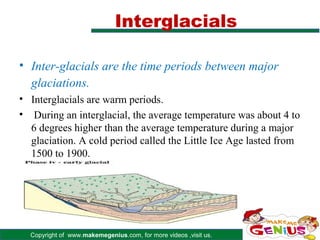
Interglacials

• Inter-glacials are the time periods between major
  glaciations.
• Interglacials are warm periods.
• During an interglacial, the average temperature was about 4 to
  6 degrees higher than the average temperature during a major
  glaciation. A cold period called the Little Ice Age lasted from
  1500 to 1900.


  Copyright of www.makemegenius.com, for more videos ,visit us.
Drifting Continents

• About 230 million years ago, all the Earth’s landmasses were
  joined in one super continent, Pangaea. The slow drifting
  apart of the continents caused dramatic changes. As the
  continents moved toward their present-day locations, the sea
  level dropped, volcanoes erupted, and much of the Earth’s
  surface was pushed upward. The combined effect was a drop
  in temperature and precipitation all over the Earth. These
  changes were gradual.


  Copyright of www.makemegenius.com, for more videos ,visit us.
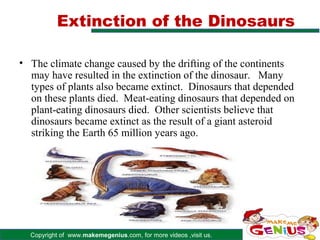
Extinction of the Dinosaurs

• The climate change caused by the drifting of the continents
  may have resulted in the extinction of the dinosaur. Many
  types of plants also became extinct. Dinosaurs that depended
  on these plants died. Meat-eating dinosaurs that depended on
  plant-eating dinosaurs died. Other scientists believe that
  dinosaurs became extinct as the result of a giant asteroid
  striking the Earth 65 million years ago.


  Copyright of www.makemegenius.com, for more videos ,visit us.
Variations in Radiant Energy

• Many scientists have tried to relate changes in the Earth’s
  climate to changes in the sun’s energy output. During periods
  of high energy output, the Earth’s temperature would rise.
  The temperature would drop during periods of low energy
  output. No evidence has been found to support this theory.


  Copyright of www.makemegenius.com, for more videos ,visit us.
Global Warming

• IN the mid-nineteenth century industrialization led to the
  increased burning of fossil fuels, including coal, oil and
  natural gas. Then these fuels are burned they release carbon
  dioxide that traps heat. As a result, the atmosphere becomes
  warmer. Meteorologists found that temperatures in the 1990’s
  were the highest in more than 100 years.


  Copyright of www.makemegenius.com, for more videos ,visit us.
Thanks
                                                                  Submitted by
                                                                     Nishi
                                                                DPS Public School


Copyright of www.makemegenius.com, for more videos ,visit us.
If you also want to share your own or your kid’s
       presentation(ppt) please send it on
info@makemegenius.com


Copyright of www.makemegenius.com, for more videos ,visit us.
“Don’t make me read, make me understand “


www.makemegenius.com– Full of ingredients to make your child a genius.


       Copyright of www.makemegenius.com, for more videos ,visit us.

Climate

  • 1.
    “Don’t make meread, make me understand “ www.makemegenius.com– Full of ingredients to make your child a genius. Copyright of www.makemegenius.com, for more videos ,visit us.
  • 2.
  • 3.
    What Causes Climate? •Climate is the name for the general conditions of temperature and precipitation for an area over a long period of time. • The climate of a region is determined by two basic factors: Temperature and  Precipitation. Copyright of www.makemegenius.com, for more videos ,visit us.
  • 4.
    Factors that affectTemperature There are three natural factors that affect the temperature at a particular location. Latitude,  Elevation and the  Presence of ocean currents Copyright of www.makemegenius.com, for more videos ,visit us.
  • 5.
    Latitude • Latitude isthe measure of the distance north and south of the equator. • Latitude is measured in degrees. • Areas close to the equator, or 0 degrees latitude, receive the direct rays of the sun. These direct rays provide the most radiant energy. Areas near the equator have a warm climate. Polar regions have a cold climate. Copyright of www.makemegenius.com, for more videos ,visit us.
  • 6.
    Elevation • Elevation, oraltitude, is the distance above sea level. • As elevation increases, the air becomes less dense. • This means there are fewer gas molecules in the air and they are spread far apart. Less- dense air cannot hold as much heat as denser air. So as elevation increases, temperature decreases. Copyright of www.makemegenius.com, for more videos ,visit us.
  • 7.
    Location • Land areasnear warm water currents have warm temperatures. • The surface temperature of water affects the temperature of the water above it. Warm water warms the air and cold water tends to cool it. • The Gulf Stream is an ocean current that carries warm water along the eastern coast of the United States. The California Current travels toward the equator carrying cold water along the west coast of the United States. Copyright of www.makemegenius.com, for more videos ,visit us.
  • 8.
    Factors that AffectPrecipitation The two factors that affect the amount of precipitation at a particular location are Prevailing winds and  Mountain ranges. Copyright of www.makemegenius.com, for more videos ,visit us.
  • 9.
    Prevailing Winds • Awind that blows more often from one direction that from any other direction is called a prevailing wind. • Prevailing winds have a great influence on the climate of regions in their path. • Different prevailing winds carry different amounts of moisture. The amount of moisture carried by a prevailing wind affects the amount of precipitation a region receives. Winds formed by rising warm air tend to bring precipitation. Copyright of www.makemegenius.com, for more videos ,visit us.
  • 10.
    Direction of PrevailingWinds • The direction from which a prevailing wind blows also affects the amount of moisture it carries. • Some prevailing winds blow from the water to the land (sea breeze). Copyright of www.makemegenius.com, for more videos ,visit us.
  • 11.
    gi es o lo in rm g te es tin a te in t er C l im me ut So a bo o w N Copyright of www.makemegenius.com, for more videos ,visit us.
  • 12.
    Desert • A regionthat receives less than 25 centimeters of rainfall a year is called a desert. • The Sahara Desert is bordered on the west by the Atlantic Ocean. The prevailing winds that blow across the Sahara originate far inland, carry little moisture and are caused by sinking cold air. Copyright of www.makemegenius.com, for more videos ,visit us.
  • 13.
    Mountain Ranges • Theamount of precipitation at a particular location is also affected by mountain ranges. • A mountain range acts as a barrier to prevailing winds. The windward side of a mountain has a wet climate. On the leeward side, relatively dry air moves down the side of the mountain and results in very little precipitation. A good example is the Great Basin on the leeward side of the Sierra Nevada Mountain Range. Copyright of www.makemegenius.com, for more videos ,visit us.
  • 14.
    Climate Zones • TheEarth’s climate can be divided into general climate zones according to average temperatures. • Scientist classify localized climates as microclimates. The three major climate zones on the Earth are the  Polar,  Temperate, and  Tropical zones. Copyright of www.makemegenius.com, for more videos ,visit us.
  • 15.
    Polar Zones • Ineach hemisphere, the polar zone extends from the pole to about 60 degrees latitude. • In polar zones, the average yearly temperature is below freezing. There are some areas in the polar zones, such as the northern coasts of Canada and Alaska and the southern tip of South America, where the snow melts during the warmest part of the year. Copyright of www.makemegenius.com, for more videos ,visit us.
  • 16.
    Temperate Zones • Ineach hemisphere, the temperate zone is found between 60 degrees and 30 degrees latitude. • In the areas of the temperate zones farther from the equator, snow is common in the winter. In the areas of the temperate zones closer to the equator, rain normally falls all year round. The average amount of precipitation is about the same throughout. The average temperatures range from 5 degrees C to 20 degrees C. Copyright of www.makemegenius.com, for more videos ,visit us.
  • 17.
    Deserts in theTemperate Zone • Deserts in the temperate zones are usually located in land, far away from the oceans. • The winds that blow across these inland deserts carry little moisture. Although very hot during the day, temperatures at night can drop to below freezing. Inland deserts are found in Australia (the Great Sandy Desert) and Central Asia ( the Gobi Desert). Copyright of www.makemegenius.com, for more videos ,visit us.
  • 18.
    Tropical Zones • Thetropical zones, which extend from 30 degrees north and south latitude to the equator, have high temperatures and high humidity. • Tropical zones are also known as low-latitude climates. The average temperature during the coldest month of the year does not fall below 18 degrees C. Many deserts are located on the western coasts of the continents. This is because the prevailing winds, the trades, blow from east to west. Copyright of www.makemegenius.com, for more videos ,visit us.
  • 19.
    Changes in Climate •The three natural factors responsible for climate changes are the slow drifting of the continents, changes in the sun’s energy output and variations in the position of the Earth relative to the sun. These natural factors are not related to human activity. The results of the human activity of the burning of fossil fuels may also lead to changes in climate. Copyright of www.makemegenius.com, for more videos ,visit us.
  • 20.
    Ice Ages • Periods when much of the Earth’s surface has been covered with enormous sheets of ice are called ice ages or major glaciations . • Scientists have found evidence of four major ice ages during the last 2 million years each lasting about 100,000 years. The average temperature was 10 to 15 degrees C. • The causes are not known but they are probably associated with variations in the tilt of the Earth’s axis and the shape of the Earth’s orbit around the sun. Copyright of www.makemegenius.com, for more videos ,visit us.
  • 21.
    Interglacials • Inter-glacials arethe time periods between major glaciations. • Interglacials are warm periods. • During an interglacial, the average temperature was about 4 to 6 degrees higher than the average temperature during a major glaciation. A cold period called the Little Ice Age lasted from 1500 to 1900. Copyright of www.makemegenius.com, for more videos ,visit us.
  • 22.
    Drifting Continents • About230 million years ago, all the Earth’s landmasses were joined in one super continent, Pangaea. The slow drifting apart of the continents caused dramatic changes. As the continents moved toward their present-day locations, the sea level dropped, volcanoes erupted, and much of the Earth’s surface was pushed upward. The combined effect was a drop in temperature and precipitation all over the Earth. These changes were gradual. Copyright of www.makemegenius.com, for more videos ,visit us.
  • 23.
    Extinction of theDinosaurs • The climate change caused by the drifting of the continents may have resulted in the extinction of the dinosaur. Many types of plants also became extinct. Dinosaurs that depended on these plants died. Meat-eating dinosaurs that depended on plant-eating dinosaurs died. Other scientists believe that dinosaurs became extinct as the result of a giant asteroid striking the Earth 65 million years ago. Copyright of www.makemegenius.com, for more videos ,visit us.
  • 24.
    Variations in RadiantEnergy • Many scientists have tried to relate changes in the Earth’s climate to changes in the sun’s energy output. During periods of high energy output, the Earth’s temperature would rise. The temperature would drop during periods of low energy output. No evidence has been found to support this theory. Copyright of www.makemegenius.com, for more videos ,visit us.
  • 25.
    Global Warming • INthe mid-nineteenth century industrialization led to the increased burning of fossil fuels, including coal, oil and natural gas. Then these fuels are burned they release carbon dioxide that traps heat. As a result, the atmosphere becomes warmer. Meteorologists found that temperatures in the 1990’s were the highest in more than 100 years. Copyright of www.makemegenius.com, for more videos ,visit us.
  • 26.
    Thanks Submitted by Nishi DPS Public School Copyright of www.makemegenius.com, for more videos ,visit us.
  • 27.
    If you alsowant to share your own or your kid’s presentation(ppt) please send it on info@makemegenius.com Copyright of www.makemegenius.com, for more videos ,visit us.
  • 28.
    “Don’t make meread, make me understand “ www.makemegenius.com– Full of ingredients to make your child a genius. Copyright of www.makemegenius.com, for more videos ,visit us.