

Jeff Hawkins NAISys 2020: How the Brain Uses Reference Frames, Why AI Needs to do the Same
The document discusses how the neocortex models the world through distributed sensory-motor systems using reference frames, which are crucial for understanding human intelligence and its implications for AI. It highlights the similarities between cortical columns and AI structures, emphasizing the need for AI to adopt similar principles of learning and knowledge representation. The author's research proposes frameworks to enhance AI performance using concepts derived from biological intelligence.
Jeff Hawkins NAISys 2020: How the Brain Uses Reference Frames, Why AI Needs to do the Same
1.
How the BrainUses Reference Frames to Model the World
Why AI Needs to do the Same
JEFF HAWKINS
NAISYS 2020
2.
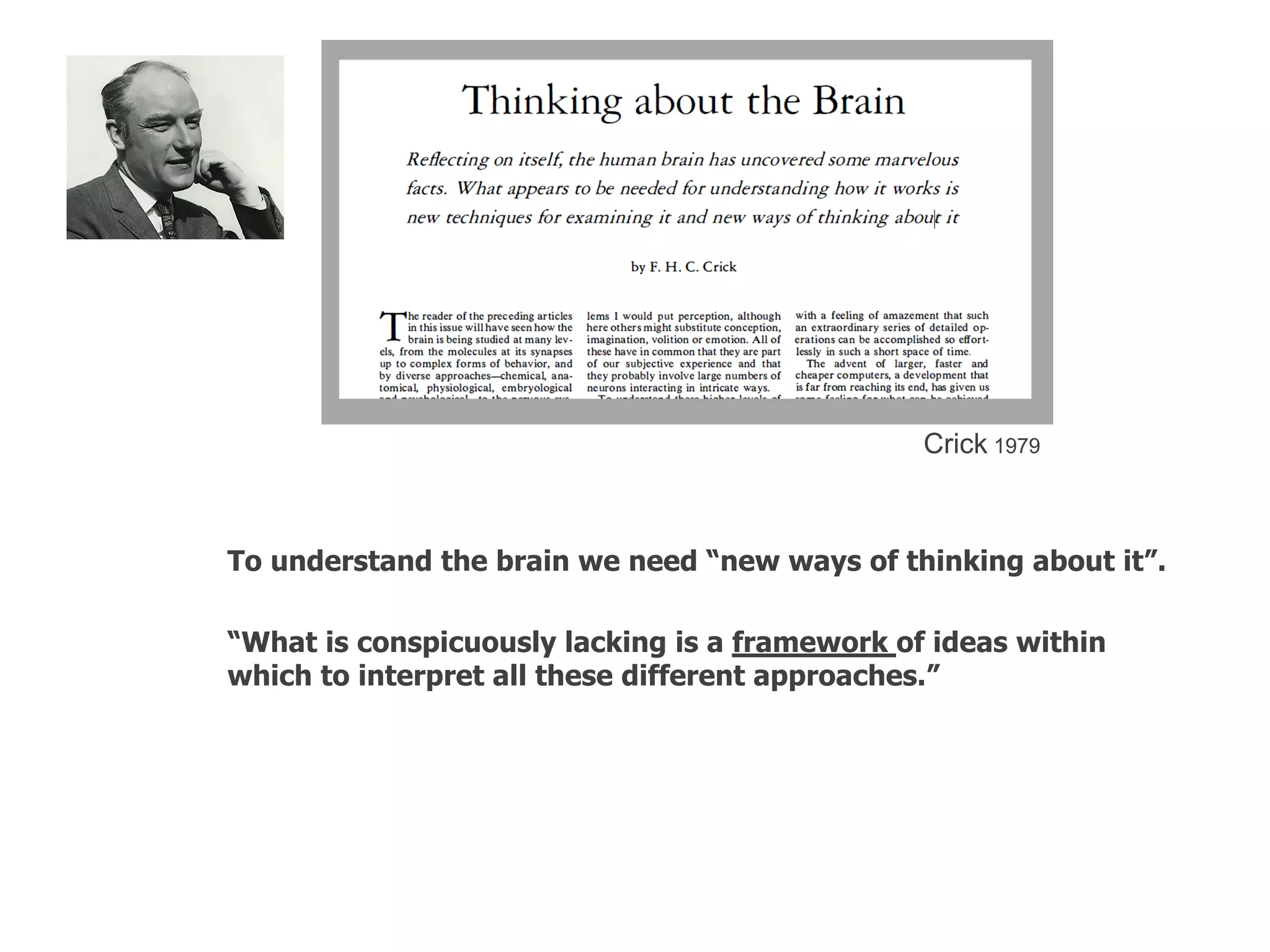
To understand thebrain we need “new ways of thinking about it”.
“What is conspicuously lacking is a framework of ideas within
which to interpret all these different approaches.”
Crick 1979
3.
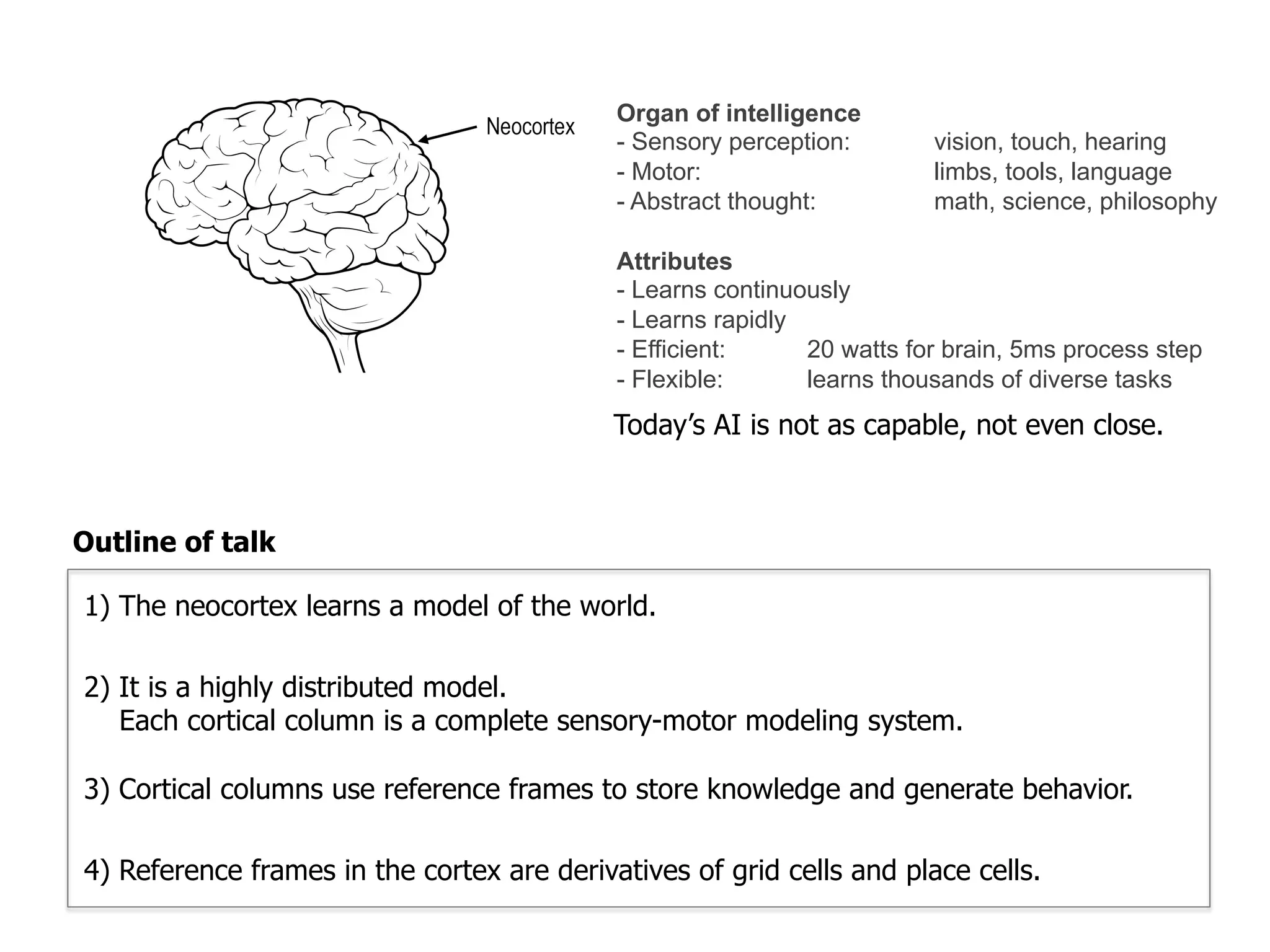
Organ of intelligence
-Sensory perception: vision, touch, hearing
- Motor: limbs, tools, language
- Abstract thought: math, science, philosophy
Attributes
- Learns continuously
- Learns rapidly
- Efficient: 20 watts for brain, 5ms process step
- Flexible: learns thousands of diverse tasks
1) The neocortex learns a model of the world.
2) It is a highly distributed model.
Each cortical column is a complete sensory-motor modeling system.
3) Cortical columns use reference frames to store knowledge and generate behavior.
4) Reference frames in the cortex are derivatives of grid cells and place cells.
Today’s AI is not as capable, not even close.
Outline of talk
4.
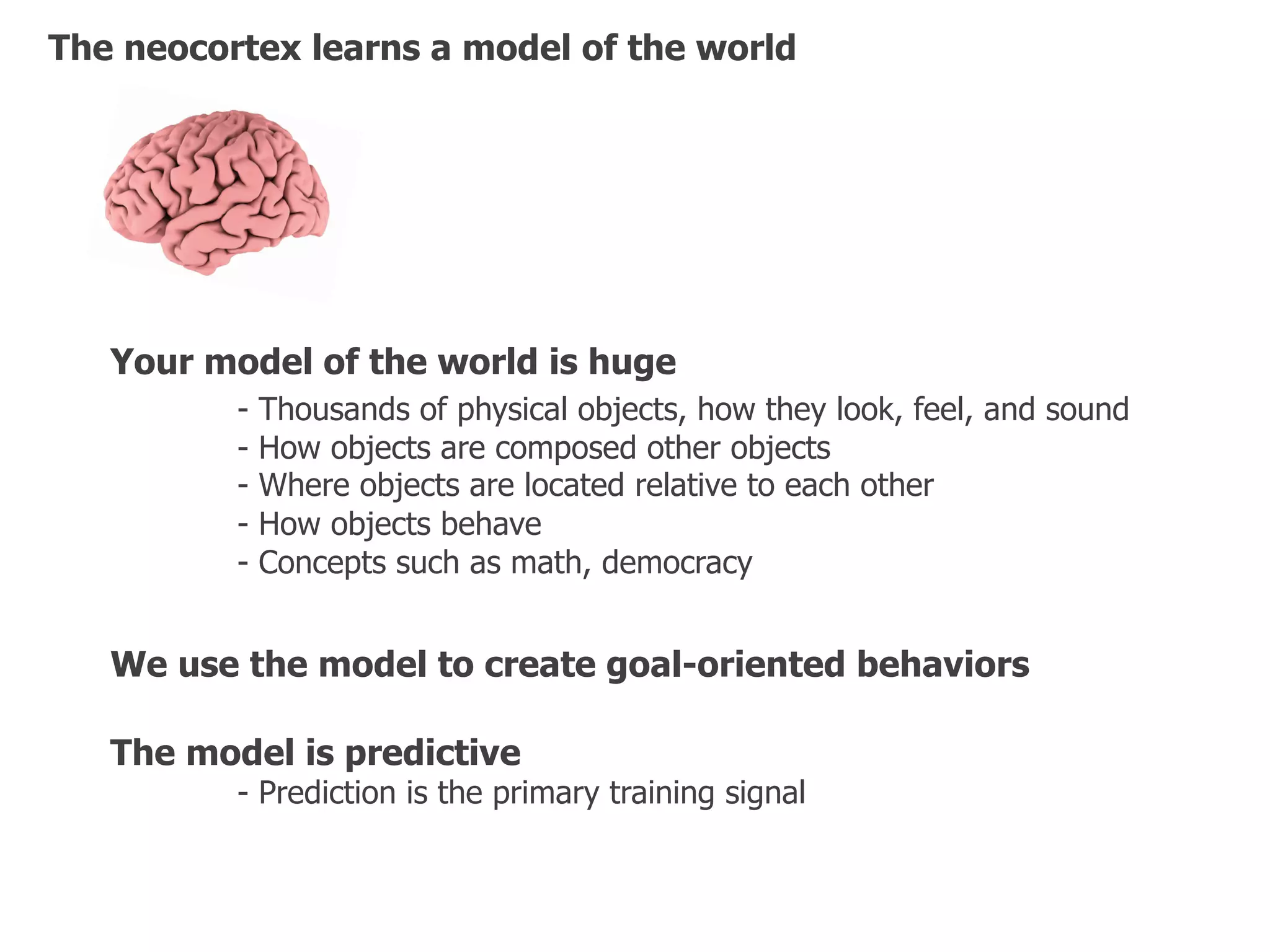
The neocortex learnsa model of the world
Your model of the world is huge
- Thousands of physical objects, how they look, feel, and sound
- How objects are composed other objects
- Where objects are located relative to each other
- How objects behave
- Concepts such as math, democracy
We use the model to create goal-oriented behaviors
The model is predictive
- Prediction is the primary training signal
5.
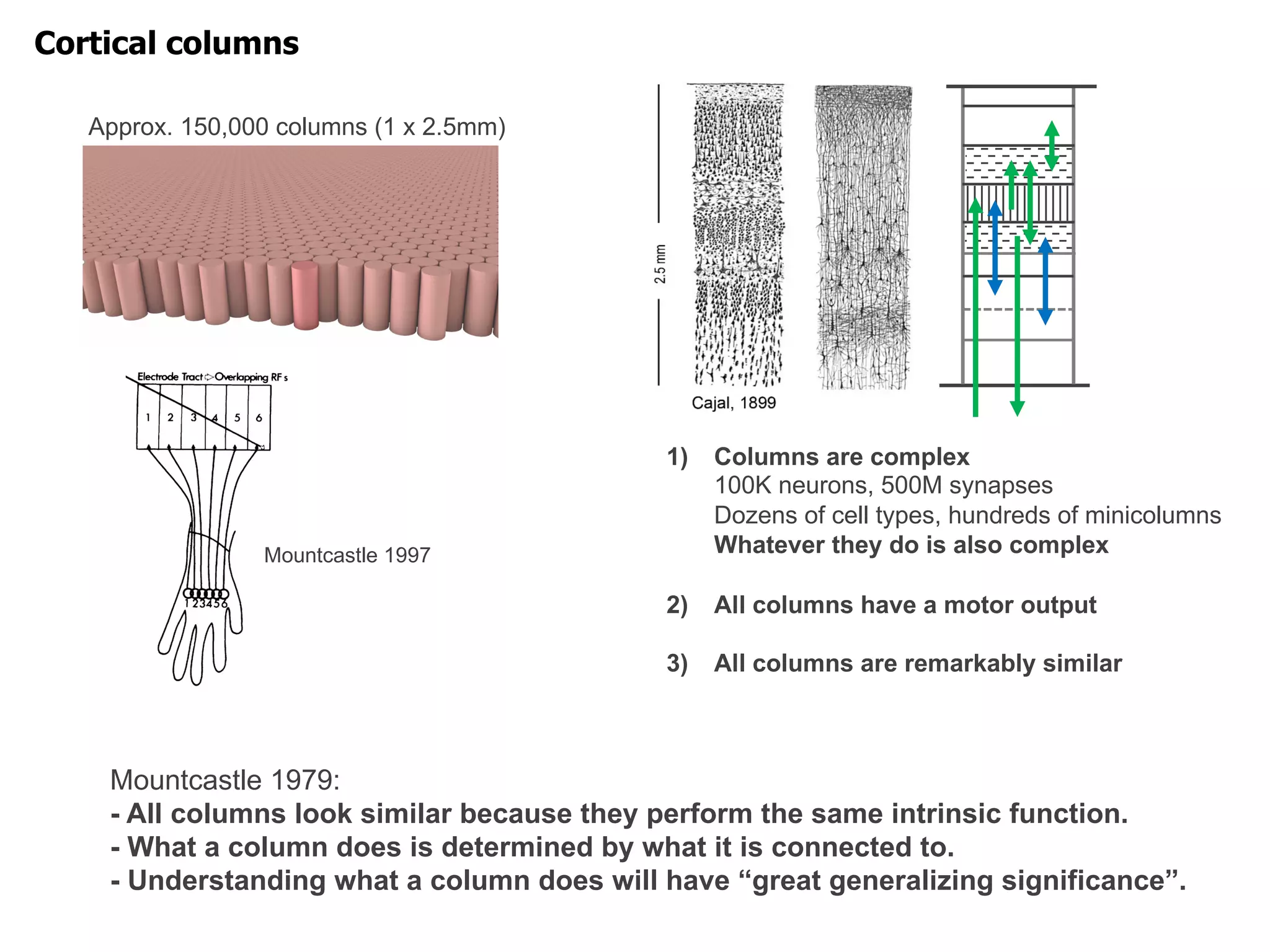
Cortical columns
Approx. 150,000columns (1 x 2.5mm)
Mountcastle 1979:
- All columns look similar because they perform the same intrinsic function.
- What a column does is determined by what it is connected to.
- Understanding what a column does will have “great generalizing significance”.
1) Columns are complex
100K neurons, 500M synapses
Dozens of cell types, hundreds of minicolumns
Whatever they do is also complex
2) All columns have a motor output
3) All columns are remarkably similar
Mountcastle 1997
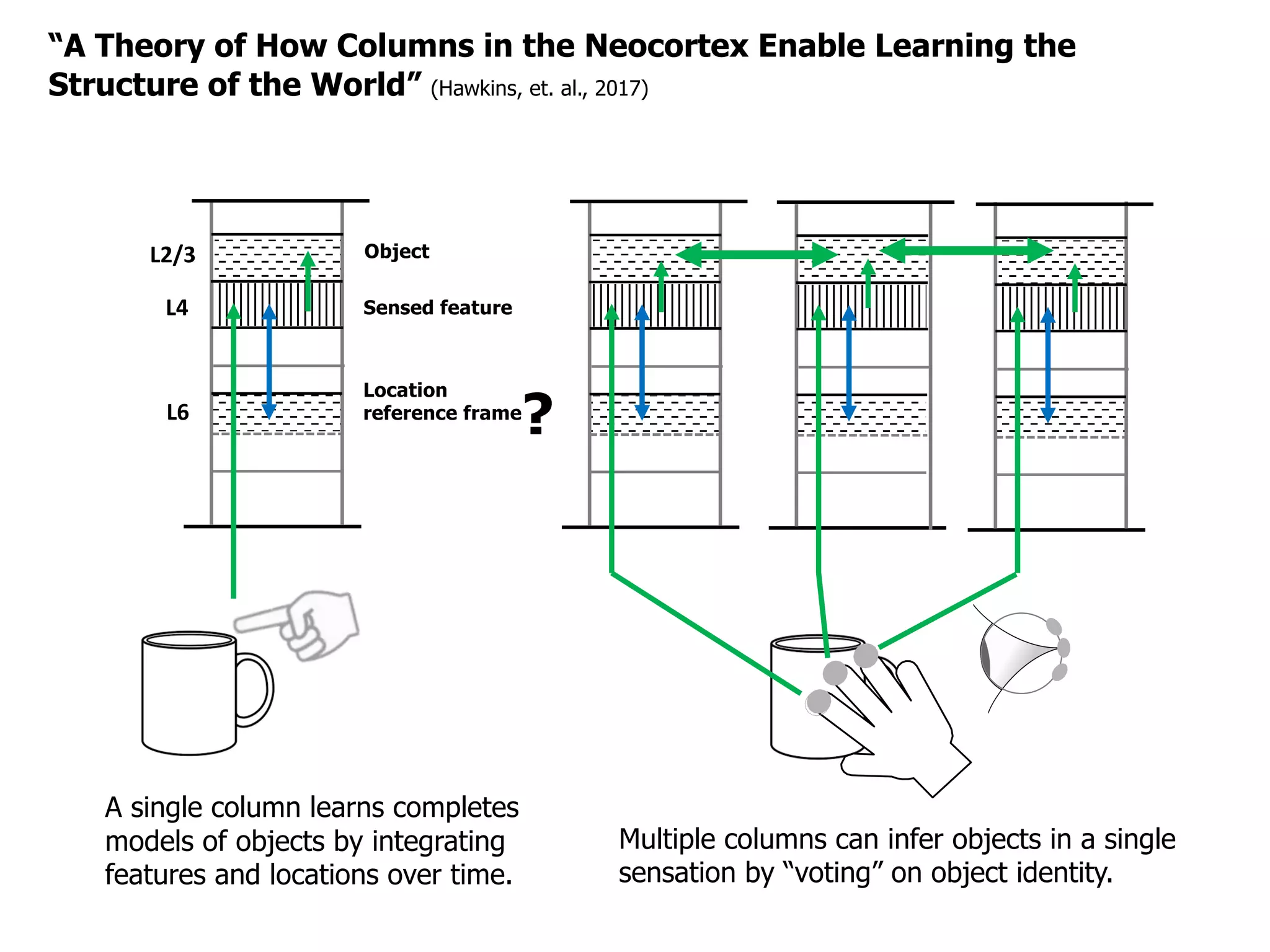
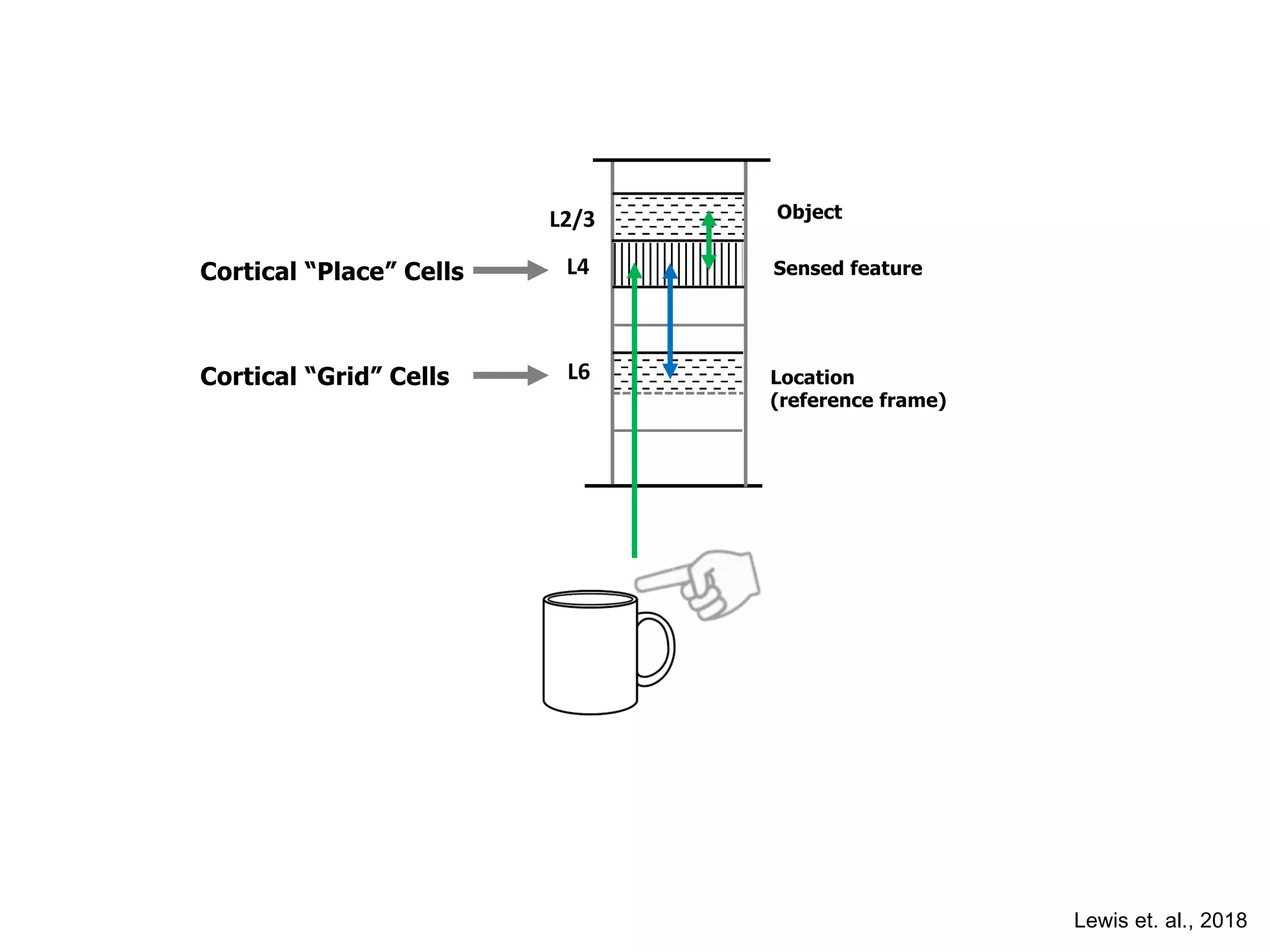
L2/3
L4
L6
Location
reference frame
Object
A singlecolumn learns completes
models of objects by integrating
features and locations over time.
“A Theory of How Columns in the Neocortex Enable Learning the
Structure of the World” (Hawkins, et. al., 2017)
Multiple columns can infer objects in a single
sensation by “voting” on object identity.
?
Sensed feature
8.
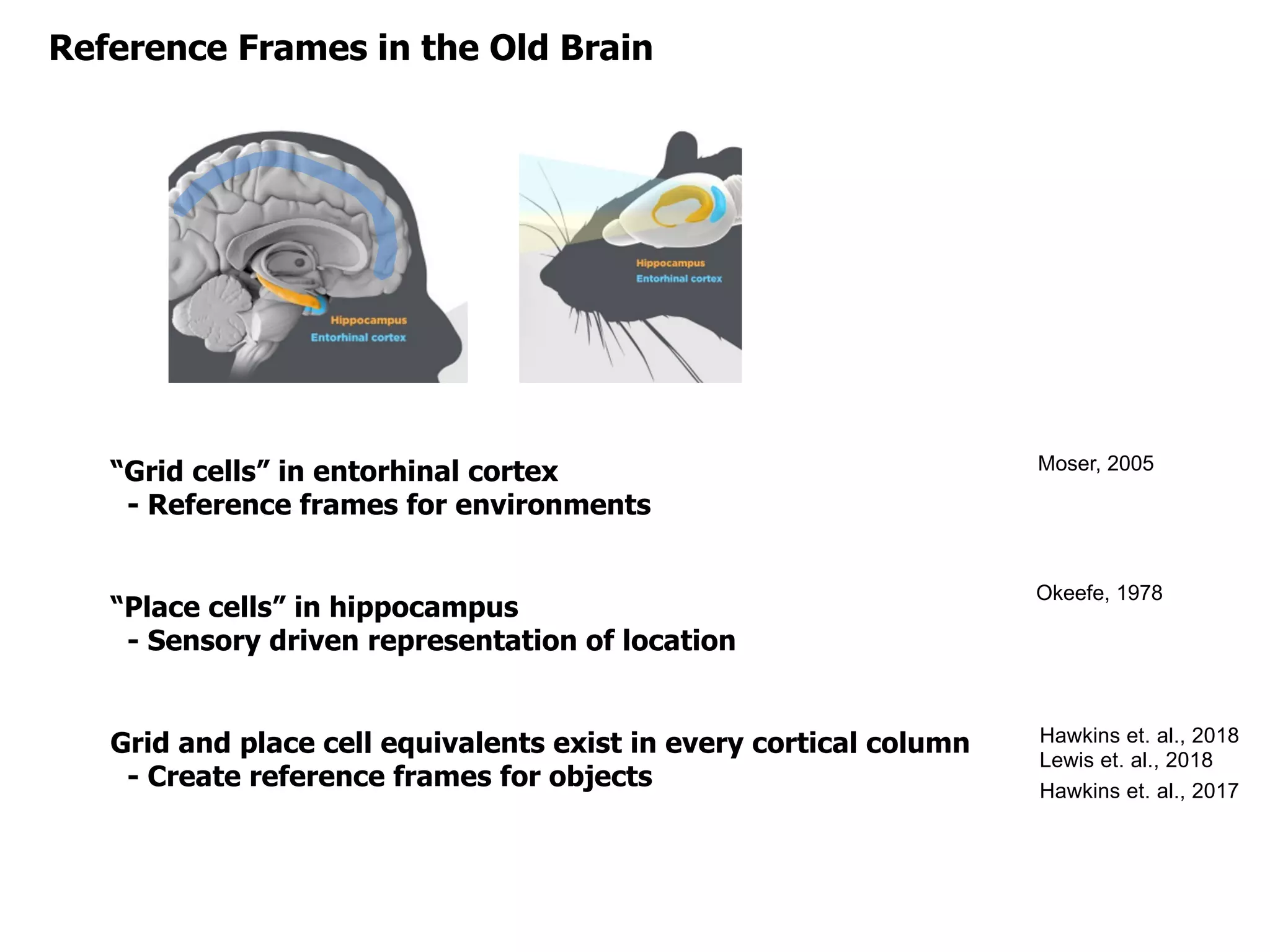
Reference Frames inthe Old Brain
“Grid cells” in entorhinal cortex
- Reference frames for environments
“Place cells” in hippocampus
- Sensory driven representation of location
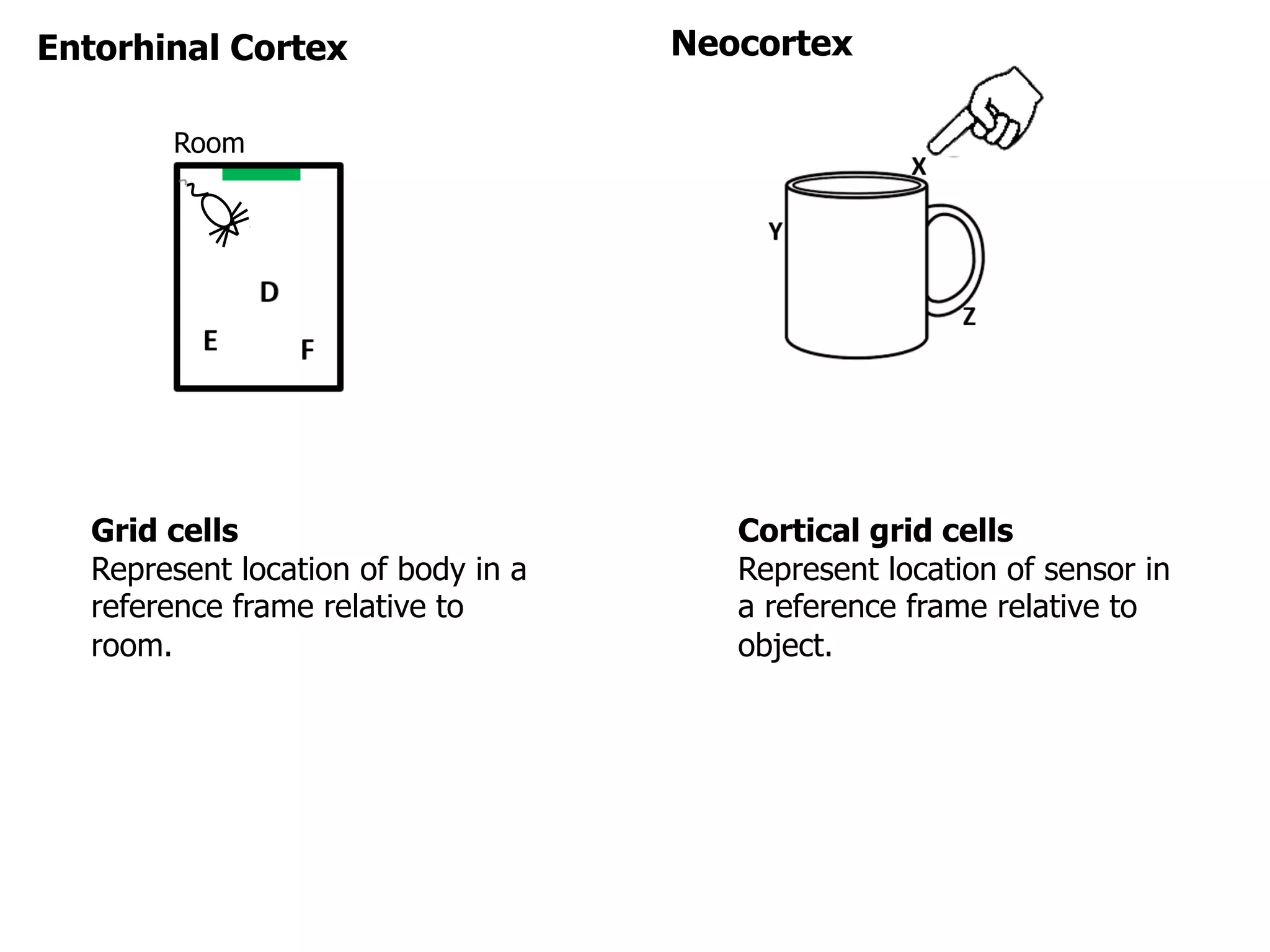
Grid and place cell equivalents exist in every cortical column
- Create reference frames for objects
Moser, 2005
Hawkins et. al., 2018
Lewis et. al., 2018
Hawkins et. al., 2017
Okeefe, 1978
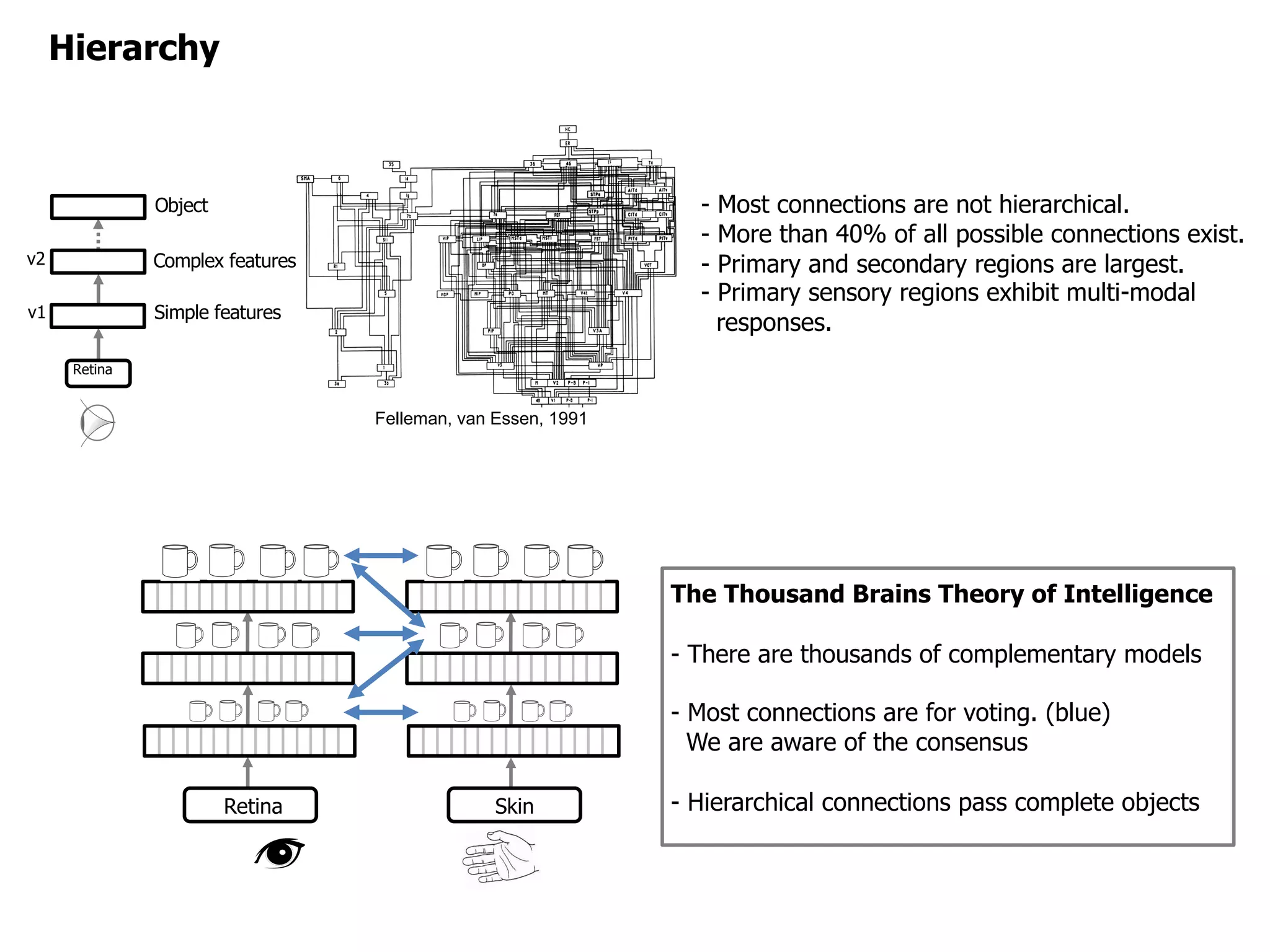
Felleman, van Essen,1991
Retina
Simple features
Complex features
Object
v1
v2
Hierarchy
- Most connections are not hierarchical.
- More than 40% of all possible connections exist.
- Primary and secondary regions are largest.
- Primary sensory regions exhibit multi-modal
responses.
Retina Skin
The Thousand Brains Theory of Intelligence
- There are thousands of complementary models
- Most connections are for voting. (blue)
We are aware of the consensus
- Hierarchical connections pass complete objects
12.
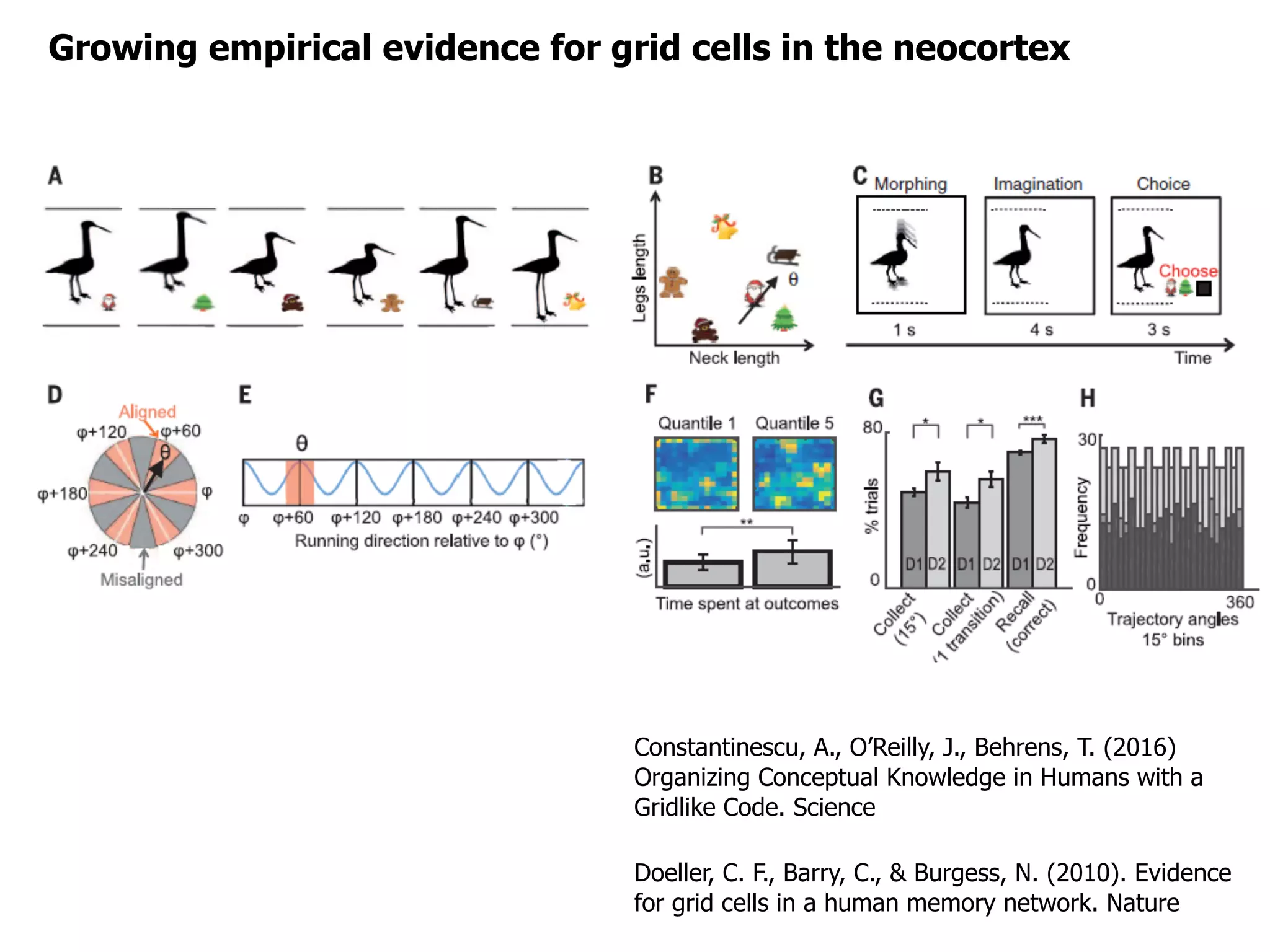
Doeller, C. F.,Barry, C., & Burgess, N. (2010). Evidence
for grid cells in a human memory network. Nature
Growing empirical evidence for grid cells in the neocortex
Constantinescu, A., O’Reilly, J., Behrens, T. (2016)
Organizing Conceptual Knowledge in Humans with a
Gridlike Code. Science
13.
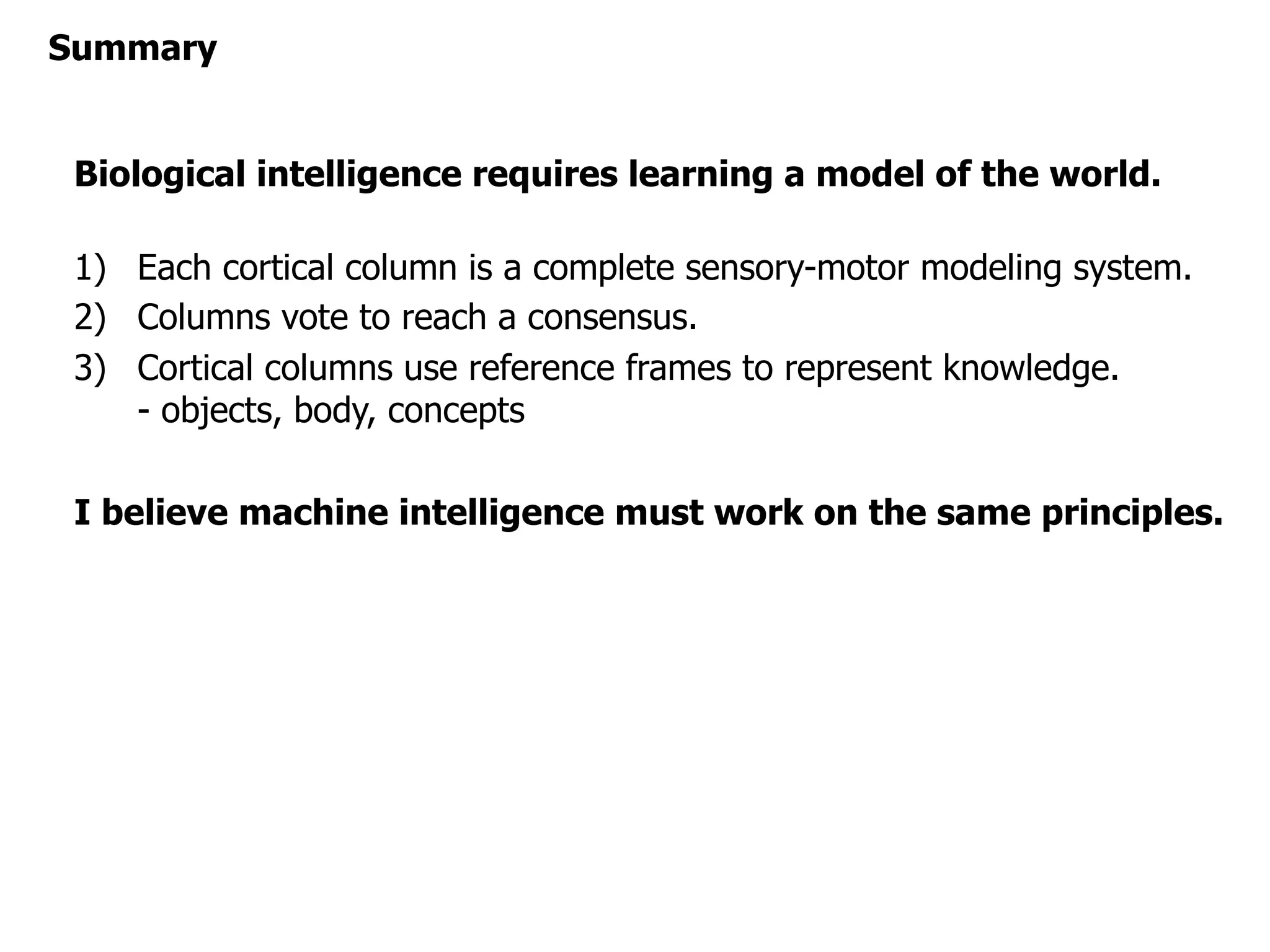
Biological intelligence requireslearning a model of the world.
1) Each cortical column is a complete sensory-motor modeling system.
2) Columns vote to reach a consensus.
3) Cortical columns use reference frames to represent knowledge.
- objects, body, concepts
I believe machine intelligence must work on the same principles.
Summary
14.
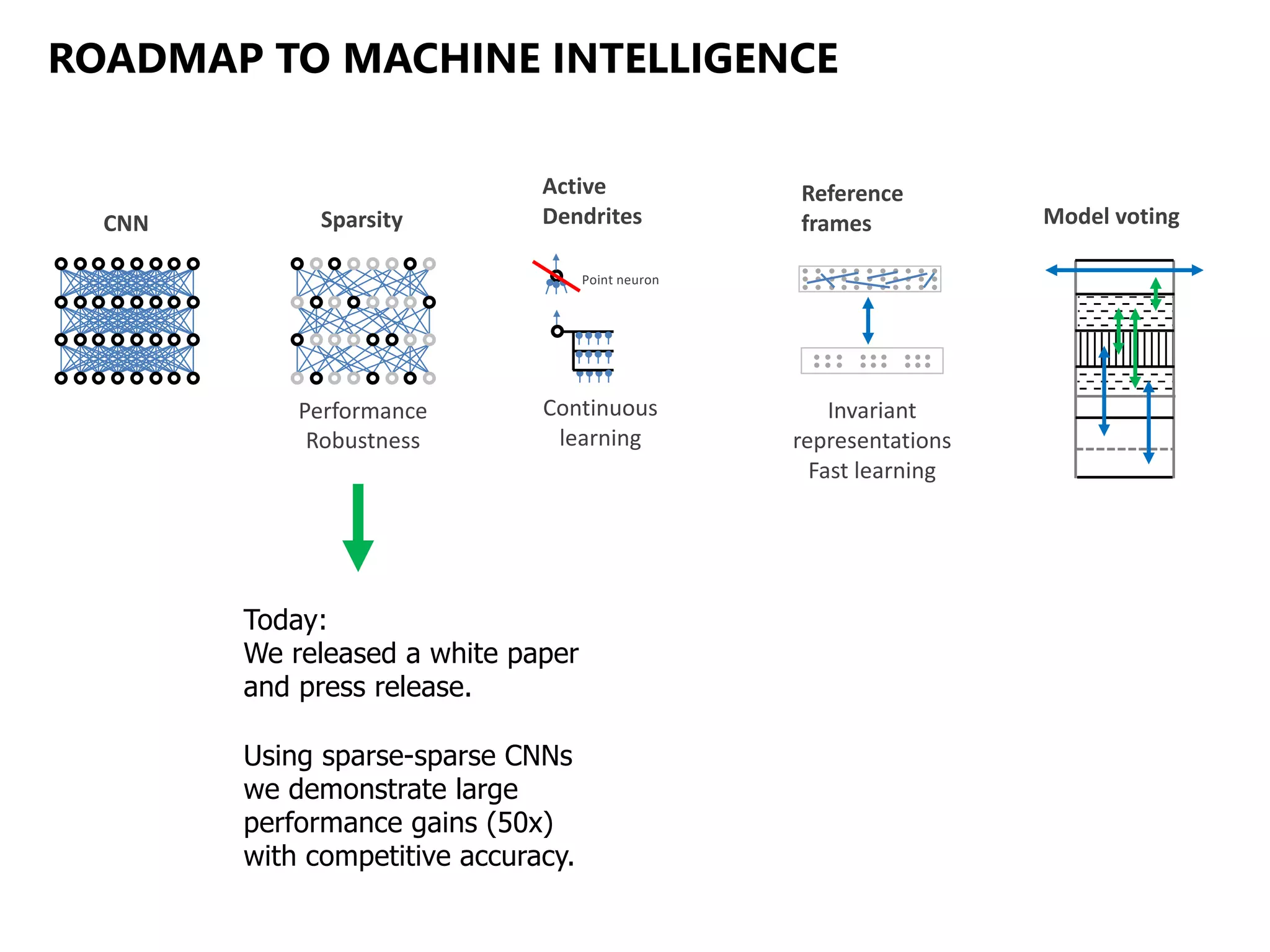
ROADMAP TO MACHINEINTELLIGENCE
Performance
Robustness
Point neuron
Continuous
learning
CNN
Invariant
representations
Fast learning
Sparsity
Active
Dendrites
Reference
frames Model voting
Today:
We released a white paper
and press release.
Using sparse-sparse CNNs
we demonstrate large
performance gains (50x)
with competitive accuracy.
15.
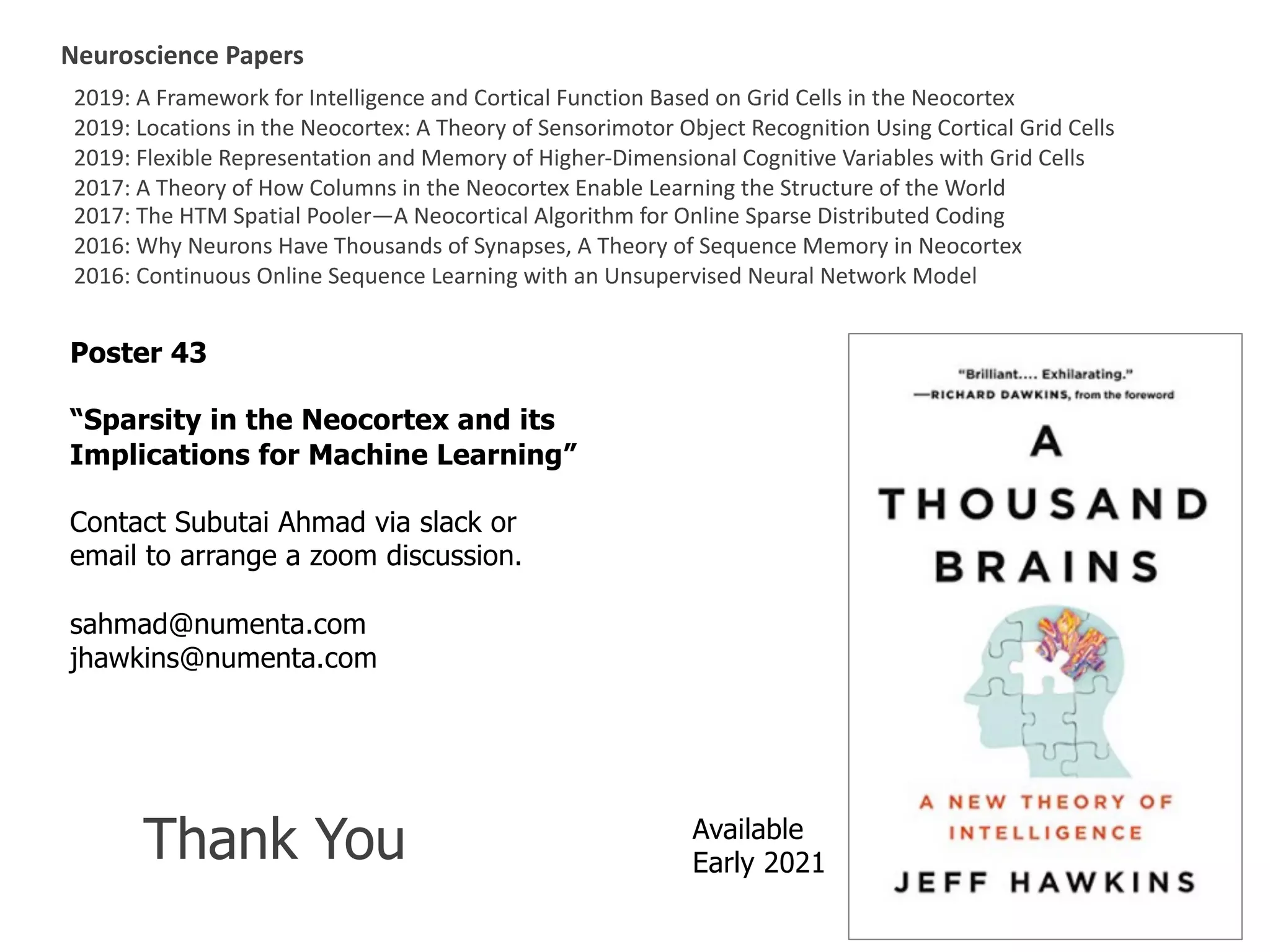
2019: A Frameworkfor Intelligence and Cortical Function Based on Grid Cells in the Neocortex
2019: Locations in the Neocortex: A Theory of Sensorimotor Object Recognition Using Cortical Grid Cells
2019: Flexible Representation and Memory of Higher-Dimensional Cognitive Variables with Grid Cells
2017: A Theory of How Columns in the Neocortex Enable Learning the Structure of the World
2017: The HTM Spatial Pooler—A Neocortical Algorithm for Online Sparse Distributed Coding
2016: Why Neurons Have Thousands of Synapses, A Theory of Sequence Memory in Neocortex
2016: Continuous Online Sequence Learning with an Unsupervised Neural Network Model
Neuroscience Papers
Poster 43
“Sparsity in the Neocortex and its
Implications for Machine Learning”
Contact Subutai Ahmad via slack or
email to arrange a zoom discussion.
sahmad@numenta.com
jhawkins@numenta.com
Available
Early 2021Thank You