Analyis of EEG and MEG data
for building dynamic functional
connectome.
Alexei Ossadtchi, Ph.D.
Higher School of Economics
St. Petersburg State University
Broadmann brain areas
Economo, C. von, Koskinas, G.N. (1925) Die Cytoarchitektonik der Hirnrinde des erwachsenen Menschen. Julius
Springer, Vienna
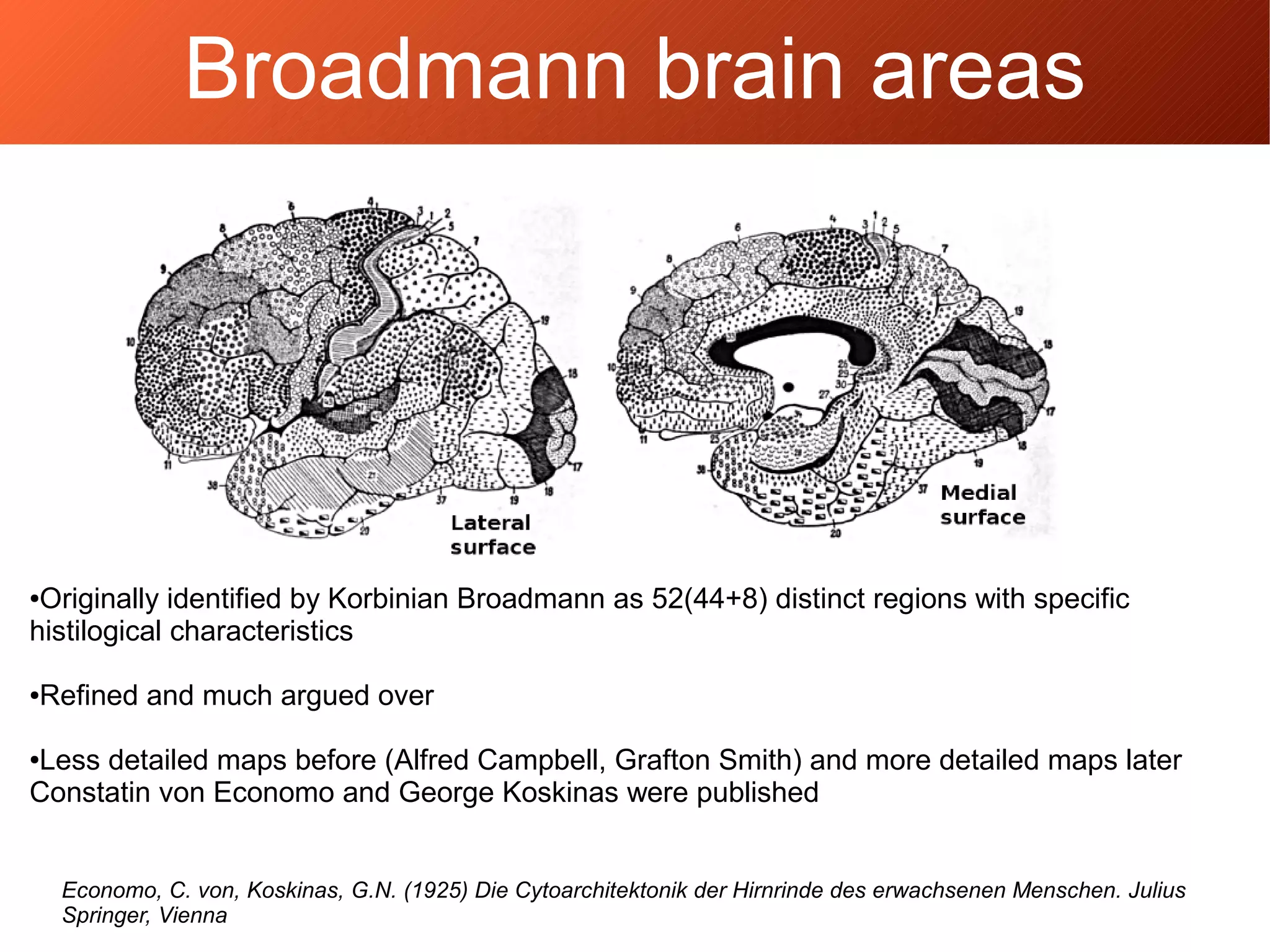
●Originally identified by Korbinian Broadmann as 52(44+8) distinct regions with specific
histilogical characteristics
●Refined and much argued over
●Less detailed maps before (Alfred Campbell, Grafton Smith) and more detailed maps later
Constatin von Economo and George Koskinas were published
Broadmann brain areas
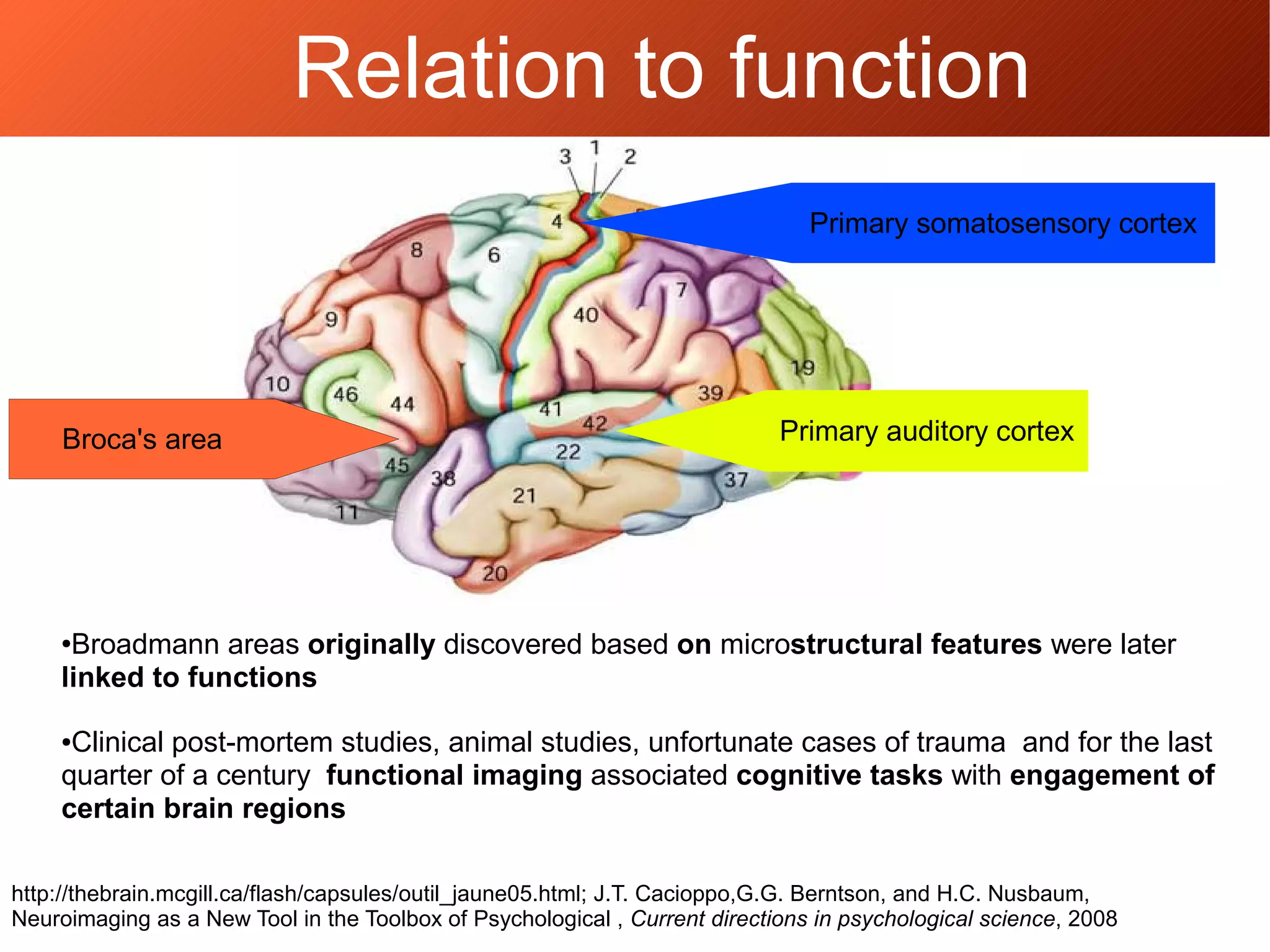
●Broadmann areas originally discovered based on microstructural features were later
linked to functions
●Clinical post-mortem studies, animal studies, unfortunate cases of trauma and for the last
quarter of a century functional imaging associated cognitive tasks with engagement of
certain brain regions
Primary auditory cortex
Primary somatosensory cortex
Broca's area
http://thebrain.mcgill.ca/flash/capsules/outil_jaune05.html; J.T. Cacioppo,G.G. Berntson, and H.C. Nusbaum,
Neuroimaging as a New Tool in the Toolbox of Psychological , Current directions in psychological science, 2008
Relation to function
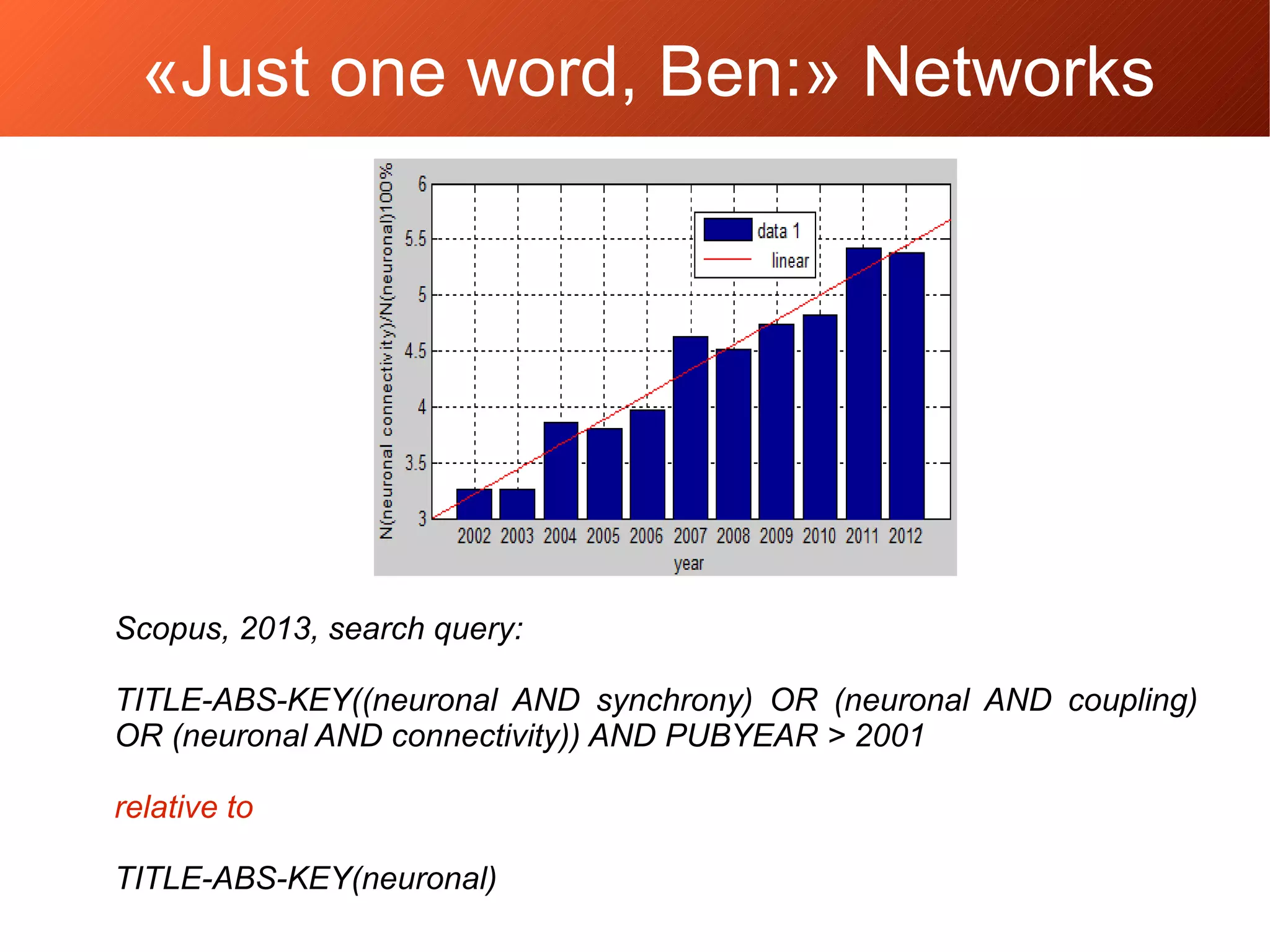
Scopus, 2013, search query:
TITLE-ABS-KEY((neuronal AND synchrony) OR (neuronal AND coupling)
OR (neuronal AND connectivity)) AND PUBYEAR > 2001
relative to
TITLE-ABS-KEY(neuronal)
«Just one word, Ben:» Networks
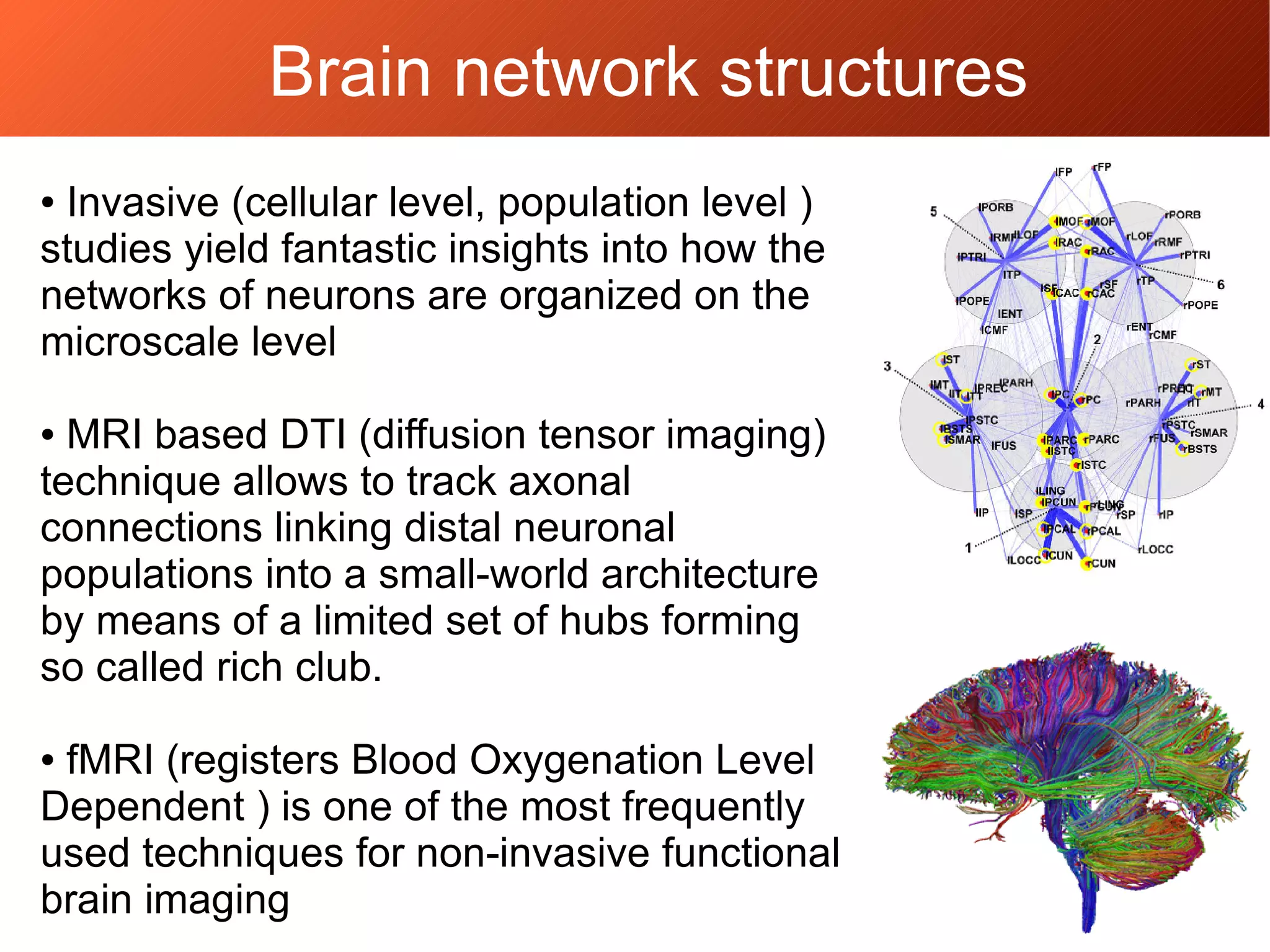
Brain network structures
● Invasive (cellular level, population level )
studies yield fantastic insights into how the
networks of neurons are organized on the
microscale level
● MRI based DTI (diffusion tensor imaging)
technique allows to track axonal
connections linking distal neuronal
populations into a small-world architecture
by means of a limited set of hubs forming
so called rich club.
● fMRI (registers Blood Oxygenation Level
Dependent ) is one of the most frequently
used techniques for non-invasive functional
brain imaging
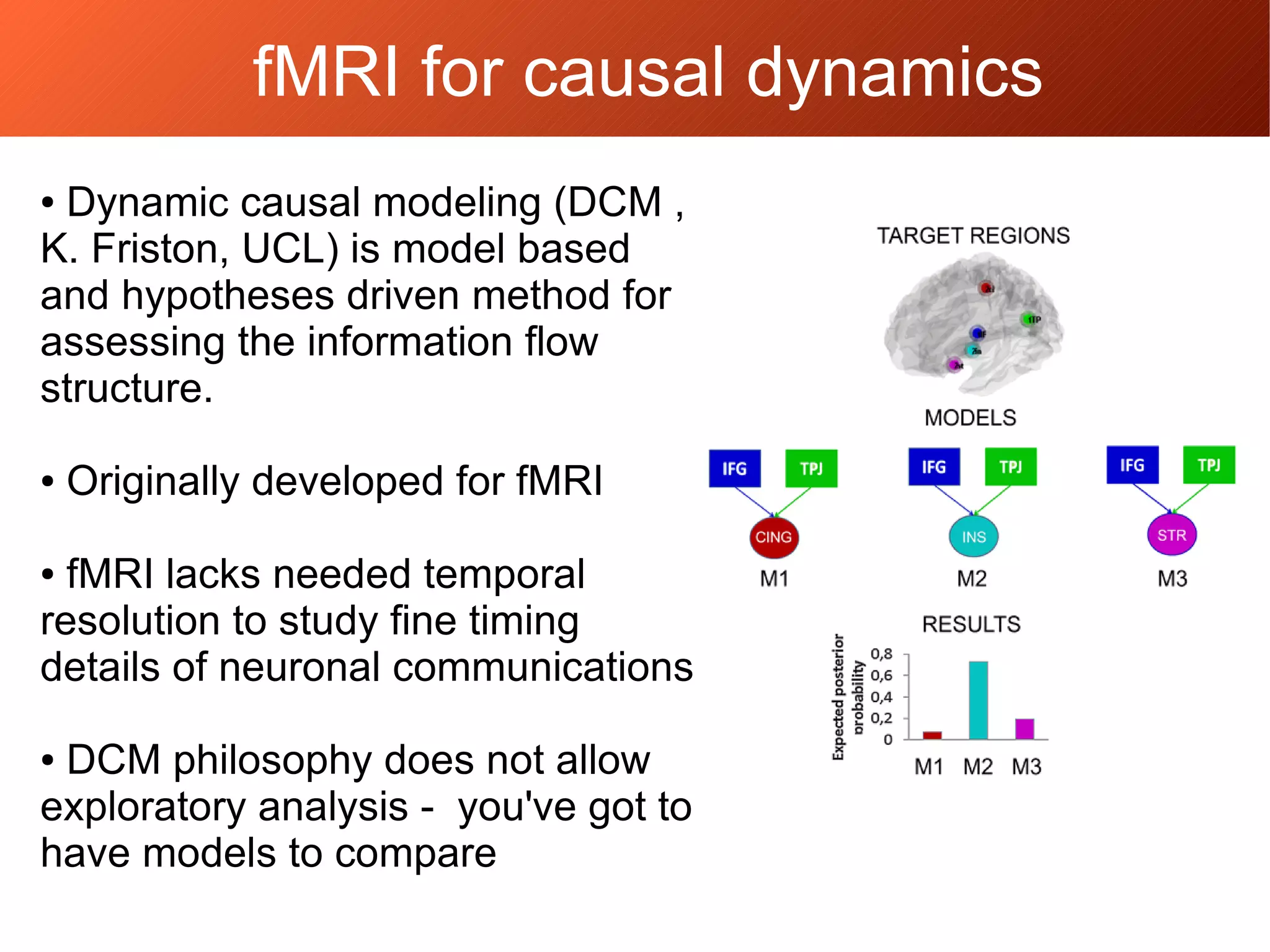
fMRI for causal dynamics
● Dynamic causal modeling (DCM ,
K. Friston, UCL) is model based
and hypotheses driven method for
assessing the information flow
structure.
● Originally developed for fMRI
● fMRI lacks needed temporal
resolution to study fine timing
details of neuronal communications
● DCM philosophy does not allow
exploratory analysis - you've got to
have models to compare
T
T
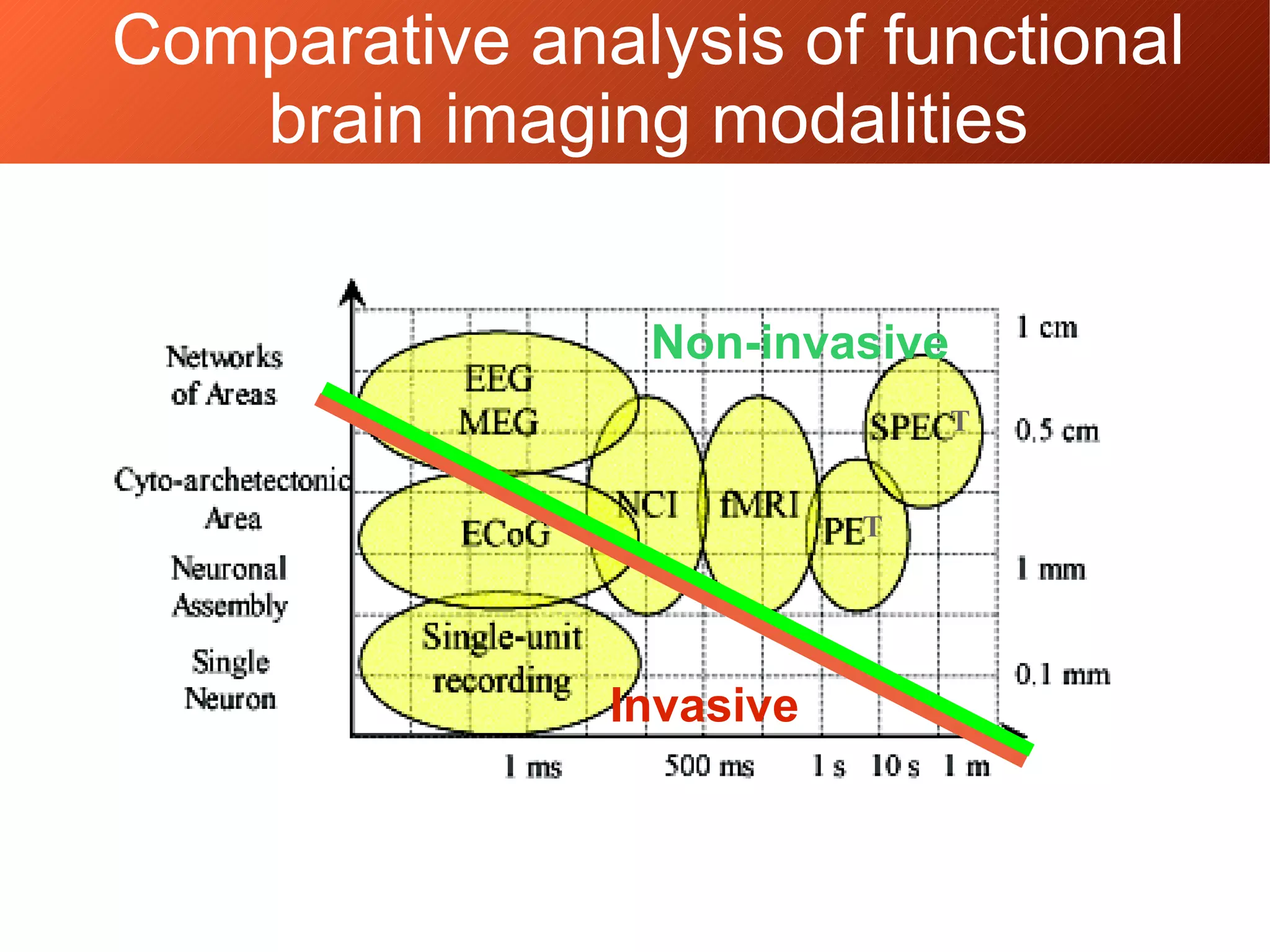
Non-invasive
Invasive
Comparative analysis of functional
brain imaging modalities
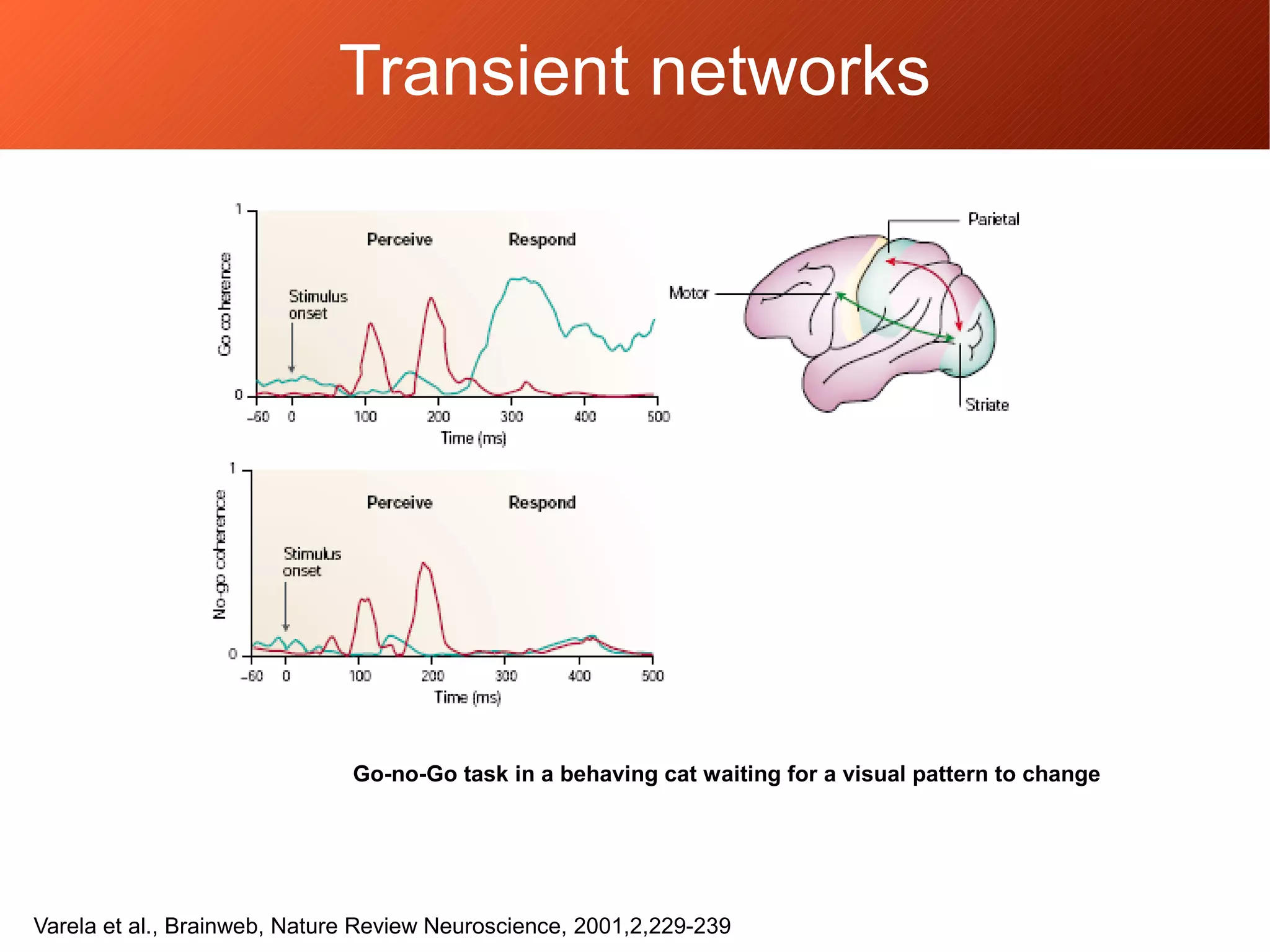
Transient networks
Go-no-Go task in a behaving cat waiting for a visual pattern to change
Varela et al., Brainweb, Nature Review Neuroscience, 2001,2,229-239
+
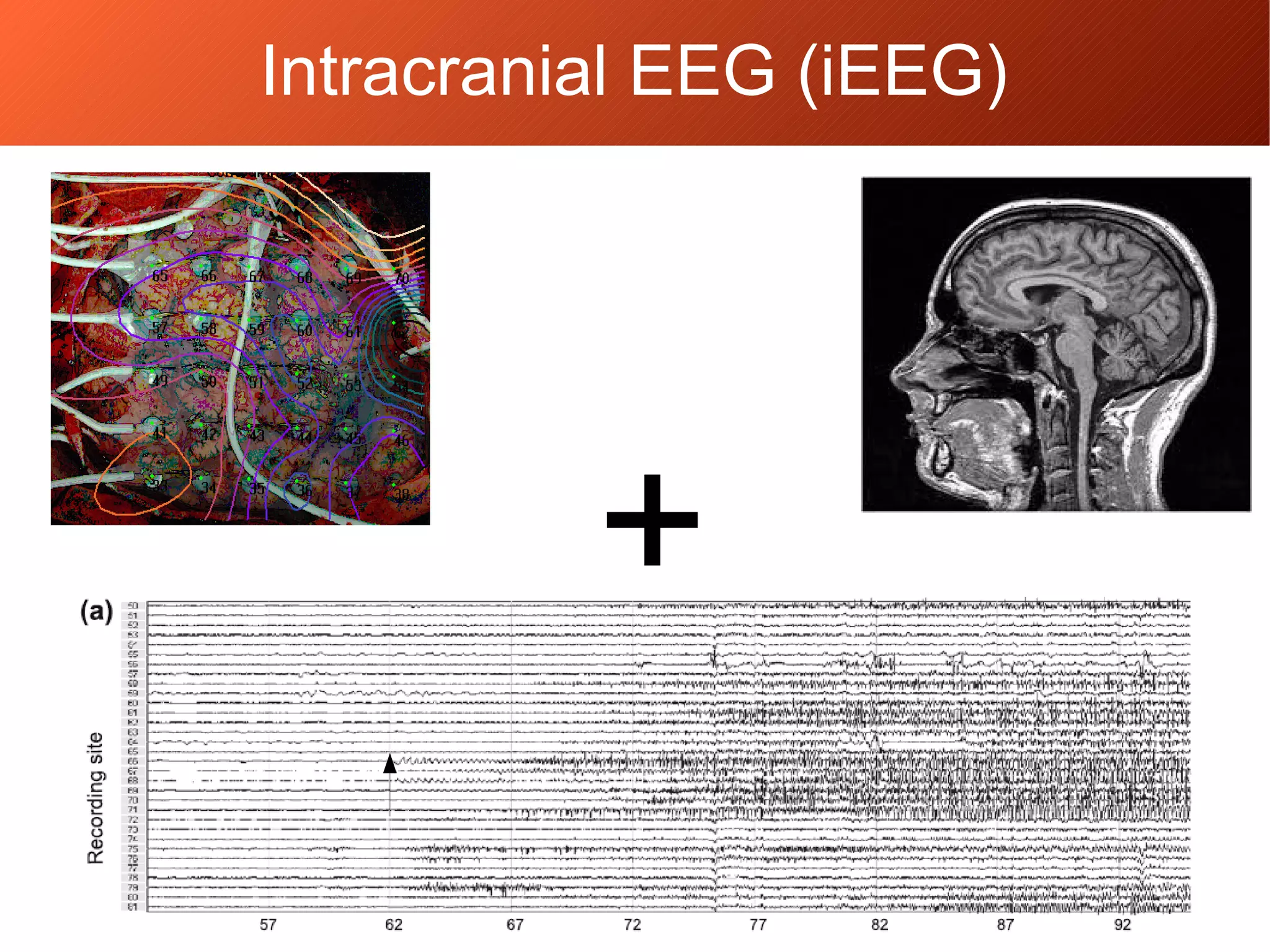
Intracranial EEG (iEEG)
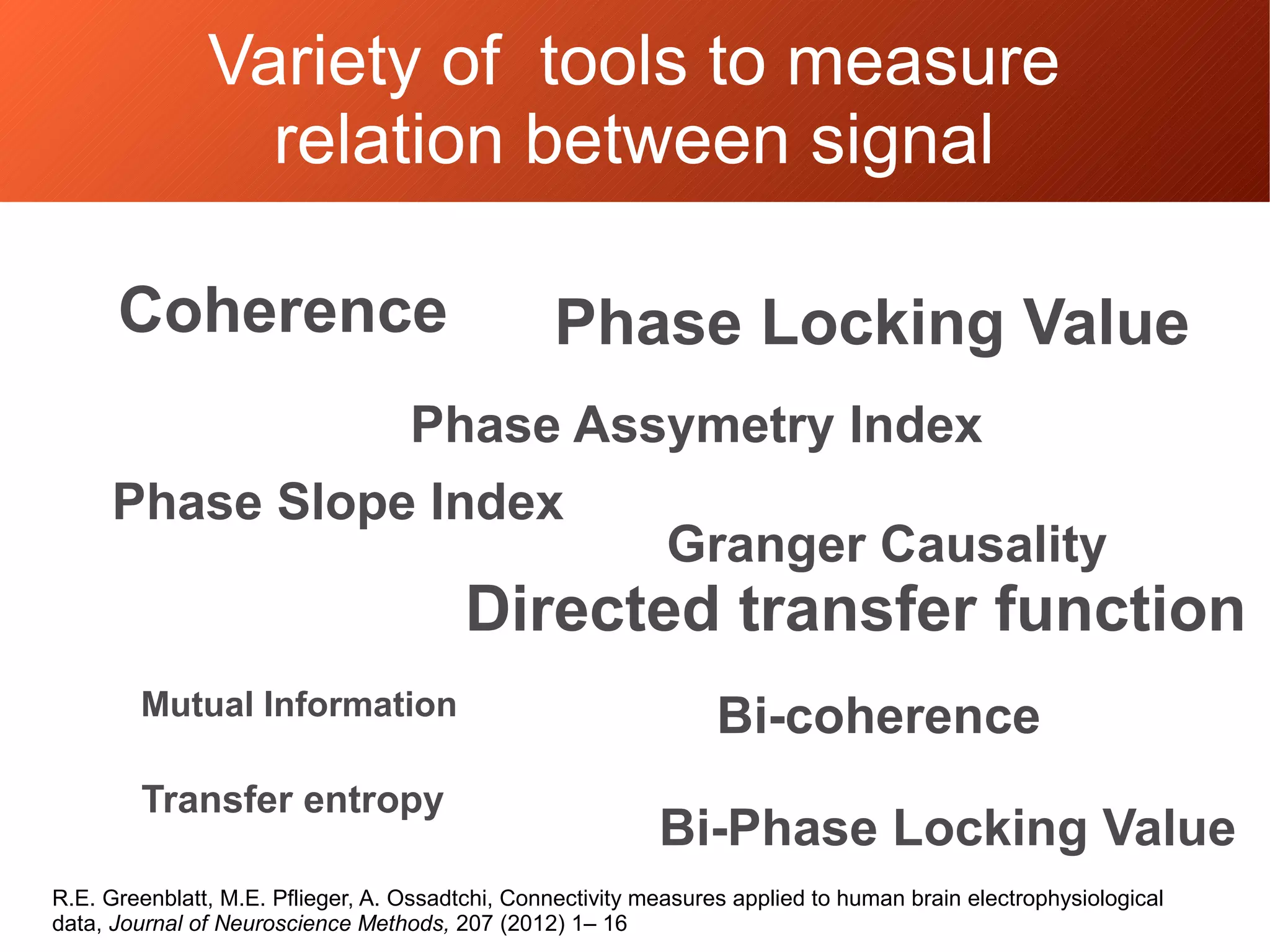
Variety of tools to measure
relation between signal
Coherence Phase Locking Value
Phase Assymetry Index
Directed transfer function
Granger Causality
Mutual Information
Transfer entropy
Bi-coherence
Bi-Phase Locking Value
Phase Slope Index
R.E. Greenblatt, M.E. Pflieger, A. Ossadtchi, Connectivity measures applied to human brain electrophysiological
data, Journal of Neuroscience Methods, 207 (2012) 1– 16
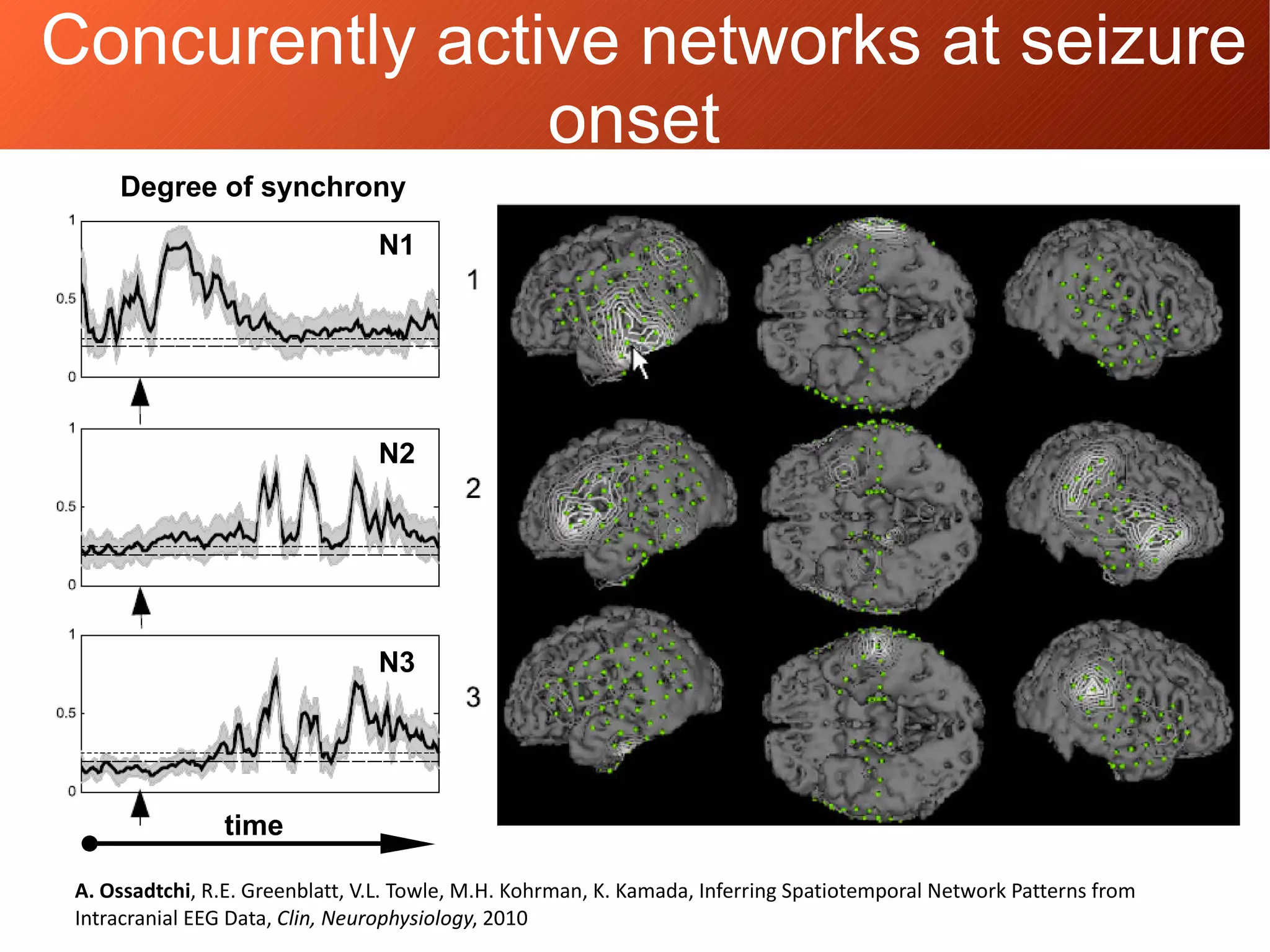
Concurently active networks at seizure
onset
A. Ossadtchi, R.E. Greenblatt, V.L. Towle, M.H. Kohrman, K. Kamada, Inferring Spatiotemporal Network Patterns from
Intracranial EEG Data, Clin, Neurophysiology, 2010
Degree of synchrony
time
N1
N2
N3
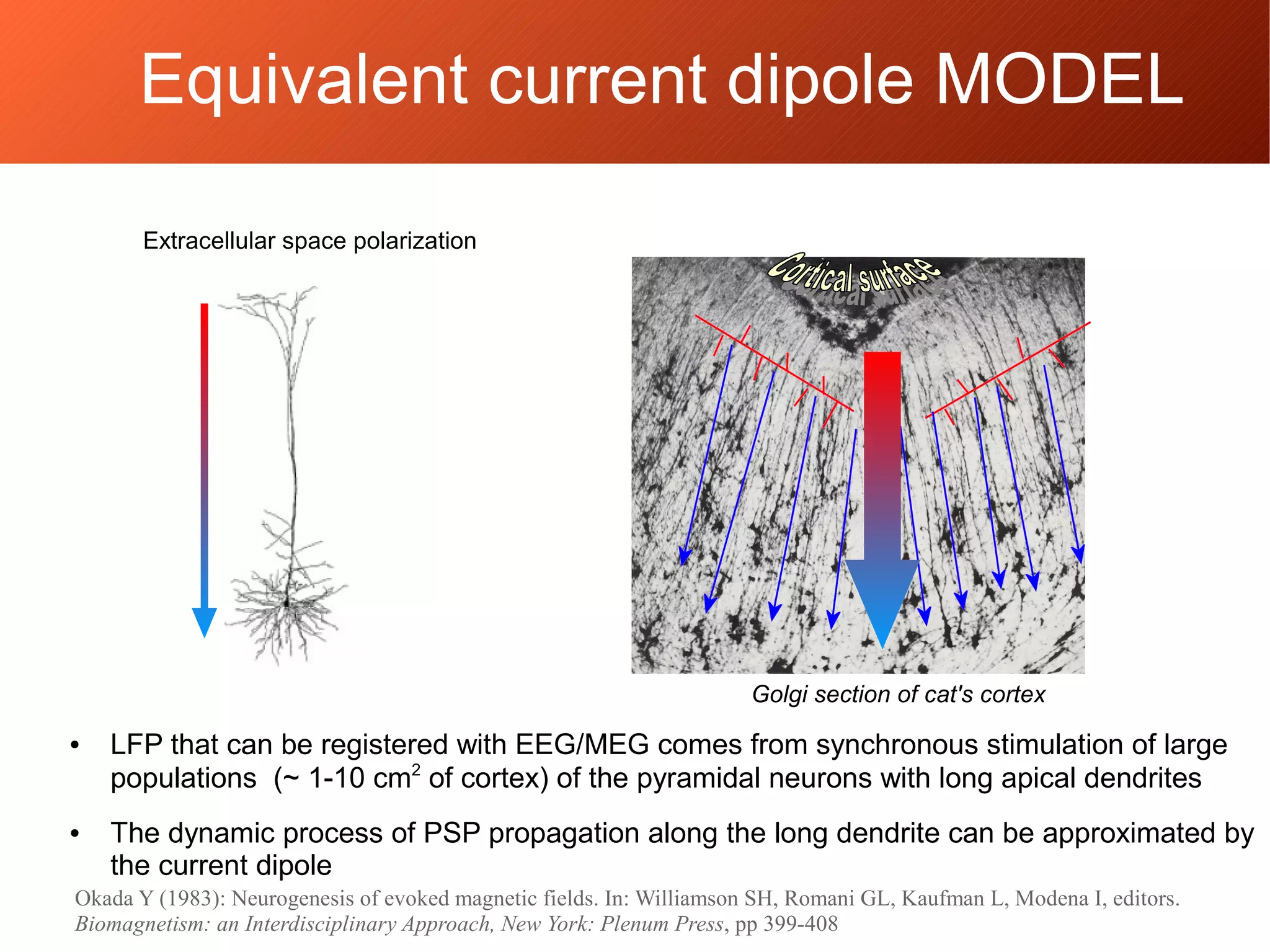
Golgi section of cat's cortex
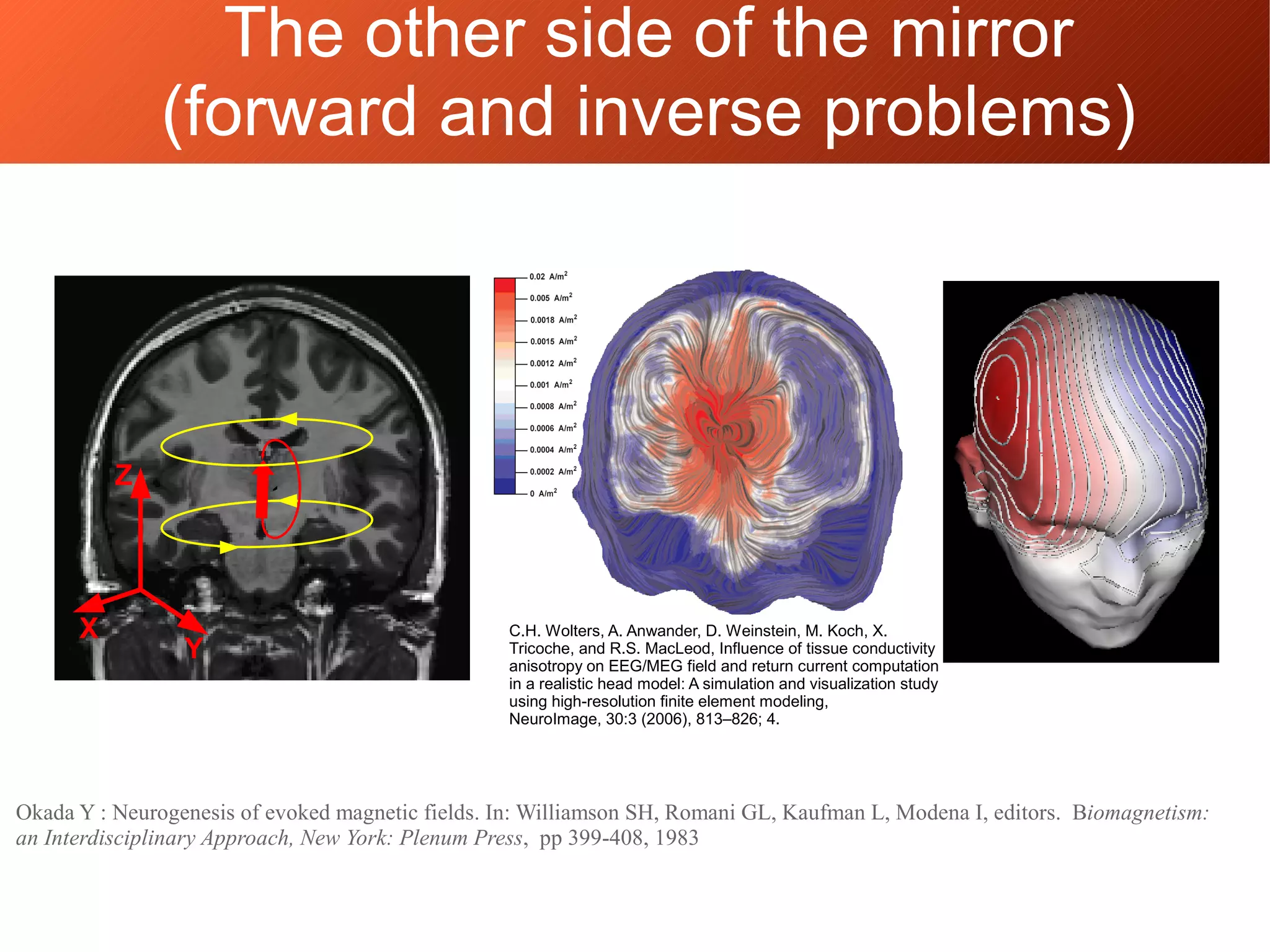
● LFP that can be registered with EEG/MEG comes from synchronous stimulation of large
populations (~ 1-10 cm2
of cortex) of the pyramidal neurons with long apical dendrites
● The dynamic process of PSP propagation along the long dendrite can be approximated by
the current dipole
Okada Y (1983): Neurogenesis of evoked magnetic fields. In: Williamson SH, Romani GL, Kaufman L, Modena I, editors.
Biomagnetism: an Interdisciplinary Approach, New York: Plenum Press, pp 399-408
Extracellular space polarization
Equivalent current dipole MODEL
X
Y
Z
Okada Y : Neurogenesis of evoked magnetic fields. In: Williamson SH, Romani GL, Kaufman L, Modena I, editors. Biomagnetism:
an Interdisciplinary Approach, New York: Plenum Press, pp 399-408, 1983
`
C.H. Wolters, A. Anwander, D. Weinstein, M. Koch, X.
Tricoche, and R.S. MacLeod, Influence of tissue conductivity
anisotropy on EEG/MEG field and return current computation
in a realistic head model: A simulation and visualization study
using high-resolution finite element modeling,
NeuroImage, 30:3 (2006), 813–826; 4.
The other side of the mirror
(forward and inverse problems)
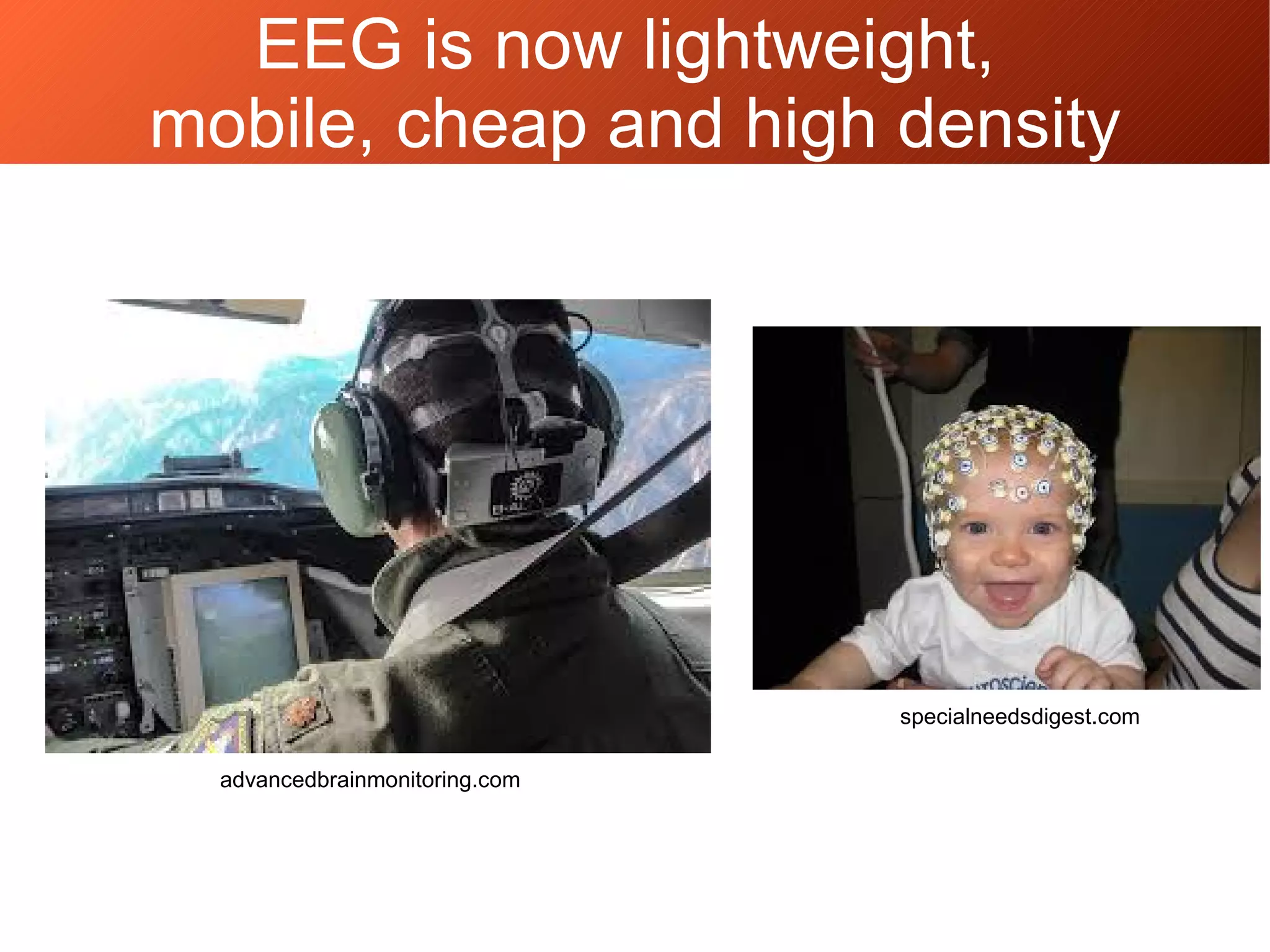
EEG is now lightweight,
mobile, cheap and high density
specialneedsdigest.com
advancedbrainmonitoring.com
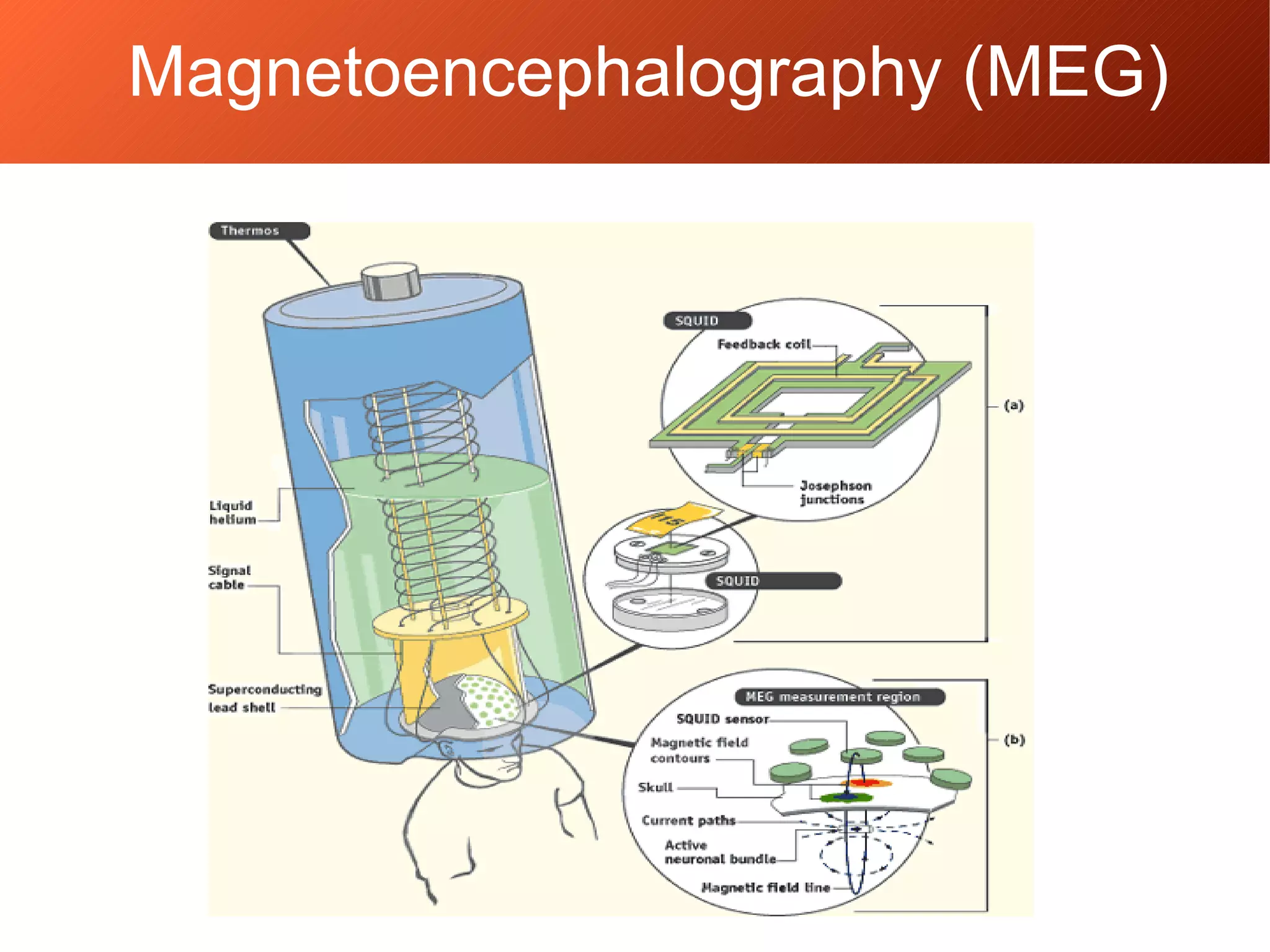
Magnetoencephalography (MEG)
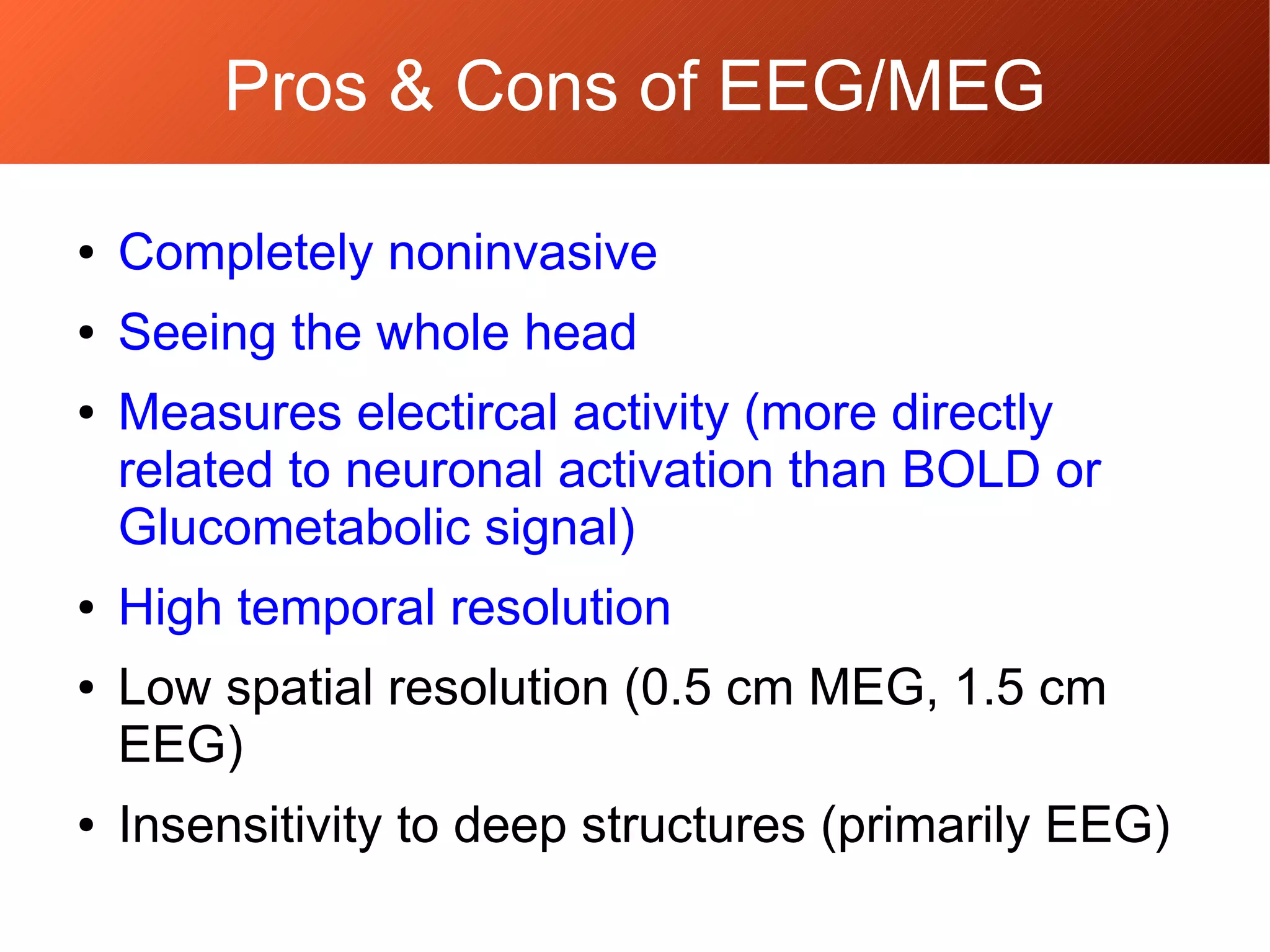
Pros & Cons of EEG/MEG
● Completely noninvasive
● Seeing the whole head
● Measures electircal activity (more directly
related to neuronal activation than BOLD or
Glucometabolic signal)
● High temporal resolution
● Low spatial resolution (0.5 cm MEG, 1.5 cm
EEG)
● Insensitivity to deep structures (primarily EEG)
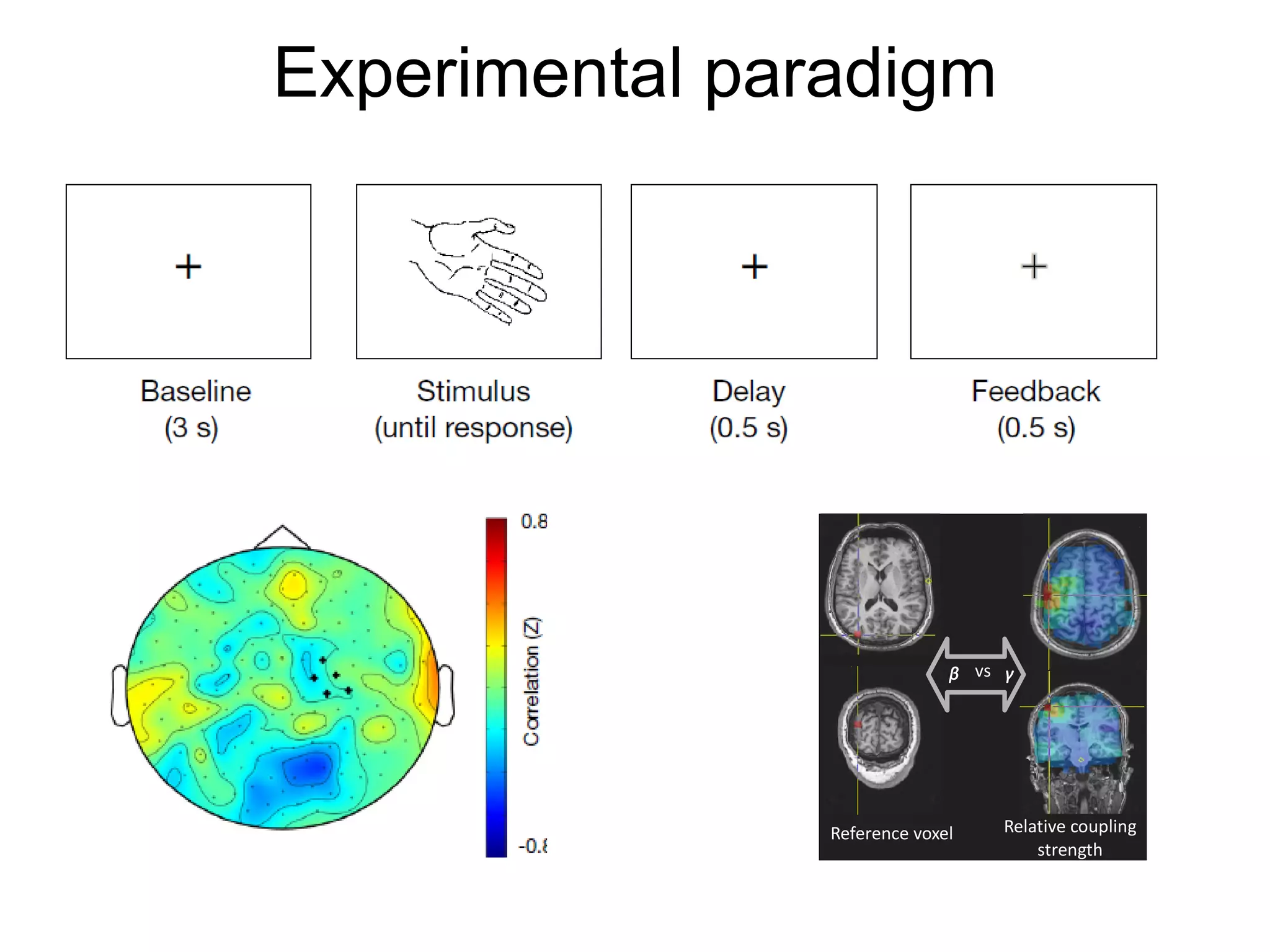
Experimental paradigm
ᵦ vs ᵧ
Reference voxel Relative coupling
strength
distribution
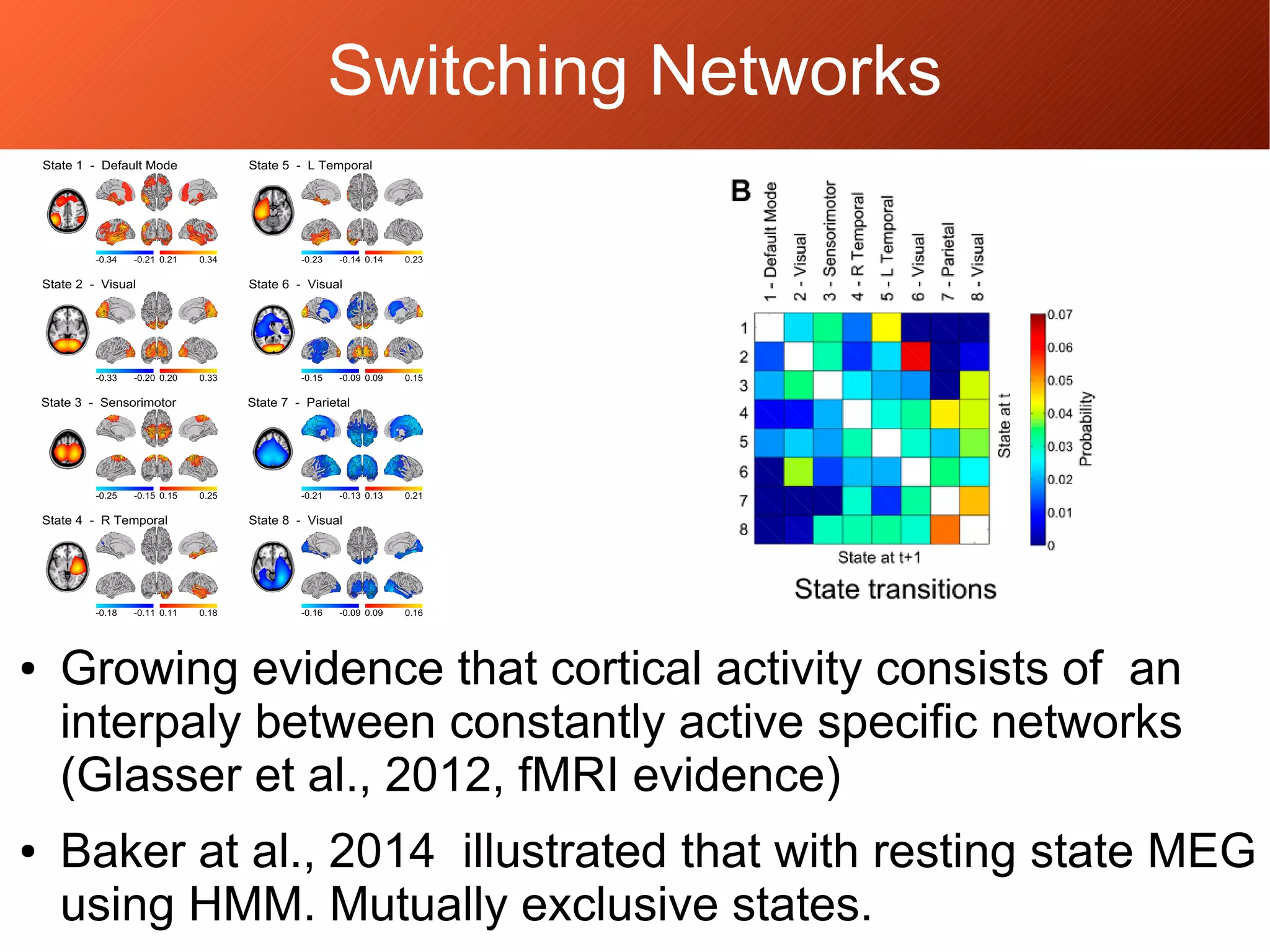
● Growing evidence that cortical activity consists of an
interpaly between constantly active specific networks
(Glasser et al., 2012, fMRI evidence)
● Baker at al., 2014 illustrated that with resting state MEG
using HMM. Mutually exclusive states.
Switching Networks
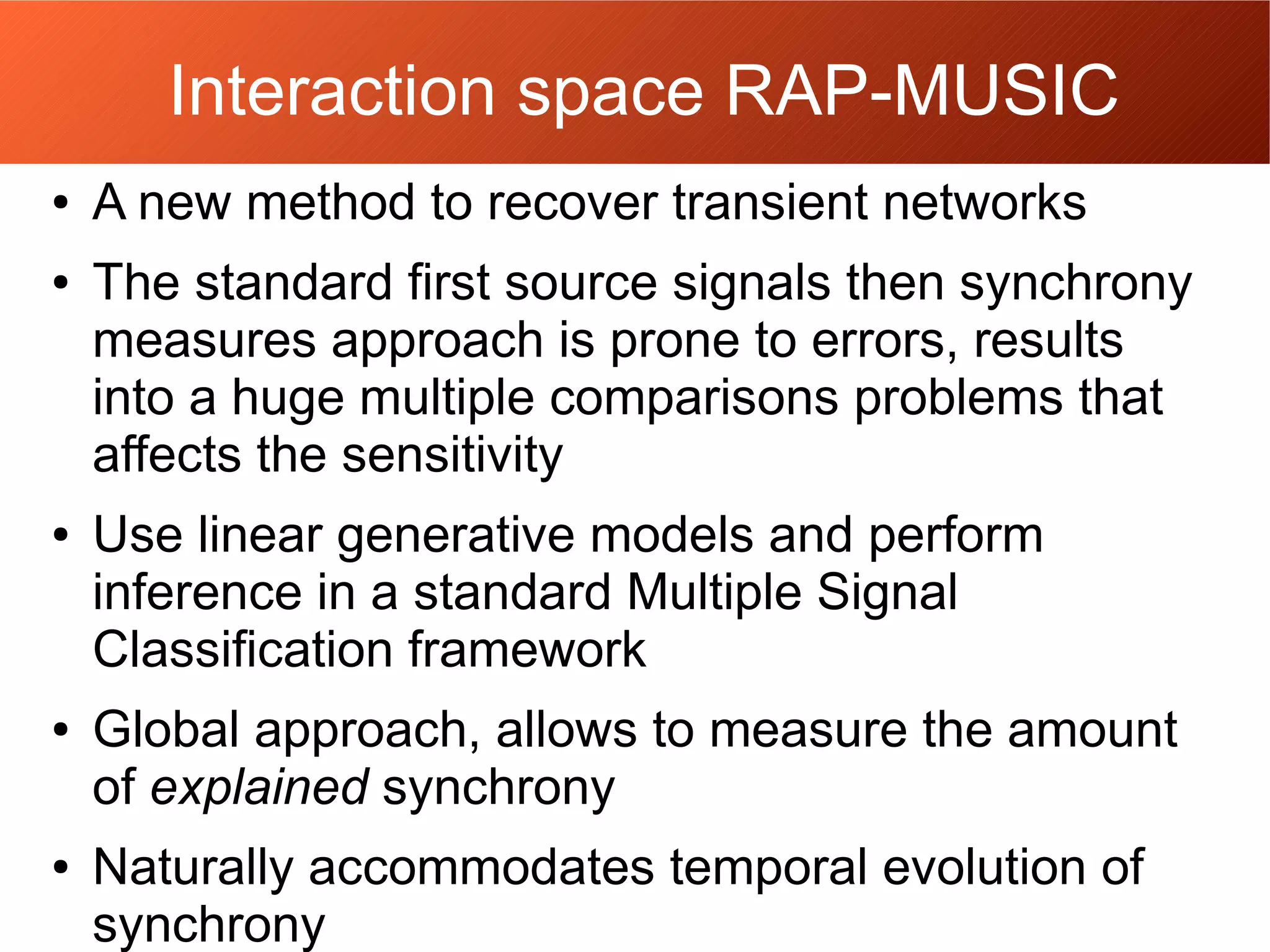
Interaction space RAP-MUSIC
● A new method to recover transient networks
● The standard first source signals then synchrony
measures approach is prone to errors, results
into a huge multiple comparisons problems that
affects the sensitivity
● Use linear generative models and perform
inference in a standard Multiple Signal
Classification framework
● Global approach, allows to measure the amount
of explained synchrony
● Naturally accommodates temporal evolution of
synchrony
Experimental Setting
● Odd-ball, movement related words (randomized
design )
● Brosym, Brosym, …, Brosai, Brosym, …, Brosok
● 120 of odd balls of each type
● Neuromag Vectorview 306 sensor MEG
machine
●
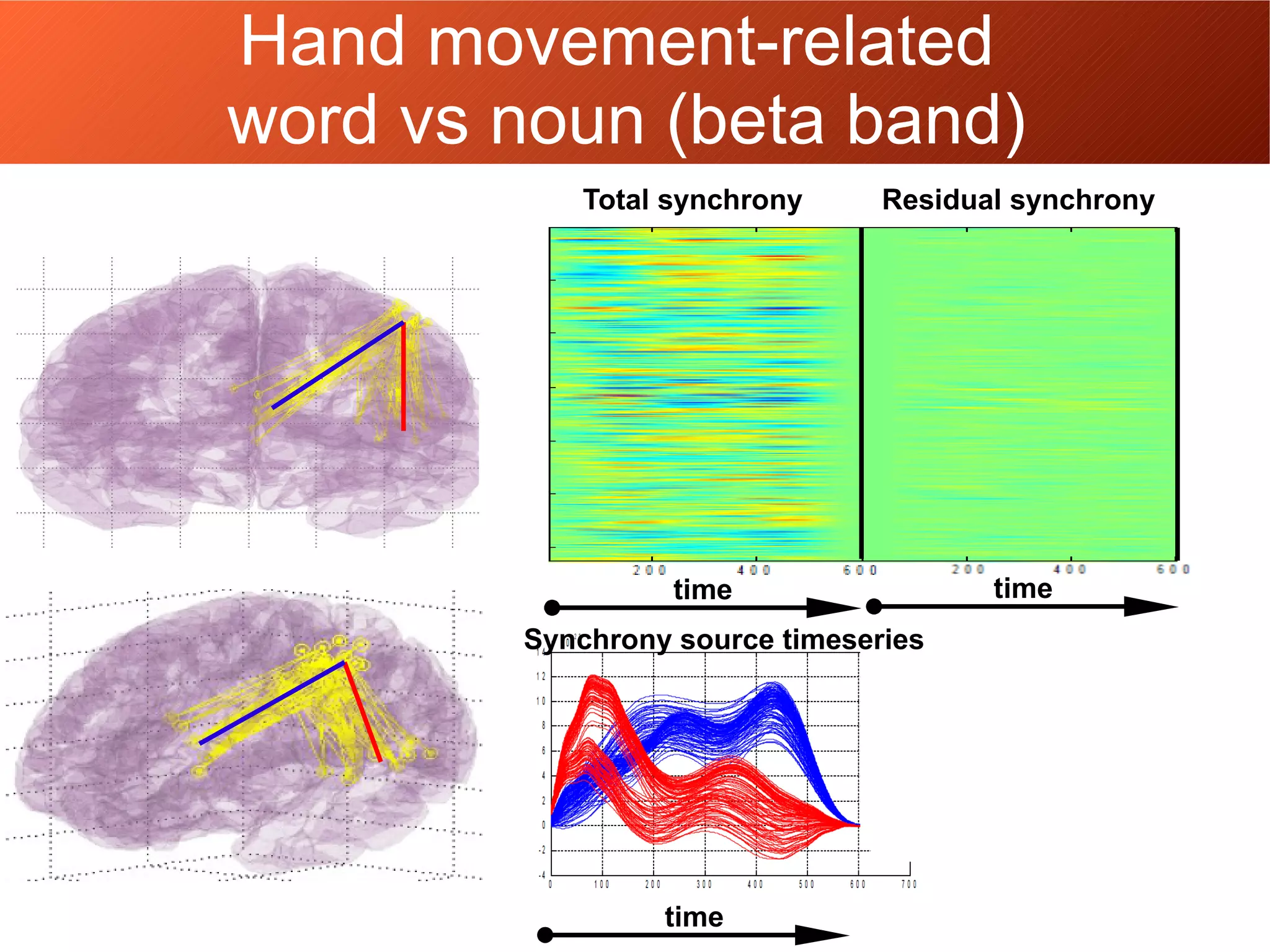
Hand movement-related
word vs noun (beta band)
Total synchrony Residual synchrony
time
time
Synchrony source timeseries
time
● Straightforward way results into a huge
multiple comparisons problem. Sensor data
simply don't have this much information and it is
unclear how to introduce the priors
● Think your source is an interacting pair of
dipoles with unknown coordinates, orientations
and activations
● Think Networks not dipoles !
Conclusion
● Understanding how we are wired and and how
these wiring patterns condition our behavior.
● Presurgical mapping of brain function to avoid
post-surgical deficit
● Diagnosis of complex neurological disorders
● Mind reading, brain state classification based
on the network activity
● Building dynamic functional connectome
Conclusion
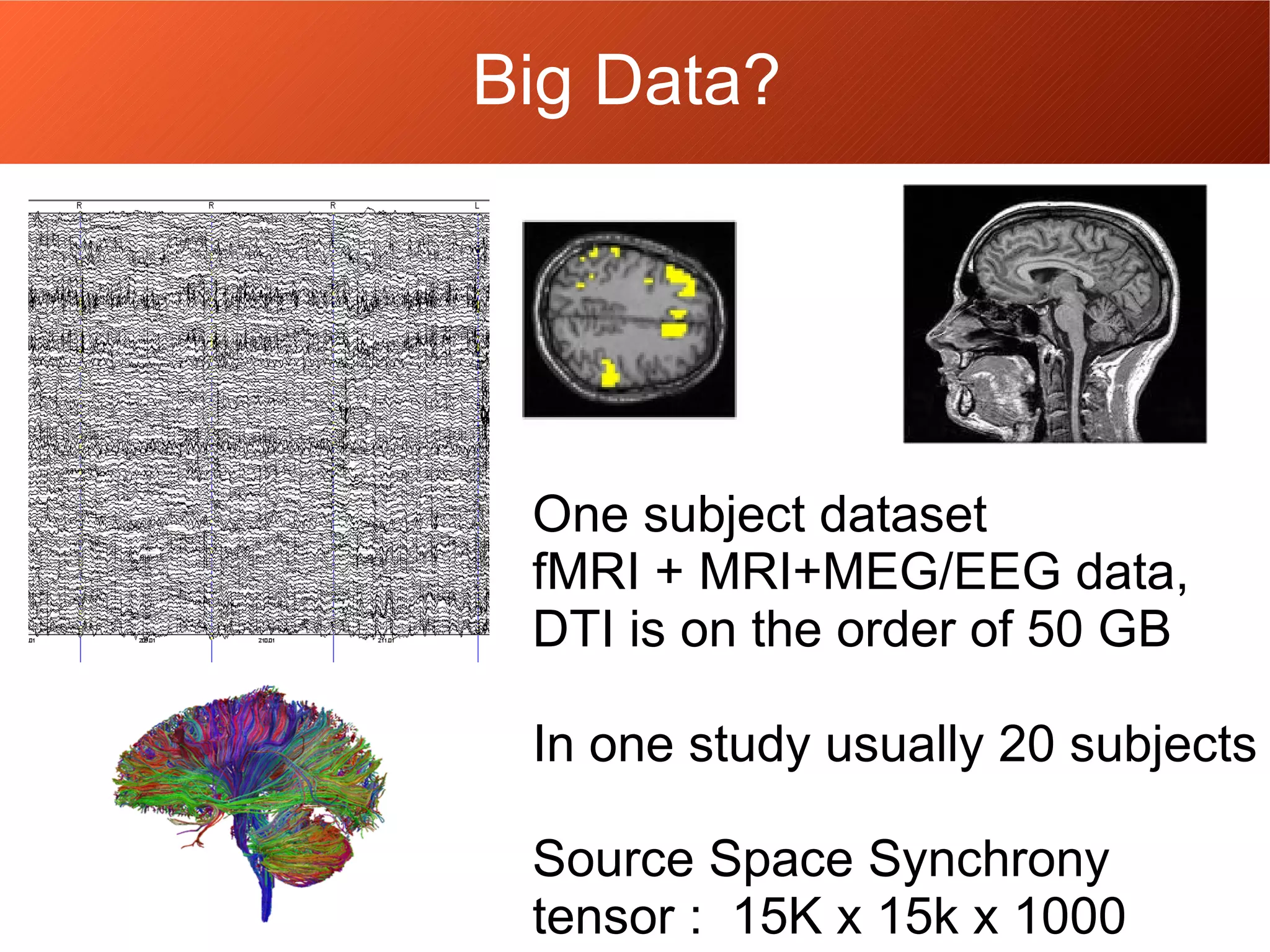
Big Data?
One subject dataset
fMRI + MRI+MEG/EEG data,
DTI is on the order of 50 GB
In one study usually 20 subjects
Source Space Synchrony
tensor : 15K x 15k x 1000
Collaborators
● Tatiana Stroganova, Moscow MEG Centre
● Richard Greeblatt, ex-president, Source Signal
Imaging Inc, San Diego, CA
● John Mosher, MEG Centre, Cleveland Clinic
● Syvain Baillett, McGill University, Montreal,
Canada
Partial support
● RFBR grant #140....,Novel instrumental-
mathematical paradigm for presurgical mapping
of language cortex, P.I. Ossadtchi,A.

Осадчий А.Е. Анализ многомерных магнито- и электроэнцефалографических данных для построения динамического функционального коннектома мо

  • 1.
    Analyis of EEGand MEG data for building dynamic functional connectome. Alexei Ossadtchi, Ph.D. Higher School of Economics St. Petersburg State University
  • 2.
    Broadmann brain areas Economo,C. von, Koskinas, G.N. (1925) Die Cytoarchitektonik der Hirnrinde des erwachsenen Menschen. Julius Springer, Vienna ●Originally identified by Korbinian Broadmann as 52(44+8) distinct regions with specific histilogical characteristics ●Refined and much argued over ●Less detailed maps before (Alfred Campbell, Grafton Smith) and more detailed maps later Constatin von Economo and George Koskinas were published Broadmann brain areas
  • 3.
    ●Broadmann areas originallydiscovered based on microstructural features were later linked to functions ●Clinical post-mortem studies, animal studies, unfortunate cases of trauma and for the last quarter of a century functional imaging associated cognitive tasks with engagement of certain brain regions Primary auditory cortex Primary somatosensory cortex Broca's area http://thebrain.mcgill.ca/flash/capsules/outil_jaune05.html; J.T. Cacioppo,G.G. Berntson, and H.C. Nusbaum, Neuroimaging as a New Tool in the Toolbox of Psychological , Current directions in psychological science, 2008 Relation to function
  • 4.
    Scopus, 2013, searchquery: TITLE-ABS-KEY((neuronal AND synchrony) OR (neuronal AND coupling) OR (neuronal AND connectivity)) AND PUBYEAR > 2001 relative to TITLE-ABS-KEY(neuronal) «Just one word, Ben:» Networks
  • 5.
    Brain network structures ●Invasive (cellular level, population level ) studies yield fantastic insights into how the networks of neurons are organized on the microscale level ● MRI based DTI (diffusion tensor imaging) technique allows to track axonal connections linking distal neuronal populations into a small-world architecture by means of a limited set of hubs forming so called rich club. ● fMRI (registers Blood Oxygenation Level Dependent ) is one of the most frequently used techniques for non-invasive functional brain imaging
  • 6.
    fMRI for causaldynamics ● Dynamic causal modeling (DCM , K. Friston, UCL) is model based and hypotheses driven method for assessing the information flow structure. ● Originally developed for fMRI ● fMRI lacks needed temporal resolution to study fine timing details of neuronal communications ● DCM philosophy does not allow exploratory analysis - you've got to have models to compare
  • 7.
    T T Non-invasive Invasive Comparative analysis offunctional brain imaging modalities
  • 8.
    Transient networks Go-no-Go taskin a behaving cat waiting for a visual pattern to change Varela et al., Brainweb, Nature Review Neuroscience, 2001,2,229-239
  • 9.
  • 10.
    Variety of toolsto measure relation between signal Coherence Phase Locking Value Phase Assymetry Index Directed transfer function Granger Causality Mutual Information Transfer entropy Bi-coherence Bi-Phase Locking Value Phase Slope Index R.E. Greenblatt, M.E. Pflieger, A. Ossadtchi, Connectivity measures applied to human brain electrophysiological data, Journal of Neuroscience Methods, 207 (2012) 1– 16
  • 11.
    Concurently active networksat seizure onset A. Ossadtchi, R.E. Greenblatt, V.L. Towle, M.H. Kohrman, K. Kamada, Inferring Spatiotemporal Network Patterns from Intracranial EEG Data, Clin, Neurophysiology, 2010 Degree of synchrony time N1 N2 N3
  • 12.
    Golgi section ofcat's cortex ● LFP that can be registered with EEG/MEG comes from synchronous stimulation of large populations (~ 1-10 cm2 of cortex) of the pyramidal neurons with long apical dendrites ● The dynamic process of PSP propagation along the long dendrite can be approximated by the current dipole Okada Y (1983): Neurogenesis of evoked magnetic fields. In: Williamson SH, Romani GL, Kaufman L, Modena I, editors. Biomagnetism: an Interdisciplinary Approach, New York: Plenum Press, pp 399-408 Extracellular space polarization Equivalent current dipole MODEL
  • 13.
    X Y Z Okada Y :Neurogenesis of evoked magnetic fields. In: Williamson SH, Romani GL, Kaufman L, Modena I, editors. Biomagnetism: an Interdisciplinary Approach, New York: Plenum Press, pp 399-408, 1983 ` C.H. Wolters, A. Anwander, D. Weinstein, M. Koch, X. Tricoche, and R.S. MacLeod, Influence of tissue conductivity anisotropy on EEG/MEG field and return current computation in a realistic head model: A simulation and visualization study using high-resolution finite element modeling, NeuroImage, 30:3 (2006), 813–826; 4. The other side of the mirror (forward and inverse problems)
  • 14.
    EEG is nowlightweight, mobile, cheap and high density specialneedsdigest.com advancedbrainmonitoring.com
  • 15.
  • 16.
    Pros & Consof EEG/MEG ● Completely noninvasive ● Seeing the whole head ● Measures electircal activity (more directly related to neuronal activation than BOLD or Glucometabolic signal) ● High temporal resolution ● Low spatial resolution (0.5 cm MEG, 1.5 cm EEG) ● Insensitivity to deep structures (primarily EEG)
  • 18.
    Experimental paradigm ᵦ vsᵧ Reference voxel Relative coupling strength distribution
  • 19.
    ● Growing evidencethat cortical activity consists of an interpaly between constantly active specific networks (Glasser et al., 2012, fMRI evidence) ● Baker at al., 2014 illustrated that with resting state MEG using HMM. Mutually exclusive states. Switching Networks
  • 20.
    Interaction space RAP-MUSIC ●A new method to recover transient networks ● The standard first source signals then synchrony measures approach is prone to errors, results into a huge multiple comparisons problems that affects the sensitivity ● Use linear generative models and perform inference in a standard Multiple Signal Classification framework ● Global approach, allows to measure the amount of explained synchrony ● Naturally accommodates temporal evolution of synchrony
  • 21.
    Experimental Setting ● Odd-ball,movement related words (randomized design ) ● Brosym, Brosym, …, Brosai, Brosym, …, Brosok ● 120 of odd balls of each type ● Neuromag Vectorview 306 sensor MEG machine ●
  • 22.
    Hand movement-related word vsnoun (beta band) Total synchrony Residual synchrony time time Synchrony source timeseries time
  • 23.
    ● Straightforward wayresults into a huge multiple comparisons problem. Sensor data simply don't have this much information and it is unclear how to introduce the priors ● Think your source is an interacting pair of dipoles with unknown coordinates, orientations and activations ● Think Networks not dipoles ! Conclusion
  • 24.
    ● Understanding howwe are wired and and how these wiring patterns condition our behavior. ● Presurgical mapping of brain function to avoid post-surgical deficit ● Diagnosis of complex neurological disorders ● Mind reading, brain state classification based on the network activity ● Building dynamic functional connectome Conclusion
  • 25.
    Big Data? One subjectdataset fMRI + MRI+MEG/EEG data, DTI is on the order of 50 GB In one study usually 20 subjects Source Space Synchrony tensor : 15K x 15k x 1000
  • 26.
    Collaborators ● Tatiana Stroganova,Moscow MEG Centre ● Richard Greeblatt, ex-president, Source Signal Imaging Inc, San Diego, CA ● John Mosher, MEG Centre, Cleveland Clinic ● Syvain Baillett, McGill University, Montreal, Canada Partial support ● RFBR grant #140....,Novel instrumental- mathematical paradigm for presurgical mapping of language cortex, P.I. Ossadtchi,A.