MIXING
KASHISH WILSON
MM COLLEGE OF PHARMACY MM(DU) MULLANA AMBALA
OBJECTIVE...
• The main objective of this mixing is to produce a bulk mixture
which when divide into different doses, every unit of divided
doses must contain the correct proportion of each ingredient. It
is critical process because the quality of the final product and
its attributes are derived by the quality of the mixing .
APPLICATION OF MIXING..
• Mixing is an intermediate step in production of tablet or capsule. Mixing of
powders in different proportion prior to granulation or tableting.
• Dry mixing of materials for direct compression in to tablets.
• Dry mixing of powder or composites powders in capsule and insufflations
respectively.
• Blending of powders are also important in preparation of cosmetic
products such as facial powder or dental powder.
• In case of potent drugs where dose is low, mixing is critical factor.
Otherwise it will affect content uniformity of tablet
FACTORS AFFECTING IN MIXING....
• Nature of product
• Particle size
• Particle charge
• Particle shape
• Proportion on material
• Relative density
• Viscosity
• Surface tension ..etc
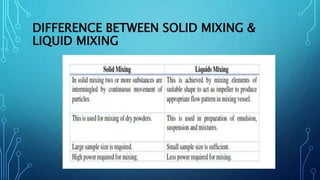
DIFFERENCE BETWEEN SOLID MIXING &
LIQUID MIXING
MECHANISM OF SOLID MIXING.....
• Convective mixing, In which group of particles move from one
position to another. It also referred to as macromixing.
• Shear mixing, In this, shearing force is created within the mass
of material by the use of a stirring arm or a burst of air.
• Diffusive mixing, During this mixing, gravitational forces cause
the upper layers of material to slip and random motion of
individual particles take place on newly developed surfaces.
Also known as micro mixing
MECHANISM OF LIQUID MIXING.....
• Bulk transport: It is the movement of large portion of material from one
location to another location. The movement is done by rotating blades or
paddles. Turbulent mixing: In this mixing is due to turbulence. Turbulence
is a function of velocity gradient between two adjacent layers of a liquid.
• Laminar mixing/Streamline mixing: When two dissimilar liquid are mixed
through a laminar flow, the shear that is generated stretches the interface
between them. In this mechanism layers folds on themselves. As a result,
the number of layers, and therefore interfacial area between them, increases
exponentially with time.
• Molecular diffusion: The mechanism responsible for mixing at molecular
level is the diffusion resulting from thermal movement of molecules.
MECHANISM OF SEMISOLID MIXING
• The mechanisms in mixing semi solids depend on the character
of the material which may show considerable variation. Many
semi solids form neutral mixtures having no tendency to
segregate although sedimentation may occur. Three most
commonly used semi solid mixers are...
• Sigma blade mixers
• Triple roller mill
• Planetary mixers
THANKS......

Mixing.pptx

  • 1.
    MIXING KASHISH WILSON MM COLLEGEOF PHARMACY MM(DU) MULLANA AMBALA
  • 2.
    OBJECTIVE... • The mainobjective of this mixing is to produce a bulk mixture which when divide into different doses, every unit of divided doses must contain the correct proportion of each ingredient. It is critical process because the quality of the final product and its attributes are derived by the quality of the mixing .
  • 3.
    APPLICATION OF MIXING.. •Mixing is an intermediate step in production of tablet or capsule. Mixing of powders in different proportion prior to granulation or tableting. • Dry mixing of materials for direct compression in to tablets. • Dry mixing of powder or composites powders in capsule and insufflations respectively. • Blending of powders are also important in preparation of cosmetic products such as facial powder or dental powder. • In case of potent drugs where dose is low, mixing is critical factor. Otherwise it will affect content uniformity of tablet
  • 4.
    FACTORS AFFECTING INMIXING.... • Nature of product • Particle size • Particle charge • Particle shape • Proportion on material • Relative density • Viscosity • Surface tension ..etc
  • 5.
    DIFFERENCE BETWEEN SOLIDMIXING & LIQUID MIXING
  • 6.
    MECHANISM OF SOLIDMIXING..... • Convective mixing, In which group of particles move from one position to another. It also referred to as macromixing. • Shear mixing, In this, shearing force is created within the mass of material by the use of a stirring arm or a burst of air. • Diffusive mixing, During this mixing, gravitational forces cause the upper layers of material to slip and random motion of individual particles take place on newly developed surfaces. Also known as micro mixing
  • 7.
    MECHANISM OF LIQUIDMIXING..... • Bulk transport: It is the movement of large portion of material from one location to another location. The movement is done by rotating blades or paddles. Turbulent mixing: In this mixing is due to turbulence. Turbulence is a function of velocity gradient between two adjacent layers of a liquid. • Laminar mixing/Streamline mixing: When two dissimilar liquid are mixed through a laminar flow, the shear that is generated stretches the interface between them. In this mechanism layers folds on themselves. As a result, the number of layers, and therefore interfacial area between them, increases exponentially with time. • Molecular diffusion: The mechanism responsible for mixing at molecular level is the diffusion resulting from thermal movement of molecules.
  • 8.
    MECHANISM OF SEMISOLIDMIXING • The mechanisms in mixing semi solids depend on the character of the material which may show considerable variation. Many semi solids form neutral mixtures having no tendency to segregate although sedimentation may occur. Three most commonly used semi solid mixers are... • Sigma blade mixers • Triple roller mill • Planetary mixers
  • 9.