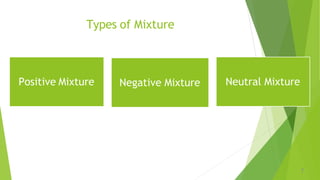
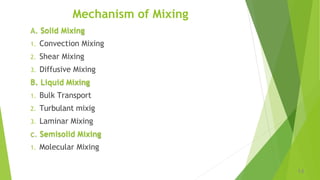
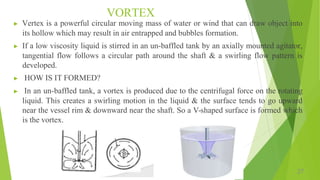
This document discusses various types of mixing mechanisms used in pharmaceutical manufacturing. It begins by defining mixing and dividing it into homogeneous and heterogeneous categories. The objectives, applications and factors affecting mixing are outlined. The key differences between solid, liquid and semisolid mixing are explained. Various mixing mechanisms for solids include convection, shear and diffusive mixing while mechanisms for liquids include bulk transport, turbulent and laminar mixing. Molecular mixing is described as the mechanism for semisolids. Common mixing equipment like propellers, turbines, paddles, ribbon blenders and planetary mixers are introduced along with their principles, construction, working and advantages/disadvantages. Vortex formation is discussed as a disadvantage of propellers.








![[Power Point] Mixing - Pharmaceutical Engineering](https://cdn.slidesharecdn.com/ss_thumbnails/forslideshare-151107043333-lva1-app6892-thumbnail.jpg?width=640&height=640&fit=bounds)


![[Paperwork] Mixing - Pharmaceutical Engineering](https://cdn.slidesharecdn.com/ss_thumbnails/papermixingcomplete-151107042824-lva1-app6892-thumbnail.jpg?width=640&height=640&fit=bounds)


