MIXING AND HOMOGENIZATION
Introduction
 To ensure uniformity
 To initiate or to enhance the physical or chemical
reactions e.g. diffusion, dissolution etc.
 To make the following products:
 Tablets
 Suspensions
 Emulsions
 Pastes
 Creams
 Ointments
 Solutions
 Syrups
 Tablet coatings
OBJECTIVE
 Mixing may be defined as a unit operation in
which two or more components, in an
unmixed or partially mixed state, are treated
so that each unit (particle, molecule etc.) of
the components lies as nearly as possible in
contact with a unit of each of the other
components.
DEFINITION
ADVANTAGE
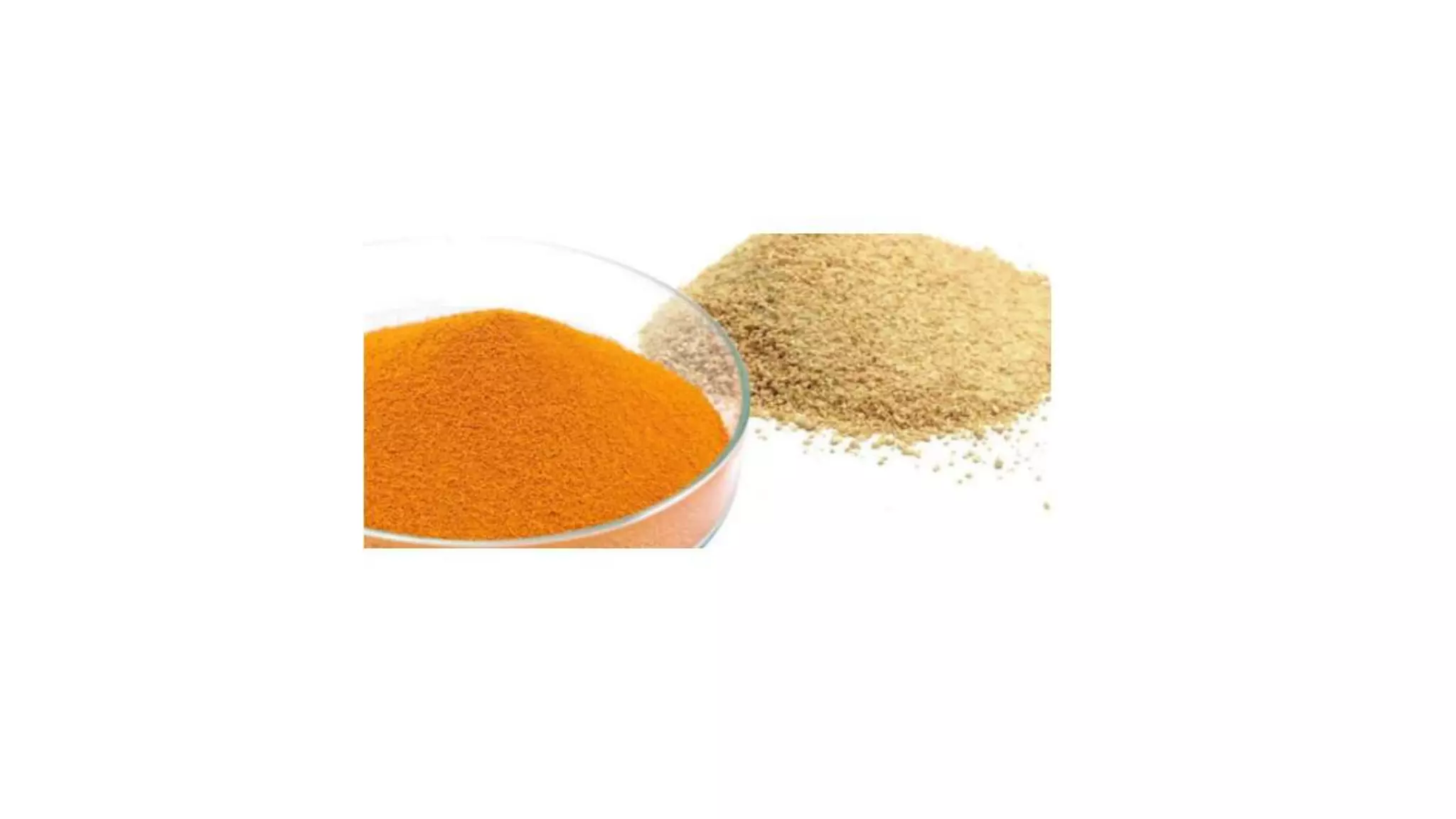
To make simple physicalmixture In the
production of tablets, capsules, sachets and
dry powders two or more powders or granules
are mixed.
Physical change
 Mixing may aim at producing a change that is
physical i.e., solution of a soluble substance.
 Dissolving a solid in a solvent mixing will take
place by diffusion but the process will be slow.
 Agitation makes the process rapid.
Dispersion
 In case of emulsions and creams two
immiscible liquids are mixed where one
liquid is dispersed into other.
 In suspension and pastes solid particles are
dispersed in a liquid by mixing.
Promotion of reaction
 Mixing encourages and controls a chemical reaction, so
ensuring uniform products
There are 3 types of mixtures in pharmaceutical industries:
A. Positive mixtures:
 Formed from materials such as, gases or miscible
liquids.
 The materials mix spontaneously and irreversibly
by diffusion
 No input of energy if time of mixing is unlimited,
although time will be shortenif energy is supplied.
 Generally, do not show any problems during mixing.
TYPES OF MIXING
B. Negative mixtures:
 Materials have the tendency to separate out from each
other.
 Energy needs to be supplied to keep
components adequately dispersed.
 Some separate faster, while for others, the separation is
slower.
For example
 In a suspension, there is the dispersion of solid in the solution
(fast separation)
 Emulsions, creams and viscous suspension have a slow
separation.
 Are more difficult to be formed and require high degree of
mixing efficiency.
C. Neutral mixtures:
 Are static in behavior
 Neither mixing nor de-mixing occurs, unless acted upon by an external
system of forces.
Examples are:
 Mixed powders
 Pastes
 Ointments.
Liquid mixing
A. Mixing of liquid and liquid
 Mixing of two or more miscible liquids
 Mixing of two or more immiscible liquids
B. Mixing of liquid & solid
 Mixing of liquids & soluble solids
 Mixing of liquids & insoluble solids
MECHANISM OF MIXING
Laminar Mixing
Laminar mixing processes are based on the repeated separation of the flow into layers, followed by redistribution and
recombination parallel to the flow direction. The number of layers, and hence the homogeneity, increases with each
additional mixing
Turbulent Mixing :
Turbulent - The ability of turbulent flows to effectively mix entrained fluids to a molecular scale is a vital part of the
dynamics of such flows, with wide-ranging consequences in nature and engineering. It is a considerable experimental,
theoretical, modeling, and computational challenge to capture and represent turbulent mixing which, for high Reynolds
number (Re) flows, occurs across a spectrum of scales of considerable span.
Molecular Diffusion
Molecular diffusion is the thermal motion of molecules at temperatures above absolute zero. Diffusion explains the net
flux of molecules from a region of higher concentration to one of lower concentration. The term "diffusion" is also
generally used to describe the flux of other physical quantities.
Pharmaceutical Mixers Should follow
 Efficient and faster mixing speed
 cGmp compliant
 Cost competitive
 Mixing coefficient is 99%
 Charging coefficient up to 80%
LIQUID MIXERS
Shaker Mixers
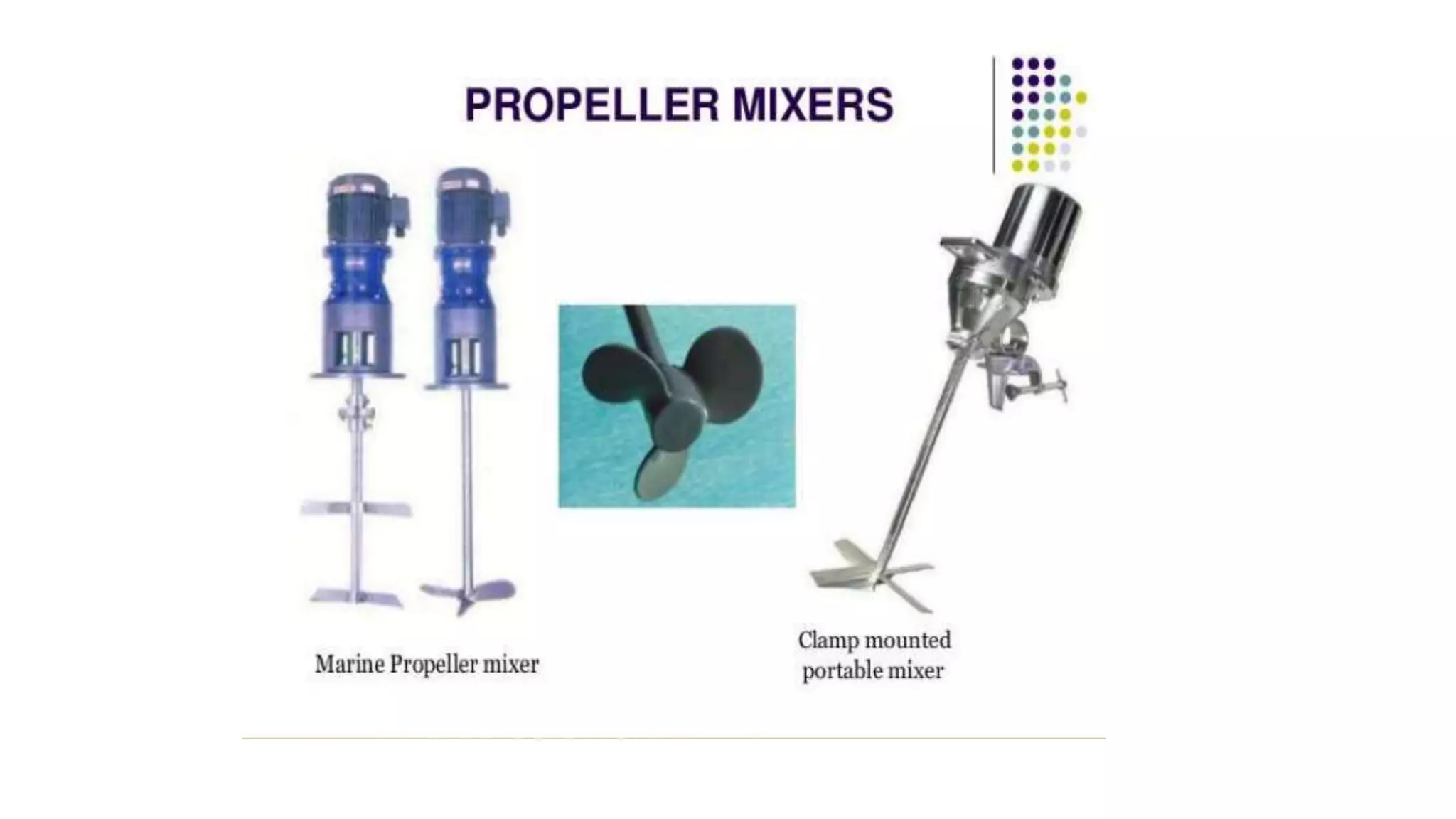
Propeller Mixers
Paddle Mixers
Example
i.e., Shaker Mixer
Agitator Machines
 This pharmaceutical mixer is relied on when mixing
liquids.
 It is recommended that when using this machine, the
liquids being mixed should not be highly viscous.
 The agitator is also relied on in mixing gases into liquid
products.
 You can also rely on this mixer when mixing liquids that
cannot easily mix.
Agitator
semisolid is a substance that is in between a solid and a liquid.
Another name for a semi-solid is a quasi-solid.
Example :
 Mayonnaise is an example of a semi-solid. Mayonnaise does not
hold its shape like a solid but does not flow like a liquid.
 A substance like gel or cream is another example of a semi-solid.
 If the solid is not too coarse, the liquid is not too viscous and
the percentage of solids is not too great, solids can be
suspended in liquids by the use of a propellers or a flat- bladed
turbine in a cylindrical container.
SEMI SOLIDS
FACTORS AFFECTING MIXING OF SOLID PARTICLES
Particle size
Particle shape
Density
Porosity
Volume
Flow properties & charge Mixing mechanism
Mixing time
 Surface area
Apparatus used:
Planetary mixers and sigma blade mixers
used as agitator mixers
Triple roller mills used as shear
mixers-size reduction
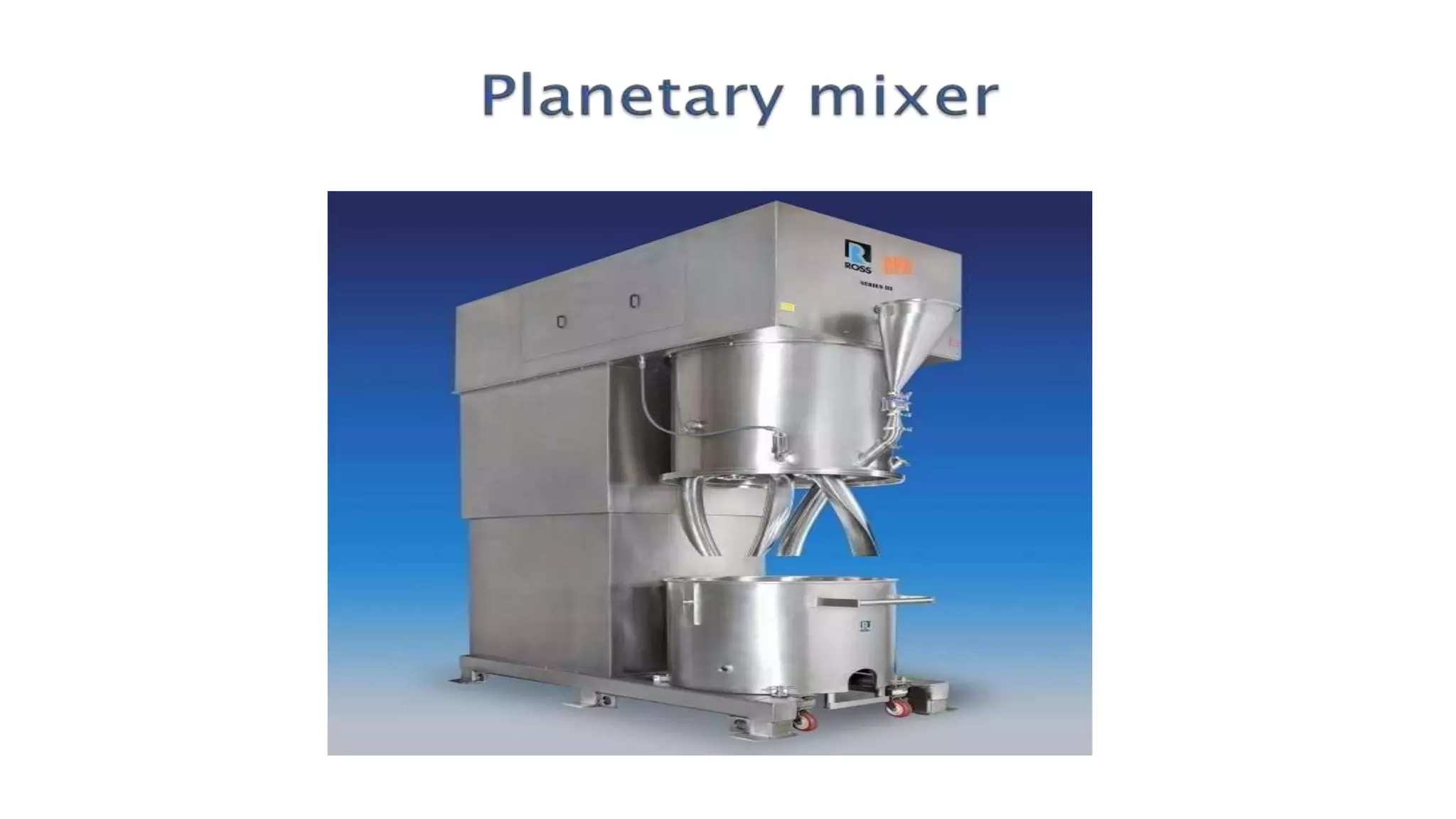
 Planetary mixers are one of the most widely used mixers in the
pharmaceutical industry.
 In the pharmaceutical industry, the planetary mixer is often used
for basic operations of mixing, blending, and low-shear
granulation.
 Also used in other industries
Example : cosmetics Food, Glass, Cements, Ceramics, metal industry
Planetary
Principles
 The Planetary Mixer have two blades which rotate on their
own axes, while they orbitthe mix vessel on a common axis.
 The blades continuously advance along the periphery of the
vessel, removing material from the vessel wall and
transporting it to the interior.
 These mixers are ideal for mixing and kneading
viscous pastes or putty-like materials.
 Planetary mixers are ideal for mixing of pharmaceutical creams, ointments,
ceramics, color and pigments, resins, ink, cosmetic creams, herbal creams etc.
 Planetary mixers are also ideal for mixing and kneading viscous pastes
under atmospheric, vacuum conditions.
 Used in the mixing of viscous, heat sensitive and cohesive pastes, dough and
moist etc.
USE OF PLANETARY
 Tablet Coatings
 Tablet Granulations
 Antacid Powder Blends
 Collagen Solutions
 Dental Composites
 Easeof cleaning
 Easeof discharge
 Semi-continuousoperation
 Capitalcost
 Energysavings
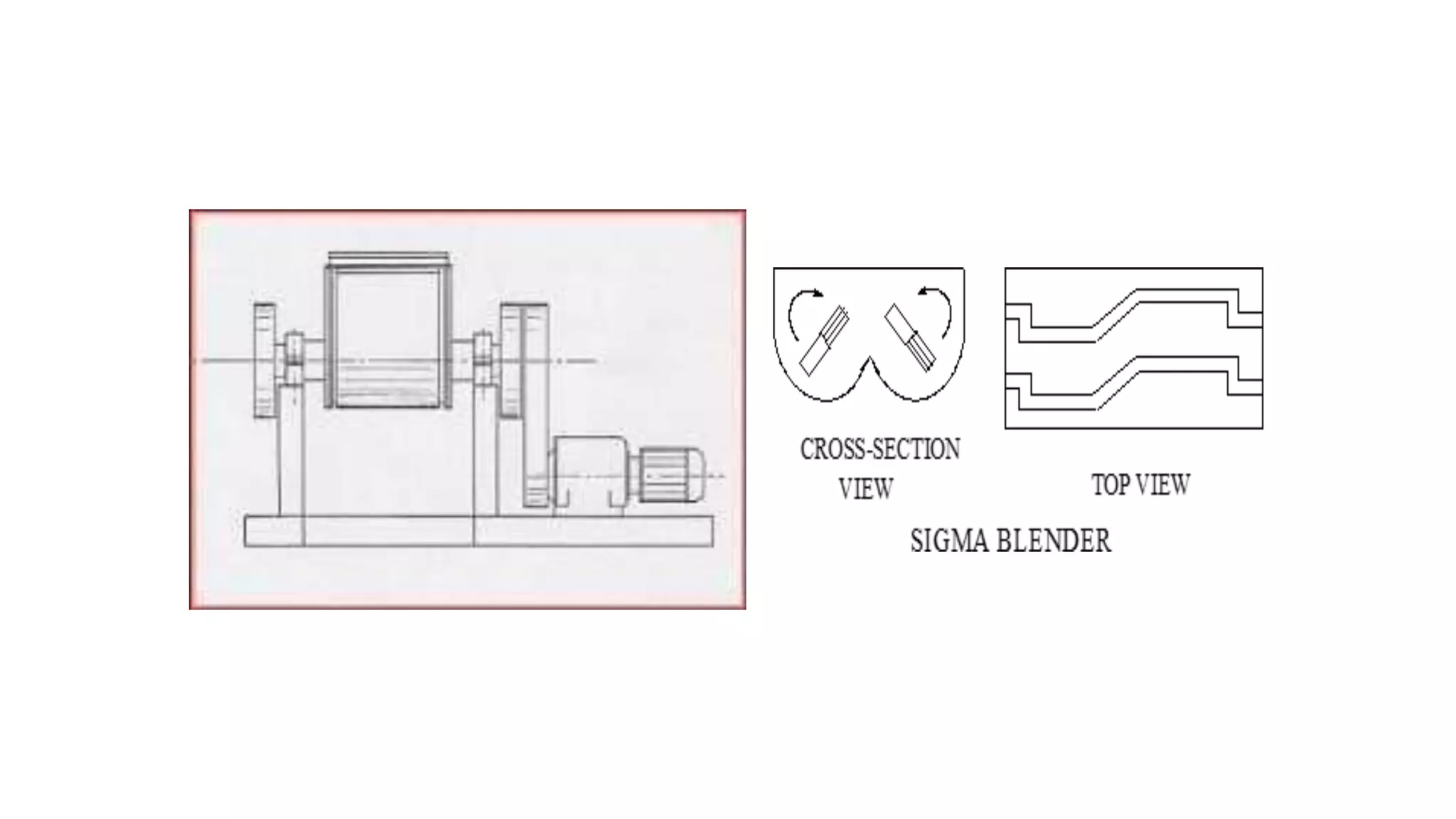
 It is an example of agitator mixers. Its shape
resemble the Greek letter sigma.
 It uses 2 mixer blades.
 Sigma blade mixer is a common form used to
handle semi-solids of plastic consistency.
SIGMA BLADE MIXER
 The two blades rotate towards each other and operate in a
mixing vessel which has a double trough shape, each blade
fitting into a trough.
 The two blades rotate at different speeds, one usually about
twice the speed of the other, resulting in a lateral pulling of
the material and divisions into Troughs, while the blade
shape and difference in speed causesend-to-end movement
Cont..
 It works on the principle of shearingand
convective in action.
 This mixer is designed for mixing, blending and
kneading of medium and heavy on- flowing pastes.
 The impellers and bowls are accurately machined to
close tolerances, eliminating build up and providing
high shear and rapiddistribution of materials.
 It is used for wet granulation process in the manufacture of
tablets, in the production of ointments and pill masses.
 This mixer is well suited to high viscosity materials like grease,
putty, toffee and bubble- gum.
 With its strong construction and high power, the sigma blade
mixer can handle the heaviest plastic materials and products like
tablet granules, and ointments that are mixed readily.
 It is used for solid-solid & liquid-solid mixing.
 It is available in working capacities of 5 litres to 2500 litres.
 To reduce the entrainment of air in ointment masses the sigma
mixer can be enclosed and operated under reduced pressure.
 This avoids entrainment of air and reduces decomposition of
oxidisable materials but use it with caution if mixer contains
volatile materials.
 The vessel is covered for heating and cooling and the blades are
hollowed.
 This is useful as some semi-solids may be reduced in viscosity
by heating, while with other materials it may be necessary to
dissipate the heat resulting from the energy put into the mixing
process
 Available in mild or stainless steel
 Available with hygienic finishes
 Heating or cooling jackets optional
APPEARANCE
ADVANTAGE
 Processes heavy pastes
 No holdup of materials
 Available with single or variable speed
DISADVANTAGE
 It works at a fixed speed
Applications
Sigma blade mixer is used in chemical and pharmaceutical
industries, to food products,
 Adhesives
 Rubber
TRIPLE ROLLER MALL FOR OINTMENT
construction and working principle:
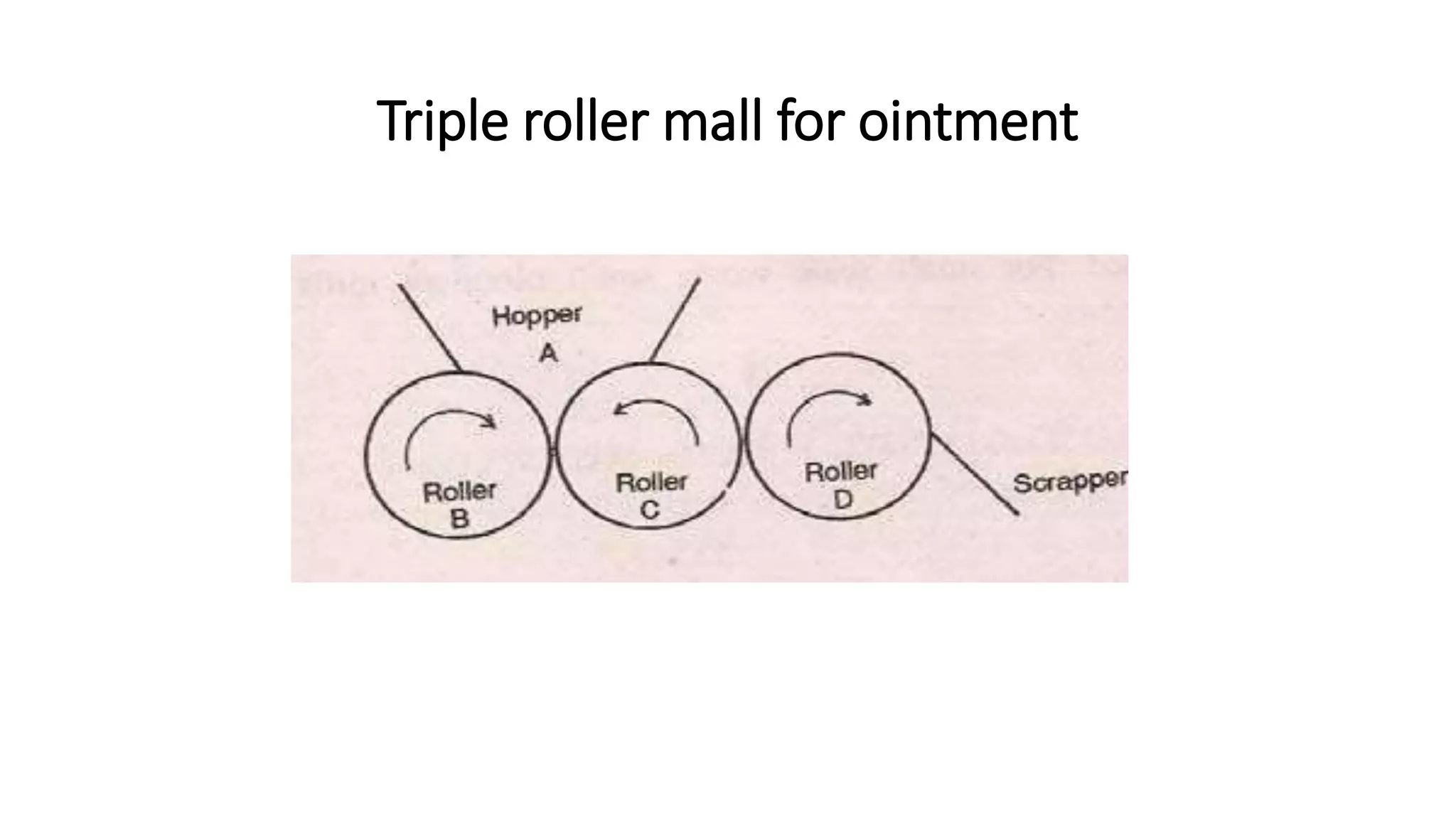
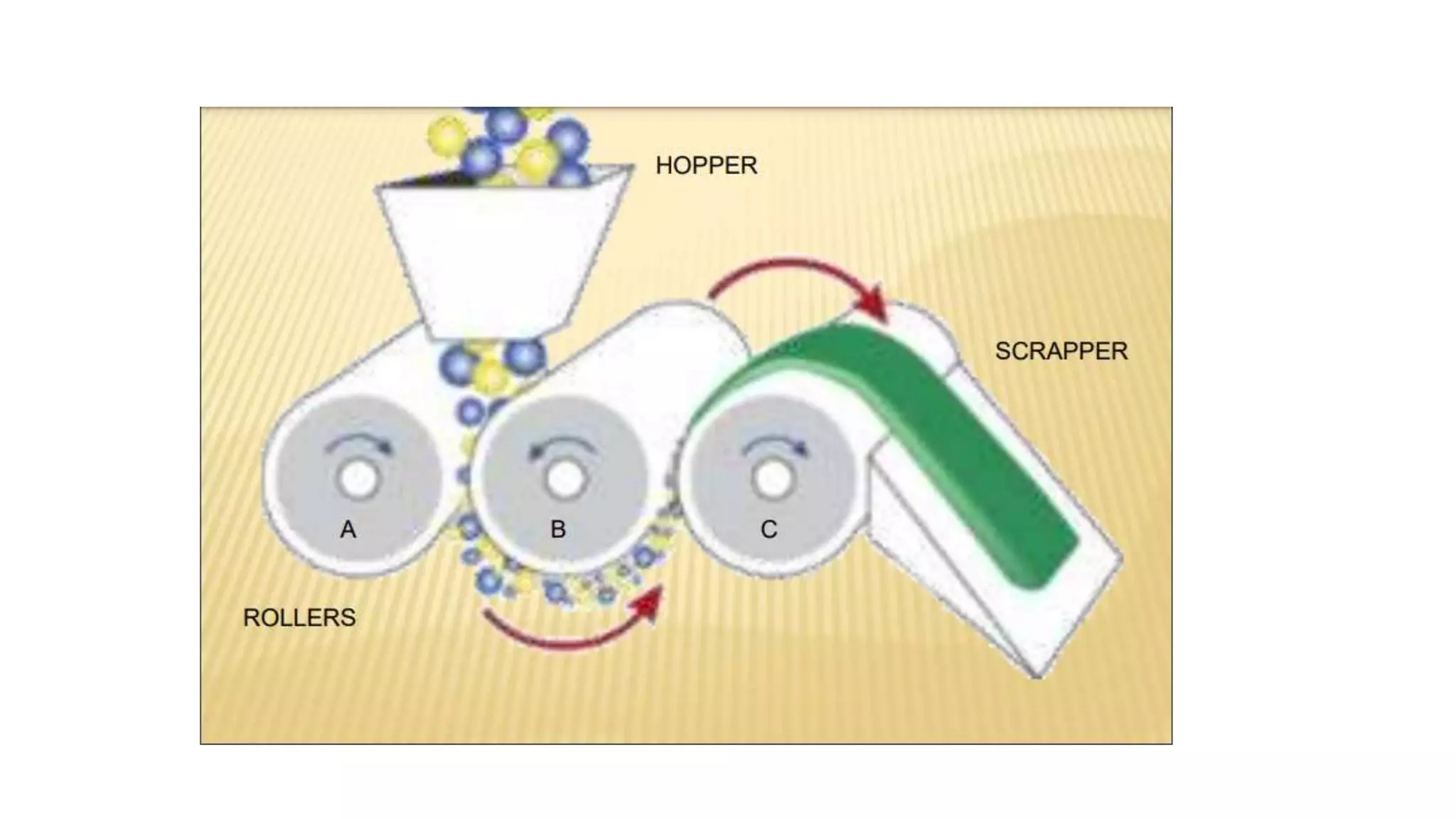
 It is fitted with three rollers, made up of hard abrasion- resistant
materials.
 Rollers are fitted in such a way that they come in close contact with
each other and rotate at different speeds.
 A scraper is used to remove the final ointment of smooth and
uniform texture.
 The feed enters through a hopper.
 The material passes through hopper A, in between
rollers B and C where size reduction occurs.
 Then the ointment is passed between the rollers C
and D, where it is further reducedin size and a
smooth mixture is obtained.
 The gap between rollers C and D is usually less than
the gap between B and C
 The smoothened material is continuously removed
from roller D by means of scraper E, from where it is
collected in a receiver.
Triple roller mall for ointment
Advantage:
Produces a uniform dispersion and a continuous process
Material used:
Stainless steel to prevent contamination
Applications:
To mix paint, chemicals, glass coatings, pigments

Mixin and homoge

  • 1.
  • 4.
     To ensureuniformity  To initiate or to enhance the physical or chemical reactions e.g. diffusion, dissolution etc.  To make the following products:  Tablets  Suspensions  Emulsions  Pastes  Creams  Ointments  Solutions  Syrups  Tablet coatings OBJECTIVE
  • 5.
     Mixing maybe defined as a unit operation in which two or more components, in an unmixed or partially mixed state, are treated so that each unit (particle, molecule etc.) of the components lies as nearly as possible in contact with a unit of each of the other components. DEFINITION
  • 6.
    ADVANTAGE To make simplephysicalmixture In the production of tablets, capsules, sachets and dry powders two or more powders or granules are mixed.
  • 7.
    Physical change  Mixingmay aim at producing a change that is physical i.e., solution of a soluble substance.  Dissolving a solid in a solvent mixing will take place by diffusion but the process will be slow.  Agitation makes the process rapid.
  • 8.
    Dispersion  In caseof emulsions and creams two immiscible liquids are mixed where one liquid is dispersed into other.  In suspension and pastes solid particles are dispersed in a liquid by mixing.
  • 9.
    Promotion of reaction Mixing encourages and controls a chemical reaction, so ensuring uniform products
  • 10.
    There are 3types of mixtures in pharmaceutical industries: A. Positive mixtures:  Formed from materials such as, gases or miscible liquids.  The materials mix spontaneously and irreversibly by diffusion  No input of energy if time of mixing is unlimited, although time will be shortenif energy is supplied.  Generally, do not show any problems during mixing. TYPES OF MIXING
  • 11.
    B. Negative mixtures: Materials have the tendency to separate out from each other.  Energy needs to be supplied to keep components adequately dispersed.  Some separate faster, while for others, the separation is slower. For example  In a suspension, there is the dispersion of solid in the solution (fast separation)  Emulsions, creams and viscous suspension have a slow separation.  Are more difficult to be formed and require high degree of mixing efficiency.
  • 12.
    C. Neutral mixtures: Are static in behavior  Neither mixing nor de-mixing occurs, unless acted upon by an external system of forces. Examples are:  Mixed powders  Pastes  Ointments.
  • 13.
    Liquid mixing A. Mixingof liquid and liquid  Mixing of two or more miscible liquids  Mixing of two or more immiscible liquids B. Mixing of liquid & solid  Mixing of liquids & soluble solids  Mixing of liquids & insoluble solids
  • 14.
    MECHANISM OF MIXING LaminarMixing Laminar mixing processes are based on the repeated separation of the flow into layers, followed by redistribution and recombination parallel to the flow direction. The number of layers, and hence the homogeneity, increases with each additional mixing Turbulent Mixing : Turbulent - The ability of turbulent flows to effectively mix entrained fluids to a molecular scale is a vital part of the dynamics of such flows, with wide-ranging consequences in nature and engineering. It is a considerable experimental, theoretical, modeling, and computational challenge to capture and represent turbulent mixing which, for high Reynolds number (Re) flows, occurs across a spectrum of scales of considerable span. Molecular Diffusion Molecular diffusion is the thermal motion of molecules at temperatures above absolute zero. Diffusion explains the net flux of molecules from a region of higher concentration to one of lower concentration. The term "diffusion" is also generally used to describe the flux of other physical quantities.
  • 15.
    Pharmaceutical Mixers Shouldfollow  Efficient and faster mixing speed  cGmp compliant  Cost competitive  Mixing coefficient is 99%  Charging coefficient up to 80%
  • 16.
    LIQUID MIXERS Shaker Mixers PropellerMixers Paddle Mixers Example i.e., Shaker Mixer
  • 17.
    Agitator Machines  Thispharmaceutical mixer is relied on when mixing liquids.  It is recommended that when using this machine, the liquids being mixed should not be highly viscous.  The agitator is also relied on in mixing gases into liquid products.  You can also rely on this mixer when mixing liquids that cannot easily mix.
  • 18.
  • 19.
    semisolid is asubstance that is in between a solid and a liquid. Another name for a semi-solid is a quasi-solid. Example :  Mayonnaise is an example of a semi-solid. Mayonnaise does not hold its shape like a solid but does not flow like a liquid.  A substance like gel or cream is another example of a semi-solid.  If the solid is not too coarse, the liquid is not too viscous and the percentage of solids is not too great, solids can be suspended in liquids by the use of a propellers or a flat- bladed turbine in a cylindrical container. SEMI SOLIDS
  • 20.
    FACTORS AFFECTING MIXINGOF SOLID PARTICLES Particle size Particle shape Density Porosity Volume Flow properties & charge Mixing mechanism Mixing time  Surface area
  • 22.
    Apparatus used: Planetary mixersand sigma blade mixers used as agitator mixers Triple roller mills used as shear mixers-size reduction
  • 23.
     Planetary mixersare one of the most widely used mixers in the pharmaceutical industry.  In the pharmaceutical industry, the planetary mixer is often used for basic operations of mixing, blending, and low-shear granulation.  Also used in other industries Example : cosmetics Food, Glass, Cements, Ceramics, metal industry Planetary
  • 26.
    Principles  The PlanetaryMixer have two blades which rotate on their own axes, while they orbitthe mix vessel on a common axis.  The blades continuously advance along the periphery of the vessel, removing material from the vessel wall and transporting it to the interior.  These mixers are ideal for mixing and kneading viscous pastes or putty-like materials.
  • 27.
     Planetary mixersare ideal for mixing of pharmaceutical creams, ointments, ceramics, color and pigments, resins, ink, cosmetic creams, herbal creams etc.  Planetary mixers are also ideal for mixing and kneading viscous pastes under atmospheric, vacuum conditions.  Used in the mixing of viscous, heat sensitive and cohesive pastes, dough and moist etc. USE OF PLANETARY
  • 28.
     Tablet Coatings Tablet Granulations  Antacid Powder Blends  Collagen Solutions  Dental Composites
  • 29.
     Easeof cleaning Easeof discharge  Semi-continuousoperation  Capitalcost  Energysavings
  • 30.
     It isan example of agitator mixers. Its shape resemble the Greek letter sigma.  It uses 2 mixer blades.  Sigma blade mixer is a common form used to handle semi-solids of plastic consistency. SIGMA BLADE MIXER
  • 31.
     The twoblades rotate towards each other and operate in a mixing vessel which has a double trough shape, each blade fitting into a trough.  The two blades rotate at different speeds, one usually about twice the speed of the other, resulting in a lateral pulling of the material and divisions into Troughs, while the blade shape and difference in speed causesend-to-end movement Cont..
  • 32.
     It workson the principle of shearingand convective in action.  This mixer is designed for mixing, blending and kneading of medium and heavy on- flowing pastes.  The impellers and bowls are accurately machined to close tolerances, eliminating build up and providing high shear and rapiddistribution of materials.
  • 33.
     It isused for wet granulation process in the manufacture of tablets, in the production of ointments and pill masses.  This mixer is well suited to high viscosity materials like grease, putty, toffee and bubble- gum.  With its strong construction and high power, the sigma blade mixer can handle the heaviest plastic materials and products like tablet granules, and ointments that are mixed readily.  It is used for solid-solid & liquid-solid mixing.
  • 35.
     It isavailable in working capacities of 5 litres to 2500 litres.  To reduce the entrainment of air in ointment masses the sigma mixer can be enclosed and operated under reduced pressure.  This avoids entrainment of air and reduces decomposition of oxidisable materials but use it with caution if mixer contains volatile materials.  The vessel is covered for heating and cooling and the blades are hollowed.  This is useful as some semi-solids may be reduced in viscosity by heating, while with other materials it may be necessary to dissipate the heat resulting from the energy put into the mixing process
  • 36.
     Available inmild or stainless steel  Available with hygienic finishes  Heating or cooling jackets optional APPEARANCE
  • 37.
    ADVANTAGE  Processes heavypastes  No holdup of materials  Available with single or variable speed DISADVANTAGE  It works at a fixed speed
  • 38.
    Applications Sigma blade mixeris used in chemical and pharmaceutical industries, to food products,  Adhesives  Rubber
  • 39.
    TRIPLE ROLLER MALLFOR OINTMENT construction and working principle:  It is fitted with three rollers, made up of hard abrasion- resistant materials.  Rollers are fitted in such a way that they come in close contact with each other and rotate at different speeds.  A scraper is used to remove the final ointment of smooth and uniform texture.  The feed enters through a hopper.
  • 40.
     The materialpasses through hopper A, in between rollers B and C where size reduction occurs.  Then the ointment is passed between the rollers C and D, where it is further reducedin size and a smooth mixture is obtained.  The gap between rollers C and D is usually less than the gap between B and C  The smoothened material is continuously removed from roller D by means of scraper E, from where it is collected in a receiver.
  • 41.
    Triple roller mallfor ointment
  • 43.
    Advantage: Produces a uniformdispersion and a continuous process Material used: Stainless steel to prevent contamination Applications: To mix paint, chemicals, glass coatings, pigments