Guided by: 
Dr.S.B.Bhanja 
M.Pharm,Ph.D
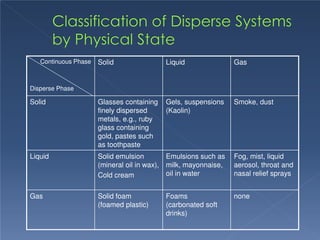
 Dispersion system is defined as a 
heterogenous two phase system in which 
internal (dispersed,discontinous ) phase is 
distributed or dispersed within the 
continuous (external) phase or vehicle. 
 The internal and external phase may be 
solids, liquids and also gases. 
Eg.suspensions,emulsions,aerosols
Continuous Phase 
Disperse Phase 
Solid Liquid Gas 
Solid Glasses containing 
finely dispersed 
metals, e.g., ruby 
glass containing 
gold, pastes such 
as toothpaste 
Gels, suspensions 
(Kaolin) 
Smoke, dust 
Liquid Solid emulsion 
(mineral oil in wax), 
Cold cream 
Emulsions such as 
milk, mayonnaise, 
oil in water 
Fog, mist, liquid 
aerosol, throat and 
nasal relief sprays 
Gas Solid foam 
(foamed plastic) 
Foams 
(carbonated soft 
drinks) 
none
A. Mixers 
B. High speed dispersers 
C. Rotor stator mixers 
D. Combination mixers 
E. In- line mixers 
F. Non- mechanical disperse processing 
G. Fine suspension and size reduction 
equipment
 Propeller mixers 
 Turbine mixers 
 Anchor mixers 
 Scraped surface agitators 
 Counter rotation
 The most often used mixing implement is marine 
propeller mixer. 
 These machines use rounded,pitched,three blade 
design that produces mostly axial flow 
 They provide good flow and blending capabilities 
in small batches of low to medium viscosities 
 Propellers mixers can be installed on vertical 
centerline or through the side wall of process vessel 
 They can be operated at around 300-400rpm 
 These are used mostly for liquid-liquid blending 
applications in some easily producible suspensions.
Marine Propeller mixer 
Clamp mounted 
portable mixer
 The most versatile of all mixers in the entire span of 
mixing equipments are the axial and radial flow 
turbines 
 Turbines mixers can be made to handle huge 
batches,evenupto 5,00,00gal & suitable for 
emulsification process. 
Radial Flow turbine Axial flow turbine
 It is low speed and low 
capability 
 The anchor agitator is a slow 
(50rpm) device whose sole 
function is to rotate the 
contents of a batch in a radial 
direction without providing any 
significant shear 
 They are typically designed to 
be able to withstand a 
maximum viscosity beyond 
which they might actually blend 
or break.
 A flexible or movable 
blades are attached to 
the anchor for the 
purpose of actually 
scrapping the side 
walls,they are known as 
scraped surface 
agitators 
 These are definitely 
required in 
emulsification 
equipment where heat 
transfers are necessary
 It consists of anchor agitator 
and counterrotating set of 
cross bars provides excellent 
blending 
 These works well on 
materials with viscosities 
from 5000-25,000cps 
 By installing a stationary 
baffle,some mixing 
capabilities are improved
It is also called as saw blade disperser  This machine consists of a variable speed 
shaft connected to an impeller with a 
serrated edge  The tip speed is set around 4000 ft/min  The diameter of impeller should be 1/3 of 
diameter of vessel  The impeller should be located one impeller 
diameter off the bottom of vessel  It can deagglomerating particles when the 
viscosities between 10,000 to 20,000cps. 
Application: 
It is used for pigment dispersion,dye stuffs, 
carbon dispersion and paints
Limitations: 
 Air incorporation is 
another problem so 
it is best used for 
suspensions and not 
for emulsions
 This mixing machine uses an impeller that is 
installed at a close tolerance to a stationary 
housing,which baffles and restrict the flow 
caused by the rotation of the impeller in the 
liquid. 
 Particles caught between rotor & stator are 
crushed and separated by mechanical 
action of the impeller. 
 They are three types: 
1. Radial flow with stator 
2. Rotating stator 
3. Axial flow rotor/stator mixers
RADIAL FLOW WITH 
STATOR 
ROTATING STATOR AXIAL FLOW ROTOR/STATOR 
MIXER
 Better control of temperature and pressures 
 Eliminates line loses caused by pumping from 
tank to tank 
 Saves floor space 
 Simplifies the process, save labor costs 
Types : Anchor plus rotor/stator 
Anchor plus disperser 
Counter rotating with coaxial 
rotor/stator
 It is combination of simple 
anchor agitator with a 
rotor/stator mixer 
 It provides a high shear rates 
for dispersion and 
emulsification 
 It is beneficial if there is 
requirement to pull down 
powders from the top 
Limitation: 
 It is difficult to design the 
anchor such that it allows the 
placement of the high shear 
mixer close to the bottom of
 It is combination 
of high speed 
disperser with an 
anchor agitator 
 It works well on 
medium to high 
viscosity 
suspensions
 This design is known as triple action mixer,combines 
the high viscosity mixing capabilities of 
counterrotating axial flow cross bars with a 
standard anchor type scraped surface agitator 
and also with a high speed rotor/stator mixer 
 It is capable of generating fine dispersions and fine 
droplets of the internal phase for stable emulsions 
 It can operated at viscosity of 50,000cps 
 They are always jacketed for heating and cooling 
because it is necessary in case of preparation of 
creams and ointments
Advantages: 
 Handles wide range of 
viscosities from water 
thin to as high as 
1million cps 
 Disperse and emulsifies 
very efficiently 
 Provides shortest mixing 
time 
Disadvantages: 
 Difficult to clean due to 
complicated design
1.Rotor/stator mixer disperser emulsifier 
2.Colloidal mill 
3.Piston homogenizer 
4.Ultrasonic vibrating homogenizer 
5.Micro fluidizer 
6.Low pressure cyclone emulsifier 
7.Homogenizer/Extruders 
8.Static mixer
 These mixers acting as submerged pumps 
design can be made that places the 
rotor/stator in a pump housing and allows 
for product to be pumped through itself. 
 The product inside the rotor/stator mixing 
pump,the droplets and particles subjected 
to a wide variety of high shear rates. 
 It is designed with fine tolerance rotor/stator 
gaps that promotes high shear rates and 
high amount of shear per pass through.
Stage 1 
Stage 2 
Stage 3
 It is used to disperse the solids into liquids 
and to emulsify liquid-liquid systems. 
 These generally used as polishing machines 
for emulsions or suspensions because they 
produce fine particle or droplet size 
product to enhance a products stability. 
 The rotor/stator gap is generally set 
between 0.030 & 0.001 inch. 
 They are operated at speed of 3600 rpm 
 The rotor diameter is 10-30cm provides flow 
rates in the area of 4000-6000L/hr 
depending upon the viscosity.
Advantages : 
 Shear rates high than in rotor/stator 
machines 
 Colloidal mill produces emulsions and 
suspensions with particle size distribution 
smaller than the particle sizes obtainable 
using fixed gap rotor/stator mixers. 
Limitations : 
 Flow rates lower than in rotor/stator 
machines 
 Not used for abrasive products
 It is the most powerfull device for producing 
emulsions and suspensions 
 It uses high power positive displacement 
piston type pump to produce pressure of 
3000-10,000 psig and then force the 
premixed product through a specially 
designed restricting wall where a extremely 
high shear forces are exerted 
 Here turbulence and high shear are the 
major parameters in size reduction
 It having continuous 
Capabilities of 2500L/hr at 
15hp to 50,000L/hr at 
150hp 
Limitations: 
 They cannot handle the 
product feed above 
200cps 
 High maintanence cost 
and down time 
 Lack product homogenity 
and batch to batch 
variability
 Has similarity with high pressure 
homogenizer effective device for 
dispersing and emulsifying 
 It uses a positive displacement pump to 
force the premixed liquid through an 
elliptical opening at a speed of 
100m/sec 
 This high speed flow impinges on to the 
edge of blade shaped obstacle called a 
vibrating knife.
 Capacities and 
pressures of systems 
range from laboratory 
units, producing 4- 
10L/min at 1200-1700 
psig requiring 2-5hp,to 
full scale productions 
units with capacities of 
upto 450L/min at 
350psig requiring 60hp.
 This device uses a high pressure positive 
displacement pump operating at a pressure of 
500-20,000psig which accelerate the process 
flow upto 500m/min through the interaction 
chamber 
 The interaction chamber consists of small 
channels known as micro channels having 
diameter narrow as 50μm and cause the flow 
of product to occur as very thin sheets. 
 The configuration of micro channels within the 
interaction chamber ressembles Y-shaped flow 
streams in which the process stream divides 
into these micro channels,creating two 
separate micro streams
 The micro streams are then brought 
together in an impingement area through 
which all of the product must flow 
 At the impingement area the collision of 
the two high speed flow streams in a very 
tight spot creates various droplet size 
reduction and different mixing mechanisms 
such a cavitation,implosion,shears and 
turbulence 
 The micro fluidizer technology satisfy the 
requirements for producing finest emulsions 
known as micro emulsions
 It is used for formation of emulsions and 
suspensions 
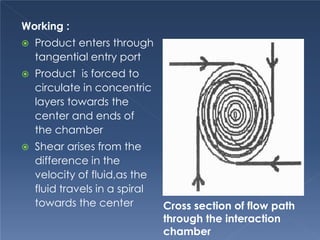
 the shear arises from the difference in the 
velocity of the fluid,as the fluid travels in a spiral 
towards the center 
 They operates in the 200psig and capacities of 
7.5-225L/min. 
 The recommended viscosity limit is 1-2000cps. 
 They are capable of producing emulsions in 
the 
2-10μm range.
Working : 
 Product enters through 
tangential entry port 
 Product is forced to 
circulate in concentric 
layers towards the 
center and ends of 
the chamber 
 Shear arises from the 
difference in the 
velocity of fluid,as the 
fluid travels in a spiral 
towards the center 
Cross section of flow path 
through the interaction 
chamber
 It is a high pressure homogenizer with an 
adjustable valve having production 
capacities from 8mL/hr to 12000mL/hr 
 A positive displacement pump produces 
pressure up to 30,000psig. 
 The apparatus capable of producing 
fine emulsions and liposomal dispersions
 A true low shear and low energy 
requirement device for emulsifying 
immiscible liquid mixture is the static 
mixture. 
 It is also called as pipe line mixture,this 
device is actually a series of specially 
designed baffles in a cylindrical pipe.
 These simple devices are extensively used 
for the preparation of unstable emulsions 
for liquid-liquid extraction purposes 
 Size distributions obtainable range from 100- 
1000μm
Critical fluids liposome process: 
 Near critical or super critical fluid solvents 
with or without polar co-solvents for the 
formation of uniform and stable liposomes 
having high encapsulation efficiences. 
 Super critical fluids can be uniquely used to 
encapsulate very hydrophobic molecules 
 Super critical fluids are gases such as 
carbon dioxide & propane
 When these fluids compressed at 
conditions above their critical 
temperature and pressure,these 
substances become fluids and ability to 
dissolve other materials. 
 The gaseous characteristics increases 
mass transfer rates,thereby significantly 
reducing processing time. 
 Small added amounts of visible polar co-solvents 
such as alcohol can be used to 
adjust polarity and to maximize the 
selectivity and capacity of the solvents
Types: 
1. Triple roll mill 
2. Ball mill 
3. Agitated bead mill
Triple roll mill: 
• Disperse small tightly bound 
agglomerates and hard discrete particles 
 Particles are subjected to 
High shear 
Mechanical crushing 
Smearing
 It is used for size reduction fine solid 
discrete particles or for 
deagglomeration of very tightly bound 
agglomerates. 
 The machine consists of cylindrical drum 
into which a charge of heavy spherical 
balls usually metal or ceramic is loaded 
along with the components of the 
dispersion.
Ball mill 
Limitations 
Typically time consuming process,milling time 
are often measured in days.
 A Modernized improvement of the ball mill is the 
agitated bead mill 
 The bead mill uses a charge of inert small balls to 
2-8mm diameter 
 Media mill- if beads are ceramic 
 Shot mill- if beads are steel 
 Sand mill- if grains of sand are used 
 The Design consist of a cylinder which can be 
either vertical or horizontal,that has a high speed 
agitator,which is capable of fluidizing the charge 
of beads,causing them to collide at very high 
speed.
 The premix is pumped through the 
housing.There is a high probability that 
each particle must be repeatedly 
subjected to the high stresses that result 
when the beads collide with each other or 
the high speed impeller 
 Agitated bead mill is used in pigment 
dispersion industry due to its fine solids 
grinding and dispersing capabilities.It is not 
often used in pharmaceutical industry 
except when particle size requirements falls 
below 10μm.
 Pharmaceutical dosage forms,disperse 
systems volume 3 by 
Lackman,Lieberman,Marcel 
Dekker,NY.pg no:291-362 
 Pharmaceutical engineering(principles & 
practices) by C.V.S. 
Subrahmanyam.pg.no:155,161,229.
ENZYME LINKED IMMUNO SORBENT 
ASSAY(ELISA)& 
RADIO IMMUNOASSAY (RIA) 
P.SAHITHI REDDY 
M.PHARMACY 
H.T.NO:256213886024 
Under the guidance of 
Mr Utham prasad
Contents 
ELISA 
OVERVIEW PRINCIPLE PROTOCOL DIFFERENT TYPES MATERIAL REQUIRED MERITS&DEMERITS APPLICATIONS
OVERVIEW: 
Enzyme Linked Immuno sorbent 
Assay (ELISA) 
Term Was Coined By Engvall and 
Pearlmann in 1971 
is a quantitative technique used in 
immunology to detect the presence of 
an antibody or an antigen in sample
• Antigen of interest is absorbed on to 
surface sorbent 
• Antigen is recognised only by the specific 
antibody immuno 
• This antibody is recognised by second 
antibody (immuno) which has enzyme 
attached (enzyme linked) 
• Substrate reacts with enzyme to produce 
product usually depicted by coloured
PRINCIPLE: 
 ELISA is based on specific interaction between Ag and 
their corresponding Ab. One of the immuno reactant is 
coated to a solid phase support such as polycarbonate, 
polyvinyl polyacrylamide tubes or microwells.  To the respective antibody or antigen is added  To antigen-antibody complex so formed an enzyme 
linked antibody is added. A colourless substance is 
added to well. This substance is a substrate for the 
enzyme which catalyses the conversion of colourless 
substance to coloured product.
MATERIALS REQUIRED 
• Test sample 
• Antibody /Antigen 
• Polystyrene microtiter plates 
• Blocking buffer 
• Washing buffer 
• Substrate 
• Enzyme
Enzymes Used in ELISA 
 Horseradish peroxidase(very 
commonly used )  Alkaline phosphatase  Beta –galactosidase  Lacto peroxidase  Tetra Methyl Benzidine (substrate)
The enzyme substrate should be colourless 
After degradation by the enzyme it should be strongly coloured 
fluorescent
TYPES: 
a)Indirect ELISA 
b)Sandwich ELISA 
c) Competitive ELISA
Sandwich ELISA direct method 
 2 Antibodies Required 
 Must Recognize Different Epitopes 
 1st Antibody Is Referred To As Capture Ab 
 2nd Antibody Detection Ab 
 2nd Antibody Is Biotinylated 
 Enzymes Commonly Used: HRP (Horse Radish 
Peroxidase) And AKP (Alkaline Phosphatase) 
 Substrate is TMB (Chromogen)
The ELISA plate is coated with Antibody to detect 
specific antigen
Protocol for sandwich 
ELISA 
Prepare a surface to which a known quantity of capture 
antibody is bound Block any non specific biding sites on the surface Apply the antigen – containing sample to the plate Wash the plate ,so that unbound antigen is removed Apply enzyme linked primary antibodies as detection 
antibodies which also bind specifically to the antigen
Wash the plate, so that the unbound antibody-enzyme 
conjugates are removed Apply a chemical which is converted by the enzyme 
into a coloured product Measure the absorbency of the plate wells to 
determine the presence and quantity of antigen
Indirect ELISA: 
• The protein antigen to be tested for is added to each 
well of ELISA plate, where it is given time to adhere 
to plastic through charge interactions 
• A solution of non-reacting protein is added to block 
any plastic surface in the well that remains uncoated 
by the protein antigen 
• Then the serum is added, which contains a mixture of 
the serum antibodies, of unknown concentration, 
some of which may bind specifically to the test 
antigen that is coating the well.
Conti…. 
• Afterwards, a secondary antibody is added, which will bind to 
the antibody bound to the test antigen in the well. This 
secondary antibody often has an enzyme attached to it 
• A substrate for this enzyme is then added. Often, this 
substrate changes colour upon reaction with the enzyme. The 
colour change shows that secondary antibody has bound to 
primary antibody, which strongly implies that the donor has 
had an immune reaction to the test antigen. 
• The higher the concentration of the primary antibody that was 
present in the serum, the stronger the colour change. Often a 
spectrometer is used to give quantitative values for colour 
strength 
•
COMPETIVE ELISA 
• The labelled antigen competes for primary antibody 
binding sites with the sample antigen (unlabelled). 
The more antigen in the sample, the less labelled 
antigen is retained in the well and the weaker the 
signal).
RESULTS 
 After reading the results the standard curve is drawn were the 
concentration is plotted on the X-axis and the absorbance on 
the Y-axis.
Advantages 
• Reagents are relatively cheap& have a long shelf life 
• Easy to perform and quick procedures 
• No radiation hazards during handling 
• Has wide usage to variety of infections
Limitations 
 To carry out the test antibody must be 
available  Concentration may be unclear  Possibility of False positive  Possibility of False negative
Applications 
The various sections devoted to the uses are 
 Detection of mycobacterium antibodies in tuberculosis  Detection of rotavirus in faeces  Detection of hepatitis B markers in serum  Detection of HIV antibodies in blood sample  Hormones  Proteins  Drug markers  Serum proteins  Vaccine quality control  Tumour markers
CONTENTS 
RADIO IMMUNOASSAY (RIA) 
OVERVIEW PRINCIPLE MATERIAL REQUIRED PROTOCOL INSTRUMENTAION MERITS&DEMERITS APPLICATIONS
Overview: 
 Radio immuno assay was developed by  Berson&yalow(1956) for the quantitative 
measurement of insulin in human plasma  RIA principles have found wide application in the 
field of drug analysis kinetic studies, immuno 
diagnosis  RIA is specific, sensitive &rapid
An immunoassay is a test that uses antibody and antigen 
complex as means as a mean of generating a measureable 
result 
An antibody :antigen complex is known as a immune 
complex. 
Immunoassays are different from other types of laboratory 
tests, such as colorimetric tests, because they use antibody: 
antigen complexes to generate a signal that can be measured . 
In contrast, most routine clinical chemistry tests utilize 
chemical reaction between the reagent and sample to generate 
a test result
Principle 
RIA is a competitive binding assay. 
The antibody & labelled antigen are always present as 
limiting factors and the concentrations of unlabelled 
antigens(sample) under examination is increased 
continually 
Uses an immune reaction 
(Antigen –antibody reaction ) to estimate ligand
Unbound Ag* and Ag washed 
Radioactivity of bound residue measured 
Ligand conc is inversely related to radioactivity 
[Ag: ligand to be measured ;Ag* radiolabelled ligand ]
Materials required 
a) Preparation &characterisation of Antigen [Ligand to be 
analysed ] 
b) Radiolabelling of the Antigen 
c) Preparation of the specific antibody 
d) Development of Assay system
PREPARATION AND RADIOLABELLING 
OF THE ANTIGEN 
Antigens prepared by 
 synthesis of the molecule  isolation from natural sources 
Radiolabelling [Tagging procedure ] 
 3H,14C,125I are used as radioactive tags  Antigens are tagged to 3H14c125I  tagging should NOT affect antigenic specificity and activity
PREAPRATION OF SPECIFIC 
ANTIBODY 
Antigen injected intradermal into rabbit 
antibody production Antibodies recovered from the serum Some ligand are not antigenic 
hormones ,steroids drugs HAPTENS 
E.g.: castrin morphine
ASSAY Procedure 
Add known amounts of the test sample+ labelled 
antigen into the microtitre wells 
 incubate – allow the reaction to reach completion Decant and wash the contents of the well-removes 
all unbound antigens Radioactivity remaining in the mocrotitre wells 
measured by a counter [GM counter, scintillation 
counter]
Conti… 
Intensity of radioactivity is inversely correlated 
with the conc of the antigens in the test sample
INSTRUMENTATION: 
CENTRIFUGE: 
 swing bucket rotor : 1200-2500 rpm  Fixed angle head rotor :3500-4000 rpm 
RADIOACTIVE counter 
 gamma counter : which is used for a gamma energy 
emitting isotopes. E.g. 125I. Scintillation counter : it is used for beta energy emitting 
isotopes.eg. Tritium 3H and 14C isotopes
The results obtained by plotting a graph 
antibody bound to labelled antigen Unlabelled antigen
Merits and demerits 
Merits : 
highly specific : immune reactions are specific 
high sensitivity : immune reaction are sensitive 
Demerits: 
radiation hazards :uses radiolabelled reagents 
Requires specially trained personnel 
Labs require special license to handle radioactive 
material 
Requires special arrangements for :requisition, 
storage of radioactive material 
radioactive waste disposal.
APPLICTIONS : 
Used in the estimation of pharmaceutical 
drugs like Morphine Clonazepam Barbiturates Neobentine Flurazepam 
And others Insulin Gastrin Glucogon Growth hormones
Limitations : 
 The limitations of the RIA are  Its expensive  Being hazardous Handling the radioactive material  The radio isotopes used 125I or 131I emit gamma 
radiation these requires a special counting machine
References : 
A textbook of pharmaceutical analysis 
Biotechnology and its applications in pharmacy
Disperse systems

Disperse systems

  • 1.
  • 2.
     Dispersion systemis defined as a heterogenous two phase system in which internal (dispersed,discontinous ) phase is distributed or dispersed within the continuous (external) phase or vehicle.  The internal and external phase may be solids, liquids and also gases. Eg.suspensions,emulsions,aerosols
  • 3.
    Continuous Phase DispersePhase Solid Liquid Gas Solid Glasses containing finely dispersed metals, e.g., ruby glass containing gold, pastes such as toothpaste Gels, suspensions (Kaolin) Smoke, dust Liquid Solid emulsion (mineral oil in wax), Cold cream Emulsions such as milk, mayonnaise, oil in water Fog, mist, liquid aerosol, throat and nasal relief sprays Gas Solid foam (foamed plastic) Foams (carbonated soft drinks) none
  • 4.
    A. Mixers B.High speed dispersers C. Rotor stator mixers D. Combination mixers E. In- line mixers F. Non- mechanical disperse processing G. Fine suspension and size reduction equipment
  • 5.
     Propeller mixers  Turbine mixers  Anchor mixers  Scraped surface agitators  Counter rotation
  • 6.
     The mostoften used mixing implement is marine propeller mixer.  These machines use rounded,pitched,three blade design that produces mostly axial flow  They provide good flow and blending capabilities in small batches of low to medium viscosities  Propellers mixers can be installed on vertical centerline or through the side wall of process vessel  They can be operated at around 300-400rpm  These are used mostly for liquid-liquid blending applications in some easily producible suspensions.
  • 7.
    Marine Propeller mixer Clamp mounted portable mixer
  • 8.
     The mostversatile of all mixers in the entire span of mixing equipments are the axial and radial flow turbines  Turbines mixers can be made to handle huge batches,evenupto 5,00,00gal & suitable for emulsification process. Radial Flow turbine Axial flow turbine
  • 9.
     It islow speed and low capability  The anchor agitator is a slow (50rpm) device whose sole function is to rotate the contents of a batch in a radial direction without providing any significant shear  They are typically designed to be able to withstand a maximum viscosity beyond which they might actually blend or break.
  • 10.
     A flexibleor movable blades are attached to the anchor for the purpose of actually scrapping the side walls,they are known as scraped surface agitators  These are definitely required in emulsification equipment where heat transfers are necessary
  • 11.
     It consistsof anchor agitator and counterrotating set of cross bars provides excellent blending  These works well on materials with viscosities from 5000-25,000cps  By installing a stationary baffle,some mixing capabilities are improved
  • 12.
    It is alsocalled as saw blade disperser  This machine consists of a variable speed shaft connected to an impeller with a serrated edge  The tip speed is set around 4000 ft/min  The diameter of impeller should be 1/3 of diameter of vessel  The impeller should be located one impeller diameter off the bottom of vessel  It can deagglomerating particles when the viscosities between 10,000 to 20,000cps. Application: It is used for pigment dispersion,dye stuffs, carbon dispersion and paints
  • 13.
    Limitations:  Airincorporation is another problem so it is best used for suspensions and not for emulsions
  • 14.
     This mixingmachine uses an impeller that is installed at a close tolerance to a stationary housing,which baffles and restrict the flow caused by the rotation of the impeller in the liquid.  Particles caught between rotor & stator are crushed and separated by mechanical action of the impeller.  They are three types: 1. Radial flow with stator 2. Rotating stator 3. Axial flow rotor/stator mixers
  • 15.
    RADIAL FLOW WITH STATOR ROTATING STATOR AXIAL FLOW ROTOR/STATOR MIXER
  • 16.
     Better controlof temperature and pressures  Eliminates line loses caused by pumping from tank to tank  Saves floor space  Simplifies the process, save labor costs Types : Anchor plus rotor/stator Anchor plus disperser Counter rotating with coaxial rotor/stator
  • 17.
     It iscombination of simple anchor agitator with a rotor/stator mixer  It provides a high shear rates for dispersion and emulsification  It is beneficial if there is requirement to pull down powders from the top Limitation:  It is difficult to design the anchor such that it allows the placement of the high shear mixer close to the bottom of
  • 18.
     It iscombination of high speed disperser with an anchor agitator  It works well on medium to high viscosity suspensions
  • 19.
     This designis known as triple action mixer,combines the high viscosity mixing capabilities of counterrotating axial flow cross bars with a standard anchor type scraped surface agitator and also with a high speed rotor/stator mixer  It is capable of generating fine dispersions and fine droplets of the internal phase for stable emulsions  It can operated at viscosity of 50,000cps  They are always jacketed for heating and cooling because it is necessary in case of preparation of creams and ointments
  • 20.
    Advantages:  Handleswide range of viscosities from water thin to as high as 1million cps  Disperse and emulsifies very efficiently  Provides shortest mixing time Disadvantages:  Difficult to clean due to complicated design
  • 21.
    1.Rotor/stator mixer disperseremulsifier 2.Colloidal mill 3.Piston homogenizer 4.Ultrasonic vibrating homogenizer 5.Micro fluidizer 6.Low pressure cyclone emulsifier 7.Homogenizer/Extruders 8.Static mixer
  • 22.
     These mixersacting as submerged pumps design can be made that places the rotor/stator in a pump housing and allows for product to be pumped through itself.  The product inside the rotor/stator mixing pump,the droplets and particles subjected to a wide variety of high shear rates.  It is designed with fine tolerance rotor/stator gaps that promotes high shear rates and high amount of shear per pass through.
  • 23.
    Stage 1 Stage2 Stage 3
  • 24.
     It isused to disperse the solids into liquids and to emulsify liquid-liquid systems.  These generally used as polishing machines for emulsions or suspensions because they produce fine particle or droplet size product to enhance a products stability.  The rotor/stator gap is generally set between 0.030 & 0.001 inch.  They are operated at speed of 3600 rpm  The rotor diameter is 10-30cm provides flow rates in the area of 4000-6000L/hr depending upon the viscosity.
  • 26.
    Advantages : Shear rates high than in rotor/stator machines  Colloidal mill produces emulsions and suspensions with particle size distribution smaller than the particle sizes obtainable using fixed gap rotor/stator mixers. Limitations :  Flow rates lower than in rotor/stator machines  Not used for abrasive products
  • 27.
     It isthe most powerfull device for producing emulsions and suspensions  It uses high power positive displacement piston type pump to produce pressure of 3000-10,000 psig and then force the premixed product through a specially designed restricting wall where a extremely high shear forces are exerted  Here turbulence and high shear are the major parameters in size reduction
  • 28.
     It havingcontinuous Capabilities of 2500L/hr at 15hp to 50,000L/hr at 150hp Limitations:  They cannot handle the product feed above 200cps  High maintanence cost and down time  Lack product homogenity and batch to batch variability
  • 29.
     Has similaritywith high pressure homogenizer effective device for dispersing and emulsifying  It uses a positive displacement pump to force the premixed liquid through an elliptical opening at a speed of 100m/sec  This high speed flow impinges on to the edge of blade shaped obstacle called a vibrating knife.
  • 30.
     Capacities and pressures of systems range from laboratory units, producing 4- 10L/min at 1200-1700 psig requiring 2-5hp,to full scale productions units with capacities of upto 450L/min at 350psig requiring 60hp.
  • 32.
     This deviceuses a high pressure positive displacement pump operating at a pressure of 500-20,000psig which accelerate the process flow upto 500m/min through the interaction chamber  The interaction chamber consists of small channels known as micro channels having diameter narrow as 50μm and cause the flow of product to occur as very thin sheets.  The configuration of micro channels within the interaction chamber ressembles Y-shaped flow streams in which the process stream divides into these micro channels,creating two separate micro streams
  • 33.
     The microstreams are then brought together in an impingement area through which all of the product must flow  At the impingement area the collision of the two high speed flow streams in a very tight spot creates various droplet size reduction and different mixing mechanisms such a cavitation,implosion,shears and turbulence  The micro fluidizer technology satisfy the requirements for producing finest emulsions known as micro emulsions
  • 35.
     It isused for formation of emulsions and suspensions  the shear arises from the difference in the velocity of the fluid,as the fluid travels in a spiral towards the center  They operates in the 200psig and capacities of 7.5-225L/min.  The recommended viscosity limit is 1-2000cps.  They are capable of producing emulsions in the 2-10μm range.
  • 36.
    Working : Product enters through tangential entry port  Product is forced to circulate in concentric layers towards the center and ends of the chamber  Shear arises from the difference in the velocity of fluid,as the fluid travels in a spiral towards the center Cross section of flow path through the interaction chamber
  • 37.
     It isa high pressure homogenizer with an adjustable valve having production capacities from 8mL/hr to 12000mL/hr  A positive displacement pump produces pressure up to 30,000psig.  The apparatus capable of producing fine emulsions and liposomal dispersions
  • 38.
     A truelow shear and low energy requirement device for emulsifying immiscible liquid mixture is the static mixture.  It is also called as pipe line mixture,this device is actually a series of specially designed baffles in a cylindrical pipe.
  • 39.
     These simpledevices are extensively used for the preparation of unstable emulsions for liquid-liquid extraction purposes  Size distributions obtainable range from 100- 1000μm
  • 40.
    Critical fluids liposomeprocess:  Near critical or super critical fluid solvents with or without polar co-solvents for the formation of uniform and stable liposomes having high encapsulation efficiences.  Super critical fluids can be uniquely used to encapsulate very hydrophobic molecules  Super critical fluids are gases such as carbon dioxide & propane
  • 41.
     When thesefluids compressed at conditions above their critical temperature and pressure,these substances become fluids and ability to dissolve other materials.  The gaseous characteristics increases mass transfer rates,thereby significantly reducing processing time.  Small added amounts of visible polar co-solvents such as alcohol can be used to adjust polarity and to maximize the selectivity and capacity of the solvents
  • 43.
    Types: 1. Tripleroll mill 2. Ball mill 3. Agitated bead mill
  • 44.
    Triple roll mill: • Disperse small tightly bound agglomerates and hard discrete particles  Particles are subjected to High shear Mechanical crushing Smearing
  • 45.
     It isused for size reduction fine solid discrete particles or for deagglomeration of very tightly bound agglomerates.  The machine consists of cylindrical drum into which a charge of heavy spherical balls usually metal or ceramic is loaded along with the components of the dispersion.
  • 46.
    Ball mill Limitations Typically time consuming process,milling time are often measured in days.
  • 47.
     A Modernizedimprovement of the ball mill is the agitated bead mill  The bead mill uses a charge of inert small balls to 2-8mm diameter  Media mill- if beads are ceramic  Shot mill- if beads are steel  Sand mill- if grains of sand are used  The Design consist of a cylinder which can be either vertical or horizontal,that has a high speed agitator,which is capable of fluidizing the charge of beads,causing them to collide at very high speed.
  • 48.
     The premixis pumped through the housing.There is a high probability that each particle must be repeatedly subjected to the high stresses that result when the beads collide with each other or the high speed impeller  Agitated bead mill is used in pigment dispersion industry due to its fine solids grinding and dispersing capabilities.It is not often used in pharmaceutical industry except when particle size requirements falls below 10μm.
  • 49.
     Pharmaceutical dosageforms,disperse systems volume 3 by Lackman,Lieberman,Marcel Dekker,NY.pg no:291-362  Pharmaceutical engineering(principles & practices) by C.V.S. Subrahmanyam.pg.no:155,161,229.
  • 51.
    ENZYME LINKED IMMUNOSORBENT ASSAY(ELISA)& RADIO IMMUNOASSAY (RIA) P.SAHITHI REDDY M.PHARMACY H.T.NO:256213886024 Under the guidance of Mr Utham prasad
  • 52.
    Contents ELISA OVERVIEWPRINCIPLE PROTOCOL DIFFERENT TYPES MATERIAL REQUIRED MERITS&DEMERITS APPLICATIONS
  • 53.
    OVERVIEW: Enzyme LinkedImmuno sorbent Assay (ELISA) Term Was Coined By Engvall and Pearlmann in 1971 is a quantitative technique used in immunology to detect the presence of an antibody or an antigen in sample
  • 54.
    • Antigen ofinterest is absorbed on to surface sorbent • Antigen is recognised only by the specific antibody immuno • This antibody is recognised by second antibody (immuno) which has enzyme attached (enzyme linked) • Substrate reacts with enzyme to produce product usually depicted by coloured
  • 55.
    PRINCIPLE:  ELISAis based on specific interaction between Ag and their corresponding Ab. One of the immuno reactant is coated to a solid phase support such as polycarbonate, polyvinyl polyacrylamide tubes or microwells.  To the respective antibody or antigen is added  To antigen-antibody complex so formed an enzyme linked antibody is added. A colourless substance is added to well. This substance is a substrate for the enzyme which catalyses the conversion of colourless substance to coloured product.
  • 56.
    MATERIALS REQUIRED •Test sample • Antibody /Antigen • Polystyrene microtiter plates • Blocking buffer • Washing buffer • Substrate • Enzyme
  • 57.
    Enzymes Used inELISA  Horseradish peroxidase(very commonly used )  Alkaline phosphatase  Beta –galactosidase  Lacto peroxidase  Tetra Methyl Benzidine (substrate)
  • 59.
    The enzyme substrateshould be colourless After degradation by the enzyme it should be strongly coloured fluorescent
  • 60.
    TYPES: a)Indirect ELISA b)Sandwich ELISA c) Competitive ELISA
  • 62.
    Sandwich ELISA directmethod  2 Antibodies Required  Must Recognize Different Epitopes  1st Antibody Is Referred To As Capture Ab  2nd Antibody Detection Ab  2nd Antibody Is Biotinylated  Enzymes Commonly Used: HRP (Horse Radish Peroxidase) And AKP (Alkaline Phosphatase)  Substrate is TMB (Chromogen)
  • 63.
    The ELISA plateis coated with Antibody to detect specific antigen
  • 64.
    Protocol for sandwich ELISA Prepare a surface to which a known quantity of capture antibody is bound Block any non specific biding sites on the surface Apply the antigen – containing sample to the plate Wash the plate ,so that unbound antigen is removed Apply enzyme linked primary antibodies as detection antibodies which also bind specifically to the antigen
  • 65.
    Wash the plate,so that the unbound antibody-enzyme conjugates are removed Apply a chemical which is converted by the enzyme into a coloured product Measure the absorbency of the plate wells to determine the presence and quantity of antigen
  • 67.
    Indirect ELISA: •The protein antigen to be tested for is added to each well of ELISA plate, where it is given time to adhere to plastic through charge interactions • A solution of non-reacting protein is added to block any plastic surface in the well that remains uncoated by the protein antigen • Then the serum is added, which contains a mixture of the serum antibodies, of unknown concentration, some of which may bind specifically to the test antigen that is coating the well.
  • 68.
    Conti…. • Afterwards,a secondary antibody is added, which will bind to the antibody bound to the test antigen in the well. This secondary antibody often has an enzyme attached to it • A substrate for this enzyme is then added. Often, this substrate changes colour upon reaction with the enzyme. The colour change shows that secondary antibody has bound to primary antibody, which strongly implies that the donor has had an immune reaction to the test antigen. • The higher the concentration of the primary antibody that was present in the serum, the stronger the colour change. Often a spectrometer is used to give quantitative values for colour strength •
  • 70.
    COMPETIVE ELISA •The labelled antigen competes for primary antibody binding sites with the sample antigen (unlabelled). The more antigen in the sample, the less labelled antigen is retained in the well and the weaker the signal).
  • 73.
    RESULTS  Afterreading the results the standard curve is drawn were the concentration is plotted on the X-axis and the absorbance on the Y-axis.
  • 74.
    Advantages • Reagentsare relatively cheap& have a long shelf life • Easy to perform and quick procedures • No radiation hazards during handling • Has wide usage to variety of infections
  • 76.
    Limitations  Tocarry out the test antibody must be available  Concentration may be unclear  Possibility of False positive  Possibility of False negative
  • 77.
    Applications The varioussections devoted to the uses are  Detection of mycobacterium antibodies in tuberculosis  Detection of rotavirus in faeces  Detection of hepatitis B markers in serum  Detection of HIV antibodies in blood sample  Hormones  Proteins  Drug markers  Serum proteins  Vaccine quality control  Tumour markers
  • 79.
    CONTENTS RADIO IMMUNOASSAY(RIA) OVERVIEW PRINCIPLE MATERIAL REQUIRED PROTOCOL INSTRUMENTAION MERITS&DEMERITS APPLICATIONS
  • 80.
    Overview:  Radioimmuno assay was developed by  Berson&yalow(1956) for the quantitative measurement of insulin in human plasma  RIA principles have found wide application in the field of drug analysis kinetic studies, immuno diagnosis  RIA is specific, sensitive &rapid
  • 81.
    An immunoassay isa test that uses antibody and antigen complex as means as a mean of generating a measureable result An antibody :antigen complex is known as a immune complex. Immunoassays are different from other types of laboratory tests, such as colorimetric tests, because they use antibody: antigen complexes to generate a signal that can be measured . In contrast, most routine clinical chemistry tests utilize chemical reaction between the reagent and sample to generate a test result
  • 82.
    Principle RIA isa competitive binding assay. The antibody & labelled antigen are always present as limiting factors and the concentrations of unlabelled antigens(sample) under examination is increased continually Uses an immune reaction (Antigen –antibody reaction ) to estimate ligand
  • 83.
    Unbound Ag* andAg washed Radioactivity of bound residue measured Ligand conc is inversely related to radioactivity [Ag: ligand to be measured ;Ag* radiolabelled ligand ]
  • 85.
    Materials required a)Preparation &characterisation of Antigen [Ligand to be analysed ] b) Radiolabelling of the Antigen c) Preparation of the specific antibody d) Development of Assay system
  • 86.
    PREPARATION AND RADIOLABELLING OF THE ANTIGEN Antigens prepared by  synthesis of the molecule  isolation from natural sources Radiolabelling [Tagging procedure ]  3H,14C,125I are used as radioactive tags  Antigens are tagged to 3H14c125I  tagging should NOT affect antigenic specificity and activity
  • 87.
    PREAPRATION OF SPECIFIC ANTIBODY Antigen injected intradermal into rabbit antibody production Antibodies recovered from the serum Some ligand are not antigenic hormones ,steroids drugs HAPTENS E.g.: castrin morphine
  • 88.
    ASSAY Procedure Addknown amounts of the test sample+ labelled antigen into the microtitre wells  incubate – allow the reaction to reach completion Decant and wash the contents of the well-removes all unbound antigens Radioactivity remaining in the mocrotitre wells measured by a counter [GM counter, scintillation counter]
  • 89.
    Conti… Intensity ofradioactivity is inversely correlated with the conc of the antigens in the test sample
  • 90.
    INSTRUMENTATION: CENTRIFUGE: swing bucket rotor : 1200-2500 rpm  Fixed angle head rotor :3500-4000 rpm RADIOACTIVE counter  gamma counter : which is used for a gamma energy emitting isotopes. E.g. 125I. Scintillation counter : it is used for beta energy emitting isotopes.eg. Tritium 3H and 14C isotopes
  • 92.
    The results obtainedby plotting a graph antibody bound to labelled antigen Unlabelled antigen
  • 93.
    Merits and demerits Merits : highly specific : immune reactions are specific high sensitivity : immune reaction are sensitive Demerits: radiation hazards :uses radiolabelled reagents Requires specially trained personnel Labs require special license to handle radioactive material Requires special arrangements for :requisition, storage of radioactive material radioactive waste disposal.
  • 94.
    APPLICTIONS : Usedin the estimation of pharmaceutical drugs like Morphine Clonazepam Barbiturates Neobentine Flurazepam And others Insulin Gastrin Glucogon Growth hormones
  • 95.
    Limitations : The limitations of the RIA are  Its expensive  Being hazardous Handling the radioactive material  The radio isotopes used 125I or 131I emit gamma radiation these requires a special counting machine
  • 96.
    References : Atextbook of pharmaceutical analysis Biotechnology and its applications in pharmacy