Mivan shuttering – latest technology in
construction…
 Mivan shuttering is a fast-paced construction technique which offers
strength and durability to a building by use of aluminium formworks.
 With a growing focus on affordable homes and "Housing for All", real
estate stakeholders are increasingly emphasising on the use of new
and innovative construction techniques. One such technology is
Mivan shuttering which is being promoted for its ability to aid mass
construction activity.
So, what exactly is Mivan Technology?
• Mivan is an aluminium formwork system developed by a European construction
company.
• In 1990, the Mivan Company Ltd. from Malaysia started manufacturing these
formwork systems.
• Today, more than 30,000sqm of formwork from Mivan Co. Ltd. is used across the
world.
• There are a number of buildings in India that are being constructed with the
help of the Mivan system, that has proven economical as well as satisfactory for
the overall Indian construction environment.
• The technology has been used extensively in Europe, Gulf Countries, Asia and
other parts of the world.
So, what exactly is Mivan Technology?
• It is suitable for constructing large number of houses in a short span of time
using room size forms to construct walls and slabs in one continuous pour on
concrete. In this system of formwork construction, cast–in–situ concrete wall and
floor slabs cast monolithic provides the structural system in one continuous
pour.
• To facilitate fast construction, early removal of forms can be achieved by hot air
curing / curing compounds.
• Large room sized forms for walls and floor slabs are erected at site.
• These strong and sturdy forms are fabricated with accuracy and are easy to
handle.
• The concrete is produced in RMC batching plants under strict quality control and
convey it to site with transit mixers.
So, what exactly is Mivan Technology?
• The frames for windows, doors and ducts for services are placed in the form
before concreting.
• Staircase flights, façade panels, chajjas and jalis etc. and other pre-fabricated
items are also integrated into the structure.
• This proves to be a major advantage as compared to other modern construction
techniques.
• High quality Mivan Formwork panels ensure consistency of dimensions.
• On the removal of the formwork mould a high quality concrete finish is produced
to accurate tolerances and verticality. The high tolerance of the finish means
that, no further plastering is required.
Sheet Thickness & Panel Sizes
• The concrete face of panels (Al Sheet) is 4 mm thick.
• Standard sizes of Panels are: 2000x600,2000x300,1200x300,850x300.
• Apart from above any size as required can be manufactured and delivered.
Load Carrying Capacity
• High load carrying capacity of 7-8 Tonnes Per square meter
• Light weight is the main advantage over conventional formwork technology.
• Aluminium formwork weighs around 18-20 kg per meter square.
Cycle Time
• Vertical (Wall) Formwork – 12 hours after concreting or when concrete strength
has reached 2N/mm2.
• Horizontal (Deck) Formwork – 36 hours after concreting or when concrete
strength has reached 10N/mm2.
• High speed of construction can be achieved by this system that means faster
completion of project.
• 7 Days per floor.
Uses of Mivan Formwork
• 3S – System of Construction – Speed, Strength, Safety
• Column and beam construction are eliminated
• Walls and slabs are cast in one operation
• Specially designed, easy to handle light weight pre-engineered aluminium forms
• Fitting and erecting the portion of shuttering
• Carrying out concreting of the walls and slabs together
Use in India
• So far, the technology has not been used extensively in India. The
concept is popular in Gulf countries, Europe and some parts of Asia.
However, its use is being promoted in India to realise the most
ambitious government scheme – Housing for All by 2022.
• To make housing affordable for masses, there is a need to focus on
new construction technologies which can reduce construction time
and cost. Mivan Shuttering is the solution to this. In addition to saving
time and money, the technology can also ensure quality and strength
of buildings.
Construction technique
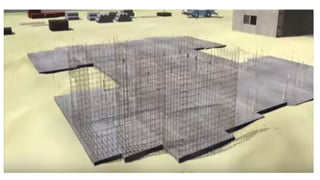
• Setting up the wall reinforcing steel - The wall reinforcing steel is used to give a
structure to the building and support the concrete until they gain half of the
required strength. The aluminium formworks are cast around the steel mesh,
which is factory made and directly erected on the construction site.
• Placement of aluminium formwork – Along the wall reinforcing steel,
prefabricated room sized walls and floor slabs are erected. These aluminium alloy
slabs are accurately made and are easy to handle.
• Spaces for windows, ducts, doors and other features such as staircases, façade
panels and chajjas are also integrated in these structures. The forms are joint
together using the pin and wedge system, which can be dismantled quickly after
the concrete structure is made.
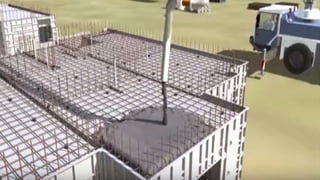
Pouring concrete – After casting the forms, high-quality concrete is
poured. This concrete takes the form and shape of the cast, which is
later removed to make way for a structure made entirely of cement
concrete supported by wall reinforcing steel. The aluminium forms can
be reused at least 250 times, resulting in minimum waste from the
construction site.
Advantages
• Mivan formwork requires relatively less labour
• More seismic resistance
• Increased durability
• Lesser number of joints and reduced leakages
• Higher carpet area
• Smooth finishing of wall and slab
• Uniform quality of construction
• Negligible maintenance
• Faster completion
Limitations of Mivan Technology
• Because of few small sizes finishing lines are seen on the concrete surfaces
Services after completing become slightly difficult due to the small width of
components
• It requires uniform planning as well as uniform elevations to be cost
effective
• The formwork requires number of spacer, wall ties etc. which are placed @
2ft c/c; these produce problems such as seepage, leakages during monsoon
due to box-type construction, contraction cracks are likely to appear
• Heat of hydration is high due to shear walls
• It is rigid in design once placed, as any alteration becomes tough later
Limitations of Mivan Technology
• It remains to be seen if this technology works in the construction industry
considering indigenous technologies are promoted off late. However, if
the advantages of the technology meet the larger goal of 'Housing for All',
it could prove to be a boon for Indian real estate.
Remedial Measures
It is possible to minimize contraction cracks by providing control strips
in the structure which could be concreted with a delay of about 3-7
days after major concreting. The problem of cracking can be avoided by
minimizing the heat of hydration by using flash.
COSTING
Here we considering mivan cost as 120USD per Sqm. without any taxes.
Now 1 USD = @ 62 INR
Hence, for per sq.m the cost is around 7500 I.N.R.
And for one sq.ft. it is around 700 I.N.R.
Mivan shuttering – latest technology in
construction…
CONCLUSION
Concrete construction has gone through significant changes since the
early 1990s and continues to develop innovation in formwork. Some of
the pioneering companies in modern form working system are peri,
doca system, outinord, meva, acrow. Mivan formwork construction is
able to provide high quality construction at unbelievable speed at
reasonable cost. This mivan technology has great potential for
application in India to provide affordable housing to its rising
population.
THANK YOU !

Mivan

  • 1.
    Mivan shuttering –latest technology in construction…  Mivan shuttering is a fast-paced construction technique which offers strength and durability to a building by use of aluminium formworks.  With a growing focus on affordable homes and "Housing for All", real estate stakeholders are increasingly emphasising on the use of new and innovative construction techniques. One such technology is Mivan shuttering which is being promoted for its ability to aid mass construction activity.
  • 2.
    So, what exactlyis Mivan Technology? • Mivan is an aluminium formwork system developed by a European construction company. • In 1990, the Mivan Company Ltd. from Malaysia started manufacturing these formwork systems. • Today, more than 30,000sqm of formwork from Mivan Co. Ltd. is used across the world. • There are a number of buildings in India that are being constructed with the help of the Mivan system, that has proven economical as well as satisfactory for the overall Indian construction environment. • The technology has been used extensively in Europe, Gulf Countries, Asia and other parts of the world.
  • 3.
    So, what exactlyis Mivan Technology? • It is suitable for constructing large number of houses in a short span of time using room size forms to construct walls and slabs in one continuous pour on concrete. In this system of formwork construction, cast–in–situ concrete wall and floor slabs cast monolithic provides the structural system in one continuous pour. • To facilitate fast construction, early removal of forms can be achieved by hot air curing / curing compounds. • Large room sized forms for walls and floor slabs are erected at site. • These strong and sturdy forms are fabricated with accuracy and are easy to handle. • The concrete is produced in RMC batching plants under strict quality control and convey it to site with transit mixers.
  • 4.
    So, what exactlyis Mivan Technology? • The frames for windows, doors and ducts for services are placed in the form before concreting. • Staircase flights, façade panels, chajjas and jalis etc. and other pre-fabricated items are also integrated into the structure. • This proves to be a major advantage as compared to other modern construction techniques. • High quality Mivan Formwork panels ensure consistency of dimensions. • On the removal of the formwork mould a high quality concrete finish is produced to accurate tolerances and verticality. The high tolerance of the finish means that, no further plastering is required.
  • 5.
    Sheet Thickness &Panel Sizes • The concrete face of panels (Al Sheet) is 4 mm thick. • Standard sizes of Panels are: 2000x600,2000x300,1200x300,850x300. • Apart from above any size as required can be manufactured and delivered.
  • 6.
    Load Carrying Capacity •High load carrying capacity of 7-8 Tonnes Per square meter • Light weight is the main advantage over conventional formwork technology. • Aluminium formwork weighs around 18-20 kg per meter square.
  • 7.
    Cycle Time • Vertical(Wall) Formwork – 12 hours after concreting or when concrete strength has reached 2N/mm2. • Horizontal (Deck) Formwork – 36 hours after concreting or when concrete strength has reached 10N/mm2. • High speed of construction can be achieved by this system that means faster completion of project. • 7 Days per floor.
  • 8.
    Uses of MivanFormwork • 3S – System of Construction – Speed, Strength, Safety • Column and beam construction are eliminated • Walls and slabs are cast in one operation • Specially designed, easy to handle light weight pre-engineered aluminium forms • Fitting and erecting the portion of shuttering • Carrying out concreting of the walls and slabs together
  • 9.
    Use in India •So far, the technology has not been used extensively in India. The concept is popular in Gulf countries, Europe and some parts of Asia. However, its use is being promoted in India to realise the most ambitious government scheme – Housing for All by 2022. • To make housing affordable for masses, there is a need to focus on new construction technologies which can reduce construction time and cost. Mivan Shuttering is the solution to this. In addition to saving time and money, the technology can also ensure quality and strength of buildings.
  • 10.
    Construction technique • Settingup the wall reinforcing steel - The wall reinforcing steel is used to give a structure to the building and support the concrete until they gain half of the required strength. The aluminium formworks are cast around the steel mesh, which is factory made and directly erected on the construction site. • Placement of aluminium formwork – Along the wall reinforcing steel, prefabricated room sized walls and floor slabs are erected. These aluminium alloy slabs are accurately made and are easy to handle. • Spaces for windows, ducts, doors and other features such as staircases, façade panels and chajjas are also integrated in these structures. The forms are joint together using the pin and wedge system, which can be dismantled quickly after the concrete structure is made.
  • 14.
    Pouring concrete –After casting the forms, high-quality concrete is poured. This concrete takes the form and shape of the cast, which is later removed to make way for a structure made entirely of cement concrete supported by wall reinforcing steel. The aluminium forms can be reused at least 250 times, resulting in minimum waste from the construction site.
  • 17.
    Advantages • Mivan formworkrequires relatively less labour • More seismic resistance • Increased durability • Lesser number of joints and reduced leakages • Higher carpet area • Smooth finishing of wall and slab • Uniform quality of construction • Negligible maintenance • Faster completion
  • 18.
    Limitations of MivanTechnology • Because of few small sizes finishing lines are seen on the concrete surfaces Services after completing become slightly difficult due to the small width of components • It requires uniform planning as well as uniform elevations to be cost effective • The formwork requires number of spacer, wall ties etc. which are placed @ 2ft c/c; these produce problems such as seepage, leakages during monsoon due to box-type construction, contraction cracks are likely to appear • Heat of hydration is high due to shear walls • It is rigid in design once placed, as any alteration becomes tough later
  • 19.
    Limitations of MivanTechnology • It remains to be seen if this technology works in the construction industry considering indigenous technologies are promoted off late. However, if the advantages of the technology meet the larger goal of 'Housing for All', it could prove to be a boon for Indian real estate.
  • 20.
    Remedial Measures It ispossible to minimize contraction cracks by providing control strips in the structure which could be concreted with a delay of about 3-7 days after major concreting. The problem of cracking can be avoided by minimizing the heat of hydration by using flash.
  • 22.
    COSTING Here we consideringmivan cost as 120USD per Sqm. without any taxes. Now 1 USD = @ 62 INR Hence, for per sq.m the cost is around 7500 I.N.R. And for one sq.ft. it is around 700 I.N.R.
  • 23.
    Mivan shuttering –latest technology in construction…
  • 24.
    CONCLUSION Concrete construction hasgone through significant changes since the early 1990s and continues to develop innovation in formwork. Some of the pioneering companies in modern form working system are peri, doca system, outinord, meva, acrow. Mivan formwork construction is able to provide high quality construction at unbelievable speed at reasonable cost. This mivan technology has great potential for application in India to provide affordable housing to its rising population.
  • 25.