SEM
SCALE
DATE
SHEET NO.
10 - 03 - 2018
1:500
COLLEGE
SUBJECT
CLASS
R.NO.
613 - LOW COST BUILDING MATERIALS AND CONSTRUCTION TECHNIQUES.
SOUMITRA SMARTNAME
JAWAHARLAL NEHRU ENGINEERING COLLEGE, CIDCO, AURANGABAD.
20213220171703210006
M-ARCH - GENERAL
2nd
SEMESTER
EARTH ARCHITECTURE7
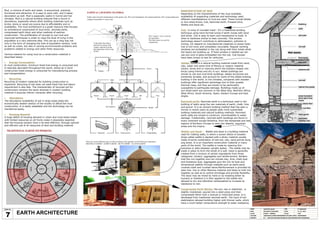
Mud, a mixture of earth and water, is economical, practical,
functional and attractive. It is easy to work with, and it takes
decoration as well. Mud is especially useful in humid and hot
climates. Mud is a natural building material that is found in
abundance, especially where other building materials such as
bricks, stone or wood are scarce due to affordability and or
availability. The mud architecture is a great resource that focuses
on architecture constructed of mud brick, rammed earth,
compressed earth block and other methods of earthen
construction. The proliferation of concept to use mud and
improved techniques in order to raise the level of living in the
population is a very welcome idea. This can go a long way not
only in the form of changing the look of population centers, rural
as well as urban, but also in solving environmental problems and
problems related to energy and other finite resources.
Various reasons for using mud as a construction material is
described below:
Energy Consumption
In mud construction, minimum fossil fuel energy is consumed and
is naturally abundant throughout the world, where as in brick
construction fossil energy is consumed for manufacturing process
and transportation.
Recycling
Recycling of modern materials for building construction is
expensive. Recycling of soil does not need fossil fuel and labour
requirement is also less. The characteristic of recycled soil for
construction remains the same whereas in modern building
material it acquires inferior character after recycling.
Abundance
The abundance availability of soil in large areas helps the
economically weaker section of the society to afford the mud
construction. It is easily adaptable and the technology can be
transferred easily.
Housing demand
A huge deficit of housing demand in urban and rural areas linked
with limited resources on all fronts make it absolutely essential
that the housing solution have o be best effective, through optimal
and efficient use of all resources of land and building material.
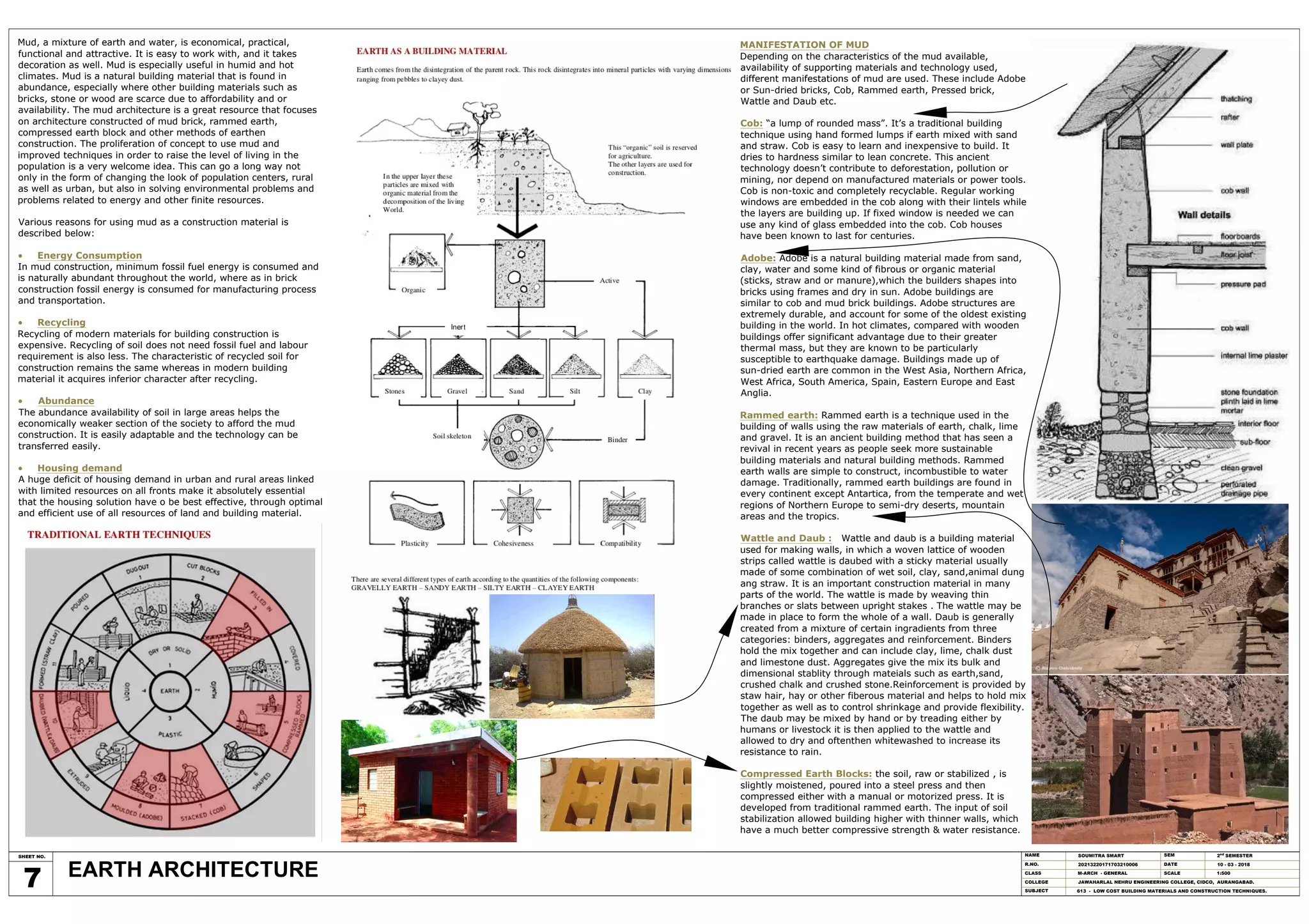
MANIFESTATION OF MUD
Depending on the characteristics of the mud available,
availability of supporting materials and technology used,
different manifestations of mud are used. These include Adobe
or Sun-dried bricks, Cob, Rammed earth, Pressed brick,
Wattle and Daub etc.
Cob:
technique using hand formed lumps if earth mixed with sand
and straw. Cob is easy to learn and inexpensive to build. It
dries to hardness similar to lean concrete. This ancient
mining, nor depend on manufactured materials or power tools.
Cob is non-toxic and completely recyclable. Regular working
windows are embedded in the cob along with their lintels while
the layers are building up. If fixed window is needed we can
use any kind of glass embedded into the cob. Cob houses
have been known to last for centuries.
Adobe: Adobe is a natural building material made from sand,
clay, water and some kind of fibrous or organic material
(sticks, straw and or manure),which the builders shapes into
bricks using frames and dry in sun. Adobe buildings are
similar to cob and mud brick buildings. Adobe structures are
extremely durable, and account for some of the oldest existing
building in the world. In hot climates, compared with wooden
buildings offer significant advantage due to their greater
thermal mass, but they are known to be particularly
susceptible to earthquake damage. Buildings made up of
sun-dried earth are common in the West Asia, Northern Africa,
West Africa, South America, Spain, Eastern Europe and East
Anglia.
Rammed earth: Rammed earth is a technique used in the
building of walls using the raw materials of earth, chalk, lime
and gravel. It is an ancient building method that has seen a
revival in recent years as people seek more sustainable
building materials and natural building methods. Rammed
earth walls are simple to construct, incombustible to water
damage. Traditionally, rammed earth buildings are found in
every continent except Antartica, from the temperate and wet
regions of Northern Europe to semi-dry deserts, mountain
areas and the tropics.
Wattle and Daub : Wattle and daub is a building material
used for making walls, in which a woven lattice of wooden
strips called wattle is daubed with a sticky material usually
made of some combination of wet soil, clay, sand,animal dung
ang straw. It is an important construction material in many
parts of the world. The wattle is made by weaving thin
branches or slats between upright stakes . The wattle may be
made in place to form the whole of a wall. Daub is generally
created from a mixture of certain ingradients from three
categories: binders, aggregates and reinforcement. Binders
hold the mix together and can include clay, lime, chalk dust
and limestone dust. Aggregates give the mix its bulk and
dimensional stablity through mateials such as earth,sand,
crushed chalk and crushed stone.Reinforcement is provided by
staw hair, hay or other fiberous material and helps to hold mix
together as well as to control shrinkage and provide flexibility.
The daub may be mixed by hand or by treading either by
humans or livestock it is then applied to the wattle and
allowed to dry and oftenthen whitewashed to increase its
resistance to rain.
Compressed Earth Blocks: the soil, raw or stabilized , is
slightly moistened, poured into a steel press and then
compressed either with a manual or motorized press. It is
developed from traditional rammed earth. The input of soil
stabilization allowed building higher with thinner walls, which
have a much better compressive strength & water resistance.

Low cost building materials

  • 1.
    SEM SCALE DATE SHEET NO. 10 -03 - 2018 1:500 COLLEGE SUBJECT CLASS R.NO. 613 - LOW COST BUILDING MATERIALS AND CONSTRUCTION TECHNIQUES. SOUMITRA SMARTNAME JAWAHARLAL NEHRU ENGINEERING COLLEGE, CIDCO, AURANGABAD. 20213220171703210006 M-ARCH - GENERAL 2nd SEMESTER EARTH ARCHITECTURE7 Mud, a mixture of earth and water, is economical, practical, functional and attractive. It is easy to work with, and it takes decoration as well. Mud is especially useful in humid and hot climates. Mud is a natural building material that is found in abundance, especially where other building materials such as bricks, stone or wood are scarce due to affordability and or availability. The mud architecture is a great resource that focuses on architecture constructed of mud brick, rammed earth, compressed earth block and other methods of earthen construction. The proliferation of concept to use mud and improved techniques in order to raise the level of living in the population is a very welcome idea. This can go a long way not only in the form of changing the look of population centers, rural as well as urban, but also in solving environmental problems and problems related to energy and other finite resources. Various reasons for using mud as a construction material is described below: Energy Consumption In mud construction, minimum fossil fuel energy is consumed and is naturally abundant throughout the world, where as in brick construction fossil energy is consumed for manufacturing process and transportation. Recycling Recycling of modern materials for building construction is expensive. Recycling of soil does not need fossil fuel and labour requirement is also less. The characteristic of recycled soil for construction remains the same whereas in modern building material it acquires inferior character after recycling. Abundance The abundance availability of soil in large areas helps the economically weaker section of the society to afford the mud construction. It is easily adaptable and the technology can be transferred easily. Housing demand A huge deficit of housing demand in urban and rural areas linked with limited resources on all fronts make it absolutely essential that the housing solution have o be best effective, through optimal and efficient use of all resources of land and building material. MANIFESTATION OF MUD Depending on the characteristics of the mud available, availability of supporting materials and technology used, different manifestations of mud are used. These include Adobe or Sun-dried bricks, Cob, Rammed earth, Pressed brick, Wattle and Daub etc. Cob: technique using hand formed lumps if earth mixed with sand and straw. Cob is easy to learn and inexpensive to build. It dries to hardness similar to lean concrete. This ancient mining, nor depend on manufactured materials or power tools. Cob is non-toxic and completely recyclable. Regular working windows are embedded in the cob along with their lintels while the layers are building up. If fixed window is needed we can use any kind of glass embedded into the cob. Cob houses have been known to last for centuries. Adobe: Adobe is a natural building material made from sand, clay, water and some kind of fibrous or organic material (sticks, straw and or manure),which the builders shapes into bricks using frames and dry in sun. Adobe buildings are similar to cob and mud brick buildings. Adobe structures are extremely durable, and account for some of the oldest existing building in the world. In hot climates, compared with wooden buildings offer significant advantage due to their greater thermal mass, but they are known to be particularly susceptible to earthquake damage. Buildings made up of sun-dried earth are common in the West Asia, Northern Africa, West Africa, South America, Spain, Eastern Europe and East Anglia. Rammed earth: Rammed earth is a technique used in the building of walls using the raw materials of earth, chalk, lime and gravel. It is an ancient building method that has seen a revival in recent years as people seek more sustainable building materials and natural building methods. Rammed earth walls are simple to construct, incombustible to water damage. Traditionally, rammed earth buildings are found in every continent except Antartica, from the temperate and wet regions of Northern Europe to semi-dry deserts, mountain areas and the tropics. Wattle and Daub : Wattle and daub is a building material used for making walls, in which a woven lattice of wooden strips called wattle is daubed with a sticky material usually made of some combination of wet soil, clay, sand,animal dung ang straw. It is an important construction material in many parts of the world. The wattle is made by weaving thin branches or slats between upright stakes . The wattle may be made in place to form the whole of a wall. Daub is generally created from a mixture of certain ingradients from three categories: binders, aggregates and reinforcement. Binders hold the mix together and can include clay, lime, chalk dust and limestone dust. Aggregates give the mix its bulk and dimensional stablity through mateials such as earth,sand, crushed chalk and crushed stone.Reinforcement is provided by staw hair, hay or other fiberous material and helps to hold mix together as well as to control shrinkage and provide flexibility. The daub may be mixed by hand or by treading either by humans or livestock it is then applied to the wattle and allowed to dry and oftenthen whitewashed to increase its resistance to rain. Compressed Earth Blocks: the soil, raw or stabilized , is slightly moistened, poured into a steel press and then compressed either with a manual or motorized press. It is developed from traditional rammed earth. The input of soil stabilization allowed building higher with thinner walls, which have a much better compressive strength & water resistance.