R S K Chaitanya
Amara Raja Infra Private Limited
Vs
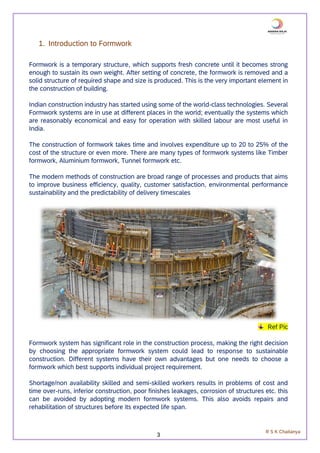
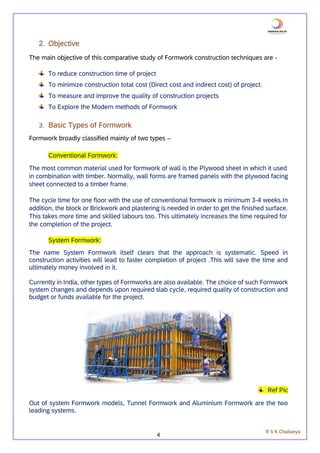
Comparison of Conventional Formwork System Construction
With
Aluminium Formwork System
2
R S K Chaitanya
Index
Page No
1. Introduction to Form Work - 3
2. Objective - 4
3. Basic Types of Formwork - 4
4. Formwork Scenario in India - 7
5. Need for Modern Formwork Systems - 7
6. Material Wastage in Construction - 8
7. Conventional Formwork - 9
8. Aluminium Formwork - 15
9. Comparison of Aluminium FW and Conventional Formwork - 27
10. Cost and Scrap Value of Aluminium Formwork - 29
11. Conclusion - 30
3
R S K Chaitanya
1. Introduction to Formwork
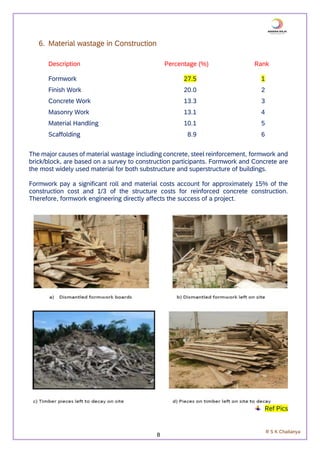
Formwork is a temporary structure, which supports fresh concrete until it becomes strong
enough to sustain its own weight. After setting of concrete, the formwork is removed and a
solid structure of required shape and size is produced. This is the very important element in
the construction of building.
Indian construction industry has started using some of the world-class technologies. Several
Formwork systems are in use at different places in the world; eventually the systems which
are reasonably economical and easy for operation with skilled labour are most useful in
India.
The construction of formwork takes time and involves expenditure up to 20 to 25% of the
cost of the structure or even more. There are many types of formwork systems like Timber
formwork, Aluminium formwork, Tunnel formwork etc.
The modern methods of construction are broad range of processes and products that aims
to improve business efficiency, quality, customer satisfaction, environmental performance
sustainability and the predictability of delivery timescales
Ref Pic
Formwork system has significant role in the construction process, making the right decision
by choosing the appropriate formwork system could lead to response to sustainable
construction. Different systems have their own advantages but one needs to choose a
formwork which best supports individual project requirement.
Shortage/non availability skilled and semi-skilled workers results in problems of cost and
time over-runs, inferior construction, poor finishes leakages, corrosion of structures etc. this
can be avoided by adopting modern formwork systems. This also avoids repairs and
rehabilitation of structures before its expected life span.
4
R S K Chaitanya
2. Objective
The main objective of this comparative study of Formwork construction techniques are -
To reduce construction time of project
To minimize construction total cost (Direct cost and indirect cost) of project.
To measure and improve the quality of construction projects
To Explore the Modern methods of Formwork
3. Basic Types of Formwork
Formwork broadly classified mainly of two types –
Conventional Formwork:
The most common material used for formwork of wall is the Plywood sheet in which it used
in combination with timber. Normally, wall forms are framed panels with the plywood facing
sheet connected to a timber frame.
The cycle time for one floor with the use of conventional formwork is minimum 3-4 weeks.In
addition, the block or Brickwork and plastering is needed in order to get the finished surface.
This takes more time and skilled labours too. This ultimately increases the time required for
the completion of the project.
System Formwork:
The name System Formwork itself clears that the approach is systematic. Speed in
construction activities will lead to faster completion of project .This will save the time and
ultimately money involved in it.
Currently in India, other types of Formworks are also available. The choice of such Formwork
system changes and depends upon required slab cycle, required quality of construction and
budget or funds available for the project.
Ref Pic
Out of system Formwork models, Tunnel Formwork and Aluminium Formwork are the two
leading systems.
5
R S K Chaitanya
Aluminium Formwork :
This is the formwork, which can be a good option for timely completion of construction with
maximum efficiency. In this system, an Aluminium alloy Al-6061-T6 is normally used. This
can withstand the load of about 65 KN/m2.
Tunnel Formwork :
Tunnel formwork system is used for a multi storied building construction in order to reduce
cycle time .As this is the type of system formwork slab & the wall are cast monolithically.
Therefore, Tunnel Formwork is a fast-track construction method .It is best suited for repetitive
type cellular projects. Different components of this system are made up of steel.
Ref Pic
It is a highly efficient Industrialized System of On-Site Construction, which enables putting-
up stable structure on a 24-Hour cycle basis Tunnel form is a formwork system that allows
the contractor to build monolithic walls and slabs in one operation on a daily cycle.
It combines the speed, quality and accuracy of factory/offsite produced ready-mix concrete
and formwork with the flexibility and economy of cast in-situ construction.
6
R S K Chaitanya
This fast-track method of construction is suitable for repetitive cellular projects, such as
hotels, apartment blocks and student accommodation. It offers economy, speed, quality and
accuracy, as well as utilizing the inherent benefits of concrete, such as fire and sound
resistance.
Its components are made of steel. Its usefulness also stems from the fact that no starter
concrete is required for walls; it allows easy alignment and de-shuttering, hot air curing to
enable early stripping and favors a standardized working sequence to improve labour
productivity.
Ref Pic
Tunnel form can accommodate room widths from 2.4 to 6.6m. When rooms are wider (up to
11m), a mid-span table is incorporated between the tunnels. Manufactured entirely from
steel, including the face of the form, the half tunnel provides the rigidity and smooth face
necessary to produce a consistently high quality finish to the concrete
When two half tunnels are put together this creates a tunnel. The tunnel sections come in
two lengths, 1.25 and 2.5m. These are fixed together to produce a tunnel length that suits
either the building dimensions. The tunnel is tailored to the room width and height by the
inclusion of infill sections, which are sacrificed at the end of the job. These are not loose
fittings but are an integral part of the tunnel.
7
R S K Chaitanya
4. Formwork Scenario In India
The Indian Construction Industry is growing at a very rapid rate and it is estimated that the
current concrete production is about 300 million cum per annum is going to be doubled in
the very near future.
The Formwork industry including Scaffolding industry in India is still in its embryonic stage.
In the current Indian market, Formwork market commands the share of approximately INR
15 billion and out of this only 20% belongs to system formwork and rest 80% was
conventional and unorganized.
Major Challenges, which Construction and Formwork Industry facing in India are –
Low technology
Depended on Labour intensive Systems
Labour-unskilled, migratory, traditional and family oriented
Absence of monitoring body – Technical supervision
As the structure grow bigger or taller and floor plate of the building is larger extent:
companies are looking for system formwork that are cost effective. Selected system
Formwork should be lighter, reusable, safe, easy to assemble and dismantle, flexible and
more durable.
5. Need for Modern Formwork Systems
The earliest formwork systems made use of wooden scantlings and timber runners as it
enabled easy forming and making at site. But these wooden scantlings and timber runners
tend to lose their structural and dimensional properties over a period time and after repeated
usage thus posing safety problems.
Many of the accidents take place in Reinforced Cement Concrete (RCC) construction
because of inferior formwork and scaffolding. Now focus has to be shifted to other key factor
“Formwork”, to face the challenges for the completion of fast track projects. By going in for
system formwork, substantial savings are possible by faster return on investments.
Here the few of the System Formworks and Its applications -
Aluminium Formwork - High Rise buildings
Tunnel Formwork - High Rise buildings
Climbing Formwork - For Silos and Cooling Towers
Flex Formwork - For column, Beam & Slab
Table Form System - For Commercial Buildings
Column Formwork - More no.of Repetitions
Wall Formwork - Basement retaining walls
8
R S K Chaitanya
6. Material wastage in Construction
Description Percentage (%) Rank
Formwork 27.5 1
Finish Work 20.0 2
Concrete Work 13.3 3
Masonry Work 13.1 4
Material Handling 10.1 5
Scaffolding 8.9 6
The major causes of material wastage including concrete, steel reinforcement, formwork and
brick/block, are based on a survey to construction participants. Formwork and Concrete are
the most widely used material for both substructure and superstructure of buildings.
Formwork pay a significant roll and material costs account for approximately 15% of the
construction cost and 1/3 of the structure costs for reinforced concrete construction.
Therefore, formwork engineering directly affects the success of a project.
Ref Pics
9
R S K Chaitanya
7. Conventional Formwork System
It is traditional formwork which is made up by timber and plywood, which is not ecofriendly.
It can be used in concreting work like beam, column, slab etc. this is traditional method in
India, it is mostly use in all type of construction works.
The timber used is a plywood board, which is made up of water resistant particles. These
plywood boards are used widely at sites where the labour cost is cheaper.
Timber Shuttering is basic material utilized for the conventional formwork due to its ease of
use by slicing easily on site. While the life span for this shuttering is not so large. The placing
of shuttering is again a task for the workers and the finishing is poor.
Ref Pic
But it is time consuming method, reuse max. 08 times, finishing not good, need plastering,
skill labour required, scrap value is also low. Its initial cost is less and only suitable for small
construction works. Timber is the most common material used for formwork. The
disadvantage with timber formwork is that it will warp, swell and shrink. Application of water
impermeable cost to the surface of wood mitigates these defects.
Merits of Conventional Formwork :
1) Simple to deal with because of its lightweight.
2) Dismantling of Shuttering is easy.
3) Broken timber parts can be replaced with new timber parts.
4) It has high thermal resistance quality, which makes it good for use in cold regions.
De- Merits of Conventional Formwork :
1) Can't be used for longer time period and have very less reuse.
2) If the timber used for shuttering is dry, the timber will absorb the water content from the
Concrete which results to weaken the structural members.
3) If the timber used for the shuttering is wet and having moisture content greater than 20%,
the shuttering will shrink which results in opening of joints and expulsion of Concrete.
10
R S K Chaitanya
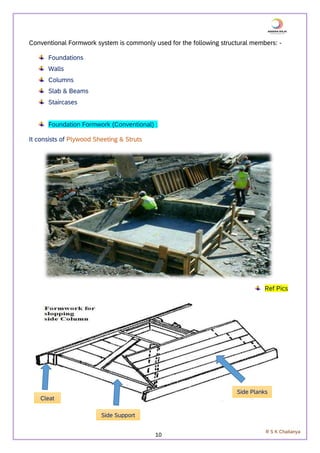
Side Support
Conventional Formwork system is commonly used for the following structural members: -
Foundations
Walls
Columns
Slab & Beams
Staircases
Foundation Formwork (Conventional) :
It consists of Plywood Sheeting & Struts
Ref Pics
Cleat
Side Planks
11
R S K Chaitanya
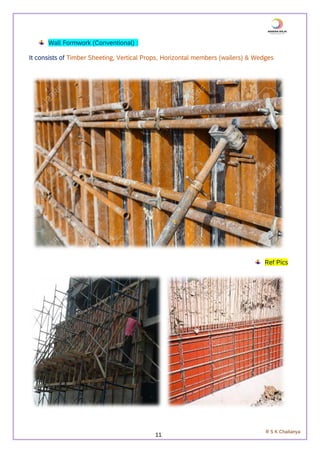
Wall Formwork (Conventional) :
It consists of Timber Sheeting, Vertical Props, Horizontal members (wailers) & Wedges
Ref Pics
12
R S K Chaitanya
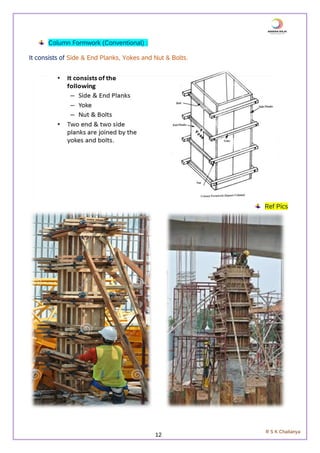
Column Formwork (Conventional) :
It consists of Side & End Planks, Yokes and Nut & Bolts.
Ref Pics
13
R S K Chaitanya
Formwork for Slabs and Beams (Conventional) :
It consists of:
Base Plates, Wedges, Props, U-Head (Head Tree), Planks, Wooden battens, and Ledgers.
Ref Pics
14
R S K Chaitanya
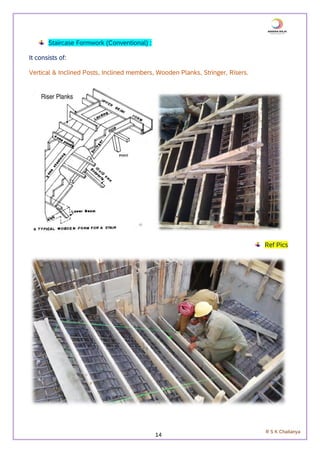
Staircase Formwork (Conventional) :
It consists of:
Vertical & Inclined Posts, Inclined members, Wooden Planks, Stringer, Risers.
Ref Pics
15
R S K Chaitanya
8. Aluminium Formwork System
Aluminium formwork is also known as MIVAN formwork system. The Aluminium formwork
system was developed by W.J. Malone, a Canadian Engineer in the late 1970’s as a system
for constructing low-cost housing units in the developing countries.
Aluminium Formwork System is a construction system for forming cast in place concrete
structure of a building. It is also a system for scheduling and controlling the work of other
construction trades such as steel reinforcement, concrete placement and mechanical and
electrical conduits.
Its speed of construction is high, good finishing, re-use of this formwork is 250 to 300 times,
and scrap value is more. But its initial investment is more and economical only for mass
housing projects.
The speed of construction by aluminium formwork system will surpass speed of most
of the other construction technologies.
The work manages aluminium lightweight formwork approach effectively in order to
accelerate the particular development, to reassure quality manage along with
strength.
Adoption of this system reduces overall cost of the structure.
This is one of the systems identified to be very much suitable for Indian conditions for
mass construction, where quality and speed can be achieved at high level.
Ref Pic
16
R S K Chaitanya
This is the formwork can be a good option for timely completion of construction with
maximum efficiency. In this system, an Aluminium alloy Al-6061-T6 is normally used. This
can withstand the load of about 65 KN/m2.
In this system of Formwork, Aluminium panels are placed vertically, attached to each other
with the help of stub pins and wedge pins. In this basically three types of panels are there:
1. Wall-Wall (with and without Rocker, Wall Top panel, Wall End Panel
2. Beam-Beam panels, Beam Bottom panels, Beam props
3. Slab- Slab panels, Slab prop
Also in addition to this, many types of accessories are also needed in order to maintain the
verticality and alignment of wall. Those are wailers, wire rope, ACT props (Adjustable
Collapsible Telescopic)
It is depends on 3S System of Construction i.e. Speed, Strength, Safety.
Uses of Aluminium Shuttering
Column and beam construction are wiped out
Walls and slabs are cast in one task
Simple to deal with because of light weight pre-engineered aluminium forms
Fitting and erecting the area of shuttering
Walls and slabs concreting can be completed together.
Construction Methods of Aluminium Shuttering:
Setting Up the Wall Strengthening With Steel:
The wall strengthening with steel is used to give a structure to the building and support the
concrete until the point when they increase half of the required strength. The aluminium
shuttering are cast around the steel mesh, which is industrial facility and directly erected on
the development site.
17
R S K Chaitanya
Placement of Aluminium Shuttering:
Along the wall strengthening with steel, pre-assembled room measured walls and floor slabs
are erected. These aluminium compound slabs are precisely made and are not difficult to
deal with.
Spaces for windows, conduits, entryways and different highlights, for example, staircases,
façade boards and so forth are coordinated in these structures. The structures are joint
together utilizing the stick and wedge framework, which can be destroyed rapidly after the
concrete structure is made.
Pouring Concrete:
After casting the structures, concrete of high quality (free flow) is poured. This concrete takes
the form and mould of the cast, which is later evacuated to clear a path for a structure made
totally of cement concrete supported by wall strengthened with steel.
The aluminium forms can be reused no less than 250 times, bringing about least waste from
the development site.
18
R S K Chaitanya
Merits of Aluminium Formwork :
1) Aluminium shuttering requires moderately less work
2) Earthquake resistance in building is more
3) Durability of the building will increase
4) Number of joints and spillages are less
5) Carpet area is high
6) Wall and floor finishing is good with very less tolerances
7) Completion time is very less
8) Plastering can be avoided; can directly apply putty over walls
9) Finishing works time is greatly reduces
10) Saving on overhead expenses due to speedy construction
11) Doesn’t require timber/plywood for construction so, it saves the environment.
12) Doesn’t require skilled and number of labour.
13) Less debris generation.
14) Carpet area will increase.
15) Collect the best premium from the customer, because of 100% RCC buildings.
16) High Quality finish and Cost Effective
17) Aluminium Panels can reuse up to 250 times
18) Erection can possible with Unskilled Labour
De- Merits of Aluminium Formwork :
1) Number of holes will be more in the vertical wall, outer wall which is in direct contact with
the rain, hole should be grouted by Non Shrink compound.
2) Service after completion become marginally troublesome becoz of the little width of parts.
3) It requires uniform arranging and additionally uniform elevations to be cost effective.
4) It requires uniform planning as well as uniform elevations to be cost effective.
5) Because of box-type development, compression breaks are probably appear
6) Due to shear walls high heat of hydration will be produced
7) It is inflexible in configuration once placed, as any alteration becomes tough later.
8) Concealed services become difficult due to small thickness of components
9) Modifications are not possible as all members are caste in RCC.
10) Large volume of work is necessary to be cost effective i.e. at least 200 repetitions
11) Due to tremendous speed of construction, working capital finance be planned
19
R S K Chaitanya
Speed of Construction – Work Cycle of Aluminium Formwork
The System usually follows a four-day cycle: -
Day 1: -The first activity consists of erection of vertical reinforcement bars and one side of
the vertical formwork for the entire floor or a part of one floor.
Day 2: -The second activity involves erection of the second side of the vertical formwork and
formwork for the floor
Day 3: - Fixing reinforcement bars for floor slabs and casting of walls and slabs.
Day 4: -Removal of vertical formwork panels after 24hours, leaving the props in place for 7
days and floor slab formwork in place for 2.5 days.
Ref Pic
20
R S K Chaitanya
Work Cycle Duration of Aluminium Formwork
De Shuttering of the panels - 12 to 15 Hrs
Positioning brackets & platforms on the level - 10 to 15 Hrs
De Shuttered panels lifted & fixed on floor - 7 to 10 Hrs
Kicker & external shutters fixed in - 7 Hrs
Shutters are erected in - 6-8 Hrs
Reinforcement - 10 to 12 Hrs
Electrical fittings - 10 Hrs
Pouring concrete - actuals
Key facts about Aluminium Formwork
Technology: Aluminium Formwork System is highly suited to load bearing wall construction
whereas traditional formwork consisting of plywood and timber is not suitable to the high
pressures of fresh concrete on the wall.
Cost: Use of this formwork in load bearing design gives an average of 15 per cent cost saving
in the structure of the building and increased usable floor space of 8 per cent over RCC
design.
Time: Aluminium Formwork technology the time required is 1/6th of the Conventional system
duration.
Lifting: As the Aluminium Formwork is lightweight, no tower cranes are required for the same
unlike in tunnel framework.
Ref Pic
21
R S K Chaitanya
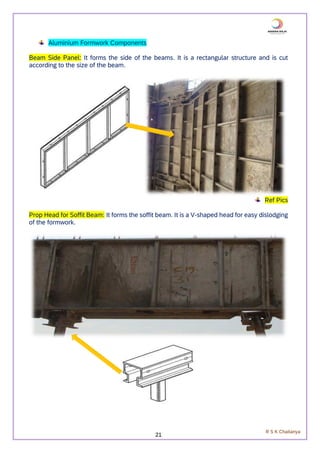
Aluminium Formwork Components
Beam Side Panel: It forms the side of the beams. It is a rectangular structure and is cut
according to the size of the beam.
Ref Pics
Prop Head for Soffit Beam: It forms the soffit beam. It is a V-shaped head for easy dislodging
of the formwork.
22
R S K Chaitanya
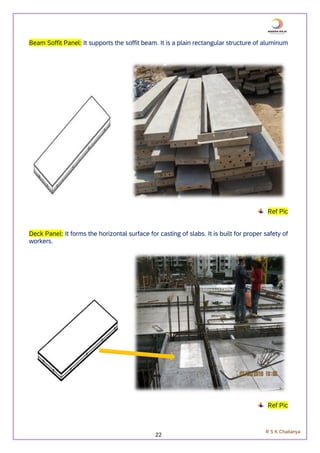
Beam Soffit Panel: It supports the soffit beam. It is a plain rectangular structure of aluminum
Ref Pic
Deck Panel: It forms the horizontal surface for casting of slabs. It is built for proper safety of
workers.
Ref Pic
23
R S K Chaitanya
Deck Prop: It forms a V-shaped prop head. It supports the deck and bears the load coming
on the deck panel.
Prop Length: It is the length of the prop. It depends upon the length of the slab.
Deck Mid – Beam: It supports the middle portion of the beam. It holds the concrete.
Ref Pics
24
R S K Chaitanya
Soffit Length: It provides support to the edge of the deck panels at their perimeter of the
room.
Deck Beam Bar: It is the deck for the beam. This component supports the deck and beam.
Ref Pics
Internal Soffit Corner: It forms the vertical internal corner between the walls and the beams,
slabs, and the horizontal internal cornice between the walls and the beam slabs and the
beam soffit.
External Soffit Corner: It forms the external corner between the components.
25
R S K Chaitanya
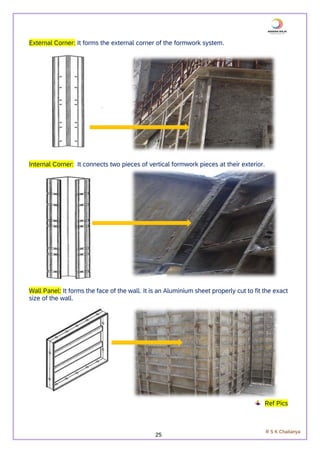
External Corner: It forms the external corner of the formwork system.
Internal Corner: It connects two pieces of vertical formwork pieces at their exterior.
Wall Panel: It forms the face of the wall. It is an Aluminium sheet properly cut to fit the exact
size of the wall.
Ref Pics
26
R S K Chaitanya
Rocker: It is a supporting component of wall. It is L-shaped panel having allotment holes for
stub pin.
Kicker: It forms the wall face at the top of the panels and acts as a ledge to support.
Ref Pics
Stub Pin: It helps in joining two wall panels. It helps in joining two joints.
27
R S K Chaitanya
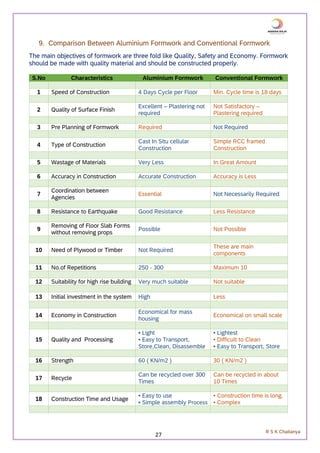
9. Comparison Between Aluminium Formwork and Conventional Formwork
The main objectives of formwork are three fold like Quality, Safety and Economy. Formwork
should be made with quality material and should be constructed properly.
S.No Characteristics Aluminium Formwork Conventional Formwork
1 Speed of Construction 4 Days Cycle per Floor Min. Cycle time is 18 days
2 Quality of Surface Finish
Excellent – Plastering not
required
Not Satisfactory –
Plastering required
3 Pre Planning of Formwork Required Not Required
4 Type of Construction
Cast In Situ cellular
Construction
Simple RCC framed
Construction
5 Wastage of Materials Very Less In Great Amount
6 Accuracy in Construction Accurate Construction Accuracy is Less
7
Coordination between
Agencies
Essential Not Necessarily Required
8 Resistance to Earthquake Good Resistance Less Resistance
9
Removing of Floor Slab Forms
without removing props
Possible Not Possible
10 Need of Plywood or Timber Not Required
These are main
components
11 No.of Repetitions 250 - 300 Maximum 10
12 Suitability for high rise building Very much suitable Not suitable
13 Initial investment in the system High Less
14 Economy in Construction
Economical for mass
housing
Economical on small scale
15 Quality and Processing
• Light
• Easy to Transport,
Store,Clean, Disassemble
• Lightest
• Difficult to Clean
• Easy to Transport, Store
16 Strength 60 ( KN/m2 ) 30 ( KN/m2 )
17 Recycle
Can be recycled over 300
Times
Can be recycled in about
10 Times
18 Construction Time and Usage
• Easy to use
• Simple assembly Process
• Construction time is long.
• Complex
28
R S K Chaitanya
Cost Comparison Between Completion of Aluminium and Conventional Formwork
Let’s consider a housing project has two towers. One building is being developed by using
traditional construction methods, while the second one is being structured employing
Aluminium formwork technology.
Illustrative Example Only:
The details of the two buildings with same floor area are as follows:
Constructed with Aluminium Formwork Constructed with conventional Formwork
No of floors - 10 No of floors - 10
Floor to floor height - 3.0 m Floor to floor height - 3.0 m
Items of work involved in the construction (substructure and superstructure) of a building
and the respective costs incurred in both the techniques will be –
S.No Items of Work Aluminium Formwork Conventional Formwork
Amount (In Rs) Amount (in Rs)
I Substructure
RCC work 32,00,000 25,00,000
Shuttering 15,00,000 10,00,000
Steel 45,00,000 34,00,000
Block Work 3,60,000 2,50,000
Fly Ash NA NA
Plastering 3,00,000 2,50,000
Painting 1,40,000 1,00,000
Total 1,00,00,000 75,00,000
II Superstructure
RCC work 3,30,00,000 2,00,00,000
Shuttering 3,00,00,000 1,50,00,000
Steel 2,70,00,000 1,00,00,000
Block Work NA 13,50,000
Fly Ash NA 1,50,000
Plastering 5,50,00,000 1,85,00,000
Painting 4,50,00,000 50,00,000
Total 10,00,00,000 7,00,00,000
In the process of developing substructure using Aluminium Formwork, Rs 1 Crore is spent.
On the flip side, the conventional construction method uses Rs 75 lakh for the same.
In case of the superstructure, Aluminium Formwork method incurs Rs 10 crore for structuring
the building. However, the traditional method would cost around Rs 7 crore.
29
R S K Chaitanya
As mentioned above, Aluminium Formwork technology has an edge over conventional
formwork in terms of the construction cycle.
Use of Aluminium Formwork construction technique can structure a 10-tower building in 2.5
years; however, the old traditional construction method would take about 3.6 years to
complete the same tower.
Considering the above comparison between the two construction methods, it is evident that
the Aluminium Formwork construction technique is appropriate for developing mass housing
projects as it lowers the overall construction cycle.
However, the traditional construction method is cheaper compared to the latest Mivan
Technology.
10. Cost and Scrap Value of Aluminium Formwork
Cost of Formwork in Construction:
The following formwork in which the latest rates of formwork is taken to analyzed for the
study to minimized the project overall cost. Plywood formwork, steel formwork and
aluminium formwork are taken in the analysis like the market rates of the material of the
formwork and the best rate at which formwork can be buy.
Following the graphical representation of the above study of rates at the different rates of
formwork. The chart shows the aluminium formwork is economical when the use of cycle.
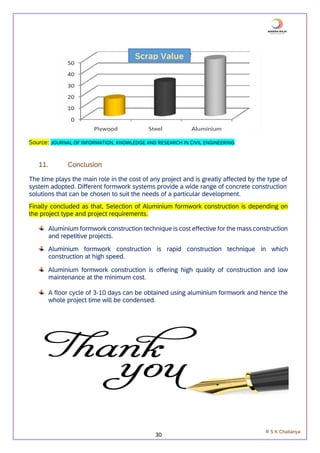
Scrap Value of Aluminium Formwork:
The scrap value is also going to in consideration for the maximum return. The companies of
aluminium formwork are dealing in such a way that maximum return at the relative interval.
The deals are done on the basis of use. The aluminium formwork is economical because of
rate of return is high.
The graphical representation shows that the aluminium formwork is the giving maximum
back at the scrap and the minimum scrap value is plywood formwork. The aluminium
formwork is repeat on of 100 cycle because the scrap value shows the 50 % back at the
reuse.
The steel formwork is also economical but the maintenance of the steel formwork is high and
the bend in the formwork is frequently seen.
30
R S K Chaitanya
Source: JOURNAL OF INFORMATION, KNOWLEDGE AND RESEARCH IN CIVIL ENGINEERING
11. Conclusion
The time plays the main role in the cost of any project and is greatly affected by the type of
system adopted. Different formwork systems provide a wide range of concrete construction
solutions that can be chosen to suit the needs of a particular development.
Finally concluded as that, Selection of Aluminium formwork construction is depending on
the project type and project requirements.
Aluminium formwork construction technique is cost effective for the mass construction
and repetitive projects.
Aluminium formwork construction is rapid construction technique in which
construction at high speed.
Aluminium formwork construction is offering high quality of construction and low
maintenance at the minimum cost.
A floor cycle of 3-10 days can be obtained using aluminium formwork and hence the
whole project time will be condensed.
Scrap Value

Aluminium Formwork Vs Conventional Formwork

  • 1.
    R S KChaitanya Amara Raja Infra Private Limited Vs Comparison of Conventional Formwork System Construction With Aluminium Formwork System
  • 2.
    2 R S KChaitanya Index Page No 1. Introduction to Form Work - 3 2. Objective - 4 3. Basic Types of Formwork - 4 4. Formwork Scenario in India - 7 5. Need for Modern Formwork Systems - 7 6. Material Wastage in Construction - 8 7. Conventional Formwork - 9 8. Aluminium Formwork - 15 9. Comparison of Aluminium FW and Conventional Formwork - 27 10. Cost and Scrap Value of Aluminium Formwork - 29 11. Conclusion - 30
  • 3.
    3 R S KChaitanya 1. Introduction to Formwork Formwork is a temporary structure, which supports fresh concrete until it becomes strong enough to sustain its own weight. After setting of concrete, the formwork is removed and a solid structure of required shape and size is produced. This is the very important element in the construction of building. Indian construction industry has started using some of the world-class technologies. Several Formwork systems are in use at different places in the world; eventually the systems which are reasonably economical and easy for operation with skilled labour are most useful in India. The construction of formwork takes time and involves expenditure up to 20 to 25% of the cost of the structure or even more. There are many types of formwork systems like Timber formwork, Aluminium formwork, Tunnel formwork etc. The modern methods of construction are broad range of processes and products that aims to improve business efficiency, quality, customer satisfaction, environmental performance sustainability and the predictability of delivery timescales Ref Pic Formwork system has significant role in the construction process, making the right decision by choosing the appropriate formwork system could lead to response to sustainable construction. Different systems have their own advantages but one needs to choose a formwork which best supports individual project requirement. Shortage/non availability skilled and semi-skilled workers results in problems of cost and time over-runs, inferior construction, poor finishes leakages, corrosion of structures etc. this can be avoided by adopting modern formwork systems. This also avoids repairs and rehabilitation of structures before its expected life span.
  • 4.
    4 R S KChaitanya 2. Objective The main objective of this comparative study of Formwork construction techniques are - To reduce construction time of project To minimize construction total cost (Direct cost and indirect cost) of project. To measure and improve the quality of construction projects To Explore the Modern methods of Formwork 3. Basic Types of Formwork Formwork broadly classified mainly of two types – Conventional Formwork: The most common material used for formwork of wall is the Plywood sheet in which it used in combination with timber. Normally, wall forms are framed panels with the plywood facing sheet connected to a timber frame. The cycle time for one floor with the use of conventional formwork is minimum 3-4 weeks.In addition, the block or Brickwork and plastering is needed in order to get the finished surface. This takes more time and skilled labours too. This ultimately increases the time required for the completion of the project. System Formwork: The name System Formwork itself clears that the approach is systematic. Speed in construction activities will lead to faster completion of project .This will save the time and ultimately money involved in it. Currently in India, other types of Formworks are also available. The choice of such Formwork system changes and depends upon required slab cycle, required quality of construction and budget or funds available for the project. Ref Pic Out of system Formwork models, Tunnel Formwork and Aluminium Formwork are the two leading systems.
  • 5.
    5 R S KChaitanya Aluminium Formwork : This is the formwork, which can be a good option for timely completion of construction with maximum efficiency. In this system, an Aluminium alloy Al-6061-T6 is normally used. This can withstand the load of about 65 KN/m2. Tunnel Formwork : Tunnel formwork system is used for a multi storied building construction in order to reduce cycle time .As this is the type of system formwork slab & the wall are cast monolithically. Therefore, Tunnel Formwork is a fast-track construction method .It is best suited for repetitive type cellular projects. Different components of this system are made up of steel. Ref Pic It is a highly efficient Industrialized System of On-Site Construction, which enables putting- up stable structure on a 24-Hour cycle basis Tunnel form is a formwork system that allows the contractor to build monolithic walls and slabs in one operation on a daily cycle. It combines the speed, quality and accuracy of factory/offsite produced ready-mix concrete and formwork with the flexibility and economy of cast in-situ construction.
  • 6.
    6 R S KChaitanya This fast-track method of construction is suitable for repetitive cellular projects, such as hotels, apartment blocks and student accommodation. It offers economy, speed, quality and accuracy, as well as utilizing the inherent benefits of concrete, such as fire and sound resistance. Its components are made of steel. Its usefulness also stems from the fact that no starter concrete is required for walls; it allows easy alignment and de-shuttering, hot air curing to enable early stripping and favors a standardized working sequence to improve labour productivity. Ref Pic Tunnel form can accommodate room widths from 2.4 to 6.6m. When rooms are wider (up to 11m), a mid-span table is incorporated between the tunnels. Manufactured entirely from steel, including the face of the form, the half tunnel provides the rigidity and smooth face necessary to produce a consistently high quality finish to the concrete When two half tunnels are put together this creates a tunnel. The tunnel sections come in two lengths, 1.25 and 2.5m. These are fixed together to produce a tunnel length that suits either the building dimensions. The tunnel is tailored to the room width and height by the inclusion of infill sections, which are sacrificed at the end of the job. These are not loose fittings but are an integral part of the tunnel.
  • 7.
    7 R S KChaitanya 4. Formwork Scenario In India The Indian Construction Industry is growing at a very rapid rate and it is estimated that the current concrete production is about 300 million cum per annum is going to be doubled in the very near future. The Formwork industry including Scaffolding industry in India is still in its embryonic stage. In the current Indian market, Formwork market commands the share of approximately INR 15 billion and out of this only 20% belongs to system formwork and rest 80% was conventional and unorganized. Major Challenges, which Construction and Formwork Industry facing in India are – Low technology Depended on Labour intensive Systems Labour-unskilled, migratory, traditional and family oriented Absence of monitoring body – Technical supervision As the structure grow bigger or taller and floor plate of the building is larger extent: companies are looking for system formwork that are cost effective. Selected system Formwork should be lighter, reusable, safe, easy to assemble and dismantle, flexible and more durable. 5. Need for Modern Formwork Systems The earliest formwork systems made use of wooden scantlings and timber runners as it enabled easy forming and making at site. But these wooden scantlings and timber runners tend to lose their structural and dimensional properties over a period time and after repeated usage thus posing safety problems. Many of the accidents take place in Reinforced Cement Concrete (RCC) construction because of inferior formwork and scaffolding. Now focus has to be shifted to other key factor “Formwork”, to face the challenges for the completion of fast track projects. By going in for system formwork, substantial savings are possible by faster return on investments. Here the few of the System Formworks and Its applications - Aluminium Formwork - High Rise buildings Tunnel Formwork - High Rise buildings Climbing Formwork - For Silos and Cooling Towers Flex Formwork - For column, Beam & Slab Table Form System - For Commercial Buildings Column Formwork - More no.of Repetitions Wall Formwork - Basement retaining walls
  • 8.
    8 R S KChaitanya 6. Material wastage in Construction Description Percentage (%) Rank Formwork 27.5 1 Finish Work 20.0 2 Concrete Work 13.3 3 Masonry Work 13.1 4 Material Handling 10.1 5 Scaffolding 8.9 6 The major causes of material wastage including concrete, steel reinforcement, formwork and brick/block, are based on a survey to construction participants. Formwork and Concrete are the most widely used material for both substructure and superstructure of buildings. Formwork pay a significant roll and material costs account for approximately 15% of the construction cost and 1/3 of the structure costs for reinforced concrete construction. Therefore, formwork engineering directly affects the success of a project. Ref Pics
  • 9.
    9 R S KChaitanya 7. Conventional Formwork System It is traditional formwork which is made up by timber and plywood, which is not ecofriendly. It can be used in concreting work like beam, column, slab etc. this is traditional method in India, it is mostly use in all type of construction works. The timber used is a plywood board, which is made up of water resistant particles. These plywood boards are used widely at sites where the labour cost is cheaper. Timber Shuttering is basic material utilized for the conventional formwork due to its ease of use by slicing easily on site. While the life span for this shuttering is not so large. The placing of shuttering is again a task for the workers and the finishing is poor. Ref Pic But it is time consuming method, reuse max. 08 times, finishing not good, need plastering, skill labour required, scrap value is also low. Its initial cost is less and only suitable for small construction works. Timber is the most common material used for formwork. The disadvantage with timber formwork is that it will warp, swell and shrink. Application of water impermeable cost to the surface of wood mitigates these defects. Merits of Conventional Formwork : 1) Simple to deal with because of its lightweight. 2) Dismantling of Shuttering is easy. 3) Broken timber parts can be replaced with new timber parts. 4) It has high thermal resistance quality, which makes it good for use in cold regions. De- Merits of Conventional Formwork : 1) Can't be used for longer time period and have very less reuse. 2) If the timber used for shuttering is dry, the timber will absorb the water content from the Concrete which results to weaken the structural members. 3) If the timber used for the shuttering is wet and having moisture content greater than 20%, the shuttering will shrink which results in opening of joints and expulsion of Concrete.
  • 10.
    10 R S KChaitanya Side Support Conventional Formwork system is commonly used for the following structural members: - Foundations Walls Columns Slab & Beams Staircases Foundation Formwork (Conventional) : It consists of Plywood Sheeting & Struts Ref Pics Cleat Side Planks
  • 11.
    11 R S KChaitanya Wall Formwork (Conventional) : It consists of Timber Sheeting, Vertical Props, Horizontal members (wailers) & Wedges Ref Pics
  • 12.
    12 R S KChaitanya Column Formwork (Conventional) : It consists of Side & End Planks, Yokes and Nut & Bolts. Ref Pics
  • 13.
    13 R S KChaitanya Formwork for Slabs and Beams (Conventional) : It consists of: Base Plates, Wedges, Props, U-Head (Head Tree), Planks, Wooden battens, and Ledgers. Ref Pics
  • 14.
    14 R S KChaitanya Staircase Formwork (Conventional) : It consists of: Vertical & Inclined Posts, Inclined members, Wooden Planks, Stringer, Risers. Ref Pics
  • 15.
    15 R S KChaitanya 8. Aluminium Formwork System Aluminium formwork is also known as MIVAN formwork system. The Aluminium formwork system was developed by W.J. Malone, a Canadian Engineer in the late 1970’s as a system for constructing low-cost housing units in the developing countries. Aluminium Formwork System is a construction system for forming cast in place concrete structure of a building. It is also a system for scheduling and controlling the work of other construction trades such as steel reinforcement, concrete placement and mechanical and electrical conduits. Its speed of construction is high, good finishing, re-use of this formwork is 250 to 300 times, and scrap value is more. But its initial investment is more and economical only for mass housing projects. The speed of construction by aluminium formwork system will surpass speed of most of the other construction technologies. The work manages aluminium lightweight formwork approach effectively in order to accelerate the particular development, to reassure quality manage along with strength. Adoption of this system reduces overall cost of the structure. This is one of the systems identified to be very much suitable for Indian conditions for mass construction, where quality and speed can be achieved at high level. Ref Pic
  • 16.
    16 R S KChaitanya This is the formwork can be a good option for timely completion of construction with maximum efficiency. In this system, an Aluminium alloy Al-6061-T6 is normally used. This can withstand the load of about 65 KN/m2. In this system of Formwork, Aluminium panels are placed vertically, attached to each other with the help of stub pins and wedge pins. In this basically three types of panels are there: 1. Wall-Wall (with and without Rocker, Wall Top panel, Wall End Panel 2. Beam-Beam panels, Beam Bottom panels, Beam props 3. Slab- Slab panels, Slab prop Also in addition to this, many types of accessories are also needed in order to maintain the verticality and alignment of wall. Those are wailers, wire rope, ACT props (Adjustable Collapsible Telescopic) It is depends on 3S System of Construction i.e. Speed, Strength, Safety. Uses of Aluminium Shuttering Column and beam construction are wiped out Walls and slabs are cast in one task Simple to deal with because of light weight pre-engineered aluminium forms Fitting and erecting the area of shuttering Walls and slabs concreting can be completed together. Construction Methods of Aluminium Shuttering: Setting Up the Wall Strengthening With Steel: The wall strengthening with steel is used to give a structure to the building and support the concrete until the point when they increase half of the required strength. The aluminium shuttering are cast around the steel mesh, which is industrial facility and directly erected on the development site.
  • 17.
    17 R S KChaitanya Placement of Aluminium Shuttering: Along the wall strengthening with steel, pre-assembled room measured walls and floor slabs are erected. These aluminium compound slabs are precisely made and are not difficult to deal with. Spaces for windows, conduits, entryways and different highlights, for example, staircases, façade boards and so forth are coordinated in these structures. The structures are joint together utilizing the stick and wedge framework, which can be destroyed rapidly after the concrete structure is made. Pouring Concrete: After casting the structures, concrete of high quality (free flow) is poured. This concrete takes the form and mould of the cast, which is later evacuated to clear a path for a structure made totally of cement concrete supported by wall strengthened with steel. The aluminium forms can be reused no less than 250 times, bringing about least waste from the development site.
  • 18.
    18 R S KChaitanya Merits of Aluminium Formwork : 1) Aluminium shuttering requires moderately less work 2) Earthquake resistance in building is more 3) Durability of the building will increase 4) Number of joints and spillages are less 5) Carpet area is high 6) Wall and floor finishing is good with very less tolerances 7) Completion time is very less 8) Plastering can be avoided; can directly apply putty over walls 9) Finishing works time is greatly reduces 10) Saving on overhead expenses due to speedy construction 11) Doesn’t require timber/plywood for construction so, it saves the environment. 12) Doesn’t require skilled and number of labour. 13) Less debris generation. 14) Carpet area will increase. 15) Collect the best premium from the customer, because of 100% RCC buildings. 16) High Quality finish and Cost Effective 17) Aluminium Panels can reuse up to 250 times 18) Erection can possible with Unskilled Labour De- Merits of Aluminium Formwork : 1) Number of holes will be more in the vertical wall, outer wall which is in direct contact with the rain, hole should be grouted by Non Shrink compound. 2) Service after completion become marginally troublesome becoz of the little width of parts. 3) It requires uniform arranging and additionally uniform elevations to be cost effective. 4) It requires uniform planning as well as uniform elevations to be cost effective. 5) Because of box-type development, compression breaks are probably appear 6) Due to shear walls high heat of hydration will be produced 7) It is inflexible in configuration once placed, as any alteration becomes tough later. 8) Concealed services become difficult due to small thickness of components 9) Modifications are not possible as all members are caste in RCC. 10) Large volume of work is necessary to be cost effective i.e. at least 200 repetitions 11) Due to tremendous speed of construction, working capital finance be planned
  • 19.
    19 R S KChaitanya Speed of Construction – Work Cycle of Aluminium Formwork The System usually follows a four-day cycle: - Day 1: -The first activity consists of erection of vertical reinforcement bars and one side of the vertical formwork for the entire floor or a part of one floor. Day 2: -The second activity involves erection of the second side of the vertical formwork and formwork for the floor Day 3: - Fixing reinforcement bars for floor slabs and casting of walls and slabs. Day 4: -Removal of vertical formwork panels after 24hours, leaving the props in place for 7 days and floor slab formwork in place for 2.5 days. Ref Pic
  • 20.
    20 R S KChaitanya Work Cycle Duration of Aluminium Formwork De Shuttering of the panels - 12 to 15 Hrs Positioning brackets & platforms on the level - 10 to 15 Hrs De Shuttered panels lifted & fixed on floor - 7 to 10 Hrs Kicker & external shutters fixed in - 7 Hrs Shutters are erected in - 6-8 Hrs Reinforcement - 10 to 12 Hrs Electrical fittings - 10 Hrs Pouring concrete - actuals Key facts about Aluminium Formwork Technology: Aluminium Formwork System is highly suited to load bearing wall construction whereas traditional formwork consisting of plywood and timber is not suitable to the high pressures of fresh concrete on the wall. Cost: Use of this formwork in load bearing design gives an average of 15 per cent cost saving in the structure of the building and increased usable floor space of 8 per cent over RCC design. Time: Aluminium Formwork technology the time required is 1/6th of the Conventional system duration. Lifting: As the Aluminium Formwork is lightweight, no tower cranes are required for the same unlike in tunnel framework. Ref Pic
  • 21.
    21 R S KChaitanya Aluminium Formwork Components Beam Side Panel: It forms the side of the beams. It is a rectangular structure and is cut according to the size of the beam. Ref Pics Prop Head for Soffit Beam: It forms the soffit beam. It is a V-shaped head for easy dislodging of the formwork.
  • 22.
    22 R S KChaitanya Beam Soffit Panel: It supports the soffit beam. It is a plain rectangular structure of aluminum Ref Pic Deck Panel: It forms the horizontal surface for casting of slabs. It is built for proper safety of workers. Ref Pic
  • 23.
    23 R S KChaitanya Deck Prop: It forms a V-shaped prop head. It supports the deck and bears the load coming on the deck panel. Prop Length: It is the length of the prop. It depends upon the length of the slab. Deck Mid – Beam: It supports the middle portion of the beam. It holds the concrete. Ref Pics
  • 24.
    24 R S KChaitanya Soffit Length: It provides support to the edge of the deck panels at their perimeter of the room. Deck Beam Bar: It is the deck for the beam. This component supports the deck and beam. Ref Pics Internal Soffit Corner: It forms the vertical internal corner between the walls and the beams, slabs, and the horizontal internal cornice between the walls and the beam slabs and the beam soffit. External Soffit Corner: It forms the external corner between the components.
  • 25.
    25 R S KChaitanya External Corner: It forms the external corner of the formwork system. Internal Corner: It connects two pieces of vertical formwork pieces at their exterior. Wall Panel: It forms the face of the wall. It is an Aluminium sheet properly cut to fit the exact size of the wall. Ref Pics
  • 26.
    26 R S KChaitanya Rocker: It is a supporting component of wall. It is L-shaped panel having allotment holes for stub pin. Kicker: It forms the wall face at the top of the panels and acts as a ledge to support. Ref Pics Stub Pin: It helps in joining two wall panels. It helps in joining two joints.
  • 27.
    27 R S KChaitanya 9. Comparison Between Aluminium Formwork and Conventional Formwork The main objectives of formwork are three fold like Quality, Safety and Economy. Formwork should be made with quality material and should be constructed properly. S.No Characteristics Aluminium Formwork Conventional Formwork 1 Speed of Construction 4 Days Cycle per Floor Min. Cycle time is 18 days 2 Quality of Surface Finish Excellent – Plastering not required Not Satisfactory – Plastering required 3 Pre Planning of Formwork Required Not Required 4 Type of Construction Cast In Situ cellular Construction Simple RCC framed Construction 5 Wastage of Materials Very Less In Great Amount 6 Accuracy in Construction Accurate Construction Accuracy is Less 7 Coordination between Agencies Essential Not Necessarily Required 8 Resistance to Earthquake Good Resistance Less Resistance 9 Removing of Floor Slab Forms without removing props Possible Not Possible 10 Need of Plywood or Timber Not Required These are main components 11 No.of Repetitions 250 - 300 Maximum 10 12 Suitability for high rise building Very much suitable Not suitable 13 Initial investment in the system High Less 14 Economy in Construction Economical for mass housing Economical on small scale 15 Quality and Processing • Light • Easy to Transport, Store,Clean, Disassemble • Lightest • Difficult to Clean • Easy to Transport, Store 16 Strength 60 ( KN/m2 ) 30 ( KN/m2 ) 17 Recycle Can be recycled over 300 Times Can be recycled in about 10 Times 18 Construction Time and Usage • Easy to use • Simple assembly Process • Construction time is long. • Complex
  • 28.
    28 R S KChaitanya Cost Comparison Between Completion of Aluminium and Conventional Formwork Let’s consider a housing project has two towers. One building is being developed by using traditional construction methods, while the second one is being structured employing Aluminium formwork technology. Illustrative Example Only: The details of the two buildings with same floor area are as follows: Constructed with Aluminium Formwork Constructed with conventional Formwork No of floors - 10 No of floors - 10 Floor to floor height - 3.0 m Floor to floor height - 3.0 m Items of work involved in the construction (substructure and superstructure) of a building and the respective costs incurred in both the techniques will be – S.No Items of Work Aluminium Formwork Conventional Formwork Amount (In Rs) Amount (in Rs) I Substructure RCC work 32,00,000 25,00,000 Shuttering 15,00,000 10,00,000 Steel 45,00,000 34,00,000 Block Work 3,60,000 2,50,000 Fly Ash NA NA Plastering 3,00,000 2,50,000 Painting 1,40,000 1,00,000 Total 1,00,00,000 75,00,000 II Superstructure RCC work 3,30,00,000 2,00,00,000 Shuttering 3,00,00,000 1,50,00,000 Steel 2,70,00,000 1,00,00,000 Block Work NA 13,50,000 Fly Ash NA 1,50,000 Plastering 5,50,00,000 1,85,00,000 Painting 4,50,00,000 50,00,000 Total 10,00,00,000 7,00,00,000 In the process of developing substructure using Aluminium Formwork, Rs 1 Crore is spent. On the flip side, the conventional construction method uses Rs 75 lakh for the same. In case of the superstructure, Aluminium Formwork method incurs Rs 10 crore for structuring the building. However, the traditional method would cost around Rs 7 crore.
  • 29.
    29 R S KChaitanya As mentioned above, Aluminium Formwork technology has an edge over conventional formwork in terms of the construction cycle. Use of Aluminium Formwork construction technique can structure a 10-tower building in 2.5 years; however, the old traditional construction method would take about 3.6 years to complete the same tower. Considering the above comparison between the two construction methods, it is evident that the Aluminium Formwork construction technique is appropriate for developing mass housing projects as it lowers the overall construction cycle. However, the traditional construction method is cheaper compared to the latest Mivan Technology. 10. Cost and Scrap Value of Aluminium Formwork Cost of Formwork in Construction: The following formwork in which the latest rates of formwork is taken to analyzed for the study to minimized the project overall cost. Plywood formwork, steel formwork and aluminium formwork are taken in the analysis like the market rates of the material of the formwork and the best rate at which formwork can be buy. Following the graphical representation of the above study of rates at the different rates of formwork. The chart shows the aluminium formwork is economical when the use of cycle. Scrap Value of Aluminium Formwork: The scrap value is also going to in consideration for the maximum return. The companies of aluminium formwork are dealing in such a way that maximum return at the relative interval. The deals are done on the basis of use. The aluminium formwork is economical because of rate of return is high. The graphical representation shows that the aluminium formwork is the giving maximum back at the scrap and the minimum scrap value is plywood formwork. The aluminium formwork is repeat on of 100 cycle because the scrap value shows the 50 % back at the reuse. The steel formwork is also economical but the maintenance of the steel formwork is high and the bend in the formwork is frequently seen.
  • 30.
    30 R S KChaitanya Source: JOURNAL OF INFORMATION, KNOWLEDGE AND RESEARCH IN CIVIL ENGINEERING 11. Conclusion The time plays the main role in the cost of any project and is greatly affected by the type of system adopted. Different formwork systems provide a wide range of concrete construction solutions that can be chosen to suit the needs of a particular development. Finally concluded as that, Selection of Aluminium formwork construction is depending on the project type and project requirements. Aluminium formwork construction technique is cost effective for the mass construction and repetitive projects. Aluminium formwork construction is rapid construction technique in which construction at high speed. Aluminium formwork construction is offering high quality of construction and low maintenance at the minimum cost. A floor cycle of 3-10 days can be obtained using aluminium formwork and hence the whole project time will be condensed. Scrap Value