Site Management Plan
1
CONSERVATION AND SITE MANAGEMENT PLAN
VISHRAMBAUG WADA, PUNE
Soumitra Smart.
S.Y.M.Arch. J.N.E.C.
Site Management Plan
2
CONSERVATION AND SITE MANAGEMENT PLAN
GENERAL INFORMATION:
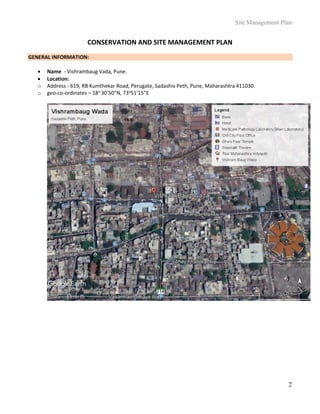
 Name - Vishrambaug Vada, Pune.
 Location:
o Address - 619, RB Kumthekar Road, Perugate, Sadashiv Peth, Pune, Maharashtra 411030.
o geo-co-ordinates – 18o
30’50”N, 73o
51’15”E
Site Management Plan
3
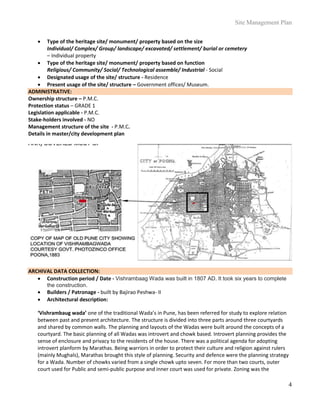
 Topographic features & maps
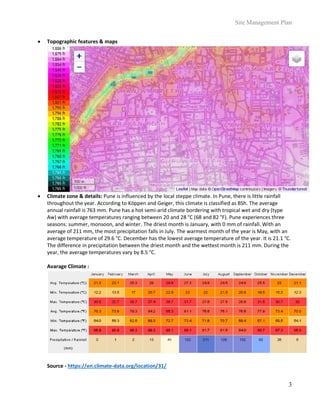
 Climate zone & details: Pune is influenced by the local steppe climate. In Pune, there is little rainfall
throughout the year. According to Köppen and Geiger, this climate is classified as BSh. The average
annual rainfall is 763 mm. Pune has a hot semi-arid climate bordering with tropical wet and dry (type
Aw) with average temperatures ranging between 20 and 28 °C (68 and 82 °F). Pune experiences three
seasons: summer, monsoon, and winter. The driest month is January, with 0 mm of rainfall. With an
average of 211 mm, the most precipitation falls in July. The warmest month of the year is May, with an
average temperature of 29.6 °C. December has the lowest average temperature of the year. It is 21.1 °C.
The difference in precipitation between the driest month and the wettest month is 211 mm. During the
year, the average temperatures vary by 8.5 °C.
Avarage Climate :
Source - https://en.climate-data.org/location/31/
Site Management Plan
4
 Type of the heritage site/ monument/ property based on the size
Individual/ Complex/ Group/ landscape/ excavated/ settlement/ burial or cemetery
– Individual property
 Type of the heritage site/ monument/ property based on function
Religious/ Community/ Social/ Technological assemble/ Industrial - Social
 Designated usage of the site/ structure - Residence
 Present usage of the site/ structure – Government offices/ Museum.
ADMINISTRATIVE:
Ownership structure – P.M.C.
Protection status – GRADE 1
Legislation applicable - P.M.C.
Stake-holders involved - NO
Management structure of the site - P.M.C.
Details in master/city development plan
ARCHIVAL DATA COLLECTION:
 Construction period / Date - Vishrambaag Wada was built in 1807 AD. It took six years to complete
the construction.
 Builders / Patronage - built by Bajirao Peshwa- II
 Architectural description:
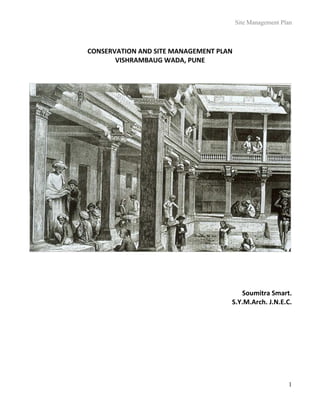
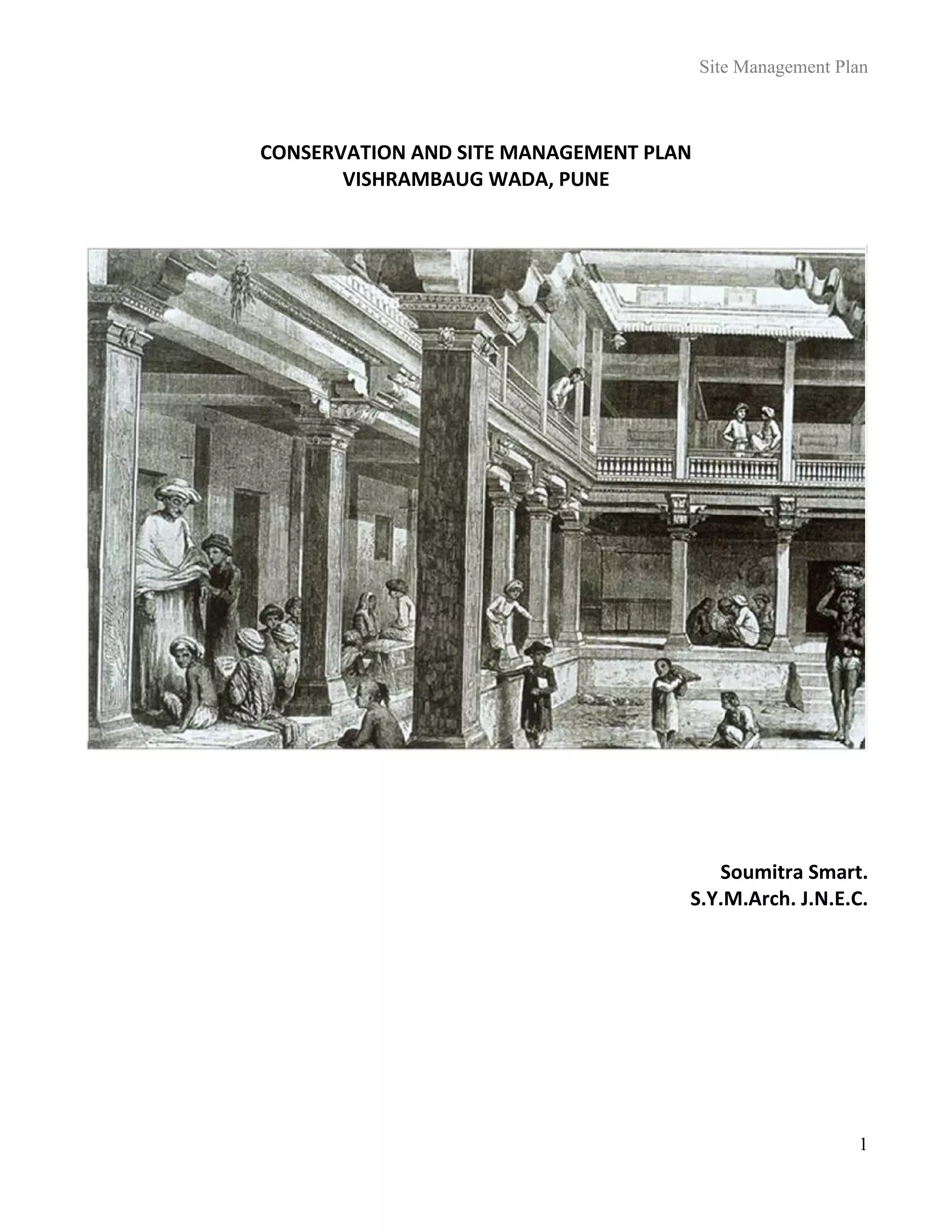
‘Vishrambaug wada’ one of the traditional Wada’s in Pune, has been referred for study to explore relation
between past and present architecture. The structure is divided into three parts around three courtyards
and shared by common walls. The planning and layouts of the Wadas were built around the concepts of a
courtyard. The basic planning of all Wadas was introvert and chowk based. Introvert planning provides the
sense of enclosure and privacy to the residents of the house. There was a political agenda for adopting
introvert planform by Marathas. Being warriors in order to protect their culture and religion against rulers
(mainly Mughals), Marathas brought this style of planning. Security and defence were the planning strategy
for a Wada. Number of chowks varied from a single chowk upto seven. For more than two courts, outer
court used for Public and semi-public purpose and inner court was used for private. Zoning was the
Site Management Plan
5
important aspect in Wada planning. Courtyard was also important symbolically, as it symbolised inwardness
in the house. The centre space is the Brahma space as per vastu shahtra. Toilets are located at the rear side
of house. Visrambaug Wada shows the courtyard patterned layout with three main courtyards one behind
the other. The first courtyard is square in plan; the second one which is bigger is rectangular in plan and the
third smaller courtyard. Vishrambaug wada is magnificent in size and scale. It shows the grid planning
design. Structural grid was called as Khan and the bay formed by number of khan was called Ghaee. Khan
was not a fixed unit of length between columns but varied from 5’ to 10’. It is a kind of modular system
which offers flexibility and economy for planning process. Considering the privacy, economical, political,
functional, cultural and religious aspects Wada plan form becomes significant.
Structural grid is clearly visible in elevation of exterior façade. An element of decoration such as cusped
arch which is non-structural false arch within each bay has been borrowed from Peshwas traditional
architecture. Style of Peshwas architecture was an amalgamation of various other styles like Rajasthani,
Gujrati and Delhi. Style of window design; manner of placing covered platforms and guard rooms (devadis)
at each side of entrance door with smaller openings above the wooden tall windows . Visrambaug wada’s
facade has a classic wooden balcony called meghadambari (a cloud capped balcony ) projecting from it.
Facade is very ornamented belonging to ruling class.
Elements
There are various elements in architecture such as spatial element, construction elements, and structural
elements. There are some elements related to decoration also. But certain thematic space and its elements
are significant in traditional architecture considering cultural, climatic and functional implications.
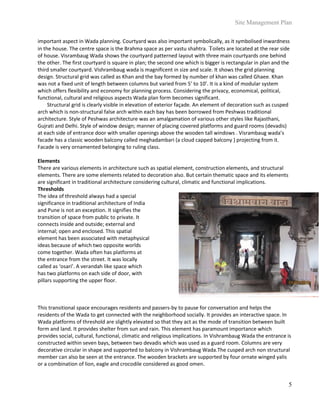
Thresholds
The idea of threshold always had a special
significance in traditional architecture of India
and Pune is not an exception. It signifies the
transition of space from public to private. It
connects inside and outside; external and
internal; open and enclosed. This spatial
element has been associated with metaphysical
ideas because of which two opposite worlds
come together. Wada often has platforms at
the entrance from the street. It was locally
called as ‘osari’. A verandah like space which
has two platforms on each side of door, with
pillars supporting the upper floor.
This transitional space encourages residents and passers-by to pause for conversation and helps the
residents of the Wada to get connected with the neighborhood socially. It provides an interactive space. In
Wada platforms of threshold are slightly elevated so that they act as the mode of transition between built
form and land. It provides shelter from sun and rain. This element has paramount importance which
provides social, cultural, functional, climatic and religious implications. In Vishrambaug Wada the entrance is
constructed within seven bays, between two devadis which was used as a guard room. Columns are very
decorative circular in shape and supported to balcony in Vishrambaug Wada.The cusped arch non structural
member can also be seen at the entrance. The wooden brackets are supported by four ornate winged yalis
or a combination of lion, eagle and crocodile considered as good omen.
Site Management Plan
6
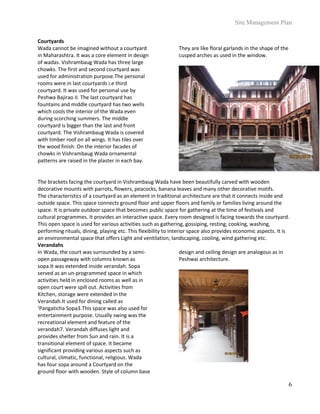
Courtyards
Wada cannot be imagined without a courtyard
in Maharashtra. It was a core element in design
of wadas. Vishrambaug Wada has three large
chowks. The first and second courtyard was
used for administration purpose.The personal
rooms were in last courtyards i.e third
courtyard. It was used for personal use by
Peshwa Bajirao II. The last courtyard has
fountains and middle courtyard has two wells
which cools the interior of the Wada even
during scorching summers. The middle
courtyard is bigger than the last and front
courtyard. The Vishrambaug Wada is covered
with timber roof on all wings. It has tiles over
the wood finish. On the interior facades of
chowks in Vishrambaug Wada ornamental
patterns are raised in the plaster in each bay.
They are like floral garlands in the shape of the
cusped arches as used in the window.
The brackets facing the courtyard in Vishrambaug Wada have been beautifully carved with wooden
decorative mounts with parrots, flowers, peacocks, banana leaves and many other decorative motifs.
The characteristics of a courtyard as an element in traditional architecture are that it connects inside and
outside space. This space connects ground floor and upper floors and family or families living around the
space. It is private outdoor space that becomes public space for gathering at the time of festivals and
cultural programmes. It provides an interactive space. Every room designed is facing towards the courtyard.
This open space is used for various activities such as gathering, gossiping, resting, cooking, washing,
performing rituals, dining, playing etc. This flexibility to interior space also provides economic aspects. It is
an environmental space that offers Light and ventilation, landscaping, cooling, wind gathering etc.
Verandahs
In Wada, the court was surrounded by a semi-
open passageway with columns known as
sopa.It was extended inside verandah. Sopa
served as an un-programmed space in which
activities held in enclosed rooms as well as in
open court were spill out. Activities from
Kitchen, storage were extended in the
Verandah.It used for dining called as
‘Pangaticha Sopa3.This space was also used for
entertainment purpose. Usually swing was the
recreational element and feature of the
verandah7. Verandah diffuses light and
provides shelter from Sun and rain. It is a
transitional element of space. It became
significant providing various aspects such as
cultural, climatic, functional, religious. Wada
has four sopa around a Courtyard on the
ground floor with wooden. Style of column base
design and ceiling design are analogous as in
Peshwai architecture.
Site Management Plan
7
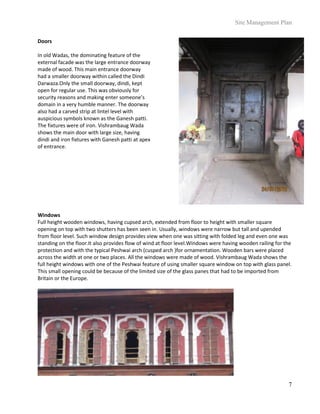
Doors
In old Wadas, the dominating feature of the
external facade was the large entrance doorway
made of wood. This main entrance doorway
had a smaller doorway within called the Dindi
Darwaza.Only the small doorway, dindi, kept
open for regular use. This was obviously for
security reasons and making enter someone’s
domain in a very humble manner. The doorway
also had a carved strip at lintel level with
auspicious symbols known as the Ganesh patti.
The fixtures were of iron. Vishrambaug Wada
shows the main door with large size, having
dindi and iron fixtures with Ganesh patti at apex
of entrance.
Windows
Full height wooden windows, having cupsed arch, extended from floor to height with smaller square
opening on top with two shutters has been seen in. Usually, windows were narrow but tall and upended
from floor level. Such window design provides view when one was sitting with folded leg and even one was
standing on the floor.It also provides flow of wind at floor level.Windows were having wooden railing for the
protection and with the typical Peshwai arch (cusped arch )for ornamentation. Wooden bars were placed
across the width at one or two places. All the windows were made of wood. Vishrambaug Wada shows the
full height windows with one of the Peshwai feature of using smaller square window on top with glass panel.
This small opening could be because of the limited size of the glass panes that had to be imported from
Britain or the Europe.
Site Management Plan
8
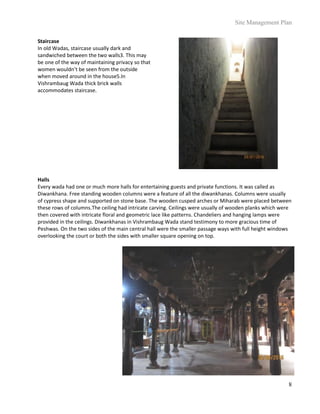
Staircase
In old Wadas, staircase usually dark and
sandwiched between the two walls3. This may
be one of the way of maintaining privacy so that
women wouldn’t be seen from the outside
when moved around in the house5.In
Vishrambaug Wada thick brick walls
accommodates staircase.
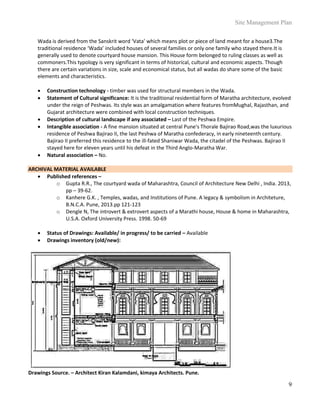
Halls
Every wada had one or much more halls for entertaining guests and private functions. It was called as
Diwankhana. Free standing wooden columns were a feature of all the diwankhanas. Columns were usually
of cypress shape and supported on stone base. The wooden cusped arches or Miharab were placed between
these rows of columns.The ceiling had intricate carving. Ceilings were usually of wooden planks which were
then covered with intricate floral and geometric lace like patterns. Chandeliers and hanging lamps were
provided in the ceilings. Diwankhanas in Vishrambaug Wada stand testimony to more gracious time of
Peshwas. On the two sides of the main central hall were the smaller passage ways with full height windows
overlooking the court or both the sides with smaller square opening on top.
Site Management Plan
9
Wada is derived from the Sanskrit word ‘Vata’ which means plot or piece of land meant for a house3.The
traditional residence ‘Wada’ included houses of several families or only one family who stayed there.It is
generally used to denote courtyard house mansion. This House form belonged to ruling classes as well as
commoners.This typology is very significant in terms of historical, cultural and economic aspects. Though
there are certain variations in size, scale and economical status, but all wadas do share some of the basic
elements and characteristics.
 Construction technology - timber was used for structural members in the Wada.
 Statement of Cultural significance: It is the traditional residential form of Maratha architecture, evolved
under the reign of Peshwas. Its style was an amalgamation where features fromMughal, Rajasthan, and
Gujarat architecture were combined with local construction techniques.
 Description of cultural landscape if any associated – Last of the Peshwa Empire.
 Intangible association - A fine mansion situated at central Pune's Thorale Bajirao Road,was the luxurious
residence of Peshwa Bajirao II, the last Peshwa of Maratha confederacy, in early nineteenth century.
Bajirao II preferred this residence to the ill-fated Shaniwar Wada, the citadel of the Peshwas. Bajirao II
stayed here for eleven years until his defeat in the Third Anglo-Maratha War.
 Natural association – No.
ARCHIVAL MATERIAL AVAILABLE
 Published references –
o Gupta R.R., The courtyard wada of Maharashtra, Council of Architecture New Delhi , India. 2013,
pp – 39-62.
o Kanhere G.K. , Temples, wadas, and Institutions of Pune. A legacy & symbolism in Architeture,
B.N.C.A. Pune, 2013.pp 121-123
o Dengle N, The introvert & extrovert aspects of a Marathi house, House & home in Maharashtra,
U.S.A. Oxford University Press. 1998. 50-69
 Status of Drawings: Available/ in progress/ to be carried – Available
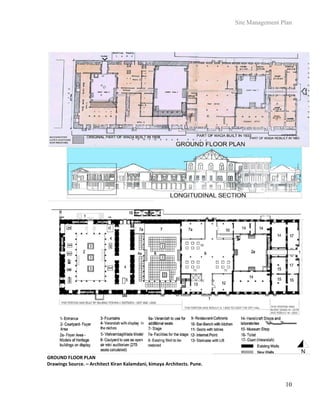
 Drawings inventory (old/new):
Drawings Source. – Architect Kiran Kalamdani, kimaya Architects. Pune.
Site Management Plan
10
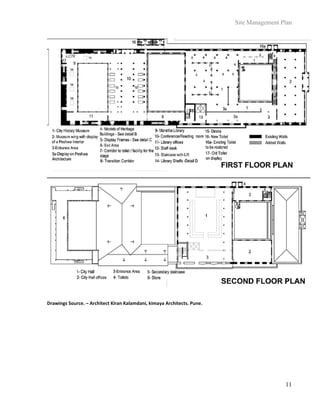
GROUND FLOOR PLAN
Drawings Source. – Architect Kiran Kalamdani, kimaya Architects. Pune.
Site Management Plan
11
Drawings Source. – Architect Kiran Kalamdani, kimaya Architects. Pune.
Site Management Plan
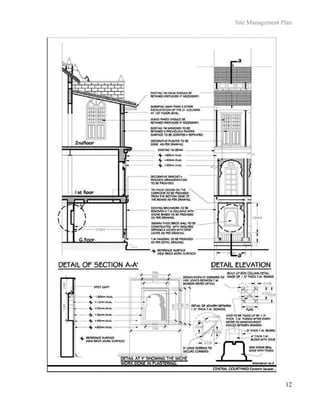
12
Site Management Plan
13
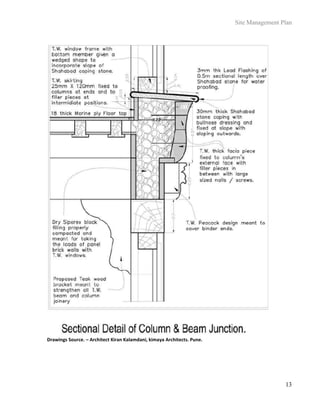
Drawings Source. – Architect Kiran Kalamdani, kimaya Architects. Pune.
Site Management Plan
14
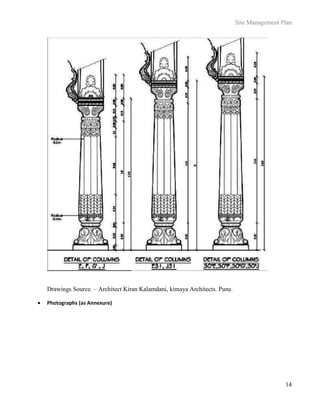
Drawings Source. – Architect Kiran Kalamdani, kimaya Architects. Pune.
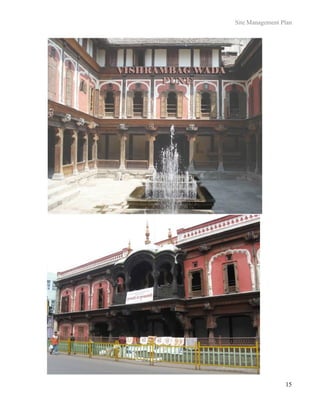
 Photographs (as Annexure)
Site Management Plan
15
Site Management Plan
16
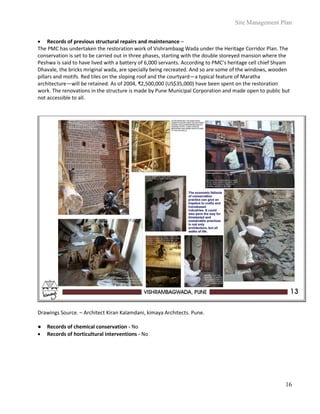
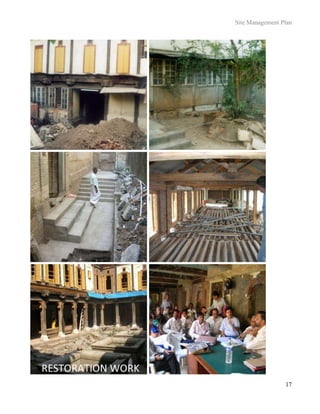
 Records of previous structural repairs and maintenance –
The PMC has undertaken the restoration work of Vishrambaag Wada under the Heritage Corridor Plan. The
conservation is set to be carried out in three phases, starting with the double storeyed mansion where the
Peshwa is said to have lived with a battery of 6,000 servants. According to PMC’s heritage cell chief Shyam
Dhavale, the bricks mriginal wada, are specially being recreated. And so are some of the windows, wooden
pillars and motifs. Red tiles on the sloping roof and the courtyard—a typical feature of Maratha
architecture—will be retained. As of 2004, ₹2,500,000 (US$35,000) have been spent on the restoration
work. The renovations in the structure is made by Pune Municipal Corporation and made open to public but
not accessible to all.
Drawings Source. – Architect Kiran Kalamdani, kimaya Architects. Pune.
● Records of chemical conservation - No
 Records of horticultural interventions - No
Site Management Plan
17
Site Management Plan
18
AREA OF THE SITE
 Within the limits of the property/ protected area/ within core area/ Within buffer zone/ regulated
area prohibited area – WITHIN THE LIMITS OF THE PROPERTY.
INVESTIGATIONS: Available/ in process/required
 Structural analysis (NDT Survey) – NOT AVAILABALE.
 Material investigation – NOT AVAILABALE.
 Soil investigations - NOT AVAILABALE.
 Palaeo-botanical analysis (in case of landscape) - NOT AVAILABALE.
 Archaeological investigations, if any - NOT AVAILABALE.
 Visitor carrying capacity
 Special Project Reports, if any – NOT AVAILABALE.
CONDITION APPRAISAL:
STATUS OF CONSERVATION (Individual/ collective)
(to be supported by condition appraisal drawings and photographs)
ISSUES/
CONDITIONS
CONDITION OBSERVATIONS
FACTORS/
REASONS RESPONSIBLE FOR
DECAY
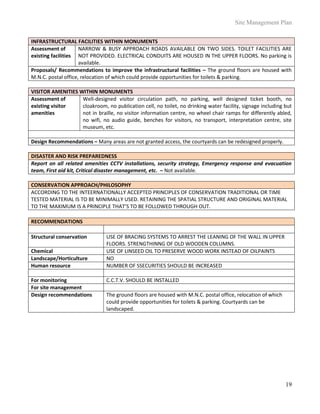
1 Structural defects DAMAGED PEACOCK BEAM
ENDS.
LEANING ACTION OF THE WALLS.
AGEING OF THE STURTURE.
DAMAGED BRICKWORK.
2 Material defects NO
3 Defects due to biological agents NO
4 Defects due to environmental
factors
OBLITERATED TIMBER
STRUCTURE
POLLUTION, ADVERSE WEATHER
5 Defects due to moisture, water
seepage and water logging
CORRODED G.I. SHEETS MOISTURE
6 Human induced defects ORIGINAL WALL FINISH OF
EXPOSED BRICK WORK WAS
DAMAGED
INAPPROPRIATE PLASTER WORK
WITH CEMENT
7 Defects due to impact of disaster NO
8 Other defects
Visitor demographics: city/ domestic/ foreign
All
Site Management Plan
19
INFRASTRUCTURAL FACILITIES WITHIN MONUMENTS
Assessment of
existing facilities
NARROW & BUSY APPROACH ROADS AVAILABLE ON TWO SIDES. TOILET FACILITIES ARE
NOT PROVIDED. ELECTRICAL CONDUITS ARE HOUSED IN THE UPPER FLOORS. No parking is
available.
Proposals/ Recommendations to improve the infrastructural facilities – The ground floors are housed with
M.N.C. postal office, relocation of which could provide opportunities for toilets & parking.
VISITOR AMENITIES WITHIN MONUMENTS
Assessment of
existing visitor
amenities
Well-designed visitor circulation path, no parking, well designed ticket booth, no
cloakroom, no publication cell, no toilet, no drinking water facility, signage including but
not in braille, no visitor information centre, no wheel chair ramps for differently abled,
no wifi, no audio guide, benches for visitors, no transport, interpretation centre, site
museum, etc.
Design Recommendations – Many areas are not granted access, the courtyards can be redesigned properly.
DISASTER AND RISK PREPAREDNESS
Report on all related amenities CCTV installations, security strategy, Emergency response and evacuation
team, First aid kit, Critical disaster management, etc. – Not available.
CONSERVATION APPROACH/PHILOSOPHY
ACCORDING TO THE INTEERNATIONALLY ACCEPTED PRINCIPLES OF CONSERVATION TRADITIONAL OR TIME
TESTED MATERIAL IS TO BE MINIMALLY USED. RETAINING THE SPATIAL STRUCTURE AND ORIGINAL MATERIAL
TO THE MAXIMUM IS A PRINCIPLE THAT’S TO BE FOLLOWED THROUGH OUT.
RECOMMENDATIONS
Structural conservation USE OF BRACING SYSTEMS TO ARREST THE LEANING OF THE WALL IN UPPER
FLOORS. STRENGTHINNG OF OLD WOODEN COLUMNS.
Chemical USE OF LINSEED OIL TO PRESERVE WOOD WORK INSTEAD OF OILPAINTS
Landscape/Horticulture NO
Human resource NUMBER OF SSECURITIES SHOULD BE INCREASED
For monitoring C.C.T.V. SHOULD BE INSTALLED
For site management
Design recommendations The ground floors are housed with M.N.C. postal office, relocation of which
could provide opportunities for toilets & parking. Courtyards can be
landscaped.
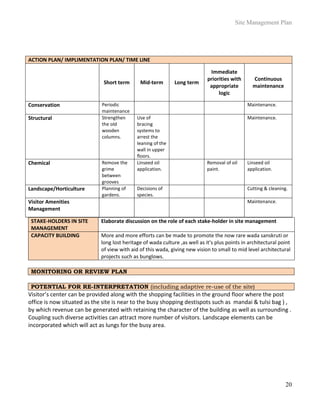
Site Management Plan
20
STAKE-HOLDERS IN SITE
MANAGEMENT
Elaborate discussion on the role of each stake-holder in site management
CAPACITY BUILDING More and more efforts can be made to promote the now rare wada sanskruti or
long lost heritage of wada culture ,as well as it’s plus points in architectural point
of view with aid of this wada, giving new vision to small to mid level architectural
projects such as bunglows.
Visitor’s center can be provided along with the shopping facilities in the ground floor where the post
office is now situated as the site is near to the busy shopping destispots such as mandai & tulsi bag ) ,
by which revenue can be generated with retaining the character of the building as well as surrounding .
Coupling such diverse activities can attract more number of visitors. Landscape elements can be
incorporated which will act as lungs for the busy area.
ACTION PLAN/ IMPLIMENTATION PLAN/ TIME LINE
Short term Mid-term Long term
Immediate
priorities with
appropriate
logic
Continuous
maintenance
Conservation Periodic
maintenance
Maintenance.
Structural Strengthen
the old
wooden
columns.
Use of
bracing
systems to
arrest the
leaning of the
wall in upper
floors.
Maintenance.
Chemical Remove the
grime
between
grooves
Linseed oil
application.
Removal of oil
paint.
Linseed oil
application.
Landscape/Horticulture Planning of
gardens.
Decisions of
species.
Cutting & cleaning.
Visitor Amenities
Management
Maintenance.
MONITORING OR REVIEW PLAN
POTENTIAL FOR RE-INTERPRETATION (including adaptive re-use of the site)

Conservation site management plan -vishrambaug vada, pune

  • 1.
    Site Management Plan 1 CONSERVATIONAND SITE MANAGEMENT PLAN VISHRAMBAUG WADA, PUNE Soumitra Smart. S.Y.M.Arch. J.N.E.C.
  • 2.
    Site Management Plan 2 CONSERVATIONAND SITE MANAGEMENT PLAN GENERAL INFORMATION:  Name - Vishrambaug Vada, Pune.  Location: o Address - 619, RB Kumthekar Road, Perugate, Sadashiv Peth, Pune, Maharashtra 411030. o geo-co-ordinates – 18o 30’50”N, 73o 51’15”E
  • 3.
    Site Management Plan 3 Topographic features & maps  Climate zone & details: Pune is influenced by the local steppe climate. In Pune, there is little rainfall throughout the year. According to Köppen and Geiger, this climate is classified as BSh. The average annual rainfall is 763 mm. Pune has a hot semi-arid climate bordering with tropical wet and dry (type Aw) with average temperatures ranging between 20 and 28 °C (68 and 82 °F). Pune experiences three seasons: summer, monsoon, and winter. The driest month is January, with 0 mm of rainfall. With an average of 211 mm, the most precipitation falls in July. The warmest month of the year is May, with an average temperature of 29.6 °C. December has the lowest average temperature of the year. It is 21.1 °C. The difference in precipitation between the driest month and the wettest month is 211 mm. During the year, the average temperatures vary by 8.5 °C. Avarage Climate : Source - https://en.climate-data.org/location/31/
  • 4.
    Site Management Plan 4 Type of the heritage site/ monument/ property based on the size Individual/ Complex/ Group/ landscape/ excavated/ settlement/ burial or cemetery – Individual property  Type of the heritage site/ monument/ property based on function Religious/ Community/ Social/ Technological assemble/ Industrial - Social  Designated usage of the site/ structure - Residence  Present usage of the site/ structure – Government offices/ Museum. ADMINISTRATIVE: Ownership structure – P.M.C. Protection status – GRADE 1 Legislation applicable - P.M.C. Stake-holders involved - NO Management structure of the site - P.M.C. Details in master/city development plan ARCHIVAL DATA COLLECTION:  Construction period / Date - Vishrambaag Wada was built in 1807 AD. It took six years to complete the construction.  Builders / Patronage - built by Bajirao Peshwa- II  Architectural description: ‘Vishrambaug wada’ one of the traditional Wada’s in Pune, has been referred for study to explore relation between past and present architecture. The structure is divided into three parts around three courtyards and shared by common walls. The planning and layouts of the Wadas were built around the concepts of a courtyard. The basic planning of all Wadas was introvert and chowk based. Introvert planning provides the sense of enclosure and privacy to the residents of the house. There was a political agenda for adopting introvert planform by Marathas. Being warriors in order to protect their culture and religion against rulers (mainly Mughals), Marathas brought this style of planning. Security and defence were the planning strategy for a Wada. Number of chowks varied from a single chowk upto seven. For more than two courts, outer court used for Public and semi-public purpose and inner court was used for private. Zoning was the
  • 5.
    Site Management Plan 5 importantaspect in Wada planning. Courtyard was also important symbolically, as it symbolised inwardness in the house. The centre space is the Brahma space as per vastu shahtra. Toilets are located at the rear side of house. Visrambaug Wada shows the courtyard patterned layout with three main courtyards one behind the other. The first courtyard is square in plan; the second one which is bigger is rectangular in plan and the third smaller courtyard. Vishrambaug wada is magnificent in size and scale. It shows the grid planning design. Structural grid was called as Khan and the bay formed by number of khan was called Ghaee. Khan was not a fixed unit of length between columns but varied from 5’ to 10’. It is a kind of modular system which offers flexibility and economy for planning process. Considering the privacy, economical, political, functional, cultural and religious aspects Wada plan form becomes significant. Structural grid is clearly visible in elevation of exterior façade. An element of decoration such as cusped arch which is non-structural false arch within each bay has been borrowed from Peshwas traditional architecture. Style of Peshwas architecture was an amalgamation of various other styles like Rajasthani, Gujrati and Delhi. Style of window design; manner of placing covered platforms and guard rooms (devadis) at each side of entrance door with smaller openings above the wooden tall windows . Visrambaug wada’s facade has a classic wooden balcony called meghadambari (a cloud capped balcony ) projecting from it. Facade is very ornamented belonging to ruling class. Elements There are various elements in architecture such as spatial element, construction elements, and structural elements. There are some elements related to decoration also. But certain thematic space and its elements are significant in traditional architecture considering cultural, climatic and functional implications. Thresholds The idea of threshold always had a special significance in traditional architecture of India and Pune is not an exception. It signifies the transition of space from public to private. It connects inside and outside; external and internal; open and enclosed. This spatial element has been associated with metaphysical ideas because of which two opposite worlds come together. Wada often has platforms at the entrance from the street. It was locally called as ‘osari’. A verandah like space which has two platforms on each side of door, with pillars supporting the upper floor. This transitional space encourages residents and passers-by to pause for conversation and helps the residents of the Wada to get connected with the neighborhood socially. It provides an interactive space. In Wada platforms of threshold are slightly elevated so that they act as the mode of transition between built form and land. It provides shelter from sun and rain. This element has paramount importance which provides social, cultural, functional, climatic and religious implications. In Vishrambaug Wada the entrance is constructed within seven bays, between two devadis which was used as a guard room. Columns are very decorative circular in shape and supported to balcony in Vishrambaug Wada.The cusped arch non structural member can also be seen at the entrance. The wooden brackets are supported by four ornate winged yalis or a combination of lion, eagle and crocodile considered as good omen.
  • 6.
    Site Management Plan 6 Courtyards Wadacannot be imagined without a courtyard in Maharashtra. It was a core element in design of wadas. Vishrambaug Wada has three large chowks. The first and second courtyard was used for administration purpose.The personal rooms were in last courtyards i.e third courtyard. It was used for personal use by Peshwa Bajirao II. The last courtyard has fountains and middle courtyard has two wells which cools the interior of the Wada even during scorching summers. The middle courtyard is bigger than the last and front courtyard. The Vishrambaug Wada is covered with timber roof on all wings. It has tiles over the wood finish. On the interior facades of chowks in Vishrambaug Wada ornamental patterns are raised in the plaster in each bay. They are like floral garlands in the shape of the cusped arches as used in the window. The brackets facing the courtyard in Vishrambaug Wada have been beautifully carved with wooden decorative mounts with parrots, flowers, peacocks, banana leaves and many other decorative motifs. The characteristics of a courtyard as an element in traditional architecture are that it connects inside and outside space. This space connects ground floor and upper floors and family or families living around the space. It is private outdoor space that becomes public space for gathering at the time of festivals and cultural programmes. It provides an interactive space. Every room designed is facing towards the courtyard. This open space is used for various activities such as gathering, gossiping, resting, cooking, washing, performing rituals, dining, playing etc. This flexibility to interior space also provides economic aspects. It is an environmental space that offers Light and ventilation, landscaping, cooling, wind gathering etc. Verandahs In Wada, the court was surrounded by a semi- open passageway with columns known as sopa.It was extended inside verandah. Sopa served as an un-programmed space in which activities held in enclosed rooms as well as in open court were spill out. Activities from Kitchen, storage were extended in the Verandah.It used for dining called as ‘Pangaticha Sopa3.This space was also used for entertainment purpose. Usually swing was the recreational element and feature of the verandah7. Verandah diffuses light and provides shelter from Sun and rain. It is a transitional element of space. It became significant providing various aspects such as cultural, climatic, functional, religious. Wada has four sopa around a Courtyard on the ground floor with wooden. Style of column base design and ceiling design are analogous as in Peshwai architecture.
  • 7.
    Site Management Plan 7 Doors Inold Wadas, the dominating feature of the external facade was the large entrance doorway made of wood. This main entrance doorway had a smaller doorway within called the Dindi Darwaza.Only the small doorway, dindi, kept open for regular use. This was obviously for security reasons and making enter someone’s domain in a very humble manner. The doorway also had a carved strip at lintel level with auspicious symbols known as the Ganesh patti. The fixtures were of iron. Vishrambaug Wada shows the main door with large size, having dindi and iron fixtures with Ganesh patti at apex of entrance. Windows Full height wooden windows, having cupsed arch, extended from floor to height with smaller square opening on top with two shutters has been seen in. Usually, windows were narrow but tall and upended from floor level. Such window design provides view when one was sitting with folded leg and even one was standing on the floor.It also provides flow of wind at floor level.Windows were having wooden railing for the protection and with the typical Peshwai arch (cusped arch )for ornamentation. Wooden bars were placed across the width at one or two places. All the windows were made of wood. Vishrambaug Wada shows the full height windows with one of the Peshwai feature of using smaller square window on top with glass panel. This small opening could be because of the limited size of the glass panes that had to be imported from Britain or the Europe.
  • 8.
    Site Management Plan 8 Staircase Inold Wadas, staircase usually dark and sandwiched between the two walls3. This may be one of the way of maintaining privacy so that women wouldn’t be seen from the outside when moved around in the house5.In Vishrambaug Wada thick brick walls accommodates staircase. Halls Every wada had one or much more halls for entertaining guests and private functions. It was called as Diwankhana. Free standing wooden columns were a feature of all the diwankhanas. Columns were usually of cypress shape and supported on stone base. The wooden cusped arches or Miharab were placed between these rows of columns.The ceiling had intricate carving. Ceilings were usually of wooden planks which were then covered with intricate floral and geometric lace like patterns. Chandeliers and hanging lamps were provided in the ceilings. Diwankhanas in Vishrambaug Wada stand testimony to more gracious time of Peshwas. On the two sides of the main central hall were the smaller passage ways with full height windows overlooking the court or both the sides with smaller square opening on top.
  • 9.
    Site Management Plan 9 Wadais derived from the Sanskrit word ‘Vata’ which means plot or piece of land meant for a house3.The traditional residence ‘Wada’ included houses of several families or only one family who stayed there.It is generally used to denote courtyard house mansion. This House form belonged to ruling classes as well as commoners.This typology is very significant in terms of historical, cultural and economic aspects. Though there are certain variations in size, scale and economical status, but all wadas do share some of the basic elements and characteristics.  Construction technology - timber was used for structural members in the Wada.  Statement of Cultural significance: It is the traditional residential form of Maratha architecture, evolved under the reign of Peshwas. Its style was an amalgamation where features fromMughal, Rajasthan, and Gujarat architecture were combined with local construction techniques.  Description of cultural landscape if any associated – Last of the Peshwa Empire.  Intangible association - A fine mansion situated at central Pune's Thorale Bajirao Road,was the luxurious residence of Peshwa Bajirao II, the last Peshwa of Maratha confederacy, in early nineteenth century. Bajirao II preferred this residence to the ill-fated Shaniwar Wada, the citadel of the Peshwas. Bajirao II stayed here for eleven years until his defeat in the Third Anglo-Maratha War.  Natural association – No. ARCHIVAL MATERIAL AVAILABLE  Published references – o Gupta R.R., The courtyard wada of Maharashtra, Council of Architecture New Delhi , India. 2013, pp – 39-62. o Kanhere G.K. , Temples, wadas, and Institutions of Pune. A legacy & symbolism in Architeture, B.N.C.A. Pune, 2013.pp 121-123 o Dengle N, The introvert & extrovert aspects of a Marathi house, House & home in Maharashtra, U.S.A. Oxford University Press. 1998. 50-69  Status of Drawings: Available/ in progress/ to be carried – Available  Drawings inventory (old/new): Drawings Source. – Architect Kiran Kalamdani, kimaya Architects. Pune.
  • 10.
    Site Management Plan 10 GROUNDFLOOR PLAN Drawings Source. – Architect Kiran Kalamdani, kimaya Architects. Pune.
  • 11.
    Site Management Plan 11 DrawingsSource. – Architect Kiran Kalamdani, kimaya Architects. Pune.
  • 12.
  • 13.
    Site Management Plan 13 DrawingsSource. – Architect Kiran Kalamdani, kimaya Architects. Pune.
  • 14.
    Site Management Plan 14 DrawingsSource. – Architect Kiran Kalamdani, kimaya Architects. Pune.  Photographs (as Annexure)
  • 15.
  • 16.
    Site Management Plan 16 Records of previous structural repairs and maintenance – The PMC has undertaken the restoration work of Vishrambaag Wada under the Heritage Corridor Plan. The conservation is set to be carried out in three phases, starting with the double storeyed mansion where the Peshwa is said to have lived with a battery of 6,000 servants. According to PMC’s heritage cell chief Shyam Dhavale, the bricks mriginal wada, are specially being recreated. And so are some of the windows, wooden pillars and motifs. Red tiles on the sloping roof and the courtyard—a typical feature of Maratha architecture—will be retained. As of 2004, ₹2,500,000 (US$35,000) have been spent on the restoration work. The renovations in the structure is made by Pune Municipal Corporation and made open to public but not accessible to all. Drawings Source. – Architect Kiran Kalamdani, kimaya Architects. Pune. ● Records of chemical conservation - No  Records of horticultural interventions - No
  • 17.
  • 18.
    Site Management Plan 18 AREAOF THE SITE  Within the limits of the property/ protected area/ within core area/ Within buffer zone/ regulated area prohibited area – WITHIN THE LIMITS OF THE PROPERTY. INVESTIGATIONS: Available/ in process/required  Structural analysis (NDT Survey) – NOT AVAILABALE.  Material investigation – NOT AVAILABALE.  Soil investigations - NOT AVAILABALE.  Palaeo-botanical analysis (in case of landscape) - NOT AVAILABALE.  Archaeological investigations, if any - NOT AVAILABALE.  Visitor carrying capacity  Special Project Reports, if any – NOT AVAILABALE. CONDITION APPRAISAL: STATUS OF CONSERVATION (Individual/ collective) (to be supported by condition appraisal drawings and photographs) ISSUES/ CONDITIONS CONDITION OBSERVATIONS FACTORS/ REASONS RESPONSIBLE FOR DECAY 1 Structural defects DAMAGED PEACOCK BEAM ENDS. LEANING ACTION OF THE WALLS. AGEING OF THE STURTURE. DAMAGED BRICKWORK. 2 Material defects NO 3 Defects due to biological agents NO 4 Defects due to environmental factors OBLITERATED TIMBER STRUCTURE POLLUTION, ADVERSE WEATHER 5 Defects due to moisture, water seepage and water logging CORRODED G.I. SHEETS MOISTURE 6 Human induced defects ORIGINAL WALL FINISH OF EXPOSED BRICK WORK WAS DAMAGED INAPPROPRIATE PLASTER WORK WITH CEMENT 7 Defects due to impact of disaster NO 8 Other defects Visitor demographics: city/ domestic/ foreign All
  • 19.
    Site Management Plan 19 INFRASTRUCTURALFACILITIES WITHIN MONUMENTS Assessment of existing facilities NARROW & BUSY APPROACH ROADS AVAILABLE ON TWO SIDES. TOILET FACILITIES ARE NOT PROVIDED. ELECTRICAL CONDUITS ARE HOUSED IN THE UPPER FLOORS. No parking is available. Proposals/ Recommendations to improve the infrastructural facilities – The ground floors are housed with M.N.C. postal office, relocation of which could provide opportunities for toilets & parking. VISITOR AMENITIES WITHIN MONUMENTS Assessment of existing visitor amenities Well-designed visitor circulation path, no parking, well designed ticket booth, no cloakroom, no publication cell, no toilet, no drinking water facility, signage including but not in braille, no visitor information centre, no wheel chair ramps for differently abled, no wifi, no audio guide, benches for visitors, no transport, interpretation centre, site museum, etc. Design Recommendations – Many areas are not granted access, the courtyards can be redesigned properly. DISASTER AND RISK PREPAREDNESS Report on all related amenities CCTV installations, security strategy, Emergency response and evacuation team, First aid kit, Critical disaster management, etc. – Not available. CONSERVATION APPROACH/PHILOSOPHY ACCORDING TO THE INTEERNATIONALLY ACCEPTED PRINCIPLES OF CONSERVATION TRADITIONAL OR TIME TESTED MATERIAL IS TO BE MINIMALLY USED. RETAINING THE SPATIAL STRUCTURE AND ORIGINAL MATERIAL TO THE MAXIMUM IS A PRINCIPLE THAT’S TO BE FOLLOWED THROUGH OUT. RECOMMENDATIONS Structural conservation USE OF BRACING SYSTEMS TO ARREST THE LEANING OF THE WALL IN UPPER FLOORS. STRENGTHINNG OF OLD WOODEN COLUMNS. Chemical USE OF LINSEED OIL TO PRESERVE WOOD WORK INSTEAD OF OILPAINTS Landscape/Horticulture NO Human resource NUMBER OF SSECURITIES SHOULD BE INCREASED For monitoring C.C.T.V. SHOULD BE INSTALLED For site management Design recommendations The ground floors are housed with M.N.C. postal office, relocation of which could provide opportunities for toilets & parking. Courtyards can be landscaped.
  • 20.
    Site Management Plan 20 STAKE-HOLDERSIN SITE MANAGEMENT Elaborate discussion on the role of each stake-holder in site management CAPACITY BUILDING More and more efforts can be made to promote the now rare wada sanskruti or long lost heritage of wada culture ,as well as it’s plus points in architectural point of view with aid of this wada, giving new vision to small to mid level architectural projects such as bunglows. Visitor’s center can be provided along with the shopping facilities in the ground floor where the post office is now situated as the site is near to the busy shopping destispots such as mandai & tulsi bag ) , by which revenue can be generated with retaining the character of the building as well as surrounding . Coupling such diverse activities can attract more number of visitors. Landscape elements can be incorporated which will act as lungs for the busy area. ACTION PLAN/ IMPLIMENTATION PLAN/ TIME LINE Short term Mid-term Long term Immediate priorities with appropriate logic Continuous maintenance Conservation Periodic maintenance Maintenance. Structural Strengthen the old wooden columns. Use of bracing systems to arrest the leaning of the wall in upper floors. Maintenance. Chemical Remove the grime between grooves Linseed oil application. Removal of oil paint. Linseed oil application. Landscape/Horticulture Planning of gardens. Decisions of species. Cutting & cleaning. Visitor Amenities Management Maintenance. MONITORING OR REVIEW PLAN POTENTIAL FOR RE-INTERPRETATION (including adaptive re-use of the site)