Construction Technology_Unit 3.2
1
Unit VI (6 hours)
High rise construction techniques: Various types and
erection methods of shuttering/form work, Operation and
erection of Ready Mix Concrete Plant, special techniques
required for construction and maintenance of high rise
construction like Pumped Concrete, slip form.
2
1. Slip form
2. Jump form
3. Climbing formwork
4.Table form/ flying form
5. Column system formwork
6.Tunnel form
Introduction to Construction formwork system
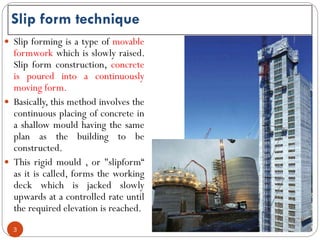
 Slip forming is a type of movable
formwork which is slowly raised.
Slip form construction, concrete
is poured into a continuously
moving form.
 Basically, this method involves the
continuous placing of concrete in
a shallow mould having the same
plan as the building to be
constructed.
 This rigid mould , or "slipform“
as it is called, forms the working
deck which is jacked slowly
upwards at a controlled rate until
the required elevation is reached.
Slip form technique
3
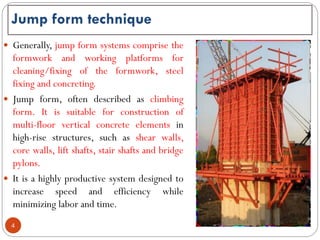
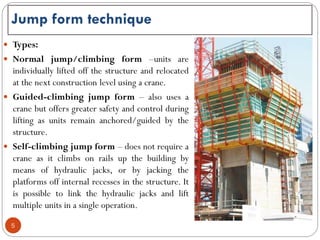
 Generally, jump form systems comprise the
formwork and working platforms for
cleaning/fixing of the formwork, steel
fixing and concreting.
 Jump form, often described as climbing
form. It is suitable for construction of
multi-floor vertical concrete elements in
high-rise structures, such as shear walls,
core walls, lift shafts, stair shafts and bridge
pylons.
 It is a highly productive system designed to
increase speed and efficiency while
minimizing labor and time.
Jump form technique
4
 Types:
 Normal jump/climbing form –units are
individually lifted off the structure and relocated
at the next construction level using a crane.
 Guided-climbing jump form – also uses a
crane but offers greater safety and control during
lifting as units remain anchored/guided by the
structure.
 Self-climbing jump form – does not require a
crane as it climbs on rails up the building by
means of hydraulic jacks, or by jacking the
platforms off internal recesses in the structure. It
is possible to link the hydraulic jacks and lift
multiple units in a single operation.
Jump form technique
5
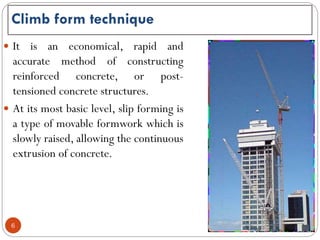
 It is an economical, rapid and
accurate method of constructing
reinforced concrete, or post-
tensioned concrete structures.
 At its most basic level, slip forming is
a type of movable formwork which is
slowly raised, allowing the continuous
extrusion of concrete.
Climb form technique
6
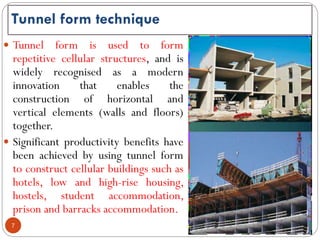
 Tunnel form is used to form
repetitive cellular structures, and is
widely recognised as a modern
innovation that enables the
construction of horizontal and
vertical elements (walls and floors)
together.
 Significant productivity benefits have
been achieved by using tunnel form
to construct cellular buildings such as
hotels, low and high-rise housing,
hostels, student accommodation,
prison and barracks accommodation.
Tunnel form technique
7
 A table form/flying form is a large
preassembled formwork and
falsework unit, often forming a
complete bay of suspended floor slab.
 It offers mobility and quick
installation for construction projects
with regular plan layouts or long
repetitive structures, so is highly
suitable for flat slab, and beam and
slab layouts.
Table form technique
8
9
1. Mivan Construction System
2. Coffor formwork system
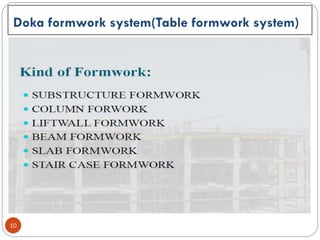
3. Doka formwork system(Table formwork system)
4. PERI formwork system
Construction formwork system in Market
10
Doka formwork system(Table formwork system)
SBG Department of Civil PCCoE,2020-21
11
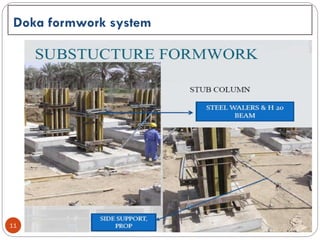
Doka formwork system
SBG Department of Civil PCCoE,2020-21
12
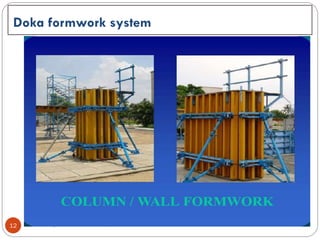
Doka formwork system
SBG Department of Civil PCCoE,2020-21
13
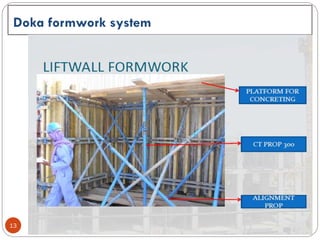
Doka formwork system
SBG Department of Civil PCCoE,2020-21
14
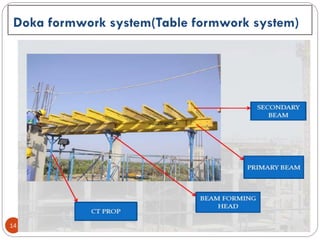
Doka formwork system(Table formwork system)
SBG Department of Civil PCCoE,2020-21
15
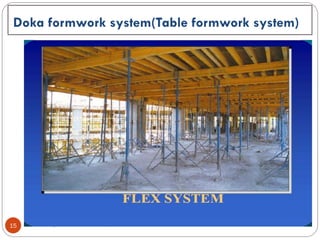
Doka formwork system(Table formwork system)
SBG Department of Civil PCCoE,2020-21
16
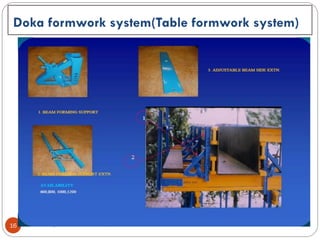
Doka formwork system(Table formwork system)
SBG Department of Civil PCCoE,2020-21
17
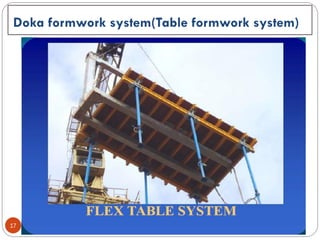
Doka formwork system(Table formwork system)
18
Doka formwork system(Table formwork system)
ADVANTAGES
● HIGH LABOR PRODUCTIVITY (APPROX 8TO 10 SQ.M PER MAN-
DAY)
● SIMPLE DESHUTTERING OPERATION
● MINIMIZES MAKING /ASSEMBLYTIME AND COST AT SITE
● ENTIREASSEMBLY CAN BE LIFTEDWITH CRANE
● SYSTEM IS RIGIDAND STABLE
● CLEANACCURATEAND SMOOTH CONCRETE FINISH
19
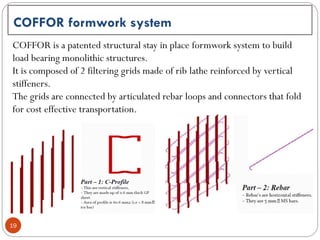
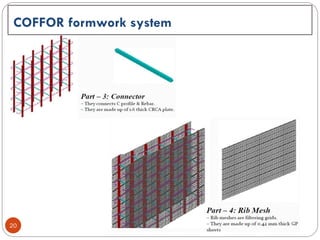
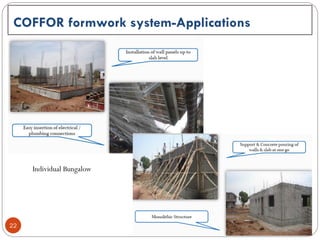
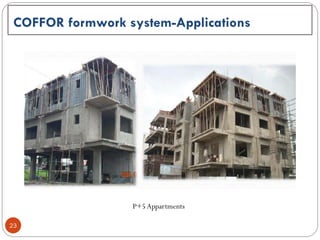
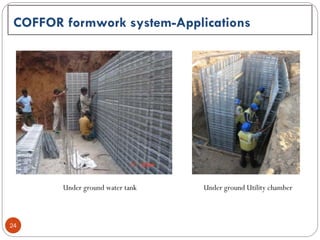
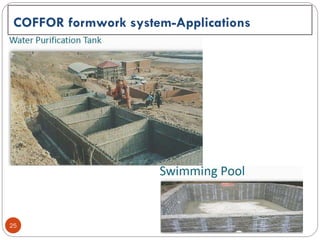
COFFOR formwork system
COFFOR is a patented structural stay in place formwork system to build
load bearing monolithic structures.
It is composed of 2 filtering grids made of rib lathe reinforced by vertical
stiffeners.
The grids are connected by articulated rebar loops and connectors that fold
for cost effective transportation.
20
COFFOR formwork system
21
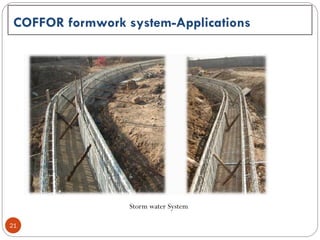
COFFOR formwork system-Applications
Storm water System
22
COFFOR formwork system-Applications
Individual Bungalow
23
COFFOR formwork system-Applications
P+5Appartments
24
COFFOR formwork system-Applications
Under ground water tank Under ground Utility chamber
25
COFFOR formwork system-Applications
26
COFFOR formwork system-Applications
Advantages-
• LessVolume Required
•No Shuttering Required
•No Crane Required
•Minimum Reinforcement
•Less allied accessories required
•Multiple Creative possibilities
•Semi-skilled labour’s required
•Less no of labour’s required
•No honey comb in concrete
•Easy installation of Electric and plumbing lines
•Rapid Concrete Shrinkage
27
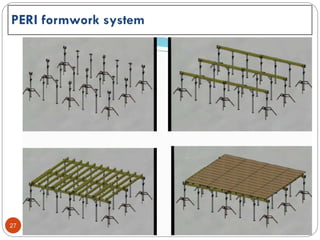
PERI formwork system
28
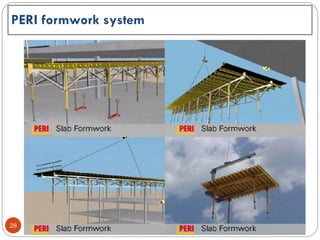
PERI formwork system
29
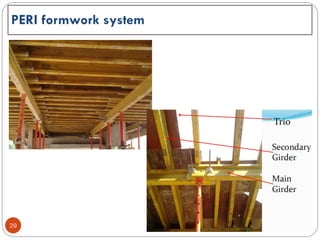
PERI formwork system
30
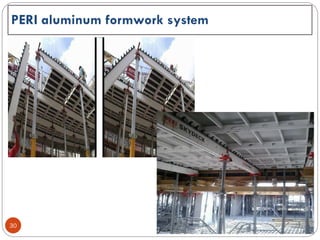
PERI aluminum formwork system
31
Mivan formwork system
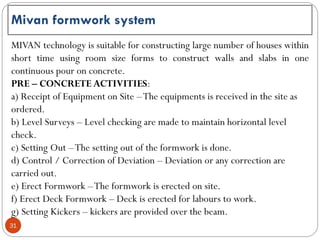
MIVAN technology is suitable for constructing large number of houses within
short time using room size forms to construct walls and slabs in one
continuous pour on concrete.
PRE – CONCRETE ACTIVITIES:
a) Receipt of Equipment on Site –The equipments is received in the site as
ordered.
b) Level Surveys – Level checking are made to maintain horizontal level
check.
c) Setting Out –The setting out of the formwork is done.
d) Control / Correction of Deviation – Deviation or any correction are
carried out.
e) Erect Formwork –The formwork is erected on site.
f) Erect Deck Formwork – Deck is erected for labours to work.
g) Setting Kickers – kickers are provided over the beam.
32
Mivan formwork system
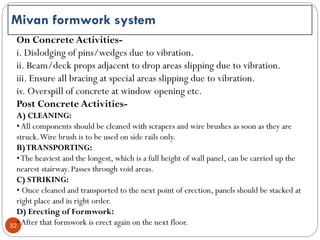
On Concrete Activities-
i. Dislodging of pins/wedges due to vibration.
ii. Beam/deck props adjacent to drop areas slipping due to vibration.
iii. Ensure all bracing at special areas slipping due to vibration.
iv. Overspill of concrete at window opening etc.
Post Concrete Activities-
A) CLEANING:
•All components should be cleaned with scrapers and wire brushes as soon as they are
struck.Wire brush is to be used on side rails only.
B)TRANSPORTING:
•The heaviest and the longest, which is a full height of wall panel, can be carried up the
nearest stairway. Passes through void areas.
C) STRIKING:
• Once cleaned and transported to the next point of erection, panels should be stacked at
right place and in right order.
D) Erecting of Formwork:
•After that formwork is erect again on the next floor.
33
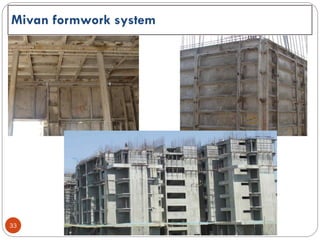
Mivan formwork system
34
Mivan formwork system
ADVANTAGES-
The MIVAN formwork is specifically designed to allow rapid construction
of all types of architectural layouts.
1) Cost effective.
2) It is more effective for mass housing to be done quickly.
3) Great construction speed.
4) High quality finish.
5) Erected using unskilled labor.
6) Panels can be reused up to 250 times.
35
Mivan formwork system
Limitation of Mivan Formwork:
1) Because of small sizes finishing lines are seen on the concrete surfaces.
2) It requires uniform planning as well as uniform elevations to be cost
effective.
3) Modifications are not possible as all members are caste in RCC.
4) Due to box-type construction shrinkage cracks are likely to appear.
5) Heat of Hydration is high due to shear walls.

Construction Technology

  • 1.
    Construction Technology_Unit 3.2 1 UnitVI (6 hours) High rise construction techniques: Various types and erection methods of shuttering/form work, Operation and erection of Ready Mix Concrete Plant, special techniques required for construction and maintenance of high rise construction like Pumped Concrete, slip form.
  • 2.
    2 1. Slip form 2.Jump form 3. Climbing formwork 4.Table form/ flying form 5. Column system formwork 6.Tunnel form Introduction to Construction formwork system
  • 3.
     Slip formingis a type of movable formwork which is slowly raised. Slip form construction, concrete is poured into a continuously moving form.  Basically, this method involves the continuous placing of concrete in a shallow mould having the same plan as the building to be constructed.  This rigid mould , or "slipform“ as it is called, forms the working deck which is jacked slowly upwards at a controlled rate until the required elevation is reached. Slip form technique 3
  • 4.
     Generally, jumpform systems comprise the formwork and working platforms for cleaning/fixing of the formwork, steel fixing and concreting.  Jump form, often described as climbing form. It is suitable for construction of multi-floor vertical concrete elements in high-rise structures, such as shear walls, core walls, lift shafts, stair shafts and bridge pylons.  It is a highly productive system designed to increase speed and efficiency while minimizing labor and time. Jump form technique 4
  • 5.
     Types:  Normaljump/climbing form –units are individually lifted off the structure and relocated at the next construction level using a crane.  Guided-climbing jump form – also uses a crane but offers greater safety and control during lifting as units remain anchored/guided by the structure.  Self-climbing jump form – does not require a crane as it climbs on rails up the building by means of hydraulic jacks, or by jacking the platforms off internal recesses in the structure. It is possible to link the hydraulic jacks and lift multiple units in a single operation. Jump form technique 5
  • 6.
     It isan economical, rapid and accurate method of constructing reinforced concrete, or post- tensioned concrete structures.  At its most basic level, slip forming is a type of movable formwork which is slowly raised, allowing the continuous extrusion of concrete. Climb form technique 6
  • 7.
     Tunnel formis used to form repetitive cellular structures, and is widely recognised as a modern innovation that enables the construction of horizontal and vertical elements (walls and floors) together.  Significant productivity benefits have been achieved by using tunnel form to construct cellular buildings such as hotels, low and high-rise housing, hostels, student accommodation, prison and barracks accommodation. Tunnel form technique 7
  • 8.
     A tableform/flying form is a large preassembled formwork and falsework unit, often forming a complete bay of suspended floor slab.  It offers mobility and quick installation for construction projects with regular plan layouts or long repetitive structures, so is highly suitable for flat slab, and beam and slab layouts. Table form technique 8
  • 9.
    9 1. Mivan ConstructionSystem 2. Coffor formwork system 3. Doka formwork system(Table formwork system) 4. PERI formwork system Construction formwork system in Market
  • 10.
  • 11.
    SBG Department ofCivil PCCoE,2020-21 11 Doka formwork system
  • 12.
    SBG Department ofCivil PCCoE,2020-21 12 Doka formwork system
  • 13.
    SBG Department ofCivil PCCoE,2020-21 13 Doka formwork system
  • 14.
    SBG Department ofCivil PCCoE,2020-21 14 Doka formwork system(Table formwork system)
  • 15.
    SBG Department ofCivil PCCoE,2020-21 15 Doka formwork system(Table formwork system)
  • 16.
    SBG Department ofCivil PCCoE,2020-21 16 Doka formwork system(Table formwork system)
  • 17.
    SBG Department ofCivil PCCoE,2020-21 17 Doka formwork system(Table formwork system)
  • 18.
    18 Doka formwork system(Tableformwork system) ADVANTAGES ● HIGH LABOR PRODUCTIVITY (APPROX 8TO 10 SQ.M PER MAN- DAY) ● SIMPLE DESHUTTERING OPERATION ● MINIMIZES MAKING /ASSEMBLYTIME AND COST AT SITE ● ENTIREASSEMBLY CAN BE LIFTEDWITH CRANE ● SYSTEM IS RIGIDAND STABLE ● CLEANACCURATEAND SMOOTH CONCRETE FINISH
  • 19.
    19 COFFOR formwork system COFFORis a patented structural stay in place formwork system to build load bearing monolithic structures. It is composed of 2 filtering grids made of rib lathe reinforced by vertical stiffeners. The grids are connected by articulated rebar loops and connectors that fold for cost effective transportation.
  • 20.
  • 21.
  • 22.
  • 23.
  • 24.
    24 COFFOR formwork system-Applications Underground water tank Under ground Utility chamber
  • 25.
  • 26.
    26 COFFOR formwork system-Applications Advantages- •LessVolume Required •No Shuttering Required •No Crane Required •Minimum Reinforcement •Less allied accessories required •Multiple Creative possibilities •Semi-skilled labour’s required •Less no of labour’s required •No honey comb in concrete •Easy installation of Electric and plumbing lines •Rapid Concrete Shrinkage
  • 27.
  • 28.
  • 29.
  • 30.
  • 31.
    31 Mivan formwork system MIVANtechnology is suitable for constructing large number of houses within short time using room size forms to construct walls and slabs in one continuous pour on concrete. PRE – CONCRETE ACTIVITIES: a) Receipt of Equipment on Site –The equipments is received in the site as ordered. b) Level Surveys – Level checking are made to maintain horizontal level check. c) Setting Out –The setting out of the formwork is done. d) Control / Correction of Deviation – Deviation or any correction are carried out. e) Erect Formwork –The formwork is erected on site. f) Erect Deck Formwork – Deck is erected for labours to work. g) Setting Kickers – kickers are provided over the beam.
  • 32.
    32 Mivan formwork system OnConcrete Activities- i. Dislodging of pins/wedges due to vibration. ii. Beam/deck props adjacent to drop areas slipping due to vibration. iii. Ensure all bracing at special areas slipping due to vibration. iv. Overspill of concrete at window opening etc. Post Concrete Activities- A) CLEANING: •All components should be cleaned with scrapers and wire brushes as soon as they are struck.Wire brush is to be used on side rails only. B)TRANSPORTING: •The heaviest and the longest, which is a full height of wall panel, can be carried up the nearest stairway. Passes through void areas. C) STRIKING: • Once cleaned and transported to the next point of erection, panels should be stacked at right place and in right order. D) Erecting of Formwork: •After that formwork is erect again on the next floor.
  • 33.
  • 34.
    34 Mivan formwork system ADVANTAGES- TheMIVAN formwork is specifically designed to allow rapid construction of all types of architectural layouts. 1) Cost effective. 2) It is more effective for mass housing to be done quickly. 3) Great construction speed. 4) High quality finish. 5) Erected using unskilled labor. 6) Panels can be reused up to 250 times.
  • 35.
    35 Mivan formwork system Limitationof Mivan Formwork: 1) Because of small sizes finishing lines are seen on the concrete surfaces. 2) It requires uniform planning as well as uniform elevations to be cost effective. 3) Modifications are not possible as all members are caste in RCC. 4) Due to box-type construction shrinkage cracks are likely to appear. 5) Heat of Hydration is high due to shear walls.