ADAPTIVE MISSILE GUIDANCE
USING GPS
INTRODUCTION:
• 1) INTRODUCTION TO MISSILE GUIDANCE:
Guided missile systems have evolved at a
tremendous rate over the past decades, and
recent break through in technology ensure that
smart warheads will have an increasing role in
maintaining our military superiority Innocent
civilians are not harmed by misfire
• 2) CONCEPT OF MISSILE GUIDANCE:
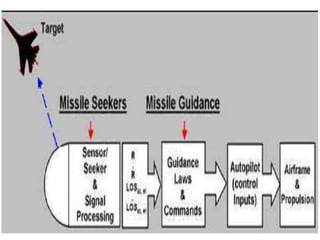
Missile guidance concerns the method by
which the missile receives its commands to move
CONTINUED :>
along a certain path to reach a target On
some missiles, these commands are generated
internally by the missile computer autopilot
On others, the commands are transmitted to
the missile by some external source The missile
sensor or seeker , on the other hand , is a
component within a missile that generates data
fed into the missile computer This data is
processed by the computer and used to generate
guidance commands
TYPES OF MISSILE GUIDANCE:
• Radar signal
• Wires
• Lasers
• Most recently GPS
A Problem
• Both remote-controlled weapons and laser-
guided weapons rely on continued visual
contact with the target In cloudy weather,
then, the bombs may veer off course, wasting
the bomb and potentially causing costly
damage to unintended targets
• Solution: satellite-guided weapons
7
INTRODUCTION TO GPS :
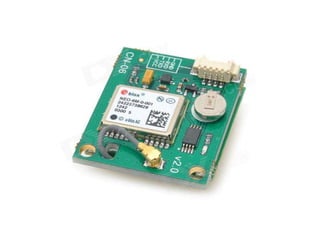
GPS, which stands for Global Positioning System,
is the only system today able to show us our
exact position on the Earth anytime, in any
weather, anywhere GPS satellites, 24 in all, orbit
at 11,000 nautical miles above the Earth Ground
stations located worldwide continuously monitor
them The satellites transmit signals that can be
detected by anyone with a GPS receiver Using
the receiver, you can determine your location
with great precision
Elements of GPS :
GPS has three parts: the space segment, the user
segment, and the control segment The space
segment consists of a constellation of 24 satellites
plus some spares, each in its own orbit 11,000
nautical miles above Earth The user segment
consists of receivers, which we can hold in our
hand or mount in a vehicle The control segment
consist, of ground stations that make sure the
satellites are working properly
WORKING OF GPS:
• 1 ) Technique called differential correction can yield
accuracies within 1 -5 meters, or even better, with advanced
equipment
• 2 ) Differential correction requires a second GPS receiver, a
base station, collecting data at a stationary position on a
precisely known point (typically it is a surveyed benchmark)
• 3 ) Because physical location of base station is known, a
correction factor can be computed by comparing known
location with GPS location determined by using satellites
MISSILE GUIDANCE USING GPS:
The central idea behind the design of
DGPS/GPS/inertial guided weapons is that of
using a 3-axis gyro/accelerometer package as
an inertial reference for the weapon's autopilot,
and correcting the accumulated drift error in
the inertial package by using GPS PPS/P-code
Such weapons are designated as "accurate"
munitions as they will offer CEPs (Circular Error
Probable) of the order of the accuracy of GPS
P -code signals, typically about 40ft
CONTINUED:>
The next incremental step is then to update the
weapon before launch with a DGPS derived
position estimate, which will allow it to correct
its GPS error as it flies to the target, such
weapons are designated "precise" and will offer
accuracies greater than laser or TV guided
weapons, potentially CEPs of several feet For
an aircraft to support such munitions , it will
require a DGPS receiver, a GPS receiver and
interfaces on its multiple ejector racks or pylons
to download target and launch point coordinates
to the weapons
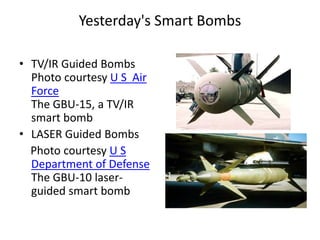
Yesterday's Smart Bombs
• TV/IR Guided Bombs
Photo courtesy U S Air
Force
The GBU-15, a TV/IR
smart bomb
• LASER Guided Bombs
Photo courtesy U S
Department of Defense
The GBU-10 laser-
guided smart bomb
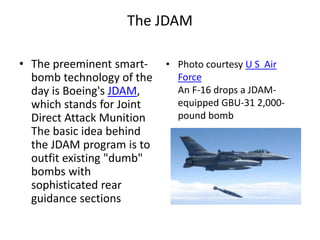
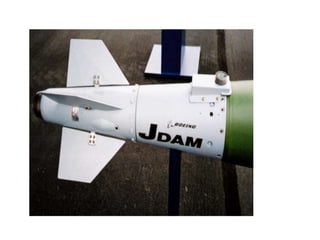
The JDAM
• The preeminent smart-
bomb technology of the
day is Boeing's JDAM,
which stands for Joint
Direct Attack Munition
The basic idea behind
the JDAM program is to
outfit existing "dumb"
bombs with
sophisticated rear
guidance sections
• Photo courtesy U S Air
Force
An F-16 drops a JDAM-
equipped GBU-31 2,000-
pound bomb
• the system is accurate to within 40 feet (13 meters)
• When everything goes exactly right, the bombs
generally hit within a few feet of their targets
• This system works fine even in bad weather, because
the JDAM gets all its information from satellite
signals, which aren't blocked by cloud cover or
obstacles The bomb doesn't have to see anything at
all to find its way to the target
• And at around $20,000 per tail kit (which can be
added to an existing warhead), it's much more
economical than $120,000+ laser-guided bombs
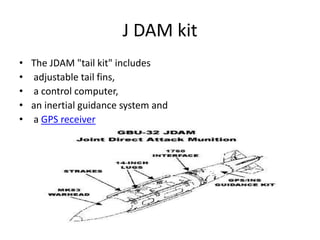
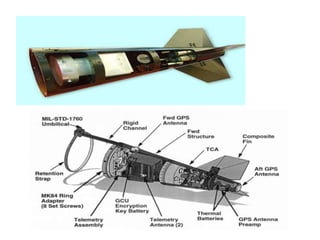
J DAM kit
• The JDAM "tail kit" includes
• adjustable tail fins,
• a control computer,
• an inertial guidance system and
• a GPS receiver
Cruise Missiles
• Cruise missile is a generic term for self-
propelled guided weapons which fly like
normal aircraft for much of their flight
• Almost all cruise missiles now are outfitted
with GPS for navigation
• Pentagon’s favorite little toy
24
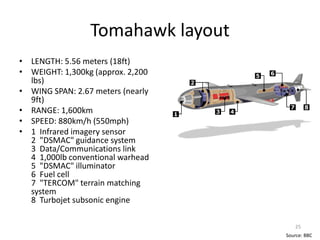
Tomahawk layout
• LENGTH: 5.56 meters (18ft)
• WEIGHT: 1,300kg (approx. 2,200
lbs)
• WING SPAN: 2.67 meters (nearly
9ft)
• RANGE: 1,600km
• SPEED: 880km/h (550mph)
• 1 Infrared imagery sensor
2 "DSMAC" guidance system
3 Data/Communications link
4 1,000lb conventional warhead
5 "DSMAC" illuminator
6 Fuel cell
7 "TERCOM" terrain matching
system
8 Turbojet subsonic engine
25
Source: BBC
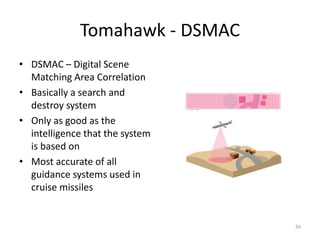
Tomahawk - DSMAC
• DSMAC – Digital Scene
Matching Area Correlation
• Basically a search and
destroy system
• Only as good as the
intelligence that the system
is based on
• Most accurate of all
guidance systems used in
cruise missiles
26
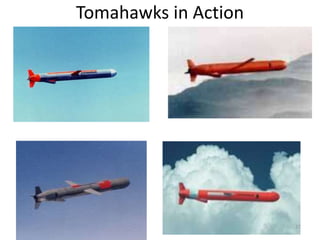
Tomahawks in Action
27
Potential Difficulties
• GPS Jamming – this is largely accounted for by INS systems
• Improving accuracy – technology limitations
• Human intelligence errors
• Potential terrorist capabilities (delivering biological weapons,
hitting high-value targets, etc. )
• Driving enemies off the conventional battlefield
• Over-reliance on weapons as the way to win a war
28
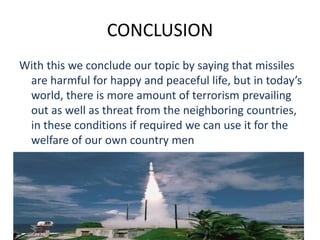
CONCLUSION
With this we conclude our topic by saying that missiles
are harmful for happy and peaceful life, but in today’s
world, there is more amount of terrorism prevailing
out as well as threat from the neighboring countries,
in these conditions if required we can use it for the
welfare of our own country men
Thank You…
ANY QUERIES?

Missile guidance

  • 1.
  • 3.
    INTRODUCTION: • 1) INTRODUCTIONTO MISSILE GUIDANCE: Guided missile systems have evolved at a tremendous rate over the past decades, and recent break through in technology ensure that smart warheads will have an increasing role in maintaining our military superiority Innocent civilians are not harmed by misfire • 2) CONCEPT OF MISSILE GUIDANCE: Missile guidance concerns the method by which the missile receives its commands to move
  • 4.
    CONTINUED :> along acertain path to reach a target On some missiles, these commands are generated internally by the missile computer autopilot On others, the commands are transmitted to the missile by some external source The missile sensor or seeker , on the other hand , is a component within a missile that generates data fed into the missile computer This data is processed by the computer and used to generate guidance commands
  • 6.
    TYPES OF MISSILEGUIDANCE: • Radar signal • Wires • Lasers • Most recently GPS
  • 7.
    A Problem • Bothremote-controlled weapons and laser- guided weapons rely on continued visual contact with the target In cloudy weather, then, the bombs may veer off course, wasting the bomb and potentially causing costly damage to unintended targets • Solution: satellite-guided weapons 7
  • 8.
    INTRODUCTION TO GPS: GPS, which stands for Global Positioning System, is the only system today able to show us our exact position on the Earth anytime, in any weather, anywhere GPS satellites, 24 in all, orbit at 11,000 nautical miles above the Earth Ground stations located worldwide continuously monitor them The satellites transmit signals that can be detected by anyone with a GPS receiver Using the receiver, you can determine your location with great precision
  • 9.
    Elements of GPS: GPS has three parts: the space segment, the user segment, and the control segment The space segment consists of a constellation of 24 satellites plus some spares, each in its own orbit 11,000 nautical miles above Earth The user segment consists of receivers, which we can hold in our hand or mount in a vehicle The control segment consist, of ground stations that make sure the satellites are working properly
  • 11.
    WORKING OF GPS: •1 ) Technique called differential correction can yield accuracies within 1 -5 meters, or even better, with advanced equipment • 2 ) Differential correction requires a second GPS receiver, a base station, collecting data at a stationary position on a precisely known point (typically it is a surveyed benchmark) • 3 ) Because physical location of base station is known, a correction factor can be computed by comparing known location with GPS location determined by using satellites
  • 12.
    MISSILE GUIDANCE USINGGPS: The central idea behind the design of DGPS/GPS/inertial guided weapons is that of using a 3-axis gyro/accelerometer package as an inertial reference for the weapon's autopilot, and correcting the accumulated drift error in the inertial package by using GPS PPS/P-code Such weapons are designated as "accurate" munitions as they will offer CEPs (Circular Error Probable) of the order of the accuracy of GPS P -code signals, typically about 40ft
  • 13.
    CONTINUED:> The next incrementalstep is then to update the weapon before launch with a DGPS derived position estimate, which will allow it to correct its GPS error as it flies to the target, such weapons are designated "precise" and will offer accuracies greater than laser or TV guided weapons, potentially CEPs of several feet For an aircraft to support such munitions , it will require a DGPS receiver, a GPS receiver and interfaces on its multiple ejector racks or pylons to download target and launch point coordinates to the weapons
  • 18.
    Yesterday's Smart Bombs •TV/IR Guided Bombs Photo courtesy U S Air Force The GBU-15, a TV/IR smart bomb • LASER Guided Bombs Photo courtesy U S Department of Defense The GBU-10 laser- guided smart bomb
  • 19.
    The JDAM • Thepreeminent smart- bomb technology of the day is Boeing's JDAM, which stands for Joint Direct Attack Munition The basic idea behind the JDAM program is to outfit existing "dumb" bombs with sophisticated rear guidance sections • Photo courtesy U S Air Force An F-16 drops a JDAM- equipped GBU-31 2,000- pound bomb
  • 20.
    • the systemis accurate to within 40 feet (13 meters) • When everything goes exactly right, the bombs generally hit within a few feet of their targets • This system works fine even in bad weather, because the JDAM gets all its information from satellite signals, which aren't blocked by cloud cover or obstacles The bomb doesn't have to see anything at all to find its way to the target • And at around $20,000 per tail kit (which can be added to an existing warhead), it's much more economical than $120,000+ laser-guided bombs
  • 21.
    J DAM kit •The JDAM "tail kit" includes • adjustable tail fins, • a control computer, • an inertial guidance system and • a GPS receiver
  • 24.
    Cruise Missiles • Cruisemissile is a generic term for self- propelled guided weapons which fly like normal aircraft for much of their flight • Almost all cruise missiles now are outfitted with GPS for navigation • Pentagon’s favorite little toy 24
  • 25.
    Tomahawk layout • LENGTH:5.56 meters (18ft) • WEIGHT: 1,300kg (approx. 2,200 lbs) • WING SPAN: 2.67 meters (nearly 9ft) • RANGE: 1,600km • SPEED: 880km/h (550mph) • 1 Infrared imagery sensor 2 "DSMAC" guidance system 3 Data/Communications link 4 1,000lb conventional warhead 5 "DSMAC" illuminator 6 Fuel cell 7 "TERCOM" terrain matching system 8 Turbojet subsonic engine 25 Source: BBC
  • 26.
    Tomahawk - DSMAC •DSMAC – Digital Scene Matching Area Correlation • Basically a search and destroy system • Only as good as the intelligence that the system is based on • Most accurate of all guidance systems used in cruise missiles 26
  • 27.
  • 28.
    Potential Difficulties • GPSJamming – this is largely accounted for by INS systems • Improving accuracy – technology limitations • Human intelligence errors • Potential terrorist capabilities (delivering biological weapons, hitting high-value targets, etc. ) • Driving enemies off the conventional battlefield • Over-reliance on weapons as the way to win a war 28
  • 29.
    CONCLUSION With this weconclude our topic by saying that missiles are harmful for happy and peaceful life, but in today’s world, there is more amount of terrorism prevailing out as well as threat from the neighboring countries, in these conditions if required we can use it for the welfare of our own country men
  • 31.