Mise en-scène & RepresentationLIGHTINGUSE OF FIGURES/CROWDSACTOR’S FACIAL EXPRESSIONSBODY LANGUAGE ACTOR’S MOVEMENTS) COSTUMEUSE OF MAKE UPLOCATION(S)/SETTINGS PROPSDEPTH OF FIELDSTAGING POSITIONS COLOUR VALUES CHARACTER PROXEMICSAims of how to use this PowerPoint: 1. To become familiar with varying forms of  mise en scene film techniques.  2. To rehearse  how individual and  combined mise en scene techniques are used to create desired meanings
Analyze of Mise en sceneis useful in further deconstructing and understanding how onscreen social groups are being represented. Each of the following are specific techniques used by directors to help construct a specific onscreen representation.Settings/ locationwhere the narrative unfolds - where the action takes placeinterior designthe mood/atmosphere and the actor’s place within itthe character’s background, surroundings, status and circumstances etcCostume and make-upthe period of time the onscreen social group belong tomembership of a specific group  social class and status -One of the main sources of information regarding the characters is their dress - whether it is a tidy v-neck sweater, a tailored woman's business suit, or an unkempt jacket. cultural background character traits, personality, values, assumed behavior and attitudeChanges in costume indicate changes in character, e.g.: rich to poor, taking off clothes as lowering defenses.Clothing might also be a trademark.
Actor’s (social group’s), expression and movement(s)Body language and gesturesPhysical appearancefacial expressions (very significant in close-ups)sound elements.The way a character (on screen social group) stands and moves is important.Actors placed positioned in foreground might be considered more important than those placed in the background.Positioning of characters within the frame may even indicate emotional distance.front (facing the camera): the position with the most intimacy. The character is looking in our direction, inviting our complicity. Three-quarter Turn: this position is useful for conveying a character's unfriendly or antisocial feelings. Purposeful and precision movement could indicate confidence and dominance whereas indecisive movement could be used to convey  passivity  and lack of power, self belief etc.
Props complete a characters dress by adding more particular detail and refining our picture of the character - High spec laptop, a Porsche, fur coats, branded hooded top, weapon etc.  Speech: regional dialect
 elaborated or restricted language
Specialized use of vocabulary
 accent
 Standard or colloquial Colour ValuesThe use of color in this shot is symbolic- connotation of use of colour i.e. black typically associated with evil, sophistication and sadness.
Character Proxemic - How much space is there between the characters?1.Intimate distances:the intimate distance ranges from skin contact to about eighteen inches away. This is the distance of physical involvement--of love, comfort, and tenderness between individuals.2.Personal distances:the personal distance ranges roughly from eighteen inches away to about four feet away. These distances tend to bereserved for friends and acquaintances.Personal distances preserve the privacy between individuals, yet these rages don't necessarily suggest exclusion, as intimate distances often do.3.Social distances:the social distance rages from four feet to about twelve feet. These distances are usually reserved for impersonal business and casual social gatherings. It'sa friendly range in most cases, yet somewhat more formal than the personal distance.4.Public distances:The public distance extends from twelve feet to twenty-five feet or more. This range tends to beformal and rather detached.
Character PlacementWhat part of the framed space do the characters occupy? Center? Top? Bottom? Edges? Why?・The area near the top of the frame can suggest ideas dealing with power, authority, and aspiration.・The areas near the bottom of the frame tend to suggest meanings opposite from the top: subservience, vulnerability, and powerlessness.・The left and right edges of the frame tend to suggest insignificance because these are the areas farthest removed from the center of the screen.

Mise en scene updated

  • 1.
    Mise en-scène &RepresentationLIGHTINGUSE OF FIGURES/CROWDSACTOR’S FACIAL EXPRESSIONSBODY LANGUAGE ACTOR’S MOVEMENTS) COSTUMEUSE OF MAKE UPLOCATION(S)/SETTINGS PROPSDEPTH OF FIELDSTAGING POSITIONS COLOUR VALUES CHARACTER PROXEMICSAims of how to use this PowerPoint: 1. To become familiar with varying forms of mise en scene film techniques. 2. To rehearse how individual and combined mise en scene techniques are used to create desired meanings
  • 2.
    Analyze of Miseen sceneis useful in further deconstructing and understanding how onscreen social groups are being represented. Each of the following are specific techniques used by directors to help construct a specific onscreen representation.Settings/ locationwhere the narrative unfolds - where the action takes placeinterior designthe mood/atmosphere and the actor’s place within itthe character’s background, surroundings, status and circumstances etcCostume and make-upthe period of time the onscreen social group belong tomembership of a specific group social class and status -One of the main sources of information regarding the characters is their dress - whether it is a tidy v-neck sweater, a tailored woman's business suit, or an unkempt jacket. cultural background character traits, personality, values, assumed behavior and attitudeChanges in costume indicate changes in character, e.g.: rich to poor, taking off clothes as lowering defenses.Clothing might also be a trademark.
  • 3.
    Actor’s (social group’s),expression and movement(s)Body language and gesturesPhysical appearancefacial expressions (very significant in close-ups)sound elements.The way a character (on screen social group) stands and moves is important.Actors placed positioned in foreground might be considered more important than those placed in the background.Positioning of characters within the frame may even indicate emotional distance.front (facing the camera): the position with the most intimacy. The character is looking in our direction, inviting our complicity. Three-quarter Turn: this position is useful for conveying a character's unfriendly or antisocial feelings. Purposeful and precision movement could indicate confidence and dominance whereas indecisive movement could be used to convey passivity and lack of power, self belief etc.
  • 4.
    Props complete acharacters dress by adding more particular detail and refining our picture of the character - High spec laptop, a Porsche, fur coats, branded hooded top, weapon etc. Speech: regional dialect
  • 5.
    elaborated orrestricted language
  • 6.
  • 7.
  • 8.
    Standard orcolloquial Colour ValuesThe use of color in this shot is symbolic- connotation of use of colour i.e. black typically associated with evil, sophistication and sadness.
  • 9.
    Character Proxemic -How much space is there between the characters?1.Intimate distances:the intimate distance ranges from skin contact to about eighteen inches away. This is the distance of physical involvement--of love, comfort, and tenderness between individuals.2.Personal distances:the personal distance ranges roughly from eighteen inches away to about four feet away. These distances tend to bereserved for friends and acquaintances.Personal distances preserve the privacy between individuals, yet these rages don't necessarily suggest exclusion, as intimate distances often do.3.Social distances:the social distance rages from four feet to about twelve feet. These distances are usually reserved for impersonal business and casual social gatherings. It'sa friendly range in most cases, yet somewhat more formal than the personal distance.4.Public distances:The public distance extends from twelve feet to twenty-five feet or more. This range tends to beformal and rather detached.
  • 10.
    Character PlacementWhat partof the framed space do the characters occupy? Center? Top? Bottom? Edges? Why?・The area near the top of the frame can suggest ideas dealing with power, authority, and aspiration.・The areas near the bottom of the frame tend to suggest meanings opposite from the top: subservience, vulnerability, and powerlessness.・The left and right edges of the frame tend to suggest insignificance because these are the areas farthest removed from the center of the screen.
  • 11.
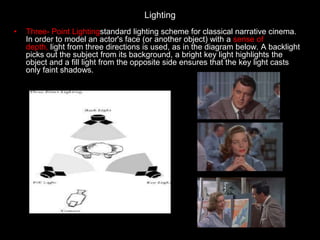
    LightingThree- Point Lightingstandardlighting scheme for classical narrative cinema. In order to model an actor's face (or another object) with a sense of depth, light from three directions is used, as in the diagram below. A backlight picks out the subject from its background, a bright key light highlights the object and a fill light from the opposite side ensures that the key light casts only faint shadows.
  • 12.
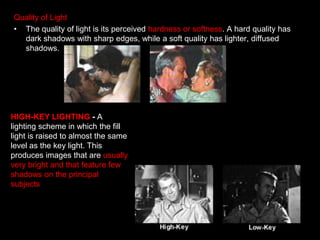
    Quality of LightThequality of light is its perceived hardness or softness. A hard quality has dark shadows with sharp edges, while a soft quality has lighter, diffused shadows.HIGH-KEY LIGHTING - A lighting scheme in which the fill light is raised to almost the same level as the key light. This produces images that are usually very bright and that feature few shadows on the principal subjects
  • 13.
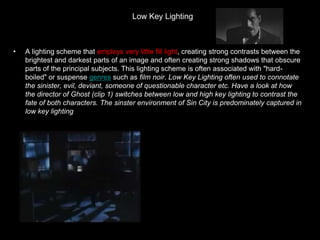
    Low Key LightingAlighting scheme that employs very little fill light, creating strong contrasts between the brightest and darkest parts of an image and often creating strong shadows that obscure parts of the principal subjects. This lighting scheme is often associated with "hard-boiled" or suspense genres such as film noir. Low Key Lighting often used to connotate the sinister, evil, deviant, someone of questionable character etc. Have a look at how the director of Ghost (clip 1) switches between low and high key lighting to contrast the fate of both characters. The sinster environment of Sin City is predominately captured in low key lighting2
  • 14.
    Mise en Scene& RepresentationUsing the option of print screen – produce a PowerPoint on how social class is being represented in terms of Camerawork and Mise-en-sceneExtended Task2. Using the option of print screen – produce aPowerPointon how social class is being represented in terms of Camerawork , Mise-en-scene and SoundClick on the link below or copy & paste the following linkhttp://www.youtube.com/watch?v=7pJhL-A8XyE&feature=related