Starter Activity: Definitions
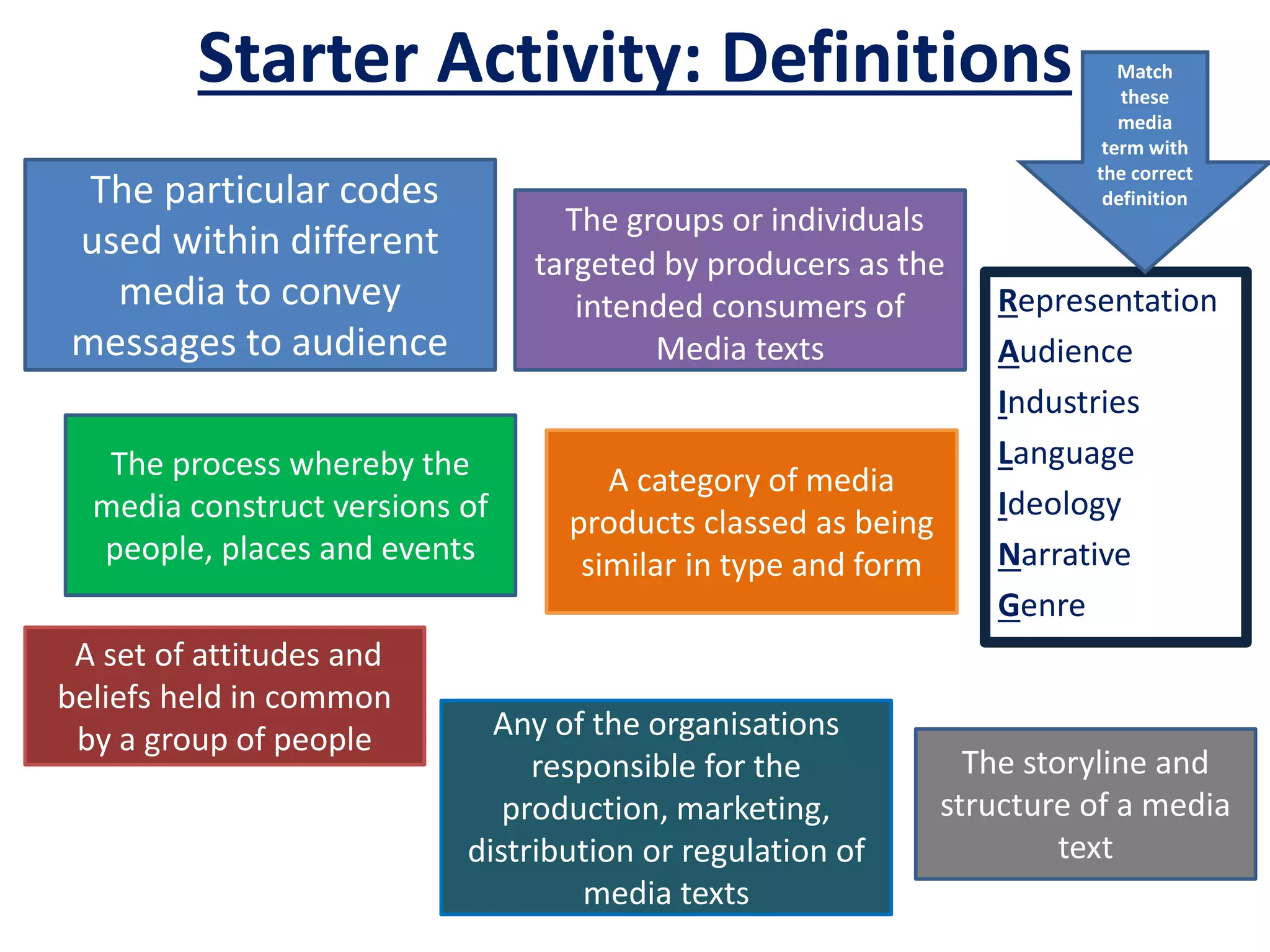
The particular codes
used within different
media to convey
messages to audience
The process whereby the
media construct versions of
people, places and events
The groups or individuals
targeted by producers as the
intended consumers of
Media texts
A category of media
products classed as being
similar in type and form
A set of attitudes and
beliefs held in common
by a group of people
The storyline and
structure of a media
text
Any of the organisations
responsible for the
production, marketing,
distribution or regulation of
media texts
Representation
Audience
Industries
Language
Ideology
Narrative
Genre
Match
these
media
term with
the correct
definition
Introduction to Media Language
Lesson 1: Mise en Scene
Learning Questions
• What is ‘Mise en Scene’?
• What media terminology should I use when
discussing Mise en Scene?
• Can I analyse the use of Mise en Scene in a
media text?
Media
Language
(Moving
Image)
Mise en scene
Camera
Costume, Hair
and Make-Up
Props
Lighting and colourPerformance
(Facial expressions and body
language) Shot Type
Camera
Angle
Dialogue
Soundtrack (Diegetic)
Editing
Order of
Shots/Continuity
Pace and
Rhythm
Special
Effects
Space
(on screen and off
screen)
Sound effects
Transitions
Shot
Duration
(Non-Diegetic)
Sound
Camera
Movement
Silence
Setting
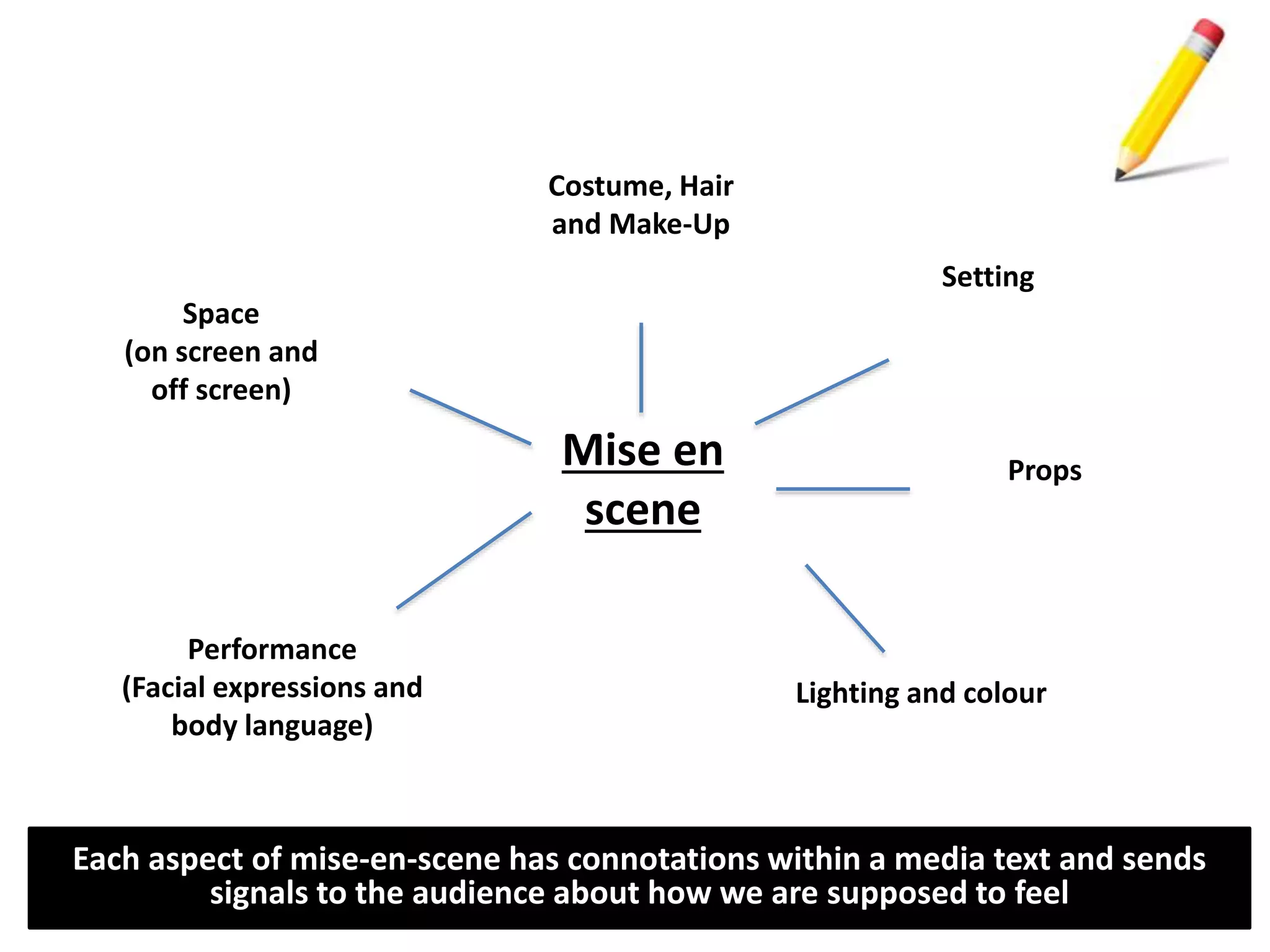
Mise en
scene
Costume, Hair
and Make-Up
Setting
Lighting and colour
Performance
(Facial expressions and
body language)
Space
(on screen and
off screen)
Props
Each aspect of mise-en-scene has connotations within a media text and sends
signals to the audience about how we are supposed to feel
Definition: Mise En Scene
• A French term meaning what is put into a scene or
frame
• Visual information in front of the camera
• Communicates essential information to the audience
Setting
• Settings & Locations play an important part in film-
making and are not just ‘backgrounds’.
• Settings can manipulate an audience by building
certain expectations (these expectations can then be
played with!).
• What settings might you find in a Science Fiction or a
Horror film?
Props
• Props build on the setting to create a believable ‘world’.
• Props can be used to establish character.
• Props can be used as symbols to connote additional
meanings over and above their material presence.
• ‘At their simplest, props work to give an authentic sense of place,
but can also be used in more complex ways to suggest important
characteristics of particular individuals or even key themes for the
whole film.’
(Benyahia, Gaffney & White, 2006)
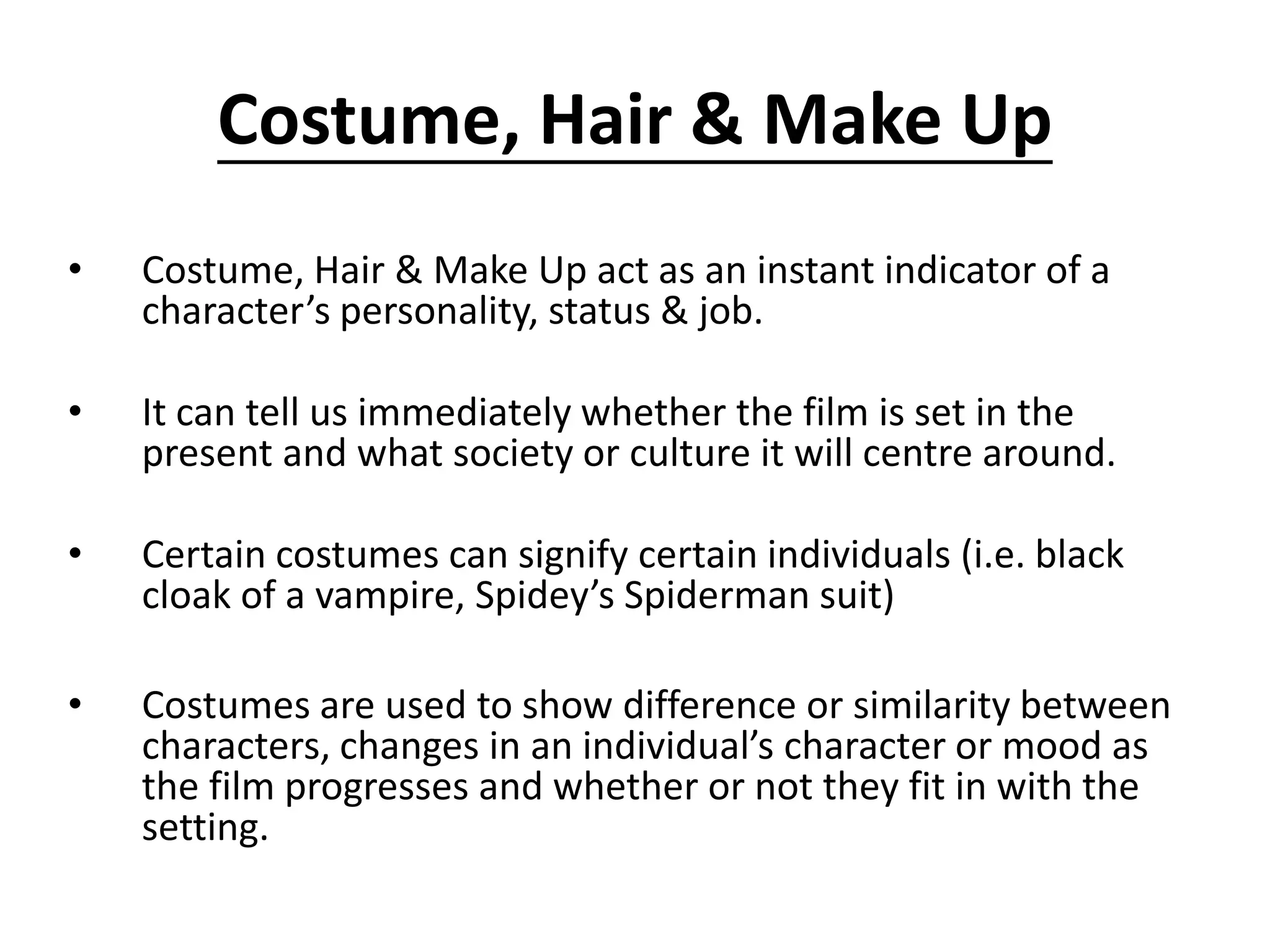
Costume, Hair & Make Up
• Costume, Hair & Make Up act as an instant indicator of a
character’s personality, status & job.
• It can tell us immediately whether the film is set in the
present and what society or culture it will centre around.
• Certain costumes can signify certain individuals (i.e. black
cloak of a vampire, Spidey’s Spiderman suit)
• Costumes are used to show difference or similarity between
characters, changes in an individual’s character or mood as
the film progresses and whether or not they fit in with the
setting.
Facial Expressions & Body Language
• Facial Expressions provide a clear indicator of how someone
is feeling.
• If someone is smiling broadly, we assume they are happy but
we may get a different feeling if this is accompanied by scary
music.
• Body Language may also indicate how a character feels
towards another character or may reflect the state of their
relationship
Space: Positioning of Characters & Objects
within a frame
• Positioning within a frame can draw our
attention to an important character/object
• A film-maker can use positioning to indicate
relationships between people
• TASK: What does the positioning in the
following images reveal about the
characters/film?
Space: Positioning of Characters & Objects
Lighting & Colour
• To highlight important characters or objects
within the frame
• To make characters look mysterious by shading
sections of the face & body
• To reflect a characters mental state/hidden
emotions
• Bright = Happy
• Dark = Sad/alone
• Strobe effect = Chaos/confusion
Types of Lighting
• HIGH KEY LIGHTING:
• More filler lights are used.
• Lighting is natural and
realistic to our eyes.
• Produces brightly lit sets or a
sunny day (right).
• The three point lighting
system is commonly used to
create this.
Types of Lighting
• LOW KEY LIGHTING:
• Expressive lighting
• Created by using only the key
& back lights
• Produces sharp contrasts of
light and dark areas
• Deep, distinct
shadows/silhouettes are
formed
Reviewing Mise en Scene
• Focus on “Mise en scene”
• What can we tell about the characters?
• What can we tell about the story/narrative?
Take
notes
Watching an unseen text
1. View the clip without taking notes
2. Take notes on the use of media language
3. Begin thinking about the meaning created by the media language
Lost (ABC): SE01 EP01 – Opening Scene
Reviewing Mise en Scene
• Focus on “Mise en scene”
• What can we tell about the characters?
• What can we tell about the story/narrative?
Take
notes
Watching an unseen text
1. View the clip without taking notes
2. Take notes on the use of media language
3. Begin thinking about the meaning created by the media language
Lesson 1 - Mise en Scene

Lesson 1 - Mise en Scene

  • 1.
    Starter Activity: Definitions Theparticular codes used within different media to convey messages to audience The process whereby the media construct versions of people, places and events The groups or individuals targeted by producers as the intended consumers of Media texts A category of media products classed as being similar in type and form A set of attitudes and beliefs held in common by a group of people The storyline and structure of a media text Any of the organisations responsible for the production, marketing, distribution or regulation of media texts Representation Audience Industries Language Ideology Narrative Genre Match these media term with the correct definition
  • 2.
    Introduction to MediaLanguage Lesson 1: Mise en Scene
  • 3.
    Learning Questions • Whatis ‘Mise en Scene’? • What media terminology should I use when discussing Mise en Scene? • Can I analyse the use of Mise en Scene in a media text?
  • 4.
    Media Language (Moving Image) Mise en scene Camera Costume,Hair and Make-Up Props Lighting and colourPerformance (Facial expressions and body language) Shot Type Camera Angle Dialogue Soundtrack (Diegetic) Editing Order of Shots/Continuity Pace and Rhythm Special Effects Space (on screen and off screen) Sound effects Transitions Shot Duration (Non-Diegetic) Sound Camera Movement Silence Setting
  • 5.
    Mise en scene Costume, Hair andMake-Up Setting Lighting and colour Performance (Facial expressions and body language) Space (on screen and off screen) Props Each aspect of mise-en-scene has connotations within a media text and sends signals to the audience about how we are supposed to feel
  • 6.
    Definition: Mise EnScene • A French term meaning what is put into a scene or frame • Visual information in front of the camera • Communicates essential information to the audience
  • 7.
    Setting • Settings &Locations play an important part in film- making and are not just ‘backgrounds’. • Settings can manipulate an audience by building certain expectations (these expectations can then be played with!). • What settings might you find in a Science Fiction or a Horror film?
  • 8.
    Props • Props buildon the setting to create a believable ‘world’. • Props can be used to establish character. • Props can be used as symbols to connote additional meanings over and above their material presence. • ‘At their simplest, props work to give an authentic sense of place, but can also be used in more complex ways to suggest important characteristics of particular individuals or even key themes for the whole film.’ (Benyahia, Gaffney & White, 2006)
  • 9.
    Costume, Hair &Make Up • Costume, Hair & Make Up act as an instant indicator of a character’s personality, status & job. • It can tell us immediately whether the film is set in the present and what society or culture it will centre around. • Certain costumes can signify certain individuals (i.e. black cloak of a vampire, Spidey’s Spiderman suit) • Costumes are used to show difference or similarity between characters, changes in an individual’s character or mood as the film progresses and whether or not they fit in with the setting.
  • 10.
    Facial Expressions &Body Language • Facial Expressions provide a clear indicator of how someone is feeling. • If someone is smiling broadly, we assume they are happy but we may get a different feeling if this is accompanied by scary music. • Body Language may also indicate how a character feels towards another character or may reflect the state of their relationship
  • 11.
    Space: Positioning ofCharacters & Objects within a frame • Positioning within a frame can draw our attention to an important character/object • A film-maker can use positioning to indicate relationships between people • TASK: What does the positioning in the following images reveal about the characters/film?
  • 12.
    Space: Positioning ofCharacters & Objects
  • 13.
    Space: Positioning ofCharacters & Objects
  • 14.
    Space: Positioning ofCharacters & Objects
  • 15.
    Lighting & Colour •To highlight important characters or objects within the frame • To make characters look mysterious by shading sections of the face & body • To reflect a characters mental state/hidden emotions • Bright = Happy • Dark = Sad/alone • Strobe effect = Chaos/confusion
  • 16.
    Types of Lighting •HIGH KEY LIGHTING: • More filler lights are used. • Lighting is natural and realistic to our eyes. • Produces brightly lit sets or a sunny day (right). • The three point lighting system is commonly used to create this.
  • 17.
    Types of Lighting •LOW KEY LIGHTING: • Expressive lighting • Created by using only the key & back lights • Produces sharp contrasts of light and dark areas • Deep, distinct shadows/silhouettes are formed
  • 18.
    Reviewing Mise enScene • Focus on “Mise en scene” • What can we tell about the characters? • What can we tell about the story/narrative? Take notes Watching an unseen text 1. View the clip without taking notes 2. Take notes on the use of media language 3. Begin thinking about the meaning created by the media language
  • 19.
    Lost (ABC): SE01EP01 – Opening Scene
  • 20.
    Reviewing Mise enScene • Focus on “Mise en scene” • What can we tell about the characters? • What can we tell about the story/narrative? Take notes Watching an unseen text 1. View the clip without taking notes 2. Take notes on the use of media language 3. Begin thinking about the meaning created by the media language