Mise - en -Scene what is it?
When applied to the cinema or TV, mise en scène refers to everything that appears before the camera and its arrangement – set, props, actors, costumes, and lighting.
Overall, mise en scène is used when the director wishes to give an impression of the characters or situation without vocally articulating it through the framework of spoken dialogue.
The common example is that of a cluttered, disorganized apartment being used to reflect the disorganization in a character's life in general, or a spartanly decorated apartment to convey a character with an "empty soul", in both cases specifically and intentionally ignoring any practicality in the setting.
So how do we decode what we see on screen?
Everything we see on screen could be termed a  sign . From a type of gun, car, wristwatch, jacket to a haircut, all these are signs.
These signs  signify  something, the physical object creates a series of thoughts in our mind, which when combined with the context in which they are placed help the film maker tell the story with great efficiency.
The meaning is determined through a set of conventions created and understood by the audience, according to its combined social and cultural background. Shared meaning is thus given to these signs.
Denotation & Connotation
Denotation  tends to be described as the definitional, 'literal', 'obvious' or 'commonsense' meaning of a sign. In this case a gun is simply a gun, a method of killing - intimidating.
The term  connotation  is used to refer to the socio-cultural and 'personal' associations (ideological, emotional etc.) of the sign. These are typically related to the interpreter's class, age, gender, ethnicity and so on. In this case the type/style of gun tells us much about its user, James Bond ’ s Walther vs. Dirty Harry ’ s Magnum for example.
So….
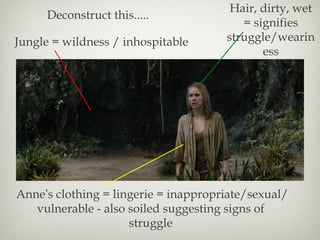
Deconstruct this..... Jungle = wildness / inhospitable  Anne ’ s clothing = lingerie = inappropriate/sexual/ vulnerable - also soiled suggesting signs of  struggle  Hair, dirty, wet = signifies struggle/weariness
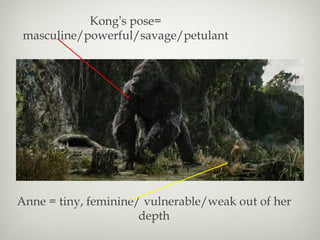
Kong ’ s pose= masculine/powerful/savage/petulant Anne = tiny, feminine/ vulnerable/weak out of her depth
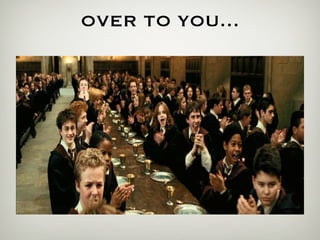
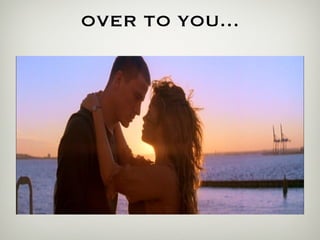
OVER TO YOU…
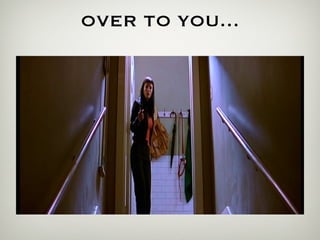
OVER TO YOU…
OVER TO YOU…
Lighting
What lighting does Picks out relevant details and figures in a scene Prioritises story information for audience Establishes a set of values to what we are seeing, by throwing more and less light on the elements in a scene Enforces emotional pull in a scene, heightening mood and atmosphere Allows camera to see properly on a technical level Creates a look for the film
The three light source set up, Key light, Fill and backlight Using a combination of these allows the creation of atmosphere/mood, and the display of sufficient detail to allow the story to be told effectively LIGHTING TERMS
LIGHTING TERMS Key light  Principal illumination source on a subject or scene. Normally positioned slightly off-center and angled to provide shadow detail. Back light  Lamp providing illumination from behind. Creates sense of depth by separating foreground subject from background area. Applied erroneously, causes severe silhouette. Fill light  Supplementary illumination, usually from a soft light positioned to the side of the subject, which lightens shadows created by the key light.
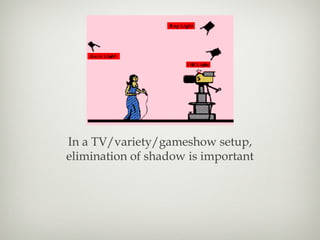
In a TV/variety/gameshow setup, elimination of shadow is important
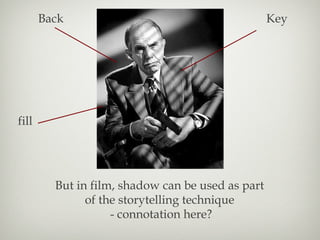
But in film, shadow can be used as part of the storytelling technique - connotation here? Key  Back fill
OTHER LIGHTING TERMS Ambient Light  A light that doesn't highlight any one subject for a natural room light effect. Usually a non-directional light. Artificial light  Man-made illumination not limited to "indoor" variety: fluorescent bulbs, jack-o'-lanterns and a car's headlights all qualify.  Directional light  Light that illuminates a relatively small area with distinct light beam; usually created with spotlight, yields harsh, defined shadows.

Mise en scene

  • 1.
    Mise - en-Scene what is it?
  • 2.
    When applied tothe cinema or TV, mise en scène refers to everything that appears before the camera and its arrangement – set, props, actors, costumes, and lighting.
  • 3.
    Overall, mise enscène is used when the director wishes to give an impression of the characters or situation without vocally articulating it through the framework of spoken dialogue.
  • 4.
    The common exampleis that of a cluttered, disorganized apartment being used to reflect the disorganization in a character's life in general, or a spartanly decorated apartment to convey a character with an "empty soul", in both cases specifically and intentionally ignoring any practicality in the setting.
  • 5.
    So how dowe decode what we see on screen?
  • 6.
    Everything we seeon screen could be termed a sign . From a type of gun, car, wristwatch, jacket to a haircut, all these are signs.
  • 7.
    These signs signify something, the physical object creates a series of thoughts in our mind, which when combined with the context in which they are placed help the film maker tell the story with great efficiency.
  • 8.
    The meaning isdetermined through a set of conventions created and understood by the audience, according to its combined social and cultural background. Shared meaning is thus given to these signs.
  • 9.
  • 10.
    Denotation tendsto be described as the definitional, 'literal', 'obvious' or 'commonsense' meaning of a sign. In this case a gun is simply a gun, a method of killing - intimidating.
  • 11.
    The term connotation is used to refer to the socio-cultural and 'personal' associations (ideological, emotional etc.) of the sign. These are typically related to the interpreter's class, age, gender, ethnicity and so on. In this case the type/style of gun tells us much about its user, James Bond ’ s Walther vs. Dirty Harry ’ s Magnum for example.
  • 12.
  • 13.
    Deconstruct this..... Jungle= wildness / inhospitable Anne ’ s clothing = lingerie = inappropriate/sexual/ vulnerable - also soiled suggesting signs of struggle Hair, dirty, wet = signifies struggle/weariness
  • 14.
    Kong ’ spose= masculine/powerful/savage/petulant Anne = tiny, feminine/ vulnerable/weak out of her depth
  • 15.
  • 16.
  • 17.
  • 18.
  • 19.
    What lighting doesPicks out relevant details and figures in a scene Prioritises story information for audience Establishes a set of values to what we are seeing, by throwing more and less light on the elements in a scene Enforces emotional pull in a scene, heightening mood and atmosphere Allows camera to see properly on a technical level Creates a look for the film
  • 20.
    The three lightsource set up, Key light, Fill and backlight Using a combination of these allows the creation of atmosphere/mood, and the display of sufficient detail to allow the story to be told effectively LIGHTING TERMS
  • 21.
    LIGHTING TERMS Keylight Principal illumination source on a subject or scene. Normally positioned slightly off-center and angled to provide shadow detail. Back light Lamp providing illumination from behind. Creates sense of depth by separating foreground subject from background area. Applied erroneously, causes severe silhouette. Fill light Supplementary illumination, usually from a soft light positioned to the side of the subject, which lightens shadows created by the key light.
  • 22.
    In a TV/variety/gameshowsetup, elimination of shadow is important
  • 23.
    But in film,shadow can be used as part of the storytelling technique - connotation here? Key Back fill
  • 24.
    OTHER LIGHTING TERMSAmbient Light A light that doesn't highlight any one subject for a natural room light effect. Usually a non-directional light. Artificial light Man-made illumination not limited to "indoor" variety: fluorescent bulbs, jack-o'-lanterns and a car's headlights all qualify. Directional light Light that illuminates a relatively small area with distinct light beam; usually created with spotlight, yields harsh, defined shadows.