Mise –en - Scene
The arrangement of everything that appears in the framing – actors,
 lighting, décor, props, costume – is called mise-en-scène, a French
term that means “placing on stage.” The frame and camerawork also
              constitute the mise-en-scène of a movie.
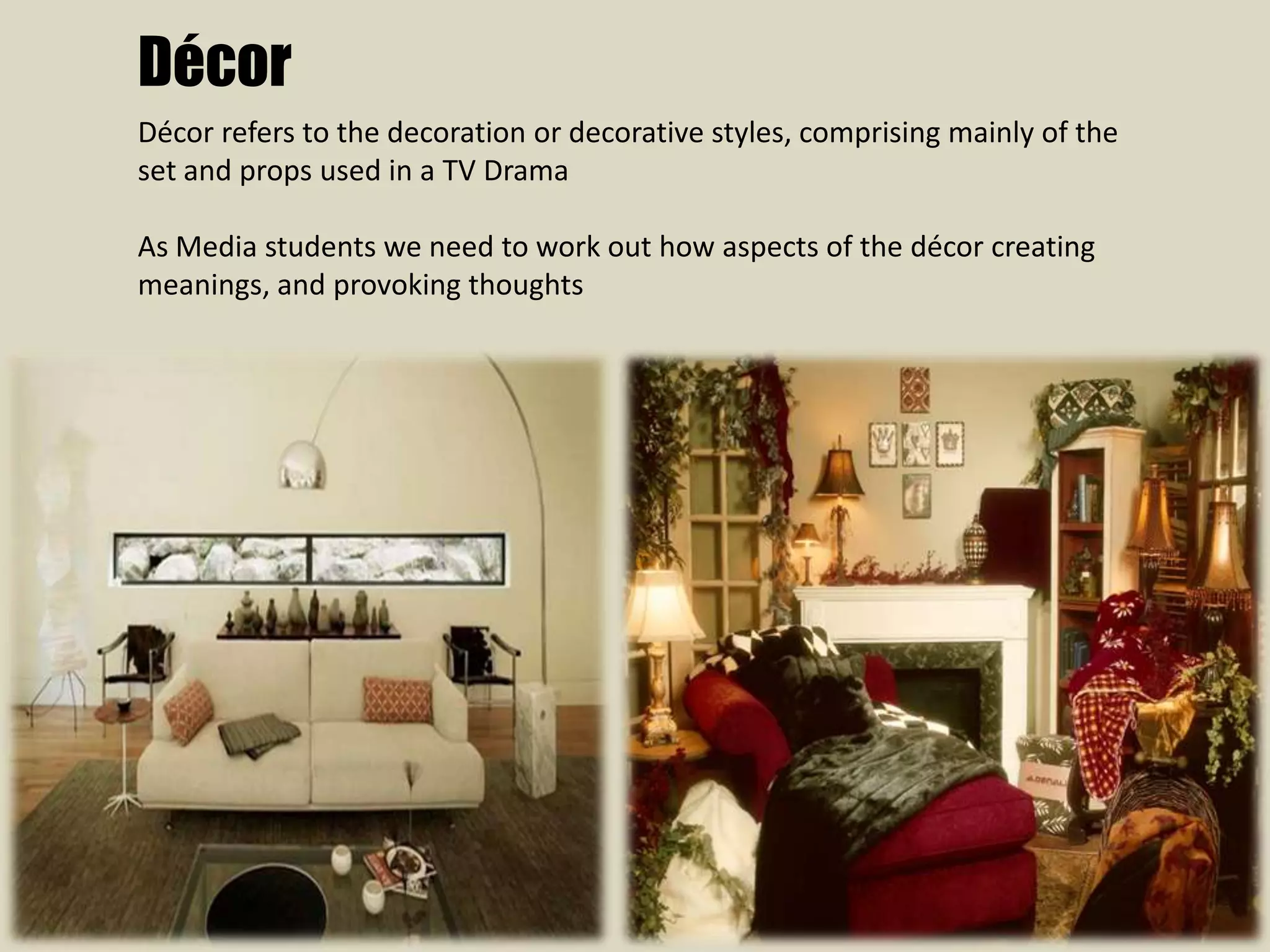
Décor
Décor refers to the decoration or decorative styles, comprising mainly of the
set and props used in a TV Drama

As Media students we need to work out how aspects of the décor creating
meanings, and provoking thoughts
Unarguably one of the
elements that has the greatest
power to evoke emotions is
lighting.

High Key Lighting
Everything looks bright with little
to no shadow at all. High-key
lighting has little dramatic effect,
and it is often used in a scene
with no tension or to attach
positive and uplifting
connotations to a character or
situation.

Low-key lighting
Often used in tense scenes or
scenes where negative
connotations are to be derived. It
comprises of a lighting pattern
that has both bright and dark
areas in the frame.
Costume & Props
The obvious purpose of costuming is
to dress an actor according to his
character. Lawyers wear suits,
nurses wear scrubs, and a drifter
could wear worn out shoes, ragged
shirt, and baggy pants.

But, more than that, costuming can
also be used to establish someone’s
hierarchic level or attach a
stereotype to them


Costuming may also be used to
emphasize a personality trait. For
instance a women wearing
leopard print may be
characterized as a predator.
Colour
• What is the dominant color?
• Are there contrasting foils?
• Is there color symbolism?
Location
The set or location of any filmed
drama is created to give meaning
to the text. A documentary will
also attempt to film contributors
in locations that are relevant to
the story or meaning of the text.


For instance, in a soap opera
such as Coronation Street, the
actual row of terraced houses,
the pub, cobbled streets etc. all
contributes to the working class
feel of the community.
Body Language   Appearance - how the actor appears in the role -
                large, small, the right size. Costume and make up
                can help an actor build a character

                Movements – an actor’s movements can enhance
                the believability of the character, and increase the
                information the audience is receiving about the
                character

                Gestures – gestures are helpful to creating the
                character

                Facial expressions – important in whether a
                character is sympathetic or not, and for reading
                emotions such as love, fear and pain.

                Vocal delivery - very important in delivering the
                lines so that comprehensive meaning is
                understandable to the audience
Staging Positions
         Which way do the characters look in relation to the camera?

An actor can be photographed in any of five basic positions, each conveying
different psychological overtones.

 – Full-front (facing the camera): the position with the most intimacy. The character is
   looking in our direction, inviting our complicity.
 – Quarter Turn: the favored position of most filmmakers. This position offers a high
   degree of intimacy but with less emotional involvement than the full-front position.
 – Profile (looking of the frame left or right): More remote than the quarter turn, the
   character in profile seems unaware of being observed, lost in his or her own thoughts.
 – Three-quarter Turn: More anonymous than the profile, this position is useful for
   conveying a character's unfriendly or antisocial feelings, for in effect, the character is
   partially turning his or her back on us, rejecting our interest.
 – Back to Camera: The most anonymous of all positions, this position is often used to
   suggest a character's alienation from the world. When a character has his or her back to
   the camera, we can only guess what's taking place internally, conveying a sense of
   concealment, or mystery.
Character Proxemics
          How much space is there between the characters?

The way people use space can be divided into four proxemic patterns.

 – Intimate distances: the intimate distance ranges from skin contact to about
   eighteen inches away. This is the distance of physical involvement--of love,
   comfort, and tenderness between individuals.
 – Personal distances: the personal distance ranges roughly from eighteen inches
   away to about four feet away. These distances tend to be reserved for friends
   and acquaintances. Personal distances preserve the privacy between
   individuals, yet these rages don't necessarily suggest exclusion, as intimate
   distances often do.
 – Social distances: the social distance rages from four feet to about twelve feet.
   These distances are usually reserved for impersonal business and casual social
   gatherings. It's a friendly range in most cases, yet somewhat more formal than
   the personal distance.
 – Public distances: The public distance extends from twelve feet to twenty-five
   feet or more. This range tends to be formal and rather detached
Character Placement
    What part of the framed space do the characters occupy?
                Center? Top? Bottom? Edges? Why?

•   The area near the top of the frame can suggest ideas dealing
    with power, authority, and aspiration.
•   The areas near the bottom of the frame tend to suggest
    meanings opposite from the top: subservience, vulnerability,
    and powerlessness.
•   The left and right edges of the frame tend to suggest
    insignificance because these are the areas farthest removed
    from the center of the screen.
In the next shot
Where is our eye attracted first?
Ghost World   directed by Terry Zwigoff (2001)
Why?...
                 The Dominant
The dominant contrast can be created by any number
  of techniques:
1. The size of an object may draw our attention to it.
2. In black and white movies, the dominant contrast is
   generally achieved through a juxtaposition of lights
   and darks.
3. In color films, the dominant is often achieved by
   having one color stand out from the others.
4. Placing one object in sharper focus than the rest of
   the shot can also create a dominant.
Close Analysis
Watch the following sequences and make notes on what meanings can be
derived from aspects of the mise-en-scene, in particular regarding
characterisation. Be prepared to share your ideas with the rest of the class.

You must consider;
                                         From the start until 1 minute
                                         30 seconds of Ugly Betty
•Location
                                         http://www.youtube.com/watch?v=qBhG78Ou
                                         rjw
•Body Language
                                         Monarch of The Glen
•Costume & Props
                                         http://www.youtube.com/watch?v=qTQDipfN8
•Colour                                  JA&feature=related

•Lighting                                Revenge
                                         http://www.youtube.com/watch?v=DJmoqRAa
•Decor                                   Gjw&feature=related

TV Drama - Mise en-scene

  • 1.
  • 2.
    The arrangement ofeverything that appears in the framing – actors, lighting, décor, props, costume – is called mise-en-scène, a French term that means “placing on stage.” The frame and camerawork also constitute the mise-en-scène of a movie.
  • 3.
    Décor Décor refers tothe decoration or decorative styles, comprising mainly of the set and props used in a TV Drama As Media students we need to work out how aspects of the décor creating meanings, and provoking thoughts
  • 4.
    Unarguably one ofthe elements that has the greatest power to evoke emotions is lighting. High Key Lighting Everything looks bright with little to no shadow at all. High-key lighting has little dramatic effect, and it is often used in a scene with no tension or to attach positive and uplifting connotations to a character or situation. Low-key lighting Often used in tense scenes or scenes where negative connotations are to be derived. It comprises of a lighting pattern that has both bright and dark areas in the frame.
  • 5.
    Costume & Props Theobvious purpose of costuming is to dress an actor according to his character. Lawyers wear suits, nurses wear scrubs, and a drifter could wear worn out shoes, ragged shirt, and baggy pants. But, more than that, costuming can also be used to establish someone’s hierarchic level or attach a stereotype to them Costuming may also be used to emphasize a personality trait. For instance a women wearing leopard print may be characterized as a predator.
  • 6.
    Colour • What isthe dominant color? • Are there contrasting foils? • Is there color symbolism?
  • 7.
    Location The set orlocation of any filmed drama is created to give meaning to the text. A documentary will also attempt to film contributors in locations that are relevant to the story or meaning of the text. For instance, in a soap opera such as Coronation Street, the actual row of terraced houses, the pub, cobbled streets etc. all contributes to the working class feel of the community.
  • 8.
    Body Language Appearance - how the actor appears in the role - large, small, the right size. Costume and make up can help an actor build a character Movements – an actor’s movements can enhance the believability of the character, and increase the information the audience is receiving about the character Gestures – gestures are helpful to creating the character Facial expressions – important in whether a character is sympathetic or not, and for reading emotions such as love, fear and pain. Vocal delivery - very important in delivering the lines so that comprehensive meaning is understandable to the audience
  • 9.
    Staging Positions Which way do the characters look in relation to the camera? An actor can be photographed in any of five basic positions, each conveying different psychological overtones. – Full-front (facing the camera): the position with the most intimacy. The character is looking in our direction, inviting our complicity. – Quarter Turn: the favored position of most filmmakers. This position offers a high degree of intimacy but with less emotional involvement than the full-front position. – Profile (looking of the frame left or right): More remote than the quarter turn, the character in profile seems unaware of being observed, lost in his or her own thoughts. – Three-quarter Turn: More anonymous than the profile, this position is useful for conveying a character's unfriendly or antisocial feelings, for in effect, the character is partially turning his or her back on us, rejecting our interest. – Back to Camera: The most anonymous of all positions, this position is often used to suggest a character's alienation from the world. When a character has his or her back to the camera, we can only guess what's taking place internally, conveying a sense of concealment, or mystery.
  • 10.
    Character Proxemics How much space is there between the characters? The way people use space can be divided into four proxemic patterns. – Intimate distances: the intimate distance ranges from skin contact to about eighteen inches away. This is the distance of physical involvement--of love, comfort, and tenderness between individuals. – Personal distances: the personal distance ranges roughly from eighteen inches away to about four feet away. These distances tend to be reserved for friends and acquaintances. Personal distances preserve the privacy between individuals, yet these rages don't necessarily suggest exclusion, as intimate distances often do. – Social distances: the social distance rages from four feet to about twelve feet. These distances are usually reserved for impersonal business and casual social gatherings. It's a friendly range in most cases, yet somewhat more formal than the personal distance. – Public distances: The public distance extends from twelve feet to twenty-five feet or more. This range tends to be formal and rather detached
  • 11.
    Character Placement What part of the framed space do the characters occupy? Center? Top? Bottom? Edges? Why? • The area near the top of the frame can suggest ideas dealing with power, authority, and aspiration. • The areas near the bottom of the frame tend to suggest meanings opposite from the top: subservience, vulnerability, and powerlessness. • The left and right edges of the frame tend to suggest insignificance because these are the areas farthest removed from the center of the screen.
  • 12.
    In the nextshot Where is our eye attracted first?
  • 13.
    Ghost World directed by Terry Zwigoff (2001)
  • 14.
    Why?... The Dominant The dominant contrast can be created by any number of techniques: 1. The size of an object may draw our attention to it. 2. In black and white movies, the dominant contrast is generally achieved through a juxtaposition of lights and darks. 3. In color films, the dominant is often achieved by having one color stand out from the others. 4. Placing one object in sharper focus than the rest of the shot can also create a dominant.
  • 15.
    Close Analysis Watch thefollowing sequences and make notes on what meanings can be derived from aspects of the mise-en-scene, in particular regarding characterisation. Be prepared to share your ideas with the rest of the class. You must consider; From the start until 1 minute 30 seconds of Ugly Betty •Location http://www.youtube.com/watch?v=qBhG78Ou rjw •Body Language Monarch of The Glen •Costume & Props http://www.youtube.com/watch?v=qTQDipfN8 •Colour JA&feature=related •Lighting Revenge http://www.youtube.com/watch?v=DJmoqRAa •Decor Gjw&feature=related