MISE-EN-SCENE
FM1(a): - An analysis of a film extract
• Mise-en-scène includes setting, props, staging, costume and makeup,
figure expression and movement and off-screen space.
SPECTATORS
 you will need to develop an awareness of an active role as
spectators in working with the micro features of film and how they
construct meanings and contribute to the sensory impact of
audiences
 how responses derive from the micro features of film and the
extent to which they derive from personal and/or cultural identity will
be explored
PRODUCERS
 you will develop your analytical and creative skills, reflecting your
growing understanding and appreciation of the micro features of film
and the ways in which these can be deployed in order to create
meaning and produce a response
OKAY, SO MICRO FEATURES
ARE VERY IMPORTANT, BUT
WHAT ARE MACRO
FEATURES?
MACRO FEATURES
 genre – the features that fit a film into a certain type, e.g. science fiction, action, horror
(don’t forget about hybrid and sub-genre)
 narrative – the plot, viewpoint, the story and the way that it is told
 representation – the way in which social groups and issues are presented in a film.
This is a key aspect of Film Studies that crosses over between macro and micro features
FM1 will largely focus on the micro features of film, but we will at
times discuss the micro features in relation to the macro features.
Macro features will be discussed in more detail in FM2.
TO SUM UP…
 macro features of film language are the major aspects of how a
film tell stories
 micro features of film language are the finer details
MISE-EN-SCENE
L.O. – What is mise-en-scene and how does it help spectators to construct meaning in film?
WHAT DOES IT ALL MEAN?
 mise-en-scene (pronounced ‘mise on sen’) is a French term that refers to a series
of elements of film construction that may be seen within the frame of a single shot
 it means ‘putting on stage’ and is really a theatre term
 it helps to think of this difficult feature as staging a play: a location is suggested
on stage, characters dress in certain ways, objects carried by characters are placed
prominently on stage
 the phrase mise-en-scene reminds us of film’s theatrical, cultural and artistic
origins
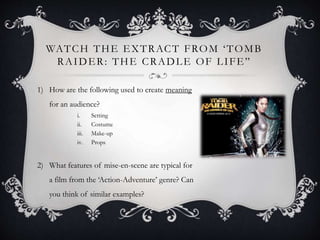
WATCH THE EXTRACT FROM ‘TOMB
RAIDER: THE CRADLE OF LIFE”
1) How are the following used to create meaning
for an audience?
i. Setting
ii. Costume
iii. Make-up
iv. Props
2) What features of mise-en-scene are typical for
a film from the ‘Action-Adventure’ genre? Can
you think of similar examples?
SETTING
 watch the opening sequence from the film ‘Donnie Darko’. Write
notes about the setting and why it has been chosen. Was it appropriate
to the film and how?
 how might the opening of a horror film be different?
 film-makers impress audiences with spectacular landscapes, massive
crowds, huge spaceships and fantastic, futuristic worlds
 special effects can be used to maximum effect in set design and rather
than employing vast numbers of extras they use computer generated images
to create them
Answer the following questions when watching the ‘Immortals’ film trailer:
1. How have special effects helped to create an effective setting?
2. Why was CGI used?
Answer the following questions:
1. What settings were used before the opening credits? Describe them
in as much detail as possible, listing the settings and the key
features of each (this can be done in pairs).
2. Why had they been chosen?
3. As a group of settings were they appropriate to the film and, if so,
in what ways?
COSTUME AND PROPS
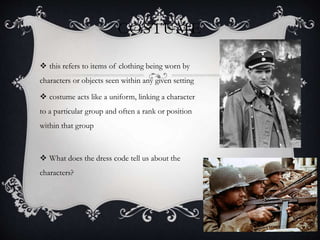
COSTUME
 this refers to items of clothing being worn by
characters or objects seen within any given setting
 costume acts like a uniform, linking a character
to a particular group and often a rank or position
within that group
 What does the dress code tell us about the
characters?
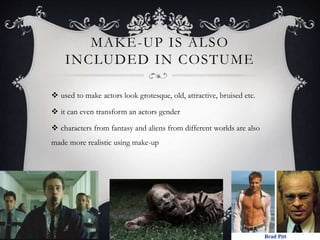
MAKE-UP IS ALSO
INCLUDED IN COSTUME
 used to make actors look grotesque, old, attractive, bruised etc.
 it can even transform an actors gender
 characters from fantasy and aliens from different worlds are also
made more realistic using make-up
PROPS
 props are the objects seen within the given setting
 props work to give an authentic sense of place
 they can also be used to suggest important characteristics of a
character or even key themes for the film
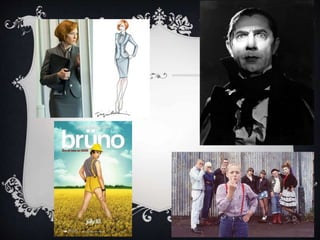
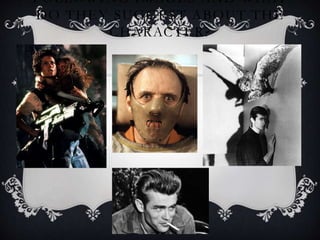
FOLLOWING IMAGES AND WHAT
DO THEY SUGGEST ABOUT THE
CHARACTER?
 costume and props can become iconic images that are instantly
recognisable. Can you think of other iconic images from popular
films?
(iconography – objects, images, characters, etc. strongly associated
with a particular genre or film)
PERFORMANCE AND
MOVEMENT
WHAT IS IT?
 This refers to the acting that is taking place. We should be focusing on their
performance and movement
 movements can be small or massive involving the whole body or just small parts of the
body
 everything is included from eye rolling to sudden running and jumping
 we can ‘read’ each movement in some way, as the director and/or actor has chosen
them carefully to put across meaning and understanding to the audience/spectator
 body language also tells us a lot about a character, situation or thought processes
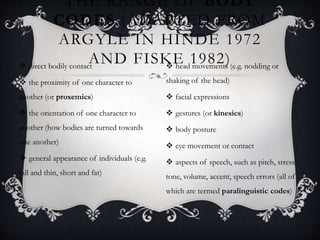
THE RANGE OF BODY
CODES (ADAPTED FROM
ARGYLE IN HINDE 1972
AND FISKE 1982)
 direct bodily contact
 the proximity of one character to
another (or proxemics)
 the orientation of one character to
another (how bodies are turned towards
one another)
 general appearance of individuals (e.g.
tall and thin, short and fat)
 head movements (e.g. nodding or
shaking of the head)
 facial expressions
 gestures (or kinesics)
 body posture
 eye movement or contact
 aspects of speech, such as pitch, stress,
tone, volume, accent, speech errors (all of
which are termed paralinguistic codes)
Although you are not expected to remember all of these it is useful to
know what to look out for when analysing a performance
Watch the opening scene from ‘Ferris Bueller’s Day Off’. Pay
microscopic attention to detail as possible. What do the performances
of each of the characters tell us about the characters themselves.
HOME LEARNING
 choose a scene from one of your favourite films
 write a 400-600 word analysis focusing on one or two aspects of
mise-en-scene. You need to word process this and should accompany
your writing with screen shots from the scene
 this will be used for display purposes, so it is important that it is
your best work possible!
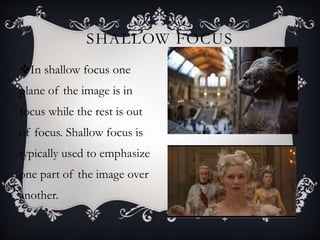
SHALLOW FOCUS
In shallow focus one
plane of the image is in
focus while the rest is out
of focus. Shallow focus is
typically used to emphasize
one part of the image over
another.
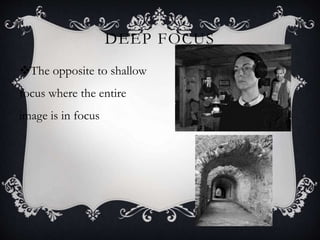
DEEP FOCUS
The opposite to shallow
focus where the entire
image is in focus
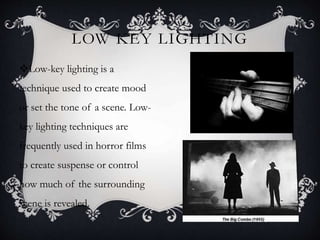
LOW KEY LIGHTING
Low-key lighting is a
technique used to create mood
or set the tone of a scene. Low-
key lighting techniques are
frequently used in horror films
to create suspense or control
how much of the surrounding
scene is revealed.
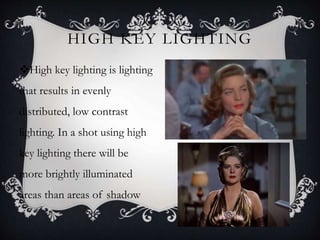
HIGH KEY LIGHTING
High key lighting is lighting
that results in evenly
distributed, low contrast
lighting. In a shot using high
key lighting there will be
more brightly illuminated
areas than areas of shadow
TRANSITIONS
 http://www.youtube.com/watch?v=KQIWywngiLI

Fm1(a) mise-en-scene

  • 1.
    MISE-EN-SCENE FM1(a): - Ananalysis of a film extract • Mise-en-scène includes setting, props, staging, costume and makeup, figure expression and movement and off-screen space.
  • 2.
    SPECTATORS  you willneed to develop an awareness of an active role as spectators in working with the micro features of film and how they construct meanings and contribute to the sensory impact of audiences  how responses derive from the micro features of film and the extent to which they derive from personal and/or cultural identity will be explored
  • 3.
    PRODUCERS  you willdevelop your analytical and creative skills, reflecting your growing understanding and appreciation of the micro features of film and the ways in which these can be deployed in order to create meaning and produce a response
  • 4.
    OKAY, SO MICROFEATURES ARE VERY IMPORTANT, BUT WHAT ARE MACRO FEATURES?
  • 5.
    MACRO FEATURES  genre– the features that fit a film into a certain type, e.g. science fiction, action, horror (don’t forget about hybrid and sub-genre)  narrative – the plot, viewpoint, the story and the way that it is told  representation – the way in which social groups and issues are presented in a film. This is a key aspect of Film Studies that crosses over between macro and micro features FM1 will largely focus on the micro features of film, but we will at times discuss the micro features in relation to the macro features. Macro features will be discussed in more detail in FM2.
  • 6.
    TO SUM UP… macro features of film language are the major aspects of how a film tell stories  micro features of film language are the finer details
  • 7.
    MISE-EN-SCENE L.O. – Whatis mise-en-scene and how does it help spectators to construct meaning in film?
  • 8.
    WHAT DOES ITALL MEAN?  mise-en-scene (pronounced ‘mise on sen’) is a French term that refers to a series of elements of film construction that may be seen within the frame of a single shot  it means ‘putting on stage’ and is really a theatre term  it helps to think of this difficult feature as staging a play: a location is suggested on stage, characters dress in certain ways, objects carried by characters are placed prominently on stage  the phrase mise-en-scene reminds us of film’s theatrical, cultural and artistic origins
  • 9.
    WATCH THE EXTRACTFROM ‘TOMB RAIDER: THE CRADLE OF LIFE” 1) How are the following used to create meaning for an audience? i. Setting ii. Costume iii. Make-up iv. Props 2) What features of mise-en-scene are typical for a film from the ‘Action-Adventure’ genre? Can you think of similar examples?
  • 10.
    SETTING  watch theopening sequence from the film ‘Donnie Darko’. Write notes about the setting and why it has been chosen. Was it appropriate to the film and how?  how might the opening of a horror film be different?
  • 11.
     film-makers impressaudiences with spectacular landscapes, massive crowds, huge spaceships and fantastic, futuristic worlds  special effects can be used to maximum effect in set design and rather than employing vast numbers of extras they use computer generated images to create them Answer the following questions when watching the ‘Immortals’ film trailer: 1. How have special effects helped to create an effective setting? 2. Why was CGI used?
  • 12.
    Answer the followingquestions: 1. What settings were used before the opening credits? Describe them in as much detail as possible, listing the settings and the key features of each (this can be done in pairs). 2. Why had they been chosen? 3. As a group of settings were they appropriate to the film and, if so, in what ways?
  • 13.
  • 14.
    COSTUME  this refersto items of clothing being worn by characters or objects seen within any given setting  costume acts like a uniform, linking a character to a particular group and often a rank or position within that group  What does the dress code tell us about the characters?
  • 16.
    MAKE-UP IS ALSO INCLUDEDIN COSTUME  used to make actors look grotesque, old, attractive, bruised etc.  it can even transform an actors gender  characters from fantasy and aliens from different worlds are also made more realistic using make-up
  • 17.
    PROPS  props arethe objects seen within the given setting  props work to give an authentic sense of place  they can also be used to suggest important characteristics of a character or even key themes for the film
  • 18.
    FOLLOWING IMAGES ANDWHAT DO THEY SUGGEST ABOUT THE CHARACTER?
  • 19.
     costume andprops can become iconic images that are instantly recognisable. Can you think of other iconic images from popular films? (iconography – objects, images, characters, etc. strongly associated with a particular genre or film)
  • 20.
  • 21.
    WHAT IS IT? This refers to the acting that is taking place. We should be focusing on their performance and movement  movements can be small or massive involving the whole body or just small parts of the body  everything is included from eye rolling to sudden running and jumping  we can ‘read’ each movement in some way, as the director and/or actor has chosen them carefully to put across meaning and understanding to the audience/spectator  body language also tells us a lot about a character, situation or thought processes
  • 22.
    THE RANGE OFBODY CODES (ADAPTED FROM ARGYLE IN HINDE 1972 AND FISKE 1982)  direct bodily contact  the proximity of one character to another (or proxemics)  the orientation of one character to another (how bodies are turned towards one another)  general appearance of individuals (e.g. tall and thin, short and fat)  head movements (e.g. nodding or shaking of the head)  facial expressions  gestures (or kinesics)  body posture  eye movement or contact  aspects of speech, such as pitch, stress, tone, volume, accent, speech errors (all of which are termed paralinguistic codes)
  • 23.
    Although you arenot expected to remember all of these it is useful to know what to look out for when analysing a performance Watch the opening scene from ‘Ferris Bueller’s Day Off’. Pay microscopic attention to detail as possible. What do the performances of each of the characters tell us about the characters themselves.
  • 24.
    HOME LEARNING  choosea scene from one of your favourite films  write a 400-600 word analysis focusing on one or two aspects of mise-en-scene. You need to word process this and should accompany your writing with screen shots from the scene  this will be used for display purposes, so it is important that it is your best work possible!
  • 25.
    SHALLOW FOCUS In shallowfocus one plane of the image is in focus while the rest is out of focus. Shallow focus is typically used to emphasize one part of the image over another.
  • 26.
    DEEP FOCUS The oppositeto shallow focus where the entire image is in focus
  • 27.
    LOW KEY LIGHTING Low-keylighting is a technique used to create mood or set the tone of a scene. Low- key lighting techniques are frequently used in horror films to create suspense or control how much of the surrounding scene is revealed.
  • 28.
    HIGH KEY LIGHTING Highkey lighting is lighting that results in evenly distributed, low contrast lighting. In a shot using high key lighting there will be more brightly illuminated areas than areas of shadow
  • 29.