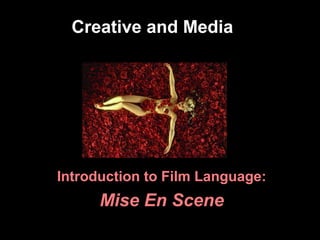
Creative and Media


Introduction to Film Language:
      Mise En Scene
Session Aims
By the end of the session you will be able to:

• Understand the concept of ‘mise en
  scene’

• Apply the concept to a film extract
Definition: Mise En Scene
• A French term meaning what is put into a scene
  or frame

• Visual information in front of the camera

• Communicates essential information to the
  audience

• Made up of 5 elements: Can you guess what
  they are?
The 5 Elements of Mise en Scene
                                 Each aspect of mise-en-
                                     scene has hidden
• Settings & Props                meanings within a film
                                 and sends signals to the
                                 audience about how we
• Costume, Hair & Make Up        are supposed to feel at a
                                       certain point

• Facial Expressions & Body Language

• Lighting & Colour

• Positioning of characters/objects within the
  frame
1. Settings & Props
•    Settings & Locations play an important part in film-
     making and are not just ‘backgrounds’

•    Sets are either built from scratch or a great deal of time
     is spent to find a setting which already exists

•    Settings can manipulate an audience by building
     certain expectations and then taking a different turn

•    TASK: What settings and props you would find in:
1.   A Science Fiction Film
2.   A Romantic Comedy
3.   A Horror Film
2. Costume, Hair & Make Up
•   Costume, Hair & Make Up act as an instant
    indicator to us of a character’s personality,
    status & job

•   It tells us immediately whether the film is set in
    the present and what society/or culture it will
    centre around

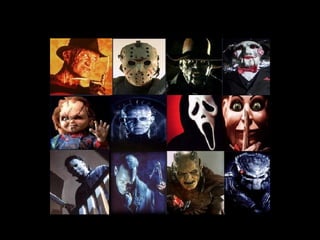
•   Certain costumes can signify certain individuals
    (i.e. black cloak of a vampire, Spidey’s
    Spiderman suit)
3. Facial Expressions & Body
               Language
•   Facial Expressions provide a clear indicator of how
    someone is feeling

•   If someone is smiling broadly, we assume they are
    happy but we may get a different feeling if this is
    accompanied by scary music

•   Body Language may also indicate how a character
    feels towards another character or may reflect the state
    of their relationship

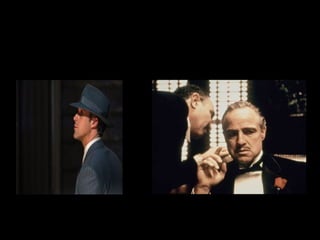
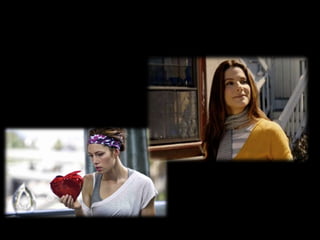
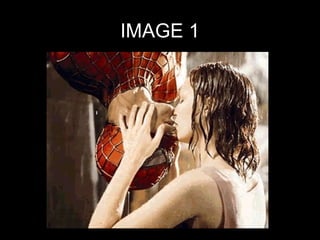
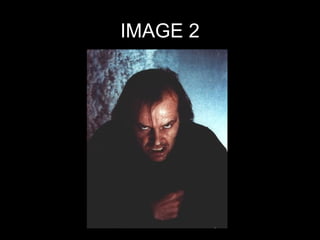
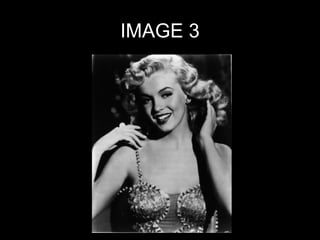
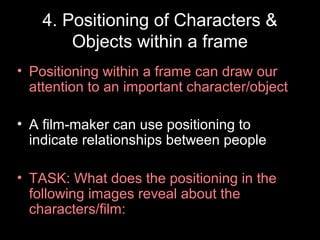
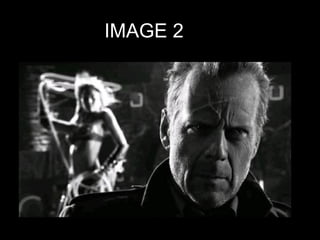
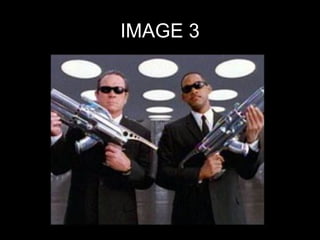
•   TASK: What meanings/emotions do the following
    images convey:
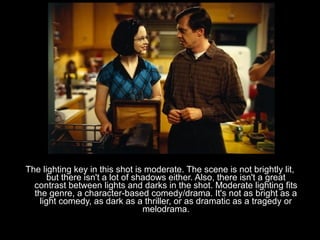
IMAGE 1
IMAGE 2
IMAGE 3
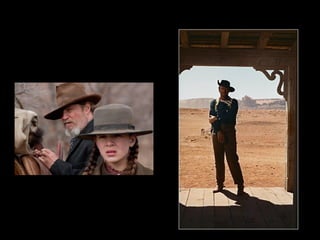
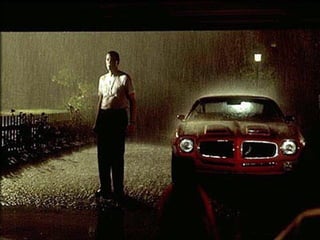
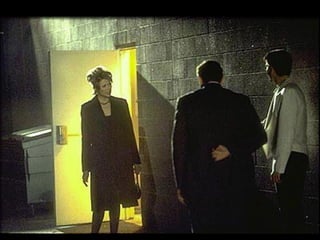
4. Positioning of Characters &
        Objects within a frame
• Positioning within a frame can draw our
  attention to an important character/object

• A film-maker can use positioning to
  indicate relationships between people

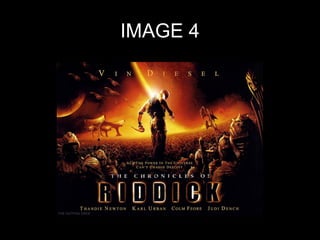
• TASK: What does the positioning in the
  following images reveal about the
  characters/film:
IMAGE 1
IMAGE 2
IMAGE 3
IMAGE 4
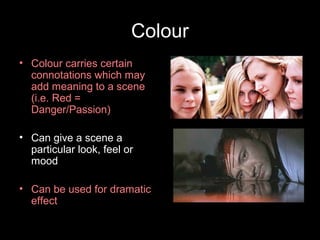
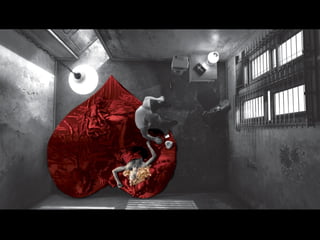
Colour
• Colour carries certain
  connotations which may
  add meaning to a scene
  (i.e. Red =
  Danger/Passion)

• Can give a scene a
  particular look, feel or
  mood

• Can be used for dramatic
  effect
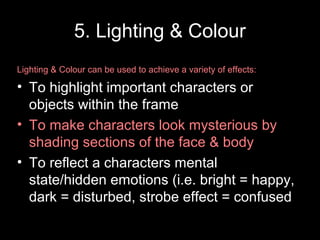
5. Lighting & Colour
Lighting & Colour can be used to achieve a variety of effects:

• To highlight important characters or
  objects within the frame
• To make characters look mysterious by
  shading sections of the face & body
• To reflect a characters mental
  state/hidden emotions (i.e. bright = happy,
  dark = disturbed, strobe effect = confused
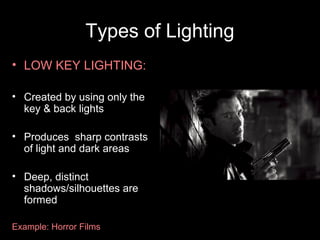
Types of Lighting
• LOW KEY LIGHTING:

• Created by using only the
  key & back lights

• Produces sharp contrasts
  of light and dark areas

• Deep, distinct
  shadows/silhouettes are
  formed

Example: Horror Films
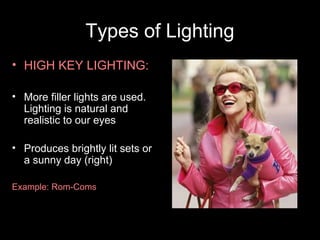
Types of Lighting
• HIGH KEY LIGHTING:

• More filler lights are used.
  Lighting is natural and
  realistic to our eyes

• Produces brightly lit sets or
  a sunny day (right)

Example: Rom-Coms
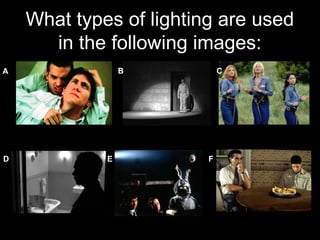
What types of lighting are used
      in the following images:
A                B           C


D            E           F
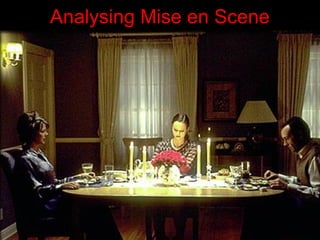
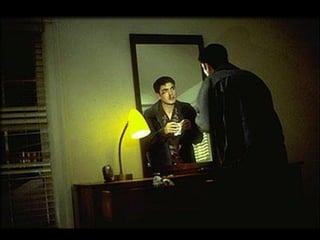
TASK: For each image, answer
   the following questions:
1. What type of lighting is used in each image
   (High or Low Key)?

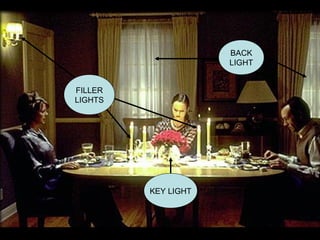
2. Where are the KEY LIGHTS, FILLER LIGHTS
   & BACK LIGHTS in each image?

3. What effects/meanings does the lighting
   suggest?
Analysing Mise en Scene
BACK
                     LIGHT


FILLER
LIGHTS


         KEY LIGHT
Analyse a sequence
When we analyse a sequence in terms of
mise en scène, we need to look at how all
the different elements and techniques
work together to:
Tell a story
Evoke an atmosphere
Give the audience information
Provoke an audience response
Highlight key themes
ACTIVITY
  Imagine a room . How would you decorate it and what would you put
               in it to suggest the following inhabitants:


1. A poor and destitute couple in the 17th Century
2. A middle-class couple in the 1940s
3. A spy in the year 2012
4. A businessman in 2012
5. A business woman 2012
6. A group of students
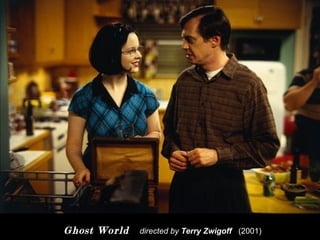
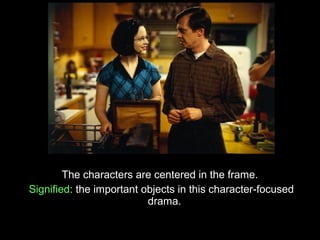
Ghost World   directed by Terry Zwigoff (2001)
The Dominant
   Where is our eye attracted first? Why?
The dominant contrast can be created by any
number of techniques. The size of an object may
draw our attention to it. In black and white
movies, the dominant contrast is generally
achieved through a juxtaposition of lights and
darks. In color films, the dominant is often
achieved by having one colour stand out from
the others. Placing one object in sharper focus
than the rest of the shot can also create a
dominant contrast a dominant.
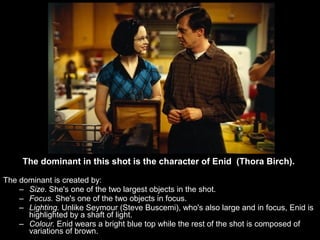
The dominant in this shot is the character of Enid (Thora Birch).

The dominant is created by:
    – Size. She's one of the two largest objects in the shot.
    – Focus. She's one of the two objects in focus.
    – Lighting. Unlike Seymour (Steve Buscemi), who's also large and in focus, Enid is
      highlighted by a shaft of light.
    – Colour. Enid wears a bright blue top while the rest of the shot is composed of
      variations of brown.
Lighting Key
High key? Low key? High contrast? Some combination
                      of these?

1. High key lighting--features bright, even illumination
   and few conspicuous shadows. This lighting key is often
   used in musicals and comedies.
2. Low key lighting--features diffused shadows and
   atmospheric pools of light. This lighting key is often
   used in mysteries and thrillers.
3. High contrast lighting--features harsh shafts of lights
   and dramatic streaks of blackness. This type of lighting
   is often used in tragedies and melodramas.
The lighting key in this shot is moderate. The scene is not brightly lit,
       but there isn't a lot of shadows either. Also, there isn't a great
  contrast between lights and darks in the shot. Moderate lighting fits
  the genre, a character-based comedy/drama. It's not as bright as a
    light comedy, as dark as a thriller, or as dramatic as a tragedy or
                                  melodrama.
Shot and Camera Proxemics
     What type of shot? How far away is the camera from the action?

   Shots are defined by the amount of subject matter that's included within the
   frame. They can be divided into six basic categories:

1. Extreme long shot--taken from a great distance, showing much of the
   locale. If people are included in these shots, they usually appear as mere
   specks.
2. Long shot--corresponds to the space between the audience and the stage
   in a live theater. The long shots show the characters and some of the locale.
3. Full shot--range with just enough space to contain the human body in full.
   The full shot shows the character and a minimal amount of the locale.
4. Medium shot--shows the human figure from the knees or waist up.
5. Close-up--concentrates on a relatively small object and show very little if
   any locale.
6. Extreme close-up--focuses on an unnaturally small portion of an object,
   giving that part great detail and symbolic significance.
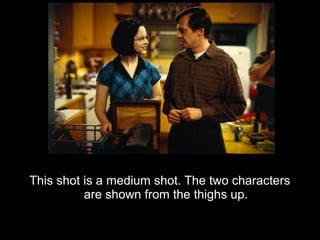
This shot is a medium shot. The two characters
          are shown from the thighs up.
Camera Angle
Are we (and the camera) looking up or down on the subject? Or is
                  the camera neutral (eye level)?

There are five basic angles in film.

    1. Bird's-eye view--the shot is photographed directly from above. This
       type of shot can be disorienting, and the people photographed seem
       insignificant.
    2. High angle--this angle reduces the size of the objects photographed. A
       person photographed from this angle seems harmless and insignificant,
       but to a lesser extent than with the bird's-eye view.
    3. Eye-level shot--the clearest view of an object, but seldom intrinsically
       dramatic, because it tends to be the norm.
    4. Low angle--this angle increases high and a sense of verticality,
       heightening the importance of the object photographed. A person shot
       from this angle is given a sense of power and respect.
    5. Oblique angle--for this angle, the camera is tilted laterally, giving the
       image a slanted appearance. Oblique angles suggest tension,
       transition, a impending movement. They are also called canted or dutch
       angles.
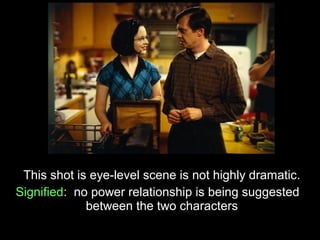
This shot is eye-level scene is not highly dramatic.
Signified: no power relationship is being suggested
             between the two characters
Colour Values
What is the dominant colour?
 Are there contrasting foils?
 Is there colour symbolism?
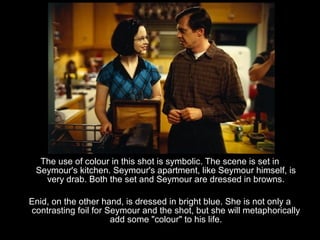
The use of colour in this shot is symbolic. The scene is set in
 Seymour's kitchen. Seymour's apartment, like Seymour himself, is
   very drab. Both the set and Seymour are dressed in browns.

Enid, on the other hand, is dressed in bright blue. She is not only a
contrasting foil for Seymour and the shot, but she will metaphorically
                      add some "colour" to his life.
Subsidiary Contrasts
After taking in the dominant, where does the
                  eye go next?

   What are the other main objects in the
       shot besides the dominant?
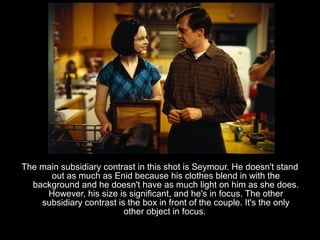
The main subsidiary contrast in this shot is Seymour. He doesn't stand
      out as much as Enid because his clothes blend in with the
  background and he doesn't have as much light on him as she does.
     However, his size is significant, and he's in focus. The other
    subsidiary contrast is the box in front of the couple. It's the only
                          other object in focus.
Density
How much visual information is packed into
              the image?

  Is the texture stark, moderate, or highly
                   detailed?
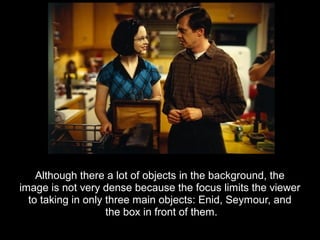
Although there a lot of objects in the background, the
image is not very dense because the focus limits the viewer
  to taking in only three main objects: Enid, Seymour, and
                    the box in front of them.
Framing
             Is the framing tight or loose?

Do the character have no room to move around, or can
         they move freely without impediments?

1. Shots where the characters are placed at the edges of
   the frame and have little room to move around within
   the frame are considered tight.
2. Longer shots, in which characters have room to move
   around within the frame, are considered loose and tend
   to suggest freedom.
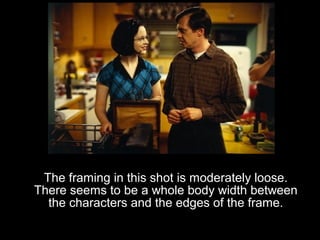
The framing in this shot is moderately loose.
There seems to be a whole body width between
  the characters and the edges of the frame.
Character Placement
    What part of the framed space do the characters
     occupy? Center? Top? Bottom? Edges? Why?

•   The area near the top of the frame can suggest ideas
    dealing with power, authority, and aspiration.
•   The areas near the bottom of the frame tend to suggest
    meanings opposite from the top: subservience,
    vulnerability, and powerlessness.
•   The left and right edges of the frame tend to suggest
    insignificance because these are the areas farthest
    removed from the center of the screen.
The characters are centered in the frame.
Signified: the important objects in this character-focused
                          drama.
Staging Positions
       Which way do the characters look vis-a-vis the camera?

An actor can be photographed in any of five basic positions, each conveying
different psychological overtones.

 – Full-front (facing the camera): the position with the most intimacy. The character
   is looking in our direction, inviting our complicity.
 – Quarter Turn: the favored position of most filmmakers. This position offers a
   high degree of intimacy but with less emotional involvement than the full-front
   position.
 – Profile (looking of the frame left or right): More remote than the quarter turn, the
   character in profile seems unaware of being observed, lost in his or her own
   thoughts.
 – Three-quarter Turn: More anonymous than the profile, this position is useful for
   conveying a character's unfriendly or antisocial feelings, for in effect, the
   character is partially turning his or her back on us, rejecting our interest.
 – Back to Camera: The most anonymous of all positions, this position is often
   used to suggest a character's alienation from the world. When a character has
   his or her back to the camera, we can only guess what's taking place internally,
   conveying a sense of concealment, or mystery.
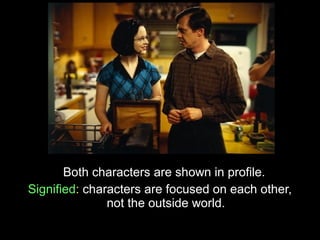
Both characters are shown in profile.
Signified: characters are focused on each other,
               not the outside world.
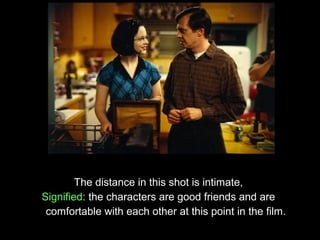
Character Proxemics
     How much space is there between the characters?

The way people use space can be divided into four proxemic
patterns.

– Intimate distances: the intimate distance ranges from skin contact to
  about eighteen inches away. This is the distance of physical
  involvement--of love, comfort, and tenderness between individuals.
– Personal distances: the personal distance ranges roughly from
  eighteen inches away to about four feet away. These distances tend to
  be reserved for friends and acquaintances. Personal distances preserve
  the privacy between individuals, yet these rages don't necessarily
  suggest exclusion, as intimate distances often do.
– Social distances: the social distance rages from four feet to about
  twelve feet. These distances are usually reserved for impersonal
  business and casual social gatherings. It's a friendly range in most
  cases, yet somewhat more formal than the personal distance.
– Public distances: The public distance extends from twelve feet to
  twenty-five feet or more. This range tends to be formal and rather
  detached
The distance in this shot is intimate,
Signified: the characters are good friends and are
 comfortable with each other at this point in the film.
HOMEWORK
• Pick a scene from a film (one that you can
  find a picture of on the internet) and do
  your own case study (similar to the one we
  have just done in class)

• Hand in date: NEXT FRIDAY

Mise en scene

  • 1.
    Creative and Media Introductionto Film Language: Mise En Scene
  • 2.
    Session Aims By theend of the session you will be able to: • Understand the concept of ‘mise en scene’ • Apply the concept to a film extract
  • 3.
    Definition: Mise EnScene • A French term meaning what is put into a scene or frame • Visual information in front of the camera • Communicates essential information to the audience • Made up of 5 elements: Can you guess what they are?
  • 4.
    The 5 Elementsof Mise en Scene Each aspect of mise-en- scene has hidden • Settings & Props meanings within a film and sends signals to the audience about how we • Costume, Hair & Make Up are supposed to feel at a certain point • Facial Expressions & Body Language • Lighting & Colour • Positioning of characters/objects within the frame
  • 5.
    1. Settings &Props • Settings & Locations play an important part in film- making and are not just ‘backgrounds’ • Sets are either built from scratch or a great deal of time is spent to find a setting which already exists • Settings can manipulate an audience by building certain expectations and then taking a different turn • TASK: What settings and props you would find in: 1. A Science Fiction Film 2. A Romantic Comedy 3. A Horror Film
  • 6.
    2. Costume, Hair& Make Up • Costume, Hair & Make Up act as an instant indicator to us of a character’s personality, status & job • It tells us immediately whether the film is set in the present and what society/or culture it will centre around • Certain costumes can signify certain individuals (i.e. black cloak of a vampire, Spidey’s Spiderman suit)
  • 11.
    3. Facial Expressions& Body Language • Facial Expressions provide a clear indicator of how someone is feeling • If someone is smiling broadly, we assume they are happy but we may get a different feeling if this is accompanied by scary music • Body Language may also indicate how a character feels towards another character or may reflect the state of their relationship • TASK: What meanings/emotions do the following images convey:
  • 12.
  • 13.
  • 14.
  • 15.
    4. Positioning ofCharacters & Objects within a frame • Positioning within a frame can draw our attention to an important character/object • A film-maker can use positioning to indicate relationships between people • TASK: What does the positioning in the following images reveal about the characters/film:
  • 16.
  • 17.
  • 18.
  • 19.
  • 20.
    Colour • Colour carriescertain connotations which may add meaning to a scene (i.e. Red = Danger/Passion) • Can give a scene a particular look, feel or mood • Can be used for dramatic effect
  • 21.
    5. Lighting &Colour Lighting & Colour can be used to achieve a variety of effects: • To highlight important characters or objects within the frame • To make characters look mysterious by shading sections of the face & body • To reflect a characters mental state/hidden emotions (i.e. bright = happy, dark = disturbed, strobe effect = confused
  • 22.
    Types of Lighting •LOW KEY LIGHTING: • Created by using only the key & back lights • Produces sharp contrasts of light and dark areas • Deep, distinct shadows/silhouettes are formed Example: Horror Films
  • 23.
    Types of Lighting •HIGH KEY LIGHTING: • More filler lights are used. Lighting is natural and realistic to our eyes • Produces brightly lit sets or a sunny day (right) Example: Rom-Coms
  • 24.
    What types oflighting are used in the following images: A B C D E F
  • 25.
    TASK: For eachimage, answer the following questions: 1. What type of lighting is used in each image (High or Low Key)? 2. Where are the KEY LIGHTS, FILLER LIGHTS & BACK LIGHTS in each image? 3. What effects/meanings does the lighting suggest?
  • 26.
  • 27.
    BACK LIGHT FILLER LIGHTS KEY LIGHT
  • 32.
    Analyse a sequence Whenwe analyse a sequence in terms of mise en scène, we need to look at how all the different elements and techniques work together to: Tell a story Evoke an atmosphere Give the audience information Provoke an audience response Highlight key themes
  • 33.
    ACTIVITY Imaginea room . How would you decorate it and what would you put in it to suggest the following inhabitants: 1. A poor and destitute couple in the 17th Century 2. A middle-class couple in the 1940s 3. A spy in the year 2012 4. A businessman in 2012 5. A business woman 2012 6. A group of students
  • 34.
    Ghost World directed by Terry Zwigoff (2001)
  • 35.
    The Dominant Where is our eye attracted first? Why? The dominant contrast can be created by any number of techniques. The size of an object may draw our attention to it. In black and white movies, the dominant contrast is generally achieved through a juxtaposition of lights and darks. In color films, the dominant is often achieved by having one colour stand out from the others. Placing one object in sharper focus than the rest of the shot can also create a dominant contrast a dominant.
  • 36.
    The dominant inthis shot is the character of Enid (Thora Birch). The dominant is created by: – Size. She's one of the two largest objects in the shot. – Focus. She's one of the two objects in focus. – Lighting. Unlike Seymour (Steve Buscemi), who's also large and in focus, Enid is highlighted by a shaft of light. – Colour. Enid wears a bright blue top while the rest of the shot is composed of variations of brown.
  • 37.
    Lighting Key High key?Low key? High contrast? Some combination of these? 1. High key lighting--features bright, even illumination and few conspicuous shadows. This lighting key is often used in musicals and comedies. 2. Low key lighting--features diffused shadows and atmospheric pools of light. This lighting key is often used in mysteries and thrillers. 3. High contrast lighting--features harsh shafts of lights and dramatic streaks of blackness. This type of lighting is often used in tragedies and melodramas.
  • 38.
    The lighting keyin this shot is moderate. The scene is not brightly lit, but there isn't a lot of shadows either. Also, there isn't a great contrast between lights and darks in the shot. Moderate lighting fits the genre, a character-based comedy/drama. It's not as bright as a light comedy, as dark as a thriller, or as dramatic as a tragedy or melodrama.
  • 39.
    Shot and CameraProxemics What type of shot? How far away is the camera from the action? Shots are defined by the amount of subject matter that's included within the frame. They can be divided into six basic categories: 1. Extreme long shot--taken from a great distance, showing much of the locale. If people are included in these shots, they usually appear as mere specks. 2. Long shot--corresponds to the space between the audience and the stage in a live theater. The long shots show the characters and some of the locale. 3. Full shot--range with just enough space to contain the human body in full. The full shot shows the character and a minimal amount of the locale. 4. Medium shot--shows the human figure from the knees or waist up. 5. Close-up--concentrates on a relatively small object and show very little if any locale. 6. Extreme close-up--focuses on an unnaturally small portion of an object, giving that part great detail and symbolic significance.
  • 40.
    This shot isa medium shot. The two characters are shown from the thighs up.
  • 41.
    Camera Angle Are we(and the camera) looking up or down on the subject? Or is the camera neutral (eye level)? There are five basic angles in film. 1. Bird's-eye view--the shot is photographed directly from above. This type of shot can be disorienting, and the people photographed seem insignificant. 2. High angle--this angle reduces the size of the objects photographed. A person photographed from this angle seems harmless and insignificant, but to a lesser extent than with the bird's-eye view. 3. Eye-level shot--the clearest view of an object, but seldom intrinsically dramatic, because it tends to be the norm. 4. Low angle--this angle increases high and a sense of verticality, heightening the importance of the object photographed. A person shot from this angle is given a sense of power and respect. 5. Oblique angle--for this angle, the camera is tilted laterally, giving the image a slanted appearance. Oblique angles suggest tension, transition, a impending movement. They are also called canted or dutch angles.
  • 42.
    This shot iseye-level scene is not highly dramatic. Signified: no power relationship is being suggested between the two characters
  • 43.
    Colour Values What isthe dominant colour? Are there contrasting foils? Is there colour symbolism?
  • 44.
    The use ofcolour in this shot is symbolic. The scene is set in Seymour's kitchen. Seymour's apartment, like Seymour himself, is very drab. Both the set and Seymour are dressed in browns. Enid, on the other hand, is dressed in bright blue. She is not only a contrasting foil for Seymour and the shot, but she will metaphorically add some "colour" to his life.
  • 45.
    Subsidiary Contrasts After takingin the dominant, where does the eye go next? What are the other main objects in the shot besides the dominant?
  • 46.
    The main subsidiarycontrast in this shot is Seymour. He doesn't stand out as much as Enid because his clothes blend in with the background and he doesn't have as much light on him as she does. However, his size is significant, and he's in focus. The other subsidiary contrast is the box in front of the couple. It's the only other object in focus.
  • 47.
    Density How much visualinformation is packed into the image? Is the texture stark, moderate, or highly detailed?
  • 48.
    Although there alot of objects in the background, the image is not very dense because the focus limits the viewer to taking in only three main objects: Enid, Seymour, and the box in front of them.
  • 49.
    Framing Is the framing tight or loose? Do the character have no room to move around, or can they move freely without impediments? 1. Shots where the characters are placed at the edges of the frame and have little room to move around within the frame are considered tight. 2. Longer shots, in which characters have room to move around within the frame, are considered loose and tend to suggest freedom.
  • 50.
    The framing inthis shot is moderately loose. There seems to be a whole body width between the characters and the edges of the frame.
  • 51.
    Character Placement What part of the framed space do the characters occupy? Center? Top? Bottom? Edges? Why? • The area near the top of the frame can suggest ideas dealing with power, authority, and aspiration. • The areas near the bottom of the frame tend to suggest meanings opposite from the top: subservience, vulnerability, and powerlessness. • The left and right edges of the frame tend to suggest insignificance because these are the areas farthest removed from the center of the screen.
  • 52.
    The characters arecentered in the frame. Signified: the important objects in this character-focused drama.
  • 53.
    Staging Positions Which way do the characters look vis-a-vis the camera? An actor can be photographed in any of five basic positions, each conveying different psychological overtones. – Full-front (facing the camera): the position with the most intimacy. The character is looking in our direction, inviting our complicity. – Quarter Turn: the favored position of most filmmakers. This position offers a high degree of intimacy but with less emotional involvement than the full-front position. – Profile (looking of the frame left or right): More remote than the quarter turn, the character in profile seems unaware of being observed, lost in his or her own thoughts. – Three-quarter Turn: More anonymous than the profile, this position is useful for conveying a character's unfriendly or antisocial feelings, for in effect, the character is partially turning his or her back on us, rejecting our interest. – Back to Camera: The most anonymous of all positions, this position is often used to suggest a character's alienation from the world. When a character has his or her back to the camera, we can only guess what's taking place internally, conveying a sense of concealment, or mystery.
  • 54.
    Both characters areshown in profile. Signified: characters are focused on each other, not the outside world.
  • 55.
    Character Proxemics How much space is there between the characters? The way people use space can be divided into four proxemic patterns. – Intimate distances: the intimate distance ranges from skin contact to about eighteen inches away. This is the distance of physical involvement--of love, comfort, and tenderness between individuals. – Personal distances: the personal distance ranges roughly from eighteen inches away to about four feet away. These distances tend to be reserved for friends and acquaintances. Personal distances preserve the privacy between individuals, yet these rages don't necessarily suggest exclusion, as intimate distances often do. – Social distances: the social distance rages from four feet to about twelve feet. These distances are usually reserved for impersonal business and casual social gatherings. It's a friendly range in most cases, yet somewhat more formal than the personal distance. – Public distances: The public distance extends from twelve feet to twenty-five feet or more. This range tends to be formal and rather detached
  • 56.
    The distance inthis shot is intimate, Signified: the characters are good friends and are comfortable with each other at this point in the film.
  • 57.
    HOMEWORK • Pick ascene from a film (one that you can find a picture of on the internet) and do your own case study (similar to the one we have just done in class) • Hand in date: NEXT FRIDAY