FORM IN FILM
TECHNICAL ASPECTS
TECHNICAL ASPECTS OVERVIEW

 A. Mise-en-scène: what is filmed; everything in front
  of the cameras. (French theatre term, literally meaning “put into
  the scene” referencing staging. Also spelled “mise en scène” without
  hyphens; it can be italicized or not)


 B. Cinematography: how something is filmed
  (photographic techniques)

 C.   Editing: how what is filmed is put together
 D. Sound: voice, music, & sound effects; can be diegetic
  (part of the story) or non-diegetic (e.g., a film score)
MISE EN SCENE

   Setting
   Costuming & Makeup
   Color
   Performance
   Composition
 Some disagreement as to what exactly constitutes mise en
  scène vs. other techniques.
    Some include lighting & camera angles (composition)
    (Both of which most filmmakers and all cinematographers would attribute to
      cinematography, but for scholarly analysis, it’s usually lumped into mise
      en scène)
MISE EN scène: Production Design
 Production Designers are usually in
  charge of the look of a film (in collaboration with
 the DP).
   They oversee the Art Director who oversees set
    design and construction . . .
         • Set Designer and construction
         • Set Decorator
         • Graphic artists and illustrators
     Prop Master
     Costume Designer, and
     Hair and Makeup Design
     Special Effects
SETTING
 Setting is where the action occurs
 Three basic shooting options:
   1. Soundstage – interiors & process
    shots (e.g., rear-screen projection during driving
    scene)

   2. Studio backlot – full size replicas
    (towns, streets, houses, shops, etc.)
   3. On location . . .
Setting, con’t.

 3. On Location:
   a. May be one place, but pretend to be
    another ("creative geography” in editing)
   b. May shoot only establishing & outside
    shots “on location”
   c. May take whole cast & crew "on
    location" to shoot exteriors & interiors
Setting, con’t.
 Function of sets:
   1. Provide information (e.g. time, place,
    character’s status, etc.).
   2. Create mood & guide our attention.
   3. May play a significant part in the action.
   4. Communicate themes & comment on
    action.
   5. Can create "special effects" (e.g. low tech
    solutions to avoid process shots).
8
9
Psycho (1960, Alfred Hitchcock)
                                  10
11
Looking at Movies DVD Clip
 Here’s our friend Dave Monahan in a DVD
  tutorial with a look at how setting can be an
  essential part of the storytelling in films . . .
  (5:00)
Costuming & Makeup
 A. Can enhance setting; must be
  appropriate for the time, place, etc.

 B. Can be realistic vs. stylized (more in
  fantasy)

 C. Can serve iconographic or symbolic
  functions (i.e. white hat/dark hat dichotomy
  for hero/villain)
14
15
16
Clip from “Anatomy of a Scene” segment


 from Sundance Channel’s series “Anatomy
  of a Scene” 11:00
 Acting 2:00
Use of color in mise en scene
 A. Color can refer to many things:
   1. Color film stock [see chapter 2]
   2. Use of color filters for light [see chapter 2]
   3. Use of color in sets, costumes, etc.

 B. Color shows different types of characters,
  places, moods, etc.
Use of color, con’t.
 C. Types of color (in both mise en scene &
  cinematography; see pp.66-70):
    1. Saturated—intense & vivid
    2. Desaturated—muted, dull, & pale
    3. Warm colors
    4. Cool colors
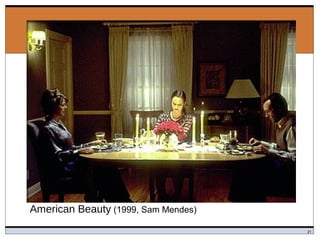
American Beauty
(1999, Sam Mendes)
                     20
American Beauty (1999, Sam Mendes)
                                     21
Use of color, con’t.
 D. Expressive uses of color (varies from
  culture to culture & context):
    1. Color motifs or patterns (a motif is a recurring
      element in a film)
    2. Specific symbolic meanings of color—e.g.
     Black, White, Red, Yellow, etc.
        (these vary dramatically in different cultures. For example, black is generally
         associated with death and dying here in the US, other countries associate
         white with death)

    3. Alternating or contrasting use of colors
 See color plates 1-32 [Chapter 2]
PERFORMANCE (acting)
 A. Usually human actors
   Required to make an effective drama
   Create identification with audience,
    enhancing our suspension of disbelief
   Bad acting (or outdated acting) prevents
    this identification.
PERFORMANCE, CON’T.

B. Various acting styles:
 1. Natural vs. Stylized (realistic vs. "playing a role")
 2 Method acting (immersing oneself in the role)
 3. Technical acting (using body movements & technique to
  evoke a role)

 4. Type casting vs. casting against type            [see p. 33,
  Fig. 1.26]

 5. Styles change over time; earlier films may
  seem overacted to modern audiences
PERFORMANCE, CON’T.
 C. Performance categories:
  1.Leading actors/actresses
       A.Often played by stars
  2.Supporting actors
       A.Character actors
  3.Extras
  4.Cameos (rarely credited, often famous people)
PERFORMANCE, CON’T.

 D. Performance challenges:
   Importance of casting & problem of miscasting
   Challenge of shooting out of sequence (movies
    usually shot out of narrative order, for convenience or
    cost)
 E. Film techniques can alter or "create" a
  performance – skillful photography & editing can
  mask a poor performance.
Film Clip
 Edward Scissorhands (1990, directed by Tim
  Burton), starring Johnny Depp and Diane Wiest (and
  Winona Ryder, not seen in clip).
 Cinematography by Stefan Czapsky
 Production Design by Bo Welch

 Clip is 5 minutes in when we first meet
  Edward (trt=8:00)
Composition & Use of Space
A. Spatial aspects of setting:
  1. Depth cues: illusion of 3-D space in 2-D
  medium:
         a. Overlapping objects
         b. Obstruction shots
         c. Deep focus (see cinematography)
         d. Forced perspective (illusion of depth & distance with
          smaller rear sets, etc.)
   2. Use of foreground, middle ground and
   background planes
   3. Rack focus: between these planes
see pp. 46-48 [also see cinematography]
Space & Composition
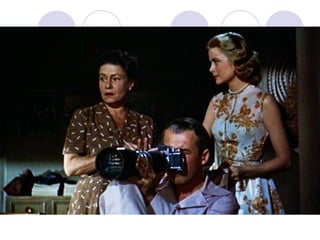
 B. Composition: arrangement of subjects in
  frame.
    1. Balance – taking sides; symmetrical to
     asymmetrical (see pp. 43-52)
    2. Rule of thirds (horizontal & vertical)
    3. Diagonals, triangles, or other groupings
    4. Contrasts
       a. Can be of tone & color, light & dark, etc.
       b. Also of shape & size
Space & Composition

  5. Proxemics: close or far distances
   between characters & objects –
     a. Tight – people & objects close
      together
     b. Loose – people & objects far apart
     c. Objects used as barriers (e.g. screen
      doors, bead curtains, etc.)
Space & Composition
  C. Other uses of space:
     Looking into windows, mirrors, etc.
     Use of empty space
     Use of offscreen space

    Discussions of composition leading directly into . . .
     Cinematography and Lighting for next class!

Fa ch1-techniques-mise en scene 2013

  • 1.
  • 2.
    TECHNICAL ASPECTS OVERVIEW A. Mise-en-scène: what is filmed; everything in front of the cameras. (French theatre term, literally meaning “put into the scene” referencing staging. Also spelled “mise en scène” without hyphens; it can be italicized or not)  B. Cinematography: how something is filmed (photographic techniques)  C. Editing: how what is filmed is put together  D. Sound: voice, music, & sound effects; can be diegetic (part of the story) or non-diegetic (e.g., a film score)
  • 3.
    MISE EN SCENE  Setting  Costuming & Makeup  Color  Performance  Composition  Some disagreement as to what exactly constitutes mise en scène vs. other techniques.  Some include lighting & camera angles (composition) (Both of which most filmmakers and all cinematographers would attribute to cinematography, but for scholarly analysis, it’s usually lumped into mise en scène)
  • 4.
    MISE EN scène:Production Design  Production Designers are usually in charge of the look of a film (in collaboration with the DP).  They oversee the Art Director who oversees set design and construction . . . • Set Designer and construction • Set Decorator • Graphic artists and illustrators  Prop Master  Costume Designer, and  Hair and Makeup Design  Special Effects
  • 5.
    SETTING  Setting iswhere the action occurs  Three basic shooting options:  1. Soundstage – interiors & process shots (e.g., rear-screen projection during driving scene)  2. Studio backlot – full size replicas (towns, streets, houses, shops, etc.)  3. On location . . .
  • 6.
    Setting, con’t.  3.On Location:  a. May be one place, but pretend to be another ("creative geography” in editing)  b. May shoot only establishing & outside shots “on location”  c. May take whole cast & crew "on location" to shoot exteriors & interiors
  • 7.
    Setting, con’t.  Functionof sets:  1. Provide information (e.g. time, place, character’s status, etc.).  2. Create mood & guide our attention.  3. May play a significant part in the action.  4. Communicate themes & comment on action.  5. Can create "special effects" (e.g. low tech solutions to avoid process shots).
  • 8.
  • 9.
  • 10.
    Psycho (1960, AlfredHitchcock) 10
  • 11.
  • 12.
    Looking at MoviesDVD Clip  Here’s our friend Dave Monahan in a DVD tutorial with a look at how setting can be an essential part of the storytelling in films . . . (5:00)
  • 13.
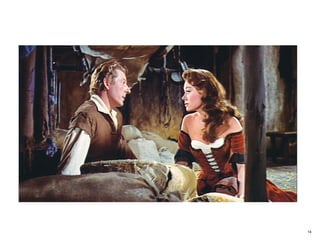
    Costuming & Makeup A. Can enhance setting; must be appropriate for the time, place, etc.  B. Can be realistic vs. stylized (more in fantasy)  C. Can serve iconographic or symbolic functions (i.e. white hat/dark hat dichotomy for hero/villain)
  • 14.
  • 15.
  • 16.
  • 17.
    Clip from “Anatomyof a Scene” segment  from Sundance Channel’s series “Anatomy of a Scene” 11:00  Acting 2:00
  • 18.
    Use of colorin mise en scene  A. Color can refer to many things:  1. Color film stock [see chapter 2]  2. Use of color filters for light [see chapter 2]  3. Use of color in sets, costumes, etc.  B. Color shows different types of characters, places, moods, etc.
  • 19.
    Use of color,con’t.  C. Types of color (in both mise en scene & cinematography; see pp.66-70):  1. Saturated—intense & vivid  2. Desaturated—muted, dull, & pale  3. Warm colors  4. Cool colors
  • 20.
  • 21.
    American Beauty (1999,Sam Mendes) 21
  • 22.
    Use of color,con’t.  D. Expressive uses of color (varies from culture to culture & context):  1. Color motifs or patterns (a motif is a recurring element in a film)  2. Specific symbolic meanings of color—e.g. Black, White, Red, Yellow, etc.  (these vary dramatically in different cultures. For example, black is generally associated with death and dying here in the US, other countries associate white with death)  3. Alternating or contrasting use of colors  See color plates 1-32 [Chapter 2]
  • 23.
    PERFORMANCE (acting)  A.Usually human actors  Required to make an effective drama  Create identification with audience, enhancing our suspension of disbelief  Bad acting (or outdated acting) prevents this identification.
  • 24.
    PERFORMANCE, CON’T. B. Variousacting styles:  1. Natural vs. Stylized (realistic vs. "playing a role")  2 Method acting (immersing oneself in the role)  3. Technical acting (using body movements & technique to evoke a role)  4. Type casting vs. casting against type [see p. 33, Fig. 1.26]  5. Styles change over time; earlier films may seem overacted to modern audiences
  • 25.
    PERFORMANCE, CON’T.  C.Performance categories: 1.Leading actors/actresses A.Often played by stars 2.Supporting actors A.Character actors 3.Extras 4.Cameos (rarely credited, often famous people)
  • 26.
    PERFORMANCE, CON’T.  D.Performance challenges:  Importance of casting & problem of miscasting  Challenge of shooting out of sequence (movies usually shot out of narrative order, for convenience or cost)  E. Film techniques can alter or "create" a performance – skillful photography & editing can mask a poor performance.
  • 27.
    Film Clip  EdwardScissorhands (1990, directed by Tim Burton), starring Johnny Depp and Diane Wiest (and Winona Ryder, not seen in clip).  Cinematography by Stefan Czapsky  Production Design by Bo Welch  Clip is 5 minutes in when we first meet Edward (trt=8:00)
  • 28.
    Composition & Useof Space A. Spatial aspects of setting: 1. Depth cues: illusion of 3-D space in 2-D medium:  a. Overlapping objects  b. Obstruction shots  c. Deep focus (see cinematography)  d. Forced perspective (illusion of depth & distance with smaller rear sets, etc.) 2. Use of foreground, middle ground and background planes 3. Rack focus: between these planes see pp. 46-48 [also see cinematography]
  • 29.
    Space & Composition B. Composition: arrangement of subjects in frame.  1. Balance – taking sides; symmetrical to asymmetrical (see pp. 43-52)  2. Rule of thirds (horizontal & vertical)  3. Diagonals, triangles, or other groupings  4. Contrasts  a. Can be of tone & color, light & dark, etc.  b. Also of shape & size
  • 32.
    Space & Composition  5. Proxemics: close or far distances between characters & objects –  a. Tight – people & objects close together  b. Loose – people & objects far apart  c. Objects used as barriers (e.g. screen doors, bead curtains, etc.)
  • 33.
    Space & Composition  C. Other uses of space:  Looking into windows, mirrors, etc.  Use of empty space  Use of offscreen space  Discussions of composition leading directly into . . . Cinematography and Lighting for next class!

Editor's Notes

  • #5 Used to be all under the Art Director, but since Gone with the Wind , William Cameron Menzies coined the term Production Designer who oversees the look. In film and television, a production designer is the person responsible for the overall look of a film. Production designers have one of the key creative roles in the creation of motion pictures and television. Working directly with the director and producer, they must select the settings and style to visually tell the story. From early in pre-production, the production designer collaborates with the director and director of photography to establish the visual feel and specific aesthetic needs of the project. The production designer guides key staff in other departments such as the costume designer, the key hair and make-up stylists, the special effects director and the locations manager (among others) to establish a unified visual appearance to the film. The "art department" is a group of people who work with the production designer to implement the scenic elements of that vision. The art director supervises set construction and painting, as well as modifications to existing locations, such as changing signs or installing new carpet. (wikipedia.com)
  • #9 The Fallen Idol (1948). Carol Reed, director. Some movies challenge us to read their mise-en-scène. Fallen Idol, © 1948 London Film Productions.
  • #10 Far From Heaven (2002). Todd Haynes, director. Mise-en-scène reinforces characters and themes. Far From Heaven, © 2002 Clear Blue Sky Production.
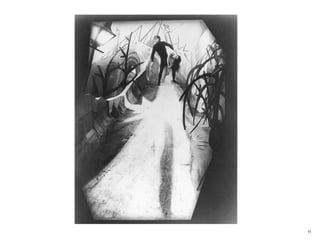
  • #12 The Cabinet of Dr. Caligari (1920). Robert Wiene, director. Painted sets reflected the anxiety, terror, and madness of the film’s characters. The Cabinet of Dr. Caligari, © 1920 Decla-Bioscop AG.
  • #15 The Court Jester (1955). Melvin Frank and Norman Panama, directors. Verisimilitude is a factor, but authenticity is not always ensured regarding costumes, makeup, or hairstyle, particularly in historical films. The Court Jester, © 1955 Dena Enterprises/Paramount Pictures.
  • #16 Moulin Rouge (2001). Baz Luhrmann, director. How much is too much? In some movies, the mise-en-scène overwhelms the narrative. Moulin Rouge, © 2001 Twentieth Century Fox Film Corporation/Bazmark Films.
  • #17 Edward Scissorhands (1990). Tim Burton, director. Style, fit, condition, patterns, and color of costumes can define and differentiate characters. Edward Scissorhands, © 1990 Twentieth Century Fox Film Corporation.
  • #21 The cold cool color scheme of Lester Burnham’s unpleasant office.
  • #25 famous method actors: Al Pacino, (also Johnny Depp, Christian Bale, Joaquin Phoenix, Denzel Washington 2. James Dean 3. Robert De Niro 4. Marlon Brando 5. Forest Whitaker 6. Daniel Day-Lewis 7. Ed Norton 8. Paul Newman 9. Dustin Hoffman 10. James Baldwin 11. Montgomery Clift 12. Jack Nicholson 13. Phillip Seymour-Hoffman 14. Anthony Hopkins Method acting is any of a family of techniques used by actors to create in themselves the thoughts and emotions of their characters, so as to develop lifelike performances. Though not all Method actors use the same approach, the "method" in Method acting usually refers to the practice, influenced by Constantin Stanislavski and created by Lee Strasberg , in which actors draw upon their own emotions and memories in their portrayals, aided by a set of exercises and practices including sense memory and affective memory . (wikipedia)
  • #26 Name some stars? Name some Character actors? A currently popular one is Ken Jeong from TV series Community as well as The Hangover, Role Models, Pineapple Express, et al
  • #29 Forced perspective is also a function of cinematography, from the types of camera angles & focal lengths used, to the use of process shots to blend backgrounds and foregrounds together (see chapter 2)
  • #33 Hitchcock Rule (for cinematographers . . . At least to think about) : The size of an object in the frame should equal its importance in the story at that moment.