PHARMACEUTICAL INORGANIC CHEMISTRY
LECTURE 9
UNIT IV
MISCELLANEOUS COMPOUNDS
⦿ By Manjusha SK
⦿ Associate professor
EMETICS -
⦿ Introduction: The drug which produces vomiting is called as emetics.
⦿ E.g. Sodium potassium tartarate, Copper sulphate.
⦿ These drugs act by stimulating the chemoreceptor trigger zone (CTZ)
located in areas of thalamus.
⦿ 1. Copper sulphate:
Method of preparation:
1. When dilute sulphuric acid react with copper oxide to form copper
sulphate.
H2 SO4 + CuO ----------- CuSO4 + H2O
2. When dilute sulphuric acid react with copper carbonate to form copper
sulphate
H2 SO4 + CuCO3 ----------- CuSO4 + H2O
⦿ Assay: Principle: Assay of copper sulphate is performed using Iodometric
titration.
Reaction:
2CuSO4 + 4KI2 ------- CuI2 +2K2 SO4
2Cu I2 --------------------Cu2 I 2 +I2
I2 +2Na2 S2O3 -------- Na2 S4O6 + 2NaI2
Procedure:
⦿ Conical Flask: Take a conical flask having 250ml capacity and add
copper sulphate, potassium iodide, acetic acid & 2 gm potassium
thiocynate. Burette: Titrate the above solution using Standardized
sodium thiosulphate
⦿ Indicator: Starch
⦿ End point: Disappearance of blue colour
⦿ Properties: Physical properties: It is……….
⦿ 1. deep blue crystals or powder. 2. soluble in water. 3. very soluble in
boiling water. 4. insoluble in alcohol. 5. acidic to litmus.
⦿ Chemical Properties: At very high temperature, it decomposes to cupric
oxide and sulphur dioxide gas.
2CuSO4 -------- 2CuO + SO2 + O2
Uses: It is… 1. Used as emetics. 2. used as chemical antidote in
phosphorous poisoning. 3. used as astringent. 4. used as fungicidal. 5.
used as ingredients of benedicts and fehlings reagent 6. used in
detection of water.
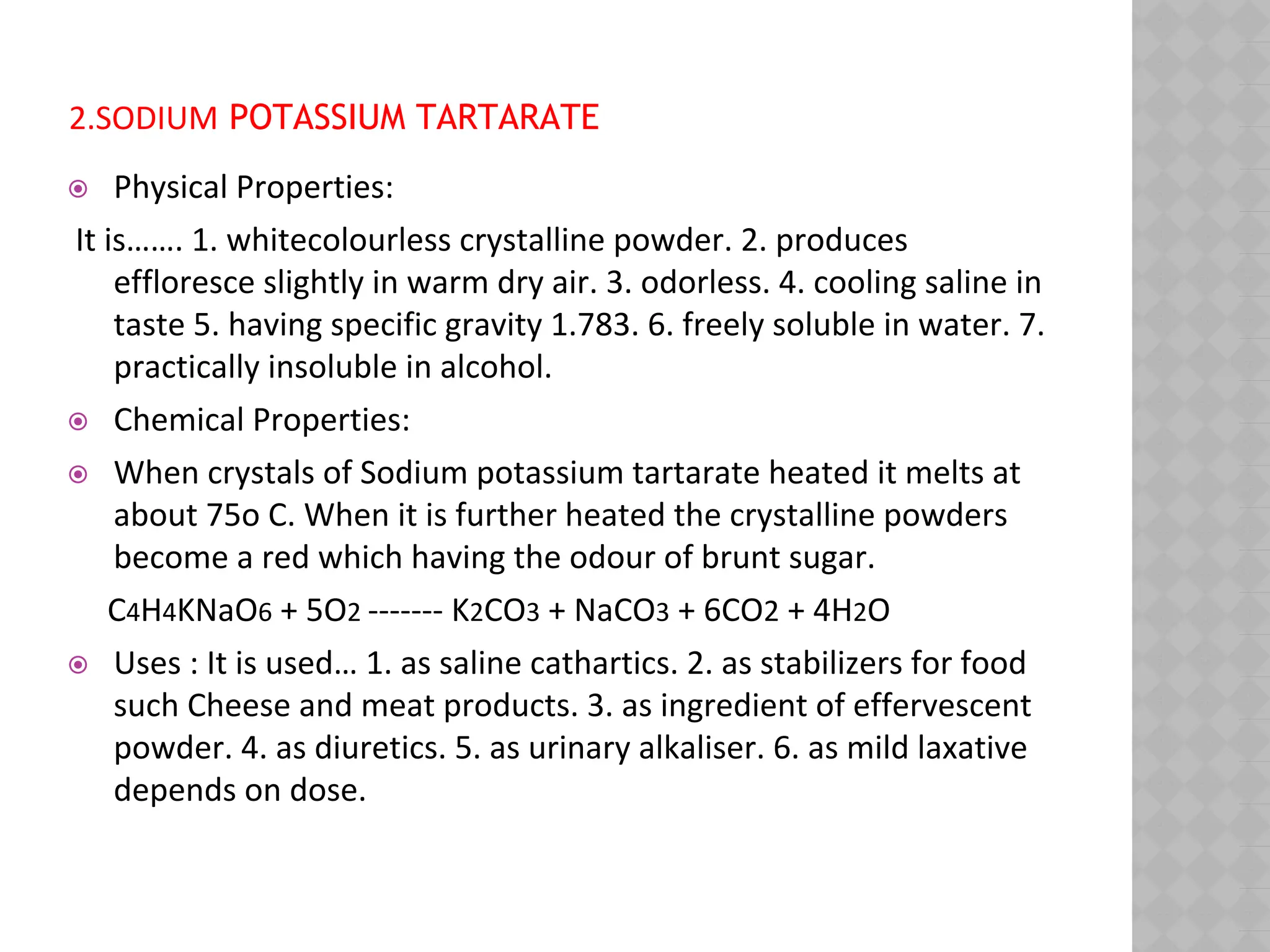
2.SODIUM POTASSIUM TARTARATE
⦿ Physical Properties:
It is……. 1. whitecolourless crystalline powder. 2. produces
effloresce slightly in warm dry air. 3. odorless. 4. cooling saline in
taste 5. having specific gravity 1.783. 6. freely soluble in water. 7.
practically insoluble in alcohol.
⦿ Chemical Properties:
⦿ When crystals of Sodium potassium tartarate heated it melts at
about 75o C. When it is further heated the crystalline powders
become a red which having the odour of brunt sugar.
C4H4KNaO6 + 5O2 ------- K2CO3 + NaCO3 + 6CO2 + 4H2O
⦿ Uses : It is used… 1. as saline cathartics. 2. as stabilizers for food
such Cheese and meat products. 3. as ingredient of effervescent
powder. 4. as diuretics. 5. as urinary alkaliser. 6. as mild laxative
depends on dose.
EXPECTORANTS
⦿ Expectorants are drugs used to help in the removal (expulsion) of
secretions or exudate from the trachea, bronchi, or lungs, and
hence they are used in the treatment of cough.
⦿ The cough is a protective physiological reflux
(both,voluntaryandinvoluntary) to clear the airway.
⦿ Hence this agent intended for treatment of cough.
⦿ Ex. Ammonium chloride
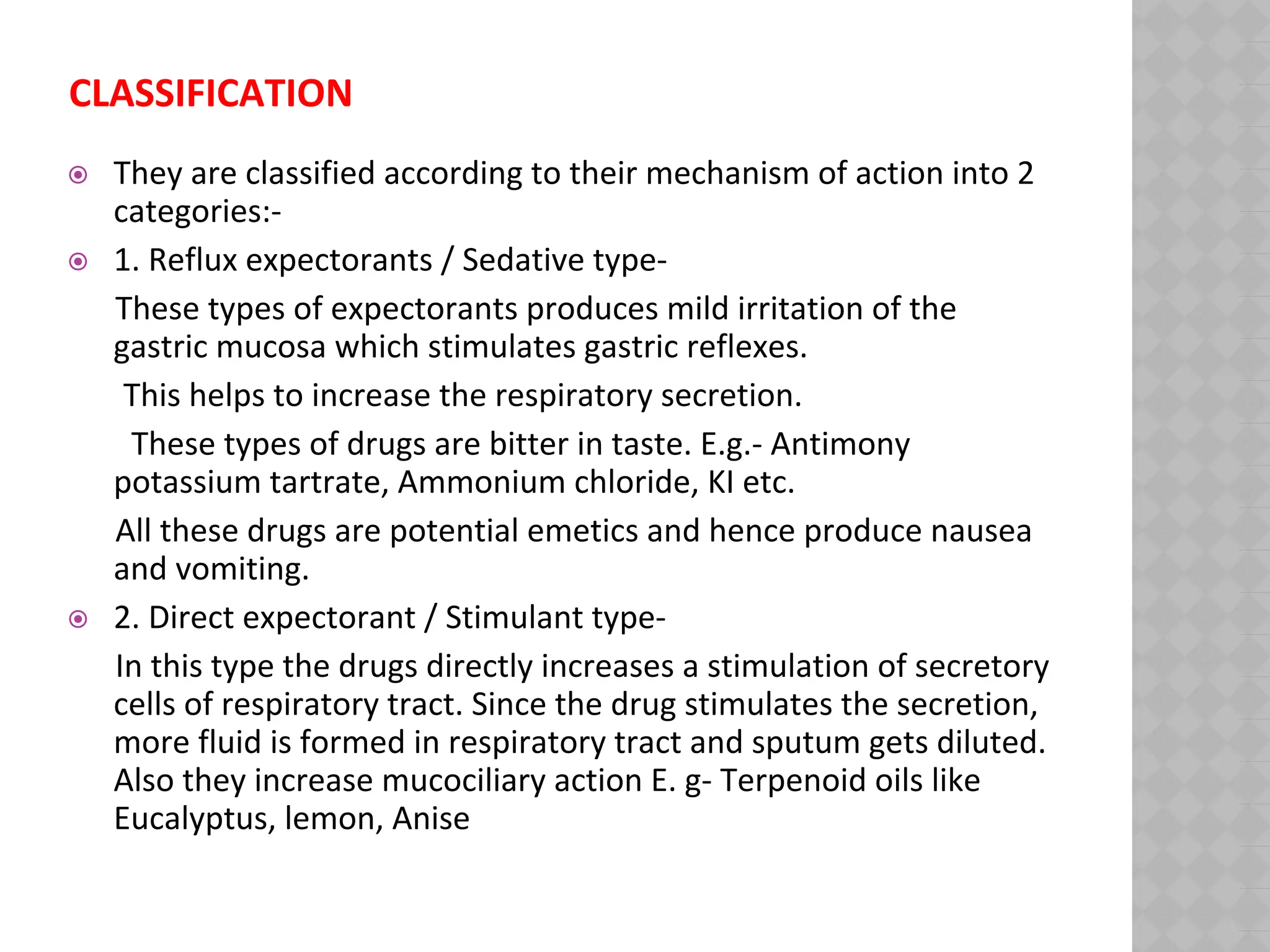
CLASSIFICATION
⦿ They are classified according to their mechanism of action into 2
categories:-
⦿ 1. Reflux expectorants / Sedative type-
These types of expectorants produces mild irritation of the
gastric mucosa which stimulates gastric reflexes.
This helps to increase the respiratory secretion.
These types of drugs are bitter in taste. E.g.- Antimony
potassium tartrate, Ammonium chloride, KI etc.
All these drugs are potential emetics and hence produce nausea
and vomiting.
⦿ 2. Direct expectorant / Stimulant type-
In this type the drugs directly increases a stimulation of secretory
cells of respiratory tract. Since the drug stimulates the secretion,
more fluid is formed in respiratory tract and sputum gets diluted.
Also they increase mucociliary action E. g- Terpenoid oils like
Eucalyptus, lemon, Anise
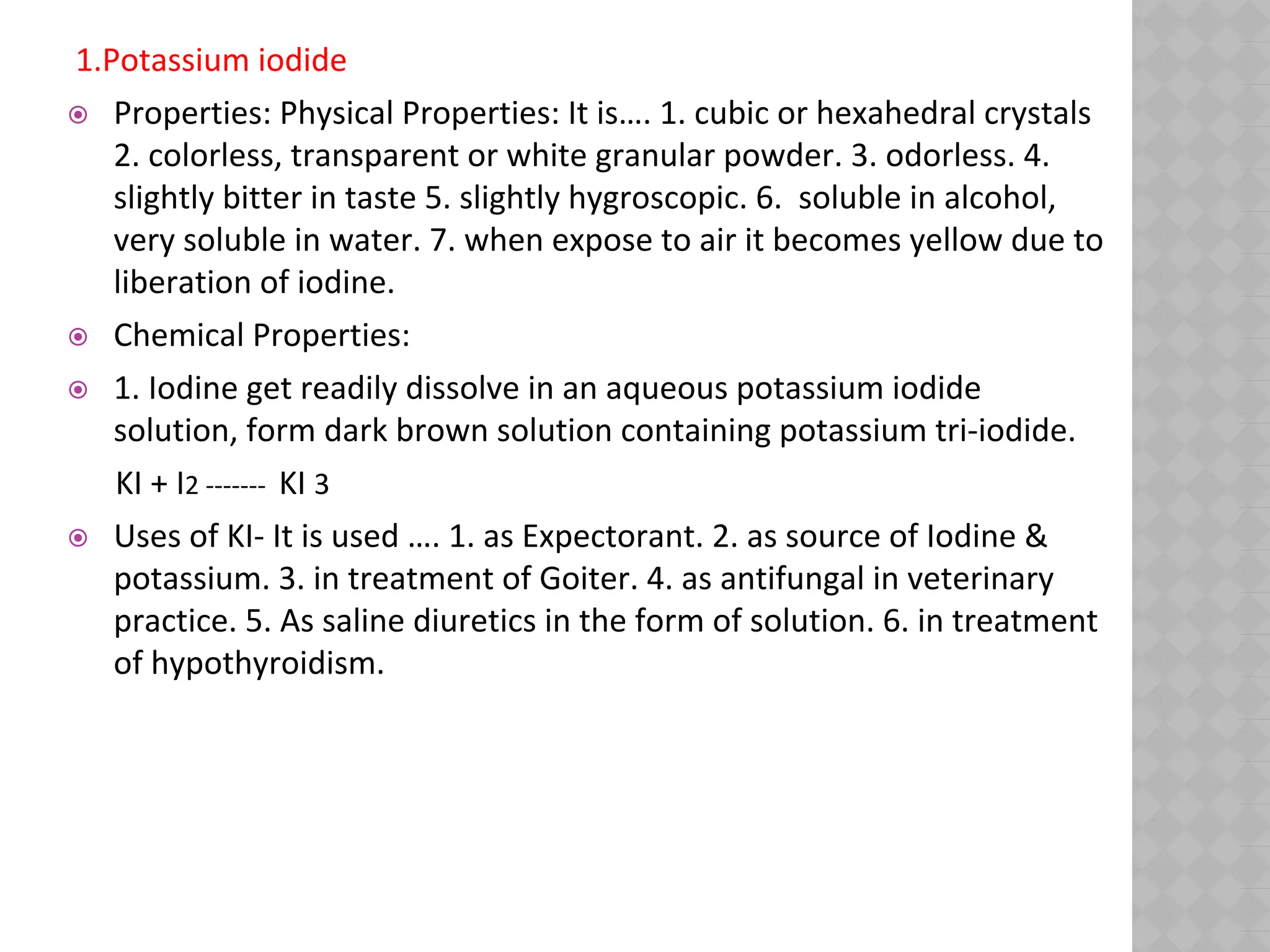
1.Potassium iodide
⦿ Properties: Physical Properties: It is…. 1. cubic or hexahedral crystals
2. colorless, transparent or white granular powder. 3. odorless. 4.
slightly bitter in taste 5. slightly hygroscopic. 6. soluble in alcohol,
very soluble in water. 7. when expose to air it becomes yellow due to
liberation of iodine.
⦿ Chemical Properties:
⦿ 1. Iodine get readily dissolve in an aqueous potassium iodide
solution, form dark brown solution containing potassium tri-iodide.
KI + I2 ------- KI 3
⦿ Uses of KI- It is used …. 1. as Expectorant. 2. as source of Iodine &
potassium. 3. in treatment of Goiter. 4. as antifungal in veterinary
practice. 5. As saline diuretics in the form of solution. 6. in treatment
of hypothyroidism.
⦿ 2.Ammonium chloride
⦿ Method of Preparation:
It is prepared by neutralization of hydrochloric acid with the help of
ammonium hydroxide and the solution get evaporates to the
dryness followed by crystallization.
NH4OH + HCl ------- NH4Cl + H2O 2.
It is prepared by treating ammonia with hydrochloric acid.
NH3 +HCl ------ NH4Cl
⦿ Assay: Assay of ammonium chloride is performed using
argentimetric titration.
THANK YOU

Pharmaceutical Inorganic Chemistry -B Pharmacy First Year -First semester -miscellaneous compound.pdf

  • 1.
    PHARMACEUTICAL INORGANIC CHEMISTRY LECTURE9 UNIT IV MISCELLANEOUS COMPOUNDS ⦿ By Manjusha SK ⦿ Associate professor
  • 2.
    EMETICS - ⦿ Introduction:The drug which produces vomiting is called as emetics. ⦿ E.g. Sodium potassium tartarate, Copper sulphate. ⦿ These drugs act by stimulating the chemoreceptor trigger zone (CTZ) located in areas of thalamus. ⦿ 1. Copper sulphate: Method of preparation: 1. When dilute sulphuric acid react with copper oxide to form copper sulphate. H2 SO4 + CuO ----------- CuSO4 + H2O 2. When dilute sulphuric acid react with copper carbonate to form copper sulphate H2 SO4 + CuCO3 ----------- CuSO4 + H2O ⦿ Assay: Principle: Assay of copper sulphate is performed using Iodometric titration. Reaction: 2CuSO4 + 4KI2 ------- CuI2 +2K2 SO4 2Cu I2 --------------------Cu2 I 2 +I2 I2 +2Na2 S2O3 -------- Na2 S4O6 + 2NaI2
  • 3.
    Procedure: ⦿ Conical Flask:Take a conical flask having 250ml capacity and add copper sulphate, potassium iodide, acetic acid & 2 gm potassium thiocynate. Burette: Titrate the above solution using Standardized sodium thiosulphate ⦿ Indicator: Starch ⦿ End point: Disappearance of blue colour ⦿ Properties: Physical properties: It is………. ⦿ 1. deep blue crystals or powder. 2. soluble in water. 3. very soluble in boiling water. 4. insoluble in alcohol. 5. acidic to litmus. ⦿ Chemical Properties: At very high temperature, it decomposes to cupric oxide and sulphur dioxide gas. 2CuSO4 -------- 2CuO + SO2 + O2 Uses: It is… 1. Used as emetics. 2. used as chemical antidote in phosphorous poisoning. 3. used as astringent. 4. used as fungicidal. 5. used as ingredients of benedicts and fehlings reagent 6. used in detection of water.
  • 4.
    2.SODIUM POTASSIUM TARTARATE ⦿Physical Properties: It is……. 1. whitecolourless crystalline powder. 2. produces effloresce slightly in warm dry air. 3. odorless. 4. cooling saline in taste 5. having specific gravity 1.783. 6. freely soluble in water. 7. practically insoluble in alcohol. ⦿ Chemical Properties: ⦿ When crystals of Sodium potassium tartarate heated it melts at about 75o C. When it is further heated the crystalline powders become a red which having the odour of brunt sugar. C4H4KNaO6 + 5O2 ------- K2CO3 + NaCO3 + 6CO2 + 4H2O ⦿ Uses : It is used… 1. as saline cathartics. 2. as stabilizers for food such Cheese and meat products. 3. as ingredient of effervescent powder. 4. as diuretics. 5. as urinary alkaliser. 6. as mild laxative depends on dose.
  • 5.
    EXPECTORANTS ⦿ Expectorants aredrugs used to help in the removal (expulsion) of secretions or exudate from the trachea, bronchi, or lungs, and hence they are used in the treatment of cough. ⦿ The cough is a protective physiological reflux (both,voluntaryandinvoluntary) to clear the airway. ⦿ Hence this agent intended for treatment of cough. ⦿ Ex. Ammonium chloride
  • 6.
    CLASSIFICATION ⦿ They areclassified according to their mechanism of action into 2 categories:- ⦿ 1. Reflux expectorants / Sedative type- These types of expectorants produces mild irritation of the gastric mucosa which stimulates gastric reflexes. This helps to increase the respiratory secretion. These types of drugs are bitter in taste. E.g.- Antimony potassium tartrate, Ammonium chloride, KI etc. All these drugs are potential emetics and hence produce nausea and vomiting. ⦿ 2. Direct expectorant / Stimulant type- In this type the drugs directly increases a stimulation of secretory cells of respiratory tract. Since the drug stimulates the secretion, more fluid is formed in respiratory tract and sputum gets diluted. Also they increase mucociliary action E. g- Terpenoid oils like Eucalyptus, lemon, Anise
  • 7.
    1.Potassium iodide ⦿ Properties:Physical Properties: It is…. 1. cubic or hexahedral crystals 2. colorless, transparent or white granular powder. 3. odorless. 4. slightly bitter in taste 5. slightly hygroscopic. 6. soluble in alcohol, very soluble in water. 7. when expose to air it becomes yellow due to liberation of iodine. ⦿ Chemical Properties: ⦿ 1. Iodine get readily dissolve in an aqueous potassium iodide solution, form dark brown solution containing potassium tri-iodide. KI + I2 ------- KI 3 ⦿ Uses of KI- It is used …. 1. as Expectorant. 2. as source of Iodine & potassium. 3. in treatment of Goiter. 4. as antifungal in veterinary practice. 5. As saline diuretics in the form of solution. 6. in treatment of hypothyroidism.
  • 8.
    ⦿ 2.Ammonium chloride ⦿Method of Preparation: It is prepared by neutralization of hydrochloric acid with the help of ammonium hydroxide and the solution get evaporates to the dryness followed by crystallization. NH4OH + HCl ------- NH4Cl + H2O 2. It is prepared by treating ammonia with hydrochloric acid. NH3 +HCl ------ NH4Cl ⦿ Assay: Assay of ammonium chloride is performed using argentimetric titration.
  • 9.