THEORY
DALTON’S
In previous lesson, you have learned about the concept of
matter. Basically, matter is everything that you see around.
Do you wander what makes up matter? Consider a certain
piece of fruit. If you cut into tiny pieces, would you reach a
point where you could no longer cut any smaller? How small
would the pieces of fruit be?
4
5
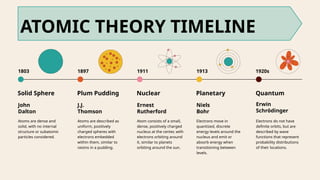
Solid Sphere
Atoms are dense and
solid, with no internal
structure or subatomic
particles considered.
Plum Pudding
Atoms are described as
uniform, positively
charged spheres with
electrons embedded
within them, similar to
raisins in a pudding.
Nuclear
Atom consists of a small,
dense, positively charged
nucleus at the center, with
electrons orbiting around
it, similar to planets
orbiting around the sun.
Planetary
Electrons move in
quantized, discrete
energy levels around the
nucleus and emit or
absorb energy when
transitioning between
levels.
Quantum
Electrons do not have
definite orbits, but are
described by wave
functions that represent
probability distributions
of their locations.
ATOMIC THEORY TIMELINE
John
Dalton
J.J.
Thomson
Ernest
Rutherford
Niels
Bohr
Erwin
Schrödinger
1803 1897 1911 1913 1920s
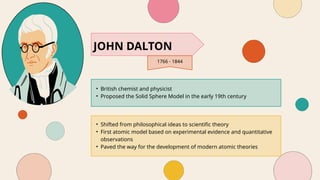
• British chemist and physicist
• Proposed the Solid Sphere Model in the early 19th century
JOHN DALTON
1766 - 1844
• Shifted from philosophical ideas to scientific theory
• First atomic model based on experimental evidence and quantitative
observations
• Paved the way for the development of modern atomic theories
Prior to John Dalton, the earliest known
views regarding the ultimate structure of
matter have been credited to Democritus,
an ancient Greek philosopher. According to
Democritus, matter is composed of
indivisible (atomos) particles known as
atoms. He also hypothesized that atoms
comes in different sizes, shape, mass,
position,, and arrangement.
1. Atoms are the smallest particles of matter. They cannot be divided into
smaller particles. They also cannot be created or destroyed.
However, in 1803, John Dalton worked out an atomic theory which was more
detailed than that of. He contributed the following postulates.
2. All atoms of an element are identical, but the atoms of one element are
different from the atoms of other elements in terms of mass, size and other
properties
3. Compounds are composed of atoms of more than one element which are
combined in fixed ratios.
4. Atoms retain their identity during chemical reactions, which involve
combination, separation, and rearrangement. They are indestructible.
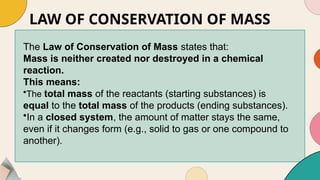
LAW OF CONSERVATION OF MASS
The Law of Conservation of Mass states that:
Mass is neither created nor destroyed in a chemical
reaction.
This means:
•The total mass of the reactants (starting substances) is
equal to the total mass of the products (ending substances).
•In a closed system, the amount of matter stays the same,
even if it changes form (e.g., solid to gas or one compound to
another).
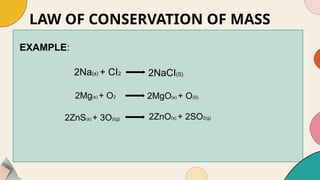
LAW OF CONSERVATION OF MASS
2Na(s) + CI2 2NaCI(S)
EXAMPLE:
2Mg(s) + O2 2MgO(s) + O(S)
2ZnS(s) + 3O2(g) 2ZnO(s) + 2SO2(g)
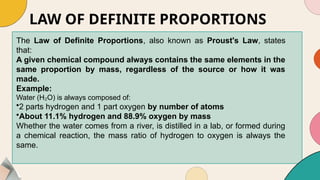
LAW OF DEFINITE PROPORTIONS
The Law of Definite Proportions, also known as Proust's Law, states
that:
A given chemical compound always contains the same elements in the
same proportion by mass, regardless of the source or how it was
made.
Example:
Water (H O) is always composed of:
₂
•2 parts hydrogen and 1 part oxygen by number of atoms
•About 11.1% hydrogen and 88.9% oxygen by mass
Whether the water comes from a river, is distilled in a lab, or formed during
a chemical reaction, the mass ratio of hydrogen to oxygen is always the
same.
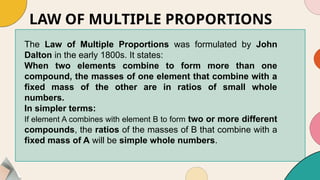
LAW OF MULTIPLE PROPORTIONS
The Law of Multiple Proportions was formulated by John
Dalton in the early 1800s. It states:
When two elements combine to form more than one
compound, the masses of one element that combine with a
fixed mass of the other are in ratios of small whole
numbers.
In simpler terms:
If element A combines with element B to form two or more different
compounds, the ratios of the masses of B that combine with a
fixed mass of A will be simple whole numbers.
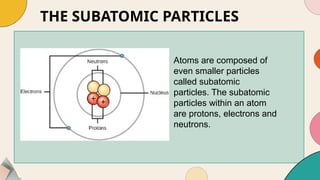
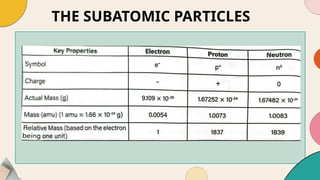
THE SUBATOMIC PARTICLES
Atoms are composed of
even smaller particles
called subatomic
particles. The subatomic
particles within an atom
are protons, electrons and
neutrons.
THE SUBATOMIC PARTICLES
HISTORY OF ATOMIC STRUCTURE
THOMSON’S EXPERIMENT
In 1897, J.J Thomson investigated the nature of cathode rays, using
the cathode ray tube.
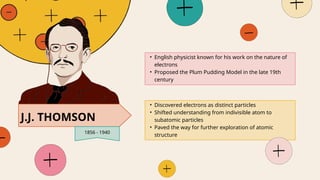
• English physicist known for his work on the nature of
electrons
• Proposed the Plum Pudding Model in the late 19th
century
• Discovered electrons as distinct particles
• Shifted understanding from indivisible atom to
subatomic particles
• Paved the way for further exploration of atomic
structure
J.J. THOMSON
1856 - 1940
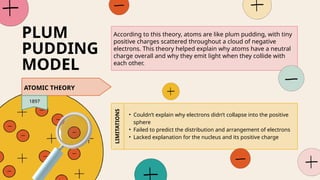
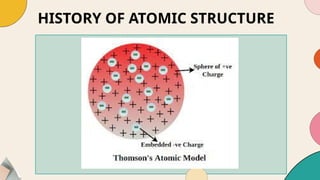
According to this theory, atoms are like plum pudding, with tiny
positive charges scattered throughout a cloud of negative
electrons. This theory helped explain why atoms have a neutral
charge overall and why they emit light when they collide with
each other.
ATOMIC THEORY
1897
• Couldn’t explain why electrons didn’t collapse into the positive
sphere
• Failed to predict the distribution and arrangement of electrons
• Lacked explanation for the nucleus and its positive charge
LIMITATIONS
PLUM
PUDDING
MODEL
HISTORY OF ATOMIC STRUCTURE
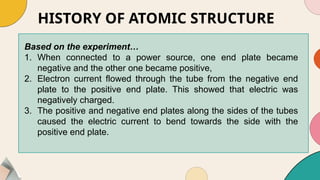
Based on the experiment…
1. When connected to a power source, one end plate became
negative and the other one became positive,
2. Electron current flowed through the tube from the negative end
plate to the positive end plate. This showed that electric was
negatively charged.
3. The positive and negative end plates along the sides of the tubes
caused the electric current to bend towards the side with the
positive end plate.
HISTORY OF ATOMIC STRUCTURE
• New Zealand-born physicist known for his contributions to nuclear
physics
• Introduced the Nuclear Model in the early 20th century
ERNEST RUTHERFORD
1871 - 1937
• First model to propose a central, massive nucleus
• Explained the behavior of positively charged alpha particles in the gold
foil experiment
• Laid the groundwork for understanding atomic structure and
radioactivity
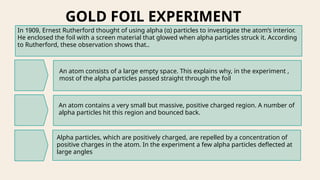
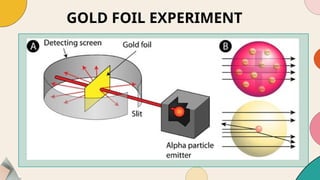
In 1909, Ernest Rutherford thought of using alpha (α) particles to investigate the atom’s interior.
He enclosed the foil with a screen material that glowed when alpha particles struck it. According
to Rutherford, these observation shows that..
GOLD FOIL EXPERIMENT
An atom consists of a large empty space. This explains why, in the experiment ,
most of the alpha particles passed straight through the foil
An atom contains a very small but massive, positive charged region. A number of
alpha particles hit this region and bounced back.
Alpha particles, which are positively charged, are repelled by a concentration of
positive charges in the atom. In the experiment a few alpha particles deflected at
large angles
GOLD FOIL EXPERIMENT
DISCOVERY OF PROTON
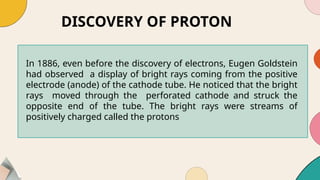
In 1886, even before the discovery of electrons, Eugen Goldstein
had observed a display of bright rays coming from the positive
electrode (anode) of the cathode tube. He noticed that the bright
rays moved through the perforated cathode and struck the
opposite end of the tube. The bright rays were streams of
positively charged called the protons
DISCOVERY OF PROTON
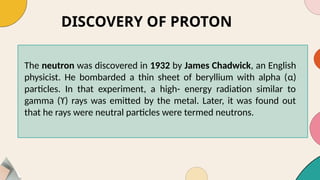
The neutron was discovered in 1932 by James Chadwick, an English
physicist. He bombarded a thin sheet of beryllium with alpha (α)
particles. In that experiment, a high- energy radiation similar to
gamma (ϒ) rays was emitted by the metal. Later, it was found out
that he rays were neutral particles were termed neutrons.
ATOMIC NUMBER AND MASS NUMBER
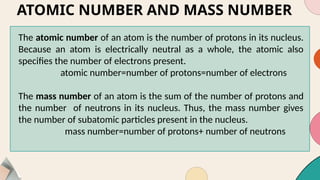
The atomic number of an atom is the number of protons in its nucleus.
Because an atom is electrically neutral as a whole, the atomic also
specifies the number of electrons present.
atomic number=number of protons=number of electrons
The mass number of an atom is the sum of the number of protons and
the number of neutrons in its nucleus. Thus, the mass number gives
the number of subatomic particles present in the nucleus.
mass number=number of protons+ number of neutrons
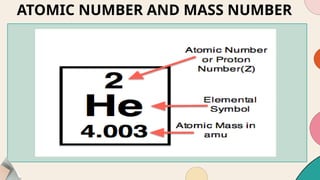
ATOMIC NUMBER AND MASS NUMBER
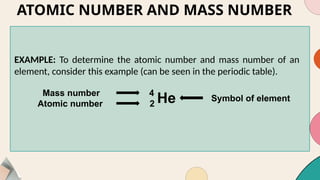
EXAMPLE: To determine the atomic number and mass number of an
element, consider this example (can be seen in the periodic table).
He
Mass number 4
Atomic number 2
Symbol of element
ATOMIC NUMBER AND MASS NUMBER
DRILL
1. British chemist and physicist and proposed the Solid Sphere
Model in the early 19th century.
JOHN DALTON
2. Prior to John Dalton, the earliest known views regarding the
ultimate structure of matter have been credited to Democritus, an
ancient Greek philosopher.
DEMOCRITUS
3. What are the basic laws of matter?
LAW OF CONSERVATION OF MASS
LAW OF MULTIPLE PROPORTIONS
LAW OF DEFINITE PROPORTIONS
4. states that Mass is neither created nor destroyed in a chemical
reaction.
LAW OF CONSERVATION OF MASS
5. It was formulated by John Dalton in the early 1800s. It states:
When two elements combine to form more than one compound,
the masses of one element that combine with a fixed mass of the
other are in ratios of small whole numbers.
LAW OF MULTIPLE PROPORTIONS
6. Also known as Proust's Law, states that a given chemical
compound always contains the same elements in the same
proportion by mass, regardless of the source or how it was
made.
LAW OF DEFINITE PROPORTION
7. New Zealand-born physicist known for his contributions to nuclear
physics introduced the Nuclear Model in the early 20th century.
ERNEST RUTHERFORD
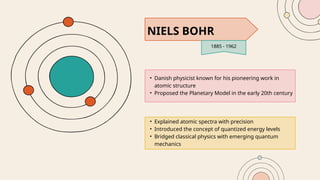
• Danish physicist known for his pioneering work in
atomic structure
• Proposed the Planetary Model in the early 20th century
• Explained atomic spectra with precision
• Introduced the concept of quantized energy levels
• Bridged classical physics with emerging quantum
mechanics
NIELS BOHR
1885 - 1962
DALTON'S ATOMIC THEORY POWERPOINT .pptx

  • 1.
  • 2.
    In previous lesson,you have learned about the concept of matter. Basically, matter is everything that you see around. Do you wander what makes up matter? Consider a certain piece of fruit. If you cut into tiny pieces, would you reach a point where you could no longer cut any smaller? How small would the pieces of fruit be? 4 5
  • 3.
    Solid Sphere Atoms aredense and solid, with no internal structure or subatomic particles considered. Plum Pudding Atoms are described as uniform, positively charged spheres with electrons embedded within them, similar to raisins in a pudding. Nuclear Atom consists of a small, dense, positively charged nucleus at the center, with electrons orbiting around it, similar to planets orbiting around the sun. Planetary Electrons move in quantized, discrete energy levels around the nucleus and emit or absorb energy when transitioning between levels. Quantum Electrons do not have definite orbits, but are described by wave functions that represent probability distributions of their locations. ATOMIC THEORY TIMELINE John Dalton J.J. Thomson Ernest Rutherford Niels Bohr Erwin Schrödinger 1803 1897 1911 1913 1920s
  • 4.
    • British chemistand physicist • Proposed the Solid Sphere Model in the early 19th century JOHN DALTON 1766 - 1844 • Shifted from philosophical ideas to scientific theory • First atomic model based on experimental evidence and quantitative observations • Paved the way for the development of modern atomic theories
  • 5.
    Prior to JohnDalton, the earliest known views regarding the ultimate structure of matter have been credited to Democritus, an ancient Greek philosopher. According to Democritus, matter is composed of indivisible (atomos) particles known as atoms. He also hypothesized that atoms comes in different sizes, shape, mass, position,, and arrangement.
  • 6.
    1. Atoms arethe smallest particles of matter. They cannot be divided into smaller particles. They also cannot be created or destroyed. However, in 1803, John Dalton worked out an atomic theory which was more detailed than that of. He contributed the following postulates. 2. All atoms of an element are identical, but the atoms of one element are different from the atoms of other elements in terms of mass, size and other properties 3. Compounds are composed of atoms of more than one element which are combined in fixed ratios. 4. Atoms retain their identity during chemical reactions, which involve combination, separation, and rearrangement. They are indestructible.
  • 7.
    LAW OF CONSERVATIONOF MASS The Law of Conservation of Mass states that: Mass is neither created nor destroyed in a chemical reaction. This means: •The total mass of the reactants (starting substances) is equal to the total mass of the products (ending substances). •In a closed system, the amount of matter stays the same, even if it changes form (e.g., solid to gas or one compound to another).
  • 8.
    LAW OF CONSERVATIONOF MASS 2Na(s) + CI2 2NaCI(S) EXAMPLE: 2Mg(s) + O2 2MgO(s) + O(S) 2ZnS(s) + 3O2(g) 2ZnO(s) + 2SO2(g)
  • 9.
    LAW OF DEFINITEPROPORTIONS The Law of Definite Proportions, also known as Proust's Law, states that: A given chemical compound always contains the same elements in the same proportion by mass, regardless of the source or how it was made. Example: Water (H O) is always composed of: ₂ •2 parts hydrogen and 1 part oxygen by number of atoms •About 11.1% hydrogen and 88.9% oxygen by mass Whether the water comes from a river, is distilled in a lab, or formed during a chemical reaction, the mass ratio of hydrogen to oxygen is always the same.
  • 10.
    LAW OF MULTIPLEPROPORTIONS The Law of Multiple Proportions was formulated by John Dalton in the early 1800s. It states: When two elements combine to form more than one compound, the masses of one element that combine with a fixed mass of the other are in ratios of small whole numbers. In simpler terms: If element A combines with element B to form two or more different compounds, the ratios of the masses of B that combine with a fixed mass of A will be simple whole numbers.
  • 11.
    THE SUBATOMIC PARTICLES Atomsare composed of even smaller particles called subatomic particles. The subatomic particles within an atom are protons, electrons and neutrons.
  • 12.
  • 13.
    HISTORY OF ATOMICSTRUCTURE THOMSON’S EXPERIMENT In 1897, J.J Thomson investigated the nature of cathode rays, using the cathode ray tube.
  • 14.
    • English physicistknown for his work on the nature of electrons • Proposed the Plum Pudding Model in the late 19th century • Discovered electrons as distinct particles • Shifted understanding from indivisible atom to subatomic particles • Paved the way for further exploration of atomic structure J.J. THOMSON 1856 - 1940
  • 15.
    According to thistheory, atoms are like plum pudding, with tiny positive charges scattered throughout a cloud of negative electrons. This theory helped explain why atoms have a neutral charge overall and why they emit light when they collide with each other. ATOMIC THEORY 1897 • Couldn’t explain why electrons didn’t collapse into the positive sphere • Failed to predict the distribution and arrangement of electrons • Lacked explanation for the nucleus and its positive charge LIMITATIONS PLUM PUDDING MODEL
  • 16.
    HISTORY OF ATOMICSTRUCTURE Based on the experiment… 1. When connected to a power source, one end plate became negative and the other one became positive, 2. Electron current flowed through the tube from the negative end plate to the positive end plate. This showed that electric was negatively charged. 3. The positive and negative end plates along the sides of the tubes caused the electric current to bend towards the side with the positive end plate.
  • 17.
  • 18.
    • New Zealand-bornphysicist known for his contributions to nuclear physics • Introduced the Nuclear Model in the early 20th century ERNEST RUTHERFORD 1871 - 1937 • First model to propose a central, massive nucleus • Explained the behavior of positively charged alpha particles in the gold foil experiment • Laid the groundwork for understanding atomic structure and radioactivity
  • 19.
    In 1909, ErnestRutherford thought of using alpha (α) particles to investigate the atom’s interior. He enclosed the foil with a screen material that glowed when alpha particles struck it. According to Rutherford, these observation shows that.. GOLD FOIL EXPERIMENT An atom consists of a large empty space. This explains why, in the experiment , most of the alpha particles passed straight through the foil An atom contains a very small but massive, positive charged region. A number of alpha particles hit this region and bounced back. Alpha particles, which are positively charged, are repelled by a concentration of positive charges in the atom. In the experiment a few alpha particles deflected at large angles
  • 20.
  • 21.
    DISCOVERY OF PROTON In1886, even before the discovery of electrons, Eugen Goldstein had observed a display of bright rays coming from the positive electrode (anode) of the cathode tube. He noticed that the bright rays moved through the perforated cathode and struck the opposite end of the tube. The bright rays were streams of positively charged called the protons
  • 22.
    DISCOVERY OF PROTON Theneutron was discovered in 1932 by James Chadwick, an English physicist. He bombarded a thin sheet of beryllium with alpha (α) particles. In that experiment, a high- energy radiation similar to gamma (ϒ) rays was emitted by the metal. Later, it was found out that he rays were neutral particles were termed neutrons.
  • 23.
    ATOMIC NUMBER ANDMASS NUMBER The atomic number of an atom is the number of protons in its nucleus. Because an atom is electrically neutral as a whole, the atomic also specifies the number of electrons present. atomic number=number of protons=number of electrons The mass number of an atom is the sum of the number of protons and the number of neutrons in its nucleus. Thus, the mass number gives the number of subatomic particles present in the nucleus. mass number=number of protons+ number of neutrons
  • 24.
    ATOMIC NUMBER ANDMASS NUMBER EXAMPLE: To determine the atomic number and mass number of an element, consider this example (can be seen in the periodic table). He Mass number 4 Atomic number 2 Symbol of element
  • 25.
    ATOMIC NUMBER ANDMASS NUMBER
  • 26.
  • 27.
    1. British chemistand physicist and proposed the Solid Sphere Model in the early 19th century. JOHN DALTON 2. Prior to John Dalton, the earliest known views regarding the ultimate structure of matter have been credited to Democritus, an ancient Greek philosopher. DEMOCRITUS 3. What are the basic laws of matter? LAW OF CONSERVATION OF MASS LAW OF MULTIPLE PROPORTIONS LAW OF DEFINITE PROPORTIONS
  • 28.
    4. states thatMass is neither created nor destroyed in a chemical reaction. LAW OF CONSERVATION OF MASS 5. It was formulated by John Dalton in the early 1800s. It states: When two elements combine to form more than one compound, the masses of one element that combine with a fixed mass of the other are in ratios of small whole numbers. LAW OF MULTIPLE PROPORTIONS
  • 29.
    6. Also knownas Proust's Law, states that a given chemical compound always contains the same elements in the same proportion by mass, regardless of the source or how it was made. LAW OF DEFINITE PROPORTION 7. New Zealand-born physicist known for his contributions to nuclear physics introduced the Nuclear Model in the early 20th century. ERNEST RUTHERFORD
  • 30.
    • Danish physicistknown for his pioneering work in atomic structure • Proposed the Planetary Model in the early 20th century • Explained atomic spectra with precision • Introduced the concept of quantized energy levels • Bridged classical physics with emerging quantum mechanics NIELS BOHR 1885 - 1962