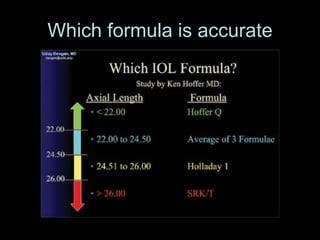
SRK/T power of +4D is more accurate for this patient since their axial length is within the normal range where third generation formulas like SRK/T are more accurate than second generation formulas like SRK II.
IOL Power Calculation
AbdelmonemM. Hamed, M.D.
Professor of ophthalmology
Benha College of Medicine
Fellow of Baylor College of Medicine,
Texas Medical Center, Houston, USA
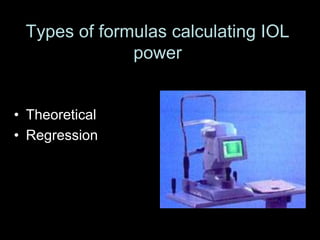
Types of formulascalculating IOL
power
• Theoretical:
– It is based on the optics of the eye( i.e.
corneal power, RI of cornea, distance of
cornea to IOL, axial length, etc…)
– 1st and 2nd generation formulas is less
accurate than regression formulas in normal
length of the eye (22 – 25.5mm)
– 3rd and 4th generation formulas is more
accurate than regression and 1st and 2nd
generation theoretical ones
4.
Types of formulascalculating IOL
power
• Regression:
– It depend on the regression analysis of acual
results of many uncomplicated IOL
implantation
– How ever it is less accurate than theoretical
formulas in short and long eyes (‹22 –
›25.5mm)
5.
Types of formulascalculating IOL
power
• 1st and 2nd generation theoretical formulas
like:
– Colenbrander
– Fyodorove
– Van der Heijde
– Binkhorst
– Hoffer
– Shammas fudged
6.
Types of formulascalculating IOL
power
• 3rd and 4th generation theoretical formulas
like:
– Holladay II
– SRK/T
– Hoffer Q
– What is the ACD?
7.
Types of formulascalculating IOL
power
• Regression formulas like:
– SRK: P=A-0.9K-2.5L
– SRK/T T= theoretical
– What is the A-constant?
8.
Types of formulascalculating IOL
power
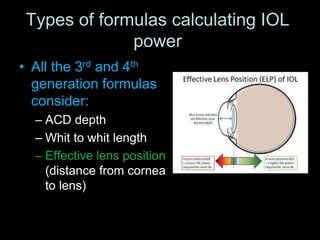
• All the 3rd and 4th
generation formulas
consider:
– ACD depth
– Whit to whit length
– Effective lens position
(distance from cornea
to lens)
9.
Potential errors leadingto the
placement of a wrong IOL include:
• Use of an older IOL formula
• Incorrect measurement of the eye's axial length
• Incorrect keratometry readings
• Mistakes in entering the data into the IOL
calculation program
• Incorrect labeling of the IOL by the
manufacturer
• Mistakes in providing the IOL at the time of
surgery
10.
Consider repeat measurementsif
• Axial length ‹22.0 or ›25.0 mm
• Average corneal power ‹ 40 D or › 47 D
• Between 2 eyes, there is a difference in:
– Corneal power › 1 D
– AL › 0.3MM
– Emmetropic IOL power › 1 D
11.
What you haveto do?
• if you have an eye filled with silicon oil
• if the patient had lasik
• If you have a child Pt.
– what is the ideal postop. Rx.
– what is the expected myopia with
development?
12.
What you haveto do?
• if you have an eye filled with silicon oil
– The RI of SO = 1.42 (higher than vitreous
1.34)
– Velocity of SO = 1000
– Do not use silicone IOL if there is SO inside
the eye.
13.
What you haveto do?
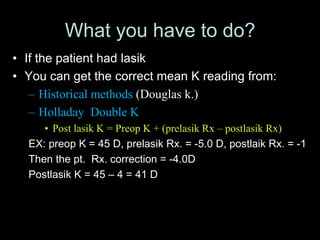
• If the patient had lasik
• You can get the correct mean K reading from:
– Historical methods (Douglas k.)
– Holladay Double K
• Post lasik K = Preop K + (prelasik Rx – postlasik Rx)
EX: preop K = 45 D, prelasik Rx. = -5.0 D, postlaik Rx. = -1
Then the pt. Rx. correction = -4.0D
Postlasik K = 45 – 4 = 41 D
14.
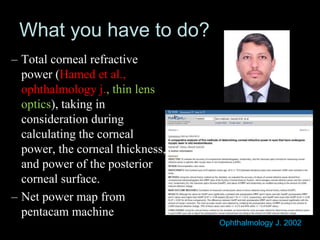
What you haveto do?
– Total corneal refractive
power (Hamed et al.,
ophthalmology j., thin lens
optics), taking in
consideration during
calculating the corneal
power, the corneal thickness,
and power of the posterior
corneal surface.
– Net power map from
pentacam machine
Ophthalmology J. 2002
15.
What you haveto do?
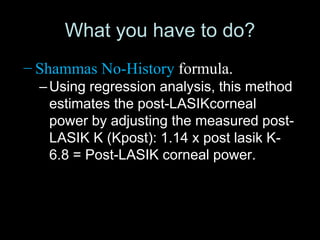
− Shammas No-History formula.
–Using regression analysis, this method
estimates the post-LASIKcorneal
power by adjusting the measured post-
LASIK K (Kpost): 1.14 x post lasik K-
6.8 = Post-LASIK corneal power.
16.
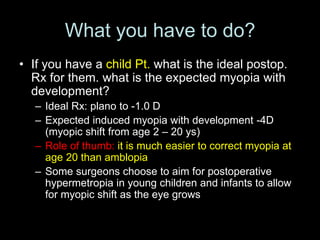
What you haveto do?
• If you have a child Pt. what is the ideal postop.
Rx for them. what is the expected myopia with
development?
– Ideal Rx: plano to -1.0 D
– Expected induced myopia with development -4D
(myopic shift from age 2 – 20 ys)
– Role of thumb: it is much easier to correct myopia at
age 20 than amblopia
– Some surgeons choose to aim for postoperative
hypermetropia in young children and infants to allow
for myopic shift as the eye grows
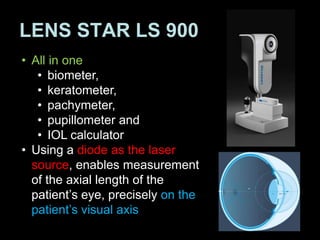
LENS STAR LS900
• All in one
• biometer,
• keratometer,
• pachymeter,
• pupillometer and
• IOL calculator
• Using a diode as the laser
source, enables measurement
of the axial length of the
patient’s eye, precisely on the
patient’s visual axis
19.
QUIZ
• Pt hasgot cataract, AL 28mm, average
corneal power 43 D
– Emmetropic IOL power with SRK II = +7D
– Emmetropic IOL power with SRK/T = +4D
• Which power you should choose?