Amblyopia
Abdelmonem M. Hamed, MD
Professor of Ophthalmology Benha College of Medicine
Fellow of Baylor College, USA
• Definition:
– Unilateral or bilateral reduction of the best
corrected VA that can not be attributed to the
effect of any structural abnormality of the eye.
– Etiology:
– any cause of abnormal visual experience early
in life like squint, refractive error, etc…
• amblyopia
– affects the central vision
– the peripheral visual field remains normal
Amblyopia
• Neurological mechanism:
– not completely understood
– may be (proven in animal models)
• abnormality of neurons in LG Nucleus
• functional deficiency of cells of 1ry visual cortex
• crowding phenomenon:
– may be due to large neurons of the receptive
neurological field
– difficult recognition of the snellens letters if
they are closely surrounded by similar forms
Amblyopia
• Types of amblyopia:
– strabismic
– anisometropic
– isoametropic
– deprivation (amblyopia ex anopsia)
Amblyopia
• strabismic amblyopia
– the most common cause
– occur in the deviating eye
– mechanism
• competitive interaction between neurons carrying the
nonfusible input from the 2 eyes
domination of the cortical centers by the fixating
eye
reduced responsiveness of the non fixating eye’s
input
Amblyopia
• Anisometropic amblyopia
– 2nd in frequency
– due to unequal refraction in 2 eyes…..one retinal image is
defocused
– mechanism: the same as in strabismic amblyopia
– how much anisometropia required to cause amblyopia:
• hypermetropia from 1-2 D…….mild amblyopia
• astigmatism from 1-2 D…….mild amblyopia
• myopia > -6 D ………sever amblyopia
• myopia < -3 D usually does cause amblyopia
Amblyopia
• Isoametropic amblyopia
– large, equal, uncorrected visual acuity in both
eyes…..mild bilateral amblyopia
– how much bilateral refractive error required to induce
amblyopia
• hyperopia > + 5 D
• myopia > -10 D
• cylinder ??? May be > 3 D
Amblyopia
Amblyopia
• Deprivation amblyopia (disuse amblyopia) (amblyopia
ex anopsia)
– due to congenital or early acquired media opacity
– the least common type of amblyopia, BUT
– the most damaging and difficult to treat form
– in general, congenital cataract that are dense and occupy the
central 3mm or more of the lens must be considered capable
of causing sever amblyopia
–
Amblyopia
• Deprivation amblyopia
– any lens opacities acquired during childhood (up to age
8-10) can be almost harmful
– smaller polar cataract; around which retinoscopy can be
readily performed, and lammellar cataracts; around
which a reasonably good view of the fundus can be
obtained, may:
– cause mild to moderate amblyopia, or
• have no effect on visual development
– occlusion amblyopia is a form of deprivation amblyopia
caused by excessive patching
Amblyopia
• Eccentric fixation
– use of a particular nonfoveal region of the retina
for monocular viewing by an amblyopic eye
– detection
• major degrees
» noncentral position of corneal reflex
» VA: 6/60 or worse
• minor
» needs special tests such as Visuscopy, Haidinger’s
brushes or Maxwell's spot
» VA: mild acuity loss
• Cataract
– removal of cataract must be during the 1st 2-3
months of life
– in symmetric cataract, the interval between the
operation on the 1st and 2nd eyes, should be
not more than 2 week
– traumatic cataract in children 8-10 years old,
should be removed in few weeks
Treatment of amblyopia
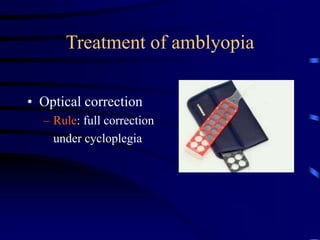
• Optical correction
– Rule: full correction
under cycloplegia
Treatment of amblyopia
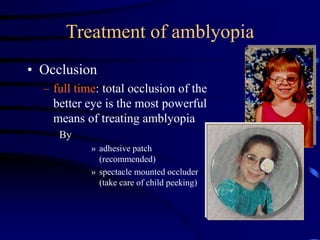
• Occlusion
– full time: total occlusion of the
better eye is the most powerful
means of treating amblyopia
By
» adhesive patch
(recommended)
» spectacle mounted occluder
(take care of child peeking)
Treatment of amblyopia
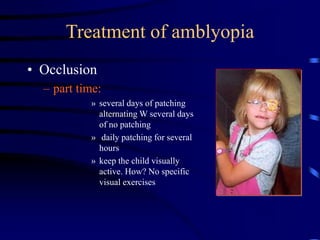
• Occlusion
– part time:
» several days of patching
alternating W several days
of no patching
» daily patching for several
hours
» keep the child visually
active. How? No specific
visual exercises
Treatment of amblyopia
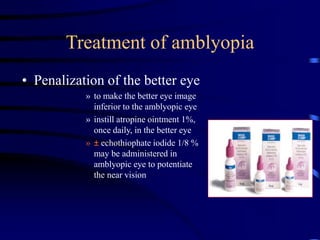
• Penalization of the better eye
» to make the better eye image
inferior to the amblyopic eye
» instill atropine ointment 1%,
once daily, in the better eye
» ± echothiophate iodide 1/8 %
may be administered in
amblyopic eye to potentiate
the near vision
Treatment of amblyopia

Amblyopia

  • 1.
    Amblyopia Abdelmonem M. Hamed,MD Professor of Ophthalmology Benha College of Medicine Fellow of Baylor College, USA
  • 2.
    • Definition: – Unilateralor bilateral reduction of the best corrected VA that can not be attributed to the effect of any structural abnormality of the eye. – Etiology: – any cause of abnormal visual experience early in life like squint, refractive error, etc… • amblyopia – affects the central vision – the peripheral visual field remains normal Amblyopia
  • 3.
    • Neurological mechanism: –not completely understood – may be (proven in animal models) • abnormality of neurons in LG Nucleus • functional deficiency of cells of 1ry visual cortex • crowding phenomenon: – may be due to large neurons of the receptive neurological field – difficult recognition of the snellens letters if they are closely surrounded by similar forms Amblyopia
  • 4.
    • Types ofamblyopia: – strabismic – anisometropic – isoametropic – deprivation (amblyopia ex anopsia) Amblyopia
  • 5.
    • strabismic amblyopia –the most common cause – occur in the deviating eye – mechanism • competitive interaction between neurons carrying the nonfusible input from the 2 eyes domination of the cortical centers by the fixating eye reduced responsiveness of the non fixating eye’s input Amblyopia
  • 6.
    • Anisometropic amblyopia –2nd in frequency – due to unequal refraction in 2 eyes…..one retinal image is defocused – mechanism: the same as in strabismic amblyopia – how much anisometropia required to cause amblyopia: • hypermetropia from 1-2 D…….mild amblyopia • astigmatism from 1-2 D…….mild amblyopia • myopia > -6 D ………sever amblyopia • myopia < -3 D usually does cause amblyopia Amblyopia
  • 7.
    • Isoametropic amblyopia –large, equal, uncorrected visual acuity in both eyes…..mild bilateral amblyopia – how much bilateral refractive error required to induce amblyopia • hyperopia > + 5 D • myopia > -10 D • cylinder ??? May be > 3 D Amblyopia
  • 8.
    Amblyopia • Deprivation amblyopia(disuse amblyopia) (amblyopia ex anopsia) – due to congenital or early acquired media opacity – the least common type of amblyopia, BUT – the most damaging and difficult to treat form – in general, congenital cataract that are dense and occupy the central 3mm or more of the lens must be considered capable of causing sever amblyopia –
  • 9.
    Amblyopia • Deprivation amblyopia –any lens opacities acquired during childhood (up to age 8-10) can be almost harmful – smaller polar cataract; around which retinoscopy can be readily performed, and lammellar cataracts; around which a reasonably good view of the fundus can be obtained, may: – cause mild to moderate amblyopia, or • have no effect on visual development – occlusion amblyopia is a form of deprivation amblyopia caused by excessive patching
  • 10.
    Amblyopia • Eccentric fixation –use of a particular nonfoveal region of the retina for monocular viewing by an amblyopic eye – detection • major degrees » noncentral position of corneal reflex » VA: 6/60 or worse • minor » needs special tests such as Visuscopy, Haidinger’s brushes or Maxwell's spot » VA: mild acuity loss
  • 11.
    • Cataract – removalof cataract must be during the 1st 2-3 months of life – in symmetric cataract, the interval between the operation on the 1st and 2nd eyes, should be not more than 2 week – traumatic cataract in children 8-10 years old, should be removed in few weeks Treatment of amblyopia
  • 12.
    Treatment of amblyopia •Optical correction – Rule: full correction under cycloplegia
  • 13.
    Treatment of amblyopia •Occlusion – full time: total occlusion of the better eye is the most powerful means of treating amblyopia By » adhesive patch (recommended) » spectacle mounted occluder (take care of child peeking)
  • 14.
    Treatment of amblyopia •Occlusion – part time: » several days of patching alternating W several days of no patching » daily patching for several hours » keep the child visually active. How? No specific visual exercises
  • 15.
    Treatment of amblyopia •Penalization of the better eye » to make the better eye image inferior to the amblyopic eye » instill atropine ointment 1%, once daily, in the better eye » ± echothiophate iodide 1/8 % may be administered in amblyopic eye to potentiate the near vision
  • 16.