Biometry: Not Only A Mere
Measurement
Ajit K Thakur
M. Optom
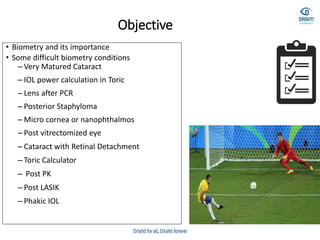
Objective
• Biometry and its importance
• Some difficult biometry conditions
– Very Matured Cataract
– IOL power calculation in Toric
– Lens after PCR
– Posterior Staphyloma
– Micro cornea or nanophthalmos
– Post vitrectomized eye
– Cataract with Retinal Detachment
– Toric Calculator
– Post PK
– Post LASIK
– Phakic IOL
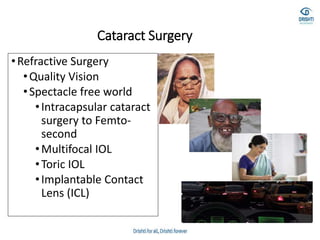
Cataract Surgery
•Refractive Surgery
•Quality Vision
•Spectacle free world
•Intracapsular cataract
surgery to Femto-
second
•Multifocal IOL
•Toric IOL
•Implantable Contact
Lens (ICL)
Biometry
• The statistical analysis of biological
observations and phenomena
• Ocular Parameters Measurement
• Play Maker of successful Cataract
Surgery
Source of Refractive Surprise
• Measurement Error
•Axial Length: 54%
•K reading: 8%
• Formula Error (Olsen JCRS 1992)
• ELP (estimated lens position) error-38%
• Lack of Personalization
• IOL insertion Error
• IOL mislabeling
•improper IOL power insertion at time of surgery
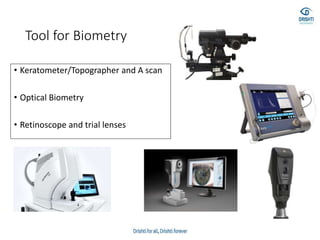
Tool for Biometry
• Keratometer/Topographer and A scan
• Optical Biometry
• Retinoscope and trial lenses
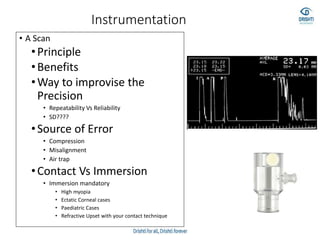
Instrumentation
• A Scan
•Principle
•Benefits
•Way to improvise the
Precision
• Repeatability Vs Reliability
• SD????
•Source of Error
• Compression
• Misalignment
• Air trap
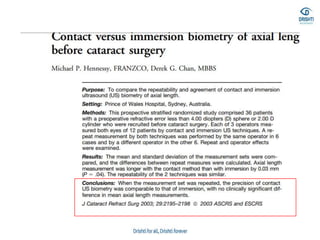
•Contact Vs Immersion
• Immersion mandatory
• High myopia
• Ectatic Corneal cases
• Paediatric Cases
• Refractive Upset with your contact technique
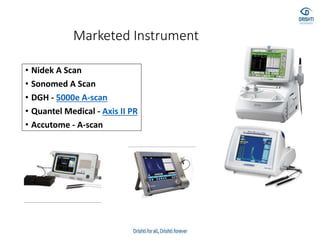
Marketed Instrument
• Nidek A Scan
• Sonomed A Scan
• DGH - 5000e A-scan
• Quantel Medical - Axis II PR
• Accutome - A-scan
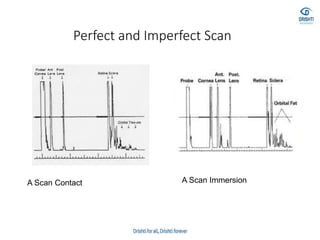
Perfect and Imperfect Scan
A Scan Contact A Scan Immersion
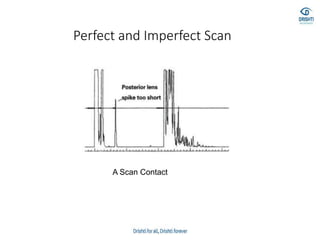
Perfect and Imperfect Scan
A Scan Contact
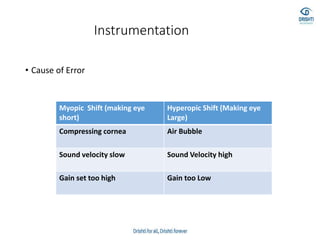
Instrumentation
• Cause of Error
Myopic Shift (making eye
short)
Hyperopic Shift (Making eye
Large)
Compressing cornea Air Bubble
Sound velocity slow Sound Velocity high
Gain set too high Gain too Low
Optical Biometry
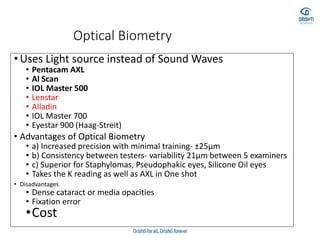
• Uses Light source instead of Sound Waves
• Pentacam AXL
• Al Scan
• IOL Master 500
• Lenstar
• Alladin
• IOL Master 700
• Eyestar 900 (Haag-Streit)
• Advantages of Optical Biometry
• a) Increased precision with minimal training- ±25μm
• b) Consistency between testers- variability 21μm between 5 examiners
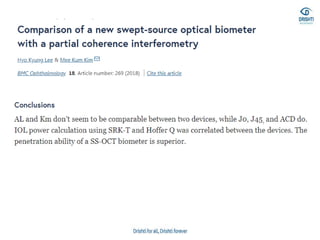
• c) Superior for Staphylomas, Pseudophakic eyes, Silicone Oil eyes
• Takes the K reading as well as AXL in One shot
• Disadvantages
• Dense cataract or media opacities
• Fixation error
•Cost
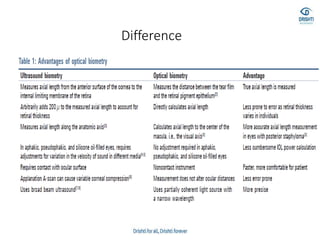
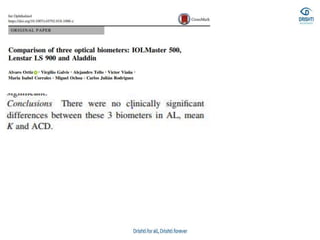
Difference
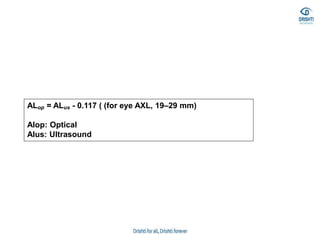
ALop = ALus - 0.117 ( (for eye AXL, 19–29 mm)
Alop: Optical
Alus: Ultrasound
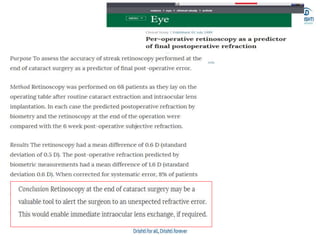
Biometry by retinoscopy
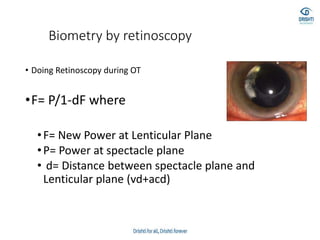
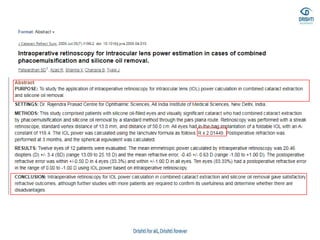
• Doing Retinoscopy during OT
•F= P/1-dF where
•F= New Power at Lenticular Plane
•P= Power at spectacle plane
• d= Distance between spectacle plane and
Lenticular plane (vd+acd)
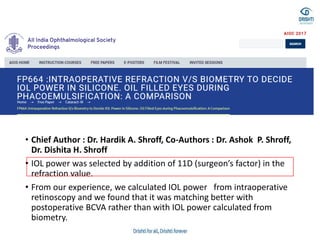
• Chief Author : Dr. Hardik A. Shroff, Co-Authors : Dr. Ashok P. Shroff,
Dr. Dishita H. Shroff
• IOL power was selected by addition of 11D (surgeon’s factor) in the
refraction value.
• From our experience, we calculated IOL power from intraoperative
retinoscopy and we found that it was matching better with
postoperative BCVA rather than with IOL power calculated from
biometry.
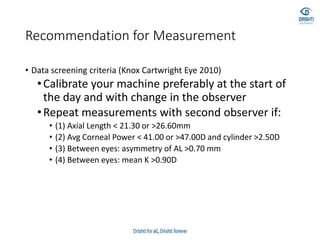
Recommendation for Measurement
• Data screening criteria (Knox Cartwright Eye 2010)
•Calibrate your machine preferably at the start of
the day and with change in the observer
•Repeat measurements with second observer if:
• (1) Axial Length < 21.30 or >26.60mm
• (2) Avg Corneal Power < 41.00 or >47.00D and cylinder >2.50D
• (3) Between eyes: asymmetry of AL >0.70 mm
• (4) Between eyes: mean K >0.90D
IOL calculating Formulae
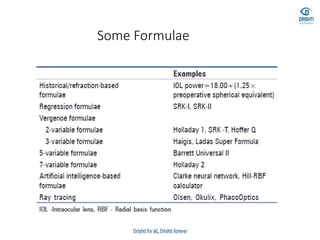
Some Formulae
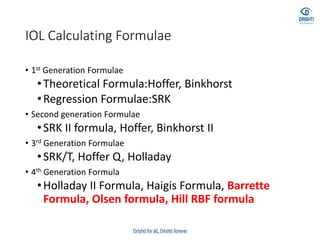
IOL Calculating Formulae
• 1st Generation Formulae
•Theoretical Formula:Hoffer, Binkhorst
•Regression Formulae:SRK
• Second generation Formulae
•SRK II formula, Hoffer, Binkhorst II
• 3rd Generation Formulae
•SRK/T, Hoffer Q, Holladay
• 4th Generation Formula
•Holladay II Formula, Haigis Formula, Barrette
Formula, Olsen formula, Hill RBF formula
IOL Formula
• SRK formula
• Calculated IOL: A-2.5L-0.9 K
• A: A constant (ELP)
• L: Measured Axial Length
• K: Average K reading
• Mathematical Formulae (Fyodorov and its
modifications)
• P = (1336/[AL- ELP]) (1336/[1336/{1000/([1000/DPostRx] - V) + K} - ELP])
• K: Net corneal power
• AL: Axial length
• P: IOL power
• ELP: Effective lens position
• DPostRx : Desired refraction
• V: Vertex distance
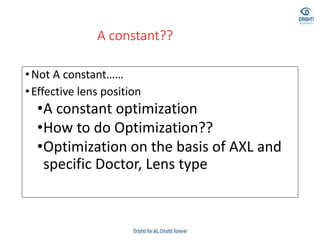
A constant??
•Not A constant……
•Effective lens position
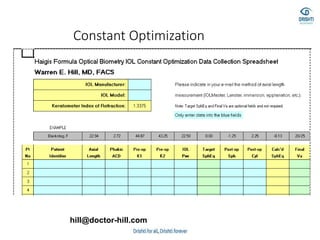
•A constant optimization
•How to do Optimization??
•Optimization on the basis of AXL and
specific Doctor, Lens type
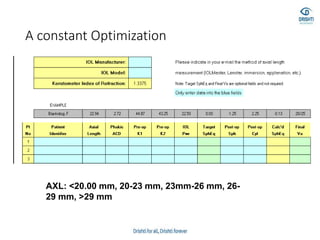
A constant Optimization
AXL: <20.00 mm, 20-23 mm, 23mm-26 mm, 26-
29 mm, >29 mm
Constant Optimization
hill@doctor-hill.com
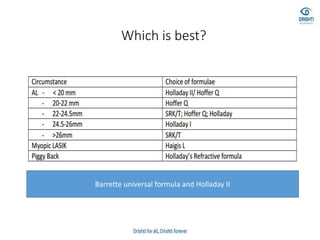
Which is best?
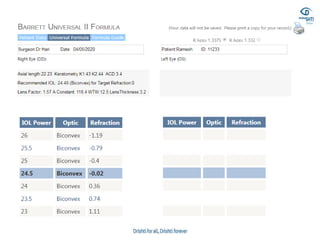
Barrette universal formula and Holladay II
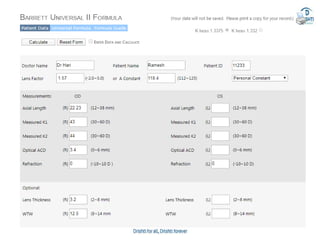
Online IOL calculating Assist
• https://ascrs.org/tools/rbf-calculator (BARRETT UNIVERSAL II FORMULA)
• https://ascrs.org/tools/rbf-calculator (Hill RBF)
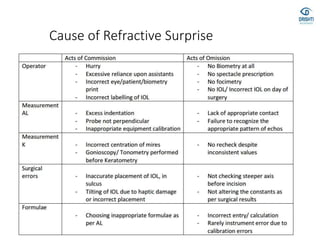
Cause of Refractive Surprise
Cases Discussion
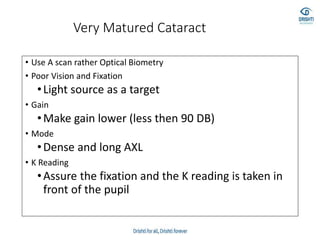
Very Matured Cataract
• Use A scan rather Optical Biometry
• Poor Vision and Fixation
•Light source as a target
• Gain
•Make gain lower (less then 90 DB)
• Mode
•Dense and long AXL
• K Reading
•Assure the fixation and the K reading is taken in
front of the pupil
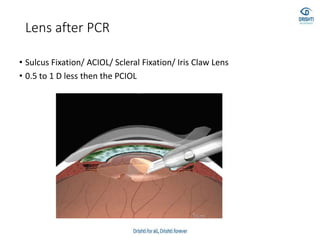
Lens after PCR
• Sulcus Fixation/ ACIOL/ Scleral Fixation/ Iris Claw Lens
• 0.5 to 1 D less then the PCIOL
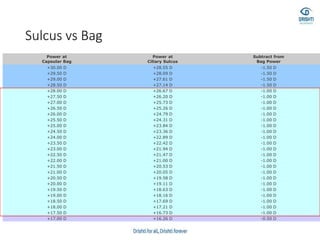
Sulcus vs Bag
Power at
Capsular Bag
Power at
Ciliary Sulcus
Subtract from
Bag Power
+30.00 D +28.55 D -1.50 D
+29.50 D +28.09 D -1.50 D
+29.00 D +27.61 D -1.50 D
+28.50 D +27.14 D -1.50 D
+28.00 D +26.67 D -1.00 D
+27.50 D +26.20 D -1.00 D
+27.00 D +25.73 D -1.00 D
+26.50 D +25.26 D -1.00 D
+26.00 D +24.79 D -1.00 D
+25.50 D +24.31 D -1.00 D
+25.00 D +23.84 D -1.00 D
+24.50 D +23.36 D -1.00 D
+24.00 D +22.89 D -1.00 D
+23.50 D +22.42 D -1.00 D
+23.00 D +21.94 D -1.00 D
+22.50 D +21.47 D -1.00 D
+22.00 D +21.00 D -1.00 D
+21.50 D +20.53 D -1.00 D
+21.00 D +20.05 D -1.00 D
+20.50 D +19.58 D -1.00 D
+20.00 D +19.11 D -1.00 D
+19.50 D +18.63 D -1.00 D
+19.00 D +18.16 D -1.00 D
+18.50 D +17.69 D -1.00 D
+18.00 D +17.21 D -1.00 D
+17.50 D +16.73 D -1.00 D
+17.00 D +16.26 D -0.50 D
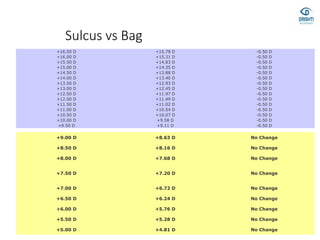
Sulcus vs Bag
+9.00 D +8.63 D No Change
+8.50 D +8.16 D No Change
+8.00 D +7.68 D No Change
+7.50 D +7.20 D No Change
+7.00 D +6.72 D No Change
+6.50 D +6.24 D No Change
+6.00 D +5.76 D No Change
+5.50 D +5.28 D No Change
+5.00 D +4.81 D No Change
+16.50 D +15.78 D -0.50 D
+16.00 D +15.31 D -0.50 D
+15.50 D +14.83 D -0.50 D
+15.00 D +14.35 D -0.50 D
+14.50 D +13.88 D -0.50 D
+14.00 D +13.40 D -0.50 D
+13.50 D +12.93 D -0.50 D
+13.00 D +12.45 D -0.50 D
+12.50 D +11.97 D -0.50 D
+12.00 D +11.49 D -0.50 D
+11.50 D +11.02 D -0.50 D
+11.00 D +10.54 D -0.50 D
+10.50 D +10.07 D -0.50 D
+10.00 D +9.58 D -0.50 D
+9.50 D +9.11 D -0.50 D
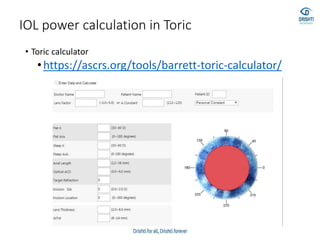
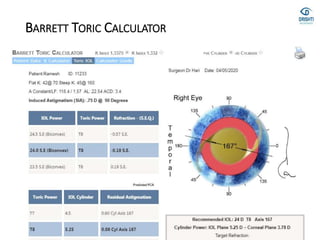
IOL power calculation in Toric
• Toric calculator
•https://ascrs.org/tools/barrett-toric-calculator/
BARRETT TORIC CALCULATOR
SIA Estimation
• https://sia-calculator.com/
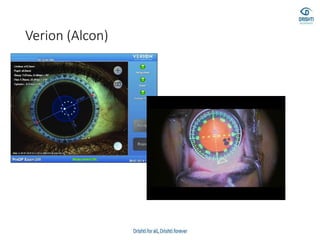
Verion (Alcon)
Rotation??
https://www.astigmatismfix.com/
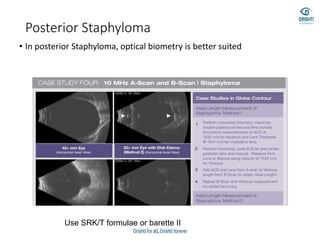
Posterior Staphyloma
• In posterior Staphyloma, optical biometry is better suited
Use SRK/T formulae or barette II
Micro cornea or nanophthalmos
• Nystagmus and difficult in doing Keratometery
• Locate Null Gaze
• Low gain
• Normal ACD or shallower ACD
• Formulae???
•Haigis and Hoffer Q
•Barrette II
• Retinoscopy during time of surgery
•0.7 D Spectacle Plane: 1 D Lenticular plane
Post vitrectomized eye
• Preoperative IOL calculation is preferred
• Use of optical biometry
• Silicon Oil Filled Globe mode
•1000 stock/ 5000 stock
•Freeze at low gain
• Do at seating position
• OVERCORRECTION??
•Planoconvex vs biconvex
Post vitrectomized eye
• Posterior Segment filled with Gas or perfluorocarbon
•ultrasound echoes are blocked
•Optical biometry
•Retinoscopy per operatively
•CT-scan imagecan be used to measure axial
length in eyes with incomplete silicone oil fill and
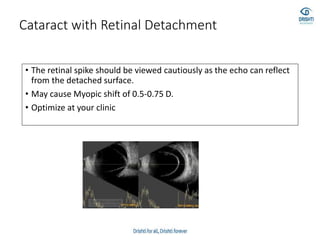
Cataract with Retinal Detachment
• The retinal spike should be viewed cautiously as the echo can reflect
from the detached surface.
• May cause Myopic shift of 0.5-0.75 D.
• Optimize at your clinic
Post LASIK/Post RK
• At least 30 methods
• Confusing for the clinicians
• The best ones
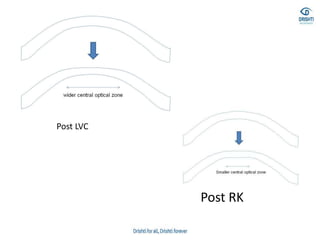
Post LVC
Post RK
Post LASIK
• When preoperative Keratometery and/or refractive change are
available
Post PK
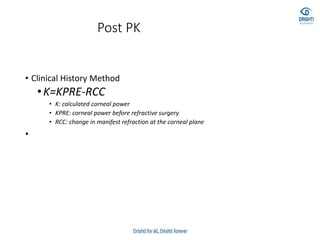
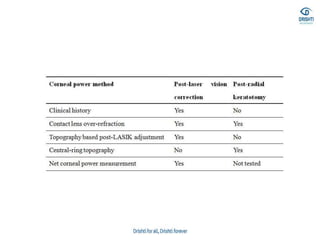
• Clinical History Method
•K=KPRE-RCC
• K: calculated corneal power
• KPRE: corneal power before refractive surgery
• RCC: change in manifest refraction at the corneal plane
•
Post PK
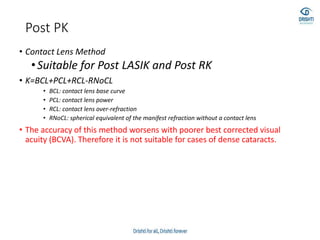
• Contact Lens Method
•Suitable for Post LASIK and Post RK
• K=BCL+PCL+RCL-RNoCL
• BCL: contact lens base curve
• PCL: contact lens power
• RCL: contact lens over-refraction
• RNoCL: spherical equivalent of the manifest refraction without a contact lens
• The accuracy of this method worsens with poorer best corrected visual
acuity (BCVA). Therefore it is not suitable for cases of dense cataracts.
Post PK
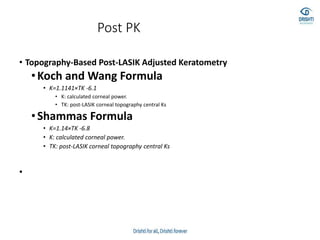
• Topography-Based Post-LASIK Adjusted Keratometry
•Koch and Wang Formula
• K=1.1141×TK -6.1
• K: calculated corneal power.
• TK: post-LASIK corneal topography central Ks
•Shammas Formula
• K=1.14×TK -6.8
• K: calculated corneal power.
• TK: post-LASIK corneal topography central Ks
•
Post PK
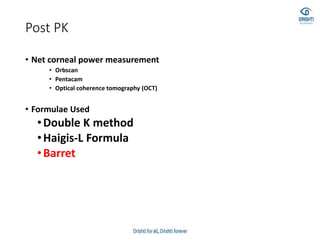
• Net corneal power measurement
• Orbscan
• Pentacam
• Optical coherence tomography (OCT)
• Formulae Used
•Double K method
•Haigis-L Formula
•Barret
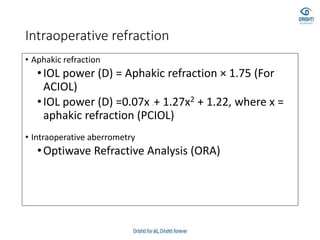
Intraoperative refraction
• Aphakic refraction
•IOL power (D) = Aphakic refraction × 1.75 (For
ACIOL)
•IOL power (D) =0.07x 2 + 1.27x2 + 1.22, where x =
aphakic refraction (PCIOL)
• Intraoperative aberrometry
•Optiwave Refractive Analysis (ORA)
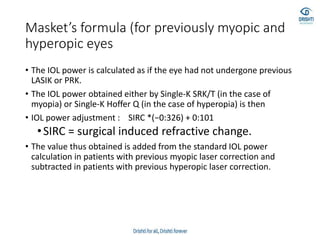
Masket’s formula (for previously myopic and
hyperopic eyes
• The IOL power is calculated as if the eye had not undergone previous
LASIK or PRK.
• The IOL power obtained either by Single-K SRK/T (in the case of
myopia) or Single-K Hoffer Q (in the case of hyperopia) is then
• IOL power adjustment : SIRC *(−0:326) + 0:101
•SIRC = surgical induced refractive change.
• The value thus obtained is added from the standard IOL power
calculation in patients with previous myopic laser correction and
subtracted in patients with previous hyperopic laser correction.
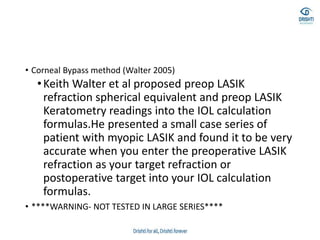
• Corneal Bypass method (Walter 2005)
•Keith Walter et al proposed preop LASIK
refraction spherical equivalent and preop LASIK
Keratometry readings into the IOL calculation
formulas.He presented a small case series of
patient with myopic LASIK and found it to be very
accurate when you enter the preoperative LASIK
refraction as your target refraction or
postoperative target into your IOL calculation
formulas.
• ****WARNING- NOT TESTED IN LARGE SERIES****
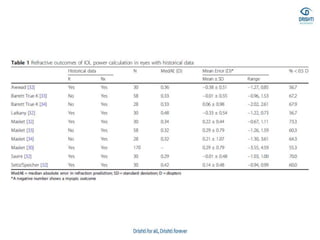
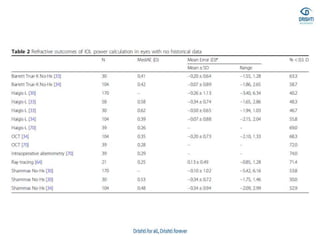
• Barrett true-K no history formula
• This version of Barrett’s formula has been developed to
• work without historical data and can be accessed via the
• same websites reported for the “historical” version (see
• 2.1.4). The formula has not been published, but the results
• are good [33].
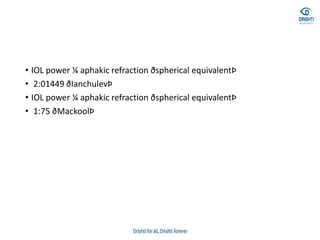
• IOL power ¼ aphakic refraction ðspherical equivalentÞ
• 2:01449 ðIanchulevÞ
• IOL power ¼ aphakic refraction ðspherical equivalentÞ
• 1:75 ðMackoolÞ
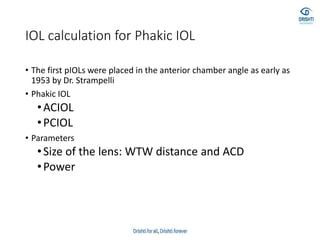
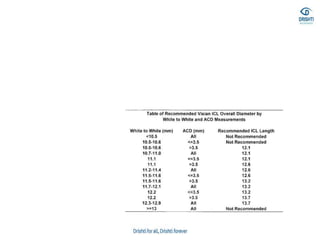
IOL calculation for Phakic IOL
• The first pIOLs were placed in the anterior chamber angle as early as
1953 by Dr. Strampelli
• Phakic IOL
•ACIOL
•PCIOL
• Parameters
•Size of the lens: WTW distance and ACD
•Power
Post PK
• https://ascrs.org/tools/iol-calculator

Biometry: Not only a mere Measurement

  • 1.
    Biometry: Not OnlyA Mere Measurement Ajit K Thakur M. Optom
  • 2.
    Objective • Biometry andits importance • Some difficult biometry conditions – Very Matured Cataract – IOL power calculation in Toric – Lens after PCR – Posterior Staphyloma – Micro cornea or nanophthalmos – Post vitrectomized eye – Cataract with Retinal Detachment – Toric Calculator – Post PK – Post LASIK – Phakic IOL
  • 3.
    Cataract Surgery •Refractive Surgery •QualityVision •Spectacle free world •Intracapsular cataract surgery to Femto- second •Multifocal IOL •Toric IOL •Implantable Contact Lens (ICL)
  • 4.
    Biometry • The statisticalanalysis of biological observations and phenomena • Ocular Parameters Measurement • Play Maker of successful Cataract Surgery
  • 5.
    Source of RefractiveSurprise • Measurement Error •Axial Length: 54% •K reading: 8% • Formula Error (Olsen JCRS 1992) • ELP (estimated lens position) error-38% • Lack of Personalization • IOL insertion Error • IOL mislabeling •improper IOL power insertion at time of surgery
  • 6.
    Tool for Biometry •Keratometer/Topographer and A scan • Optical Biometry • Retinoscope and trial lenses
  • 7.
    Instrumentation • A Scan •Principle •Benefits •Wayto improvise the Precision • Repeatability Vs Reliability • SD???? •Source of Error • Compression • Misalignment • Air trap •Contact Vs Immersion • Immersion mandatory • High myopia • Ectatic Corneal cases • Paediatric Cases • Refractive Upset with your contact technique
  • 8.
    Marketed Instrument • NidekA Scan • Sonomed A Scan • DGH - 5000e A-scan • Quantel Medical - Axis II PR • Accutome - A-scan
  • 9.
    Perfect and ImperfectScan A Scan Contact A Scan Immersion
  • 10.
    Perfect and ImperfectScan A Scan Contact
  • 11.
    Instrumentation • Cause ofError Myopic Shift (making eye short) Hyperopic Shift (Making eye Large) Compressing cornea Air Bubble Sound velocity slow Sound Velocity high Gain set too high Gain too Low
  • 13.
    Optical Biometry • UsesLight source instead of Sound Waves • Pentacam AXL • Al Scan • IOL Master 500 • Lenstar • Alladin • IOL Master 700 • Eyestar 900 (Haag-Streit) • Advantages of Optical Biometry • a) Increased precision with minimal training- ±25μm • b) Consistency between testers- variability 21μm between 5 examiners • c) Superior for Staphylomas, Pseudophakic eyes, Silicone Oil eyes • Takes the K reading as well as AXL in One shot • Disadvantages • Dense cataract or media opacities • Fixation error •Cost
  • 14.
  • 17.
    ALop = ALus- 0.117 ( (for eye AXL, 19–29 mm) Alop: Optical Alus: Ultrasound
  • 18.
    Biometry by retinoscopy •Doing Retinoscopy during OT •F= P/1-dF where •F= New Power at Lenticular Plane •P= Power at spectacle plane • d= Distance between spectacle plane and Lenticular plane (vd+acd)
  • 21.
    • Chief Author: Dr. Hardik A. Shroff, Co-Authors : Dr. Ashok P. Shroff, Dr. Dishita H. Shroff • IOL power was selected by addition of 11D (surgeon’s factor) in the refraction value. • From our experience, we calculated IOL power from intraoperative retinoscopy and we found that it was matching better with postoperative BCVA rather than with IOL power calculated from biometry.
  • 22.
    Recommendation for Measurement •Data screening criteria (Knox Cartwright Eye 2010) •Calibrate your machine preferably at the start of the day and with change in the observer •Repeat measurements with second observer if: • (1) Axial Length < 21.30 or >26.60mm • (2) Avg Corneal Power < 41.00 or >47.00D and cylinder >2.50D • (3) Between eyes: asymmetry of AL >0.70 mm • (4) Between eyes: mean K >0.90D
  • 23.
  • 24.
  • 25.
    IOL Calculating Formulae •1st Generation Formulae •Theoretical Formula:Hoffer, Binkhorst •Regression Formulae:SRK • Second generation Formulae •SRK II formula, Hoffer, Binkhorst II • 3rd Generation Formulae •SRK/T, Hoffer Q, Holladay • 4th Generation Formula •Holladay II Formula, Haigis Formula, Barrette Formula, Olsen formula, Hill RBF formula
  • 26.
    IOL Formula • SRKformula • Calculated IOL: A-2.5L-0.9 K • A: A constant (ELP) • L: Measured Axial Length • K: Average K reading • Mathematical Formulae (Fyodorov and its modifications) • P = (1336/[AL- ELP]) (1336/[1336/{1000/([1000/DPostRx] - V) + K} - ELP]) • K: Net corneal power • AL: Axial length • P: IOL power • ELP: Effective lens position • DPostRx : Desired refraction • V: Vertex distance
  • 27.
    A constant?? •Not Aconstant…… •Effective lens position •A constant optimization •How to do Optimization?? •Optimization on the basis of AXL and specific Doctor, Lens type
  • 28.
    A constant Optimization AXL:<20.00 mm, 20-23 mm, 23mm-26 mm, 26- 29 mm, >29 mm
  • 29.
  • 30.
    Which is best? Barretteuniversal formula and Holladay II
  • 31.
    Online IOL calculatingAssist • https://ascrs.org/tools/rbf-calculator (BARRETT UNIVERSAL II FORMULA) • https://ascrs.org/tools/rbf-calculator (Hill RBF)
  • 34.
  • 35.
  • 36.
    Very Matured Cataract •Use A scan rather Optical Biometry • Poor Vision and Fixation •Light source as a target • Gain •Make gain lower (less then 90 DB) • Mode •Dense and long AXL • K Reading •Assure the fixation and the K reading is taken in front of the pupil
  • 37.
    Lens after PCR •Sulcus Fixation/ ACIOL/ Scleral Fixation/ Iris Claw Lens • 0.5 to 1 D less then the PCIOL
  • 38.
    Sulcus vs Bag Powerat Capsular Bag Power at Ciliary Sulcus Subtract from Bag Power +30.00 D +28.55 D -1.50 D +29.50 D +28.09 D -1.50 D +29.00 D +27.61 D -1.50 D +28.50 D +27.14 D -1.50 D +28.00 D +26.67 D -1.00 D +27.50 D +26.20 D -1.00 D +27.00 D +25.73 D -1.00 D +26.50 D +25.26 D -1.00 D +26.00 D +24.79 D -1.00 D +25.50 D +24.31 D -1.00 D +25.00 D +23.84 D -1.00 D +24.50 D +23.36 D -1.00 D +24.00 D +22.89 D -1.00 D +23.50 D +22.42 D -1.00 D +23.00 D +21.94 D -1.00 D +22.50 D +21.47 D -1.00 D +22.00 D +21.00 D -1.00 D +21.50 D +20.53 D -1.00 D +21.00 D +20.05 D -1.00 D +20.50 D +19.58 D -1.00 D +20.00 D +19.11 D -1.00 D +19.50 D +18.63 D -1.00 D +19.00 D +18.16 D -1.00 D +18.50 D +17.69 D -1.00 D +18.00 D +17.21 D -1.00 D +17.50 D +16.73 D -1.00 D +17.00 D +16.26 D -0.50 D
  • 39.
    Sulcus vs Bag +9.00D +8.63 D No Change +8.50 D +8.16 D No Change +8.00 D +7.68 D No Change +7.50 D +7.20 D No Change +7.00 D +6.72 D No Change +6.50 D +6.24 D No Change +6.00 D +5.76 D No Change +5.50 D +5.28 D No Change +5.00 D +4.81 D No Change +16.50 D +15.78 D -0.50 D +16.00 D +15.31 D -0.50 D +15.50 D +14.83 D -0.50 D +15.00 D +14.35 D -0.50 D +14.50 D +13.88 D -0.50 D +14.00 D +13.40 D -0.50 D +13.50 D +12.93 D -0.50 D +13.00 D +12.45 D -0.50 D +12.50 D +11.97 D -0.50 D +12.00 D +11.49 D -0.50 D +11.50 D +11.02 D -0.50 D +11.00 D +10.54 D -0.50 D +10.50 D +10.07 D -0.50 D +10.00 D +9.58 D -0.50 D +9.50 D +9.11 D -0.50 D
  • 40.
  • 42.
    IOL power calculationin Toric • Toric calculator •https://ascrs.org/tools/barrett-toric-calculator/
  • 43.
  • 44.
  • 45.
  • 46.
  • 47.
    Posterior Staphyloma • Inposterior Staphyloma, optical biometry is better suited Use SRK/T formulae or barette II
  • 48.
    Micro cornea ornanophthalmos • Nystagmus and difficult in doing Keratometery • Locate Null Gaze • Low gain • Normal ACD or shallower ACD • Formulae??? •Haigis and Hoffer Q •Barrette II • Retinoscopy during time of surgery •0.7 D Spectacle Plane: 1 D Lenticular plane
  • 49.
    Post vitrectomized eye •Preoperative IOL calculation is preferred • Use of optical biometry • Silicon Oil Filled Globe mode •1000 stock/ 5000 stock •Freeze at low gain • Do at seating position • OVERCORRECTION?? •Planoconvex vs biconvex
  • 50.
    Post vitrectomized eye •Posterior Segment filled with Gas or perfluorocarbon •ultrasound echoes are blocked •Optical biometry •Retinoscopy per operatively •CT-scan imagecan be used to measure axial length in eyes with incomplete silicone oil fill and
  • 51.
    Cataract with RetinalDetachment • The retinal spike should be viewed cautiously as the echo can reflect from the detached surface. • May cause Myopic shift of 0.5-0.75 D. • Optimize at your clinic
  • 52.
    Post LASIK/Post RK •At least 30 methods • Confusing for the clinicians • The best ones
  • 53.
  • 54.
    Post LASIK • Whenpreoperative Keratometery and/or refractive change are available
  • 55.
    Post PK • ClinicalHistory Method •K=KPRE-RCC • K: calculated corneal power • KPRE: corneal power before refractive surgery • RCC: change in manifest refraction at the corneal plane •
  • 56.
    Post PK • ContactLens Method •Suitable for Post LASIK and Post RK • K=BCL+PCL+RCL-RNoCL • BCL: contact lens base curve • PCL: contact lens power • RCL: contact lens over-refraction • RNoCL: spherical equivalent of the manifest refraction without a contact lens • The accuracy of this method worsens with poorer best corrected visual acuity (BCVA). Therefore it is not suitable for cases of dense cataracts.
  • 57.
    Post PK • Topography-BasedPost-LASIK Adjusted Keratometry •Koch and Wang Formula • K=1.1141×TK -6.1 • K: calculated corneal power. • TK: post-LASIK corneal topography central Ks •Shammas Formula • K=1.14×TK -6.8 • K: calculated corneal power. • TK: post-LASIK corneal topography central Ks •
  • 58.
    Post PK • Netcorneal power measurement • Orbscan • Pentacam • Optical coherence tomography (OCT) • Formulae Used •Double K method •Haigis-L Formula •Barret
  • 60.
    Intraoperative refraction • Aphakicrefraction •IOL power (D) = Aphakic refraction × 1.75 (For ACIOL) •IOL power (D) =0.07x 2 + 1.27x2 + 1.22, where x = aphakic refraction (PCIOL) • Intraoperative aberrometry •Optiwave Refractive Analysis (ORA)
  • 61.
    Masket’s formula (forpreviously myopic and hyperopic eyes • The IOL power is calculated as if the eye had not undergone previous LASIK or PRK. • The IOL power obtained either by Single-K SRK/T (in the case of myopia) or Single-K Hoffer Q (in the case of hyperopia) is then • IOL power adjustment : SIRC *(−0:326) + 0:101 •SIRC = surgical induced refractive change. • The value thus obtained is added from the standard IOL power calculation in patients with previous myopic laser correction and subtracted in patients with previous hyperopic laser correction.
  • 62.
    • Corneal Bypassmethod (Walter 2005) •Keith Walter et al proposed preop LASIK refraction spherical equivalent and preop LASIK Keratometry readings into the IOL calculation formulas.He presented a small case series of patient with myopic LASIK and found it to be very accurate when you enter the preoperative LASIK refraction as your target refraction or postoperative target into your IOL calculation formulas. • ****WARNING- NOT TESTED IN LARGE SERIES****
  • 64.
    • Barrett true-Kno history formula • This version of Barrett’s formula has been developed to • work without historical data and can be accessed via the • same websites reported for the “historical” version (see • 2.1.4). The formula has not been published, but the results • are good [33].
  • 65.
    • IOL power¼ aphakic refraction ðspherical equivalentÞ • 2:01449 ðIanchulevÞ • IOL power ¼ aphakic refraction ðspherical equivalentÞ • 1:75 ðMackoolÞ
  • 68.
    IOL calculation forPhakic IOL • The first pIOLs were placed in the anterior chamber angle as early as 1953 by Dr. Strampelli • Phakic IOL •ACIOL •PCIOL • Parameters •Size of the lens: WTW distance and ACD •Power
  • 70.