IOL CALCULATIONS IN
SPECIAL CASES
Presenter : Dr Nikhil Agrawal (1st year resident)
Moderator : Dr Tarun Gupta
Dhir HOSPITAL AND POSTGRADUATE INSTITUTE OF OPHTHALMOLOGY
BIOMETRY
• Biometry is the method of applying mathematics to biology.
• The refractive power of the eye primarily depends upon the cornea, the lens,
ocular media, and the axial length of the eye.
• Required power of IOL can be calculated if we know these .
IOL FORMULAS WE USE TODAY
• SRK-T
• OLSEN
• KANE
• HILL-RBF
• BARRETT UNIVERSAL II
Intraocular Lens Power Calculation after
Corneal Refractive Surgery
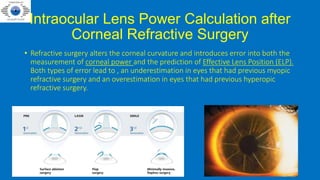
• Refractive surgery alters the corneal curvature and introduces error into both the
measurement of corneal power and the prediction of Effective Lens Position (ELP).
Both types of error lead to , an underestimation in eyes that had previous myopic
refractive surgery and an overestimation in eyes that had previous hyperopic
refractive surgery.
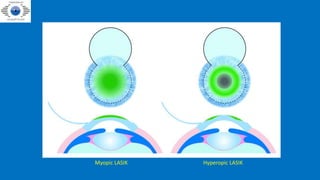
Myopic LASIK Hyperopic LASIK
Keratometry Error after Laser Vision
Correction
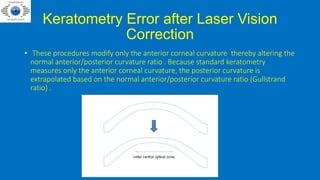
• These procedures modify only the anterior corneal curvature thereby altering the
normal anterior/posterior curvature ratio . Because standard keratometry
measures only the anterior corneal curvature, the posterior curvature is
extrapolated based on the normal anterior/posterior curvature ratio (Gullstrand
ratio) .
Keratometry Error after Radial
Keratotomy
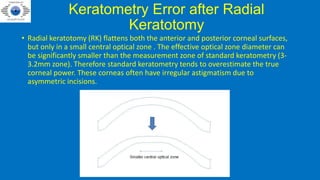
• Radial keratotomy (RK) flattens both the anterior and posterior corneal surfaces,
but only in a small central optical zone . The effective optical zone diameter can
be significantly smaller than the measurement zone of standard keratometry (3-
3.2mm zone). Therefore standard keratometry tends to overestimate the true
corneal power. These corneas often have irregular astigmatism due to
asymmetric incisions.
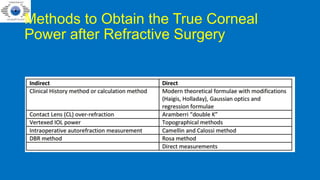
Methods to Obtain the True Corneal
Power after Refractive Surgery
Indirect Method
1. Clinical history method : The corneal power is calculated by
Corneal power before refractive surgery - Change in manifest refraction at the
corneal plane
Convert the pre and postoperative refraction into Spherical Equivalent Refraction.
Now convert this SER at spectacle plane to SER at corneal plane .
SEQC=1000/[(1000/SEQS)-Vertex Distance]
Unavailability or inaccuracy of these data and interval changes in the corneal
curvature or lens power pose a problem .
Also, clinical history method is not suitable for RK because of unstable corneal
power (Post RK cornea typically flattens progressively over many years).
Indirect Method
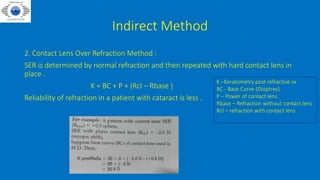
2. Contact Lens Over Refraction Method :
SER is determined by normal refraction and then repeated with hard contact lens in
place .
K = BC + P + (Rcl – Rbase )
Reliability of refraction in a patient with cataract is less .
K –Keratometry post refractive sx
BC - Base Curve (Dioptres)
P – Power of contact lens
Rbase – Refraction without contact lens
Rcl – refraction with contact lens
Indirect Method
3. Vertexed IOL Method :
 Theoretical nomograms were developed after calculating IOL power post LASIK .
The change in the spherical equivalent after LASIK was used to modify the IOL
power .
4. Intraoperative Retinoscopy / Autorefraction :
After cataract extraction in aphakic eye intraoperative retinoscopy to calculate
IOL power .
Asepsis during surgery may be jeopardized .
Indirect Method
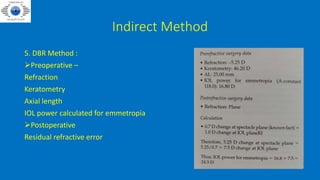
5. DBR Method :
Preoperative –
Refraction
Keratometry
Axial length
IOL power calculated for emmetropia
Postoperative
Residual refractive error
Direct Method
Approximation of posterior corneal curvature is done to predict the corneal power
and ELP .
1. Corneal Topography / Keratometry Method -
Post-LASIK Adjusted Keratometry
The post-lasik K reading is under corrected (14%) to get an accurate postoperative
K reading .
o Koch and Wang Formula -K=1.1141×TK -6.1
o Shammas Formula- K=1.14×TK -6.8
Direct Method
2. Aramberri Double K Method :
Pre- LASIK corneal power ( or 43.5 if unknown ) – For calculation of ELP
Post-LASIK corneal power – For calculation of IOL power
Can be Done using Hoffer Q , Holladay 1, SRK/T formulae.
3. Rosa Method :
Uses a correction factor R which is derived by regression .
Can be applied to SRK/T and holladay 1.
Direct Method
4. Direct Measurement of Anterior and Posterior Curvatures
Orbscan- Combines Placido disk and slit-scanning technology to directly measure
elevation and curvature of both the surfaces .
Pentacam (Oculus, Germany) is a rotating Scheimpflug photography system that
can provide a topographic analysis of the corneal front and back surfaces as well as
central corneal thickness.
Optical coherence tomography (OCT) can be used to measure both anterior and
posterior corneal power.
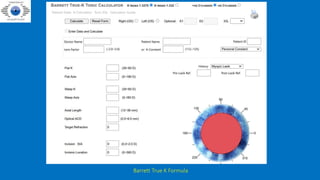
https://iolcalc.ascrs.org/wbfrmCalculator.aspx
Barrett True K Formula
Paediatric IOL Power Calculation
Problems
Axial Length
Keratometery
Age
Target
Refraction
Amblyopia
Formula
Selection of a fixed power lens for implantation in a still growing
eye requires a complicated decision making process .
Paediatric IOL Power Calculation
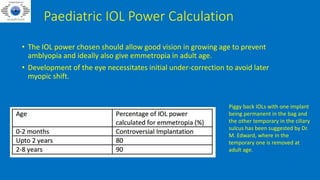
• The IOL power chosen should allow good vision in growing age to prevent
amblyopia and ideally also give emmetropia in adult age.
• Development of the eye necessitates initial under-correction to avoid later
myopic shift.
Piggy back IOLs with one implant
being permanent in the bag and
the other temporary in the ciliary
sulcus has been suggested by Dr.
M. Edward, where in the
temporary one is removed at
adult age.
Axial Length
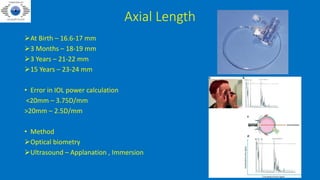
At Birth – 16.6-17 mm
3 Months – 18-19 mm
3 Years – 21-22 mm
15 Years – 23-24 mm
• Error in IOL power calculation
<20mm – 3.75D/mm
>20mm – 2.5D/mm
• Method
Optical biometry
Ultrasound – Applanation , Immersion
Keratometery
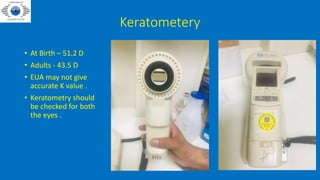
• At Birth – 51.2 D
• Adults - 43.5 D
• EUA may not give
accurate K value .
• Keratometry should
be checked for both
the eyes .
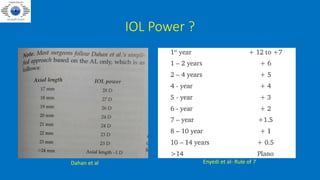
IOL Power ?
Dahan et al Enyedi et al- Rule of 7
IOL Power ?
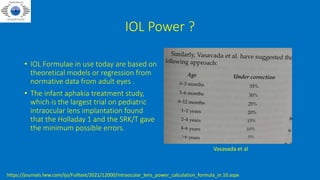
• IOL Formulae in use today are based on
theoretical models or regression from
normative data from adult eyes .
• The infant aphakia treatment study,
which is the largest trial on pediatric
intraocular lens implantation found
that the Holladay 1 and the SRK/T gave
the minimum possible errors.
Vasavada et al
https://journals.lww.com/ijo/Fulltext/2021/12000/Intraocular_lens_power_calculation_formula_in.10.aspx
IOL Power ?
• Pediatric IOL calculator uses
computerized software for IOL
power calculation that is
calculated from pediatric aphakic
models.
Target Post-Op Refraction
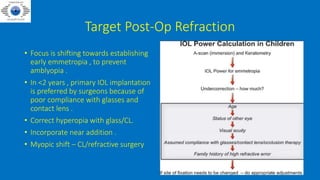
• Focus is shifting towards establishing
early emmetropia , to prevent
amblyopia .
• In <2 years , primary IOL implantation
is preferred by surgeons because of
poor compliance with glasses and
contact lens .
• Correct hyperopia with glass/CL.
• Incorporate near addition .
• Myopic shift – CL/refractive surgery
Infant Aphakia Treatment Study (IATS)
• If possible, leave babies operated on in the first 7 months of life aphakic and use a
contact lens, with the plan to implant an IOL at about 5 years of age .
• Cataract surgery without an implant is done through 2 openings of less than 1 mm
each—and thus is much less traumatic to the infant’s eye.
• There was a 70% chance of at least 1 reoperation with an IOL. In contrast, the risk
of a second operation was only 20% with contact lenses.
• The risk of glaucoma at 5 years in the IATS was about 20%.
• The median visual acuity was the same for both the contact lens and IOL cohorts.
However, at 4.5 years, twice as many treated eyes in the contact lens cohort had
better than 20/40 acuity.
IOL Power Calculation for
Post-Vitrectomised Eyes
Eyes without silicone oil: Should be considered as normal eye .
Silicone Filled Eyes
• The velocity of sound in silicone is slower than in vitreous, axial length will be
falsely increased .
• Silicone in the eye itself acts as a negative lens hence the IOL power must be
increased by 2-3 D.
• Measurement of AL by optical method has been found to much more accurate for
silicone filled eyes.
• Eyes with gas (perflurocarbons )- blocks ultrasound , optical method is used .
1,000-centistoke SO – 980m/s
5,000-centistoke SO – 1040m/s
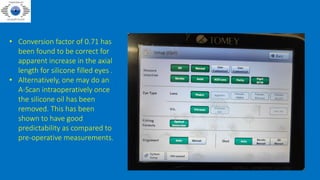
• Conversion factor of 0.71 has
been found to be correct for
apparent increase in the axial
length for silicone filled eyes .
• Alternatively, one may do an
A-Scan intraoperatively once
the silicone oil has been
removed. This has been
shown to have good
predictability as compared to
pre-operative measurements.
IOL Power Calculation for
Post-Vitrectomised Eyes
• Eye incompletely filled with silicone oil : Ultrasound biometry should be done in
seating position .
• When silicone oil is removed 2-5 D of induced myopia should be expected .
• Avoid – Silicone IOL , Plate heptic single piece IOL , IOL with holes , Multifocal IOL.
• Hydrophilic acrylic lenses are at risk for calcification .
• Prefer – IOL with large heptic , Heparin coated , Plano-convex lens (plano side
towards vitreous ) , PMMA lens .
IOL Power Calculation for
Post-Vitrectomised Eyes
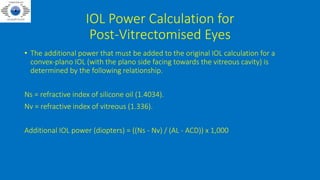
• The additional power that must be added to the original IOL calculation for a
convex-plano IOL (with the plano side facing towards the vitreous cavity) is
determined by the following relationship.
Ns = refractive index of silicone oil (1.4034).
Nv = refractive index of vitreous (1.336).
Additional IOL power (diopters) = ((Ns - Nv) / (AL - ACD)) x 1,000
Special Circumstances
Corneal Transplants
• It is extremely difficult to accurately predict corneal power in transplant patients.
• If a triple procedure is planned it is suggested that K readings of other eye be
used.
• An alternative option is to use the average k readings from a series of previous
transplants.
• Optimum method : Step-1: Keratoplasty with cataract removal .
Step-2: After 3 months , secondary stage IOL implant.
Use Spectacle version formula for IOL power .
Improving Outcome
• Patient counselling and requirements
• Appropriate alterations to biometry according to surgeon .
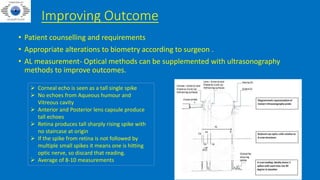
• AL measurement- Optical methods can be supplemented with ultrasonography
methods to improve outcomes.
 Corneal echo is seen as a tall single spike
 No echoes from Aqueous humour and
Vitreous cavity
 Anterior and Posterior lens capsule produce
tall echoes
 Retina produces tall sharply rising spike with
no staircase at origin
 If the spike from retina is not followed by
multiple small spikes it means one is hitting
optic nerve, so discard that reading.
 Average of 8-10 measurements
• The Barrett and
Olsen formulas has
the best outcomes
in terms of accuracy
of postoperative
spherical
equivalent .
• They perform well
across a range of
axial lengths and
biometric
dimensions.
REFERENCES
• https://eyewiki.aao.org/Biometry_for_IntraOcular_Lens_(IOL)_Power_Calculation
• AK Khurana Optics and Refraction
• https://www.aao.org/eyenet/article/selecting-intraocular-lens-power-in-children
• https://eyewiki.aao.org/Intraocular_Lens_Power_Calculation_after_Corneal_Refra
ctive_Surgery
• https://bmcophthalmol.biomedcentral.com/articles/10.1186/s12886-022-02304-2
• https://www.escrs.org/vienna2011/programme/handouts/ic-10/ic-
10_merle_handout.pdf
• https://doctor-hill.com/iol-power-calculations/silicone-oil/
Feedbacks:
nikhilagrawalbv@gmail.com

IOL CALCULATIONS IN SPECIAL CASES

  • 1.
    IOL CALCULATIONS IN SPECIALCASES Presenter : Dr Nikhil Agrawal (1st year resident) Moderator : Dr Tarun Gupta Dhir HOSPITAL AND POSTGRADUATE INSTITUTE OF OPHTHALMOLOGY
  • 2.
    BIOMETRY • Biometry isthe method of applying mathematics to biology. • The refractive power of the eye primarily depends upon the cornea, the lens, ocular media, and the axial length of the eye. • Required power of IOL can be calculated if we know these .
  • 3.
    IOL FORMULAS WEUSE TODAY • SRK-T • OLSEN • KANE • HILL-RBF • BARRETT UNIVERSAL II
  • 4.
    Intraocular Lens PowerCalculation after Corneal Refractive Surgery • Refractive surgery alters the corneal curvature and introduces error into both the measurement of corneal power and the prediction of Effective Lens Position (ELP). Both types of error lead to , an underestimation in eyes that had previous myopic refractive surgery and an overestimation in eyes that had previous hyperopic refractive surgery.
  • 5.
  • 6.
    Keratometry Error afterLaser Vision Correction • These procedures modify only the anterior corneal curvature thereby altering the normal anterior/posterior curvature ratio . Because standard keratometry measures only the anterior corneal curvature, the posterior curvature is extrapolated based on the normal anterior/posterior curvature ratio (Gullstrand ratio) .
  • 7.
    Keratometry Error afterRadial Keratotomy • Radial keratotomy (RK) flattens both the anterior and posterior corneal surfaces, but only in a small central optical zone . The effective optical zone diameter can be significantly smaller than the measurement zone of standard keratometry (3- 3.2mm zone). Therefore standard keratometry tends to overestimate the true corneal power. These corneas often have irregular astigmatism due to asymmetric incisions.
  • 8.
    Methods to Obtainthe True Corneal Power after Refractive Surgery
  • 9.
    Indirect Method 1. Clinicalhistory method : The corneal power is calculated by Corneal power before refractive surgery - Change in manifest refraction at the corneal plane Convert the pre and postoperative refraction into Spherical Equivalent Refraction. Now convert this SER at spectacle plane to SER at corneal plane . SEQC=1000/[(1000/SEQS)-Vertex Distance] Unavailability or inaccuracy of these data and interval changes in the corneal curvature or lens power pose a problem . Also, clinical history method is not suitable for RK because of unstable corneal power (Post RK cornea typically flattens progressively over many years).
  • 10.
    Indirect Method 2. ContactLens Over Refraction Method : SER is determined by normal refraction and then repeated with hard contact lens in place . K = BC + P + (Rcl – Rbase ) Reliability of refraction in a patient with cataract is less . K –Keratometry post refractive sx BC - Base Curve (Dioptres) P – Power of contact lens Rbase – Refraction without contact lens Rcl – refraction with contact lens
  • 11.
    Indirect Method 3. VertexedIOL Method :  Theoretical nomograms were developed after calculating IOL power post LASIK . The change in the spherical equivalent after LASIK was used to modify the IOL power . 4. Intraoperative Retinoscopy / Autorefraction : After cataract extraction in aphakic eye intraoperative retinoscopy to calculate IOL power . Asepsis during surgery may be jeopardized .
  • 12.
    Indirect Method 5. DBRMethod : Preoperative – Refraction Keratometry Axial length IOL power calculated for emmetropia Postoperative Residual refractive error
  • 13.
    Direct Method Approximation ofposterior corneal curvature is done to predict the corneal power and ELP . 1. Corneal Topography / Keratometry Method - Post-LASIK Adjusted Keratometry The post-lasik K reading is under corrected (14%) to get an accurate postoperative K reading . o Koch and Wang Formula -K=1.1141×TK -6.1 o Shammas Formula- K=1.14×TK -6.8
  • 14.
    Direct Method 2. AramberriDouble K Method : Pre- LASIK corneal power ( or 43.5 if unknown ) – For calculation of ELP Post-LASIK corneal power – For calculation of IOL power Can be Done using Hoffer Q , Holladay 1, SRK/T formulae. 3. Rosa Method : Uses a correction factor R which is derived by regression . Can be applied to SRK/T and holladay 1.
  • 15.
    Direct Method 4. DirectMeasurement of Anterior and Posterior Curvatures Orbscan- Combines Placido disk and slit-scanning technology to directly measure elevation and curvature of both the surfaces . Pentacam (Oculus, Germany) is a rotating Scheimpflug photography system that can provide a topographic analysis of the corneal front and back surfaces as well as central corneal thickness. Optical coherence tomography (OCT) can be used to measure both anterior and posterior corneal power.
  • 16.
  • 17.
  • 18.
    Paediatric IOL PowerCalculation Problems Axial Length Keratometery Age Target Refraction Amblyopia Formula Selection of a fixed power lens for implantation in a still growing eye requires a complicated decision making process .
  • 19.
    Paediatric IOL PowerCalculation • The IOL power chosen should allow good vision in growing age to prevent amblyopia and ideally also give emmetropia in adult age. • Development of the eye necessitates initial under-correction to avoid later myopic shift. Piggy back IOLs with one implant being permanent in the bag and the other temporary in the ciliary sulcus has been suggested by Dr. M. Edward, where in the temporary one is removed at adult age.
  • 20.
    Axial Length At Birth– 16.6-17 mm 3 Months – 18-19 mm 3 Years – 21-22 mm 15 Years – 23-24 mm • Error in IOL power calculation <20mm – 3.75D/mm >20mm – 2.5D/mm • Method Optical biometry Ultrasound – Applanation , Immersion
  • 21.
    Keratometery • At Birth– 51.2 D • Adults - 43.5 D • EUA may not give accurate K value . • Keratometry should be checked for both the eyes .
  • 22.
    IOL Power ? Dahanet al Enyedi et al- Rule of 7
  • 23.
    IOL Power ? •IOL Formulae in use today are based on theoretical models or regression from normative data from adult eyes . • The infant aphakia treatment study, which is the largest trial on pediatric intraocular lens implantation found that the Holladay 1 and the SRK/T gave the minimum possible errors. Vasavada et al https://journals.lww.com/ijo/Fulltext/2021/12000/Intraocular_lens_power_calculation_formula_in.10.aspx
  • 24.
    IOL Power ? •Pediatric IOL calculator uses computerized software for IOL power calculation that is calculated from pediatric aphakic models.
  • 25.
    Target Post-Op Refraction •Focus is shifting towards establishing early emmetropia , to prevent amblyopia . • In <2 years , primary IOL implantation is preferred by surgeons because of poor compliance with glasses and contact lens . • Correct hyperopia with glass/CL. • Incorporate near addition . • Myopic shift – CL/refractive surgery
  • 26.
    Infant Aphakia TreatmentStudy (IATS) • If possible, leave babies operated on in the first 7 months of life aphakic and use a contact lens, with the plan to implant an IOL at about 5 years of age . • Cataract surgery without an implant is done through 2 openings of less than 1 mm each—and thus is much less traumatic to the infant’s eye. • There was a 70% chance of at least 1 reoperation with an IOL. In contrast, the risk of a second operation was only 20% with contact lenses. • The risk of glaucoma at 5 years in the IATS was about 20%. • The median visual acuity was the same for both the contact lens and IOL cohorts. However, at 4.5 years, twice as many treated eyes in the contact lens cohort had better than 20/40 acuity.
  • 27.
    IOL Power Calculationfor Post-Vitrectomised Eyes Eyes without silicone oil: Should be considered as normal eye . Silicone Filled Eyes • The velocity of sound in silicone is slower than in vitreous, axial length will be falsely increased . • Silicone in the eye itself acts as a negative lens hence the IOL power must be increased by 2-3 D. • Measurement of AL by optical method has been found to much more accurate for silicone filled eyes. • Eyes with gas (perflurocarbons )- blocks ultrasound , optical method is used . 1,000-centistoke SO – 980m/s 5,000-centistoke SO – 1040m/s
  • 28.
    • Conversion factorof 0.71 has been found to be correct for apparent increase in the axial length for silicone filled eyes . • Alternatively, one may do an A-Scan intraoperatively once the silicone oil has been removed. This has been shown to have good predictability as compared to pre-operative measurements.
  • 30.
    IOL Power Calculationfor Post-Vitrectomised Eyes • Eye incompletely filled with silicone oil : Ultrasound biometry should be done in seating position . • When silicone oil is removed 2-5 D of induced myopia should be expected . • Avoid – Silicone IOL , Plate heptic single piece IOL , IOL with holes , Multifocal IOL. • Hydrophilic acrylic lenses are at risk for calcification . • Prefer – IOL with large heptic , Heparin coated , Plano-convex lens (plano side towards vitreous ) , PMMA lens .
  • 31.
    IOL Power Calculationfor Post-Vitrectomised Eyes • The additional power that must be added to the original IOL calculation for a convex-plano IOL (with the plano side facing towards the vitreous cavity) is determined by the following relationship. Ns = refractive index of silicone oil (1.4034). Nv = refractive index of vitreous (1.336). Additional IOL power (diopters) = ((Ns - Nv) / (AL - ACD)) x 1,000
  • 32.
    Special Circumstances Corneal Transplants •It is extremely difficult to accurately predict corneal power in transplant patients. • If a triple procedure is planned it is suggested that K readings of other eye be used. • An alternative option is to use the average k readings from a series of previous transplants. • Optimum method : Step-1: Keratoplasty with cataract removal . Step-2: After 3 months , secondary stage IOL implant. Use Spectacle version formula for IOL power .
  • 33.
    Improving Outcome • Patientcounselling and requirements • Appropriate alterations to biometry according to surgeon . • AL measurement- Optical methods can be supplemented with ultrasonography methods to improve outcomes.  Corneal echo is seen as a tall single spike  No echoes from Aqueous humour and Vitreous cavity  Anterior and Posterior lens capsule produce tall echoes  Retina produces tall sharply rising spike with no staircase at origin  If the spike from retina is not followed by multiple small spikes it means one is hitting optic nerve, so discard that reading.  Average of 8-10 measurements
  • 34.
    • The Barrettand Olsen formulas has the best outcomes in terms of accuracy of postoperative spherical equivalent . • They perform well across a range of axial lengths and biometric dimensions.
  • 35.
    REFERENCES • https://eyewiki.aao.org/Biometry_for_IntraOcular_Lens_(IOL)_Power_Calculation • AKKhurana Optics and Refraction • https://www.aao.org/eyenet/article/selecting-intraocular-lens-power-in-children • https://eyewiki.aao.org/Intraocular_Lens_Power_Calculation_after_Corneal_Refra ctive_Surgery • https://bmcophthalmol.biomedcentral.com/articles/10.1186/s12886-022-02304-2 • https://www.escrs.org/vienna2011/programme/handouts/ic-10/ic- 10_merle_handout.pdf • https://doctor-hill.com/iol-power-calculations/silicone-oil/
  • 36.