IOL POWER
CALCULATION
NORMAL & POST
LASIK EYES
INDOREDRISHTI.WORDPRESS.COM
DR DINESH MITTAL DR SONALEE MITTAL
DRISHTI EYE HOSP VIJAYNAGAR INDORE
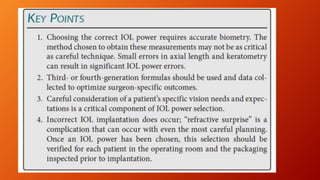
1 Cataract surgery has evolved into a
refractive procedure with the goal of
eliminating or significantly reducing the
need for spectacle dependence.
•2. One must consider not only the
astigmatism induced by the cataract
incision itself, but also the correction of
preexisting astigmatism.
•3. Incision length, depth, and distance
from visual axis all affect astigmatism.
•4. LRIs are commonly used to correct
preexisting astigmatism, and
•published nomograms are helpful in
tailoring a surgical approach.
•5. Toric IOLs and excimer laser ablation
are alternative approaches to correcting
astigmatism in the patient for refractive
cataract surgery.
•No single approach is best suited for all
patients.
INTRAOCULAR LENS CALCULATIONS
•Choosing the appropriate IOL power is a
major determinant of patient
satisfaction with cataract surgery.
•accurate measurements ,
•selecting calculations ),
• and assessing the patient’s needs to
determine postoperative refractive
target
BIOMETRY
•At minimum, 2 measurements reqd
to calculate implant power:
&
( )
•Precise measurements critical
•error of 0.3 mm in axial length will
result in a 1-D error in IOL power.
Axial Length
•Axial length has been obtained utilizing
.
•This measurement is determined by
;
• an ultrasound pulse is applied and the transit
time through the eye is measured. Using
estimated velocities of ultrasound waves
through various media (ie, cornea, aqueous,
lens, and vitreous) the distance travelled
through the eye is calculated.
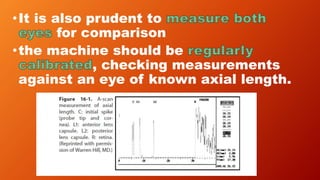
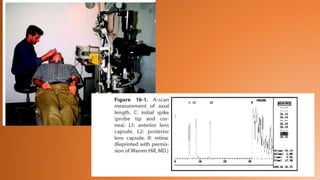
• The instrument should have an screen
to differentiate a good measurement from a poor
one. or spikes should be
observed when the probe is aligned properly
• These include the following: a tall peak for the
cornea, tall peaks for the anterior and posterior
lens capsule, tall peak for the retina, mod-erate
peak for the sclera, and moderate-to-low peaks for
orbital fat. If these spikes are not well seen, then
the probe may be misaligned.
A SCAN ULTRASOUND
•The must
be performed carefully, as com-
pressing the cornea will result in a
shorter-than-expected measurement
and should
be taken and averaged.
•If several are taken and differ by a
significant amount, they should be
readings
can be obtained.
•It is also prudent to
for comparison
•the machine should be
, checking measurements
against an eye of known axial length.
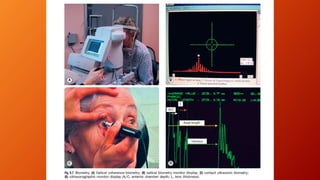
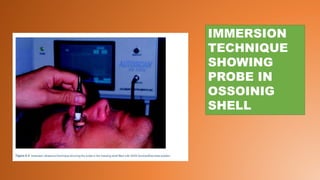
Immersion technique
The immersion technique may more accurately
represent the true axial length because there is
.
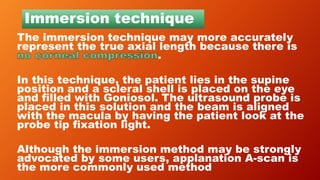
In this technique, the patient lies in the supine
position and a scleral shell is placed on the eye
and filled with Goniosol. The ultrasound probe is
placed in this solution and the beam is aligned
with the macula by having the patient look at the
probe tip fixation light.
Although the immersion method may be strongly
advocated by some users, applanation A-scan is
the more commonly used method
IMMERSION
TECHNIQUE
SHOWING
PROBE IN
OSSOINIG
SHELL
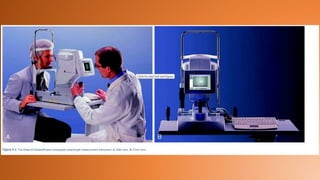
Optical biometry: IOLMaster
• In the last decade, the technique of
optical coherence biometry was in-
troduced by Haigis, which utilizes light
rather than ultrasound to measure the
length of the eye. The first device
introduced was the IOLMaster (Zeiss),
based on the principle of partial
coherence interferometry using a 780-
nm multimode laser diode.
•Measurements taken without contact
to eye, thus eliminating variability due
to an examiner technique.
•The distance measured lies between
the anterior surface of tear film &
retinal pigmented pigment epithelium
, which may
be more physiologically accurate
patient asked to focus on a small red
fixation light, & examiner maneuvers
focusing spot within the measurement
reticule, sampling areas until the best
peak pattern is obtained.
5 to 20 measurements obtained until the
readings differ by less than 0.1 mm.
Maximal axial length measured 40 mm.
IOLMASTER USE
IOL MASTER DISADVANTAGE
The primary disadvantage of this
optical device is that
, such as a corneal scar,
dense posterior subcapsular plaque,
darkly brunescent cataract, or vitreous
hemorrhage, will reduce the signal-to-
noise ratio (SNR) to the point that
.
A-scans should be
under the following conditions
• 1. Axial length is less than 22 mm or
greater than 25 mm in either eye.
• 2. The difference between the 2 eyes is
greater than 0.3 mm.
• 3. The measurements do not correlate
with the patient’s refraction (ie,
hyperopes should have shorter eyes,
and myopes should have longer eyes).
Lens power
calculation
formulas
evolved over
past 30 yrs,
since first
theoretical
formula for
iris-supported iol
published by
Fyodorov in
1967.
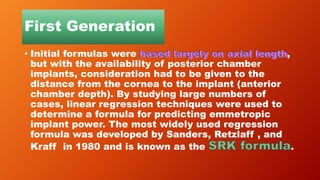
First Generation
• Initial formulas were ,
but with the availability of posterior chamber
implants, consideration had to be given to the
distance from the cornea to the implant (anterior
chamber depth). By studying large numbers of
cases, linear regression techniques were used to
determine a formula for predicting emmetropic
implant power. The most widely used regression
formula was developed by Sanders, Retzlaff , and
Kraff in 1980 and is known as the .
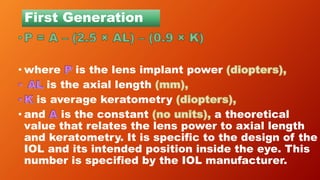
First Generation
• where is the lens implant power
is the axial length
is average keratometry
• and is the constant a theoretical
value that relates the lens power to axial length
and keratometry. It is specific to the design of the
IOL and its intended position inside the eye. This
number is specified by the IOL manufacturer.
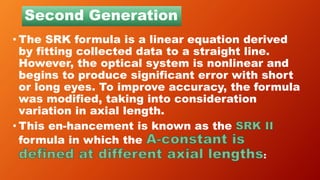
Second Generation
• The SRK formula is a linear equation derived
by fitting collected data to a straight line.
However, the optical system is nonlinear and
begins to produce significant error with short
or long eyes. To improve accuracy, the formula
was modified, taking into consideration
variation in axial length.
• This en-hancement is known as the
formula in which the
:
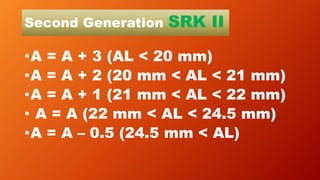
Second Generation SRK II
•A = A + 3 (AL < 20 mm)
•A = A + 2 (20 mm < AL < 21 mm)
•A = A + 1 (21 mm < AL < 22 mm)
• A = A (22 mm < AL < 24.5 mm)
•A = A – 0.5 (24.5 mm < AL)
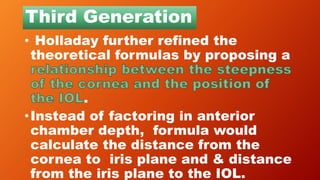
Third Generation
• Holladay further refined the
theoretical formulas by proposing a
.
•Instead of factoring in anterior
chamber depth, formula would
calculate the distance from the
cornea to iris plane and & distance
from the iris plane to the IOL.
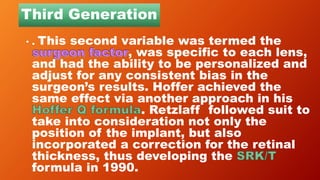
Third Generation
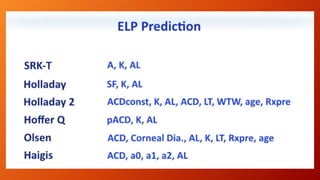
• . This second variable was termed the
, was specific to each lens,
and had the ability to be personalized and
adjust for any consistent bias in the
surgeon’s results. Hoffer achieved the
same effect via another approach in his
. Retzlaff followed suit to
take into consideration not only the
position of the implant, but also
incorporated a correction for the retinal
thickness, thus developing the
formula in 1990.
Fourth Generation
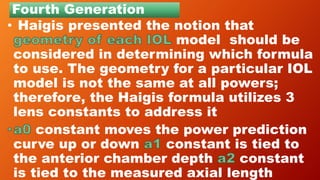
• Haigis presented the notion that
model should be
considered in determining which formula
to use. The geometry for a particular IOL
model is not the same at all powers;
therefore, the Haigis formula utilizes 3
lens constants to address it
constant moves the power prediction
curve up or down constant is tied to
the anterior chamber depth constant
is tied to the measured axial length
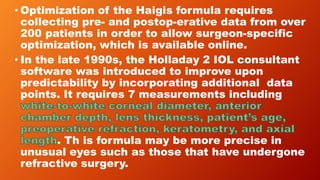
• Optimization of the Haigis formula requires
collecting pre- and postop-erative data from over
200 patients in order to allow surgeon-specific
optimization, which is available online.
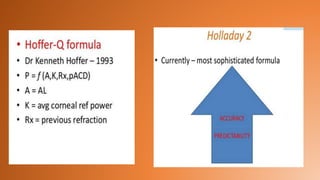
• In the late 1990s, the Holladay 2 IOL consultant
software was introduced to improve upon
predictability by incorporating additional data
points. It requires 7 measurements including
. Th is formula may be more precise in
unusual eyes such as those that have undergone
refractive surgery.
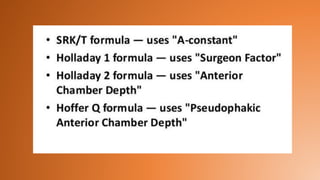
•One or more of the
are generally programmed
into A-scan biometers sold today.
•The optical biometers are now
incorporating the
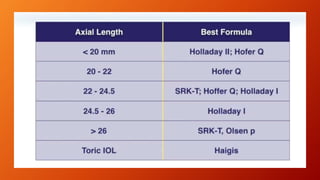
•Over time, some trends have
emerged regarding which formulas
to use in general categories of
patients:
FORMULAE BASED
ON MATHEMATICAL PRINCIPLES
REVOLVING AROUND THE
SCHEMATIC EYE
FORMULAE WORKING
BACKWARDS ON POSTOPERATIVE
OUTCOMES
GENERATION
MIX OF BOTH
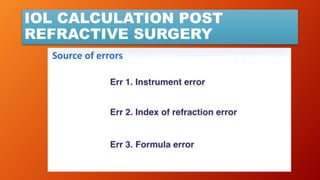
IOL CALCULATION POST
REFRACTIVE SURGERY
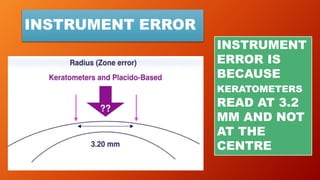
INSTRUMENT ERROR
INSTRUMENT
ERROR IS
BECAUSE
KERATOMETERS
READ AT 3.2
MM AND NOT
AT THE
CENTRE
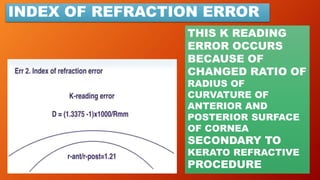
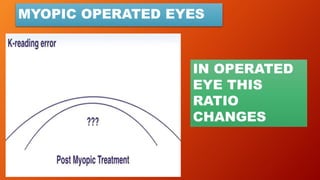
INDEX OF REFRACTION ERROR
THIS K READING
ERROR OCCURS
BECAUSE OF
CHANGED RATIO OF
RADIUS OF
CURVATURE OF
ANTERIOR AND
POSTERIOR SURFACE
OF CORNEA
SECONDARY TO
KERATO REFRACTIVE
PROCEDURE
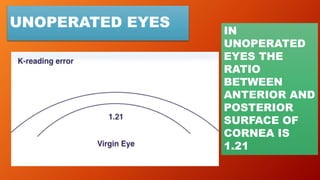
UNOPERATED EYES IN
UNOPERATED
EYES THE
RATIO
BETWEEN
ANTERIOR AND
POSTERIOR
SURFACE OF
CORNEA IS
1.21
MYOPIC OPERATED EYES
IN OPERATED
EYE THIS
RATIO
CHANGES
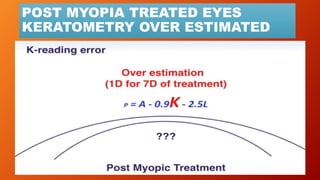
POST MYOPIA TREATED EYES
KERATOMETRY OVER ESTIMATED
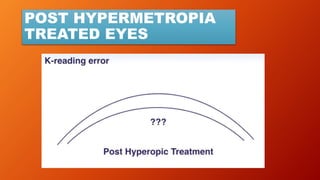
POST HYPERMETROPIA
TREATED EYES
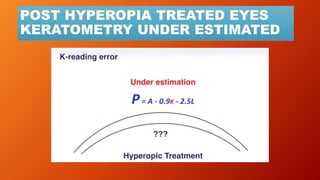
POST HYPEROPIA TREATED EYES
KERATOMETRY UNDER ESTIMATED
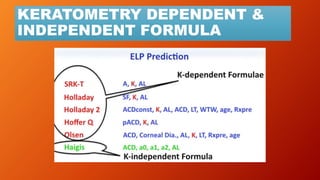
KERATOMETRY DEPENDENT &
INDEPENDENT FORMULA
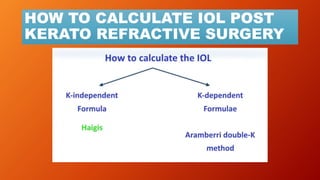
HOW TO CALCULATE IOL POST
KERATO REFRACTIVE SURGERY
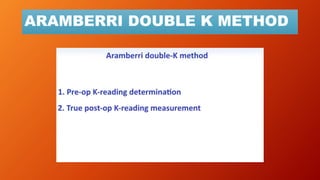
ARAMBERRI DOUBLE K METHOD
PRE OP K READING FOR ELP
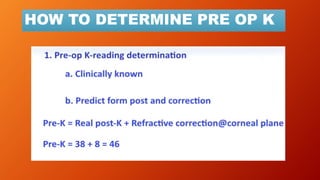
HOW TO DETERMINE PRE OP K
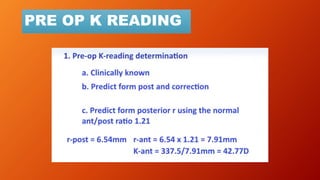
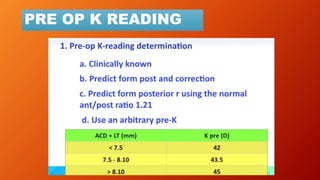
PRE OP K READING
PRE OP K READING
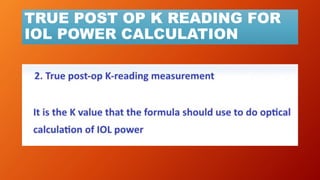
TRUE POST OP K READING FOR
IOL POWER CALCULATION
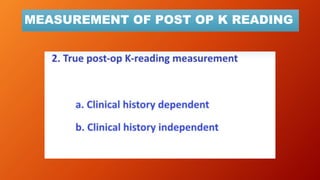
MEASUREMENT OF POST OP K READING
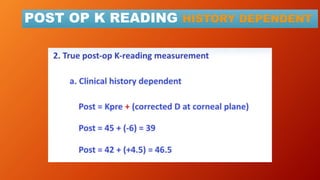
POST OP K READING HISTORY DEPENDENT
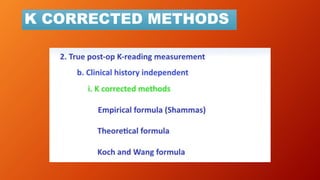
POST OP K READING HISTORY
INDEPENDENT
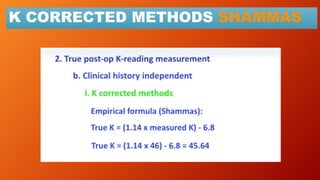
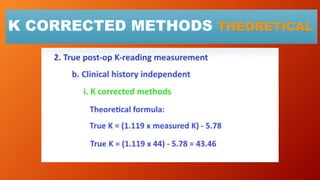
K CORRECTED METHODS
K CORRECTED METHODS SHAMMAS
K CORRECTED METHODS THEORETICAL
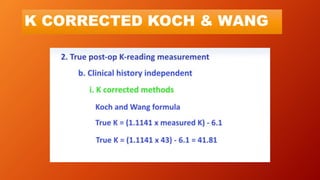
K CORRECTED KOCH & WANG
POST OP K READING
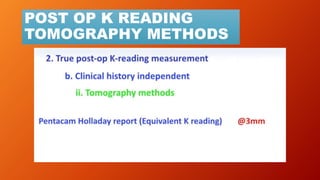
TOMOGRAPHY METHODS
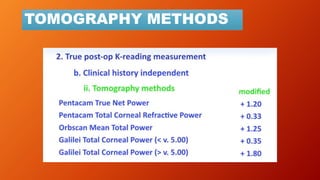
TOMOGRAPHY METHODS
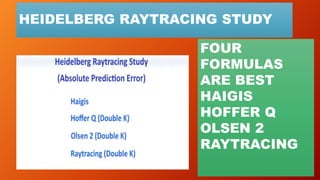
HEIDELBERG RAYTRACING STUDY
FOUR
FORMULAS
ARE BEST
HAIGIS
HOFFER Q
OLSEN 2
RAYTRACING
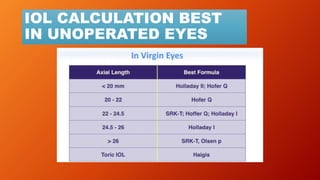
IOL CALCULATION BEST
IN UNOPERATED EYES
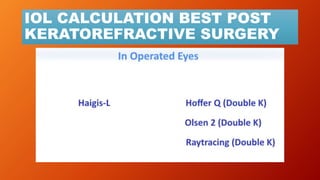
IOL CALCULATION BEST POST
KERATOREFRACTIVE SURGERY
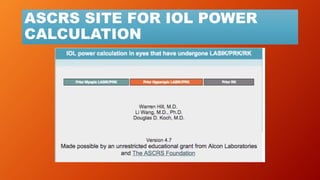
ASCRS SITE FOR IOL POWER
CALCULATION
THANK YOU
DR DINESH
DR SONALEE

Iol power calculation normal and post lasik eyes

  • 1.
    IOL POWER CALCULATION NORMAL &POST LASIK EYES INDOREDRISHTI.WORDPRESS.COM
  • 2.
    DR DINESH MITTALDR SONALEE MITTAL DRISHTI EYE HOSP VIJAYNAGAR INDORE
  • 8.
    1 Cataract surgeryhas evolved into a refractive procedure with the goal of eliminating or significantly reducing the need for spectacle dependence. •2. One must consider not only the astigmatism induced by the cataract incision itself, but also the correction of preexisting astigmatism. •3. Incision length, depth, and distance from visual axis all affect astigmatism.
  • 9.
    •4. LRIs arecommonly used to correct preexisting astigmatism, and •published nomograms are helpful in tailoring a surgical approach. •5. Toric IOLs and excimer laser ablation are alternative approaches to correcting astigmatism in the patient for refractive cataract surgery. •No single approach is best suited for all patients.
  • 10.
    INTRAOCULAR LENS CALCULATIONS •Choosingthe appropriate IOL power is a major determinant of patient satisfaction with cataract surgery. •accurate measurements , •selecting calculations ), • and assessing the patient’s needs to determine postoperative refractive target
  • 12.
    BIOMETRY •At minimum, 2measurements reqd to calculate implant power: & ( ) •Precise measurements critical •error of 0.3 mm in axial length will result in a 1-D error in IOL power.
  • 13.
    Axial Length •Axial lengthhas been obtained utilizing . •This measurement is determined by ; • an ultrasound pulse is applied and the transit time through the eye is measured. Using estimated velocities of ultrasound waves through various media (ie, cornea, aqueous, lens, and vitreous) the distance travelled through the eye is calculated.
  • 14.
    • The instrumentshould have an screen to differentiate a good measurement from a poor one. or spikes should be observed when the probe is aligned properly • These include the following: a tall peak for the cornea, tall peaks for the anterior and posterior lens capsule, tall peak for the retina, mod-erate peak for the sclera, and moderate-to-low peaks for orbital fat. If these spikes are not well seen, then the probe may be misaligned. A SCAN ULTRASOUND
  • 15.
    •The must be performedcarefully, as com- pressing the cornea will result in a shorter-than-expected measurement and should be taken and averaged. •If several are taken and differ by a significant amount, they should be readings can be obtained.
  • 16.
    •It is alsoprudent to for comparison •the machine should be , checking measurements against an eye of known axial length.
  • 18.
    Immersion technique The immersiontechnique may more accurately represent the true axial length because there is . In this technique, the patient lies in the supine position and a scleral shell is placed on the eye and filled with Goniosol. The ultrasound probe is placed in this solution and the beam is aligned with the macula by having the patient look at the probe tip fixation light. Although the immersion method may be strongly advocated by some users, applanation A-scan is the more commonly used method
  • 19.
  • 20.
    Optical biometry: IOLMaster •In the last decade, the technique of optical coherence biometry was in- troduced by Haigis, which utilizes light rather than ultrasound to measure the length of the eye. The first device introduced was the IOLMaster (Zeiss), based on the principle of partial coherence interferometry using a 780- nm multimode laser diode.
  • 22.
    •Measurements taken withoutcontact to eye, thus eliminating variability due to an examiner technique. •The distance measured lies between the anterior surface of tear film & retinal pigmented pigment epithelium , which may be more physiologically accurate
  • 23.
    patient asked tofocus on a small red fixation light, & examiner maneuvers focusing spot within the measurement reticule, sampling areas until the best peak pattern is obtained. 5 to 20 measurements obtained until the readings differ by less than 0.1 mm. Maximal axial length measured 40 mm. IOLMASTER USE
  • 24.
    IOL MASTER DISADVANTAGE Theprimary disadvantage of this optical device is that , such as a corneal scar, dense posterior subcapsular plaque, darkly brunescent cataract, or vitreous hemorrhage, will reduce the signal-to- noise ratio (SNR) to the point that .
  • 25.
    A-scans should be underthe following conditions • 1. Axial length is less than 22 mm or greater than 25 mm in either eye. • 2. The difference between the 2 eyes is greater than 0.3 mm. • 3. The measurements do not correlate with the patient’s refraction (ie, hyperopes should have shorter eyes, and myopes should have longer eyes).
  • 26.
    Lens power calculation formulas evolved over past30 yrs, since first theoretical formula for iris-supported iol published by Fyodorov in 1967.
  • 28.
    First Generation • Initialformulas were , but with the availability of posterior chamber implants, consideration had to be given to the distance from the cornea to the implant (anterior chamber depth). By studying large numbers of cases, linear regression techniques were used to determine a formula for predicting emmetropic implant power. The most widely used regression formula was developed by Sanders, Retzlaff , and Kraff in 1980 and is known as the .
  • 29.
    First Generation • whereis the lens implant power is the axial length is average keratometry • and is the constant a theoretical value that relates the lens power to axial length and keratometry. It is specific to the design of the IOL and its intended position inside the eye. This number is specified by the IOL manufacturer.
  • 30.
    Second Generation • TheSRK formula is a linear equation derived by fitting collected data to a straight line. However, the optical system is nonlinear and begins to produce significant error with short or long eyes. To improve accuracy, the formula was modified, taking into consideration variation in axial length. • This en-hancement is known as the formula in which the :
  • 31.
    Second Generation SRKII •A = A + 3 (AL < 20 mm) •A = A + 2 (20 mm < AL < 21 mm) •A = A + 1 (21 mm < AL < 22 mm) • A = A (22 mm < AL < 24.5 mm) •A = A – 0.5 (24.5 mm < AL)
  • 32.
    Third Generation • Holladayfurther refined the theoretical formulas by proposing a . •Instead of factoring in anterior chamber depth, formula would calculate the distance from the cornea to iris plane and & distance from the iris plane to the IOL.
  • 34.
    Third Generation • .This second variable was termed the , was specific to each lens, and had the ability to be personalized and adjust for any consistent bias in the surgeon’s results. Hoffer achieved the same effect via another approach in his . Retzlaff followed suit to take into consideration not only the position of the implant, but also incorporated a correction for the retinal thickness, thus developing the formula in 1990.
  • 35.
    Fourth Generation • Haigispresented the notion that model should be considered in determining which formula to use. The geometry for a particular IOL model is not the same at all powers; therefore, the Haigis formula utilizes 3 lens constants to address it constant moves the power prediction curve up or down constant is tied to the anterior chamber depth constant is tied to the measured axial length
  • 36.
    • Optimization ofthe Haigis formula requires collecting pre- and postop-erative data from over 200 patients in order to allow surgeon-specific optimization, which is available online. • In the late 1990s, the Holladay 2 IOL consultant software was introduced to improve upon predictability by incorporating additional data points. It requires 7 measurements including . Th is formula may be more precise in unusual eyes such as those that have undergone refractive surgery.
  • 37.
    •One or moreof the are generally programmed into A-scan biometers sold today. •The optical biometers are now incorporating the •Over time, some trends have emerged regarding which formulas to use in general categories of patients:
  • 39.
    FORMULAE BASED ON MATHEMATICALPRINCIPLES REVOLVING AROUND THE SCHEMATIC EYE FORMULAE WORKING BACKWARDS ON POSTOPERATIVE OUTCOMES GENERATION MIX OF BOTH
  • 42.
  • 43.
  • 44.
    INDEX OF REFRACTIONERROR THIS K READING ERROR OCCURS BECAUSE OF CHANGED RATIO OF RADIUS OF CURVATURE OF ANTERIOR AND POSTERIOR SURFACE OF CORNEA SECONDARY TO KERATO REFRACTIVE PROCEDURE
  • 45.
    UNOPERATED EYES IN UNOPERATED EYESTHE RATIO BETWEEN ANTERIOR AND POSTERIOR SURFACE OF CORNEA IS 1.21
  • 46.
    MYOPIC OPERATED EYES INOPERATED EYE THIS RATIO CHANGES
  • 47.
    POST MYOPIA TREATEDEYES KERATOMETRY OVER ESTIMATED
  • 48.
  • 49.
    POST HYPEROPIA TREATEDEYES KERATOMETRY UNDER ESTIMATED
  • 50.
  • 51.
    HOW TO CALCULATEIOL POST KERATO REFRACTIVE SURGERY
  • 52.
  • 53.
    PRE OP KREADING FOR ELP
  • 54.
  • 55.
    PRE OP KREADING
  • 56.
    PRE OP KREADING
  • 57.
    TRUE POST OPK READING FOR IOL POWER CALCULATION
  • 58.
    MEASUREMENT OF POSTOP K READING
  • 59.
    POST OP KREADING HISTORY DEPENDENT
  • 60.
    POST OP KREADING HISTORY INDEPENDENT
  • 61.
  • 62.
  • 63.
  • 64.
  • 65.
    POST OP KREADING TOMOGRAPHY METHODS
  • 66.
  • 67.
    HEIDELBERG RAYTRACING STUDY FOUR FORMULAS AREBEST HAIGIS HOFFER Q OLSEN 2 RAYTRACING
  • 68.
    IOL CALCULATION BEST INUNOPERATED EYES
  • 69.
    IOL CALCULATION BESTPOST KERATOREFRACTIVE SURGERY
  • 70.
    ASCRS SITE FORIOL POWER CALCULATION
  • 71.