5. Case Study of MIMO Concepts in Wireless Communication
1.
Journal of EngineeringTechnology and Sciences
Volume 02, Issue 02, February 2025 ISSN: 3048-913X
www.jets.org.in DOI: https://doi.org/10.5281/zenodo.14966909
Published by: Surya Publishers www.jets.org.in 16 | Page
Case Study of MIMO Concepts
Syam Sundar
Department of Electronics and Communication Engineering, VR Siddhartha college of Engineering
Corresponding Author: syamsundarpece@gmail.com
To Cite this Article
Syam Sundar, “Case Study of MIMO Concepts”, Journal of Engineering Technology and Sciences, Vol. 02, Issue 02,
February 2025, pp:16-18
_____________________________________________________________________________________________
Abstract: Multiple-Input A crucial component of contemporary wireless communication systems, multiple-output
(MIMO) technology improves spectrum efficiency, dependability, and data speed. MIMO uses several antennas at the
transmitter and receiver to take advantage of multiplexing advantages and spatial diversity to increase system
capacity and signal quality. The three main MIMO techniques—beamforming, spatial multiplexing, and spatial
diversity—each address distinct performance goals.
While spatial multiplexing boosts data throughput by sending separate data streams, spatial diversity reduces
fading effects by sending redundant signals over many pathways. By directing signal energy towards the intended
receivers in the best possible way, beamforming enhances interference suppression and the signal-to-noise ratio.
MIMO is essential to modern standards like Wi-Fi, LTE, and 5G and is vital to the development of wireless
communications. This study examines the fundamental ideas, advantages, difficulties, and uses of MIMO systems,
emphasizing their importance in next-generation wireless networks.
Keywords: Multimedia, wireless, B-splines, Video coding, Low bit rate
_____________________________________________________________________________________
I. Introduction
Multiple-Input Wireless communication has been transformed by Multiple-Output (MIMO) technology,
which greatly increases spectrum efficiency, dependability, and data speeds. MIMO uses several antennas at both ends
to take advantage of multiplexing and spatial diversity, in contrast to conventional Single-Input Single-Output (SISO)
systems, which use a single antenna at both the transmitter and the receiver. This enables improved communication
performance, especially in settings with high levels of signal fading and interference.
The three core methods of MIMO are beamforming, spatial multiplexing, and spatial diversity. By sending
redundant signals over various pathways, spatial diversity helps reduce signal deterioration brought on by multipath
fading. By sending separate data streams over several antennas, spatial multiplexing effectively doubles the capacity
without using more bandwidth, increasing throughput. By concentrating signal energy in particular directions,
beamforming lowers interference and increases signal-to-noise ratio (SNR).
Modern wireless communication protocols, such as LTE, 5G, and Wi-Fi (IEEE 802.11n, 802.11ac, and
802.11ax), now require the inclusion of MIMO technology. It is essential for facilitating dependable connectivity, low
latency communication, and high-speed data transfer in applications ranging from Internet of Things (IoT) devices to
mobile networks. MIMO has benefits, but it also has drawbacks that call for creative solutions, like more hardware
complexity, signal processing overhead, and power consumption.
This essay gives a general review of MIMO concepts, going over its main ideas, advantages, difficulties, and
practical uses. The significance of MIMO in influencing the direction of communication technology is shown by the
rising demand for high-performance wireless networks.
II. Benefits and Drawbacks of MIMO
Benefits of MIMO
Enhanced Data Throughput: MIMO systems increase data rates by sending several separate data streams at once,
hence expanding the channel capacity without using more bandwidth.
Increased Spectral Efficiency: MIMO makes the best use of the available spectrum by employing multiple antennas,
which enables faster data transfer rates per unit of bandwidth.
Enhanced Reliability (Diversity Gain): MIMO uses spatial diversity to reduce multipath fading, which makes
communication reliable and steady even in difficult situations.
Improved Coverage and Signal-to-Noise Ratio (SNR): MIMO beamforming techniques focus signal energy on the
2.
Case Study ofMIMO Concepts
17 | Page
targeted receivers, increasing network coverage and signal strength.
Interference Reduction: By spatially differentiating signals, MIMO can minimize interference in congested wireless
situations, resulting in more effective spectrum use. Crucial for Wi-Fi and 4G/5G MIMO is a key component of
contemporary wireless protocols including LTE, 5G, and Wi-Fi 6 in order to provide high-speed and low-latency
communication.
Drawbacks of MIMO
Enhanced Hardware Complexity: MIMO necessitates a number of antennas, RF chains, and advanced signal
processing, which raises the cost and complexity of implementation.
Greater electricity Consumption: MIMO is less energy-efficient than simpler systems because it requires more
electricity for additional antennas and signal processing units.
Complex Signal Processing: MIMO detection, equalization, and beamforming require sophisticated algorithms, which
raises latency and processing demands.
Channel Estimation Challenges: In fast-changing environments, it can be challenging to get accurate channel state
information (CSI), which is essential for MIMO's best performance.
Dense Network Interference: Although MIMO can lessen interference in some situations, performance in dense
networks may be harmed by cross-channel interference and pilot contamination.
Cost of Deployment and Maintenance: MIMO implementation in big networks necessitates a substantial
infrastructure investment, which drives up costs for network operators.
Notwithstanding these difficulties, MIMO is still an essential component of contemporary wireless communication,
and its drawbacks are being lessened by ongoing improvements in hardware and algorithm development.
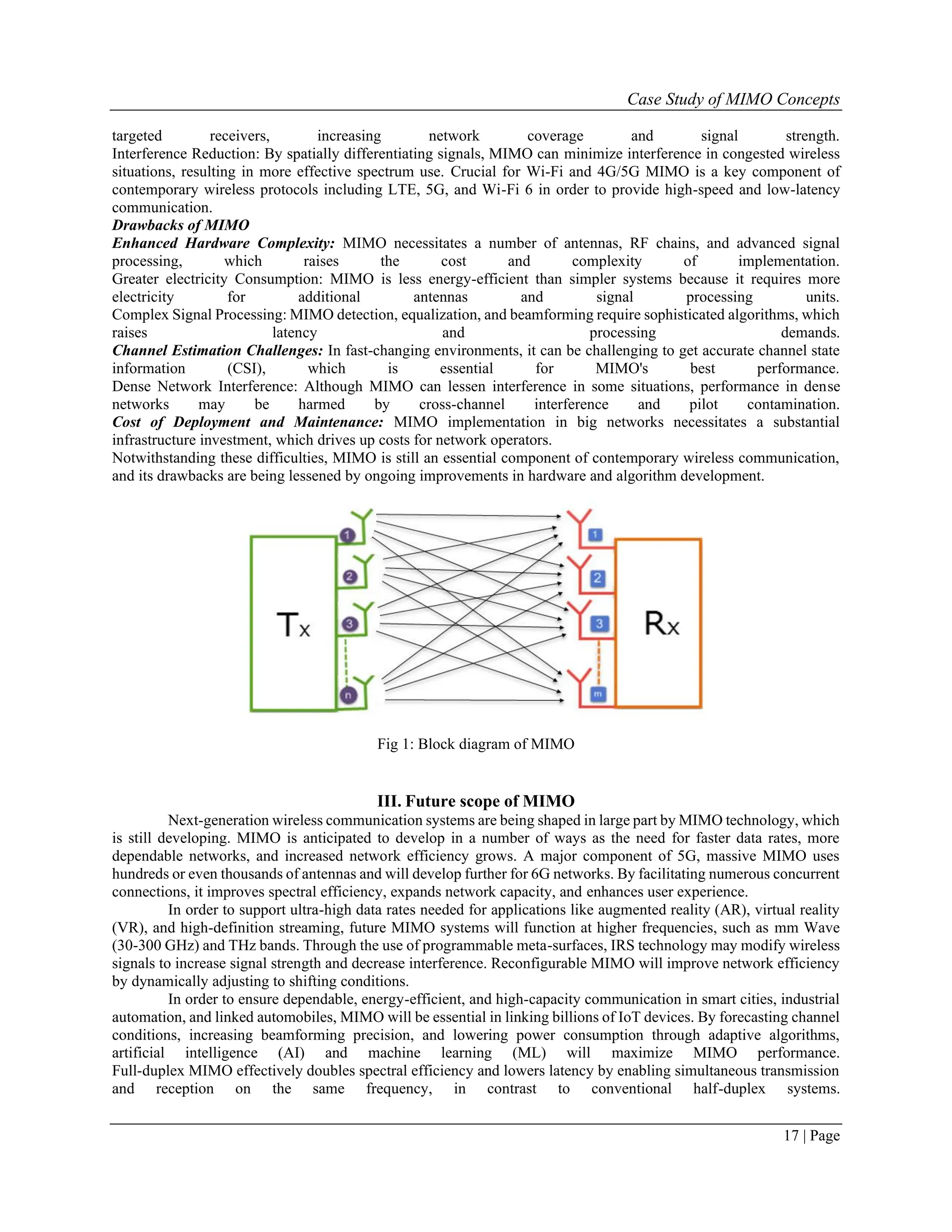
Fig 1: Block diagram of MIMO
III. Future scope of MIMO
Next-generation wireless communication systems are being shaped in large part by MIMO technology, which
is still developing. MIMO is anticipated to develop in a number of ways as the need for faster data rates, more
dependable networks, and increased network efficiency grows. A major component of 5G, massive MIMO uses
hundreds or even thousands of antennas and will develop further for 6G networks. By facilitating numerous concurrent
connections, it improves spectral efficiency, expands network capacity, and enhances user experience.
In order to support ultra-high data rates needed for applications like augmented reality (AR), virtual reality
(VR), and high-definition streaming, future MIMO systems will function at higher frequencies, such as mm Wave
(30-300 GHz) and THz bands. Through the use of programmable meta-surfaces, IRS technology may modify wireless
signals to increase signal strength and decrease interference. Reconfigurable MIMO will improve network efficiency
by dynamically adjusting to shifting conditions.
In order to ensure dependable, energy-efficient, and high-capacity communication in smart cities, industrial
automation, and linked automobiles, MIMO will be essential in linking billions of IoT devices. By forecasting channel
conditions, increasing beamforming precision, and lowering power consumption through adaptive algorithms,
artificial intelligence (AI) and machine learning (ML) will maximize MIMO performance.
Full-duplex MIMO effectively doubles spectral efficiency and lowers latency by enabling simultaneous transmission
and reception on the same frequency, in contrast to conventional half-duplex systems.
3.
Case Study ofMIMO Concepts
18 | Page
In order to improve communication for space exploration and provide high-speed internet access in remote locations,
future satellite networks will incorporate MIMO.
IV. Conclusion
MIMO technology will continue to be a driving force in wireless communications, evolving with
advancements in hardware, AI-driven signal processing, and high-frequency spectrum utilization. Its integration with
6G, smart networks, and emerging technologies will redefine connectivity, paving the way for a faster, more reliable,
and more intelligent communication ecosystem.
References
[1] Canterle, D. R., da Silveira, T. L., Bayer, F. M., & Cintra, R. J. (2020). A Multiparametric Class of Low-complexity Transforms for Image
and Video Coding. Signal Processing, 176, 107685.
[2] Chen, F., Zhang, J., Zheng, M., Wu, J., & Ling, N. (2021). Long-Term Rate Control for Concurrent Multipath Real-Time Video Transmission
in Heterogeneous Wireless Networks. Journal of Visual Communication and Image Representation, 102999.
[3] Esakki, G., Panayides, A., Teeparthi, S., &Pattichis, M. (2020, August). A comparative performance evaluation of VP9, x265, SVT-AV1,
VVC codecs are leveraging the VMAF perceptual quality metric. In Applications of Digital Image Processing XLIII (Vol. 11510, p. 1151010).
International Society for Optics and Photonics.
[4] Khursheed, S., Badruddin, N., Jyoti, V., & Hashmi, M. A. Fast Side Information Generation for High-Resolution Videos Distributed Video
Coding Applications.
![Case Study of MIMO Concepts
18 | Page
In order to improve communication for space exploration and provide high-speed internet access in remote locations,
future satellite networks will incorporate MIMO.
IV. Conclusion
MIMO technology will continue to be a driving force in wireless communications, evolving with
advancements in hardware, AI-driven signal processing, and high-frequency spectrum utilization. Its integration with
6G, smart networks, and emerging technologies will redefine connectivity, paving the way for a faster, more reliable,
and more intelligent communication ecosystem.
References
[1] Canterle, D. R., da Silveira, T. L., Bayer, F. M., & Cintra, R. J. (2020). A Multiparametric Class of Low-complexity Transforms for Image
and Video Coding. Signal Processing, 176, 107685.
[2] Chen, F., Zhang, J., Zheng, M., Wu, J., & Ling, N. (2021). Long-Term Rate Control for Concurrent Multipath Real-Time Video Transmission
in Heterogeneous Wireless Networks. Journal of Visual Communication and Image Representation, 102999.
[3] Esakki, G., Panayides, A., Teeparthi, S., &Pattichis, M. (2020, August). A comparative performance evaluation of VP9, x265, SVT-AV1,
VVC codecs are leveraging the VMAF perceptual quality metric. In Applications of Digital Image Processing XLIII (Vol. 11510, p. 1151010).
International Society for Optics and Photonics.
[4] Khursheed, S., Badruddin, N., Jyoti, V., & Hashmi, M. A. Fast Side Information Generation for High-Resolution Videos Distributed Video
Coding Applications.](https://image.slidesharecdn.com/05-250406185552-8723871d/75/5-Case-Study-of-MIMO-Concepts-in-Wireless-Communication-3-2048.jpg)


![Mimo [new]](https://cdn.slidesharecdn.com/ss_thumbnails/mimonew-150914045107-lva1-app6892-thumbnail.jpg?width=640&height=640&fit=bounds)


![[Year 2012-13] Mimo technology](https://cdn.slidesharecdn.com/ss_thumbnails/mimotechnology-180701101303-thumbnail.jpg?width=640&height=640&fit=bounds)


