Introduction
Whatis MIMO?
Spatial Diversity and Spatial Multiplexing
MEMO capacity on fading channels
Benefits of MIMO
Drawbacks of MIMO
Conclusion
Content
3.
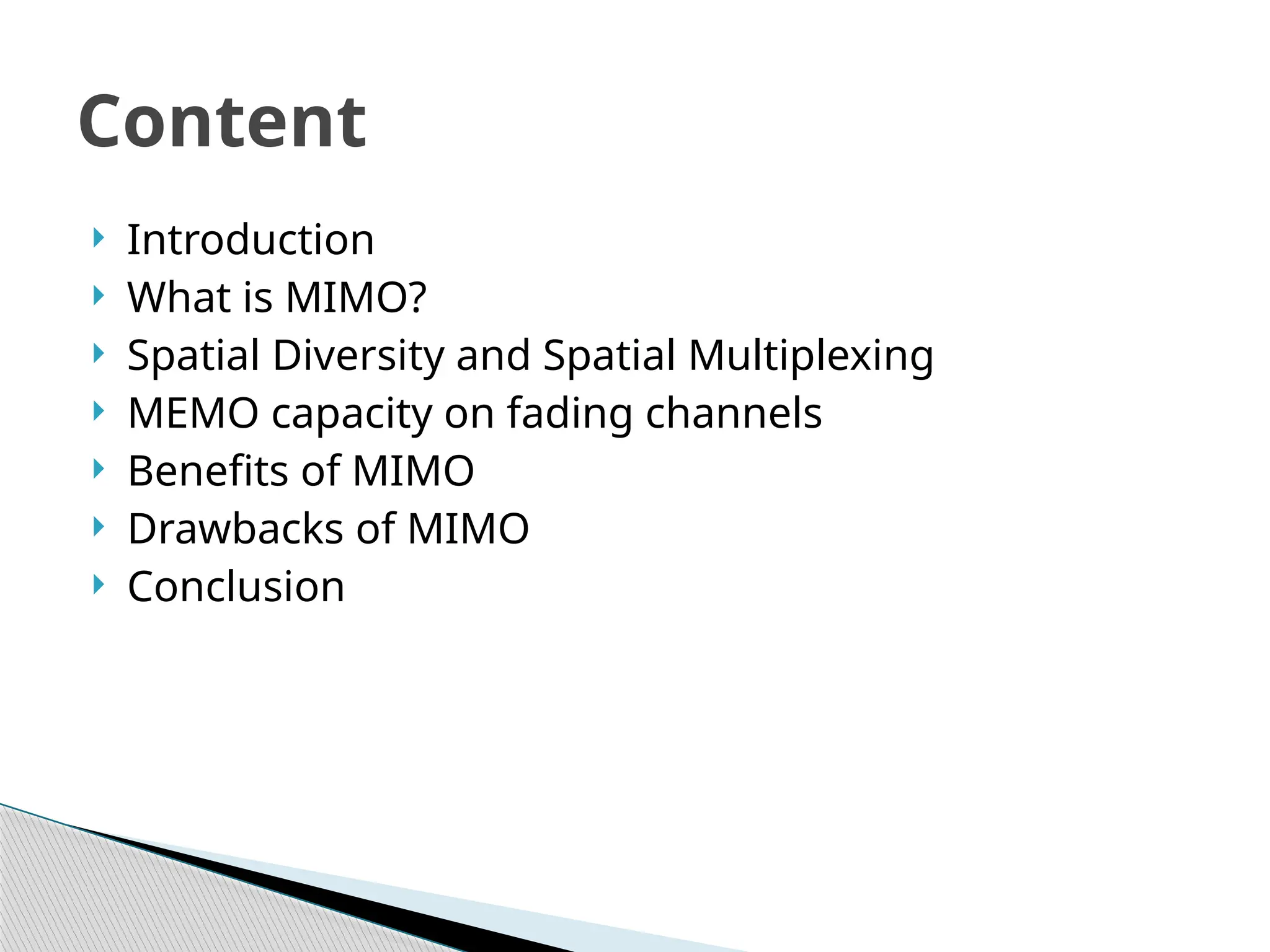
MIMO Systems:
usemultiple inputs and multiple outputs from a
single channel
are defined by Spatial Diversity and Spatial
Multiplexing
Introduction
4.
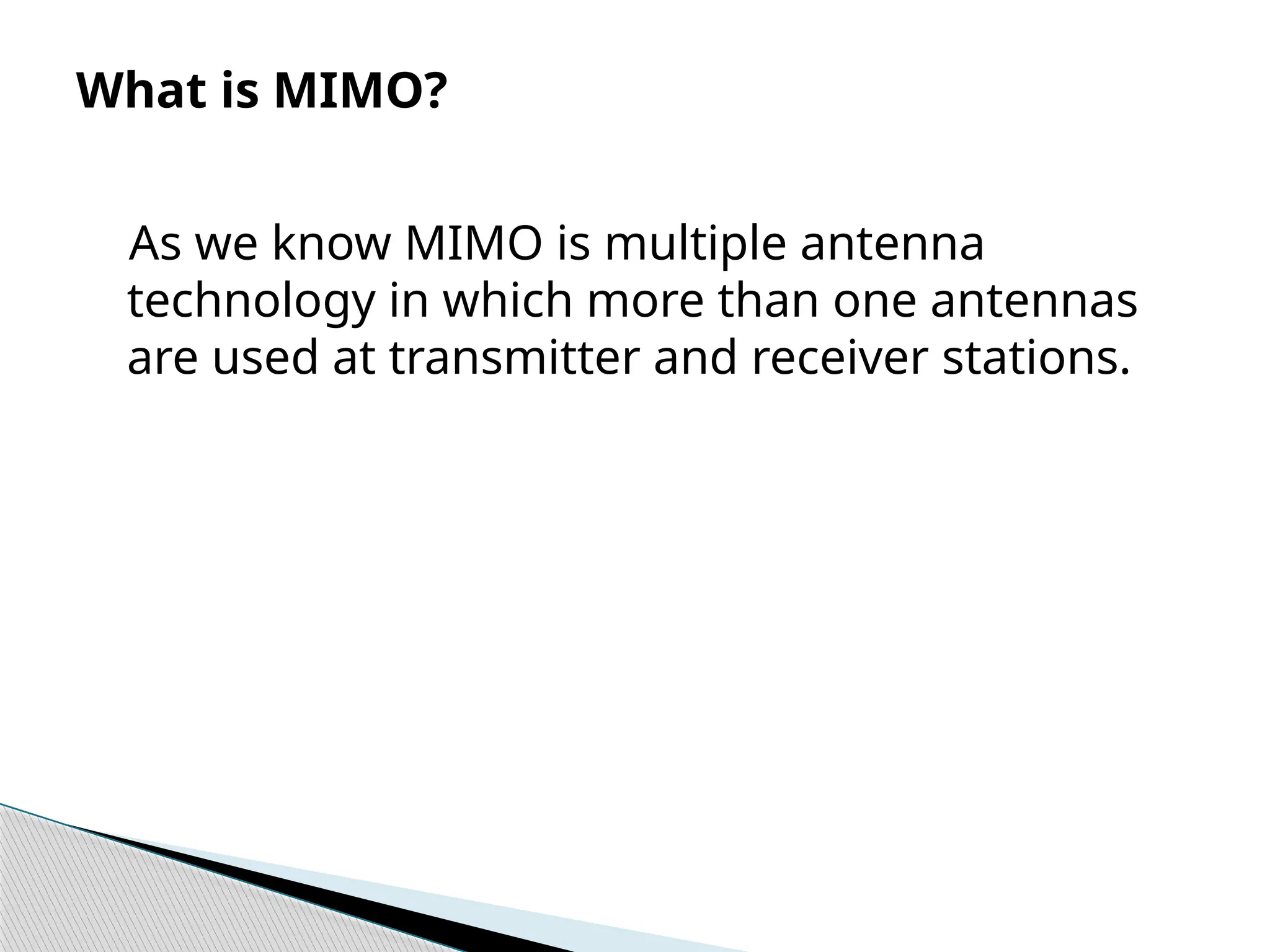
As we knowMIMO is multiple antenna
technology in which more than one antennas
are used at transmitter and receiver stations.
What is MIMO?
5.
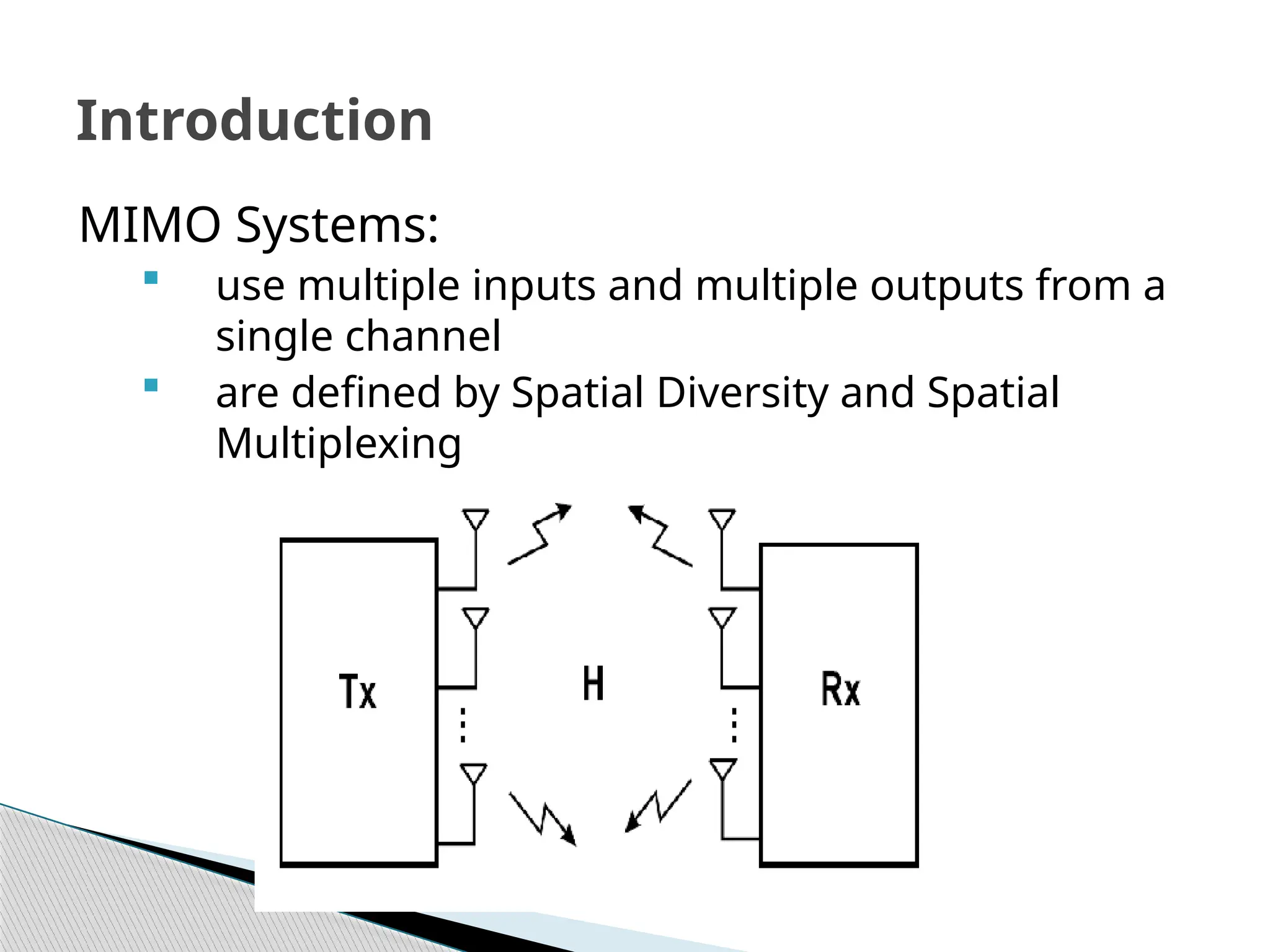
Spatial Diversity
◦Signal copies are transferred from multiple
antennas or received at more than one antenna
◦ redundancy is provided by employing an array of
antennas, with a minimum separation of λ/2
between neighbouring antennas
Spatial Multiplexing
◦ the system is able to carry more than one data
stream over one frequency, simultaneously
Spatial Diversity and Spatial Multiplexing
6.
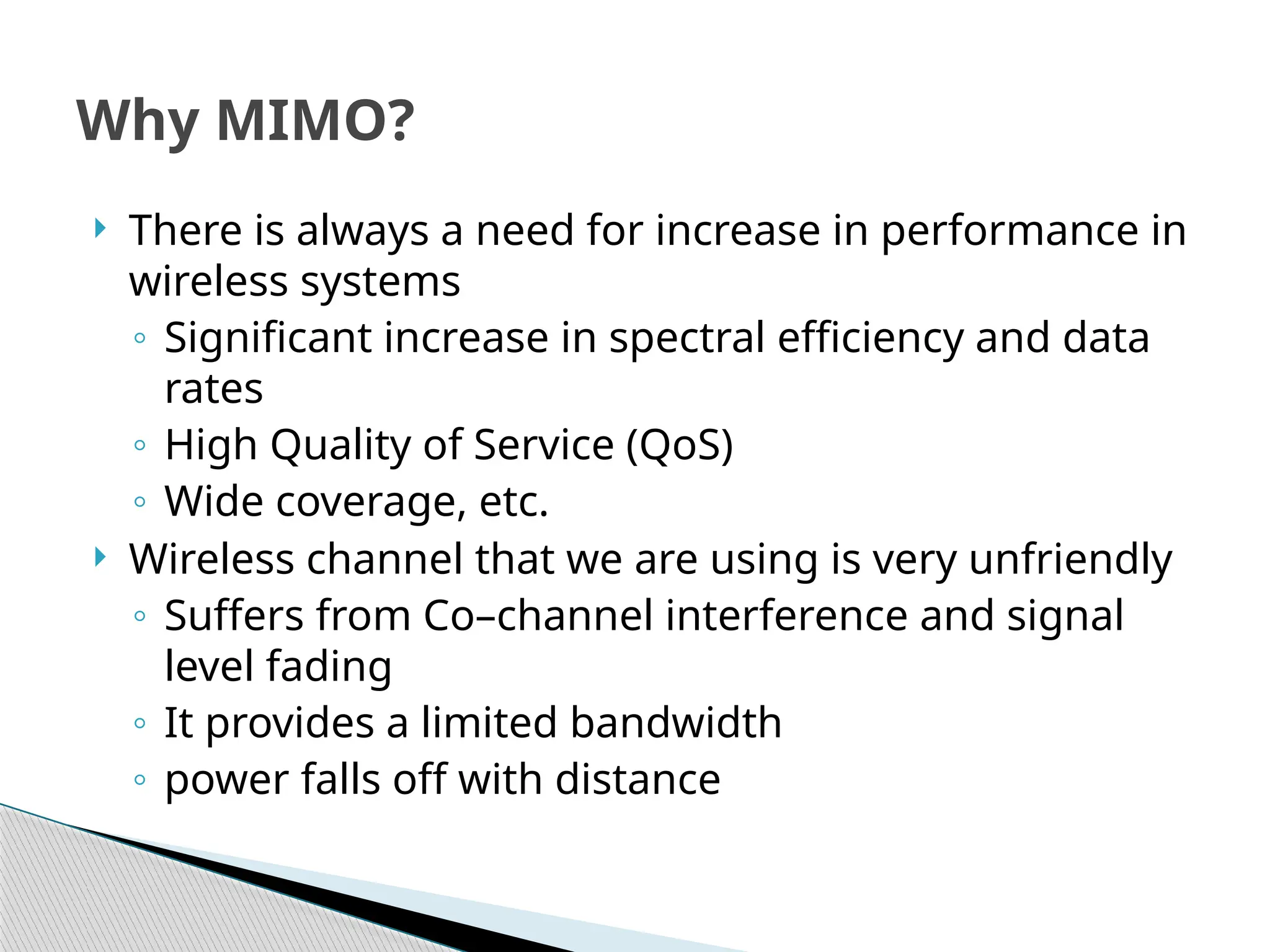
There isalways a need for increase in performance in
wireless systems
◦ Significant increase in spectral efficiency and data
rates
◦ High Quality of Service (QoS)
◦ Wide coverage, etc.
Wireless channel that we are using is very unfriendly
◦ Suffers from Co–channel interference and signal
level fading
◦ It provides a limited bandwidth
◦ power falls off with distance
Why MIMO?
7.
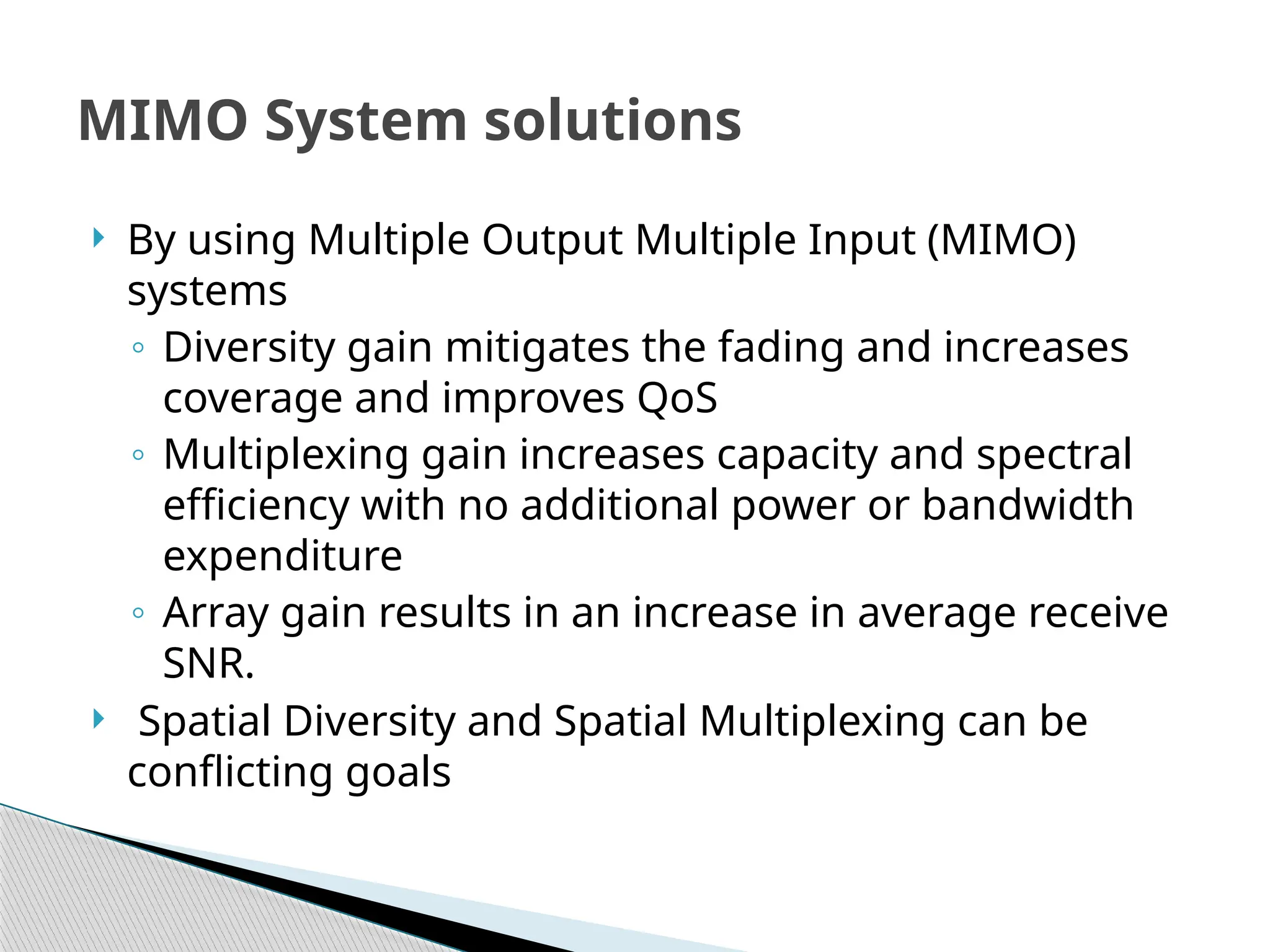
By usingMultiple Output Multiple Input (MIMO)
systems
◦ Diversity gain mitigates the fading and increases
coverage and improves QoS
◦ Multiplexing gain increases capacity and spectral
efficiency with no additional power or bandwidth
expenditure
◦ Array gain results in an increase in average receive
SNR.
Spatial Diversity and Spatial Multiplexing can be
conflicting goals
MIMO System solutions
8.
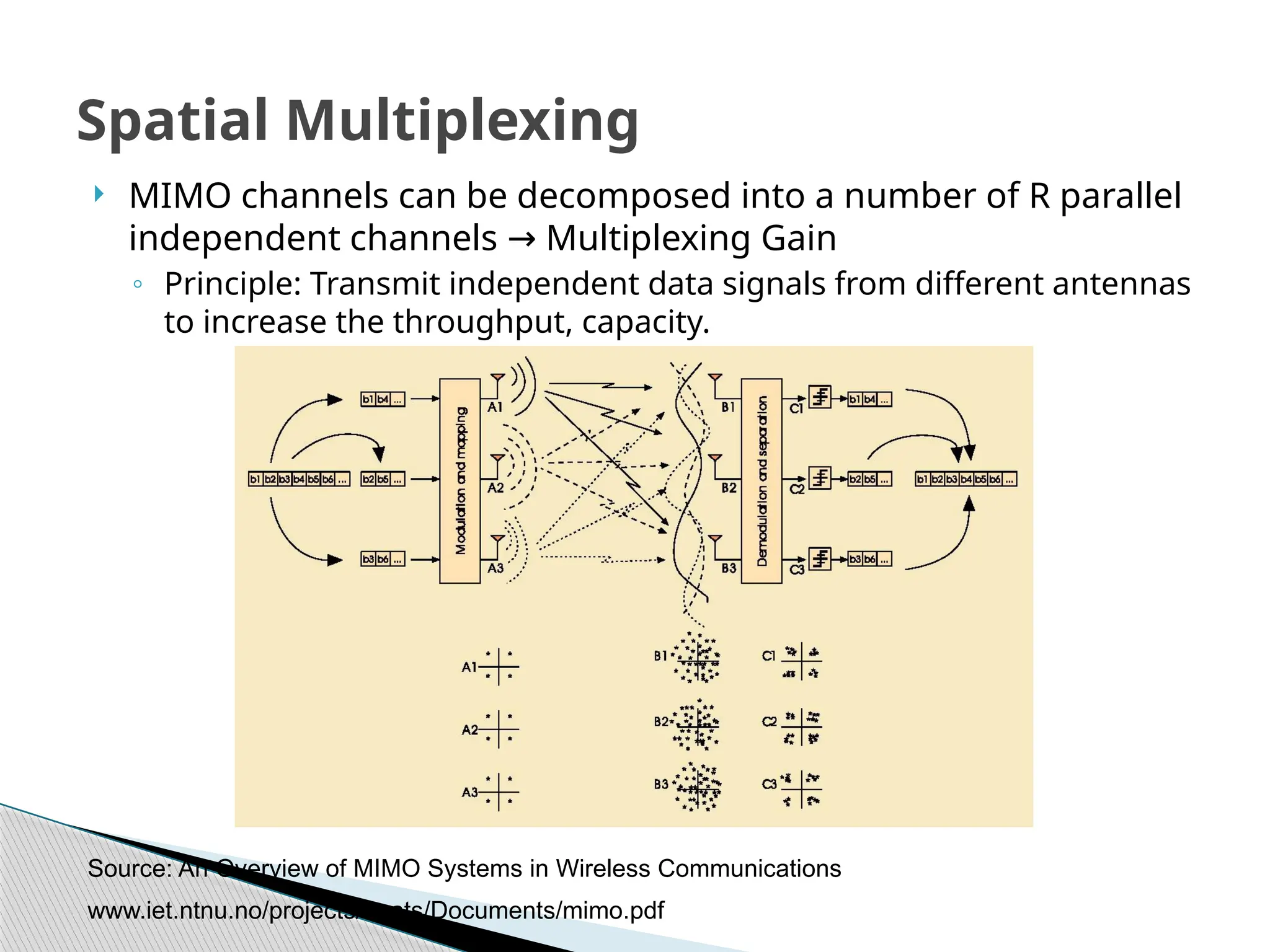
MIMO channelscan be decomposed into a number of R parallel
independent channels Multiplexing Gain
→
◦ Principle: Transmit independent data signals from different antennas
to increase the throughput, capacity.
Spatial Multiplexing
Source: An Overview of MIMO Systems in Wireless Communications
www.iet.ntnu.no/projects/beats/Documents/mimo.pdf
9.
MEMO capacity onfading channels
The capacity increase can be seen by comparing MEMO
systems with SISO, SIMO, and MISO systems
◦ SISO:capacity is given by Shannon’s classical formula:
Where B is the BW and h is the fading gain
◦ SIMO (with M transmitting antennas), the capacity is given by
[2]
◦ MISO (with M transmitting antennas), the capacity is given by
[2]
)
2
1
(
2
log h
snr
B
C
)
1
2
1
(
2
log
m
n
n
h
snr
B
C
)
1
2
1
(
2
log
N
n
n
h
N
snr
B
C
10.
MEMO capacity onfading channels
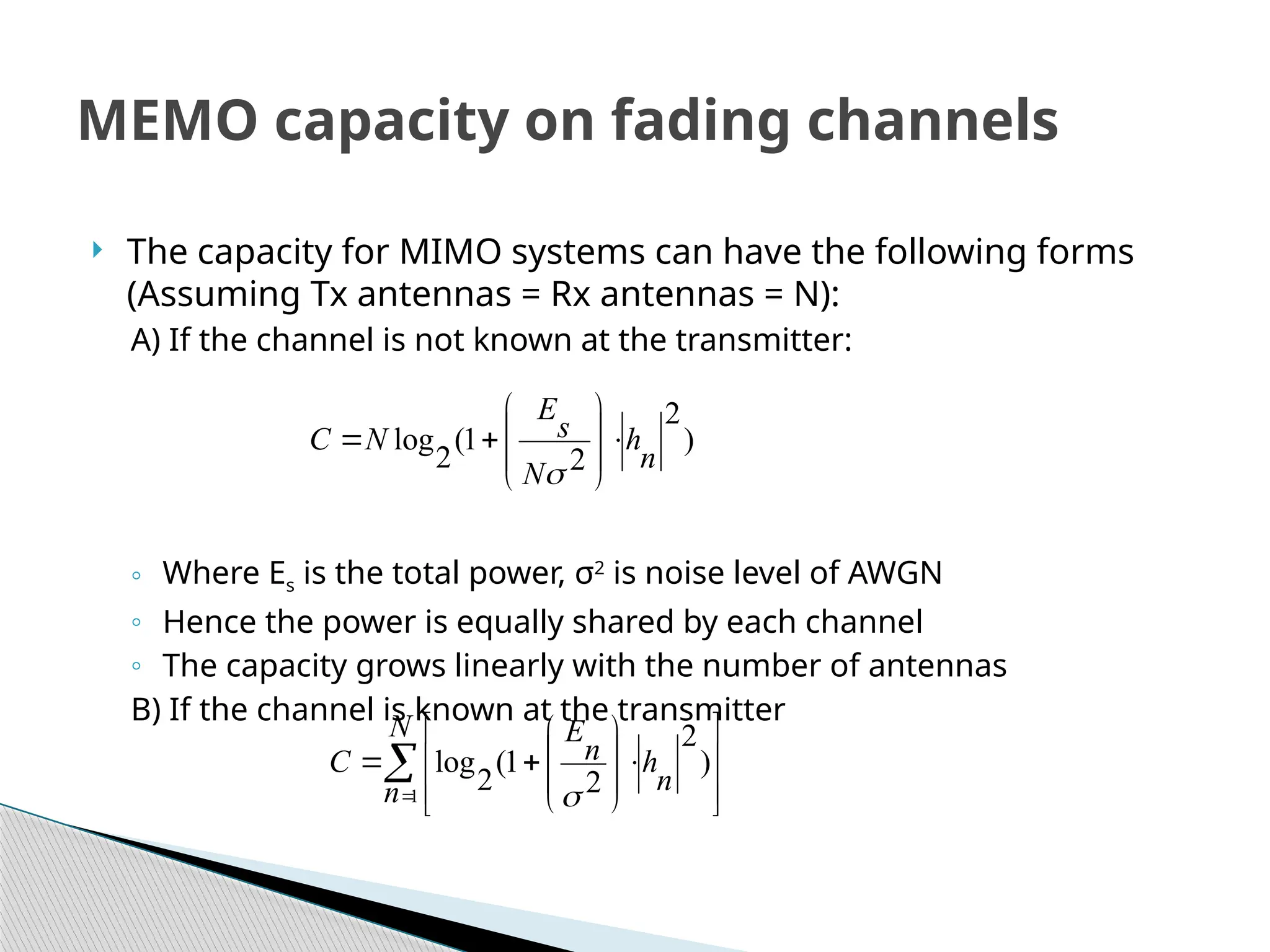
The capacity for MIMO systems can have the following forms
(Assuming Tx antennas = Rx antennas = N):
A) If the channel is not known at the transmitter:
◦ Where Es is the total power, σ2
is noise level of AWGN
◦ Hence the power is equally shared by each channel
◦ The capacity grows linearly with the number of antennas
B) If the channel is known at the transmitter
)
2
2
1
(
2
log
n
h
N
s
E
N
C
N
n n
h
n
E
C
1
)
2
2
1
(
2
log
11.
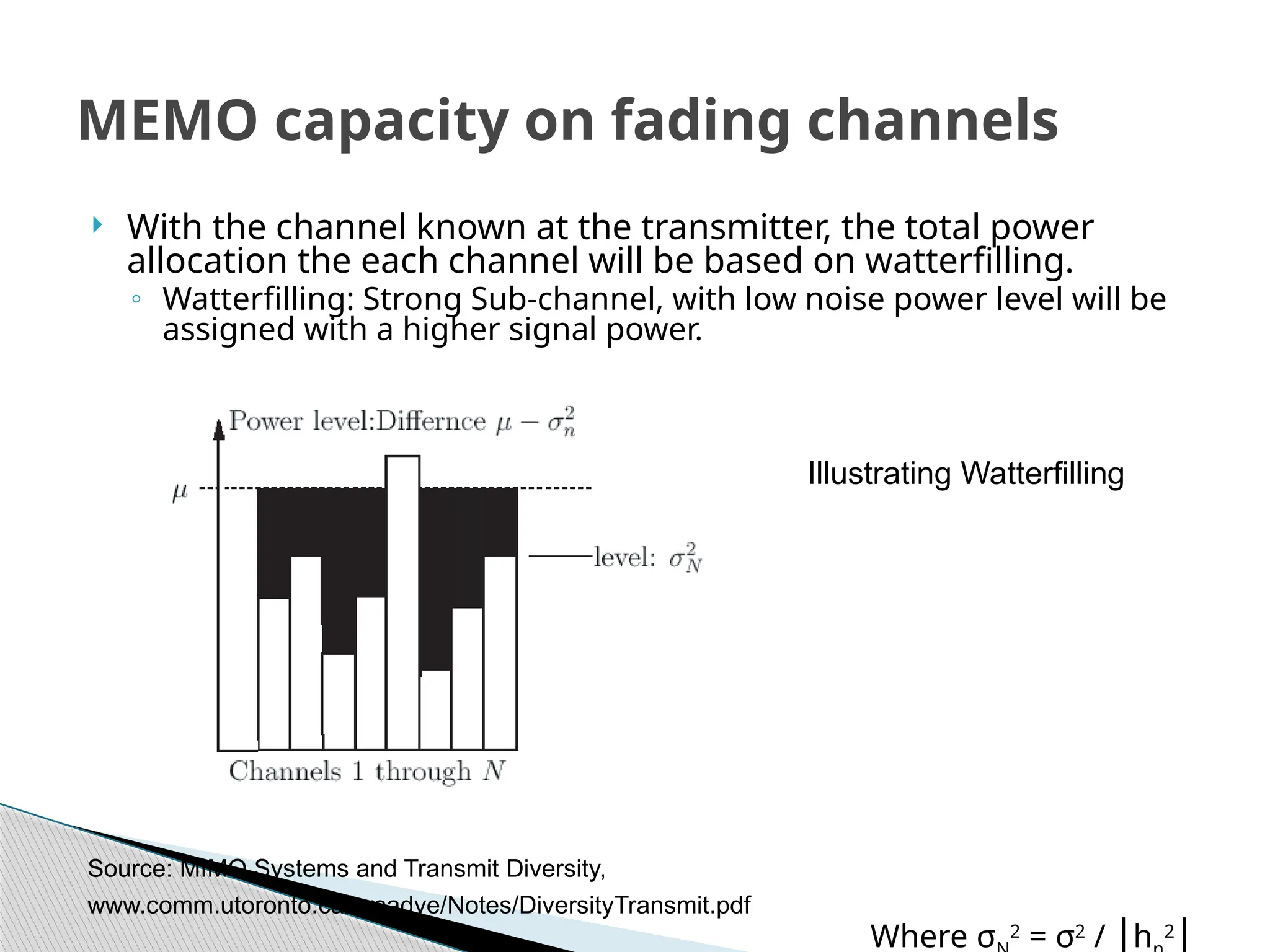
With thechannel known at the transmitter, the total power
allocation the each channel will be based on watterfilling.
◦ Watterfilling: Strong Sub-channel, with low noise power level will be
assigned with a higher signal power.
Where σ 2
= σ2
/ h
│ 2
│
MEMO capacity on fading channels
Illustrating Watterfilling
Source: MIMO Systems and Transmit Diversity,
www.comm.utoronto.ca/~rsadve/Notes/DiversityTransmit.pdf
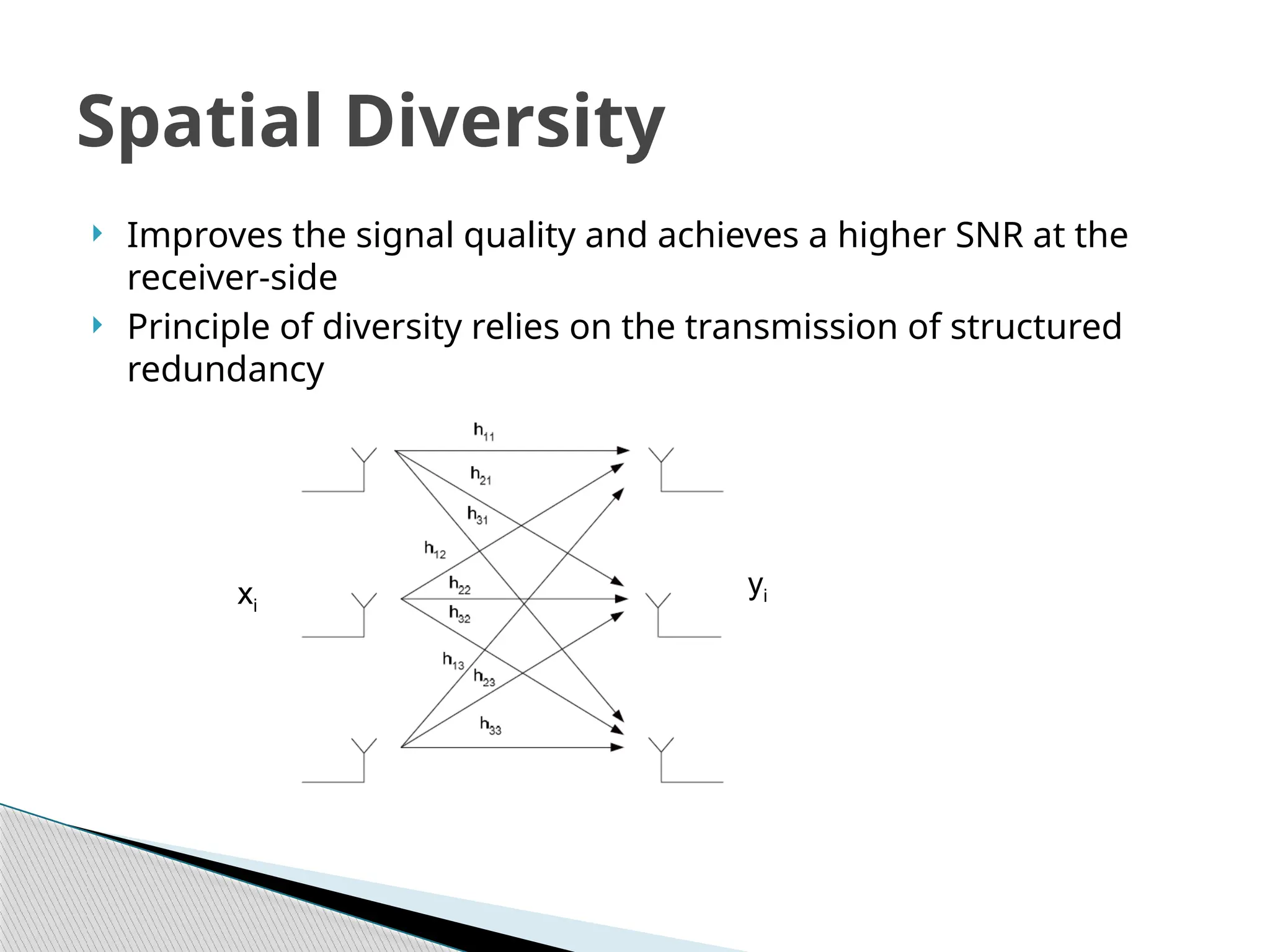
Improves thesignal quality and achieves a higher SNR at the
receiver-side
Principle of diversity relies on the transmission of structured
redundancy
Spatial Diversity
xi
yi
14.
MIMO Diversity andReliability
The performance improvement in SNR and error probability
for MIMO can be compared with SISO, SIMO, and MISO
The detailed calculation for SNR and Pe is shown in [1]
◦ SISO:
◦ Receive Diversity (SIMO):
N
i
n
x
h
y i
i
i
,
2
,
1
,
N
i
h
SNR
h
SNR
2
)
(
2
1
1
SNR
Pe
n
hx
y
2
2
2
)
( h
SNR
n
E
hx
E
h
SNR
and
N
SNR
Pe
2
1
1
and
15.
MIMO Diversity andReliability
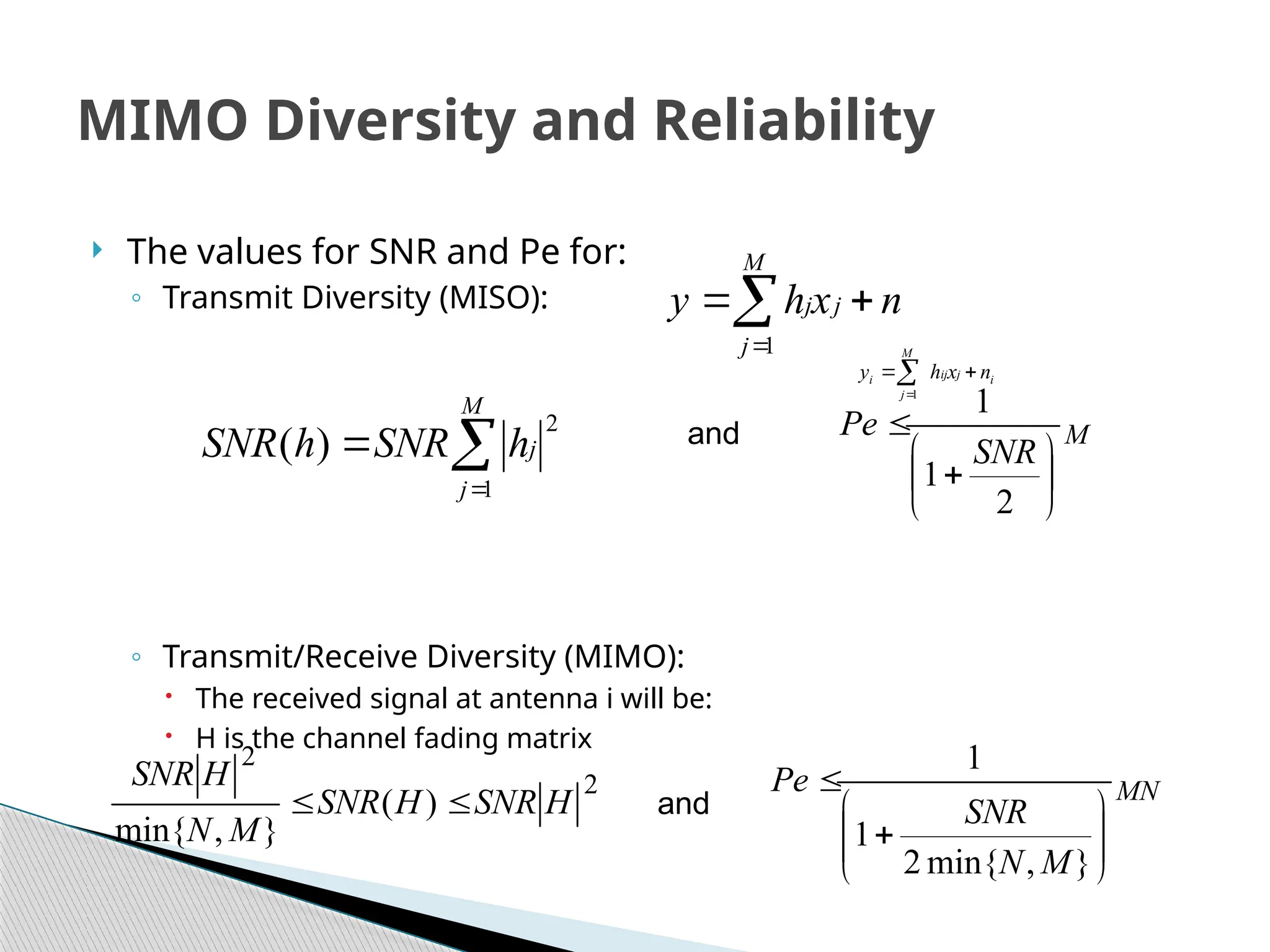
The values for SNR and Pe for:
◦ Transmit Diversity (MISO):
◦ Transmit/Receive Diversity (MIMO):
The received signal at antenna i will be:
H is the channel fading matrix
i
j
ij
M
j
i n
x
h
y
1
2
2
)
(
}
,
min{
H
SNR
H
SNR
M
N
H
SNR
M
SNR
Pe
2
1
1
n
x
h
y j
M
j
j
1
M
j
j
h
SNR
h
SNR
1
2
)
( and
MN
M
N
SNR
Pe
}
,
min{
2
1
1
and
16.
➨There is lowersusceptibility of tapping by
unauthorized persons due to multiple antennas and
algorithms.
The systems with MIMO offers high QoS (Quality of
➨
Service) with increased spectral efficiency and data
rates.
The wide coverage supported by MIMO system
➨
helps in supporting large number of subscribers per
cell.
The MIMO based system is widely
➨
Benefits of MIMO
17.
➨The hardware resourcesincrease power
requirements. Battery gets drain faster due to
processing of complex and computationally intensive
signal processing algorithms. This reduces battery
lifetime of MIMO based devices.
MIMO based systems cost higher compare to single
➨
antenna based system due to increased hardware
and advanced software requirements.
Drawbacks of MIMO
18.
The capacityof Receive or Transmit Diversity grows
logarithmically with the number of antennas
Capacity of MEMO increases linearly with the number of
antennas
Using Spatial Diversity:
◦ The SNR increases and Pe decreases when using MIMO
Spatial Multiplexing and Spatial Diversity are conflicting
objectives
Conclusion

![MEMO capacity on fading channels
The capacity increase can be seen by comparing MEMO
systems with SISO, SIMO, and MISO systems
◦ SISO:capacity is given by Shannon’s classical formula:
Where B is the BW and h is the fading gain
◦ SIMO (with M transmitting antennas), the capacity is given by
[2]
◦ MISO (with M transmitting antennas), the capacity is given by
[2]
)
2
1
(
2
log h
snr
B
C
)
1
2
1
(
2
log
m
n
n
h
snr
B
C
)
1
2
1
(
2
log
N
n
n
h
N
snr
B
C](https://image.slidesharecdn.com/ecemimoppt-250404174954-623621f3/75/Seminar-on-multiple-input-multiple-output-system-9-2048.jpg)
![0
5
10
15
20
25
30
35
40
45
50
55
60
0 1 2 3 4 5 6 7 8 9 10 11 12 13 14 15 16 17 18 19 20 21 22 23 24 25
SNR [dB]
Average
Capacity
[bits/sec/Hz]
N=1 M=1 N=2 M=1 N=1 M=2 N=2 M=2 N=2 M=4 N=2 M=6 N=4 M=4 N=8 M=8
Average capacity of a MIMO Rayleigh
fading channel []
Source: Space-time Diversity Codes for Fading Channels, [3]](https://image.slidesharecdn.com/ecemimoppt-250404174954-623621f3/75/Seminar-on-multiple-input-multiple-output-system-12-2048.jpg)
![MIMO Diversity and Reliability
The performance improvement in SNR and error probability
for MIMO can be compared with SISO, SIMO, and MISO
The detailed calculation for SNR and Pe is shown in [1]
◦ SISO:
◦ Receive Diversity (SIMO):
N
i
n
x
h
y i
i
i
,
2
,
1
,
N
i
h
SNR
h
SNR
2
)
(
2
1
1
SNR
Pe
n
hx
y
2
2
2
)
( h
SNR
n
E
hx
E
h
SNR
and
N
SNR
Pe
2
1
1
and](https://image.slidesharecdn.com/ecemimoppt-250404174954-623621f3/75/Seminar-on-multiple-input-multiple-output-system-14-2048.jpg)

![[Year 2012-13] Mimo technology](https://cdn.slidesharecdn.com/ss_thumbnails/mimotechnology-180701101303-thumbnail.jpg?width=640&height=640&fit=bounds)


![Mimo [new]](https://cdn.slidesharecdn.com/ss_thumbnails/mimonew-150914045107-lva1-app6892-thumbnail.jpg?width=640&height=640&fit=bounds)


